Sample QuestionsUnderstanding Elementary Shape questions
One sample from each question group in this chapter. Select any group above to see the full set with answer keys.
Find the supplement of each of the following angles.$120^\circ $
- ✓
$60^\circ$
- B
$150^\circ$
- C
$20^\circ$
- D
Answer: A.
View full solution →Which of the following statement is true?
- A
The opposite sides of a trapezium are par-allel.
- B
All the sides of a parallelogram are of equal in length.
- ✓
The diagonals of a square are perpendicular to each other.
- D
All the angles of a rectangle are not equal
Answer: C.
View full solution →A triangle having three equal sides is called
Answer: C.
View full solution →A triangle having two equal sides is called
Answer: B.
View full solution →A triangle having three unequal sides is called a
Answer: A.
View full solution →Directions: In the following questions, the Assertions $(A)$ and Reason$(s)$ $(R)$ have been put forward. Read both the statements carefully and choose the correct alternative from the following:
Assertion (A): A line segment is a fixed portion of a line
Reason (R): We use this idea to compare line segments.
- ✓
Both $A$ and $R$ are true and $R$ is the correct explanation of $A$
- B
Both $A$ and $R$ are true but $R$ is not the correct explanation of $A$
- C
$A$ is true but $R$ is false
- D
$A$ is false but $R$ is true
Answer: A.
View full solution →Directions: In the following questions, the Assertions $(A)$ and Reason$(s)$ $(R)$ have been put forward. Read both the statements carefully and choose the correct alternative from the following:
Assertion (A): If the square of the longest side is less than the sum of the squares of two smaller sides.
Reason (R): If any one angle is greater than $90^\circ $, then the triangle is called an obtuse angled triangle.
- A
Both $A$ and $R$ are true and $R$ is the correct explanation of $A$
- B
Both $A$ and $R$ are true but $R$ is not the correct explanation of $A$
- C
$A$ is true but $R$ is false
- ✓
$A$ is false but $R$ is true
Answer: D.
View full solution →Directions: In the following questions, the Assertions $(A)$ and Reason$(s)$ $(R)$ have been put forward. Read both the statements carefully and choose the correct alternative from the following:
Assertion (A): A triangle is made of three, a quadrilateral of four segments.
Reason (R): The measure of each line segment is a unique number called its length.
- A
Both $A$ and $R$ are true and $R$ is the correct explanation of $A$
- ✓
Both $A$ and $R$ are true but $R$ is not the correct explanation of $A$
- C
$A$ is true but $R$ is false
- D
$A$ is false but $R$ is true
Answer: B.
View full solution →Directions: In the following questions, the Assertions $(A)$ and Reason$(s)$ $(R)$ have been put forward. Read both the statements carefully and choose the correct alternative from the following:
Assertion (A): A line segment is a fixed portion of a line
Reason (R): We use this idea to compare line segments
- ✓
Both $A$ and $R$ are true and $R$ is the correct explanation of $A$
- B
Both $A$ and $R$ are true but $R$ is not the correct explanation of $A$
- C
$A$ is true but $R$ is false
- D
$A$ is false but $R$ is true
Answer: A.
View full solution →Directions: In the following questions, the Assertions $(A)$ and Reason$(s)$ $(R)$ have been put forward. Read both the statements carefully and choose the correct alternative from the following:
Assertion (A): A trapezium is a convex quadrilateral with exactly one pair of opposite sides parallel to each other
Reason (R): A two-dimensional quadrilateral that has a pair of non-adjacent parallel sides and a pair of non-parallel sides is referred to as a trapezium shape
- ✓
Both $A$ and $R$ are true and $R$ is the correct explanation of $A$
- B
Both $A$ and $R$ are true but $R$ is not the correct explanation of $A$
- C
$A$ is true but $R$ is false
- D
$A$ is false but $R$ is true
Answer: A.
View full solution →A hexagon is a two-dimensional figure.
A triangular prism has three rectangular faces.
A triangular prism has five vertices.
A closed cylinder has two flat faces.
The perpendicular bisector of a line segment divides the segment into two equal parts.
If in $\triangle M N P, M N=5.5 cm , N P=5.5 cm$ and $M P=5.5 cm$, then $\triangle M N P$ is………. (a scalene triangle, an isosceles triangle, an equilateral triangle)
View full solution →If in $\triangle F O X, F O=4 cm , O X=5 cm$ and $F X=6 cm$, then $\triangle F O X$ is………. (an equilateral triangle, a scalene triangle, an isosceles triangle)
View full solution →If in $\triangle D E F, D E=5 cm , E F=6 cm$ and $D F=5 cm$, then $\triangle D E F$ is………. (an isosceles triangle. an equilateral triangle, a scalene triangle)
View full solution →If in $\triangle XYZ , \angle X =40^{\circ}, \angle Y =50^{\circ}$ and $\angle Z =90^{\circ}$, then $\triangle XYZ$ is………. (an acute angled triangle, a right angled triangle, an obtuse angled triangle)
View full solution →If in $\triangle PQR , \angle P =20^{\circ}, \angle Q =50^{\circ}$ and $\angle R =110^{\circ}$, then $\triangle PQR$ is……….(an acute angled triangle. a right angled triangle, an obtuse angled triangle)
View full solution →Name the given polygon in the figure.

Name the polygon.
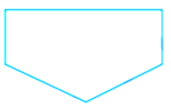
Name the below polygon.

Name the given polygon.

Examine whether the given figure is polygon and if not why?

A figure is said to be regular, if its sides are equal in length and angles are equal in measure. Can you identify the regular quadrilateral?
Give reason for square is also a parallelogram.
Give reason for squares, rectangles, parallelograms are all quadrilaterals.
Give reason for a square can be thought of as a special rhombus.
Give reason that a rectangle can be thought of as a special parallelogram.
A diagonal is a line segment that joins any two vertices of the polygon and is not a side of the polygon. Draw a rough sketch of a pentagon and draw its diagonals.
Draw a rough sketch of a regular octagon. (Use squared paper if you wish). Draw a rectangle by joining exactly four of the vertices of the octagon.
Draw a rough sketch of a regular hexagon. Connecting any three of its vertices, draw a triangle. Identify the type of the triangle you have drawn.
What fraction of a clockwise revolution does the hour hand of a clock turn through, when it goes from $6$ to $3$
View full solution →What fraction of a clockwise revolution does the hour hand of a clock turn through, when it goes from $1$ to $10$
View full solution →Match the following:
| Measures of Triangle |
Type of Triangle |
| $(a)$ $3$ sides of equal length |
$(i)$ Scalene |
| $(b)$ $2$ sides of equal length |
$(ii)$ Isosceles right angled |
| $(c)$ All sides are of different length |
$(iii)$ Obtuse angled |
| $(d)$ $3$ acute angles |
$(iv)$ Right angled |
| $(e)$ $1$ right angle |
$(v)$ Equilateral |
| $(f)$ $1$ obtuse angle |
$(vi)$ Acute angled |
| $(g)$$1$ right angle with two sides of equal length |
$(vii)$ Isosceles |
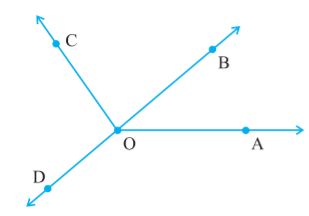
View full solution →Measure and classify each angle:
| Angle |
Measure |
Type |
| $\angle AOB$ |
|
|
| $\angle AOC$ |
|
|
| $\angle BOC$ |
|
|
| $\angle DOC$ |
|
|
| $\angle DOA$ |
|
|
| $\angle DOB$ |
|
|
View full solution →Match the following:
| $(a)$ Straight angle |
$(i)$ Less than one-fourth a revolution |
| $(b)$ Right angle |
$(ii)$ More than half a revolution |
| $(c)$ Acute angle |
$(iii)$ Half of a revolution |
| $(d)$ Obtuse angle |
$(iv)$ One-fourth a revolution |
| $(v)$Reflex angle |
$(v)$Between $\frac{1}{4}$ and $\frac{1}{2}$ of a revolution |
| |
$(vi)$One complete revolution |
View full solution →How many right angles do you make if you start facing south and turn to north?
How many right angle do you make if you start facing west and turn to west?