Questions · Page 1 of 3

[1 Marks Each] M.C.Q.

🎯

Test yourself on this topic

50 questions · timed · auto-graded

MCQ 11 Mark
Which part of spinach is used as vegetable?
  • A
    Stems
  • B
    Roots
  • Leaves
  • D
    Modified roots
Answer
Correct option: C.
Leaves

The leaves of spinach is used as a vegetable which contain Iron, and protein in large quantity. Spinach has high nutritional value. Along with Iron and protein it contains Vitamin $A, B, C$ and $K$ along with magnesium and calcium in small amounts.
View full question & answer
MCQ 21 Mark
The distribution of veins in the leaves is:
  • A
    Midrib
  • B
    Veins
  • Leaf venation
  • D
    Node
Answer
Correct option: C.
Leaf venation
The distribution of veins in the leaves is leaf venation.
View full question & answer
MCQ 31 Mark
The leaf uses water to make food. The water is supplied to the leaf by:
  • A
    Roots.
  • Stem.
  • C
    Flower.
  • D
    All of these.
Answer
Correct option: B.
Stem.
Stem.
View full question & answer
MCQ 41 Mark
A pistil consists of:
  • A
    Ovary.
  • B
    Ovary and style.
  • C
    Ovary and stigma.
  • Ovary, style and stigma.
Answer
Correct option: D.
Ovary, style and stigma.
Pistil consists of ovary, style and stigma.
View full question & answer
MCQ 51 Mark
Those flowers have both segments and pistils are:
  • Bisexual
  • B
    Unisexual
  • C
    Stamen
  • D
    None of these
Answer
Correct option: A.
Bisexual
Flowers that have both segments and pistil are bisexual.
View full question & answer
MCQ 61 Mark
The design made by veins in the leaf is called ?
  • Leaf venation
  • B
    Parallel venation
  • C
    Reticulate venation
  • D
    Lamina
Answer
Correct option: A.
Leaf venation
Leaf venation
View full question & answer
MCQ 71 Mark
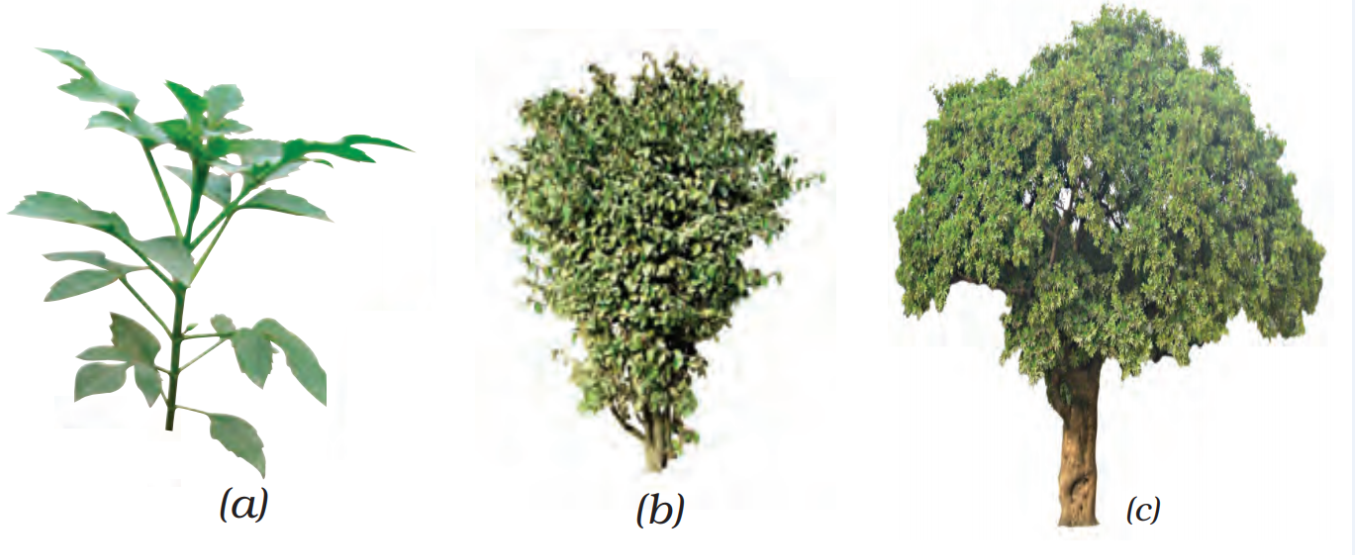
Look at the below pictures and correctly label $A, B.C.$
  • $A-$Herb, $B-$Shrub, $C-$Tree.
  • B
    $A-$Shrub, $B-$Herb, $C-$Tree.
  • C
    $A-$Tree, $B-$Herb, $C-$Shrub.
  • D
    None of these.
Answer
Correct option: A.
$A-$Herb, $B-$Shrub, $C-$Tree.

It is the correct labelling.

View full question & answer
MCQ 81 Mark
The thick view in the middle of the leaf is:
  • Midrib
  • B
    Veins
  • C
    Leaf venation
  • D
    Node
Answer
Correct option: A.
Midrib
Midrib is the thick vein in the middle of the leaf.
View full question & answer
MCQ 91 Mark
A modified leaf that forms one of the components of calyx of flower and made of small leaf like structures is fallown as:
  • A
    Petals.
  • Sepals.
  • C
    Stamen.
  • D
    None of these.
Answer
Correct option: B.
Sepals.
These are characteristics of sepals.
View full question & answer
MCQ 101 Mark
Which part of the plant anchors the plant firmly in the soil?
  • Root.
  • B
    Stem.
  • C
    Both of these.
  • D
    None of these.
Answer
Correct option: A.
Root.
Root.
View full question & answer
MCQ 111 Mark
The part of embryo that give rise to stem is called
  • A
    Lenticels
  • B
    Radicle
  • C
    Hypocotyls
  • Plumule
Answer
Correct option: D.
Plumule
The part of embryo that give rise to stem is called plumule. Plumule bears the first true leaves of any plant. Growth of plumule does not begin until the cotyledons have grown above ground.
View full question & answer
MCQ 121 Mark
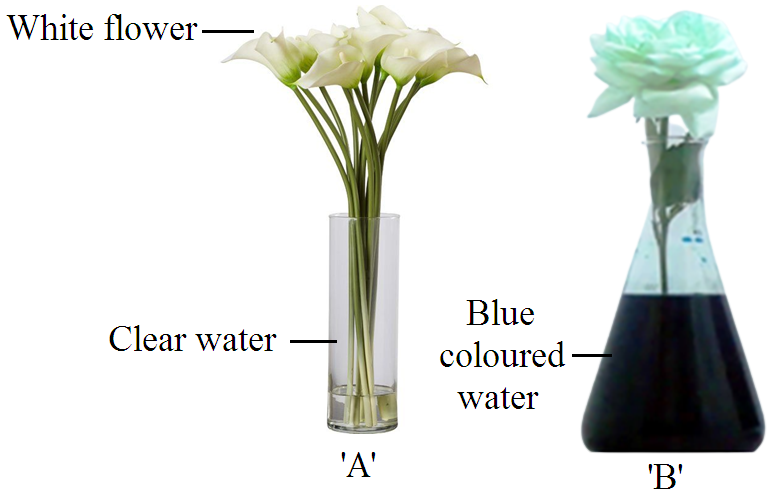
Look at the figures below and try to guess the colour of flower in fig. $'B'$ after few hours? The colour of flower will most likely be:
  • A
    White.
  • Blue.
  • C
    Red.
  • D
    Half blue and other half red.
Answer
Correct option: B.
Blue.

Due to capillary action blue water rises and reaches up to flower.

View full question & answer
MCQ 131 Mark
The part of leaf that is attached to the stem is called ?
  • A
    Vein
  • Petiole
  • C
    Midrib
  • D
    Lamina
Answer
Correct option: B.
Petiole
Petiole
View full question & answer
MCQ 141 Mark
Ginger shows brown scale like leaves on it. The part of ginger that we use in cooking is actually a:
  • Stem.
  • B
    Root.
  • C
    Leaf.
  • D
    Fruit.
Answer
Correct option: A.
Stem.
Stem.
View full question & answer
MCQ 151 Mark
The lowermost and swollen part of the pistil is called _____ ?
  • A
    Sepals
  • B
    etals
  • C
    Ovules
  • Ovary
Answer
Correct option: D.
Ovary
Ovary
View full question & answer
MCQ 161 Mark
Which of the following type of plants has thick, hard and woody stem?
  • Tree.
  • B
    Shrub.
  • C
    Herb.
  • D
    All of these.
Answer
Correct option: A.
Tree.
Herb has a soft stem while shrubs have thin stem.
View full question & answer
MCQ 171 Mark
Which is a correct set of parts of a pistil?
  • A
    Ovary, style and filament.
  • B
    Ovary style and stigma.
  • C
    Ovary, anther and filament.
  • Filament and anther.
Answer
Correct option: D.
Filament and anther.
Filament and anther are the parts of stamen.
View full question & answer
MCQ 181 Mark
A brinjal plant belongs to which of the following category?
  • Herb.
  • B
    Shrub.
  • C
    Tree.
  • D
    None of these.
Answer
Correct option: A.
Herb.
Herb.
View full question & answer
MCQ 191 Mark
The small bead like structures inside the ovary is called _____ ?
  • A
    Sepals
  • B
    Petals
  • Ovules
  • D
    Ovary
Answer
Correct option: C.
Ovules
Ovules
View full question & answer
MCQ 211 Mark
Which of the following statements are incorrect?
  • A
    Maize and wheat are plants with fibrous root.
  • B
    Tulsi plant has soft green stem. It is a herb.
  • C
    Money plant is climber as it has weak stem and needs support to stand.
  • Potato is an underground root.
Answer
Correct option: D.
Potato is an underground root.
View full question & answer
MCQ 221 Mark
Which is not a part of a leaf?
  • A
    Petiole.
  • B
    Lamina.
  • C
    Veins.
  • Nodes.
Answer
Correct option: D.
Nodes.
Nodes are found on stem.
View full question & answer
MCQ 231 Mark
The out side the soil gives support to the branches of the plants and trees due to which they do not break.
  • A
    Stem
  • B
    Soil
  • C
    Branches
  • Roots
Answer
Correct option: D.
Roots
The roots out side the soil gives support to the branches of the plants and trees duo to which they do not break.
View full question & answer
MCQ 241 Mark
Which of the following statements is/ are correct?
  • A
    Stems absorb water and minerals from the soil.
  • Stems conduct water from roots to the leaves.
  • C
    Stems conduct food from roots to various parts of plant.
  • D
    None of the above.
Answer
Correct option: B.
Stems conduct water from roots to the leaves.
Roots (not stem) absorb water find minerals from the soil. Stem conducts food from leaves (not roots) to other parts of plant.
View full question & answer
MCQ 251 Mark
Why are roots said to anchor the plant in soil?
  • A
    The roots absorb water from the soil.
  • B
    The roots transport water and minerals to various parts of plant.
  • The roots help in holding the plant firmly in the soil.
  • D
    The roots are fibrous in nature.
Answer
Correct option: C.
The roots help in holding the plant firmly in the soil.
View full question & answer
MCQ 261 Mark
Direction: The questions in this segment consists of two statements, one labelled as "assertion $A$" and the other labelled as "reason $R$" You are to examine these two statements carefully and decide if the assertion $A$ and reason $R$ are individually true and if so, whether the reason is a correct explanation of the assertion. Select your answers to these items using codes given below.
Assertion (A): Trees are plants which are very tall. They have a hard and thick brown stem.
Reason (R): Lamina is thin, flat, broad, green part of leaf.
  • A
    Both $A$ and $R$ are true and $R$ is the correct explanation of $A.$
  • Both $A$ and $R$ are true but $R$ is not the correct explanation of $A.$
  • C
    $A$ is true but $R$ is false.
  • D
    $A$ is false but $R$ is true.
Answer
Correct option: B.
Both $A$ and $R$ are true but $R$ is not the correct explanation of $A.$
View full question & answer
MCQ 271 Mark
Which of the following has fibrous root?
  • A
    Peas.
  • Wheat.
  • C
    Radish.
  • D
    Neem.
Answer
Correct option: B.
Wheat.
Wheat roots spread out in the soil.
View full question & answer
MCQ 281 Mark
Potato tuber is:
  • A
    Root
  • B
    Stem
  • C
    Modified root
  • Modified stem
Answer
Correct option: D.
Modified stem
The potato tuber used as vegetable is underground modified stem. Potato tuber consists of all parts which a stem consists such as nodes and internodes.
The nodes are the eyes and each eye has a leaf scar and bud.
Thus potato tuber is a modified stem.
View full question & answer
MCQ 291 Mark
When the leaf is tested for starch, which colour confirms the test?
  • A
    Blue.
  • B
    Black.
  • C
    Red.
  • Blue-black.
Answer
Correct option: D.
Blue-black.
Blue-black.
View full question & answer
MCQ 301 Mark
Classify Neem in one of the categories of plants:
  • A
    Herb.
  • B
    Shrub.
  • Tree.
  • D
    All of these.
Answer
Correct option: C.
Tree.
Tree.
View full question & answer
MCQ 311 Mark
Direction: Read the passages given below and answer the questions that follow. Passage To see the inner parts of the flower clearly, you have to cut it open, if its petals are joined, e.g. In Datura and other bell shaped flowers, the petals have to be cut length wise so that inner parts can be seen clearly. Which one of the following is the inner most part of a flower and also the female structure of a flower?
  • A
    Anther.
  • B
    Ovary.
  • Pistil.
  • D
    None of these.
Answer
Correct option: C.
Pistil.
Pistil is the female structure of the flower and is the innermost part of flower. It consists of ovary, style and stigma.
View full question & answer
MCQ 321 Mark
The prominent line in the middle of the leaf is called ?
  • A
    Vein
  • B
    Petiole
  • Midrib
  • D
    Lamina
Answer
Correct option: C.
Midrib
Midrib
View full question & answer
MCQ 331 Mark
Which of the following terms constitute the female part of the flower.
  • A
    Sepals, petal and stamen.
  • Stigma, style and ovary.
  • C
    Ovary, stamen and stigma.
  • D
    Ovary, style and stamen.
Answer
Correct option: B.
Stigma, style and ovary.

The pistil or carpel is the female part of a flower. It is made up of three parts as: Stigma Top part of pistil. It is sticky and receives pollen. Style Middle part of pistil. It is a tube that connects stigma to ovary.
Ovary Swollen part at the bottom of pistil that contains ovules.

View full question & answer
MCQ 341 Mark
Leaves are green due to presence of green pigment called:
  • Chlorophyll
  • B
    Leucoplasts
  • C
    Xanthophylls
  • D
    Hydrophytes
Answer
Correct option: A.
Chlorophyll
Leaves are green due to presence of green pigment called chlorophyll which is present inside chloroplast.
View full question & answer
MCQ 351 Mark
Which of the following in used to test the presence of starch?
  • A
    Copper sulphate.
  • Iodine.
  • C
    Sugar.
  • D
    Water.
Answer
Correct option: B.
Iodine.
Iodine.
View full question & answer
MCQ 361 Mark
Find the odd one out:
  • A
    Ovary, style, stigma.
  • B
    Filament, anther, pollen.
  • Beetroot, potato, carrot.
  • D
    Potato, carrot, radish.
Answer
Correct option: C.
Beetroot, potato, carrot.
Beet root is and underground root whereas potato and carrot are underground stem.
View full question & answer
MCQ 371 Mark
. is the part of the stem between two nodes.
  • A
    Node
  • B
    Midrib
  • Internode
  • D
    Veins
Answer
Correct option: C.
Internode
Internode is the part of the stem between two nodes.
View full question & answer
MCQ 381 Mark
The arrangement of leaves at a node is:
  • Phyllotaxy
  • B
    Stamen
  • C
    Petals
  • D
    Sepals
Answer
Correct option: A.
Phyllotaxy
The arrangement of leaves at a node is phyllotaxy.
View full question & answer
MCQ 391 Mark
Pollen grains are produced inside
  • Anther
  • B
    Pistil
  • C
    Stigma
  • D
    Ovary
Answer
Correct option: A.
Anther
Pollen grains are produced inside anther of the stamen that produce male gametes. Pollen from the anther is transferred to stigma of another flower through wind or animal. It reaches the female part at the stigma to produce new plant.
View full question & answer
MCQ 401 Mark
A tomato plant has stems of which colour?
  • Green.
  • B
    Red.
  • C
    Sometimes green, sometimes red.
  • D
    Neither green nor red.
Answer
Correct option: A.
Green.
The stem of tomato plant is green.
View full question & answer
MCQ 411 Mark
Those roots come out from the base of stem is:
  • A
    Taproot
  • Fibrous roots
  • C
    Veins
  • D
    None of these
Answer
Correct option: B.
Fibrous roots

Fibrous roots come out from the base of stem.

View full question & answer
MCQ 421 Mark
Which of the following is the female reproductive part of flower?
  • A
    Sepal.
  • B
    Androecium.
  • Gynoecium.
  • D
    Petal.
Answer
Correct option: C.
Gynoecium.
Gynoecium.
View full question & answer
MCQ 431 Mark
Direction: Match Column$-I$ with Column$-II$ and select the correct answer using the codes given below the columns.
S.No.
Column-$I$
S.No.
Column-$II$
$A.$
Tap root
$(p)$
The part of leaf.
$B.$
Fibrous roots
$(q)$
The main root of plants with reticulate venation.
$C.$
Stem
$(r)$
Found in plants with parallel venation.
$D.$
Petiole
$(s)$
Conducts water.
  • A
    $A-(p), B-(q), C-(r), D-(s)$
  • $A-(q), B-(r), C-(s), D-(p)$
  • C
    $A-(r), B-(s), C-(p), D-(q)$
  • D
    $A-(s), B-(p), C-(q), D-(r)$
Answer
Correct option: B.
$A-(q), B-(r), C-(s), D-(p)$
View full question & answer
MCQ 441 Mark
Direction: Read the passages given below and answer the questions that follow. Passage If you look at a leaf carefully you can easily see some lines on the leaf. These lines are called veins. In some cases you can see a thick vein in the middle of the leaf. This vein is called midrib. The design made by veins is called the leaf venation. Parallel venation can be seen in:
  • Leaves of grass.
  • B
    Leaves of Peepal tree.
  • C
    Both of the above.
  • D
    None of these.
Answer
Correct option: A.
Leaves of grass.
Parallel venation can be seen in leaves of grass.
View full question & answer
MCQ 451 Mark
The arrangement of leaves at a node is:
  • Phyllotaxy
  • B
    Stamen
  • C
    Petals
  • D
    Sepals
Answer
Correct option: A.
Phyllotaxy
The arrangement of leaves at a node is phyllotaxy.
View full question & answer
MCQ 461 Mark
Direction: Match Column$-I$ with Column$-II$ and select the correct answer using the codes given below the columns.
S.No.
Column - $I$
S.No.
Column - $II$
$A.$
Ovary
$(p)$
The slender, elongated portion of pistil.
$B.$
Ovule
$(q)$
The upper two lobed part of a plant stamen.
$C.$
Pistil
$(r)$
Enlarged basal portion of pistil.
$D.$
Style
$(s)$
An oval body in ovary of a flower which develops into a seed.
  • A
    $A-(p), B-(q), C-(r), D-(s)$
  • B
    $A-(r), B-(s), C-(p), D-(q)$
  • $A-(r), B-(s), C-(q), D-(p)$
  • D
    $A-(p), B-(s), C-(r), D-(q)$
Answer
Correct option: C.
$A-(r), B-(s), C-(q), D-(p)$
View full question & answer
MCQ 471 Mark
The lines on the broad green part of the leaf are called:
  • A
    Lamina.
  • Veins.
  • C
    Venation.
  • D
    None of these.
Answer
Correct option: B.
Veins.
The lines on the broad green part of leaf are called veins.
View full question & answer
MCQ 481 Mark
The food produced in the leaves is in the form of:
  • Starch.
  • B
    Proteins.
  • C
    Chlorophyll.
  • D
    All of these.
Answer
Correct option: A.
Starch.
The food produced in the leaves is in the form of starch.
View full question & answer
MCQ 491 Mark
In leaves the veins run parallel to each other in:
  • A
    Reticulate venation
  • Parallel venation
  • C
    Both $(a)$ and $(b)$
  • D
    None of these
Answer
Correct option: B.
Parallel venation
In leaves the veins runs parallel to each other in parallel venation.
View full question & answer
MCQ 501 Mark
A process in which water comes out from the leaves in the form of vapour is:
  • A
    Photosynthesis
  • Transpiration
  • C
    Venation
  • D
    Conduction
Answer
Correct option: B.
Transpiration
Transpiration is a process in which water comes from the leaves in the form of vapour.
View full question & answer