Questions

3 Marks Question

🎯

Test yourself on this topic

12 questions · timed · auto-graded

Question 13 Marks
If $\triangle$ is an operation such that for integers a and b we have a $\triangle b = a \times b -2 \times a \times b + b \times b (-a) \times b + b \times b$ then find. Also show that $4\triangle(-3)\neq(-3)\triangle4$ and$(-7)\triangle(-1)\neq(-1)\triangle(-7)$
Answer
Now, put $a = (-7)$ and $b = (-1)\Rightarrow (-7)\triangle (-1)$
$= (-7) \times (-1) -2 \times (-7) \times (-1) + (-1) \times (-1){-(-7)} \times (-1) + (-1) \times (-1)$
$= 7 - 14 + 1 \times 7 \times (-1) + 1$
$= 7 - 4 - 7 + 1 - 13$ Now, put $a$
$= (-1)$ and $b = (-7)$
$= (-1) \triangle (-7)$
$= (-1) \times (-7) -2 \times (-1) \times (-7) + (-7) \times (-7) \{-(-1)\} \times (-7) + (-7) \times (-7)$
$= 7 - 14 + 49(1) \times (-7) + 49$
$= 7 - 14 - 343 + 49$
$= -301$ Clearly,
$=(-7)\triangle(-1)\neq(-1)\triangle(-7)$
View full question & answer
Question 23 Marks
You have $Rs. 500$ in your savings account at the beginning of the month. The record below shows all of your transactions during the month. How much money is in your account after these transactions?
Cheque No.
Date
Transaction Description
Payment
Deposit
$384102$
$4/9$
Jal Board
$Rs. 120$
$Rs. 200$
$275146$
$12/9$
Deposit
 
 
$384103$
$22/9$
LIC India
$Rs. 240$
$Rs. 150$
$801351$
$29/9$
Deposit
 
 
Answer
According to the question. Already available amount $= Rs. 500 $
On $4/9$ with cheque number $384102$ withdraw $Rs. 120$
 Also, with cheque number $275146$ on $12/9$ deposited amount was $Rs. 200$
In the same way, on $22/9$ with cheque number $384103, Rs. 240$ paid to $LIC$ of India,
also. On $29/9$ with cheque number $801351,$ deposited amount was $Rs. 150$
Thus, net amount available in bank account will be $=$ Already saved amount $+$ Deposited amount $–$ Debited amount $($paid amount$)$
$= 500 + 200 + 150 - 120 - 240 = 850 + (-360) = Rs. 490$
 
View full question & answer
Question 33 Marks
Observe the following patterns and fill in the blanks to make the statements true:$ -5 \times 4 = -20 -5 \times 3 = -15 = -20 - (-5) -5 \times 2 =$ _____ $= -15 - (-5) -5 \times 1 =$ _____ $=$ _____. $-5 \times 0 = 0 = $_____. $-5 \times -1 = 5 =$ _____.$ -5 \times -2 = $_____ $= $_____.
Answer
By obseving the pattern, we find that lst column is constant, i.e.
$-5,$ llnd column is decreasing bt $1,$
$lllrd$ column is increasing bt $5,$
$lVth$ column is also increasing by $5$ and
$Vth$ column is constant, i.e.$ -5.$
So accordingly.
$-5 \times 4 = -20 -5 \times 3 = -15 = -20 - (-5)$
$-5 \times 2 = -10 = -15 - (-5)$
$-5 \times 1 = -5 = (-10) - (-5)$
$-5 \times 0 = 0 = (-5) - (-5)$
$-5 \times -1 = 5 = 5 = 0 - (-5)$
$-5 \times -2 = 10 = 5 - (-5)$
View full question & answer
Question 43 Marks
A multistorey building has $25$ floors above the ground level each of height $5m$. It also has $3$ floors in the basement each of height $5m.$ A lift in building moves at a rate of $1m/s.$ If a man starts from $50m$ above the ground, how long will it take him to reach at $2nd$ floor of basement$?$
Answer
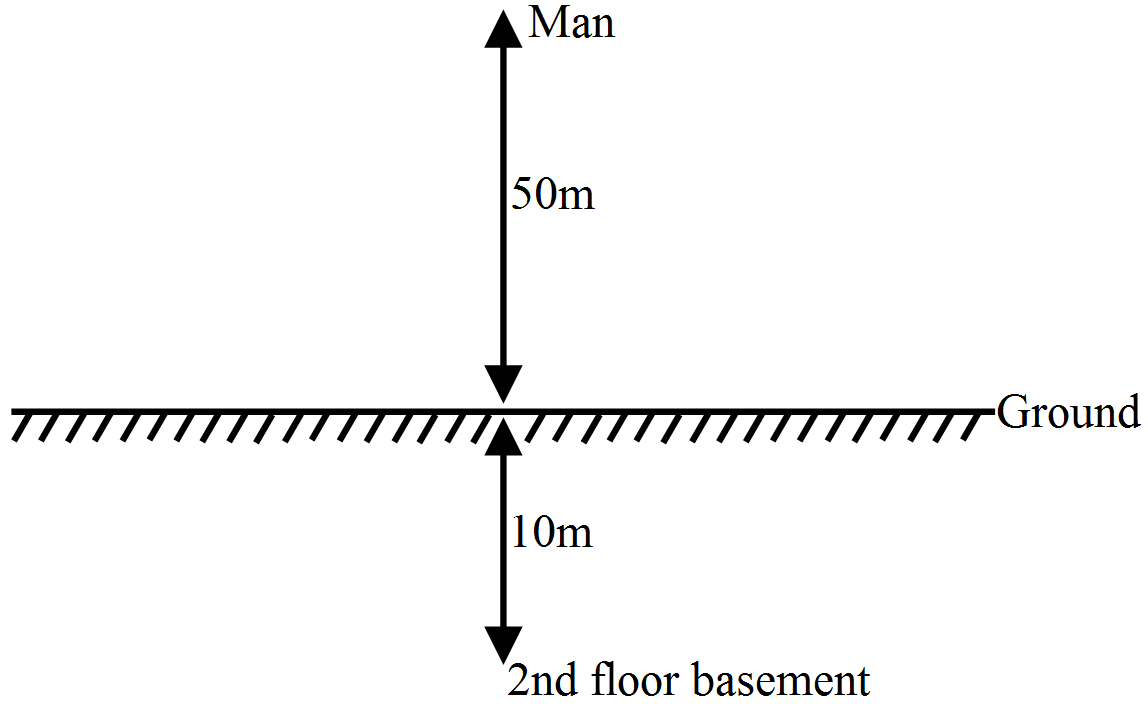
Man covers the distance above the ground $= 50m$
and man covers the distance below the ground $= 2 \times 5 = 10m$
Thus, total distance $= 50m + 10m =60m$
$[\because$ dstance between two floors $= 5m]$

$\because$ speed of the lift $= m/s$
Hence, time taken to reach second floor of basement
$=\frac{\text{Distance}}{\text{Speed}}=\frac{60\text{m}}{1\text{m/s}}60\text{s}\ \text{or}\ 1\text{min}$
View full question & answer
Question 53 Marks
Science Application: An atom consists of charged particles called electrons and protons. Each proton has a charge of $+1$ and each electron has a charge of $-1.$ Remember number of electrons is equal to number of protons, while answering these questions: What is the charge on an atom$?$
Answer
Let $a$ be the number of electrons in an atom. Number of protons in the atom,
will also be equal to a. Since, an atom has equal number of protons and electrons.
$\therefore$ Charge on one electron $= (-1)$
$\because$ Total charge in a electrons $= a \times (-1) = -a$
$\therefore$ Charge on one proton $= (+1)$
$\because$ Total charge in a protons $= a \times (+1) = +a$
Hence, total charge on the atom $=$ Charge of electrons $+$ Charge of protons $= -a + a = 0$
View full question & answer
Question 63 Marks
Science Application:
An atom consists of charged particles called electrons and protons. Each proton has a charge of $+1$ and each electron has a charge of $-1.$ Remember number of electrons is equal to number of protons, while answering these questions:
What will be the charge on an atom if it gains an electron$?$
Answer
If an atom gains an electron, it will have $(a + 1)$ electrons and a protons
$\therefore$ Charge in one electron
$= -1$
Charge in $(a + 1)$ electrons
$= -1 \times (a + 1)$
$= -(a + 1)$
$\therefore$Charge in one proton
$= (+1)$
Charge in a protons
$= (+1) \times a$
$= (+ a)$
Hence, total charge on the atom
$=$ Charge of electrons $+$ Charge of protons
$= a -(a + 1)$
$= (-1)$
View full question & answer
Question 73 Marks
Observe the following patterns and fill in the blanks to make the statements true: $7 × 4 = 28 7 × 3 = \_\_\_\_\_\_\_ = 28 - 7$ $7 × 2 = \_\_ _\_ = \_\_\_\_\_\_\_- 7$ $7 × 1 = 7 = \_\_\_\_\_ - 7$ $7 × 0 = \_\_\_\_\_ = \_\_\_\_\_ -\_\_\_\_\_.$ $7 × -1 = -7 = \_\_\_\_\_ - \_\_\_\_\_.$ $7 × -2 = \_\_\_\_\_ = \_\_\_\_\_ - \_\_\_\_\_.$ $7 × -3 \_\_\_\_\_ = \_\_\_\_\_ -\_\_\_\_\_.$
Answer
By obseving the pattern, we find that lst column is constant, i.e. $7,$
$llnd$ column is decreasing bt $1,$
$lllrd$ column is increasing bt $7,$
$lVth$ column is also increasing by $7$ and
$Vth$ column is constant, i.e. $+7.$
So accordingly. $7 \times 4 = 28$
$7 \times 3 = 21 = 28 - 7$
$7 \times 2 = 14 = 21 - 7$
$7 \times 1 = 7 = 14 - 7$
$7 \times 0 = 0 = 7 - 7$
$7 \times -1 = -7 = 0 = - 7$
$7 \times -2 = -14 = (-7) = - 7$
$7 \times -3 = (-21) = (-14) -$
View full question & answer
Question 83 Marks
Science Application: An atom consists of charged particles called electrons and protons. Each proton has a charge of $+1$ and each electron has a charge of $-1$. Remember number of electrons is equal to number of protons, while answering these questions: What will be the charge on an atom if it loses an electron$?$
Answer
If an atom loses an electron, it will have $(a -1)$ electrons and a protons.
$\therefore$ Charge in one electron $= (-1)$
$\because$ Charge in $(a -1)$ electrons $= (a -1) \times (-1) = -(a -1) = (1 -a)$
$\therefore$Charge in one proton $= (+1)$
$\because$ Charge in a protons $= (+1) \times a = (+a)$
Hence, total charge on the atom $=$ Charge of electrons $+$ Charge of protons $= 1 -a + a = + 1$
View full question & answer
Question 93 Marks
If $\triangle$ is an operation such that for integers a and b we have $ a \triangle b$
$= a \times b -2 \times a \times b + b \times b (-a) \times b + b \times b$ then find.
$4\triangle(-3)$
Answer
We have, $\text{a}\ \triangle\ \text{b}$
$= a \times b - 2 \times a \times b + b \times (b) \times (-a) b + b \times b$
Now, put $a = 4$ and $b = (-3)$
$4 \triangle (-3) = 4 \times (-3) - 2 \times 4 (-3) + (-3) \times (-3)(-4) \times (-3) + (-3)\times (-3)$
$= -12 - 2 \times (-12) + (9) \times (12) + 9$
$= -12 + 24 + 108 + 9 = 129.$
Now, put $a = -3$ and $b = 4$
$\Rightarrow (-3) \triangle 4 = (-3) 4 - 2 \times (-3) \times (-4) + 4 \times 4\{-(-3)\} \times 4 + 4 \times 4$
$= (-12) + 24 + 16(3) \times 4 + 16$
$= (-12) + 24 + 192 + 16$
$= 220$
Clearly, $4\triangle(-3)\neq(-3)\triangle4$
 
View full question & answer
Question 103 Marks
Write a pair of integers whose product is $-12$ and there lies seven integers between them (excluding the given integers).
Answer
For a pair of integers, whose product is $-12$ and there lies seven integers between them,
Two solutions are possible, i.e. $(-6$ and $2)$ and $(-2$ and $6).$
$\Rightarrow -6 \times 2 = -12 - 2 \times 6 = -12$
$1st$ pair
Let first integer $= -6$ and second integer
$\Rightarrow (-6) \times 2 = 12$ and $7$ integers are lying between them.

$2nd$ pair Let first integer $= -2$ and second integer $= 6$
$\Rightarrow (-2) \times 6 = 12$ and $7$ integers are lying between them.
View full question & answer
Question 113 Marks
Height of a place $A$ is $1800m$ above sea level. Another place $B$ is $700m$ below sea level. What is the difference between the levels of these two places$?$
Answer
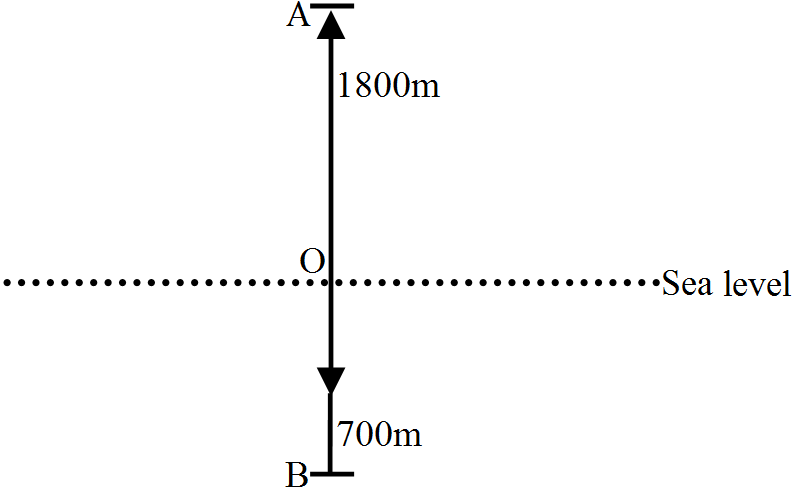
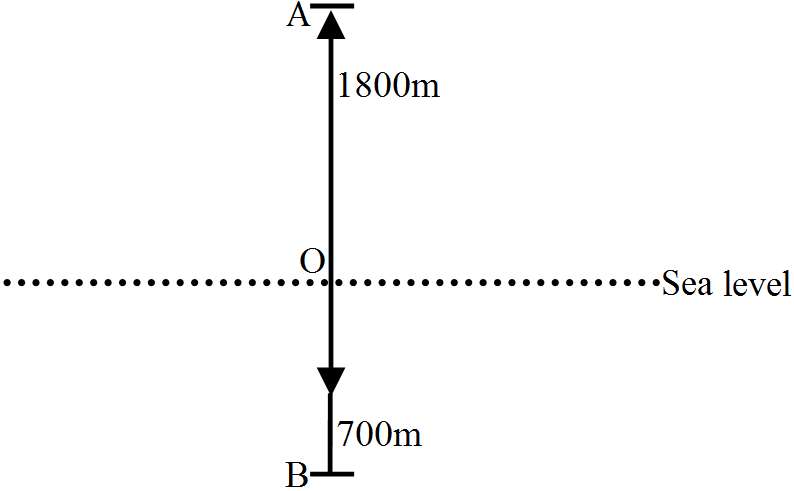
As per the given information, we can draw the diagram,


Let $O$ be the point of level of sea.
Difference between these two points,
$A$ and $B =$ Height between sea level and point $A\ +$ Height between point $B$ and sea level $= AO + OB = 1800 + 700 = 2500m$
View full question & answer
Question 123 Marks
The table given below shows the elevations relative to sea level of four locations.Taking sea level as zero, answer the following questions:
Location Elevation $($in $m)$
$A$ $-180$
$B$ $1600$
$C$ $-55$
$D$ $3200$
$a.$ Which location is closest to sea level?
$b.$ Which location is farthest from sea level?
$c.$ Arrange the locations from the least to the greatest elevation.
Answer
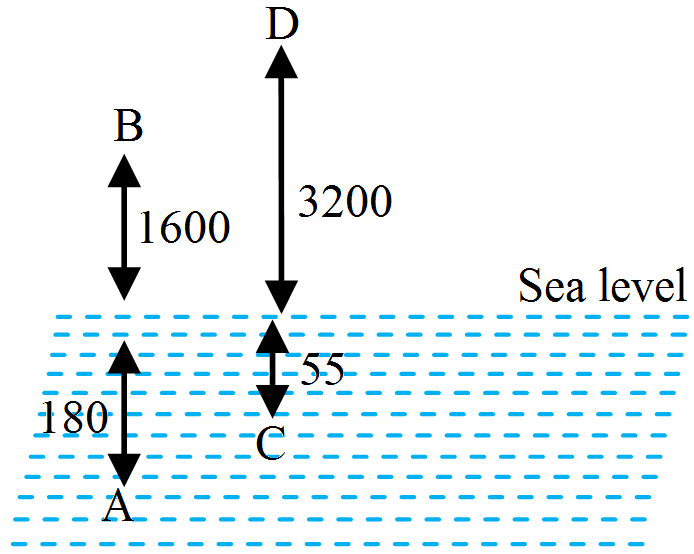
$a.$ From the adjacent figure, we can clearly see that $C$ is closest to sea level.
$b. D$ is farthest from sea level.
$c.$ Locations from the least to the greatest elevation will be in the order $A,S$ and $D.$
View full question & answer
3 Marks Question - MATHS STD 7 Questions - Vidyadip