Questions

3 Marks Question

🎯

Test yourself on this topic

23 questions · timed · auto-graded

Question 13 Marks
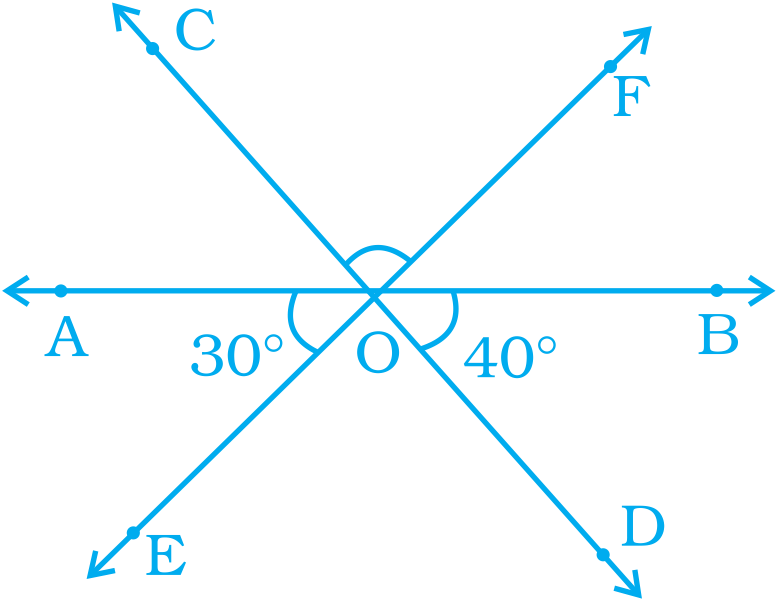
Three lines $AB, CD$ and $EF$ intersect each other at $O.$ If $\angle\text{AOE} = 30^\circ$ and $\angle\text{DOB} = 40^\circ$ Fig. find $\angle\text{COF}$.
Answer
From the given figure, we have.
$\angle\text{AOE}+\angle\text{EOD}+\angle\text{DOB}=180^\circ[\because$ sum of all the angles on a straight line is $180^\circ ]$
$\Rightarrow30^\circ+\angle\text{EOD}+40^\circ=180^\circ$
$\Rightarrow\angle\text{EOD}=180^\circ-70^\circ$
$\Rightarrow\angle\text{EOD}=110^\circ$
Again, $\angle\text{EOD}=\angle\text{COF} [$Vertycally opposite angles$]$
$\Rightarrow\angle\text{COF}=110^\circ$
View full question & answer
Question 23 Marks
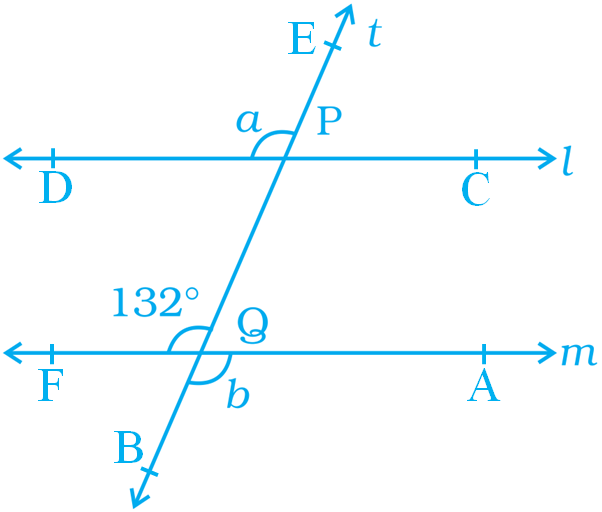
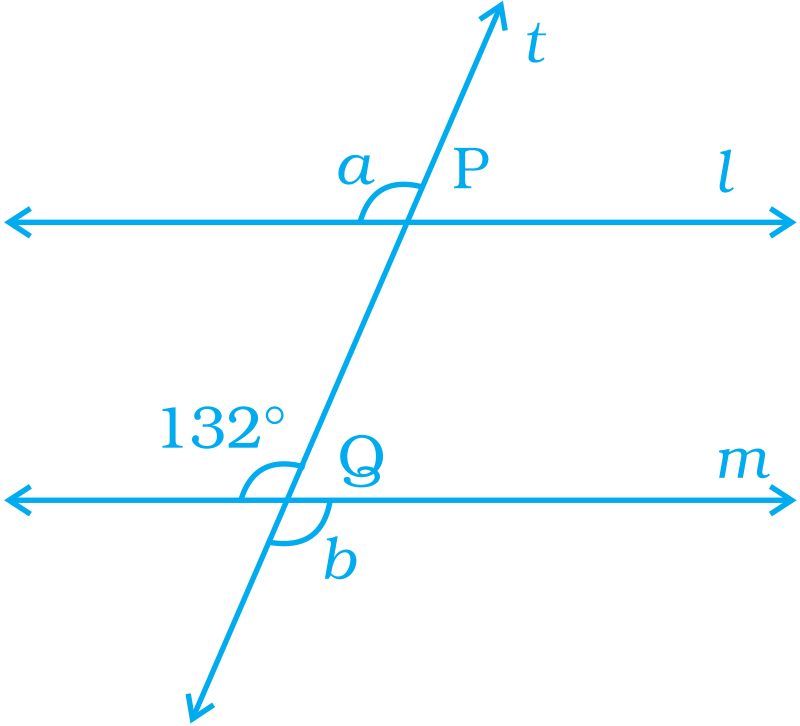
In Fig. $l || m$ and a line t intersects these lines at $P$ and $Q,$ respectively. Find the sum $2a + b.$
Answer

Form the figure, we can say that $\angle\text{AQB}=\angle\text{FQP} [$Vertycally opposite angles$]$
$\Rightarrow\text{b}=132^\circ$
Since, $l,m$ are parallal linces and $t$ is transversal.
Therefore, $\angle\text{EPD}=\angle\text{PQF} [$Corresponding angles$]$
$\Rightarrow\text{a}=132^\circ$
Now, $2\text{a}+\text{b}=2\times132^\circ+132^\circ=264^\circ+132^\circ=396^\circ$
View full question & answer
Question 33 Marks
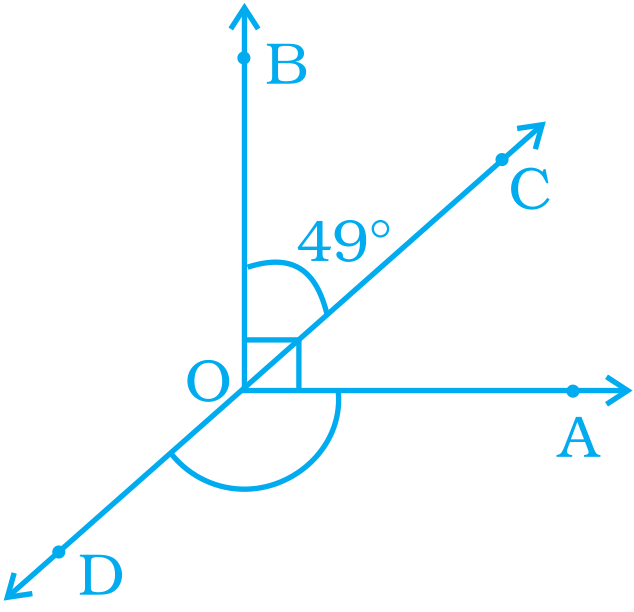
In Fig. $OB$ is perpendicular to $OA$ and $ \text{BOC} = 49^\circ $. Find $\angle\text{AOD}$.
Answer
From the given figure, we have $\angle\text{DOB}+\angle\text{BOC}=180^\circ$ [Liner pair]
$\Rightarrow\angle\text{DOB}+49^\circ=180^\circ$
​​​​​​​$[\because\angle\text{BOC=49}^\circ]$
$\Rightarrow\angle\text{DOB}=180^\circ-49^\circ=131^\circ$ Now, $\angle\text{DOB}+\angle\text{BOA}+\angle\text{AOB}=360^\circ$
$[\because $ sum of all the angles around apoint is $360^\circ ]$
$\Rightarrow131^\circ+90^\circ+\angle\text{AOD}=360^\circ$
$[\because\ \angle\text{DOB}=131^\circ,\angle\text{BOA}=90^\circ]$
$\Rightarrow221^\circ+\angle\text{AOD}=360^\circ$
$\Rightarrow\angle \text{AOD}=360^\circ-221^\circ=139^\circ$
View full question & answer
Question 43 Marks
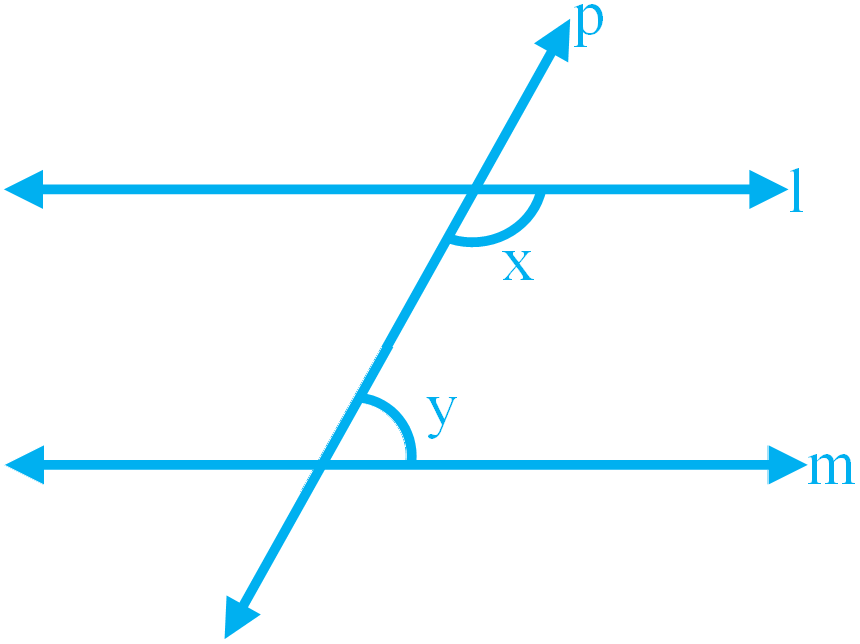
If a transversal intersects two parallel lines, and the difference of two interior angles on the same side of a transversal is $20^\circ ,$ find the angles.
Answer
Let the two interior angles on the same side of transversal are $x$ and $y.$
Given, their difference is $20^\circ .$
$\therefore \text{x}-\text{y}=20^\circ$
$\Rightarrow \text{y}=\text{x}-20^\circ$
Since, $l$ amd $m$ are parallel and $p$ is transversal.

Then, $\text{x}+\text{y}=180^\circ  [ \because$ sum of an interior angles is $180^\circ ]$
$\therefore\text{x}+\text{x}-20^\circ =180^\circ[ $from Eq,$(i)]$
$\Rightarrow 2\text{x}=180^\circ+20^\circ$
$\Rightarrow 2\text{x}=200^\circ$
$\Rightarrow\text{x}=\frac{200^\circ}{2}=100^\circ$
Now, $\text{y}=\text{x}-20^\circ$
$\therefore\text{y}=100^\circ-20^\circ= 80^\circ$
Therefore, the angles are $100^\circ $ and $80^\circ ,$ respectively
View full question & answer
Question 53 Marks
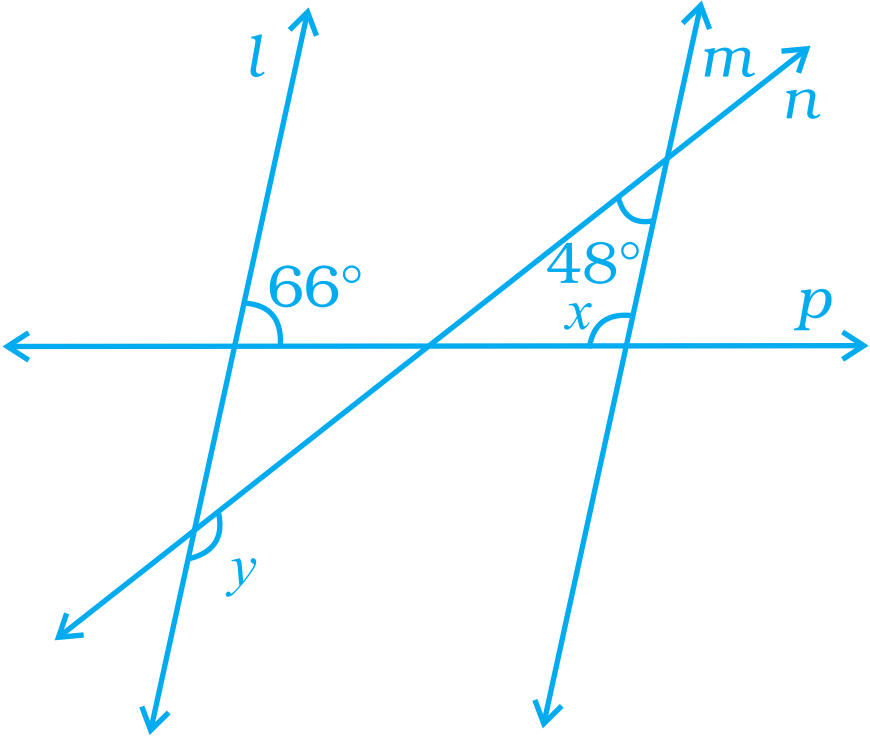
In Fig. two parallel lines $l$ and $m$ are cut by two transversals $n$ and $p.$ Find the values of $x$ and $y.$
Answer
Since, lines $l$ and $m$ are parallel and $p$ is transversal.
Therefore, $x + 66^\circ = 180^\circ [$Consecutive angles$] $
$\Rightarrow x = 180^\circ - 66^\circ $
$\Rightarrow x = 144^\circ $
Again, lince $l, m$ are parallal and $n$ is transversal.
Therefore, $y + 48^\circ = 180^\circ [$Consecutive angles$] $
$\Rightarrow y = 180^\circ = 48^\circ $
$ \Rightarrow y = 132^\circ $
View full question & answer
Question 63 Marks
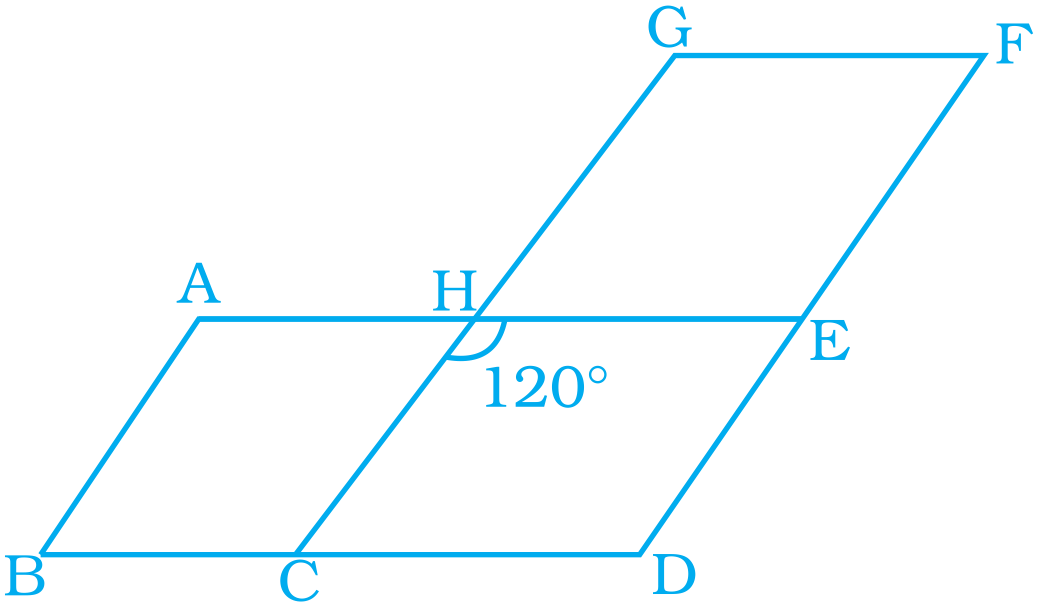
In Fig. $AE || GF || BD, AB || CG || DF$ and $\angle \text{CHE} = 120^\circ$. Find $\angle\text{ABC}$ and $\angle\text{CDE}$.
Answer
Since, $BD || AE$ and $CG$ is transversal.
Therefore, $\angle\text{BCH}=\angle\text{EHC}$ [Alternate interior angles]
$\Rightarrow\angle\text{BCH}=120^\circ$
Again, $CG || DF$ and $BD$ is transversal.
Therefore, $\angle\text{BCH}=\angle\text{CDE}$ [Correspoding angles]
$\Rightarrow\angle\text{CDE}=120^\circ$
Also, $AB || CG$ and $BC$ is transversal.
Therefore, $\angle\text{ABC}=\angle\text{BCH}=180^\circ$ [Consecutive angles]
$\Rightarrow\angle\text{ABC}=180^\circ-120^\circ$
$\Rightarrow\angle\text{ABC}=60^\circ$
View full question & answer
Question 73 Marks
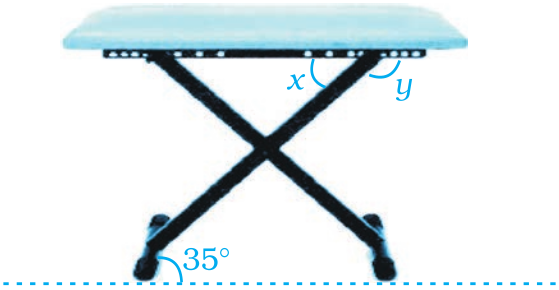
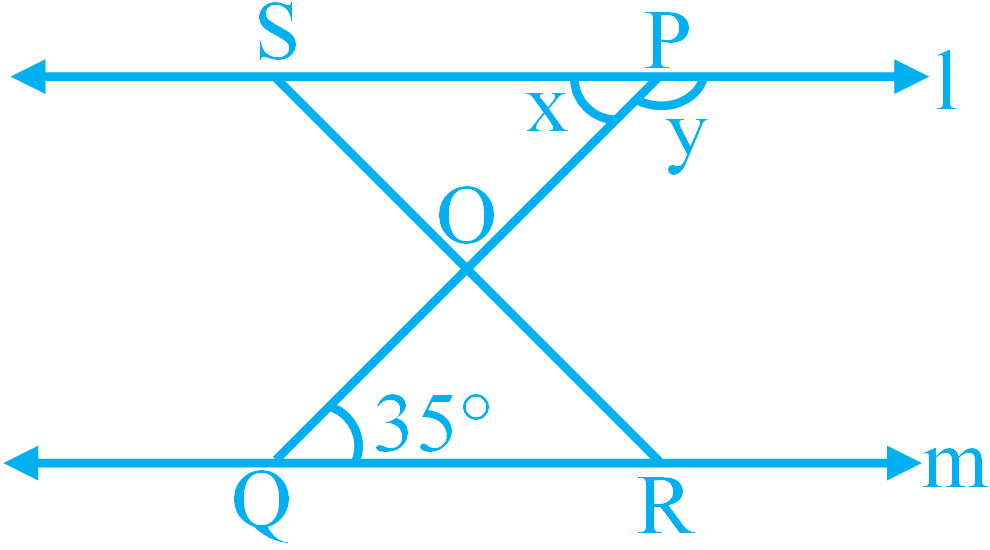
The legs of a stool make an angle of $35^\circ $ with the floor as shown in Fig. Find the angles $x$ and $y.$
Answer

Since, $l,m$ are parallel lines and $PQ$ is transversal.
$\therefore \text{ x}= \angle\text{PQR}$ [Alternate interior angles]
$\Rightarrow\text{x}=35^\circ$
$[\because \angle\text{PQR}=35^\circ]$
Agein, $\text{x}+\text{y}=180^\circ$ [linear pair]
$\Rightarrow35^\circ +\text{y}=180^\circ$
$\Rightarrow\text{y}=180^\circ-35^\circ=145^\circ$
View full question & answer
Question 83 Marks
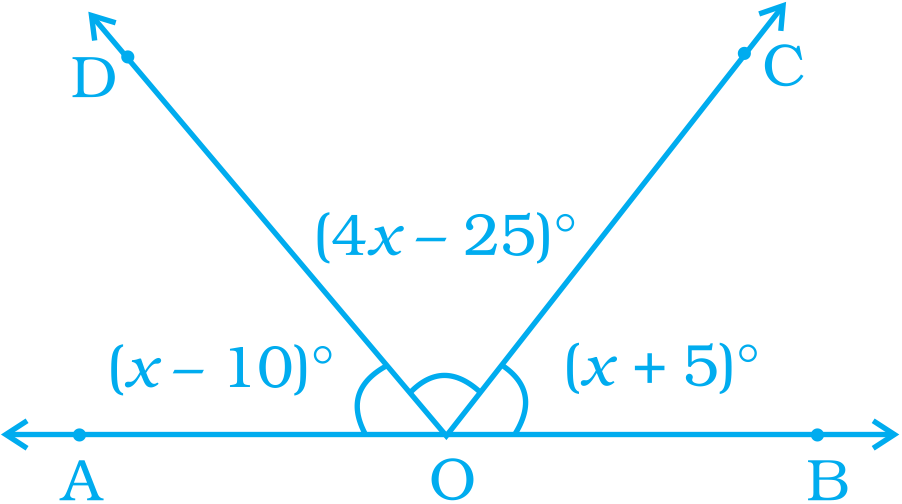
In Fig. find the value of $\angle\text{BOC}$, if points $A, O$ and $B$ are collinear.
Answer
Since, $A, 0$ and $B$ are collinear.
Then, $AOB$ will be a straight line and sum of all the angles on a straight line is $180^\circ .$
$\therefore\angle \text{AOD}+\angle \text{DOC}+\angle \text{COB}=180^\circ$
$\Rightarrow (x - 10)^\circ + (4x - 25)^\circ + (x + 5)^\circ = 180^\circ $
$\Rightarrow x - 10^\circ + 4x - 25^\circ + x + 5 = 180^\circ $
$\Rightarrow 6x - 30^\circ = 180^\circ$
$\Rightarrow 6x = 180^\circ + 30^\circ $
$\Rightarrow 6x = 210^\circ$
$\Rightarrow x = 35^\circ $
Now, $\angle\text{BOC}=(\text{x}+5)^\circ$
$​​​​​​​= (35 + 5)^\circ = 40^\circ $
View full question & answer
Question 93 Marks
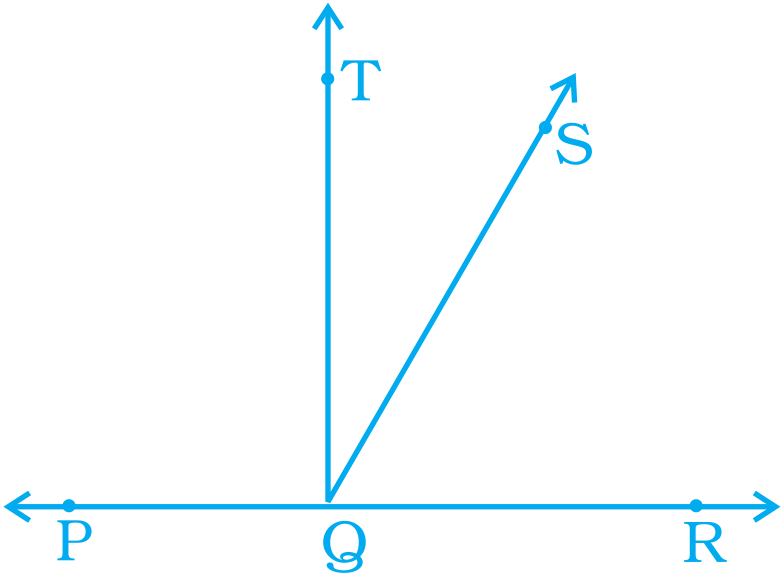
In Fig. $P, Q$ and $R$ are collinear points and $\text{TQ }\bot \text{ PR}$,
  1. Pair of complementary angles
  2. Two pairs of supplementary angles.
  3. Four pairs of adjacent angles.
Answer
  1. Complementary angles are those whose sum is $90^\circ .$
$\therefore \angle\text{TQS}$ and $\angle\text{SQR}$ are pair of complementary angles, as their sum is $90^\circ .$
  1. Supplementary angles are those whose sum is $180^\circ .$
$\therefore \angle\text{SQR}, \angle\text{SQP}; \angle\text{TQR}, \angle\text{TQP}$ are pair so supplementary angles.
  1. Two angles are called adjacent angles, if they have a common vertex and a common arm but no common interior points.
$\therefore\angle\text{SQR}, \angle\text{SQT}, \angle\text{TQR}, \angle\text{TQP},$
$\angle\text{SQT}, \angle\text{TQP}; \angle\text{PQS}, \angle\text{SQR}$ are pairs of adjacent angles.
View full question & answer
Question 103 Marks
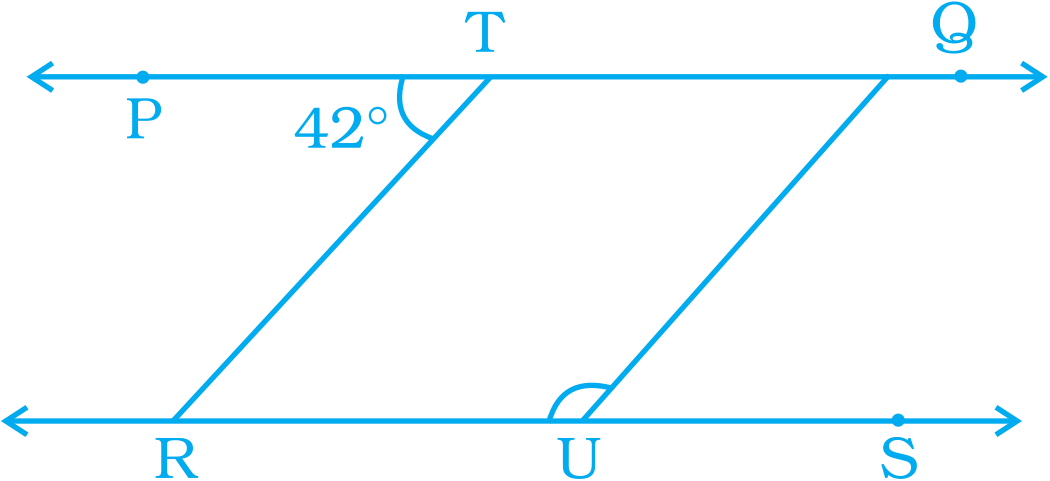
In Fig. $PQ || RS, TR || QU$ and $\angle\text{PTR} = 42^\circ$. Find $\angle\text{QUR}$.
Answer
Since, $PQ$ and $RS$ are parallel and $TR$ is transversal.
Therefore, $\angle\text{PTR}=\angle\text{TRU} [$Alternate interior angles$]$
$\Rightarrow\angle\text{TRU}=42^\circ$
Now, $TR$ is parallel to $QU$ and $RS$ is transversal.
Therefore, $\angle\text{TRU}+\angle\text{RUQ}=180^\circ [$Consecutive interior angles$]$
$\Rightarrow\angle42^\circ+\angle\text{RUQ}=180^\circ$
$\Rightarrow\angle\text{ROQ}=180^\circ-42^\circ=138^\circ$
View full question & answer
Question 113 Marks
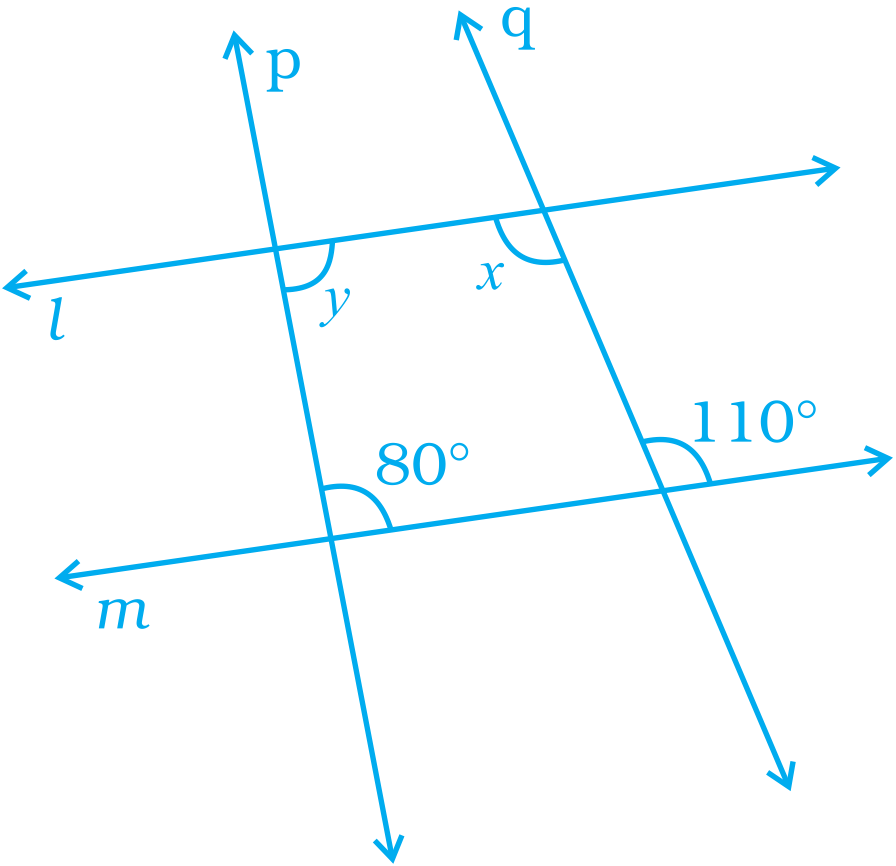
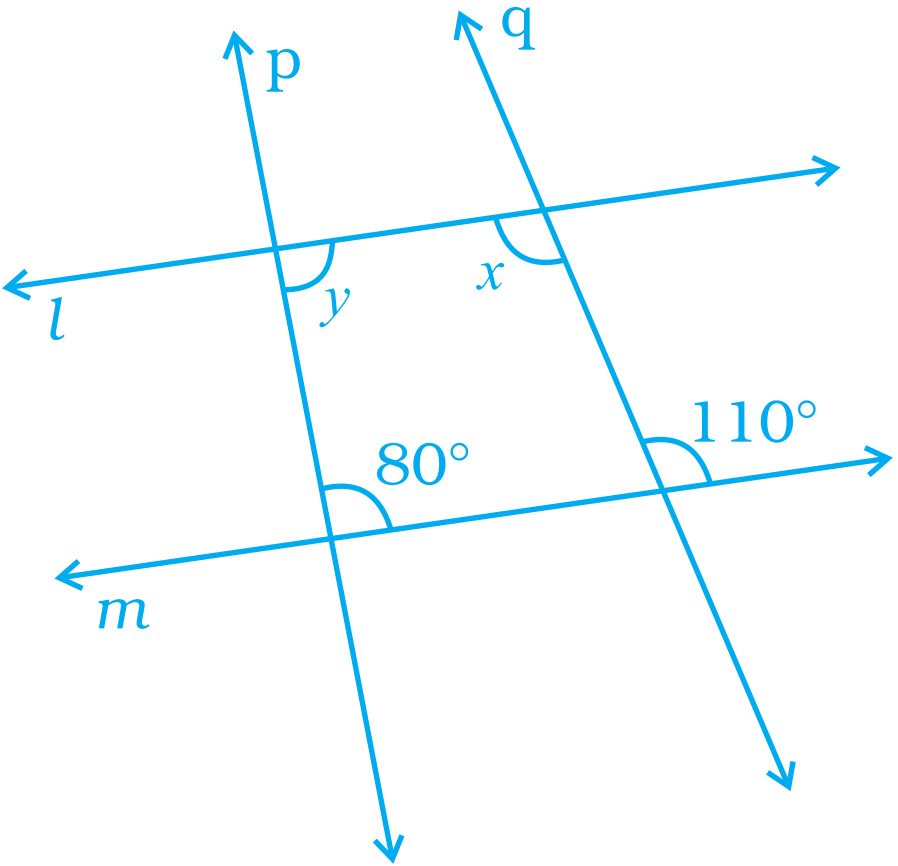
In Fig. two parallel lines $l$ and $m$ are cut by two transversals $p$ and $q.$ Determine the values of $x$ and $y.$
Answer
From the given figure, $x = 110^\circ [$Alternate interior angles$]$ And $y + 80^\circ = 180^\circ [\because$ sum of interior angles on the same side of transversal $180^\circ ]$

$\Rightarrow y = 180^\circ - 80^\circ $
$\Rightarrow y = 100^\circ $
View full question & answer
Question 123 Marks
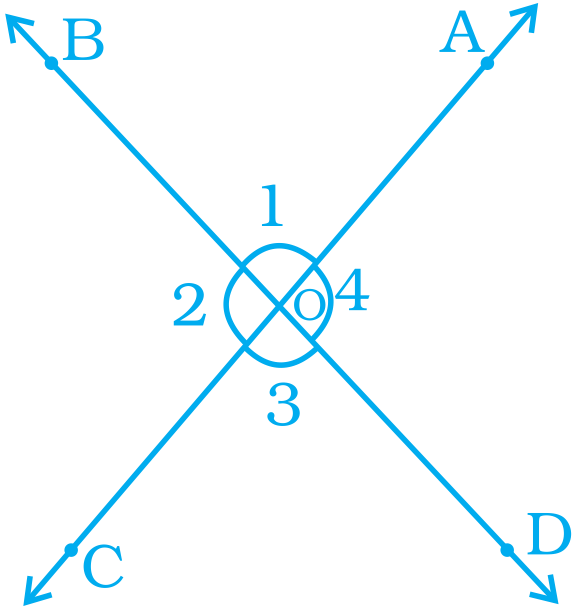
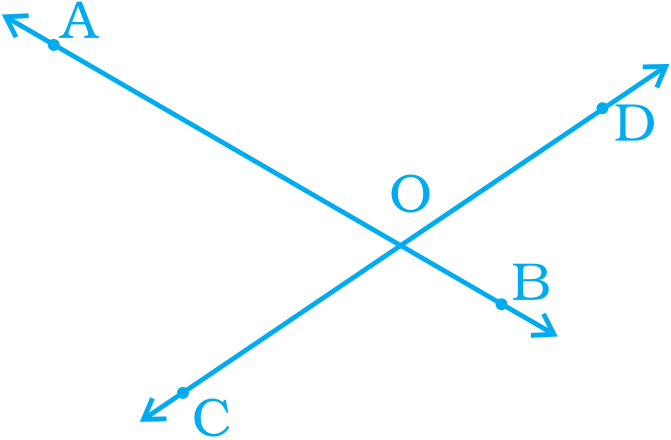
If two angles have a common vertex and their arms form opposite rays Fig. Then,
  1. How many angles are formed?
  2. How many types of angles are formed?
  3. Write all the pairs of vertically opposite angles.
Answer
  1. $13$ angles are formed, namely $\angle\text{AOB}, \angle\text{BOC}, \angle\text{COD}, \angle\text{DOA}, \angle\text{AOC}, \angle\text{BOD},\\ \angle\text{DOB}, \angle\text{AOD}, \angle\text{BOA}, \angle\text{COB}, \angle\text{DOC}, \angle\text{AOA}. $
  2. Following types of angles are formed:
  1. Linear pair.
  2. Supplementary.
  3. Vertically opposite.
  4. Adjacent.
  1. Following are the pair of vertically opposite angles: $\angle1, \angle3; \angle2, \angle4.$
View full question & answer
Question 133 Marks
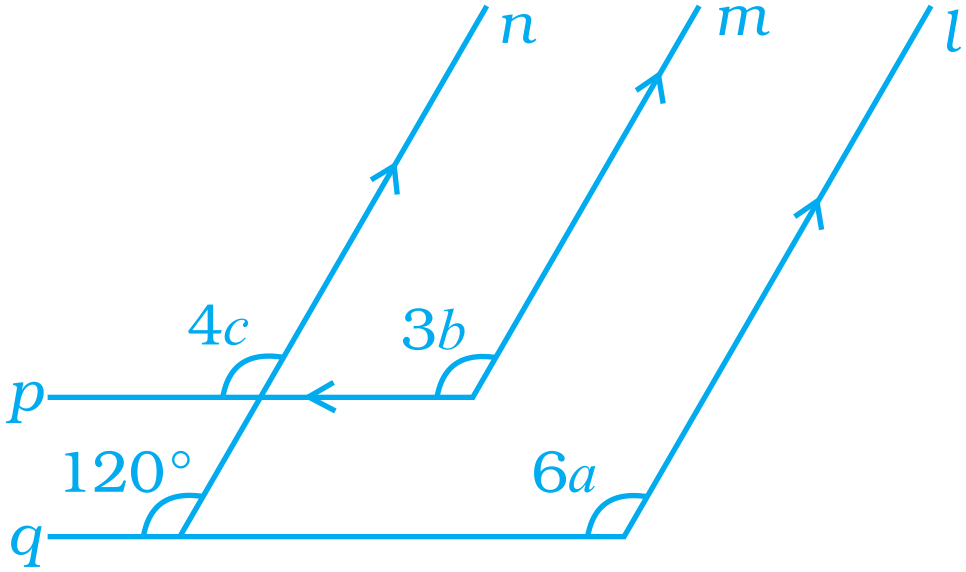
In Fig. $l, m$ and $n$ are parallel lines, and the lines p and q are also parallel. Find the values of $a, b$ and $c.$
Answer
Since, lines $l, n$ are parallel and $q$ is transversal.
Therfore, $6\text{a}=120^\circ$ [Consecutive angles]
$\Rightarrow \text{a}=\frac {120^\circ}{6}\Rightarrow\text{a}=20^\circ$
Also, lines i $p, q$ are parallal and $n$ is transversal.
Therfore, $4\text{c}=120^\circ$ [Consecutive angles]
$\Rightarrow \text{c}=\frac {120^\circ}{4}$
$\Rightarrow \text{c}=30^\circ$
Also, lines i $m, n$ are parallal and $p$ is transversal.
Therfore, $4\text{c}=3\text{b}$ [Consecutive angles]
$\Rightarrow \text{b}=\frac {4\text{c}}{3}$
$\Rightarrow \text{b}=\frac {4\times30^\circ}{3}$
$\Rightarrow \text{b}=40^\circ$
View full question & answer
Question 143 Marks
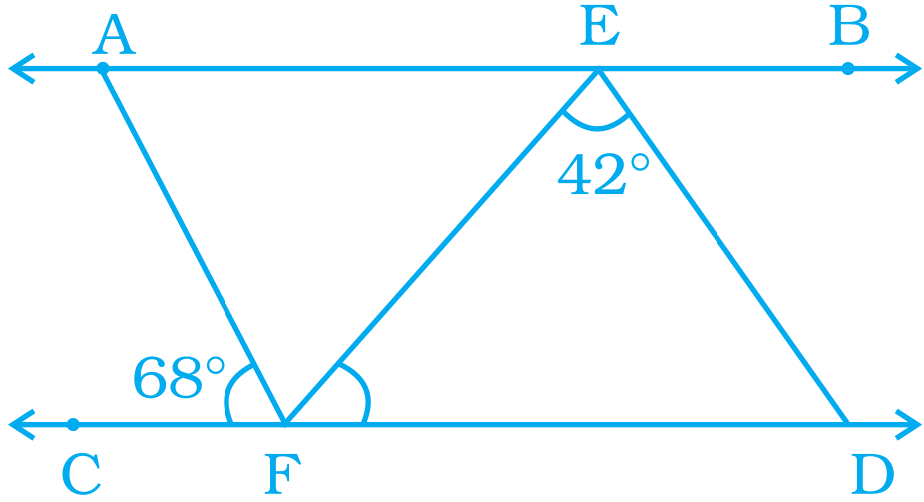
In Fig. $AB || CD, AF || ED,$ $\angle\text{AFC} = 68^\circ$ and $\angle\text{FED} = 42^\circ$. Find $\angle\text{FED} = 42^\circ$.
Answer
$AF$ and $ED$ are parallel and $EF$ is transversal.
Then, $\angle\text{AFE}=\angle\text{FED} [$Alternate interior angls$]$
$\Rightarrow\angle\text{AFE}=42^\circ$
$\because\angle\text{FED=42}^\circ$
Now, $\angle\text{AFC}+\angle\text{AFE}+\angle\text{EFD}=180^\circ  [ \because$ sum of all the angles on a straight line is $180^\circ ] $
$\Rightarrow68^\circ+42^\circ+\text{EFD}=180^\circ$
$\Rightarrow110^\circ+\angle\text{EFD}=180^\circ$
$\Rightarrow\text{EFD}=180^\circ-110^\circ=70^\circ$
View full question & answer
Question 153 Marks
Two angles are making a linear pair. If one of them is one-third of the other, find the angles.
Answer
Let one angle be $x.$
It is given that other angle is one-third of first.
So, other angles will be $\frac{1}{3}\text{x}.$
Again, given that both the angles are making a liner pair.
So, their sum will be $180^\circ $
$\therefore \text{x}+\frac{1}{3}\text{x}=180^\circ$
$\Rightarrow\frac{3\text{x}+\text{x}}{3}=180^\circ [$taking $LCM$ of $1$ and $3$ on $LHS]$
$\Rightarrow\frac{4\text{x}}{3}=180^\circ$
$\Rightarrow\text{x}=\frac{180^\circ\times3}{4}$
$\Rightarrow\text{x}=135^\circ$
Hence, the angles are $135^\circ $ and $\frac{1}{3}\times135^\circ,$ i.e. $135^\circ $ and $45^\circ .$
View full question & answer
Question 163 Marks
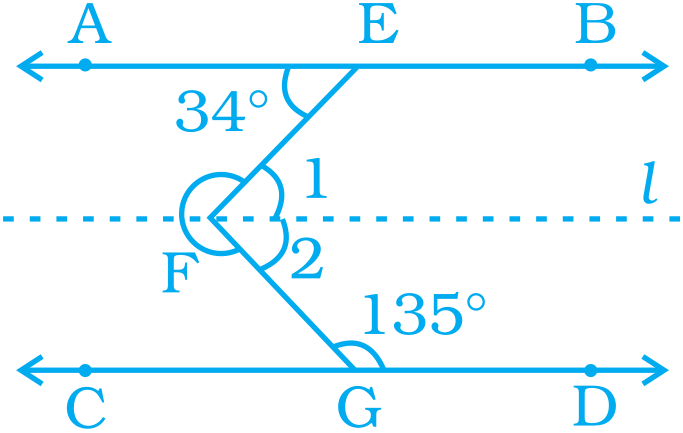
In Fig. $AB || CD$ Find the reflex $\angle\text{EFG}$.

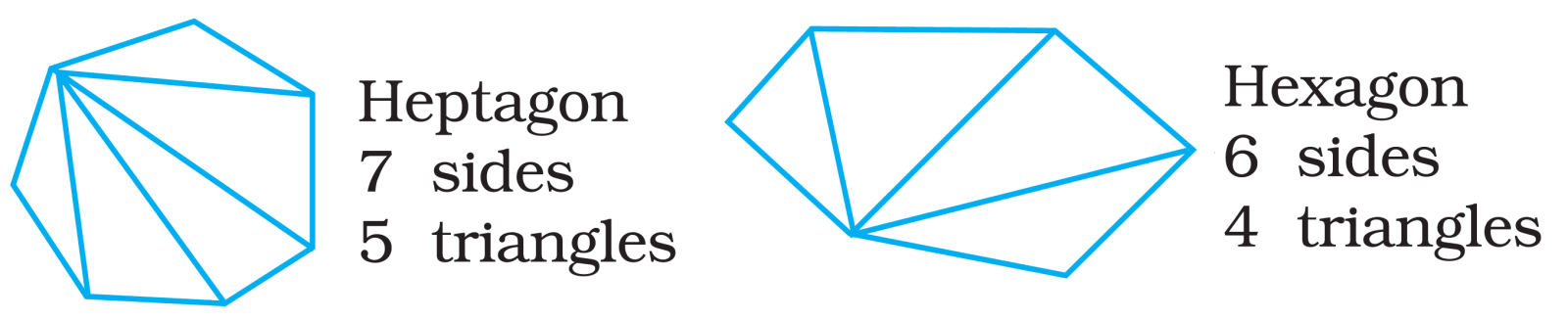
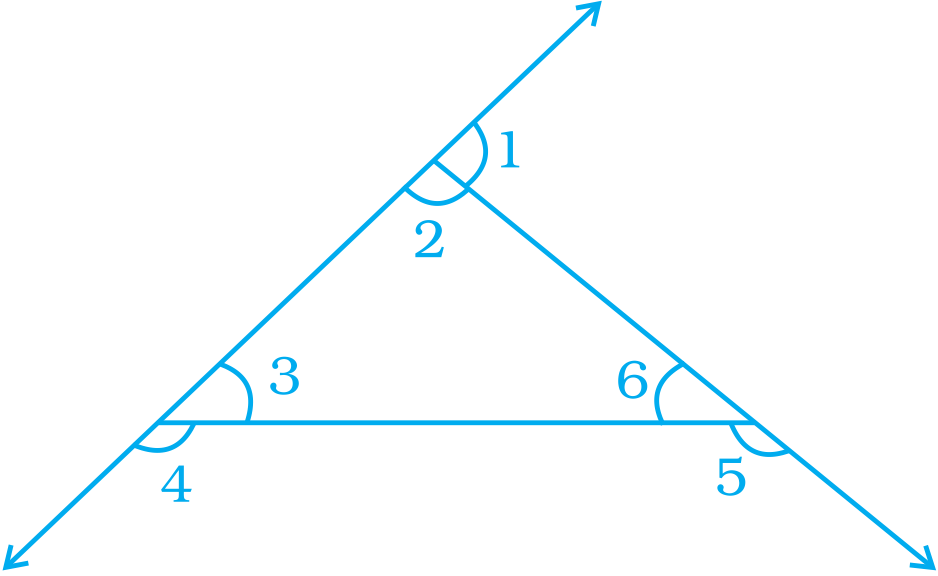
Look for a pattern between the number of sides and the number of triangles.
Answer
Construct a line $l$ parallel to $AB,$ passing through $F.$
$l$ is parallel to both $AB$ and $CD.$
Then, $\angle1=34^\circ$ [Alternate angles]
And $\angle2+135^\circ=180^\circ [$Consecutive angles$]$
$\Rightarrow\angle2=180^\circ-135^\circ$
$\Rightarrow\angle2=45^\circ$
$\therefore\angle\text{EFG}=\angle1+\angle2$
$\Rightarrow\angle\text{EFG}=34^\circ+45^\circ$
$\Rightarrow\angle\text{EFG}=79^\circ$
$\therefore\text{Reflex of }\angle\text{EFG}=360^\circ-\angle\text{EFG}$
$=360^\circ-79^\circ$ $[\because\angle\text{EFG}=79^\circ]$
$=281^\circ$
View full question & answer
Question 173 Marks
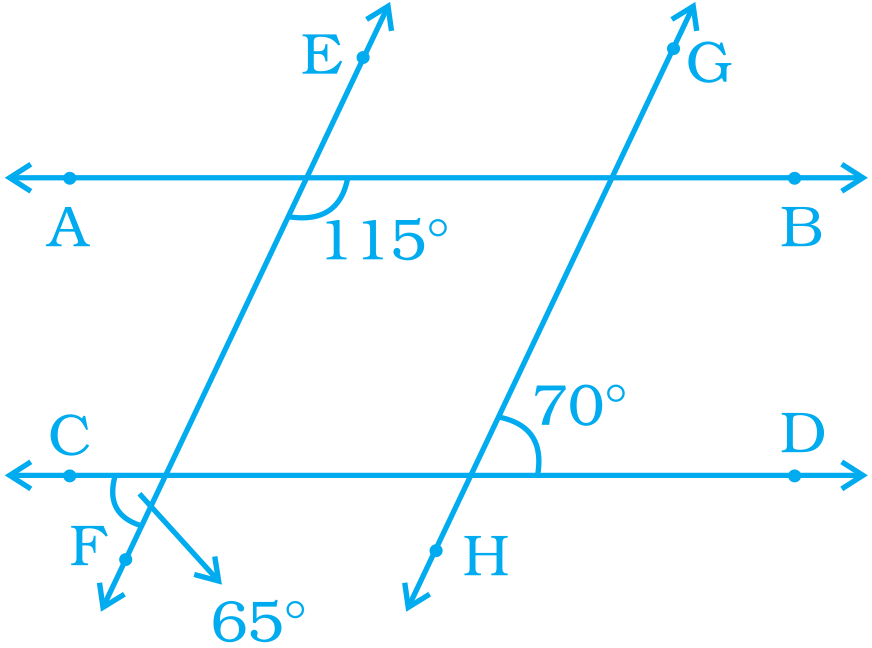
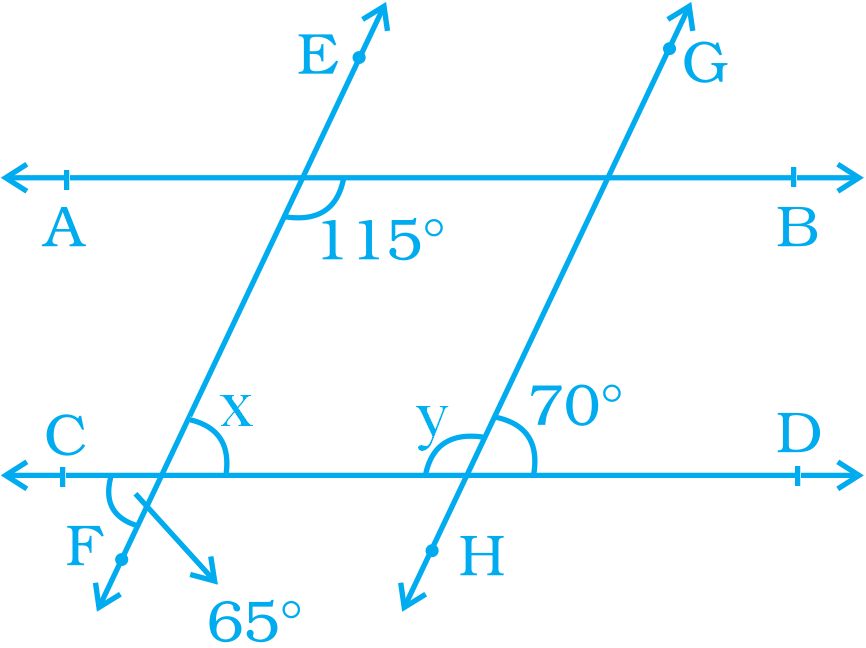
In Fig. examine whether the following pairs of lines are parallel or not:
  1. $EF$ and $GH$
  2. $AB$ and $CD$
Answer

From the given figure, $x = 65^\circ [$Vertically opposite akngles$]$ And
$y = 180^\circ - 70^\circ [$Liner$] $
$\Rightarrow y = 110^\circ $
Now, $x + y = 65^\circ + 110^\circ = 175^\circ \neq 180^\circ $
Hence, $EF$ and $GH$ are not parallal.
Also, $x + 115^\circ = 65^\circ + 115^\circ = 180^\circ $
Hence, $AB$ and $CD$ are not parallal.
View full question & answer
Question 183 Marks
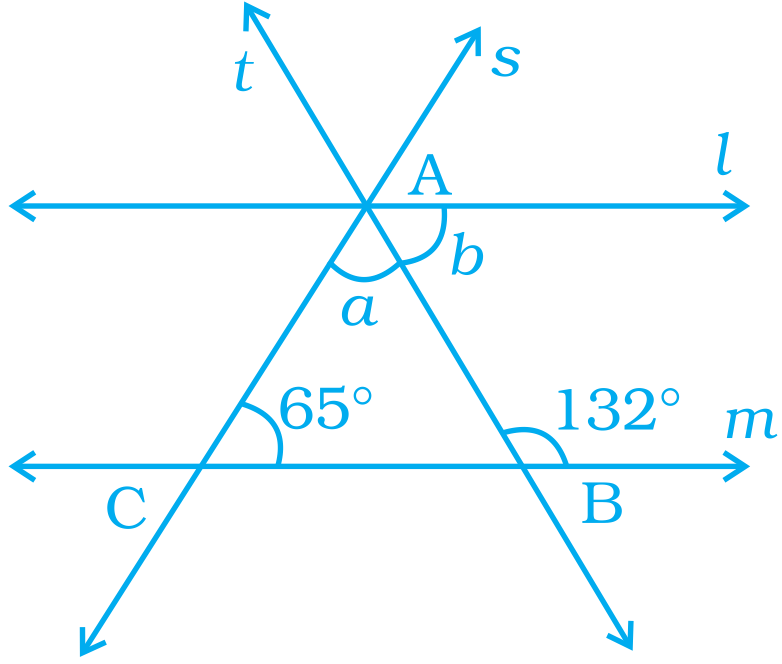
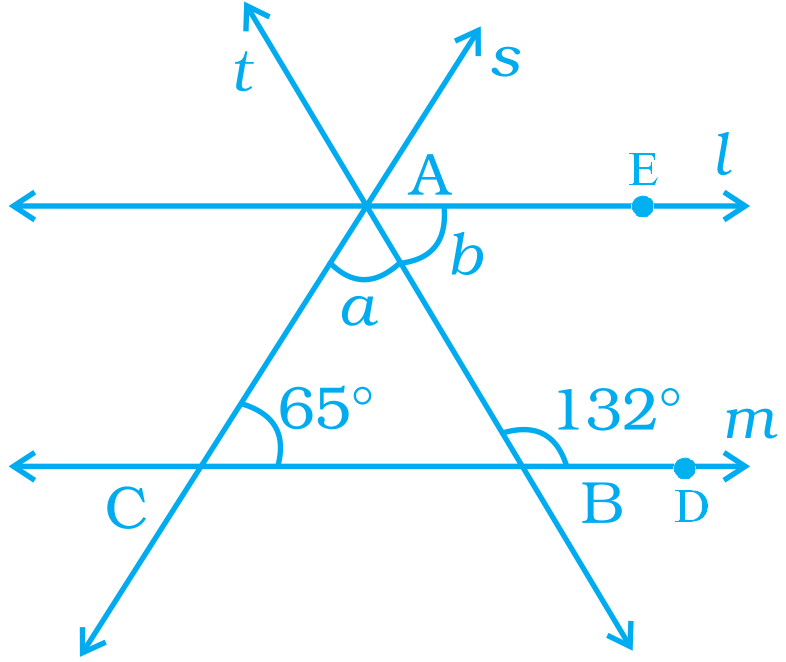
In Fig. if $l || m,$ find the values of $a$ and $b.$
Answer
Since, $l, m$ are parallel lines and $t$ is transversal.

 Therefore, $\angle\text{EAB}+\angle\text{DBA}=180^\circ [$Consecutive interior angles$]$
$\Rightarrow\text{b}+132^\circ=180^\circ$
$\Rightarrow\text{b}=180^\circ-132^\circ$
$\Rightarrow\text{b}=48^\circ$
Again, $l, m$ are parallal lince and $s$ is transversal.
Therefore, $\angle\text{EAC}+\angle\text{BCA}=180^\circ [$Consecutive interior angles$]$
$\Rightarrow \text{a}+\text{b}+65^\circ=180^\circ$
$\Rightarrow\text{a}+48^\circ +65^\circ=180^\circ$
$[\because\text{b}=48^\circ]$
$\Rightarrow\text{a}=180^\circ-48^\circ-65^\circ$
$\Rightarrow\text{a}=67^\circ$
View full question & answer
Question 193 Marks
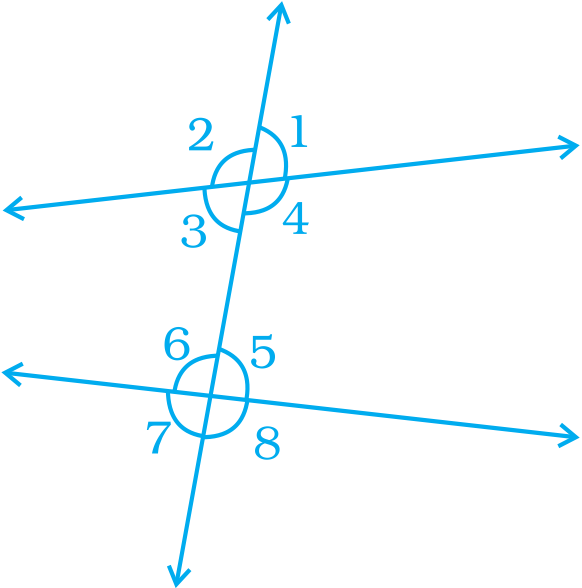
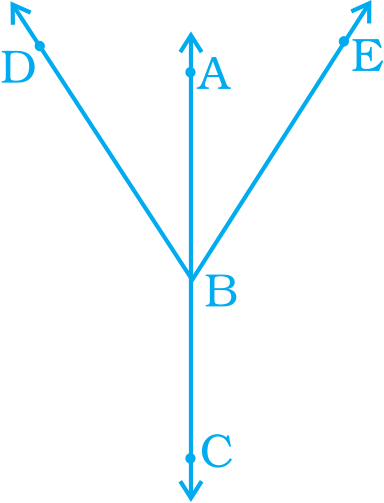
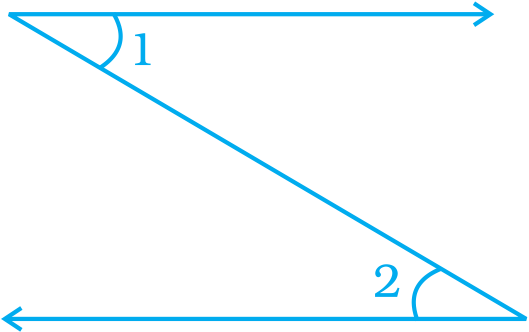
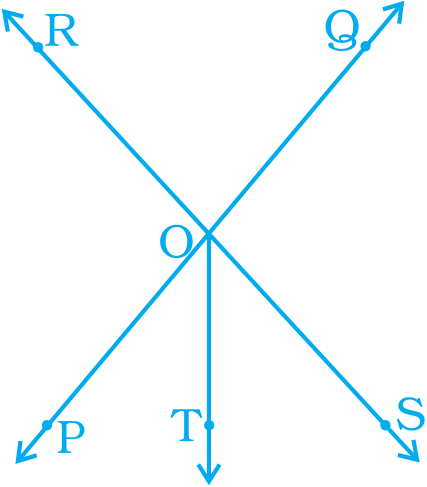
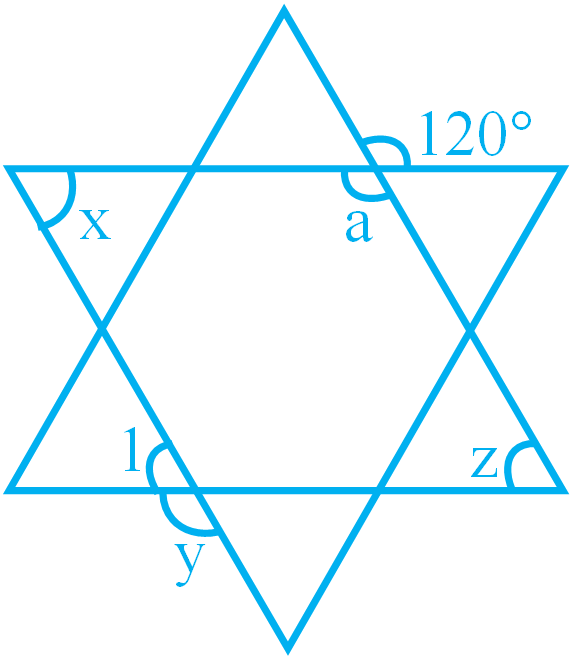
In the following figures, write, if any, $(i)$ each pair of vertically opposite angles, and $(ii)$ each linear pair.
  1.  
  1.  
  1.  
  1.  
Answer
Vertically opposite angles are the angles, opposite to each other when two lines cross, A linear pair is a pair of adjacent angles whose non-common sides are opposite rays. Following are vertically opposite angles and linear pair in the above figure:
Figure Vertically opposite angles Liner pair
$(a)$ $\angle1,\angle3;\angle2,\angle4;\angle5,\angle6,\angle8$ $\angle1,\angle2;\angle1,\angle4;\angle4,\angle3;\angle3,\angle2;\angle5,\angle8;$
$\angle8,\angle7;\angle7,\angle6,\angle6,\angle5$
$(b)$ Nil $\angle\text{ABD},\angle\text{DBC};\angle\text{ABE},\angle\text{EBC}$
$(c)$ Nil Nil
$(d)$ $\angle\text{ROQ},\angle\text{POS},\angle\text{ROP},\angle\text{QOC}$ $\angle\text{ROP},\angle\text{POS};\angle\text{ROT},\angle\text{TOS};\angle\text{QOS},\angle\text{SOP};$
$\angle\text{QOT }\angle\text{TOP};\angle\text{ROQ},\angle\text{QOS};\angle\text{ROQ},\angle\text{ROP}.$
View full question & answer
Question 203 Marks
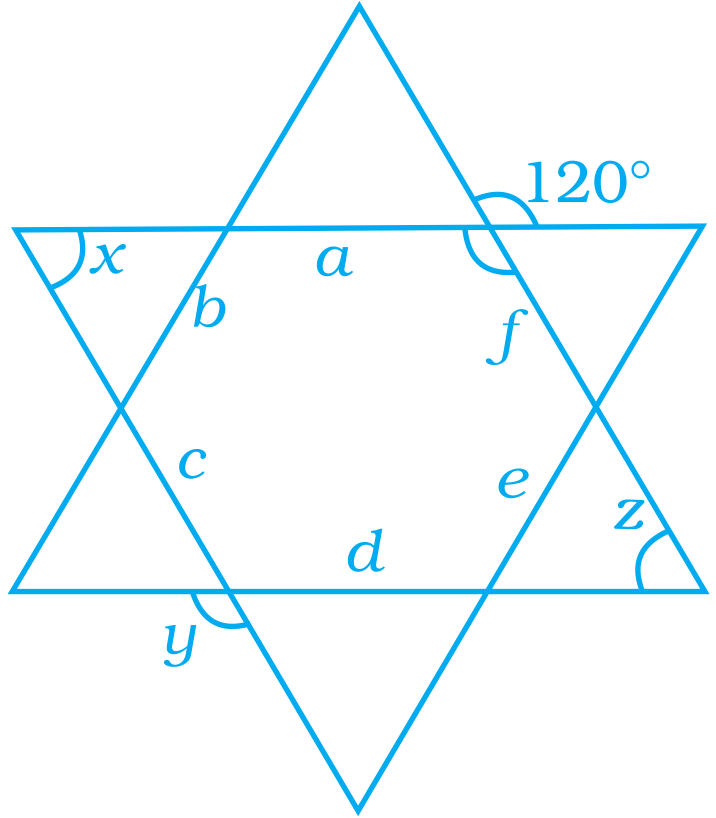
Amisha makes a star with the help of line segments $a, b, c, d, e$ and $f,$ in which $a || d, b || e$ and $c || f.$ Chhaya marks an angle as $120^\circ $ as shown in Fig. and asks
Amisha to find the $\angle\text{x}$, $\angle\text{y}$ and $\angle\text{z}$. Help Amisha in finding the angles.
Answer
From the given figure, we have.
$\angle\text{a}=120^\circ [$Vertically opposite angles$]$
Now, $\angle\text{x}+ \angle\text{a}=18^\circ [$Consecutive interior angles$]$
$\Rightarrow\angle\text{x}+120^\circ=180^\circ$
$\Rightarrow\angle\text{x}=180^\circ-120^\circ=60^\circ$

Agein, $\angle\text{x}=\angle1 [$Alternate interior angles$]$
$\Rightarrow60^\circ=\angle1$
Also, $\angle1+\angle\text{y}=180^\circ\Rightarrow60^\circ\angle\text{y}=180^\circ [$Liner pair$]$
$\Rightarrow\angle\text{y}=180^\circ-60^\circ=120^\circ$
Also, $\angle\text{z}+\angle\text{a}=180^\circ[$ Consecutive interior angles$]$
$\Rightarrow\angle\text{z}+120^\circ=180^\circ$
$\Rightarrow\angle\text{z}=180^\circ-120^\circ=60^\circ$
View full question & answer
Question 213 Marks
Name the pairs of supplementary angles in the following figures:
  1.  
  1.  
  1.  
Answer
When the sum of the measures of two angles is $180^\circ ,$ the angles are called supplementary angles. Linear pair angles are supplementary angles as their sum is $180^\circ .$ Following are the pairs of supplementary angles in the above figures:
Figure Pair of supplementary angles
$(a)$ $\angle\text{AOD},\angle\text{AOC};\angle\text{AOC},\angle\text{BOC};\angle\text{BOC},\angle\text{AOD},\angle\text{BOD}$
$(b)$ $\angle\text{POS},\angle\text{SOQ};\angle\text{POR},\angle\text{QOR}$
$(c)$ $\angle1,\angle2;\angle5,\angle6;\angle3,\angle4$
View full question & answer
Question 223 Marks
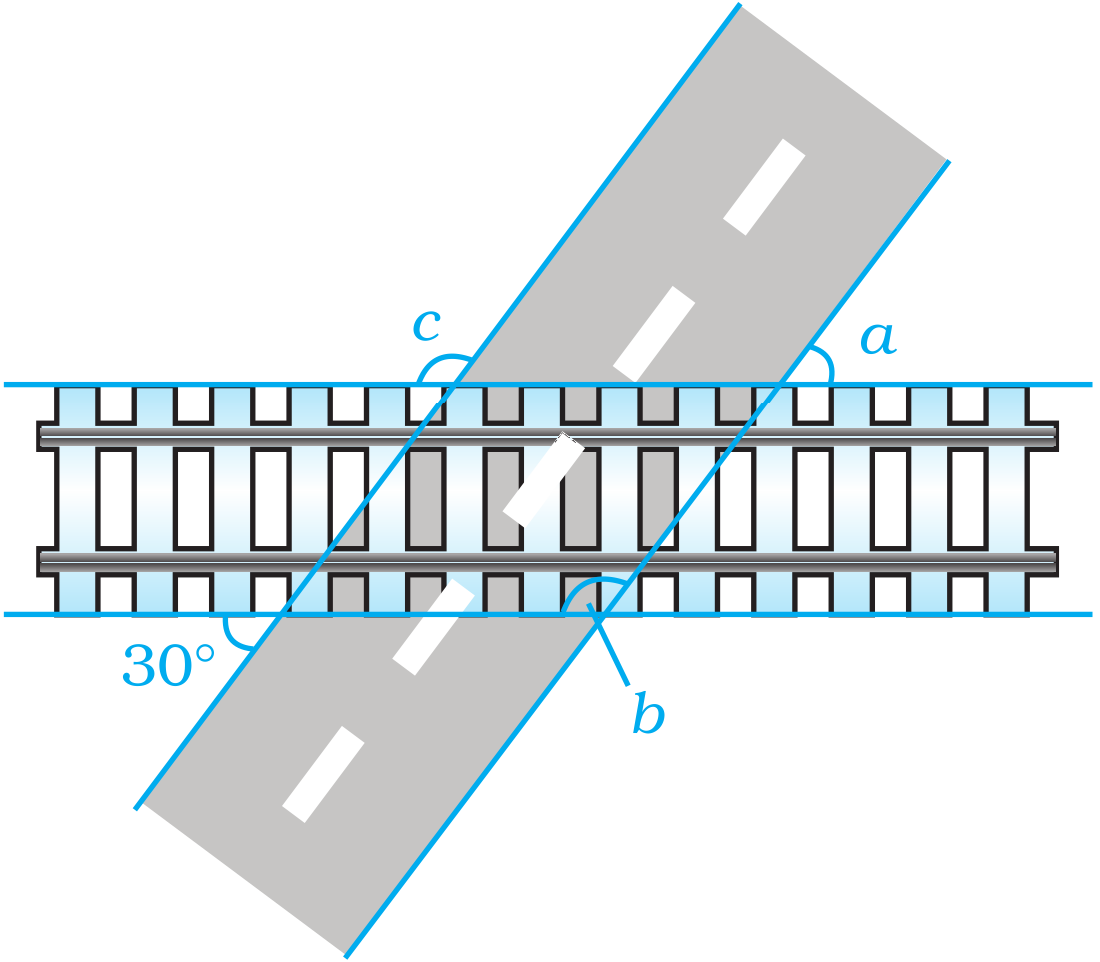
A road crosses a railway line at an angle of $30^\circ $ as shown in Fig. Find the values of $a, b$ and $c.$
Answer
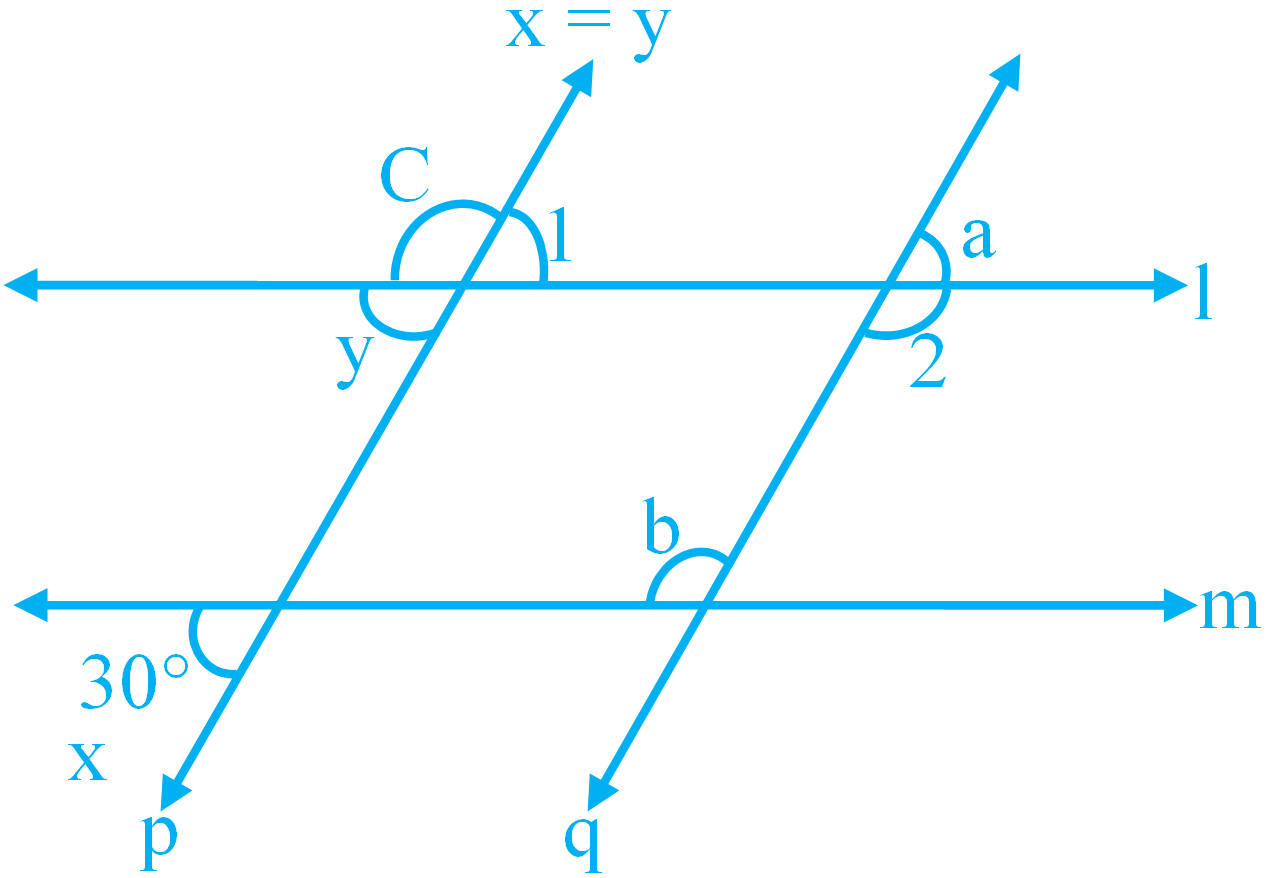
Lines $l$ and $m$ are parallel, $P$ is transversal and $x = 30^\circ $
Threrefore, $x = y [$Corresponding angles$]$

$\Rightarrow\text{y} = 30^\circ$ Now, $\text{c} + \text{y} =18^\circ$ [Liner piar]
$\Rightarrow\text{c} + 30^\circ = 180^\circ$
$\Rightarrow\text{c}=180^\circ-30^\circ$
$\Rightarrow\text{c} =  150^\circ$ Now, $\angle1+ \text{c}=180^\circ$
$\Rightarrow\angle1+150^\circ=180^\circ$
$\Rightarrow\angle1=180^\circ-150^\circ=30^\circ$
$\therefore\angle1 =\text{a}$ [Corresponding angles]
$\Rightarrow\text{a}=30^\circ$ Also,$\angle2+\text{a}=180^\circ$
$\Rightarrow\angle2+30^\circ=180^\circ$
$\Rightarrow\angle2=180^\circ-30^\circ=150^\circ$
Agin, $\angle2 = \text{b}$ [Alternate interior angls]
$\Rightarrow\text{b}=150^\circ$
Hence, $a = 30^\circ , b = 150^\circ $ and $c = 150^\circ $
View full question & answer
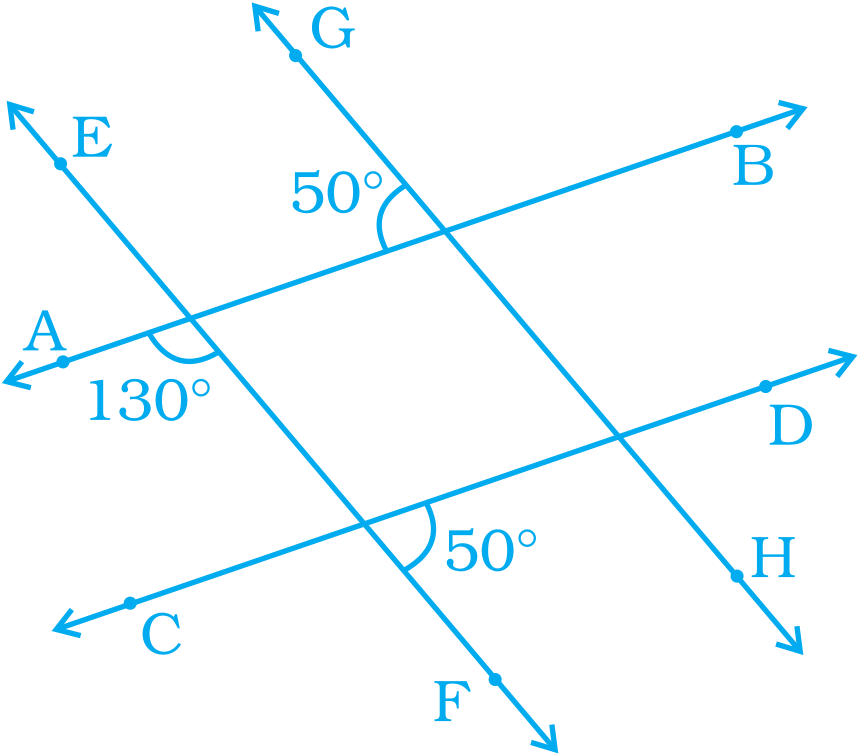
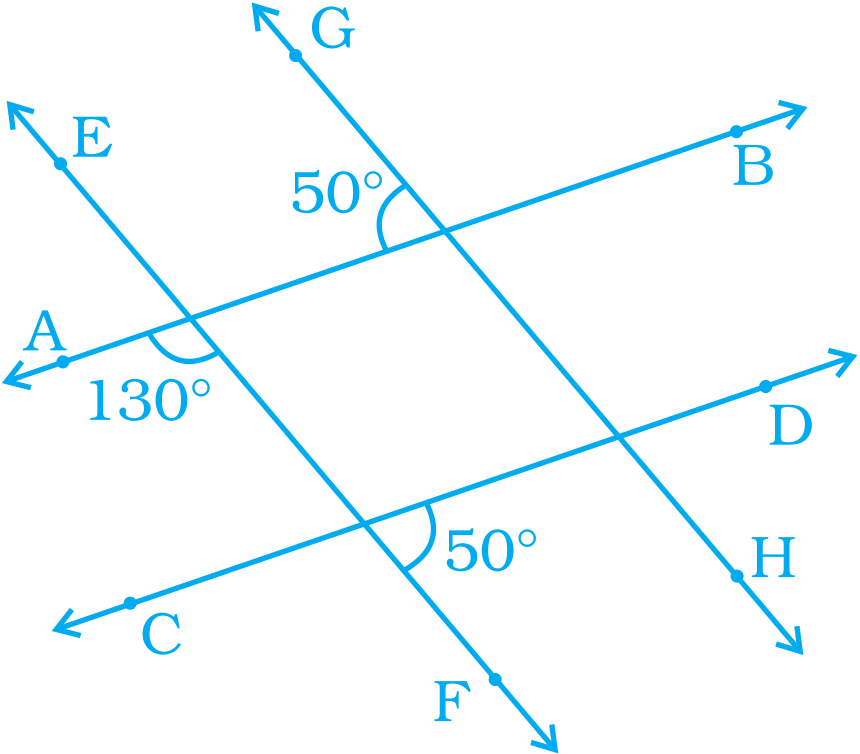
Question 233 Marks
In Fig. show that
  1. $AB || CD$
  2. $EF || GH$
Answer
  1. From the given figure,
$\angle\text{CIF}+\angle\text{FIJ}=180^\circ$ [Liner pair]
$\Rightarrow\angle\text{CIF}=180^\circ-\angle\text{FIJ}=180^\circ-50^\circ=130^\circ$

Now, $\angle\text{ALI}+\angle\text{CIF}=130^\circ$
$\therefore \text{ AB }|| \text{ CD}$ as their corresponding angles are equal.
  1. From the given figure,
$\angle\text{GKL}+\angle\text{LKJ}=180^\circ$ [Liner pair]
$\Rightarrow\angle\text{LKJ}=180^\circ-\angle\text{GKL}=180^\circ-50^\circ=130^\circ$
Now, $\angle\text{ALI}+\angle\text{LKJ}=130^\circ$
$\therefore \text{ EF }|| \text{ GH}$ as their corresponding angles are equal.
View full question & answer