Questions

5 Marks Questions

🎯

Test yourself on this topic

6 questions · timed · auto-graded

Question 15 Marks
The area of a square and a rectangle are equal. If the side of the square is $40 \ cm$ and the breadth of the rectangle is $25 \ cm$, find the length of the rectangle. Also, find the perimeter of the rectangle.
Answer
Area of square $=(\text { side })^2=40 \mathrm{~cm} \times 40 \mathrm{~cm}=1600 \mathrm{~cm}^2$
Given that:
Area of the rectangle $=$ Area of the square
$\Rightarrow$ Area of the rectangle $=1600 \mathrm{~cm}^2$,
Also, Breadth of the rectangle $=25 \mathrm{~cm}$.
$\Rightarrow$ Area of the rectangle $=l \times b$
$\therefore 1600=l \times 25$
$\therefore \frac{1600}{25}=l$
$\Rightarrow l=64 \mathrm{~cm}$
So, the length of the rectangle is $64 \ cm .$
Now, Perimeter of the rectangle $=2(l+b)=2(64+25) \mathrm{cm}$
$=2 \times 89 \mathrm{~cm}=178 \mathrm{~cm}$
So, the perimeter of the rectangle is $178 \ cm$ even though its area is the same as that of the square.
View full question & answer
Question 25 Marks
A wire is in the shape of a square of side $10 \ cm$. If the wire is rebent into a rectangle of length $12 \ cm$, find its breadth. Which encloses more area, the square or the rectangle?
Answer
Here, we have
Side of the square $=10 \mathrm{~cm}$
Length of the wire $=$ Perimeter of the square $=4 \times$ side $=4 \times 10 \mathrm{~cm}=40 \mathrm{~cm}$
Length of the rectangle, $\mathrm{l}=12 \mathrm{~cm}$.
Let b be the breadth of the rectangle.
Perimeter of rectangle $=$ Length of wire $=40 \mathrm{~cm}$
Perimeter of the rectangle $=2(l+b)$
$\Rightarrow 40=2(12+b)$
$\Rightarrow \frac{40}{2}=12+b$
$\therefore b=20-12=8 \mathrm{~cm}$
The breadth of the rectangle is $8 \ cm .$
Area of the square $=(\text { side })^2=10 \mathrm{~cm} \times 10 \mathrm{~cm}=100 \mathrm{~cm}^2$
Area of the rectangle $=l \times b$
$=12 \mathrm{~cm} \times 8 \mathrm{~cm}=96 \mathrm{~cm}^2$
hence the area of the square is more than rectangle.
View full question & answer
Question 35 Marks
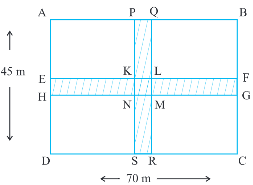
Two cross roads, each of width $5 \ m$, run at right angles through the centre of a rectangular park of length $70 \ m$ and breadth $45 \ m$ and parallel to its sides. Find the area of the roads. Also find the cost of constructing the roads at the rate of ₹ $105 ~per ~m^2$.
Answer
Clearly, area of the cross roads is the area of shaded portion,
i.e., the area of the rectangle $PQRS$ and the area of the rectangle $EFGH$.
But while doing this, the area of the square $KLMN$ is taken twice,
which is to be subtracted once to get the required area.
Now, $P Q=5 \mathrm{~m}$ and $P S=45 \mathrm{~m}$
$\mathrm{EH}=5 \mathrm{~m} \text { and } \mathrm{EF}=70 \mathrm{~m}$
$\mathrm{KL}=5 \mathrm{~m} \text { and } \mathrm{KN}=5 \mathrm{~m}$
Therefore, area of the path = Area of the rectangle $PQRS +$ area of the rectangle $EFGH -$ Area of the square $KLMN$
$=\mathrm{PS} \times \mathrm{PQ}+\mathrm{EF} \times \mathrm{EH}-\mathrm{KL} \times \mathrm{KN}$
$=(45 \times 5+70 \times 5-5 \times 5) \mathrm{m}^2$
$=(225+350-25) \mathrm{m}^2=550 \mathrm{~m}^2$
Hence, cost of constructing the path $=₹ 105 \times 550=₹ 57,750$
View full question & answer
Question 45 Marks
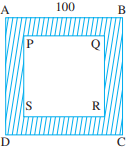
A path $5 \ m$ wide runs along inside a square park of side $100 \ m$. Find the area of the path. Also find the cost of cementing it at the rate of ₹ $250 ~per ~10 ~m^2$.
Answer
Let $A B C D$ be the square park of side $100 \ m .$
The shaded region represents the path $5 \ m$ wide.
$P Q=100-(5+5)=90 \mathrm{~m}$
Area of square $A B C D=(\text { side })^2=(100)^2 \mathrm{~m}^2=10000 \mathrm{~m}^2$
Area of square PQRS $=(\text { side })^2=(90)^2 \mathrm{~m}^2=8100 \mathrm{~m}^2$
$\therefore$ Area of the path $=(10000-8100) \mathrm{m}^2=1900 \mathrm{~m}^2$
Now, cost of cementing $10 \mathrm{~m}^2=₹ 250$
$\therefore$ cost of cementing $1 \mathrm{~m}^2=\frac{250}{10}=₹ 25$
So, cost of cementing $1900 \mathrm{~m}^2=\frac{250}{10} \times 1900=₹ 47,500$
View full question & answer
Question 55 Marks
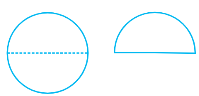
Sudhanshu divides a circular disc of radius $7 \ cm$ in two equal parts. What is the perimeter of each semicircular shape disc? (Use $\pi = \frac{22}{7}$)
Answer

To find the perimeter of the semicircular disc (Fig),
We need to find
$(i)$ Circumference of semicircular shape
$(ii)$ Diameter
Given that radius $(r) = 7 cm.$
We know that the circumference of circle = 2$\pi$r
Hence, the circumference of the semi-circle $=\frac{1}{2} \times 2 \pi r=\pi r$
$=\frac{22}{7} \times 7 \mathrm{cm} = 22 cm$
Also, The diameter of the circle $= 2r = 2 \times 7 cm = 14 cm$
Thus, Perimeter of each semi-circular disc $= (22 + 14) cm = 36 cm$
View full question & answer
Question 65 Marks
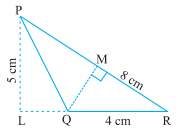
In $\triangle PQR, PR = 8 \ cm, QR = 4 \ cm$ and $PL = 5 \ cm ($Fig$).$ Find:

$i.$ the area of the $\triangle PQR$
$ii. QM$
Answer
Here, we shall proceed as follows:
Given that
Base $= QR = 4 \ cm,$
Height $= PL = 5 \ cm$
$i.$ Therefore, Area of the triangle $\ce{PQR} =\frac{1}{2} \times b \times h$
$=\frac{1}{2} \times 4 \mathrm{\ cm} \times 5 \mathrm{\ cm} $
​​​​​​​$= 10 ~\ cm^2$
$ii.$ Here,
$PR =$ base $= 8 \ cm$
$QM =$ height$ = ?$
Area $=10 ~\ cm^2$
Also, area of triangle $=\frac{1}{2} \times b \times h$
$\Rightarrow$ $10=\frac{1}{2} \times 8 \times h$
$\Rightarrow$ $h=\frac{10}{4}=\frac{5}{2}=2.5$
So, $QM = 2.5 \ cm$
View full question & answer