Questions

3 Marks Question

🎯

Test yourself on this topic

21 questions · timed · auto-graded

Question 13 Marks
$AM$ is a median of a triangle $ABC.$
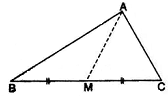
Is $AB + BC + CA > 2 AM?($Consider the sides of triangles $\triangle ABM$ and $\triangle AMC.)$
Answer
In $\triangle ABM$
$AB + BM > AM....[$Sum of the lengths of any two sides of a triangle is greater than the length of the third side$].....(1)$
In $\triangle ACM$
$CA + CM > AM....[$Sum of the lenghts of any two sides of a triangle is greater than the length of the third side$].....(2)$
Sum $(1)$ and $(2)$
$(AB + BM) + (CA + CM) > AM + AM$
$ \therefore AB + (BM + CM) + CA > 2AM$
$\therefore AB + BC + CA > 2AM$
View full question & answer
Question 23 Marks
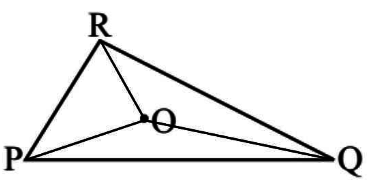
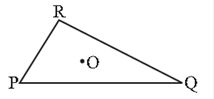
Take any point $O$ in the interior of a triangle $PQR.$ Is $OR + OP > RP?$
Answer


From the figure, we have,
If $O$ is a point in the interior of the given triangle
Then,
Three triangles can be constructed, these are:
$\triangle OPQ,  \triangle OQR$ and $\triangle ORP$
We know that,
In a triangle, the sum of the length of either two sides of the triangle is always greater than the third side
Hence,
$\triangle ORP$ is a triangle having sides $OR, OP$ and $PR$
As, $OR + OP > PR$
View full question & answer
Question 33 Marks
Take any point $O$ in the interior of a triangle $PQR.$ Is $OQ + OR > QR?$
Answer
According to the given condition in the question,
We have:
If $O$ is a point in the interior of the given triangle
Then,
Three triangles can be constructed, these are:
$\triangle OPQ, \triangle OQR$ and $\triangle ORP$
We know that,
In a triangle,
The sum of the length of either two sides of the triangle is always greater than the third side
Therefore,
$\triangle OQR$ is a triangle having sides $OR, OQ$ and $QR$
As, $OQ + OR > QR$
View full question & answer
Question 43 Marks
Take any point $O$ in the interior of a triangle $PQR.$ Is $OP + OQ > PQ?$
Answer


According to the question,
If $O$ is a point in the interior of the given triangle
Then,
Three triangles can be constructed, which are:
$\triangle OPQ, \triangle OQR,$ and $\triangle ORP$
We know that,
In a triangle, the sum of the length of either two sides of the triangle is always greater than the third side
Therefore,
$\triangle OPQ$ is a triangle having sides $OP, OQ,$ and $PQ$
As, $OP + OQ > PQ$
View full question & answer
Question 53 Marks
Is it possible to have a triangle with the sides $6\ cm, 3\ cm, 2\ cm$
Answer
We know that,
In a triangle,
The sum of the length of either two sides of the triangle is always greater than the third side
Here,
The given sides of the triangle are:
$6\ cm, 3\ cm,$ and $2\ cm$
Now,
$6 + 3 = 9\ cm$ and $9\ cm > 2\ cm$
$3 + 2 = 5\ cm$ But, $5\ cm < 6 \ cm$
Therefore,
The triangle is not possible as the sum of the length of either two sides of the triangle is not greater than the third side.
View full question & answer
Question 63 Marks
Is it possible to have a triangle with the sides $3\ cm, 6\ cm, 7\ cm$
Answer
We know that,
In a triangle, the sum of the length of either two sides of the triangle is always greater than the third side
The given sides of the triangle are:
$3\ cm, 6\ cm,$ and $7\ cm$
Now,
$3 + 6 = 9\ cm$ and, $9\ cm > 7\ cm$
$6 + 7 = 13\ cm$ and, $13\ cm > 3\ cm$
$3 + 7 = 10\ cm$ and, $10\ cm > 6\ cm$
Hence,
This triangle is possible as the sum of the length of either two sides of the triangle is greater than the third side.
View full question & answer
Question 73 Marks
Is it possible to have a triangle with the sides $2\ cm, 3\ cm, 5\ cm$
Answer
We know that,
In a triangle, the sum of the length of either two sides of the triangle is always greater than the third side
The given sides of the triangle in this question are:
$2\ cm, 3\ cm,$ and $5\ cm$
Now,
$2\ cm + 3\ cm= 5\ cm$
Therefore,
This triangle is not possible as the sum of the length of either two sides of the triangle is not greater than the third side.
View full question & answer
Question 83 Marks
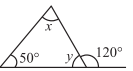
Find the values of the unknowns $x$ and $y$ in the diagram:
Answer
$50^\circ + x^\circ = 120^\circ .....(1) [$By the exterior-angle property of a triangle$]$
$\therefore x^\circ = 120^\circ – 50^\circ $
$\therefore x^\circ = 70^\circ ......(2)$
$\therefore x = 70^\circ ......(3)$
Again, $x^\circ + y^\circ + 50^\circ = 180^\circ $
$\therefore x^\circ + y^\circ + 50^\circ = 180^\circ ......[$ By the exterior-angle property of a triangle$] (4)$
$\therefore x^\circ + y^\circ = 180^\circ – 50^\circ $
$\therefore x^\circ + y^\circ = 130^\circ $
$\therefore 70^\circ + y^\circ 30^\circ – 70^\circ $
$\therefore y^\circ = 60 = 130^\circ .....[$Using $(2)]$
$\therefore y^\circ = 1^\circ .......(5)$
$\therefore y^\circ = 60^\circ ......(6)$
View full question & answer
Question 93 Marks
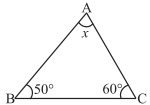
Find the value of the unknown x in the diagram:
Answer
From the given figure, we have,
$1^{\text {st }}$ interior angle $=x, 2^{\text {nd }}$ interior angle $=50^{\circ}$ and $3^{\text {rd }}$ interior angle $=60^{\circ}$
We have to find out the value of $x$
Thus,
$x+50^{\circ}+60^{\circ}=180^{\circ} \text { (angle sum property of triangle) }$
$x+110^{\circ}=180^{\circ}$
$x=180^{\circ}-110^{\circ}$
$x=70^{\circ}$
Hence, the value of $x$ is $70^{\circ}$
View full question & answer
Question 103 Marks
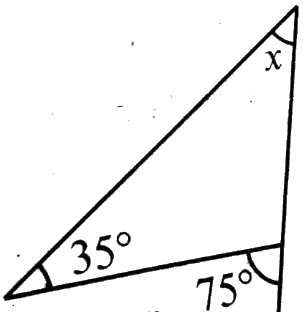
Find the value of the unknown interior angle x in the following figure :
Answer
It is given in the question that,
1st interior angle $=\mathrm{x}$ and 2nd interior angle $=35^{\circ}$
Note: According to exterior angle theorem:
The measure of an exterior angle of a triangle is equal to the sum of the measure of the two non-adjacent interior angles of the triangle.
Exterior angle $=75^{\circ}$
Sum of interior angles $=x+35^{\circ}$
Using exterior angle theorem,
we have $75^{\circ}=x+35^{\circ} \mathrm{x}=75^{\circ}-35^{\circ}$
$x+35^{\circ}=75^{\circ}$...........(By Exterior Angle Theorem)
$x=75^{\circ}-35^{\circ}$
$x=40^{\circ}$
$\qquad$
View full question & answer
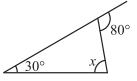
Question 113 Marks
Find the value of the unknown interior angle x in the figure:
Answer
Given that,
$1^{\text {st }}$ interior angle $=x$ and $2^{\text {nd }}$ interior angle $=30^{\circ}$
Now, According to exterior angle theorem:
The measure of an exterior angle of a triangle is equal to the sum of the measure of the two non-adjacent interior angles of the triangle.
Here, Exterior angle $=80^{\circ}$
Sum of interior angles $=x+30^{\circ}$
Using exterior angle theorem, we have,
$80^{\circ}=x+30^{\circ}$
$x=80^{\circ}-30^{\circ}$
$x=50^{\circ}$
Hence, the value of $x$ is $50^{\circ}$
View full question & answer
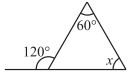
Question 123 Marks
Find the value of the unknown interior angle $x$ in the figure:
Answer
Given that,
$1^{\text {st }}$ interior angle $=x$ and, $2^{\text {nd }}$ interior angle $=60^{\circ}$
Now, According to exterior angle theorem:
The measure of an exterior angle of a triangle is equal to the sum of the measure of the two non-adjacent interior angles of the triangle.
Here, Exterior angle $=120^{\circ}$
Sum of interior angles $=x+60^{\circ}$
Using exterior angle theorem, we have
$120^{\circ}=x+60^{\circ}$
$x=120^{\circ}-60^{\circ}$
$x=60^{\circ}$
Hence, the value of $x$ is $60^{\circ}$
View full question & answer
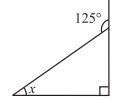
Question 133 Marks
Find the value of the unknown interior angle $x$ in the figure:
Answer
Given that,
$1^{\text {st }}$ interior angle $=x$ and $2^{\text {nd }}$ interior angle $=90^{\circ}$
Now, according to exterior angle theorem:
The measure of an exterior angle of a triangle is equal to the sum of the measure of the two non-adjacent interior angles of the triangle.
Here, Exterior angle $=125^{\circ}$
Sum of interior angles $=x+90^{\circ}$
Using exterior angle theorem, we have
$125^{\circ}=x+90^{\circ}$
$x=125^{\circ}-90^{\circ}$
$x=35^{\circ}$
Hence, the value of $x$ is $35^{\circ}$
View full question & answer
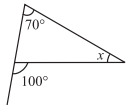
Question 143 Marks
Find the value of the unknown interior angle $x$ in the figure:
Answer
Given that,
$1^{\text {st }}$ interior angle $=70^{\circ}$ and $2^{\text {nd }}$ interior angle $=x$
Now, According to exterior angle theorem:
The measure of an exterior angle of a triangle is equal to the sum of the measure of the two non-adjacent interior angles of the triangle.
Here, Exterior angle $=100^{\circ}$
Sum of interior angles $=70^{\circ}+x$
Using exterior angle theorem, we have
$100^{\circ}=70^{\circ}+x$
$x=100^{\circ}-70^{\circ}$
$x=30^{\circ}$
Hence, the value of $x$ is $30^{\circ}$
View full question & answer
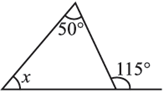
Question 153 Marks
Find the value of the unknown interior angle $x$ in the figure:
Answer
Given that,
$1^{\text {st }}$ interior angle $=x$ and $2^{\text {nd }}$ interior angle $=50^{\circ}$
Now, According to exterior angle theorem:
The measure of an exterior angle of a triangle is equal to the sum of the measure of the two non-adjacent interior angles of the triangle.
Here, Exterior angle $=115^{\circ}$
Sum of interior angles $=x+50^{\circ}$
Using exterior angle theorem, we have,
$115^{\circ}=x+50^{\circ}$
$x=115^{\circ}-50^{\circ}$
$x=65^{\circ}$
Hence, the value of $x$ is $65^{\circ}$
View full question & answer
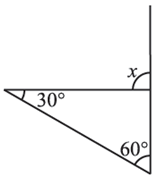
Question 163 Marks
Find the value of the unknown exterior angle $x$ in the diagram:
Answer
Given that,
$1^{\text {st }}$ interior angle $=30^{\circ}$ and $2^{\text {nd }}$ interior angle $=60^{\circ}$
Now, According to exterior angle theorem:
The measure of an exterior angle of a triangle is equal to the sum of the measure of the two non-adjacent interior angles of the triangle.
Here, Exterior angle $=\mathrm{x}$
Sum of interior angles $=30^{\circ}+60^{\circ}$
Using, exterior angle theorem, we have
$x=30^{\circ}+60^{\circ}$
$x=90^{\circ}$
Hence, the value of $x$ is $90^{\circ}$
View full question & answer
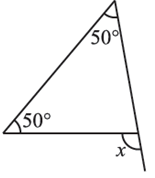
Question 173 Marks
Find the value of the unknown exterior angle $x$ in the diagram:
Answer
Given that,
$1^{\text {st }}$ interior angle $=50^{\circ}$ and $2^{\text {nd }}$ interior angle $=50^{\circ}$
According to exterior angle theorem:
The measure of an exterior angle of a triangle is equal to the sum of the measure of the two non-adjacent interior angles of the triangle.
Here, Exterior angle $=x$
Sum of interior angles $=50^{\circ}+50^{\circ}$
Using exterior angle theorem, we have
$x=50^{\circ}+50^{\circ}$
$x=100^{\circ}$
Hence, the value of $x$ is $100^{\circ}$
View full question & answer
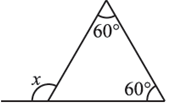
Question 183 Marks
Find the value of the unknown exterior angle $x$ in the diagram:
Answer
It is given that,
$1^{\text {st }}$ interior angle $=60^{\circ}$ and $2^{\text {nd }}$ interior angle $=60^{\circ}$
Now by According to exterior angle theorem,
The measure of an exterior angle of a triangle is equal to the sum of the measure of the two non-adjacent interior angles of the triangle.
Here, Exterior angle $=x$
Sum of interior angles $=60^{\circ}+60^{\circ}$
Using exterior angle theorem, we have
$x=60^{\circ}+60^{\circ}$
$x=120^{\circ}$
Hence, the value of $x$ is $120^{\circ}$
View full question & answer
Question 193 Marks
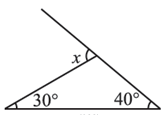
Find the value of the unknown exterior angle $x$ in the diagram:
Answer
Given that,
1st interior angle = $30^\circ$ and $2nd$ interior angle $= 40^\circ$
Now, According to exterior angle theorem,
The measure of an exterior angle of a triangle is equal to the sum of the measure of the two non-adjacent interior angles of the triangle.
Exterior angle $= x$
Sum of interior angles $= 30^\circ  + 40^\circ$
Using exterior angle theorem, we have
$x = 30^\circ  + 40^\circ$
$x =70^\circ$
Hence, the value of $x$ is $70^\circ$
View full question & answer
Question 203 Marks
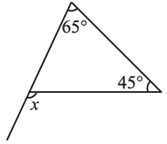
Find the value of the unknown exterior angle $x$ in the diagram:
Answer
From the given figure, we have,
$1st$ interior angle $= 65^\circ$ and $2nd$ interior angle $ = 45^\circ$
Now, According to exterior angle theorem,
The measure of an exterior angle of a triangle is equal to the sum of the measure of the two non-adjacent interior angles of the triangle.
Exterior angle $= x$
Sum of interior angles $= 65^\circ + 45^\circ$
Using, exterior angle theorem, we have
$x = 65^\circ  +  45^\circ$
$x = 110^\circ$
Hence, the value of $x$ is $110^\circ$
View full question & answer
Question 213 Marks
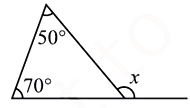
Find the value of the unknown exterior angle $x$ in the diagram:
Answer
From the given figure, we have,
$1^{\text {st }}$ interior angle $=50^{\circ}$ and $2^{\text {nd }}$ interior angle $=70^{\circ}$
Now, According to exterior angle theorem,
The measure of an exterior angle of a triangle is equal to the sum of the measure of the two non-adjacent interior angles of the triangle.
Here, Exterior angle $=\mathrm{x}$
Sum of interior angles $=50^{\circ}+70^{\circ}$
Thus, using exterior angle theorem,
$x=50^{\circ}+70^{\circ}$
$x=120^{\circ}$
$\therefore$ The value of x is $120^{\circ}$
View full question & answer