Questions

3 Marks Question

🎯

Test yourself on this topic

15 questions · timed · auto-graded

Question 13 Marks
Describe in detail about the occurrence of oceanic currents.
Answer
Since, it is a fact that the water present in the ocean (near the equator) is heated by the sun to a very higher temperature than the water near the poles of the earth. It is due to the falling of the sun rays perpendicularly in the equatorial region. So, in the equatorial region, the ocean water expands and becomes lighter. While on the other side, the water in the polar region remains cold and heavy. It leads to the flow of convection currents of heat of warm water from the equator towards the poles. Heat of the cold water flow from the poles towards the equator just below the surface of ocean. So, these types of currents are known as oceanic currents.
View full question & answer
Question 23 Marks
Explain in brief, why we wear dark coloured clothes in winter and light coloured clothes in summer.
Answer
We wear dark coloured clothes in winter to keep us warm as they absorb all the heat radiation coming from the sun whereas light coloured clothes reflect most of the heat radiation coming from the sun that falls on them and therefore we feel more comfortable wearing them in the summer.
View full question & answer
Question 33 Marks
Why is mercury used as an indicator in a thermometer?
Answer
  1. Mercury expands evenly as the temperature rises.
  2. It is a good conductor of heat.
  3. It is silvery white and can be seen from outside the glass.
  4. It does not stick to glass.
View full question & answer
Question 43 Marks

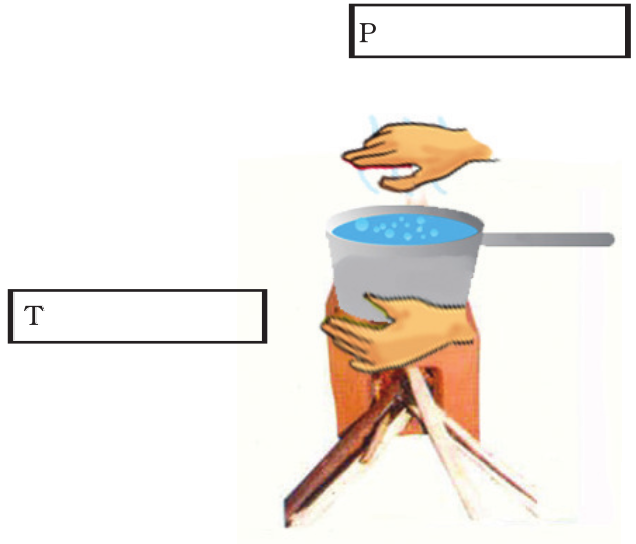
Observe the picture given as Figure. Water is being boiledb in a pan of wide base.
  1. Which position $P$ or $T$ will feel warmer?
  2. Fill up the boxes $P$ and $T$ to indicate the mode of flow of heat to the hand.
Answer
  1. From the given diagram, position $P$ will feel warmer because of hot air rising up.
  2. The flow of heat to $P$ is a convection process because the air .near the boiling water gets not and rises. However, on the sides such as at $T$, there is no convection and air does not feel as hot as at the top. Therefore, flow of heat to $T$ is a radiation process.
View full question & answer
Question 53 Marks
For setting curd, a small amount of curd is added to warm milk. The microbes present in the curd help in setting if the temperature of the mixture remains approximately between $35^\circ C$ to $40^\circ C$. At places, where room temperature remains much below the range, setting of curd becomes difficult. Suggest a way to set curd in such a situation.
Answer
For the setting of curd at places where temperature is below room temperature, the container in which curd is to be made, must be kept in a thermally insulated cover or it can be wrapped either by a woollen material or a jute sack so that temperature is maintained for the setting of curd. The container can also be kept in the sun or near the gas stove while cooking food for the setting of curd.
View full question & answer
Question 63 Marks
Describe the effects of heat.
Answer
The effects of heat are:
  1. When an object is heated, then it becomes hotter and may get expand. So, in this heat may change the state of the body like ice can also get change into the water.
  2. Heat sometimes acts as a catalyst to speed up the chemical reaction.
  3. Heat can even kill the bacteria as well.
View full question & answer
Question 73 Marks
Discuss why wearing more layers of clothing during winter keeps us warmer than wearing just one thick piece of clothing.
Answer
During winters, we prefer wearing more layers of clothing than just one thick piece of clothing because air gets trapped in between the various clothing layers. Being a poor conductor of heat, air prevents heat loss from our body. Hence, layers of clothing keep us warmer than a single layer.
View full question & answer
Question 83 Marks
Instead of water explain the reason, why do the mercury is used in the thermometer?
Answer
Due to following reasons, mercury is used in the thermometers instead of water:
  1. When the thermometer breaks, the mercury can be easily collected.
  2. Mercury can has more expansion than the water.
  3. Also, mercury do not stick on the walls of thermometer like water.
View full question & answer
Question 93 Marks
What is the Relation between Celsius, Fahrenheit and Kelvin scales?
Answer
Since the range of temperature from ice-point to steam-point is equal in all the three scales, $100$ centigrade degrees $= (212 - 32)$ or $180$ Fahrenheit degrees $= (373 - 273)$ or $100$ absolute degrees. We consider three thermometers in the above three scales are dipped simultaneously in a liquid of certain temperature. Let the temperatures recorded in the Celsius, Fahrenheit and Kelvin thermometers respectively be $C, F$ and $K$. Now it can be proved that $\frac{\text{c}}{\text{5}}=\frac{\text{F}-32}{9}=\frac{\text{K}-273}{5}$
View full question & answer
Question 103 Marks
Explain sea breeze.
Answer
During the day, the land gets heated faster than the water. The air over theland becomes hotter and rises up. The cooler air from the sea rushes in towards the land to take its place. The warm air from the land moves towards the sea to complete the cycle. The air from the sea is called the sea breeze.
View full question & answer
Question 113 Marks
State similarities between the laboratory thermometer and the clinical thermometer.
Answer
  • Laboratory thermometer and the clinical thermometer consist of a long, narrow, uniform glass tube.
  • Laboratory thermometer and the clinical thermometer have a bulb containing mercury at the end of the tube.
  • Laboratory thermometer and the clinical thermometer are marked with Celsius scale on the glass tube.
View full question & answer
Question 123 Marks
Explain the reason for the following statement, “When heat is applied at the bottom of the water vessel, then it gets heated more quickly than when it is heated at the top.”
Answer
The particles of water become more lighter and rise up in the middle. Due to this, the cold particles of water which are heavier come down along the sides of the vessel. So, the convection currents of heat are setup and water becomes hot. The moment, when the heat is applied at the top, then the water present in the upper portion becomes hot and these hot water molecules get fixed over the surface. Since, water is a bad conductor of heat, due to which water present at the lower end (or bottom) of the vessel remains.
View full question & answer
Question 133 Marks
In places of hot climate it is advised that the outer walls of houses be painted white. Explain.
Answer
In places of hot climate, it is advised to paint the outer walls of houses as white because a light colour such as white reflects back most of the heat that falls on it. Hence, a light colour tends to keep the house cool.
View full question & answer
Question 143 Marks
Explain how water heated by convection?
Answer
The water is poor conductor of heat so do not heated by conduction. When water is heated, the water became lighter. Hot water rises up. The cold water from the sides moves down towards the source of heat. This water also gets hot and rises upward and water from the sides moves down. This process continues till the whole water gets heated. This mode of heat transfer is known as convection.
View full question & answer
Question 153 Marks
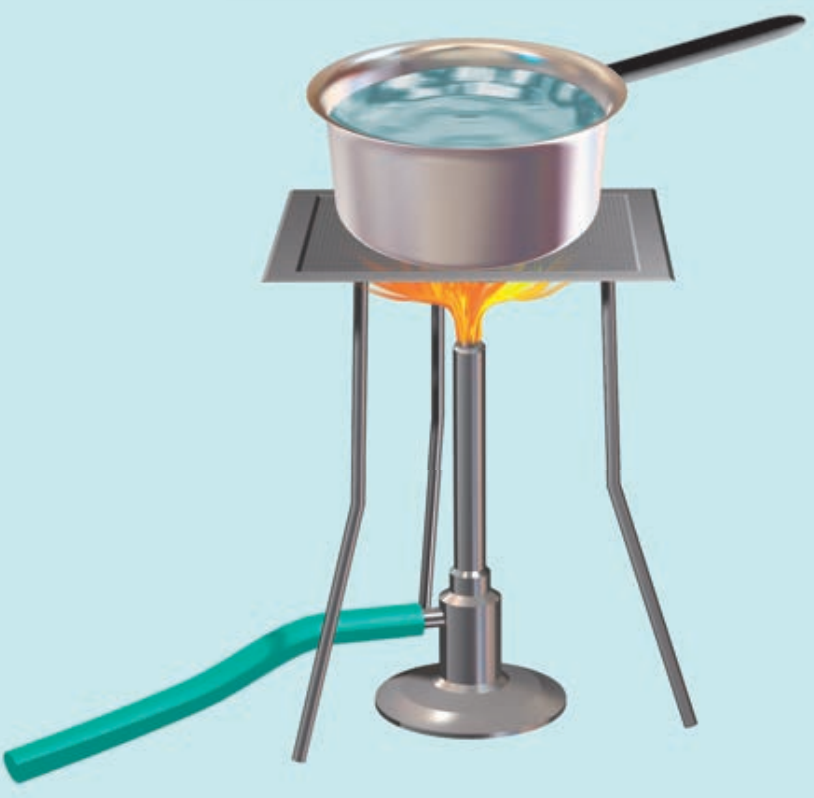
Look at Mark where the heat is being transferred by conduction, by convection and by radiation.
Answer
  1. Transfer of heat from burner to pan is by radiation.
  2. Transfer of heat from pan to water is by conduction.
  3. Transfer of heat within water is by convection.
View full question & answer