Questions · Page 1 of 4

MCQ (1 Marks)

🎯

Test yourself on this topic

50 questions · timed · auto-graded

MCQ 11 Mark
The basic unit of speed is:
  • A
    km/min
  • B
    m/min
  • C
    km/h
  • m/s
Answer
Correct option: D.
m/s
m/s

The basic unit of distance is metre (m).

The basic unit of time is second (s).

Speed = Distance/Time

Therefore, the basic unit of speed is m/s.
View full question & answer
MCQ 21 Mark
Which of the following relations is correct?
  • A
    Speed = Distance × Time
  • Speed $=\frac{\text { Distance }}{\text { Time }}$
  • C
    Speed $=\frac{\text { Time }}{\text { Distance }}$
  • D
    Speed $=\frac{1}{\text { Distnace } x \text { Time }}$
Answer
Correct option: B.
Speed $=\frac{\text { Distance }}{\text { Time }}$
Speed of an object is given by the relation

Speed = `"Distance"/"Time"`

View full question & answer
MCQ 31 Mark
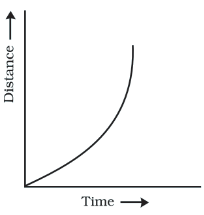
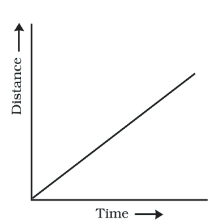
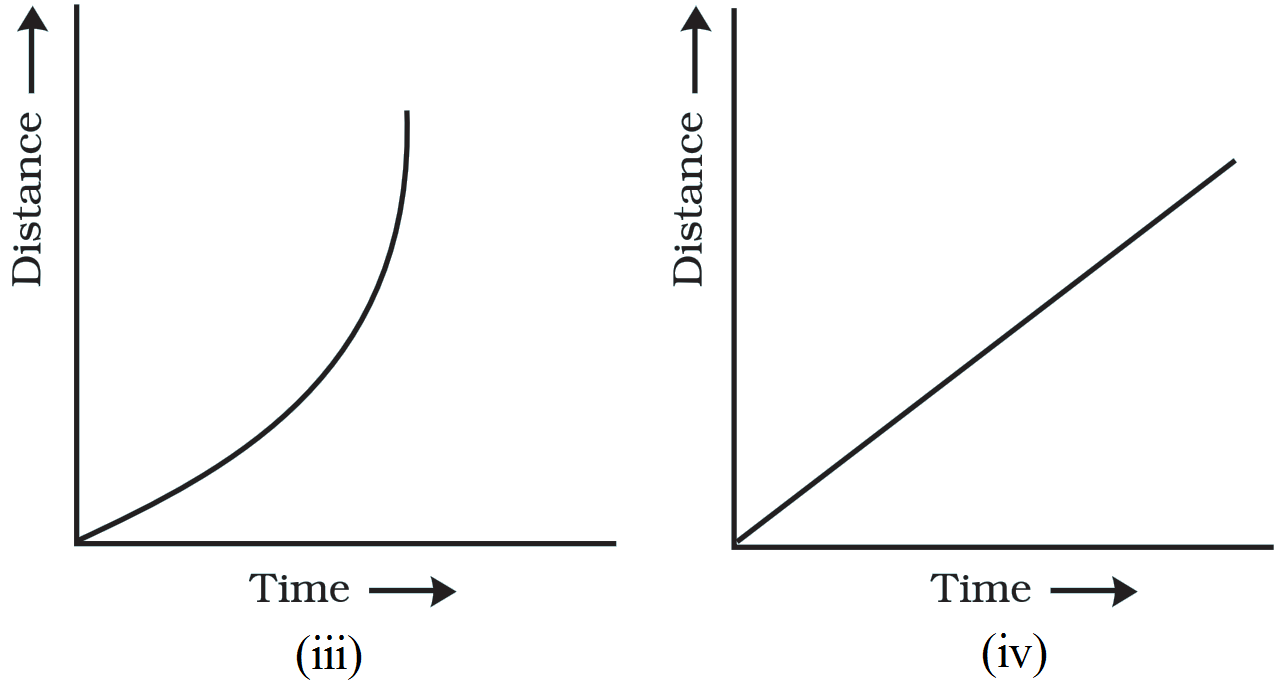
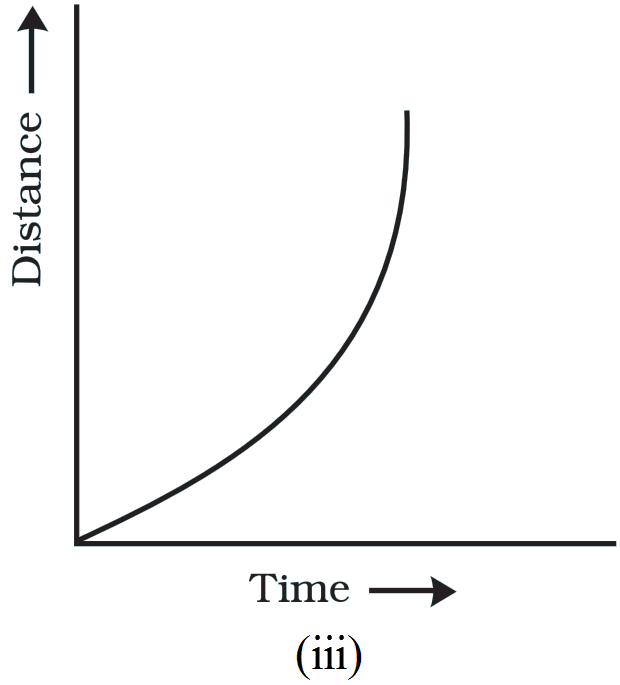
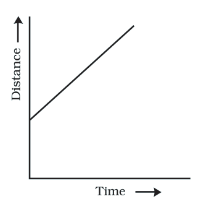
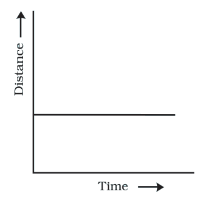
Which of the following distance-time graphs shows a truck moving with speed which is not constant?
  • A
    Image
  • B
    Image
  • Image
  • D
    Image
Answer
Correct option: C.
Image
Graph (3)

In a distance-time graph, the constant speed of a truck will be represented by a straight line.

In a distance-time graph, a straight line parallel to the time axis indicates that the truck is not moving.

A curved line on the distance-time graph indicates that the truck is moving with a speed which is not constant.

View full question & answer
MCQ 41 Mark
A car moves with a speed of $40 \ km/h$ for $15$ minutes and then with a speed of $60 \ km/h$ for the next $15$ minutes. The total distance covered by the car is:
  • A
    $100 \ km$
  • $25 \ km$
  • C
    $15 \ km$
  • D
    $10 \ km$
Answer
Correct option: B.
$25 \ km$
$25 km$
Case I
Speed of the car $=40 km / h$
Time taken $=15 min =15 / 60=0.25 h$
Speed $=\frac{\text { Distance Covered }}{\text { Time Taken }}$
Distance covered, $d_1=$ Speed $\times$ Time taken $=40 \times 0.25=10 km$
Case II
Speed of the car $=60 km / h$
Time taken $=15 min =\frac{15}{60}=0.25 h$
Speed $=\frac{\text { Distnace covered }}{\text { Time Taken }}$
Distance covered, $d_2=$ Speed $\times$ Time taken $=60 \times 0.25=15 km$
Total distance covered by the car, $d=d_1+d_2=10+15=25 km$
Therefore, the total distance covered by the car is $25 km$.
View full question & answer
MCQ 51 Mark
A car travels first $60\ km$ of a distance in 1hr, next $70\ km$ of the distance in next hour and remaining $20\ km$ distance in final hour. Then, its motion is:
  • A
    Uniform motion.
  • Non - uniform motion.
  • C
    Either uniform or non - uniform motion.
  • D
    Neither uniform nor non-uniform motion.
Answer
Correct option: B.
Non - uniform motion.

During first hour, $\text{Speed}=\frac{60}{1}\text{km/ h}=60\text{km/ hr}$
During second hour, $\text{Speed}=\frac{70}{1}\text{km/ h}=70\text{km/ hr}$
During third hour, $\text{Speed}=\frac{20}{1}\text{km/ h}=20\text{km/ hr}$
So, the car travels different distances in equal time intervals.
This is an example of non - uniform motion.

View full question & answer
MCQ 61 Mark
A bus travels $54\ km$ in $90$ min. The speed of the bus is:
  • A
    $0.6m/s.$
  • $10m/s.$
  • C
    $5.4m/s.$
  • D
    $3.6m/s.$
Answer
Correct option: B.
$10m/s.$

As we know that speed $=\frac{\text{Distance}}{\text{Time}}$
$=\frac{54\times1000}{90\times60}\begin{bmatrix}1\text{km}=1000\text{m} \\1\text{min}=60\text{s}\ \ \ \ \ \ \ \end{bmatrix}=10\text{m/s}.$

View full question & answer
MCQ 71 Mark
Which of the following is not used to measure time?
  • A
    Computer
  • B
    Mobile
  • C
    Wrist watch
  • Candle clock
Answer
Correct option: D.
Candle clock
The candle clock was used to measure time in ancient times whereas nowadays, computers, mobiles, and wristwatches are used to measure time.
View full question & answer
MCQ 81 Mark
The unit of speed of train is:
  • A
    Meter per hour
  • B
    Meter per second
  • Kilometer per hour
  • D
    Mile per second
Answer
Correct option: C.
Kilometer per hour
The unit of speed of train is kilometer per hour.
View full question & answer
MCQ 91 Mark
Name one unit of time bigger than a second.
  • A
    Plank time
  • B
    Zeptosecond
  • C
    Picosecond
  • Kilosecond
Answer
Correct option: D.
Kilosecond

$1$ kilosecond $= 1000$ seconds.

View full question & answer
MCQ 101 Mark
A simple pendulum takes $32s$ to complete $20$ oscillations, what is the time period of the pendulum?
  • $1.6s$
  • B
    $2.6s$
  • C
    $3.6s$
  • D
    $4.8s$
Answer
Correct option: A.
$1.6s$

Time taken to complete $20$ oscillations $= 32s$
Time taken to complete $1$ oscillation $ = \frac{32}{20}\text{s} = 1.6\text{s}$
Time period of a pendulum is time taken by it to complete $1$ oscillation.
Time period of pendulum is $1.6$ seconds.

View full question & answer
MCQ 111 Mark
The basic unit of speed is:
  • A
    $Km/ min.$
  • B
    $m/ min.$
  • C
    $Km/ \sec.$
  • $m/ \sec.$
Answer
Correct option: D.
$m/ \sec.$
$m/ \sec.$
View full question & answer
MCQ 121 Mark
An example of Oscillatory motion is:
  • A
    Motion of a cycle wheel.
  • B
    Movement of a car on a straight road.
  • C
    Motion of earth around the sun.
  • Motion of a swing.
Answer
Correct option: D.
Motion of a swing.
Motion of a swing.
View full question & answer
MCQ 131 Mark
When a graph between two physical quantities is a straight line, the two quantities are:
  • A
    Both constant
  • B
    Independent of each other
  • Directly proportional
  • D
    Inversely proportional
Answer
Correct option: C.
Directly proportional

As we know the equation of a straight line is $Y = mX + C$
Let us assume $X$ and $Y$ are two different physical quantity and $C$ is any constant.
and the graph between them is straight line.
According to above equation,
$\text{Y}\propto\text{X}$
Hence, $X$ and $Y$ are Directly proportional.

View full question & answer
MCQ 141 Mark
A boy cycles a distance of $640m$ in $2$ minutes and $40$ seconds. What is the speed of the cycle?
  • $4m/ s$
  • B
    $8m/ s$
  • C
    $12m/ s$
  • D
    $16m/ s$
Answer
Correct option: A.
$4m/ s$

Distance covered $= 640m$
Time taken $= 2\ min \ 40\ sec$
$= 2 × 60 + 40 = 160s$ (because $1$ minute $= 60$ seconds)
$\therefore\text{Speed}=\frac{\text{Distance}}{\text{Time}}=\frac{640}{160}=4\text{m}/\text{s}$

View full question & answer
MCQ 151 Mark
A person has two hourglasses, one of $30$ seconds and the other of $1$ minute. Which of the following time intervals can he not measure?
  • A
    $30$ seconds
  • B
    $60$ seconds
  • $50$ seconds
  • D
    $90$ seconds
Answer
Correct option: C.
$50$ seconds

A person has two hourglasses, one of $30$ seconds and the other of $1$ minute.
$1$ minute $= 60$ seconds
$H.C.F.$ of $30$ seconds and $60$ seconds $=30$ seconds
He can only measure time intervals of $30, 60$, and $90$ seconds.
But he cannot measure the time interval of $50$ seconds.

View full question & answer
MCQ 161 Mark
Odometer is to mileage as compass is to:
  • A
    Speed
  • B
    Hiking
  • C
    Needle
  • Direction
Answer
Correct option: D.
Direction
An odometer is an instrument used to measure mileage.
A compass is an instrument used to determine direction.
Choices $a, b,$ and $c$ are incorrect because none is an instrument.
View full question & answer
MCQ 171 Mark
The most common example of periodic motion or oscillatory motion is:
  • A
    Interval
  • B
    Pendulum
  • Simple pendulum
  • D
    Speedometer
Answer
Correct option: C.
Simple pendulum
Simple pendulum is periodic or oscillatory motion.
View full question & answer
MCQ 181 Mark
Which of the following is required to facilitate the measurement of time?
  • A
    A wave with high energy
  • B
    A periodic event
  • C
    A device calibrated to measure time
  • Both $B$ and $C$
Answer
Correct option: D.
Both $B$ and $C$

In order to facilitate the measurement of time, a periodic event is required along with a device to calibrate the measured time.

View full question & answer
MCQ 191 Mark
Speedometer drive is usually taken from:
  • A
    Dynamo
  • B
    Fan belt
  • C
    Flywheel
  • Front wheel
Answer
Correct option: D.
Front wheel
Speedometer drive is usually taken from front wheel.
View full question & answer
MCQ 201 Mark
Time period of a simple pendulum depends upon its.
  • A
    Weight of bob
  • Length
  • C
    Both $(a)$ and $(b)$
  • D
    None of these
Answer
Correct option: B.
Length
The time period of the simple pendulum depends upon the length of the pendulum and also to some extent it depends upon the degree of the amplitude.
That is the width of the pendulum's swing.
In general, the time period of a pendulum means one complete cycle that is one complete left swing and right swing.
View full question & answer
MCQ 211 Mark
How many days are present between the years $2005$ and $2008$ including these years?
  • $1461$
  • B
    $1460$
  • C
    $730$
  • D
    $731$
Answer
Correct option: A.
$1461$

We know that, in one year, there are $365$ days.
Out of the year $2005, 2006, 2007$ and $2008$, the year $2008$ is a leap year which has $366$ days.
So, total number of days $= 365 + 365 + 365 + 366 = 1461$ days.

View full question & answer
MCQ 221 Mark
Which of the following is/ are good example(s) of non - uniform motion?
  • A
    When an object is moving in a circular path with uniform speed
  • B
    A car is travelling in an overcrowded zigzag road
  • C
    Motion of a pendulum
  • Both $B$ and $C$
Answer
Correct option: D.
Both $B$ and $C$

An object covering equal distances in equal time interval, i.e.
moving with a uniform speed is said to be in a uniform motion.
An object moving in a circular path with uniform speed is said to be in a uniform circular motion.
Since, in a motion of a pendulum and in a car travelling in an overcrowded zig zag road, the speed of the object is changing and is not uniform, hence they are examples of non - uniform motion.

View full question & answer
MCQ 231 Mark
The distance-time graph for a vehicle standing on a road side will be:
  • A
    Straight line inclined by some angle to $x-$axis.
  • Straight line parallel to $x-$axis.
  • C
    Straight line parallel to $y-$axis.
  • D
    None of the above.
Answer
Correct option: B.
Straight line parallel to $x-$axis.
View full question & answer
MCQ 241 Mark
If the an object moving along a straight line, keeps changing its speed then:
  • A
    The motion is said to be a uniform motion.
  • The motion is said to be a non uniform motion.
  • C
    The object is said to be stationary.
  • D
    The motion is said to be a fast motion.
Answer
Correct option: B.
The motion is said to be a non uniform motion.
View full question & answer
MCQ 251 Mark
A century has:
  • $100$ years
  • B
    $100$ months
  • C
    $100$ seconds
  • D
    $100$ weeks
Answer
Correct option: A.
$100$ years

$1$ century $= 100$ years
A century has $100$ years.

View full question & answer
MCQ 261 Mark
A speedometer typically has a threshold of about $15 \ km/hr$. If the car starts from rest and accelerates, the speedometer will:
  • A
    Start reading from the moment the car starts.
  • Start reading when the speed reaches $15km/ hr.$
  • C
    Start reading when the speed reaches $30km/ hr.$
  • D
    None of these.
Answer
Correct option: B.
Start reading when the speed reaches $15km/ hr.$
Threshold of the speedometer represents the minimum speed of the vehicle by which it must be moving to display the instantaneous speed of the vehicle.
Thus, $15 km/hr$ threshold of the speedometer means that it starts reading the speed of the vehicle once the speed reaches $15km/ hr.$
View full question & answer
MCQ 271 Mark
Which of the following relations is correct?
  • A
    $\text{Speed} = \text{Distance × Time.}$
  • $\text{Speed}=\frac{\text{Distance}}{\text{Time}}$
  • C
    $\text{Speed}=\frac{\text{Time}}{\text{Distance}}$
  • D
    $\text{Speed}=\frac{\text{1}}{\text{Distance}}\times\text{Time}$
Answer
Correct option: B.
$\text{Speed}=\frac{\text{Distance}}{\text{Time}}$
View full question & answer
MCQ 281 Mark
Which of the following is used as measuring time?
  • Sand glass
  • B
    Computer
  • C
    Laptop
  • D
    Mobie
Answer
Correct option: A.
Sand glass
An hourglass $($or sandglass, sand timer, sand clock or egg timer$)$ is a device used to measure the passage of time.
It comprises two glass bulbs connected vertically by a narrow neck that allows a regulated flow of a substance $($historically sand$)$ from the upper bulb to the lower one.
View full question & answer
MCQ 291 Mark
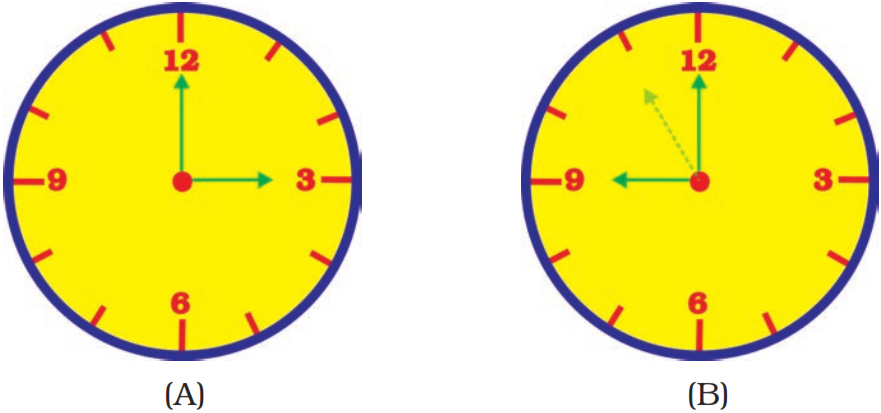
Two clocks $A$ and $B$ are shown in Figure, Clock A has an hour and a minute hand, whereas clock $B$ has an hour hand, minute hand as well as a second hand. Which of the following statement is correct for these clocks?
  • A
    A time interval of $30$ seconds can be measured by clock $A.$
  • B
    A time interval of $30$ seconds cannot be measured by clock $B.$
  • Time interval of $5$ minutes can be measured by both $A$ and $B.$
  • D
    Time interval of $4$ minutes $10$ seconds can be measured by clock $A.$
Answer
Correct option: C.
Time interval of $5$ minutes can be measured by both $A$ and $B.$

The time interval of $5$ min can be measured by both $A$ and $B$. Since, the time interval of $30$ seconds cannot be measured by clock $A$ and can be measured by clock $B$. Also, the time interval of $4$ min $10$ seconds cannot be measured by clock $A$, but can be measured by clock $B.$

View full question & answer
MCQ 301 Mark
The rate of change of displacement is called:
  • Velocity
  • B
    Acceleration
  • C
    Rest
  • D
    Motio
Answer
Correct option: A.
Velocity
The rate of change of displacement is called velocity.
View full question & answer
MCQ 311 Mark
An ancient Time measuring device $"\ce{SUNDIAL}"$ at JantarMantar is in:
  • A
    Ahmedabad.
  • B
    Bombay.
  • Delhi.
  • D
    Lucknow.
Answer
Correct option: C.
Delhi.
Delhi.
View full question & answer
MCQ 321 Mark
The time interval between one sunrise and next sunrise is called a:
  • A
    Year
  • B
    Month
  • Day
  • D
    Week
Answer
Correct option: C.
Day
The time interval between one sunrise to next sunrise is a day.
View full question & answer
MCQ 331 Mark
Which of the following instrument have very high level of accuracy?
  • Electronic stopwatch
  • B
    Stop clock
  • C
    Pendulum clock
  • D
    Hour glass
Answer
Correct option: A.
Electronic stopwatch
Electronic stopwatch, stop clock, pendulum clock and hour glass are the instruments used for measuring the time.
Among the following, electronic stopwatch has the highest level of accuracy whereas hourglass has the lowest level of accuracy in measuring time.
View full question & answer
MCQ 341 Mark
The speed of a train is $60\ km/ h.$ The distance covered by the train is $4$ hours would be:
  • A
    $15\ km$
  • $240\ km$
  • C
    $\frac{1}{15}\text{km}$
  • D
    None of these
Answer
Correct option: B.
$240\ km$

The distance covered by a train would be $240\ km.$

View full question & answer
MCQ 351 Mark
Which of the following relations is correct?
  • A
    $\text{Speed}=\text{Distance}\times\text{Time}$
  • $\text{Speed}=\frac{\text{Distance}}{\text{Time}}$
  • C
    $\text{Speed}=\frac{\text{Time}}{\text{Distance}}$
  • D
    $\text{Speed}=\frac{\text{1}}{\text{Distance}\times\text{Time}}$
Answer
Correct option: B.
$\text{Speed}=\frac{\text{Distance}}{\text{Time}}$
View full question & answer
MCQ 361 Mark
An ancient Time measuring device $SUNDIAL$ at Jantar Mantar is in:
  • A
    Ahmedabad
  • B
    Bombay
  • Jaipur
  • D
    Lucknow
Answer
Correct option: C.
Jaipur

The World's Largest Sundial in Jaipur has been telling time for almost $300$ years.

View full question & answer
MCQ 371 Mark
A device used to measure the distance moved by a vehicle:
  • Odometer
  • B
    Speedometer
  • C
    Both
  • D
    None of these
Answer
Correct option: A.
Odometer
An odometer measured the distance moved by a vehicle.
View full question & answer
MCQ 381 Mark
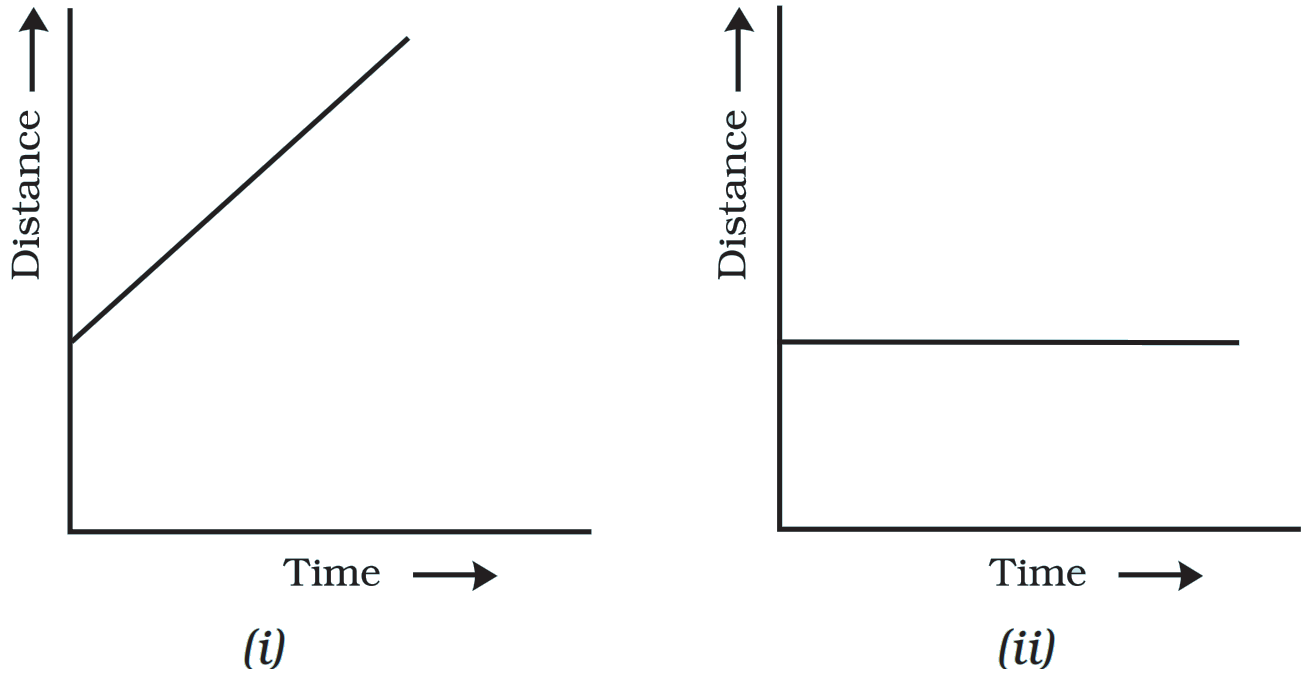
Which of the following distance-time graphs shows a truck moving with speed which is not constant?

  • A
    $(i)$
  • B
    $(ii)$
  • $(iii)$
  • D
    $(iv)$
Answer
Correct option: C.
$(iii)$

Explanantion:
In a distance - time graph, the constant speed of a truck will be represented by a straight line. In a distance time graph, a straight line parallel to the time axis indicates that the truck is not moving. A curved line on the distance-time graph indicates that the truck is moving with a speed which is not constant.
View full question & answer
MCQ 391 Mark
$4.15 p.m$. in $12$ hour system is written as _____ in $24$ hour clock system.
  • A
    $11$ hours $46$ minutes
  • B
    $4$ hours $15$ minutes
  • C
    $22$ hours $15$ minutes
  • $16$ hours $15$ minutes
Answer
Correct option: D.
$16$ hours $15$ minutes

In $24$ hour clock system, $4.15 p.m.$ will be written as
$12 + 4.15 = 12hrs + 4hrs + 15$ minutes $= 16$ hours $15$ minutes.

View full question & answer
MCQ 401 Mark
The odometer of a car reads $57321.0\ km$ when the clock shows the time $08:30 AM$. What is the distance moved by the car, if at $08:50 AM$, the odometer reading has changed to $57336.0km?$
  • A
    $75\ km$
  • B
    $50\ km$
  • $15\ km$
  • D
    $10\ km$
Answer
Correct option: C.
$15\ km$

An odometer is a device that gives us the distance covered by a car.
Distance covered by the car in the given time is $d = 57336.0 − 57321 = 15.0\ km.$

View full question & answer
MCQ 411 Mark
Which of the following formulae is correct?
  • A
    $\text{Speed}=\text{Distance}\times\text{time}$
  • B
    $\text{Speed}=\frac{\text{Time}}{\text{Distance}}$
  • C
    $\text{Speed}=\frac{1}{\text{Distance}\times\text{Time}}$
  • $\text{Speed}=\frac{\text{Distance}}{\text{time}}$
Answer
Correct option: D.
$\text{Speed}=\frac{\text{Distance}}{\text{time}}$
Speed of an object is defined as distance moved per unit time.
It denotes how fast or how slow the object is moving.
It is given by $\text{Speed}=\frac{\text{Distance}}{\text{time}}$
View full question & answer
MCQ 421 Mark
A particle vibrates $10$ times in $1 sec$. What is the time period of vibration of the particle?
  • A
    $10sec$
  • B
    $1sec$
  • $0.1sec$
  • D
    $0.01sec$
Answer
Correct option: C.
$0.1sec$

Time period of vibration is the time taken for $1$ vibration.
Given:
$10$ vibrations are completed in $1sec.$
$1$ vibration will taken only: $\frac{1}{10}=0.1\text{sec}$

View full question & answer
MCQ 431 Mark
The basic unit of speed is:
  • A
    km/min.
  • B
    m/min.
  • C
    km/h.
  • m/s.
Answer
Correct option: D.
m/s.

The basic unit of distance is metre $(m).$
The basic unit of time is second $(s).$
$\text{Speed}=\frac{\text{Distance}}{\text{Time}}$
Therefore, the basic unit of speed is m/s.
View full question & answer
MCQ 441 Mark
The speed of a car is $40 \ km/ h$. What is time taken to reach from one city to another city if the distance between the two cities is $480\ km:$
  • A
    $10$ hours
  • B
    $11$ hours
  • C
    $14$ hours
  • $12$ hours
Answer
Correct option: D.
$12$ hours

The time is taken by a car is $12$ hours.

View full question & answer
MCQ 451 Mark
Which of the following motion is circular motion:
  • A
    Motion of a child over see saw
  • B
    Motion of a car running on a straight road
  • C
    Motion of an electric bell hammer
  • Motion of a child in a merry go round
Answer
Correct option: D.
Motion of a child in a merry go round
A child in a merry $-$ go $-$ round is circular motion.
View full question & answer
MCQ 461 Mark
Time:
  • A
    $\text{t}=\text{d}\times\text{s}$
  • B
    $\text{t}=\frac{\text{s}}{\text{d}}$
  • $\text{t}=\frac{\text{d}}{\text{s}}$
  • D
    $\text{t}=\frac{1}{\text{s}\times\text{d}}$
Answer
Correct option: C.
$\text{t}=\frac{\text{d}}{\text{s}}$
View full question & answer
MCQ 471 Mark
A car moves with a speed of $80 km/ h$ for $15$ minutes and then with a speed of $60 km/ h$ for the next $15$ minutes. The total distance covered by the car is:
  • A
    $100\ km.$
  • B
    $50\ km.$
  • $35\ km.$
  • D
    $70\ km.$
Answer
Correct option: C.
$35\ km.$
$35\ km.$
View full question & answer
MCQ 481 Mark
On which axis is dependent variable represented?
  • A
    $x-$axis.
  • $y-$axis.
  • C
    On any axis.
  • D
    Depends on the data.
Answer
Correct option: B.
$y-$axis.
$y-$axis.
View full question & answer
MCQ 491 Mark
Which of the following cannot be used for measurement of time?
  • A
    A leaking tap.
  • B
    Simple pendulum.
  • C
    Shadow of an object during the day.
  • Blinking of eyes.
Answer
Correct option: D.
Blinking of eyes.
Blinking of eyes is not a periodic phenomenon $(i.e.$ it does not repeat after definite intervals of time$),$ so we cannot measure the time using this phenomenon.
View full question & answer
MCQ 501 Mark
The time taken by a vibrating body to complete one vibration is:
  • A
    Speed
  • Time of period
  • C
    Distance
  • D
    All of these
Answer
Correct option: B.
Time of period
The time taken by a vibrating body to complete one vibration is time period.
View full question & answer