Questions

M.C.Q. [1 Marks Each]

🎯

Test yourself on this topic

17 questions · timed · auto-graded

MCQ 11 Mark
The base of a triangle is $14\ cm$ and its height is $8\ cm.$ The area of the triangle is:
  • A
    $112 \mathrm{~cm}^2$
  • $56 \mathrm{~cm}^2$
  • C
    $122 \mathrm{~cm}^2$
  • D
    $66 \mathrm{~cm}^2$
Answer
Correct option: B.
$56 \mathrm{~cm}^2$
Area of the triangle $=\Big(\frac{1}{ 2}\times14\times8\Big)\text{cm}^2$
$=56\text{cm}^2$
View full question & answer
MCQ 21 Mark
The parallel sides of a trapezium are $54 \ cm$ and $26\ cm$ and the distance between them is $15\ cm.$ The area of the trapezium is:
  • A
    $ 702 \mathrm{~cm}^2 $
  • B
    $ 810 \mathrm{~cm}^2 $
  • C
    $ 405 \mathrm{~cm}^2 $
  • $ 600 \mathrm{~cm}^2 $
Answer
Correct option: D.
$ 600 \mathrm{~cm}^2 $
Area of the trapezium $\Big\{\frac{1}{2}\times(54+26)\times15\Big\}\text{cm} ^2$
$=\Big(\frac{1}{2}\times80\times15\Big)\text{cm}^2$
$=600\text{cm}^2$
View full question & answer
MCQ 31 Mark
Tick the correct answer in the following: The lengths of the parallel sides of a trapezium are $19\ cm$ and $19\ cm$ and its area is $128\ cm^2$. The distance between the parallel sides is:
  • A
    $9\ cm$
  • B
    $7\ cm$
  • $8\ cm$
  • D
    $12.5\ cm$
Answer
Correct option: C.
$8\ cm$
Length of parallel sides are $19\ cm\ 13\ cm,$
Area of trapezium $= 180\ cm^2$
Distance between then,
$=\frac{\text{Area}\times2}{\text{Sum of parallel sides}}$
$=\frac{128\times2}{19+13}$
$=\frac{128\times2}{32}$
$=8\text{cm}$
View full question & answer
MCQ 41 Mark
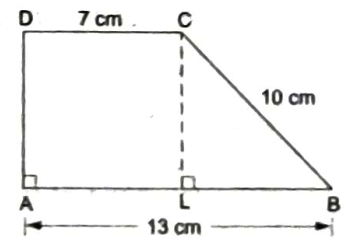
Tick the correct answer in the following: In the given figure, $AB \| DC$ and $\text{AB}\perp\text{DC}$ If $DC = 7\ cm, BC = 10\ cm, AB = 13\ cm$ and $\text{CL}\perp\text{AB},$ the area of trap. $\text{ABCD}$ is:
  • A
    $ 84 \mathrm{~cm}^2 $
  • B
    $ 72 \mathrm{~cm}^2 $
  • $ 80 \mathrm{~cm}^2 $
  • D
    $ 91 \mathrm{~cm}^2 $
Answer
Correct option: C.
$ 80 \mathrm{~cm}^2 $
In the figure, $AB \| DC, $
$\text{DA}\perp\text{AB}$
$DC = 7\ cm, BC = 10\ cm, AB = 13\ cm$
$\text{CL}\perp\text{AB}$
$AD = DC = 7\ cm$
and $LB - 13 - 7 = 6\ cm$
In right $\triangle\text{BCE},$
$ B C^2=C E^2+E B^2$
$\Rightarrow(10)^2=C E^2+(6)^2 $
$ \Rightarrow 100=C E^2+36 $
$ \Rightarrow C E^2=100-36=64=(8)^2 $
$\therefore CF = 8\ cm,$
Now area of trap. $\text{ABCD}$
$\frac{1}{2}(\text{AB}+\text{CD})\times\text{CE}$
$=\frac{1}{2}(13+7)\times8\text{cm}^2$
$=\frac{1}{2}\times20\times8=80\text{cm}^2$
View full question & answer
MCQ 51 Mark
The area of a rhombus is $120\ cm^2$ and one of its diagonals is $24\ cm. $ Each side of the rhombus is:
  • A
    $10\ cm$
  • $13\ cm$
  • C
    $12\ cm$
  • D
    $15\ cm$
Answer
Correct option: B.
$13\ cm$
Let $\text{ABCD}$ be a rhombus whose diagonals $AC$ and $BD$ intersect at a point $O.$
Let the length of the diagonal $AC$ be $24\ cm.$
Area of the rhombus $=\Big(\frac{1}{2}\times\text{AC}\times\text{BD}\Big)\text{cm}^2$
But the area of the rohmbus is $120\ cm^2 ($given$)$
$\therefore\frac{1}{2}\times\text{AC}\times\text{BD}=120$
Or $\frac{1}{2}\times24\times\text{BD}=120$
Or $12\times\text{BD}=120$
Or $\text{BD}=\frac{120}{12}=10\text{cm}$
$\text{OB}=\frac{\text{BD}}{2}=\frac{10}{2}=5\text{cm}$
And $\text{OA}=\frac{\text{AC}}{2}=\frac{24}{2}=12\text {cm}$
Now, in right trianlge $\text{AOB:}$
$(\text{AB})^2=(\text{OA})^2+(\text{OB})^2$
$(\text{AB})^2=12^2+5^2$
$=144+25$
$=169$
$\text{AB}=\sqrt{169}=13\text {cm} $
Therefore, each side of the rhombus is $13\ cm.$
View full question & answer
MCQ 61 Mark
The diagonal of a quadrilateral is $20\ cm$ in length and the lengths of perpendiculars on it from the opposite vertices are $8.5 \ cm$ and $11.5\ cm.$ The area of the quadrilateral is:
  • A
    $ 400 \mathrm{~cm}^2 $
  • $ 200 \mathrm{~cm}^2 $
  • C
    $ 300 \mathrm{~cm}^2 $
  • D
    $ 240 \mathrm{~cm}^2 $
Answer
Correct option: B.
$ 200 \mathrm{~cm}^2 $
 Let $\text{ABCD}$ be a quadilateral.
Diagonal, $AC = 20\ cm$
$\text{BL}\perp\text{AC},$ such that $BL = 8.5\ cm$
$\text{DM}\perp\text{AC},$ such that $DM = 11.5\ cm$
Area of the quadilateral $(\text{Area of }\triangle\text{DAC})+(\text{Area of }\triangle\text{ACB})$
$=\bigg[\Big(\frac{1}{2}\times\text{AC}\times\text{DM}\Big)+\Big(\frac{1}{2}\times\text{AC}\times\text{BL}\Big)\bigg]\text{cm}^2$
$=\bigg[\Big(\frac{1}{2}\times20\times11.5\Big)+\Big(\frac{1}{2}\times20\times8.5\Big)\bigg]\text{cm}^2$
$=(85+115)\text{cm}^2$
$=200\text{cm}^2$
View full question & answer
MCQ 71 Mark
The base of a triangle is four times its height and its area is $50m^2$. The length of its base is:
  • A
    $10m$
  • B
    $15m$
  • $20m$
  • D
    $25m$
Answer
Correct option: C.
$20m$
Let the height of the triangle be $x\ m$ and its base be $4x\ m$ respectively.
Then, area of the triangle $=\Big(\frac{1}{2}\times4\text{x}\times\text{x}\Big)\text{m}^2$
$=2\text{x}^2\text{m}^2$
But, the area of the triangle is $50m^2$.
$\therefore2\text{x}^2=50$
$\Rightarrow\text{x}^2=\frac{50}{2}$
$\Rightarrow\text{x}^2=25$
$\Rightarrow\text{x}=\sqrt{25}$
$\Rightarrow\text{x}=5$
$\therefore$ Length of its base $= (4 \times 5)m = 20m.$
View full question & answer
MCQ 81 Mark
Tick the correct answer in the following: The area of a trapezium is $180\ cm^2$ and its height is $9\ cm$. If one of the parallel sides is longer than the other by $6\ cm,$ the length of the longer of the parallel sides is:
  • A
    $17\ cm$
  • $23\ cm$
  • C
    $18\ cm$
  • D
    $24\ cm$
Answer
Correct option: B.
$23\ cm$
Area of trapezium $= 180\ cm^2$
and height $(h) = 9\ cm$
Sum of parallel sides $=\frac{\text{Area}\times2}{\text{Height}}$
$=\frac{180\times2}{9}=40\text{cm}$
But longer sides is greater than shorter side by $6\ cm,$
Longer side $=\frac{40-6}{2}+6$
$= 17 + 6$
$= 23\ cm.$
View full question & answer
MCQ 91 Mark
Each side of a rhombus is $15\ cm$ and the length of one of its diagonals is $24\ cm.$ The area of the rhombus is:
  • A
    $ 432 \mathrm{~cm}^2 $
  • $ 216 \mathrm{~cm}^2 $
  • C
    $ 180 \mathrm{~cm}^2 $
  • D
    $ 144 \mathrm{~cm}^2 $
Answer
Correct option: B.
$ 216 \mathrm{~cm}^2 $
Let $\text{ABCD}$ be a rhombus whose diagonals $AC$ and $BD$ intersect at a point $O.$
Let the length of the diagonal $AC$ be $24\ cm$ and the side of the rhombus be $15\ cm.$
We know that the diagonals of the rhombus bisect each other at right angles.
$\therefore\text{AO}=\frac{1}{2}\text{AC}$
$\Rightarrow\text{AO}=\Big(\frac{1}{2}\times24\Big)\text{cm}$
$\Rightarrow\text{AO}=12\text{cm}$
From right $\triangle\text{AOB},$ we have:
$\text{BO}^2=\text{AB}^2-\text{AO}^2$
$\Rightarrow\text{BO}^2\Big\{(15)^2-(12)^2\Big\}$
$\Rightarrow\text{BO}^2=(225-144)$
$\Rightarrow\text{BO}^2=81$
$\Rightarrow\text{BO}^2=\sqrt{81}$
$\Rightarrow\text{BO}=\sqrt{81}$
$\Rightarrow\text{BO}=9\text{cm}$
$\therefore\text{BD}=2\times\text{BO}$
$\text{BD}=(2\times9)\text{cm}$
$\text{BD}=18\text{cm}$
Hence, the length of the other diagonals is $18\ cm.$
Area of the rhombus $=\Big(\frac{1}{2}\times24\times18\Big)\text{cm}^2$
$216\text{cm}^2$
View full question & answer
MCQ 101 Mark
The area of a trapezium is $384\ cm^2$. Its parallel sides are in the ratio $5 : 3$ and the distance between them is $12\ cm.$ The longer of the parallel sides is:
  • A
    $24\ cm$
  • $40\ cm$
  • C
    $32\ cm$
  • D
    $42\ cm$
Answer
Correct option: B.
$40\ cm$
Area of the trapezium $=\Big\{\frac{1}{2}\times(5\text{x}+3\text{x})\times12\Big\}\text{cm}^2$
$=\Big(\frac{1}{2}\times8\text{x}\times12\Big)\text{cm}^2=48\text{x}\ \text{cm}^2$
But, the area of the trapezium is $384\ cm^2$.
$48\text{x}=384$
$\Rightarrow\text{x}=\frac{384}{48}=8$
Longer side $= 5x = 5 \times 8 = 40\ cm.$
View full question & answer
MCQ 111 Mark
Tick the correct answer in the following: The parallel sides of a trapezium are in the ratio $3 : 4$ and the perpendicular distance between them is $12\ cm$. If the area of the trapezium is $630\ cm^2$, then its shorter of the parallel sides is:
  • $45\ cm$
  • B
    $42\ cm$
  • C
    $60\ cm$
  • D
    $36\ cm$
Answer
Correct option: A.
$45\ cm$
Ratio in parallel sides $= 3 : 4$
Perpendicular distance $(h) = 12\ cm$
Area of trapezium $= 630\ cm^2$
$\therefore$ Sum of parallel sides $\frac{\text{Area}\times2}{\text{Altitude}}$
$=\frac{630\times2}{12}$
$=105\text{cm}$
Now shorter side $=\frac{105\times3}{3+4}$
$=\frac{105\times3}{7}$
$=45\text{cm}$
View full question & answer
MCQ 121 Mark
Tick the correct answer in the following: The parallel sides of a trapezium measure $14\ cm$ and $18\ cm$ and the distance between them is $9\ cm.$ The area of the trapezium is:
  • A
    $ 96 \mathrm{~cm}^2 $
  • $ 144 \mathrm{~cm}^2 $
  • C
    $ 189 \mathrm{~cm}^2 $
  • D
    $ 207 \mathrm{~cm}^2 $
Answer
Correct option: B.
$ 144 \mathrm{~cm}^2 $
Parallel sides $14\ cm$ and $18\ cm,$
Distance between parallel sides $(h) = 9\ cm,$
$\therefore$ Area of trap $=\frac{1}{2} ($sum of parallel sides$)\times $ height
$=\frac{1}{2}(14+18)\times9$
$=\frac{1}{2}\times32\times9\text{cm}^2$
$=144\text{cm}^2$
View full question & answer
MCQ 141 Mark
The area of a trapezium is $180 cm^2$ and its height is 9 cm. If one of the parallel sides is longer than the other by 6 cm, the length of the longer of the parallel sides is
  • A
    17 cm
  • 23 cm
  • C
    18 cm
  • D
    24 cm
Answer
Correct option: B.
23 cm
B
View full question & answer
MCQ 151 Mark
The parallel sides of a trapezium are in the ratio 3 : 4 and the perpendicular distance between them is 12 cm. If the area of the trapezium is$630 cm^2$, then its shorter of the parallel sides is
  • 45 cm
  • B
    42 cm
  • C
    60 cm
  • D
    36 cm
Answer
Correct option: A.
45 cm
A
View full question & answer
MCQ 161 Mark
The lengths of the parallel sides of a trapezium are 19 cm and 13 cm and its area is $128 cm^2$. The distance between the parallel sides is
  • A
    9 cm
  • B
    7 cm
  • 8 cm
  • D
    12.5 cm
Answer
Correct option: C.
8 cm
C
View full question & answer
MCQ 171 Mark
The parallel sides of a trapezium measure 14 cm and 18 cm and the distance between them is 9 cm. The area of the trapezium is
  • A
    $96 cm^2$
  • $144 cm^2$
  • C
    $189 cm^2$
  • D
    $207 cm^2$
Answer
Correct option: B.
$144 cm^2$
B
View full question & answer