MCQ 1011 Mark
$8$ persons can stay in a cubical room. Each person requires $27m^3$ of air. The side of the cube is:
AnswerA. $6m$
Solution:
$\text{Volume} = 8 \times 27 = 216\text{m}^3$
$\therefore \text{side} =\sqrt[3]{216} = 6\text{m}$
View full question & answer→MCQ 1021 Mark
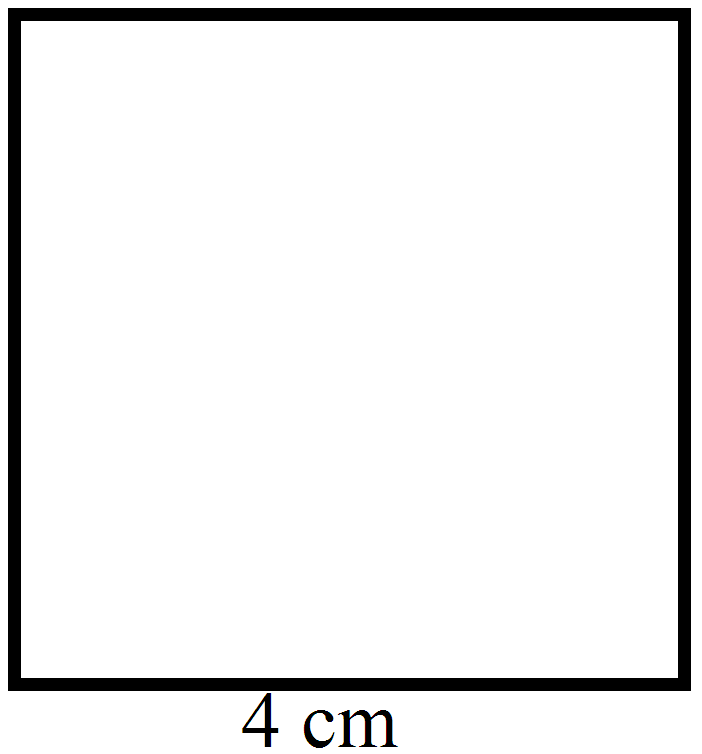
The area of the figure is:
- ✓
$16cm^2$
- B
$8cm^2$
- C
$4cm^2$
- D
$12cm^2$
AnswerCorrect option: A. $16cm^2$
A. $16cm^2$
Solution:
Area $= 4 \times 4 = 16cm^2.$
View full question & answer→MCQ 1031 Mark
During renovation in Connaught place there are $23$ cylindrical pillars which were needed to be whitewashed. The radius of each pillar is $35cm$ and height is $5m.$ Find the total cost of painting of all pillars at the rate of $Rs. 9$ per $m^2.$
- A
$Rs. 2,365$
- B
$Rs. 2,200$
- ✓
$Rs. 2,277$
- D
$Rs. 2,489$
AnswerCorrect option: C. $Rs. 2,277$
Here, height$(h) = 5m$
Radius$(r) = 35\text{cm}=\frac{35}{100}=0.35\text{m}$
Curved surface area of a pillar will be given by the formula $2\pi\text{rh}$
$\therefore \text{Surface area }2\times \frac{22}{7}\times0.35\times5$
$= 0.5 \times 22$
$= 11m^2$
As there are $23$ pillar,
Total surface area $= 23 \times 11 = 253m^2$
Total cost $= 9 \times 253 = Rs. 2,277$
View full question & answer→MCQ 1041 Mark
If the altitudw of an Equilateral triangle is $\sqrt{6}\text{cm}$, its area is:
- A
$2\sqrt{2}\text{cm}^2$
- B
$6\sqrt{2}\text{cm}^2$
- ✓
$2\sqrt{3}\text{cm}^2$
- D
$\text{None of these}$
AnswerCorrect option: C. $2\sqrt{3}\text{cm}^2$
$2\sqrt{3}\text{cm}^2$
View full question & answer→MCQ 1051 Mark
The area of a trapezium is $480cm^2,$ the distance between two parallel sides is $15cm$ and one of the parallel side is $20cm.$ The other parallel side is:
- A
$20cm$
- B
$34cm$
- ✓
$44cm$
- D
$50cm$
AnswerCorrect option: C. $44cm$
C. $44cm$
Solution:
Area of trapezium $=\frac{1}{2}\text{h}(\text{a+b)}$
$A = 20cm,$
$H = 15cm,$
Area $= 480sq. cm,$
$480=\frac{1}{2}(15)(20+\text{b})$
$20+\text{b} =\frac{(480\times2)}{15}$
$20+\text{b} = 64$
$\text{b}= 44\text{cm}$
View full question & answer→MCQ 1061 Mark
A cuboid has ______ pairs of identical faces.
Answer All six faces are rectangular, and opposites faces are identical. So, there are three pairs of identical faces.
View full question & answer→MCQ 1071 Mark
If the height of a cylinder becomes $\frac{1}4{}$ of the original height and the radius is doubled, then which of the following will be true?
AnswerCorrect option: C. Curved surface area of the cylinder will be halved.
Let the new height and radius be $\frac{\text{h}}{4}$ and $2r$ respectively, where r and h are original radius and original height respectively of the cyinder.
We know that, curved surface area of cylinder $=2\pi\text{rh}$
Then, curved surface of the new cylinder
$=2\pi(2\text{r})\times\frac{1}{4}\text{h}=4\pi\text{r}\times\frac{1}{4}\text{h}=\pi\text{rh}$
$=\frac{1}{2}\times2\pi\text{rh}$ $[$multiplying and dividing by $2]$
$=\frac{1}{2}$ original curved surface area
Hence, the curved surface area of the cylinder will be halved.
View full question & answer→MCQ 1081 Mark
What is the volume of a sphere whose radius is $3\ cm?$
- A
$24\pi\text{cm}^3$
- ✓
$36\pi\text{cm}^3$
- C
$30\pi\text{cm}^3$
- D
$27\pi\text{cm}^3$
AnswerCorrect option: B. $36\pi\text{cm}^3$
$36\pi\text{cm}^3$
View full question & answer→MCQ 1091 Mark
The base radius and height of a right circular cylinder are $14cm$ and $5cm$ respectively. Its curved surface is:
- A
$220cm^2$
- ✓
$440cm^2$
- C
$1232cm^2$
- D
$1670cm^2$
AnswerCorrect option: B. $440cm^2$
B. $440cm^2$
Solution:
Curved surface $ = 2\times\frac{22}{7}\times14\times5$
$= 440\text{cm}^2$
View full question & answer→MCQ 1101 Mark
If the base of rhombus of $7cm$ and its altitude is $4cm,$ its area will be.
- A
$14cm^2$
- B
$28cm$
- C
$14cm$
- ✓
$28cm^2$
AnswerCorrect option: D. $28cm^2$
D. $28cm^2$
View full question & answer→MCQ 1111 Mark
If each side of an equilateral triangle is doubled, then its area becomes how many times$?$
View full question & answer→MCQ 1121 Mark
If the height of a cylinder is halved, its volume becomes how many times$?$
- ✓
$\frac{1}{2}$
- B
$\frac{1}{3}$
- C
$2$
- D
$3$
AnswerCorrect option: A. $\frac{1}{2}$
$\frac{1}{2}$
View full question & answer→MCQ 1131 Mark
The ratio of the radii of two right circular cylinders is $1 : 2$ and the ratio of their heights is $4 : 1.$ The ratio of their volumes is:
- ✓
$1 : 1$
- B
$1 : 2$
- C
$2 : 1$
- D
$4 : 1$
AnswerCorrect option: A. $1 : 1$
$\frac{\text{r}_1}{\text{r}_1} = \frac{\pi(1)^24}{\pi(2)^21} = 1:1$
View full question & answer→MCQ 1141 Mark
View full question & answer→MCQ 1151 Mark
The diagonal of a quadrilateral is $20\ cm$ in length and the lengths of perpendiculars on it from the opposite vertices are $8.5\ cm$ and $11.5\ cm.$ The area of the quadrilateral is:
- A
$400\ cm^2$
- ✓
$200\ cm^2$
- C
$300\ cm^2$
- D
$240\ cm^2$
AnswerCorrect option: B. $200\ cm^2$
B. $200\ cm^2$
Solution:
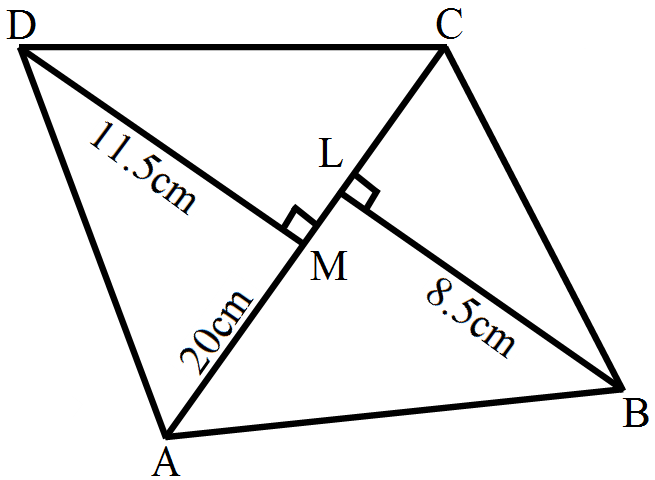
Let $ABCD$ be a quadilateral.
Diagonal, $AC = 20\ cm$
$\text{BL}\perp\text{AC},$ such that $BL = 8.5\ cm$
$\text{DM}\perp\text{AC},$ such that $DM = 11.5\ cm$
Area of the quadilateral $(\text{Area of }\triangle\text{DAC})+(\text{Area of }\triangle\text{ACB})$
$=\bigg[\Big(\frac{1}{2}\times\text{AC}\times\text{DM}\Big)+\Big(\frac{1}{2}\times\text{AC}\times\text{BL}\Big)\bigg]\text{cm}^2$
$=\bigg[\Big(\frac{1}{2}\times20\times11.5\Big)+\Big(\frac{1}{2}\times20\times8.5\Big)\bigg]\text{cm}^2$
$=(85+115)\text{cm}^2$
$=200\text{cm}^2$ View full question & answer→MCQ 1161 Mark
Find the volume of a cuboid whose length is $8\ cm,$ breadth $6\ cm$ and height $3.5\ cm.$
- A
$168\ cm^2$
- ✓
$168\ cm^3$
- C
$215\ cm^3$
- D
$150\ cm^3$
AnswerCorrect option: B. $168\ cm^3$
B. $168\ cm^3$
View full question & answer→MCQ 1171 Mark
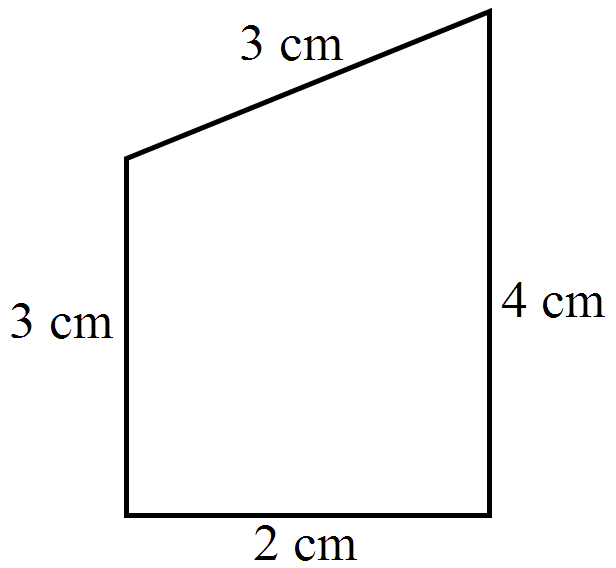
The perimeter of the trapezium is:
- ✓
$12\ cm$
- B
$24\ cm$
- C
$6\ cm$
- D
$18\ cm$
AnswerCorrect option: A. $12\ cm$
Perimeter $= 3 + 3 + 2 + 4 = 12\ cm$
View full question & answer→MCQ 1181 Mark
$1m^3 \ =$
AnswerCorrect option: A. $1000000\ cm^3$
A. $1000000\ cm^3$
View full question & answer→MCQ 1191 Mark
Mr. Manish Wants to get his room whitewashed including the ceiling. Find the total cost of whitewashing at the rate of $Rs. 7$ per $m^2$ if the dimensions of the room is $13\ m \times 9\ m \times 5\ m.$
- ✓
$Rs. 3178$
- B
$Rs. 2580$
- C
$Rs. 1550$
- D
$Rs. 1589$
AnswerCorrect option: A. $Rs. 3178$
Here, length$(I) =13 m$
Breadth $(b)=9 m$
And, height( $h$ ) $=5 m$
We need to find the area of wall individually,
Area of the two opposite walls will be given by,
$2(b \times h)=2(9 \times 5)=90 m^2$
Area of the other two walls will be,
$2(I \times h)=2(13 \times 5)=130 m^2$
Area of the ceiling will be given by,
$2(I \times b)=2(13 \times 9)=234 m^2$
The required area will be,
Required area $=90 m^2+130 m^2+234 m^2$
$=454 m^2$
Total cost $=454 \times 7=$ $Rs. 3118$
View full question & answer→MCQ 1201 Mark
The base of a triangle is four times its height and its area is $50m^2.$ The length of its base is:
AnswerC. $20m$
Solution:
Let the height of the triangle be x m and its base be $4x$ m respectively.
Then, area of the triangle $=\Big(\frac{1}{2}\times4\text{x}\times\text{x}\Big)\text{m}^2$
$=2\text{x}^2\text{m}^2$
But, the area of the triangle is $50m^2.$
$\therefore2\text{x}^2=50$
$\Rightarrow\text{x}^2=\frac{50}{2}$
$\Rightarrow\text{x}^2=25$
$\Rightarrow\text{x}=\sqrt{25}$
$\Rightarrow\text{x}=5$
$\therefore$ Length of its base $= (4 \times 5)m = 20m.$
View full question & answer→MCQ 1211 Mark
If a cuboid has a volume of $513cm^3$ and area of the base as $27cm^2,$ what would be its height?
- ✓
$19cm$
- B
$23cm$
- C
$17cm$
- D
$29cm$
AnswerCorrect option: A. $19cm$
A. $19cm$
Solution:
We know that the relation between volume of the cuboid and the area of the base is,
Volume of a cuboid $= Area of the base \times Height$
Putting the values, we'll get
$513 = 127 \times Height$
Height $= 19cm$
View full question & answer→MCQ 1221 Mark
If the edge of a cube is $1cm$ then which of the following is its total surface area?
- A
$1cm^2$
- B
$4cm^2$
- ✓
$6cm^2$
- D
AnswerCorrect option: C. $6cm^2$
C. $6cm^2$
Solution:
Edge of the cube $= 1cm$
We know that,
Total surface area of cube $= 6a^2$
$= 6(1)^2$
$= 6cm^2$
Therefore, the TSA of cube is $6cm^2.$
View full question & answer→MCQ 1231 Mark
Two cubes have volumes in the ratio $1 : 64.$ The ratio of the area of a face of first cube to that of the other is:
- A
$1 : 4$
- B
$1 : 8$
- ✓
$1 : 16$
- D
$1 : 32$
AnswerCorrect option: C. $1 : 16$
Let $a$ and $b$ be the edges of the two cubes, respectively.
Then, according to the question,
$\text{a}^3:\text{b}^3=1:64$ [$\because$ volume of cube = (edge)$^3$]
$\Rightarrow\frac{\text{a}^3}{\text{b}^2}=\frac{1}{64}$
$\Rightarrow\Big(\frac{\text{a}}{\text{b}}\Big)^3=\Big(\frac{1}{4}\Big)^3$
$\Rightarrow\frac{\text{a}}{\text{b}}=\frac{1}{4}$ [taking cube roots on both sides]
Now, ratio of areas, $\Big(\frac{\text{a}}{\text{b}}\Big)^2=\Big(\frac{1}{4}\Big)^2$ [$\because$ surface area of cube $= 6 \times$ (edge)$^2$]
$\Rightarrow\frac{\text{a}^2}{\text{b}^2}=\frac{1}{16}$
$\therefore\text{a}^2:\text{b}^2=1:16$
View full question & answer→MCQ 1241 Mark
$1$ liter is equal to how many cubic centimeters$?$
- A
$10\ cu.cm$
- B
$10000\ cu.cm$
- C
$100\ cu.cm$
- ✓
$1000\ cu.cm$
AnswerCorrect option: D. $1000\ cu.cm$
$1000\ cu.cm$
View full question & answer→MCQ 1251 Mark
Tick the correct answer in the following: The area of a trapezium is $180cm^2$ and its height is $9cm.$ If one of the parallel sides is longer than the other by $6cm,$ the length of the longer of the parallel sides is:
- A
$17cm$
- ✓
$23cm$
- C
$18cm$
- D
$24cm$
AnswerCorrect option: B. $23cm$
B. $23cm$
Solution:
Area of trapezium $= 180cm^2$
and height $(h) = 9cm$
Sum of parallel sides $=\frac{\text{Area}\times2}{\text{Height}}$
$=\frac{180\times2}{9}=40\text{cm}$
But longer sides is greater than shorter side by $6cm,$
Longer side $=\frac{40-6}{2}+6$
$= 17 + 6 = 23cm.$
View full question & answer→MCQ 1261 Mark
The sides of a triangle are $3cm, 5cm$ and $4cm.$ Its area is:
- ✓
$6cm^2$
- B
$7.5cm^2$
- C
$17.5cm^2$
- D
$27.5cm^2$
AnswerCorrect option: A. $6cm^2$
A. $6cm^2$
View full question & answer→MCQ 1271 Mark
If a cuboidal box has height, length and width as $20cm, 15cm$ and $10cm$ respectively. Then its total surface area is:
- A
$1100cm^2$
- ✓
$1300cm^2$
- C
$1200cm^2$
- D
$1400cm^2$
AnswerCorrect option: B. $1300cm^2$
B. $1300cm^2$
Solution:
Total surface area $= 2(20 \times 15 + 20 \times 10 + 10 \times 15)$
TSA $= 2(300 + 200 + 150)$
$= 1300cm^2$
View full question & answer→MCQ 1281 Mark
A cube of side $5cm$ is painted on all its faces. If it is sliced into $1$ cubic centimetre cubes, how many $1$ cubic centimetre cubes will have exactly one of their faces painted?
AnswerC. $54$
Solution:
Given, a cube of side $5cm$ is painted on all its faces and is sliced into $1cm^3$cubes. Then, from figure, it is clear that there are $9$ cubes available on face.
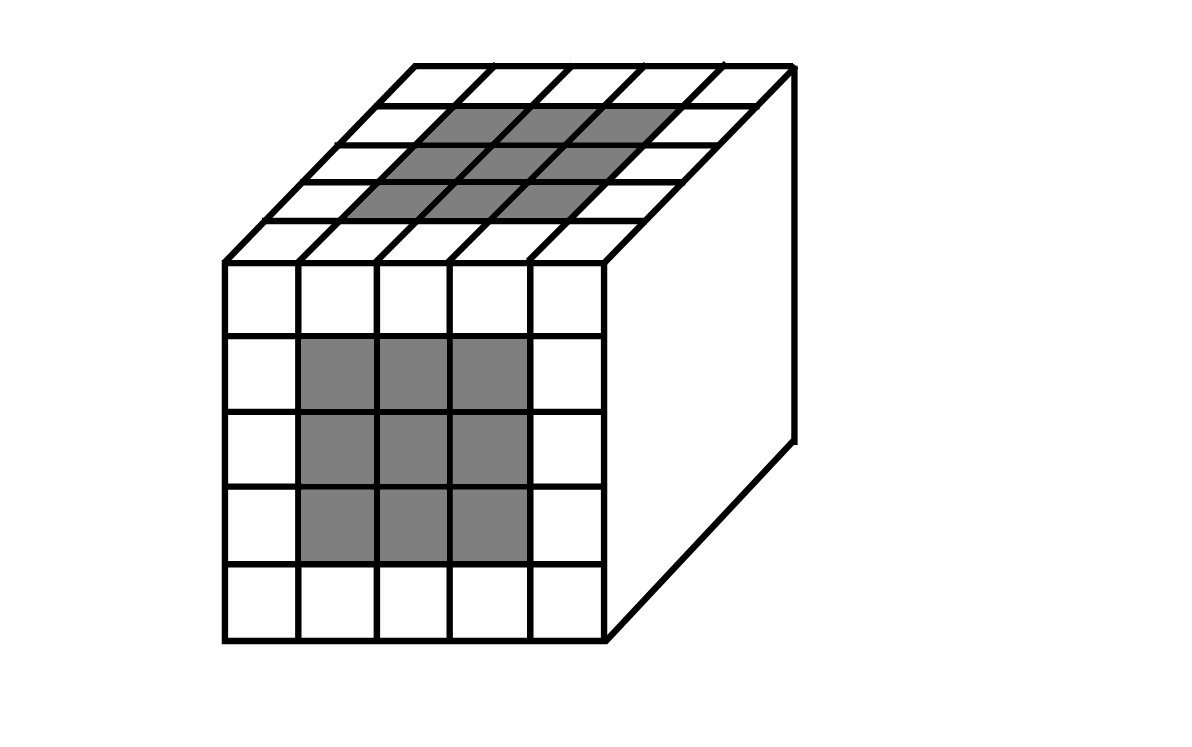
Since, there are six faces available.
Hence, total number of smaller cubes $= 6 \times 9 = 54$ View full question & answer→MCQ 1291 Mark
$1cm^3 =$
AnswerCorrect option: A. $1000mm^3$
A. $1000mm^3$
View full question & answer→MCQ 1301 Mark
If the height of a cylinder becomes $\frac{1}{4}$ of the original height and the radius is doubled, then which of the following will be true?
AnswerCorrect option: B. Volume of the cylinder will remain unchanged.
We know that, the volume of a cylinder having base radius $r$ and height $h$ is $\text{V}=\pi\text{r}^2\text{h}$
Now, If new height is $\frac{1}{4}^{th}$ of the original helight and the redius is doubled,
i.e. $\text{h}'=\frac{1}{4}\text{h}$ and $\text{r}'=2\text{r},$ then
New volume, $\text{V}'=\pi(2\text{r})^2\times\frac{1}{4}\text{h}=4\pi\text{r}^2\times\frac{1}{4}\text{h}$
$=\pi\text{r}^2\text{h = V}$
Hence, the new volume of cylinder is same as the original volume.
View full question & answer→MCQ 1311 Mark
Three cubes of metal whose edges are $6cm, 8cm$ and $10cm$ respectively are melted to form a single cube. The edge of the new cube is:
- ✓
$12cm$
- B
$24cm$
- C
$18cm$
- D
$20cm$
AnswerCorrect option: A. $12cm$
A. $12cm$
Solution:
The edges of three cubes are $6cm, 8cm$ and $10cm,$ respectively.
$\therefore$ Sum of volumes of the three metal cubes
$= 63 + 83 + 103$ [$\because$ volume of cube = (edge)$^3$]
$= 216 + 512 + 1000$
$= 1728cm^3$
Since, a new cube is formed by melting these three cubes.
Let a be the side of new cube. Then,
Volume of the new cube = Sum of volumes of three metal cubes
$\Rightarrow a^3 = 1728$
$\therefore a = 12cm$
Hence, the edge of the new cube is $12cm.$
View full question & answer→MCQ 1321 Mark
The volume of a cylinder whose radius $r$ is equal to its height is:
AnswerCorrect option: C. $\pi\text{r}^3$
Given, $r = h$
Then, volume of cylinder $=\pi\text{r}^2\text{h}=\pi\text{r}^2\text{r}=\pi\text{r}^3$
View full question & answer→MCQ 1331 Mark
If the radius of a cylinder is tripled but its curved surface area is unchanged, then its height will be:
AnswerLet $h'$ be the new height.
Curved surface area of a cylinder with radius $r$ and height $h$
$=2\pi\text{rh}$
Now, according to the question, radius is tripled. Then,
Curved surface area $=2\pi\times3\text{r}\times\text{h}'=2\pi\text{rh}$
$\Rightarrow6\pi\text{r}\times\text{h}'=2\pi\text{h}$
$\Rightarrow\text{h}'=\frac{2\pi\text{rh}}{6\pi\text{r}}$
$\therefore\text{h}'=\frac{1}{3}\text{h}$
Hence, the new height will be $\frac{1}{3}$ of the original height.
View full question & answer→MCQ 1341 Mark
One side of an equilateral triangle is $30\ cm.$ Its area is:
- A
$112.5\text{cm}^2$
- B
$225\text{cm}^2$
- C
$225\sqrt{2}\text{cm}^2$
- ✓
$225\sqrt{3}\text{cm}^2$
AnswerCorrect option: D. $225\sqrt{3}\text{cm}^2$
$225\sqrt{3}\text{cm}^2$
View full question & answer→MCQ 1351 Mark
The ratio of radii of two cylinders is $1 : 2$ and heights are in the ratio $2 : 3.$ The ratio of their volumes is:
- ✓
$1 : 6$
- B
$1 : 9$
- C
$1 : 3$
- D
$2 : 9$
AnswerCorrect option: A. $1 : 6$
A. $1 : 6$
Solution:
Let $r_1, r_2$ be radii of two cylinders and $h_1, h_2$ be their heights.
Then, $\frac{\text{r}_1}{\text{r}_2}=\frac{1}{2}$ and $\frac{\text{h}_1}{\text{h}_2}=\frac{2}{3}$
Now, $\frac{\text{V}1}{\text{V}_2}=\frac{\pi\text{r}^1_2\text{h}_1}{\pi\text{r}^2_2\text{h}_2}=\Big(\frac{\text{r}_1}{\text{r}_2}\Big)^2\times\frac{\text{h}_1}{\text{h}_2}=\Big(\frac{1}{2}\Big)^2\times\frac{2}{3}$
$=\frac{1}{4}\times\frac{2}{3}=\frac{1}{6}=1:6$
Hence, $V_1 : V_2 = 1 : 6$
View full question & answer→MCQ 1361 Mark
If the side of the cube is $2m,$ then the surface area of the cube is.
- A
$12m^2$
- B
$12m$
- ✓
$24m^2$
- D
$24m$
AnswerCorrect option: C. $24m^2$
C. $24m^2$
View full question & answer→MCQ 1371 Mark
The area of a triangle with base $b$ and altitube $h$ is:
- ✓
$\frac{1}{2} \text{bh}$
- B
$\text{bh}$
- C
$\frac{1}{3} \text{bh}$
- D
$\frac{1}{4} \text{bh}$
AnswerCorrect option: A. $\frac{1}{2} \text{bh}$
$\frac{1}{2} \text{bh}$
View full question & answer→MCQ 1381 Mark
The diagonal of a quadrilateral shaped field is $24m$ and perpendicular dropped on it from the remaining opposite vertices are $6m$ and $12m.$ Find the area of the field.
- A
$343m^2$
- B
$125m^2$
- ✓
$216m^2$
- D
AnswerCorrect option: C. $216m^2$
C. $216m^2$
View full question & answer→MCQ 1391 Mark
The volume of a cylinder of base redius $r$ and heigh $h$ is:
AnswerCorrect option: B. $\pi\text{r}^2\text{h}$
$\pi\text{r}^2\text{h}$
View full question & answer→MCQ 1401 Mark
The base of an isosceles right triangle is $30cm.$ Its are is:
- A
$225\sqrt3\text{cm}^2$
- ✓
$225\text{m}^2$
- C
$5\sqrt2\text{cm}^2$
- D
$\text{None of these}$
AnswerCorrect option: B. $225\text{m}^2$
B. $225cm^2$
View full question & answer→MCQ 1411 Mark
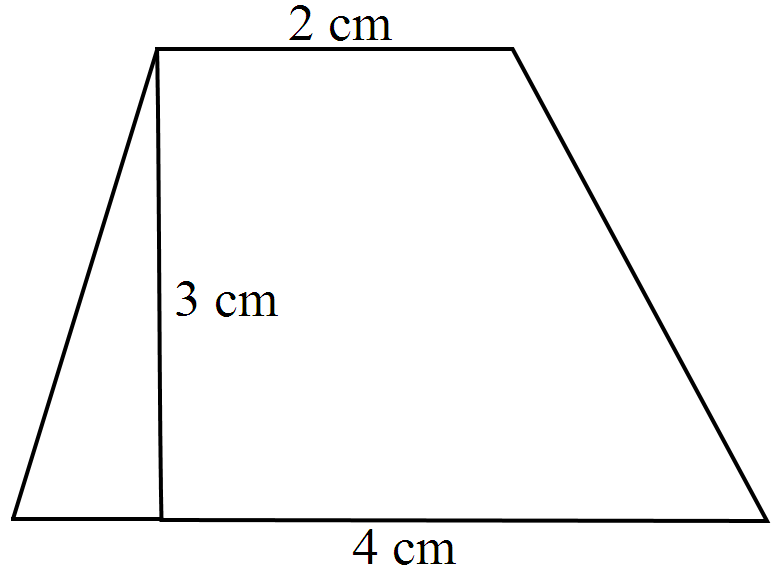
The area of the trapezium is:
- ✓
$9cm^2$
- B
$6cm^2$
- C
$7cm^2$
- D
$24cm^2$
AnswerCorrect option: A. $9cm^2$
A. $9cm^2$
Solution:
$\text{Area} = \frac{(4 + 2)^3}{2} = 9\text{cm}^2$
View full question & answer→MCQ 1421 Mark
Area of a triangle with base $(b)$ and height $(h)$ is:
- A
$b.h$
- B
$2b.h$
- ✓
$\frac{1}{2}\text{b.h}$
- D
AnswerCorrect option: C. $\frac{1}{2}\text{b.h}$
$\frac{1}{2}\text{b.h}$
View full question & answer→MCQ 1431 Mark
The height of a cylinder whose radius is $7cm$ and the total surface area is $968cm^2$ is:
- ✓
$15cm$
- B
$17cm$
- C
$19cm$
- D
$21cm$
AnswerCorrect option: A. $15cm$
A. $15cm$
Solution:
Total surface area $=2\pi\text{r}(\text{h+r})$
$968 = 2\times\frac{22}{7}\times7(7+\text{h})$
$\text{h} = 15\text{cm}$
View full question & answer→MCQ 1441 Mark
A glass in the form of a right circular cylinder is half full of water. Its base radius is $3\ cm$ and height is $8\ cm.$ The volume of water is:
- A
$18\pi\text{cm}^3$
- ✓
$36\pi\text{cm}^3$
- C
$9\pi\text{cm}^3$
- D
$36\text{cm}^3$
AnswerCorrect option: B. $36\pi\text{cm}^3$
Volume $= \frac{1}{2}\pi \times3\times3\times8 $
$=36\pi\text{cm}^3$
View full question & answer→MCQ 1451 Mark
Which of the following is the once of a rhombus$?$
- A
Product of its diagonals.
- B
$\frac{1}{2} ($sum of its diagonals$).$
- ✓
$\frac{1}{2}($Product of its diagonals$).$
- D
$2($Product of its diagonals$).$
AnswerCorrect option: C. $\frac{1}{2}($Product of its diagonals$).$
A rhombus is a parallelogram with four congruent sides. Since it is a parallelogram, it has also all the properties of a parallelogram.
One of these properties is that the diagonals bisect each other. That is, they divide each other into two equal parts.
The area is half the product of the diagonals.
View full question & answer→MCQ 1461 Mark
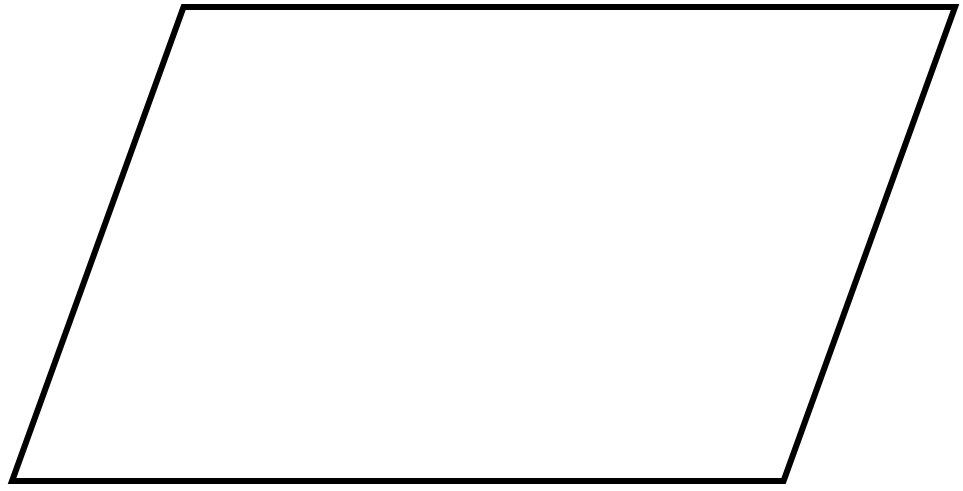
The diagram has the shape of a:
MCQ 1471 Mark
A square is a special case of:
MCQ 1481 Mark
The area of a rhombus is $25cm^2$ and one of its diagonals is $4cm.$ Its perimeter is:
- A
$36cm$
- B
- ✓
$4\sqrt{53}\text{cm}$
- D
$2\sqrt{53}\text{cm}$
AnswerCorrect option: C. $4\sqrt{53}\text{cm}$
C. $4\sqrt{53}\text{cm}$
View full question & answer→MCQ 1491 Mark
Each side of a rhombus is $15\ cm$ and the length of one of its diagonals is $24\ cm.$ The area of the rhombus is:
- A
$432\ cm^2$
- ✓
$216\ cm^2$
- C
$180\ cm^2$
- D
$144\ cm^2$
AnswerCorrect option: B. $216\ cm^2$
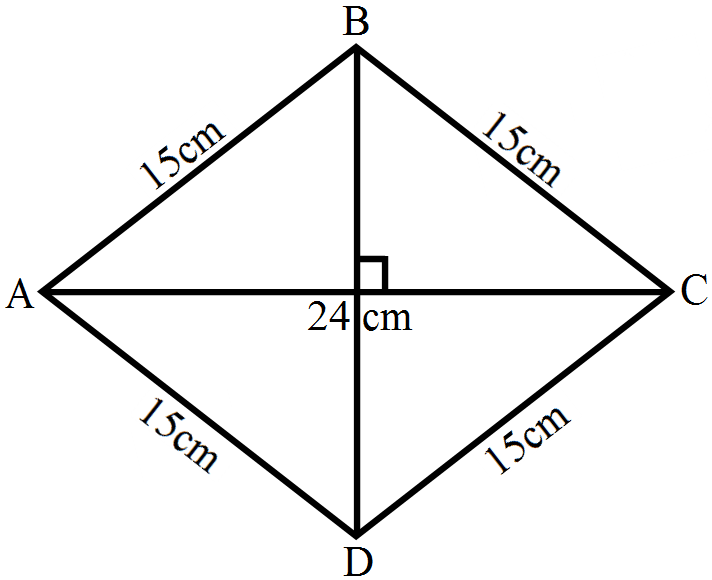
Let $ABCD$ be a rhombus whose diagonals $AC$ and $BD$ intersect at a point $O.$
Let the length of the diagonal $AC$ be $24\ cm$ and the side of the rhombus be $15\ cm.$
We know that the diagonals of the rhombus bisect each other at right angles.
$\therefore\text{AO}=\frac{1}{2}\text{AC}$
$\Rightarrow\text{AO}=\Big(\frac{1}{2}\times24\Big)\text{cm}$
$\Rightarrow\text{AO}=12\text{cm}$
From right $\triangle\text{AOB},$ we have:
$\text{BO}^2=\text{AB}^2-\text{AO}^2$
$\Rightarrow\text{BO}^2\Big\{(15)^2-(12)^2\Big\}$
$\Rightarrow\text{BO}^2=(225-144)$
$\Rightarrow\text{BO}^2=81$
$\Rightarrow\text{BO}^2=\sqrt{81}$
$\Rightarrow\text{BO}=\sqrt{81}$
$\Rightarrow\text{BO}=9\text{cm}$
$\therefore\text{BD}=2\times\text{BO}$
$\text{BD}=(2\times9)\text{cm}$
$\text{BD}=18\text{cm}$
Hence, the length of the other diagonals is $18cm.$
Area of the rhombus $=\Big(\frac{1}{2}\times24\times18\Big)\text{cm}^2$
$216\text{cm}^2$ View full question & answer→MCQ 1501 Mark
The heights of two right circular cylinders are the same. Their volumes are respectively $16\pi\text{m}^3$ and $81\pi\text{m}^3$. The ratio of their base radii is:
- A
$16 : 81$
- ✓
$4 : 9$
- C
$2 : 3$
- D
$9 : 4$
AnswerCorrect option: B. $4 : 9$
$\frac{\pi\text{r}_1^2\text{h}}{\pi\text{r}_2^2\text{h}} = \frac{16\pi}{81\pi}$
$\Rightarrow \frac{\text{r}_1}{\text{r}_2} = \frac{4}{9}$
View full question & answer→