Questions

3 Marks Question

🎯

Test yourself on this topic

9 questions · timed · auto-graded

Question 13 Marks
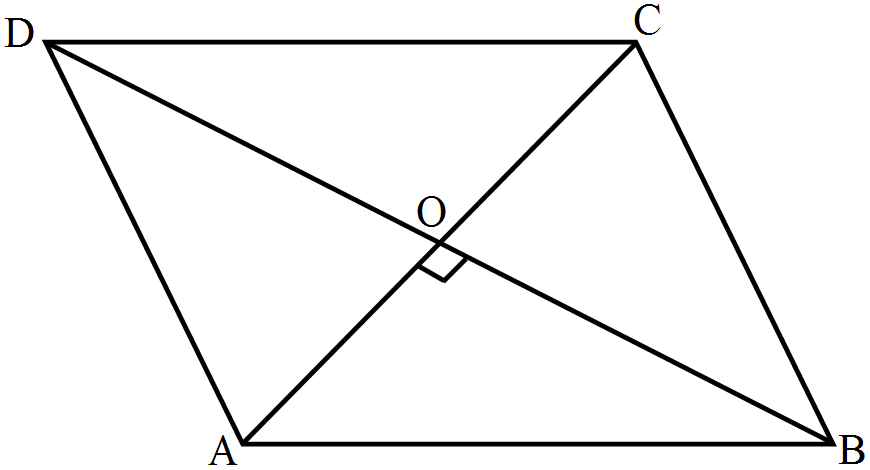
The lengths of the diagonals of a rhombus are $16\ cm$ and $12\ cm$ respectively. Find the length of each of its sides.
Answer
We know that the diagonals of a rhombus bisect each other at right angles.
$AC$ and $BD$ are intersecting at a point $O$.
$\text{AO}=\frac{1}{2}\text{AC}=\Big(\frac{1}{2}\times16\Big)=8\text{cm}$
$\text{BD}=\frac{1}{2}\text{BD}= \Big(\frac{1}{2}\times12\Big)=6\text{cm}$
From the right $\triangle\text{AOB},$ we have,
$\therefore\text{AB}^2=\text{AO}^2+\text{BO}^2$
$\Rightarrow\text{AB}^2=\big\{(8)^2+(6)^2\big\}\text{cm}^2$
$\Rightarrow\text{AB}=\sqrt{100}=10\text{cm}$
Therefore, length of each side is $10\ cm$. Because all sides of a rhombus are equal.
View full question & answer
Question 23 Marks
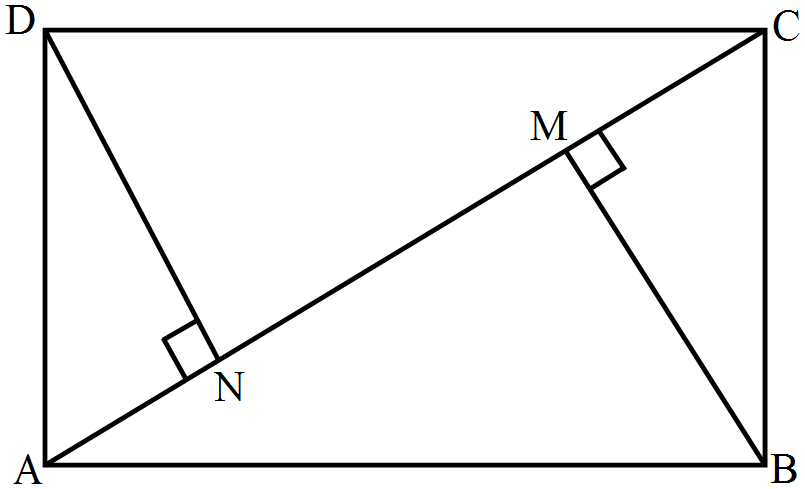
In the adjacent figure, $ABCD$ is a rectangle. If $BM$ and $DN$ are perpendiculars from $B$ and $D$ on $AC$, prove that $\triangle\text{BMC}\cong\triangle\text{DNA}.$ Is it true that $BM = DN$?
Answer
In $\triangle\text{BMC}$ and $\triangle\text{DNA}:$
$\angle\text{DNA}=\angle\text{BMC}=90^\circ$
$\angle\text{BCM}=\angle\text{DAN}$ (alternative angles)
$BC = DA$ (opposite sides)
By $AAS$ congruency criteria: $\triangle\text{BMC}\cong\triangle\text{DNA}$ (proved)
So, we can write $BM = DN$.
View full question & answer
Question 33 Marks
Two adjacent angles of a parallelogram are in the ratio $4 : 5$. Find the measure of each of its angles.
Answer
Let the measure of the adjacent angles be $4x$ and $5x$,
$\therefore4\text{x}+5\text{x}=180$
$\Rightarrow9\text{x}=180$ $\Rightarrow\text{x}=20$
Therefore the measue of the required angle is: $\angle\text{A}=4\times20=80^\circ$
$\angle\text{B}=5\times20=100^\circ$
$\angle\text{B}+\angle\text{C}=180^\circ$
$\Rightarrow\angle\text{C}=180^\circ-100^\circ=80^\circ$
$\angle\text{C}+\angle\text{D}=180^\circ$
$\Rightarrow\angle\text{D}=180^\circ-80^\circ=100^\circ$
View full question & answer
Question 43 Marks
$ABCD$ is a parallelogram in which $\angle\text{A}=110^\circ.$ Find the measure of each of the angles $\angle\text{A},\angle\text{B}$ and $\angle\text{D.}$
Answer
It is a given that $ABCD$ is a parallelogram in which $\angle\text{A}=110^\circ.$
Since, the sum of any two adjacent angle of a parallelogram is $180^\circ$ ,
we have, $\angle\text{A}+\angle\text{B}=180^\circ$
$\Rightarrow\angle\text{B}=180^\circ-110^\circ$
$\Rightarrow\angle\text{B}=706^\circ$ Also, $\angle\text{B}+\angle\text{C}=180^\circ$
$\Rightarrow\angle\text{C}=180^\circ-70^\circ$
$\Rightarrow\angle\text{C}=110^\circ$ Further, $\angle\text{C}+\angle\text{D}=180^\circ$
$\Rightarrow\angle\text{D}=180^\circ-110^\circ$
$\Rightarrow\angle\text{D}=70^\circ$
$\therefore\angle\text{B}=70^\circ,\angle\text{C}=110^\circ$ and $\angle\text{D}=90^\circ.$
View full question & answer
Question 53 Marks
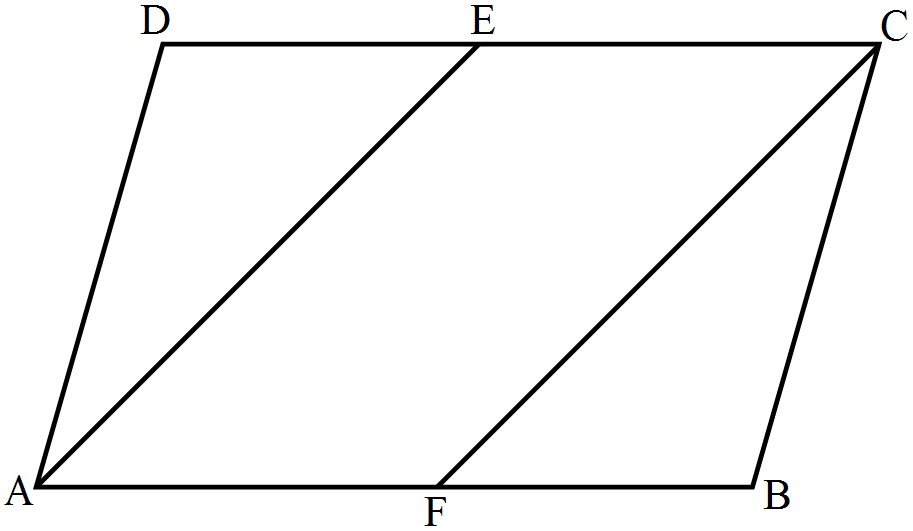
In the adjacent figure, $ABCD$ is a parallelogram and line segments $AE$ and $CF$ bisect the angles $A$ and $C$ respectively. Show that $AE\ ||\ CF$.
Answer
In $\triangle\text{AD}$ and $\triangle\text{CBF},$
we have $\text{AD}=\text{BC},\angle\text{B}=\angle\text{D}$ and $\angle\text{DAE}=\angle\text{BCF}$
$\because\angle\text{A}=\angle\text{C}$
$\Rightarrow\frac{1}{2}\angle\text{A}=\frac{1}{2}\angle\text{C}$
$\Rightarrow\angle\text{DAE}=\angle\text{BCF}$
$\therefore\triangle\text{ADE}\cong\triangle\text{CBF}$ And therefore,$\text{CD}-\text{DE}=\text{AB}-\text{BF}$ So, $CE = AF$
$\therefore$ $AECF$ is a parallelogram, Hence, $AE\ ||\ CF$.
View full question & answer
Question 63 Marks
Two sides of a parallelogram are in the ratio $5 : 3$. If its perimeter is $64\ cm$, find the lengths of its sides.
Answer
Let the measure of the sides be $5x$ and $3x$.
Its perimeter $= 2(5x + 3x)$
$\therefore$ $2(5x + 3x) = 64$
$\Rightarrow 16x = 64$
$\Rightarrow x = 4$
Therefore, one side $= 5 \times 4 = 20$
Other side $= 3 \times 4 = 12$
View full question & answer
Question 73 Marks
The sum of two opposite angles of a parallelogram is $130^\circ $. Find the measure of each of its angles.
Answer
$\angle\text{A}+\angle\text{C}=130$
Let the measure of $\angle\text{A}=\angle\text{C}=\text{x}$
$\therefore2\text{x}=130$
$\Rightarrow\text{x}=65$
Therefore, $\angle\text{A}=65$
$\therefore\angle\text{A}+\angle\text{B}=180$
$\Rightarrow\angle\text{B}=180-65$
$\Rightarrow\angle\text{B}=115$
$\Rightarrow\angle\text{C}=65$
$\therefore\angle\text{C}+\angle\text{D}=180$
$\Rightarrow\angle\text{D}=180-65$
$\Rightarrow\angle\text{D}=115.$
View full question & answer
Question 83 Marks
Two adjacent angles of a parallelogram are $(3x - 4)^\circ $ and $(3x + 16)^\circ $. Find the value of $x$ and hence find the measure of each of its angles.
Answer
$(3x - 4) + (3x + 16) = 180 $
$\Rightarrow 3x - 4 + 3x + 16 = 180$
$\Rightarrow 6x + 12 = 180 $
$\Rightarrow 6x = 180 - 12 $
$\Rightarrow 6x = 168 $
$\Rightarrow x = 28$
Therefore, the measure of the angle is: $\angle\text{A}=(3\times28-4)=80^\circ$
$\angle\text{B}=(3\times28+16)=100^\circ$
View full question & answer
Question 93 Marks
The perimeter of a parallelogram is $140\ cm$. If one of the sides is longer than the other by $10\ cm$, find the length of each of its sides.
Answer
Let the length of one side be $x\ cm$ and other is $(x + 10)\ cm$.
 $\therefore$ $2(x + x + 10) = 140$
$\Rightarrow 4x + 20 = 140$
$ \Rightarrow 4x = 140 - 20 $
$\Rightarrow 4x = 120 $
$\Rightarrow x = 30$
Length of one side is $30\ cm$ and other side $= (30 + 10) = 40\ cm.$ 
View full question & answer