Question 12 Marks
There are $500$ children in a school. For a $P.T.$ drill they have to stands in such a manner that the number of rows is equal to number of columns. How many children would be left out in this arrangement.
AnswerLet the number of rows be $x$
Then the number of columns in $x$
So, the number of plants is $x$ $\times$ $x = x^2$
which is a perfect square.
Let us find out the square root of $500$ by division method.
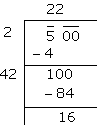
We get the remainder $16$. It shows that $22^2$ is less than $500$ by $16$.
This means that $16$ children would be left out in this arrangement. View full question & answer→Question 22 Marks
A gardener has $1000$ plants. He wants to plant these in such a way that the number of rows and the number of columns remain same. Find the minimum number of plants he needs more for this.
AnswerLet the number of rows be $x$
Then the number of columns in $x$
So, the number of plants is $x$ $\times$ $x = x^2$
which is a perfect square.
Let us find out the square root of $1000$ by division method.
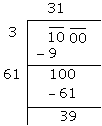
This shows that $31^2< 1000.$
Next perfect square number is $32^2= 1024.$
Hence, the minimum number of plants he needs more for this $= 1024 – 1000 = 24$. View full question & answer→Question 32 Marks
In a right triangle $ABC$, $\angle B = 90^{\circ}$. If $AC = 13\ cm, BC = 5\ cm$, find $AB$.
Answer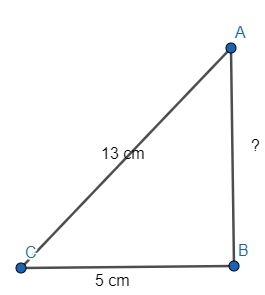
It is given that $\triangle \mathrm{ABC}$ is right-angled at $B$
Pythagoras Theorem: In a right angles triangle, the square of the hypotenuse is equal to the sum of squares of the other two sides.
Therefore, by using Pythagoras theorem, we get:
$A C^{2}=A B^{2}+B C^{2}$
$13 ^{2}={AB}^{2}+5^{2}$
$\Rightarrow$$\mathrm{AB}^{2}=169 -25 $
$\mathrm{AB}^{2}=144 $
$\Rightarrow$$\mathrm{AB}=\sqrt{144} $
$AB = 12$
Therefore, $AB = 12\ cm$ View full question & answer→Question 42 Marks
In a right triangle $ABC$, $\angle$$B = 90^\circ$. If $AB = 6\ cm, BC = 8\ cm$, find $AC$.
AnswerIn the right triangle $ABC$,
$\because $ $\angle$$B = 90^\circ . . . .$ [given]
$\therefore$ By Pythagoras theorem
$AC^2= AB^2+ BC^2$
$\therefore$ $AC^2= 6^2+ 8^2$
$\therefore$ $AC^2= 36 + 64$
$\therefore$ $AC^2= 100$
$\therefore$ AC = $\sqrt {100} $
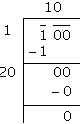
Therefore, $\sqrt {100} = 10$.
Hence, $AC$ is equal to $10\ cm$. View full question & answer→Question 52 Marks
Find the length of the side of a square where area is 441 $m^2$.
AnswerArea of the square = 441 $m^2$
$\therefore$ Length of the side of the square $ = \sqrt {441} m$
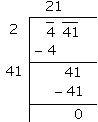
Therefore, $ = \sqrt {441} = 21$.
Hence, the length of the side of the square is $21\ m$. View full question & answer→Question 62 Marks
Find the least number which must be added to $6412$ so as to get a perfect square. Also find the square root of the perfect square so obtained.
Answer
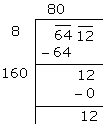
This shows that $80^2< 6412$
Next perfect square is $81^2= 6561$
Hence, the number to be added is $81^2– 6412 = 6561 – 6412 = 149$
Therefore, the perfect square so obtained is $6412 + 149 = 6561$
Hence, $\sqrt {6561} = 81$. View full question & answer→Question 72 Marks
Find the least number which must be added to $1825$ so as to get a perfect square. Also find the square root of the perfect square so obtained.
Answer
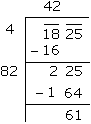
This shows that $42^2< 1825$
Next perfect square is $43^2= 1849$
Hence, the number to be added is $43^2– 1825 = 1849 – 1825 = 24$
Therefore, the perfect square so obtained is $1825 + 24 = 1849$
Hence, $\sqrt {1849}$ $= 43$. View full question & answer→Question 82 Marks
Find the least number which must be added to $252$ so as to get a perfect square. Also find the square root of the perfect square so obtained.
Answer
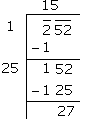
This shows that $15^2< 252$
Next perfect square is $16^2= 256$
Hence, the number to be added is $16^2– 252 = 256 – 252 = 4$
Therefore, the perfect square so obtained is $252 + 4 = 256$.
Hence, $\sqrt {256} $ $= 16$. View full question & answer→Question 92 Marks
Find the least number which must be added to $1750$ so as to get a perfect square. Also find the square root of the perfect square so obtained.
Answer
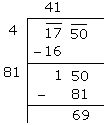
This shows that $41^2< 1750$
Next perfect square is $42^2 = 1764$
Hence, the number to be added is $42^2– 1750 = 1764 – 1750 = 14$
Therefore, the perfect square so obtained is $1750 + 14 = 176$4.
Hence, $\sqrt {1764} $$= 42$. View full question & answer→Question 102 Marks
Find the least number which must be added to $525$ so as to get a perfect square. Also find the square root of the perfect square so obtained.
Answer
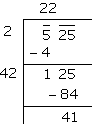
This shows that $22^2< 525.$
Next perfect square is $23^2= 529.$
Hence, the number to be added is $23^2– 525 = 529 – 525 = 4$
Therefore, the perfect square so obtained is $525 + 4 = 529$.
Hence, $\sqrt {529} $$=23$. View full question & answer→Question 112 Marks
Find the least number which must be subtracted from $4000$ so as to get a perfect square. Also find the square root of the perfect square so obtained.
Answer
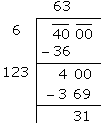
This shows that $63^2$ is less than $4000$ by $31$. This means, if we subtract the remainder from the number, we get a perfect square, So, the required least number is $31$.
Therefore, the required perfect square is $4000 – 31 = 3969$.
Hence, $\sqrt {3969}$$=63$. View full question & answer→Question 122 Marks
Find the square root of $31.36$ decimal number.
View full question & answer→Question 132 Marks
Find the square root of $42.25$ decimal number.
Answer
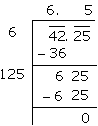
Hence, $\sqrt {42.25}$$=6.5$ View full question & answer→Question 142 Marks
Find the square root of $51.84$ decimal number.
Answer
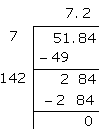
Hence, $\sqrt {51.84}$$=7.2$ View full question & answer→Question 152 Marks
Find the square root of $7.29$ decimal number.
Answer
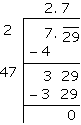
Hence, $\sqrt {7.29} $$=2.7$ View full question & answer→Question 162 Marks
Find the square root of $2.56$ decimal number.
Answer
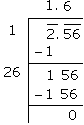
Hence, $\sqrt {2.56} $$=1.6$ View full question & answer→Question 172 Marks
Find the square root of $576$ by Division method.
Answer
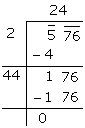
Therefore, $\sqrt {576} $$=24$ View full question & answer→Question 182 Marks
Find the square root of $7921$ by Division method.
Answer
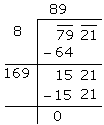
Therefore, $\sqrt {7921} $$=89$ View full question & answer→Question 192 Marks
Find the square root of $5776$ by Division method.
Answer
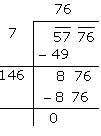
Therefore, $\sqrt {5776}$$=76$ View full question & answer→Question 202 Marks
Find the square root of $1369$ by Division method.
Answer
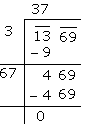
Therefore, $\sqrt {1369} $$=37$ View full question & answer→Question 212 Marks
Find the square root of $3249$ by Division method.
Answer
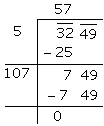
Hence, the square root of $3249$ is $57$. View full question & answer→Question 222 Marks
Find the square root of $529$ by Division method.
Answer
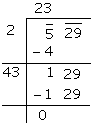
Therefore, $\sqrt {529} $ $= 23$ View full question & answer→Question 232 Marks
Find the square root of $3481$ by Division method.
Answer
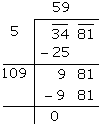
Therefore, $\sqrt {3481} $ $= 59$ View full question & answer→Question 242 Marks
Find the square root of $4489$ by Division method.
Answer
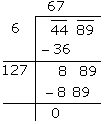
Therefore, $\sqrt {4489} $ $= 67$ View full question & answer→Question 252 Marks
Find the square root of $900$ by Division method.
Answer
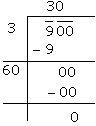
Therefore, $\sqrt {900}$$=30$ View full question & answer→Question 262 Marks
Find the square root of $3136$ by Division method.
Answer
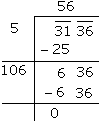
Therefore, $\sqrt {3136} $$=56$ View full question & answer→Question 272 Marks
Find the square root of $1024$ by Division method.
Answer
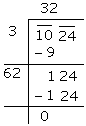
Therefore, $\sqrt {1024} $$=32$ View full question & answer→Question 282 Marks
Find the square root of $2304$ by Division method.
Answer
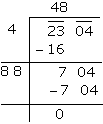
Therefore, $\sqrt {2304} $ $= 48$ View full question & answer→Question 292 Marks
Find the smallest whole number with which $1620$ should be divided so as to get a perfect square. Also, find the square root of the square number so obtained.
AnswerThe prime factorisation of $1620 is 1620 = 2 \times 2 \times 3 \times 3 \times 3 \times 3 \times 5$
We see that prime factor $5$ has no pair. So, if we divide $1620$ by $5$, then we get
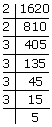
$1620 = 2$ $ \times 2 \times 3 \times 3 \times 3 \times 3$
Now each factor has a pair.
Therefore, $\frac{1620}{5}$ $= 324$ is a perfect square.
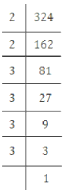
$324 = 2 \times 2 \times 3 \times 3 \times 3 \times 3$
$\sqrt{324}$ $= 18$ View full question & answer→Question 302 Marks
Find the smallest whole number with which $2800$ should be divided so as to get a perfect square. Also find the square root of the square number so obtained.
AnswerThe prime factorisation of $2800$ is $2800$ $= 2 \times 2 \times 2 \times 2 \times 5 \times 5 \times 7$
We see that prime factor $7$ has no pair.
So, if we divide $2800$ by $7$, then we get
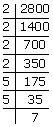
$2800$ $\div$ $7 = 2 \times 2 \times 2 \times 2 \times 5 \times 5$
Now each factor has a pair. Therefore, $2800$ $\div$ $7 = 400$ is a perfect square. Thus, the required smallest number is $7$.
Hence, $\sqrt {400} $ =$ 2$ $\times$ $2$ $\times$ $5 = 20$. View full question & answer→Question 312 Marks
Find the smallest whole number with which $2645$ should be divided so as to get a perfect square. Also find the square root of the square number so obtained.
AnswerThe prime factorisation of $2645$ is $2645 = 5$ $\times$ $23$ $\times$ $23$.
We see that prime factor $5$ has no pair. So, if we divide $2645$ by $5$, then we get

$\frac{2645 }{ 5}$ $= 23$ $\times$ $23$
Now the only prime factor $23$ has a pair. Therefore, $\frac{2645 }{ 5}$ $= 529$ is a perfect square. Thus the required smallest number is $5$.
Hence, $\sqrt {529} $ $= 23$. View full question & answer→Question 322 Marks
Find the smallest whole number with which $396$ should be divided so as to get a perfect square. Also find the square root of the square number so obtained.
AnswerThe prime factorisation of $396$ is $396 = 2 \times 2 \times 3 \times 3 \times 11$
We see that prime factor $11$ has no pair. So, if we divide $396$ by $11$, then we get

$\frac {396 }{ 11}$$= 2 \times 2 \times 3 \times 3$
Now each prime factor has a pair. Therefore, $\frac {396 }{ 11}$ $= 36$ is a perfect square. Thus, the required smallest number is $11$. View full question & answer→Question 332 Marks
Find the smallest whole number with which $2925$ should be divided so as to get a perfect square. Also find the square root of the square number so obtained.
AnswerThe prime factorisation of $252$ is $252 = 3$ $\times$ $3$ $\times$ $5$ $\times$ $5$ $\times$ $13$
We see that prime factor $13$ has no pair. So, if we divide $2925$ by $13$, then we get

$\frac {2925 }{ 13}$$= 3 \times 3 \times 5 \times 5$
Now each prime factor has a pair. Therefore, $\frac {2925 }{ 13}$ $= 225$ is a perfect square.
Thus, the required smallest number is $13$.
Hence, $\sqrt {225} $ $= 3$ $\times$ $5 = 15$. View full question & answer→Question 342 Marks
Find the smallest whole number with which $252$ should be divided so as to get a perfect square. Also find the square root of the square number so obtained.
AnswerThe prime factorisation of $252$ is $252 = 2$ $\times$ $2$ $\times$ $3$ $\times$ $3$ $\times$ $7$
We see that prime factor $7$ has no pair. So, if we divide $252$ by $7$, then we get

$\frac {252 }{ 7}$ $= 2$ $\times$ $2$ $\times$ $3$ $\times$ $3$
Now each prime factor has a pair. Therefore, $\frac {252 }{ 7}$ $= 36$ is a perfect square.
Thus, the required smallest number is $7$.
Hence, $\sqrt {36} $ $= 2$ $\times$ $3 = 6$. View full question & answer→Question 352 Marks
Find the smallest whole number with which $768$ should be multiplied so as to get perfect square number. Also find the square root of the square number so obtained.
AnswerThe prime factorisation of $768$ is $768 = 2 \times 2 \times 2 \times 2 \times 2 \times 2 \times 2 \times 2 \times 3$
As the prime factor $3$ has no pair, $768$ is not a perfect square.
If $3$ gets a pair, then the number will be a perfect square.
So, we multiply $768$ by $3$ to get
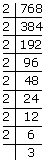
$768 \times 3 = 2 \times 2 \times 2 \times 2 \times 2 \times 2 \times 2 \times 2 \times3 \times 3$
Now each prime factor has a pair. Therefore, $768$ $\times$ $3 = 2304$ is a perfect square.
Thus the required smallest number is $3$.
Thus, $\sqrt {2304} $$= 48$. View full question & answer→Question 362 Marks
Find the smallest whole number with which $1458$ should be multiplied so as to get perfect square number. Also find the square root of the square number so obtained.
AnswerThe prime factorisation of $1458$ is $1458 = 2 \times 3 \times 3 \times 3 \times 3 \times 3 \times 3$
As the prime factor $2$ has no pair, $1458$ is not a perfect square.
If $2$ gets a pair, then the number will be a perfect square.
So, we multiply $1458$ by $2$ to get
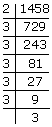
$1458 \times 2 = 2 \times 2 \times 3 \times 3 \times 3 \times 3 \times 3 \times 3$
Now each prime factor has a pair.
Therefore, $1458 \times 2 = 2916$ is a perfect square.
Thus the required smallest number is $2$.
Thus, $\sqrt {2916} $ $= 2$ $\times$ $3$ $\times$ $3$ $\times$ $3 = 54$ View full question & answer→Question 372 Marks
Find the smallest whole number with which $2028$ should be multiplied so as to get perfect square number. Also find the square root of the square number so obtained.
AnswerThe prime factorisation of $2028$ is $2028 = 2 \times 2 \times 3 \times 13 \times 13$
As the prime factor $3$ has no pair, $2028$ is not a perfect square.
If $3$ gets a pair, then the number will be a perfect square. So, we multiply $2028$ by $3$ to get

$2028$ $\times$ $3 = 2 \times 2 \times 3 \times 3 \times 13 \times 13$
Now each prime factor has a pair.
Therefore, $2028$ $\times$ $3 = 6084$ is a perfect square.
Thus the required smallest number is $3$.
Thus, $\sqrt {6084} $ $= 2$ $\times$ $3$ $\times$ $13 = 78$. View full question & answer→Question 382 Marks
Find the smallest whole number with which $1008$ should be multiplied so as to get perfect square number. Also find the square root of the square number so obtained.
AnswerThe prime factorisation of $1008$ is $1008 = 2 \times 2 \times 2 \times 2 \times 3 \times 3 \times 7$
As the prime factor$ 7$ has no pair, $1008$ is not a perfect square.
If 7 gets a pair, then the number will be a perfect square. So, we multiply $1008$ by $7$ to get
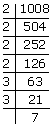
$1008 \times 7 = 2 \times 2 \times 2 \times 2 \times 3 \times 3 \times 7 \times 7$
Now each prime factor has a pair. Therefore, $1008 \times 7 = 7056$ is a perfect square. Thus the required smallest number is$ 7.$
Thus,$ \sqrt {7056} = 2 \times 2 \times 3 \times 7 = 87.$ View full question & answer→Question 392 Marks
Find the smallest whole number with which $180$ should be multiplied so as to get perfect square number. Also find the square root of the square number so obtained.
AnswerThe prime factorisation of $180$ is $180 = 2 \times 2 \times 3 \times 3 \times 5$
As the prime factor $5$ has no pair, $180$ is not a perfect square.
If $5$ gets a pair, then the number will be a perfect square. So, we multiply $180$ by $5$ to get

$180 \times 5 = 2 \times 2 \times 3 \times 3 \times 5 \times 5$
No each prime factor has a pair. Therefore, $180 \times 5 = 900$ is a perfect square.
Thus the required smallest number is $5$.
Thus, $\sqrt {900} = 2 \times 3 \times 5 = 30$. View full question & answer→Question 402 Marks
Find the smallest whole number with which $252$ should be multiplied so as to get perfect square number. Also find the square root of the square number so obtained.
AnswerThe prime factorisation of $252$ is $252 = 2 \times 2 \times 3 \times 3 \times 7$
As the prime factor $7$ has no pair, $252$ is not a perfect square.
If $7$ gets a pair, then the number will be a perfect square. So, we multiply $252$ by $7$ to get
$252 \times 7 = 2 \times 2 \times 3 \times 3 \times 7 \times 7$
Now each prime factor has a pair.
Therefore, $252 \times 7 = 1764$ is a perfect square.
Thus the required smallest number is $7$.
Thus, $\sqrt {1764} = 2 \times 3 \times 7 = 42$ View full question & answer→Question 412 Marks
Find the square root of $529$ by the Prime Factorisation Method.
AnswerThe prime factorisation of $529$ is
$529 = 23$ $\times $ $23$
By pairing the prime factors, we get

$529 = 23$ $\times $ $23$
So, $\sqrt {529} $ $= 23$ View full question & answer→Question 422 Marks
Find the square root of $9216$ by the Prime Factorisation Method.
AnswerThe prime factorisation of $9216$ is
$9216 = 2 \times 2 \times 2 \times 2 \times 2 \times 2 \times 2 \times 2 \times 2 \times 2 \times 3 \times 3$
By pairing the prime factors, we get
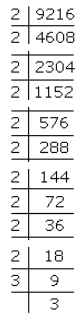
$9216 = 2 \times 2 \times 2 \times 2 \times 2 \times 2 \times 2 \times 2 \times 2 \times 2 \times 3 \times 3$
So, $\sqrt {9216} = 2 \times 2 \times 2 \times 2 \times 2 \times 3$ View full question & answer→Question 432 Marks
Find the square root of $5929$ by the Prime Factorisation Method.
AnswerThe prime factorisation of $5929$ is
$5929 = 7 \times 7 \times 11 \times 11$
By pairing the prime factors, we get

$5929 = 7 \times 7 \times 11 \times 11$
So, $\sqrt {5929} = 7 \times 11 = 77$ View full question & answer→Question 442 Marks
Find the square root of $9604$ by the Prime Factorisation Method.
AnswerThe prime factorisation of $9604$ is
$9604 = 2 \times 2 \times 7 \times 7 \times 7 \times 7$
By pairing the prime factors, we get
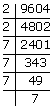
$9604 = 2 \times 2 \times 7 \times 7 \times 7 \times 7$
So, $\sqrt {9604} = 2 \times 7 \times 7 = 98$ View full question & answer→Question 452 Marks
Find the square root of $7744$ by the Prime Factorisation Method.
AnswerThe prime factorisation of $7744$ is
$7744 = 2 \times 2 \times 2 \times 2 \times 2 \times 2 \times 11 \times 11$
By pairing the prime factors, we get
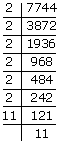
$7744 = 2 \times 2 \times 2 \times 2 \times 2 \times 2 \times 11 \times 11$
So, $\sqrt {7744} = 2 \times 2 \times 2 \times 11 = 88$ View full question & answer→Question 462 Marks
Find the square root of $4096$ by the Prime Factorisation Method.
Answer$4096$
The prime factorisation of $4096$ is
$4096 = 2 \times 2 \times 2 \times 2 \times 2 \times 2 \times 2 \times 2 \times 2 \times 2 \times 2 \times 2$
By pairing the prime factors, we get
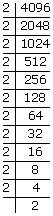
$4096 = 2 \times 2 \times 2 \times 2 \times 2 \times 2 \times 2 \times 2 \times 2 \times 2 \times 2 \times 2$
So, $\sqrt {4096} = 2 \times 2 \times 2 \times 2 \times 2 \times 2 = 64$ View full question & answer→Question 472 Marks
Find the square root of $1764$ by the Prime Factorisation Method.
Answer$1764$
The prime factorisation of $1764$ is
$1764 = 2 \times 2 \times 3 \times 3 \times 7 \times 7$
By pairing the prime factors, we get
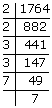
$1764 = 2 \times 2 \times 3 \times 3 \times 7 \times 7$
So, $\sqrt {1764} = 2 \times 3 \times 7= 42$ View full question & answer→Question 482 Marks
Find the square root of $400$ by the Prime Factorisation Method.
Answer$400$
The prime factorisation of $400$ is
$400 = 2 \times 2 \times 2 \times 2 \times 5 \times 5$
By pairing the prime factors, we get
$400 = 2 \times 2 \times 2 \times 2 \times 5 \times 5$
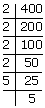
Therefore, $\sqrt {400} = 2 \times 2 \times 5 = 20$ View full question & answer→Question 492 Marks
Find the square root of $8100$ by the Prime Factorisation Method.
AnswerThe prime factorisation of $8100$ is
$8100 = 2 \times 2 \times 3 \times 3 \times 3 \times 3 \times 5 \times 5 $
By pairing the prime factors, we get
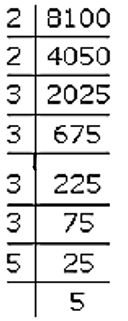
$8100 = 2 \times 2 \times 3 \times 3 \times 3 \times 3 \times 5 \times 5$
So, $\sqrt {8100} = 2 \times 3 \times 3 \times 5 = 90.$ View full question & answer→Question 502 Marks
Find the square root of $729$ by the Prime Factorisation Method.
AnswerThe prime factorisation of $729$ is
$729 = 3 \times 3 \times 3 \times 3 \times 3 \times 3$
By pairing the prime factors, we get
$729 = 3 \times 3 \times 3 \times 3 \times 3 \times 3$
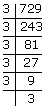
So, $\sqrt {729} = 3 \times 3 \times 3 = 27$ View full question & answer→