MCQ 1011 Mark
What is the perpendicular drawn at any point on a mirror called?
AnswerThe perpendicular drawn to the reflecting surface of a mirror at the point of incidence is called 'normal'. The point on the reflecting surface where the light ray is incident is called the point of incidence.
View full question & answer→MCQ 1021 Mark
A ray of light is incident on a plane mirror at an angle of $60^\circ$. What is the angle of deviation?
- ✓
$60^\circ$
- B
$30^\circ$
- C
$90^\circ$
- D
$180^\circ$
AnswerCorrect option: A. $60^\circ$
View full question & answer→MCQ 1031 Mark
We are able to see an object due to the presence of:
MCQ 1041 Mark
Statement $I:$ The phenomenon of left appearing right and right appearing left on reflection in a plane mirror is called later inversion.
Statement $II:$ Number of images formed for an object kept in between two mirror placed at angle $90^\circ$ to each other are $3.$
- A
Both Statements are true, Statement$-II$ is the correct explanation of Statement$-I.$
- ✓
Both Statements are true. Statement$-II$ is not correct explanation of Statement$-I.$
- C
Statement$-I$ is true, Statement$-II$ is false.
- D
Statement$-I$ is false, Statement$-II$ is true.
AnswerCorrect option: B. Both Statements are true. Statement$-II$ is not correct explanation of Statement$-I.$
View full question & answer→MCQ 1051 Mark
If refractive indices of glass and water are respectively $\frac{3}{2}$ and $\frac{4}{2}$, then the refractive index of glass with respective to water is.
- A
$2$
- B
$\frac{8}{9}$
- ✓
$\frac{9}{8}$
- D
$\frac{1}{2}$
AnswerCorrect option: C. $\frac{9}{8}$
View full question & answer→MCQ 1061 Mark
A clock hung on a wall of a hall has marks instead of numerals on its dial. On the opposite wall, there is a plane mirror and the image of the clock in the mirror indicates the time $7.40.$ hence, the time on the clock is.
- A
$7.40$
- ✓
$4.20$
- C
$5.40$
- D
$10.7$
AnswerCorrect option: B. $4.20$
View full question & answer→MCQ 1071 Mark
How does the eye change in order to focus on near or distant objects?
- A
The lens moves in or out.
- B
The retina moves in or out.
- ✓
The lens becomes thicker or thinner.
- D
The pupil becomes larger or smaller.
AnswerCorrect option: C. The lens becomes thicker or thinner.
The shape of the lens is changed by ciliary muscles so that the image forms at a sharp focus at the retina. The lens becomes thicker to focus at near objects and becomes thinner to focus at distant objects.
View full question & answer→MCQ 1081 Mark
Statement $I:$ The reflected ray formed by the plane mirror which is rotated with angle $\theta$ is shifted through an angle of $2\theta$.
Statement $II:$ Reflected ray rotates with an angle of $2\theta$ if the mirror rotates with $\theta$.
- ✓
Both Statements are true, Statement$-II$ is the correct explanation of Statement$-I.$
- B
Both Statements are true. Statement$-II$ is not correct explanation of Statement$-I.$
- C
Statement$-I$ is true. Statement$-II$ is false.
- D
Statement$-I$ is false, Statement$-II$ is true.
AnswerCorrect option: A. Both Statements are true, Statement$-II$ is the correct explanation of Statement$-I.$
View full question & answer→MCQ 1091 Mark
Three light bulbs are concealed from an observer by an opaque wall as shown. Without shifting the positions of the observer and the bulbs, the images of which of the bulbs can the observer see from the plane mirror?
- A
$P$ and $P$
- ✓
$P$ and $Q$
- C
Only $P$
- D
$Q$ and $R$
AnswerCorrect option: B. $P$ and $Q$
Bulbs $P$ and $Q$ lies in the plane of incidence of mirror while bulb $R$ does not. Thus, only the images of the bulbs $P$ and $Q$ can be seen by the observer from the plane mirror.
View full question & answer→MCQ 1101 Mark
Which of the following occurs in persons suffering from myopia?
- A
The eye ball is shortened.
- B
Ciliary muscles contract.
- ✓
- D
AnswerA person suffering from myopia has elongation of the eye ball. As such he cannot see distant objects clearly. A suitable concave lens can rectify the above defect, so that the image falls on the retina.
View full question & answer→MCQ 1111 Mark
Rainbow is a natural phenomenon showing.
MCQ 1121 Mark
Read the following sentences carefully, and choose the correct one:
- A
Periscope is used to see over the heads of a crowd.
- B
Periscope is used by soldiers sitting in a trench to observe the enemy activities outside.
- C
Periscope is used by a navy officer sitting in a submarine to see ships over the surface of water in the sea.
- ✓
AnswerHere, all the statements are correct.
View full question & answer→MCQ 1131 Mark
Which of the following ray diagrams shown below shows respectively the short sightedness condition and its correctness by using a lens?
$i.$ 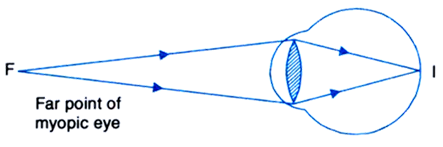
$ii.$ 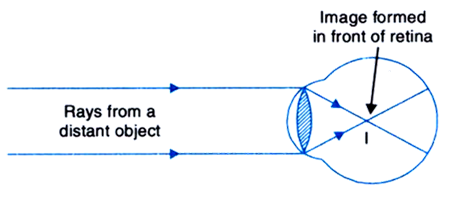
$iii.$ 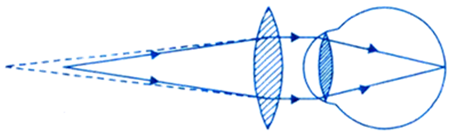
$iv.$ 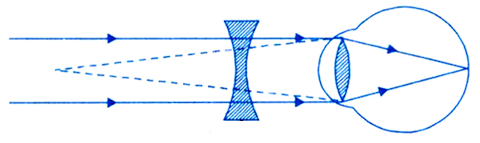
- A
$(i)$ and $(iv)$
- B
$(i)$ and $(iii)$
- ✓
$(ii)$ and $(iv)$
- D
$(ii)$ and $(iii)$
AnswerCorrect option: C. $(ii)$ and $(iv)$
In short sightedness image is formed in front of the retina and short sightedness can be corrected by using a concave lens.
View full question & answer→MCQ 1141 Mark
The change in converging power of an eye$-$lens is caused by the action of:
AnswerWe can clearly view an object only when image is clearly reflected on retina. Our eyes focus distinct and near objects and reflects the image on retina. When eyes need to focus distinct object, then ciliary muscles reflex which increases the focal length. The eye lens converges the light and the objects are said to be unaccommodated. When eyes need to focus nearby object, then ciliary muscles relax which decreases the focal length. The eye lens diverges the light and the objects are said to be accommodated. The accommodation power of eyes is as close as $25 \ cm$ and as far as infinity.
View full question & answer→MCQ 1151 Mark
A small boy places a paper written $'\text{PAPYRUS}'$ in front of a plane mirror. He finds that it appears totally inverted in opposite direction. He gets confused. He goes to his mother and tells his problem. His mother explains him the exact reason for this. The exact reason could be$..........$
View full question & answer→MCQ 1161 Mark
Statement $I:$ All the light rays actually converge at some point.
Statement $II:$ All the light rays appears to converge at some point.
- A
Both Statements are true. Statement$-II$ is the correct explanation of Statement$-I.$
- B
Both Statements are true, Statement$-II$ is not correct explanation of Statement$-I.$
- C
Statement$-I$ is true, Statement$-II$ is false.
- ✓
Statement$-I$ is false, Statement$-II$ is true.
AnswerCorrect option: D. Statement$-I$ is false, Statement$-II$ is true.
View full question & answer→MCQ 1171 Mark
If the angle of incidence of light falling on a plane mirror is 30degree, what will be the angle of reflection$?$
- A
$90$ degree
- B
$60$ degree
- ✓
$30$ degree
- D
$0$ degree
AnswerCorrect option: C. $30$ degree
View full question & answer→MCQ 1181 Mark
A When the angle between two plane mirrors is $60^\circ ,$ how many images will be formed by the mirrors$?$
AnswerIf two plane mirrors are inclined at an angle of $60^\circ ,$ then
$\text{n} = \frac{360}{60} -1=5$
images are formed.
View full question & answer→MCQ 1191 Mark
For a normal eye, in an adult, what is the least distance of distinct vision$?$
- A
$5$ to $8\ cm.$
- B
$10$ to $15\ cm.$
- ✓
$20$ to $25\ cm.$
- D
$30$ to $35\ cm.$
AnswerCorrect option: C. $20$ to $25\ cm.$
The point nearest to the eye at which an object is distinctly visible is called the near point of the eye. The distance of the near point of the eye is called the least distance of distinct vision. It varies with age. For an infant, it is $5$ to $8\ cm,$ for an adult, it is $20$ to $25\ cm.$
View full question & answer→MCQ 1201 Mark
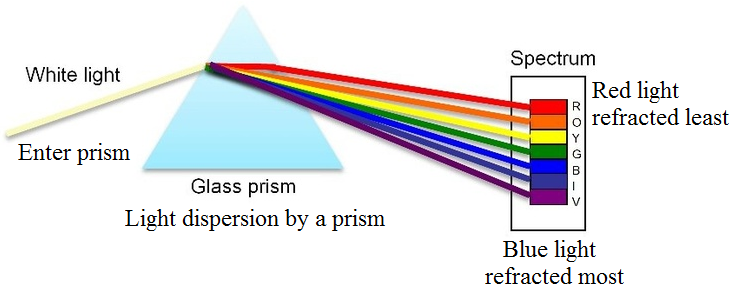
When the white light is allowed to pass through the glass prism it under goes dispersion and splits up into its constituent colours. Which colour of the light show minimum refraction?
MCQ 1211 Mark
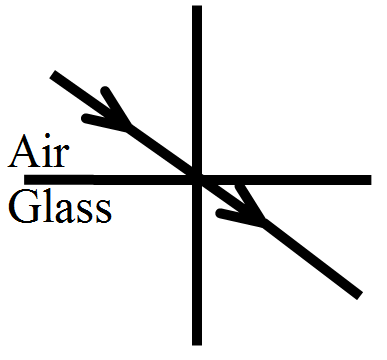
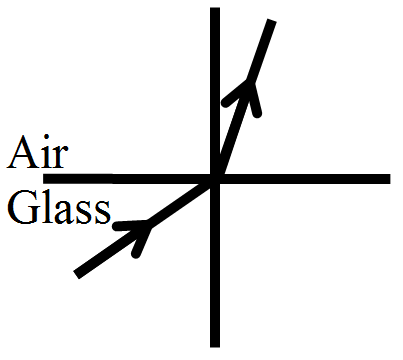
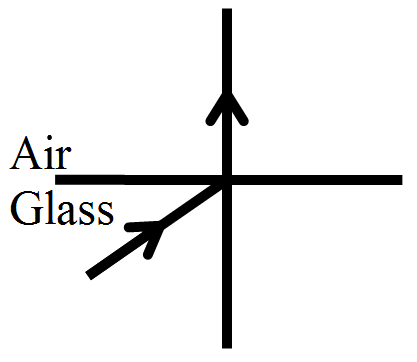
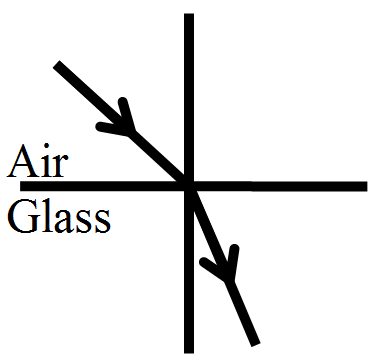
The second medium is optically denser.
- ✓
Ray bends towards normal.
- B
Ray bends away from normal.
- C
- D
AnswerCorrect option: A. Ray bends towards normal.
View full question & answer→MCQ 1221 Mark
Which of the following is the requirement of nocturnal animals like owl an bat?
- A
- B
- C
Retina with large number of rods.
- ✓
AnswerThe nocturnal animals need more light to see at night. The large cornea and pupil allow more light to enter into their eyes. They also have retina with large number of rods.
View full question & answer→MCQ 1231 Mark
The human eye forms the image of an object at its:
AnswerThe image of an object is formed at the retina of an eye which is the third and the innermost coat of an eye. Light rays are focused on the retina by cornea, lens and the pupil.
View full question & answer→MCQ 1241 Mark
An incident ray makes an angle of $65^\circ $ with the surface of a plane mirror. The angle of reflection in this case will be:
- A
$65^\circ $
- B
$45^\circ$
- C
$25^\circ$
- ✓
$35^\circ$
AnswerCorrect option: D. $35^\circ$
Angle of incidence is always equal to angle of refection. Hence, angle of reflection will be $35^\circ .$
View full question & answer→MCQ 1251 Mark
Which one of the following is correct?
AnswerLight is refracted towards the normal when it goes from a rarer medium to a denser medium.
View full question & answer→MCQ 1261 Mark
A ray of light is incident on a plane mirror at an angle of incidence of $30\ ?.$ The deviation produced by the mirror is:
- A
$30^\circ$
- B
$60^\circ$
- C
$90^\circ$
- ✓
$120^\circ$
AnswerCorrect option: D. $120^\circ$
View full question & answer→MCQ 1271 Mark
What is the phenomenon of light bouncing back into the same medium called?
AnswerThe phenomenon of light in which, light is reflected or bounced back into the same medium is called reflection.
View full question & answer→MCQ 1281 Mark
What is the nature of image formed on the retina of human eye of an object?
AnswerThe human eye serves as a convex lens. It forms real, inverted and diminished image of an object.
View full question & answer→MCQ 1291 Mark
Reflection is possible in case of.
- ✓
- B
- C
Both $(a)$ and $(b)$
- D
Neither $(a)$ nor $(b)$
View full question & answer→MCQ 1301 Mark
The spherical surfaces that have a property of reflection and that are highly polished are called.
MCQ 1311 Mark
A ray of light incident on a refracting surface. If the angle of incidence $60^\circ$ and the angle of refraction is $45^\circ$, then angle of deviation is.
- A
$30^\circ$
- B
$90^\circ$
- ✓
$15^\circ$
- D
$0^\circ$
AnswerCorrect option: C. $15^\circ$
$\text{d}=\text{i}=\text{r};$
$\text{d}= 15^\circ$
View full question & answer→MCQ 1321 Mark
A ray of light that falls on an eye first passes through the.
MCQ 1331 Mark
In the above problem, find the position of lower edge of the mirror relative to the ground is.
- A
$160\ cm$
- B
$75\ cm$
- ✓
$100\ cm$
- D
$200\ cm$
AnswerCorrect option: C. $100\ cm$
Height of the lower edge from ground $= h/ 2, h \rightarrow $ height of eyes from ground.
View full question & answer→MCQ 1341 Mark
A car or a truck driver always prefers a convex mirror in his vehicle. This is due to the fact that, the image formed in the convex mirror is always$..........$
View full question & answer→MCQ 1351 Mark
Consider the following statements and choose the correct one:
AnswerHere, all the statements are correct.
View full question & answer→MCQ 1361 Mark
A prism splits up light into different colours but a glass slab does not show dispersion because:
- A
The emergent ray is deviated from the direction of the incident ray by the angle of deviation.
- ✓
The incident and emergent rays are parallel to each other.
- C
The emergent ray is laterally displaced from glass slab and changes its direction.
- D
The incident and emergent rays are not parallel to each other.
AnswerCorrect option: B. The incident and emergent rays are parallel to each other.
Dispersion occurs when light is passed through a prism due to the difference in the angle of deviation for different colours. The opposite sides of a glass slab are parallel and therefore different colors emerge parallel to each other and are seen simultaneously.
View full question & answer→MCQ 1371 Mark
The diagram shows the path of a light ray $X,$ directed at a plane mirror.
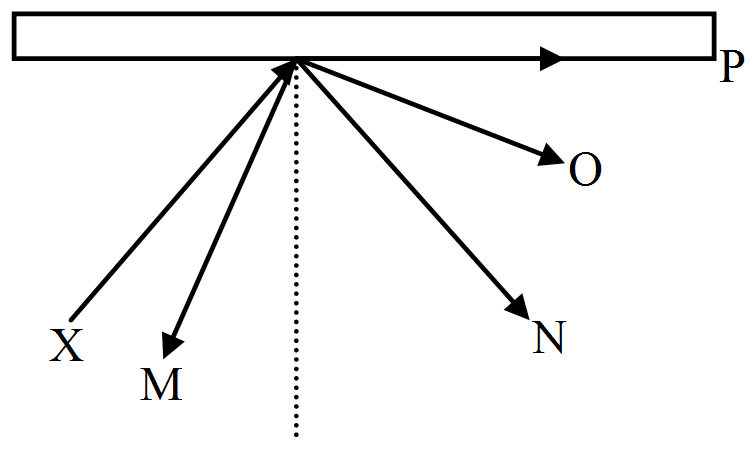
Which of the following is the correct reflected ray$?$ AnswerWe know that for a reflected ray, the angle that the incident ray makes with the line perpendicular to the surface is equal to the angle made by the reflected ray with this perpendicular line. $N$ is the correct reflected ray of $X.$
View full question & answer→MCQ 1381 Mark
Light of the wave length $7200\mathring{\text{A}}$ in air has a wave length in glass is equal to $(\mu =1.5)$.
- A
$7200\mathring{\text{A}}$
- ✓
$4800\mathring{\text{A}}$
- C
$1080\mathring{\text{A}}$
- D
$3600\mathring{\text{A}}$
AnswerCorrect option: B. $4800\mathring{\text{A}}$
$\frac{\mu_\text{m}}{\mu_\text{a}} = \frac{\lambda_\text{c}}{\lambda_\text{m}};$
$\frac{3}{2}=\frac{7200\mathring{\text{A}}}{\lambda_\text{m}};$
$\lambda_\text{m} = 2 \times 2400\mathring{\text{A}}$
$= 4800\mathring{\text{A}}$
View full question & answer→MCQ 1391 Mark
Identify the part of the human eye on which different images are formed.
AnswerImages are formed on the retina.
View full question & answer→MCQ 1401 Mark
Identify the nature of the image formed by the eye lens of a human eye.
- A
Real, upright and enlarged.
- B
Real, upright and diminished.
- ✓
Real, inverted and diminished.
- D
Virtual, inverted and diminished.
AnswerCorrect option: C. Real, inverted and diminished.
The image formed on the retina is real, inverted and diminished. The optic nerve transmits the inverted image to the brain which reads it as an erect image.
View full question & answer→MCQ 1411 Mark
If the velocity of light in vacuum is $c\ m/ s,$ then the velocity of light in a medium of refractive index $1.5$ is $..............$
- A
$1.5 \times c$
- B
$c$
- ✓
$\frac{\text{c}}{1.5}$
- D
AnswerCorrect option: C. $\frac{\text{c}}{1.5}$
View full question & answer→MCQ 1421 Mark
The virtual images are the image which cannot be obtained on the screen. Identify the virtual image from the figure given below:
- A
$-\frac{7}{3}$
- B
$-\frac{8}{7}$
- C
$\Big(-\frac{7}{8}\Big)$
- ✓
$\frac{4}{9}$
AnswerCorrect option: D. $\frac{4}{9}$
View full question & answer→MCQ 1431 Mark
Which of the following statements are correct regarding the image formed by a concave lens$?$
$i.$ The nature of image does not change much with the change in the object distance.
$ii.$ Always a virtual image is formed.
$iii.$ The image is larger in size.
$iv.$ Image is never formed between the optical centre and the focus.
- A
Only $(i), (ii)$ and $(iii).$
- ✓
Only $(i)$ and $(ii).$
- C
Only $(iii)$ and $(iv)$
- D
Only $(ii), (iii)$ and $(iv).$
AnswerCorrect option: B. Only $(i)$ and $(ii).$
View full question & answer→MCQ 1441 Mark
As the angle between two plane mirrors is decreased gradually, the number of images of an object placed between them:
- ✓
- B
- C
First increases then decreases.
- D
First decreases then increases.
AnswerWhen the angle between mirrors is $180^\circ $ then only single image is obtained. If the angle decreases, then the number of images increases. If the angle increases, then the number of images decreases. And when the angle between two plane mirrors become $0$ degree, that is, when the two plane mirrors become parallel to each other then, an infinite number of images are formed.
View full question & answer→MCQ 1451 Mark
An object is placed $40\ cm$ in front of a convex mirror of radius of curvature, $20\ cm.$ The image:
- A
Is real and $8\ cm$ behind the mirror.
- B
Is real and $8\ cm$ in front of the mirror.
- C
Is virtual and $8\ cm$ in front of the mirror.
- ✓
Is virtual and $8\ cm$ behind the mirror.
AnswerCorrect option: D. Is virtual and $8\ cm$ behind the mirror.
View full question & answer→MCQ 1461 Mark
When a light ray passes from one medium $(\mu_1)$ to other medium $(\mu_2)$. Refraction does not take place in the following situation.
- ✓
- B
$\mu_1 > \mu_2$
- C
$\mu_1 = \mu_2$
- D
$\mu_1 < \mu_2$
Answerif $\text{i} =0^\circ$then $\text{r}=0^\circ$
if $\mu_1 =\mu_2 $ then $\text{i} = \text{r}$
View full question & answer→MCQ 1471 Mark
If two plane mirrors are inclined at an angle of $40^\circ ,$ number of images formed will be:
View full question & answer→MCQ 1481 Mark
The size of the pupil of the eye is adjusted by:
AnswerThe muscles of the iris dilate and constrict the pupil and thus increases and reduces the amount of light entering the eye.
View full question & answer→MCQ 1491 Mark
The angle between the reflected ray and the nor:
MCQ 1501 Mark
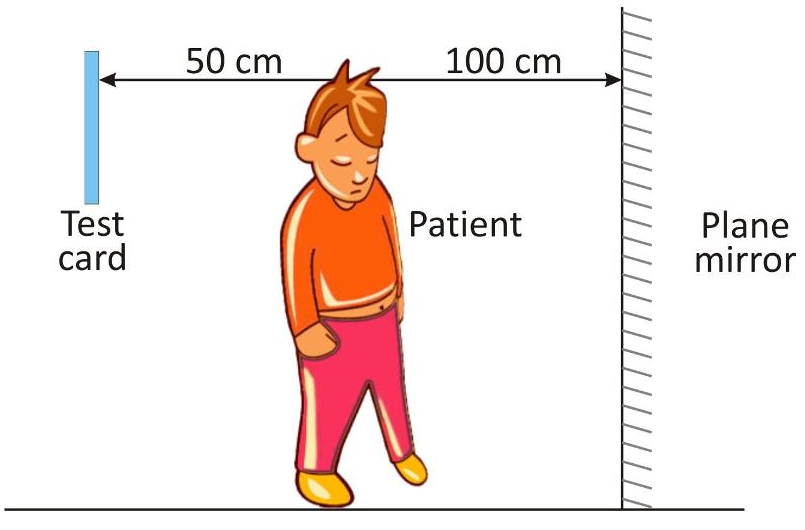
An optician holds a test card $50\ cm$ behind a patient. The patient then looks in the plane mirror which is $100\ cm$ away. How far away from the patient's eyes is the image of the test card?
- A
$100\ cm$
- B
$150\ cm$
- C
$200\ cm$
- ✓
$250\ cm$
AnswerCorrect option: D. $250\ cm$
Object distance $= 150\ cm$
$\therefore$ Image distance $= 150\ cm$ (as in plane mirror, object distance is always equal to the image distance)
The patient is $100\ cm$ away from the mirror.
So, the distance between the patient's eyes and the image $= 100\ cm + 150\ cm = 250\ cm$
View full question & answer→