- A$8\ cm$
- B$36\ cm$
- C$4\ cm$
- ✓$6\ cm$
$\Rightarrow(\text{side})^2=\frac{9\sqrt{3}\times4}{\sqrt{3}}=36$
$\therefore\ \text{side}=\pm\sqrt{36}=6\text{cm}$
9 questions · timed · auto-graded
Area of equilateral $\triangle=\frac{\sqrt{3}}{4}(\text{side})^2$
$=\frac{\sqrt{3}}{4}\big(2\sqrt{3}\big)^2=3\sqrt{3}=3\times1.732$
$=5.196\text{cm}^2$
Since, the three sides of a triangle are $a = 56\ cm, b = 60\ cm$ and $c = 52\ cm$
Then, semi-perimeter of a triangle,
$\text{s}=\frac{\text{a}+\text{b}+\text{c}}{2}=\frac{56+60+52}{2}=\frac{168}{2}=84\text{cm}$
Area of triangle $=\sqrt{\text{s}(\text{s}-\text{a})(\text{s}-\text{b})(\text{s}-\text{c})}$ [by Heron's formula]
$=\sqrt{84(84-56)(84-60)(84-52)}$
$=\sqrt{4\times7\times3\times4\times7\times4\times2\times3\times4\times4\times2}$
$=\sqrt{(4)^6\times(7)^2\times(3)^2}$
$=(4)^3\times7\times3=1344\text{cm}^2$
Hence, the area of triangle is $1344 \mathrm{~cm}^2$
Since, the edges of a triangular are $a = 6\ cm, b = 8\ cm$ and $c = 10\ cm$
Now, semi-perimeter of a triangular board.
$\text{s}=\frac{\text{a}+\text{b}+\text{c}}{2}$
$=\frac{6+8+10}{2}=\frac{24}{2}=12\text{cm}$
Now, area of a triangular board $=\sqrt{\text{s}(\text{s}-\text{a})(\text{s}-\text{b})(\text{s}-\text{c})}$
$=\sqrt{12(12-6)(12-8)(12-10)}$
$=\sqrt{12\times6\times4\times2}$
$=\sqrt{(12)^2\times(2)^2}$
$=12\times2=24\text{cm}^2$
Since, the cost of painting for area $1 \mathrm{~cm}^2=$ $Rs.\ 0.09$
$\therefore$ Cost of paint for area $24 \mathrm{~cm}^2=0.09 \times 24=$ $Rs.\ 2.16$
Hence, the cost of a triangular board is $Rs.\ 2.16$
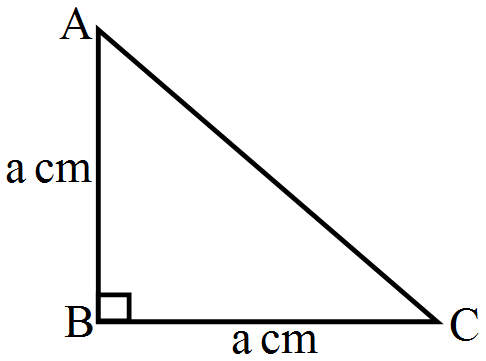
$ABC$ is an isosceles right triangle. We have,

$\text{AB}=\text{BC}=\text{a cm}$
Area of $\triangle=\frac{1}{2}\text{base}\times\text{Height}$
$\Rightarrow\ 8=\frac{1}{2}\times\text{a}\times\text{a}$ $\big[\because\ \text{AB}=\text{BC}=\text{a cm}\big]$
$\Rightarrow\ \text{a}^2=16$ $\therefore\ \text{a}=+\sqrt{16}=4\text{cm}$
Using Pythagoras theorem,
Hypotenuse $\text{AC}=\sqrt{4^2+4^2}$
$=\sqrt{16+16}=\sqrt{32}\text{cm}$