Only a unique line can be drawn through a given point.
B
Infinitely many lines can be drawn through two given points.
✓
If two circles are equal, then their radii are equal.
D
A line has a definite length.
Answer
Correct option: C.
If two circles are equal, then their radii are equal.
In option $(a)$, infinite number of line can be drawn to pass through a given point. So, it is not a true statement.
In option $(b)$, only one line can be drawn to pass through two given points. So, it is not a true statement.
In option $(c)$,
'If two circles are equal, then their radii are equal' is the true statement.
In option $(d)$, A line has no end points. A line has an indefinite length. So, it is not a true statement.
In ancient India, the shapes of altars used for household rituals were:
A
Squares and rectangles.
✓
Squares and circles.
C
Triangles and rectangles.
D
Trapeziums and pyramids.
Answer
Correct option: B.
Squares and circles.
Squares and circular altars were used for household rituals.
Whereas altars having shapes as combinatiotanglens of recs, triangles and trapeziums were used for public worship.
The floor and a wall of a room are parallel planes.
B
The ceiling and a wall of a room are parallel planes.
✓
The floor and the ceiling of a room are parallel planes.
D
Two adjacent walls of a room are parallel planes.
Answer
Correct option: C.
The floor and the ceiling of a room are parallel planes.
Two lines are said to be parallel, if they have no point in common.
Options $(a), (b)$ and $(d)$ have a common point, hence they are not parallel.
In option $(c)$, the floor and the ceiling of a room are parallel to each other is a true statement.
Euclid stated that 'all right angles are equal to each other', in the form of:
A
A definition.
✓
An axiom.
C
A postulate.
D
A proof.
Answer
Correct option: B.
An axiom.
Euclid stated that 'All right angles are equal to each other' in the form of a postulate.
This is Euclid's Postulate $4$. Note: The answer in the book is option $(a)$. But if you have a look at the Euclid's postulate, the answer is a postulate.
Option $(a)$ is true, since we can pass an infinite number of lines through a given point.
Option $(b)$ is true, since a unique line can be drawn to pass through two given points.
Consider option $(c)$.
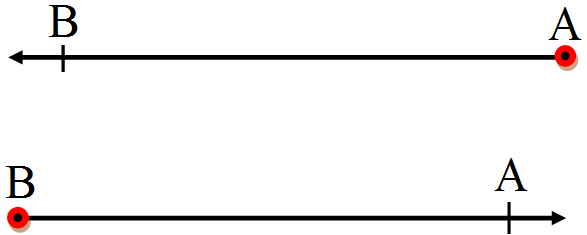
A ray is a line segment that extends indefinitely in one direction as shown below.
$\text{Ray }\overrightarrow{\text{AB}}=\text{ray}\ \overrightarrow{\text{BA}}$ is a false statement since clearly the lines extend indefinitely.
As shown in the above diagram, a ray has only one end-point. So, option $(d)$ is true.
Hence, the only false statement is option $(c)$.
A point $C$ is called the mid-point of a line segment $\overrightarrow{\text{AB}}$ if.
A
$C$ is an interior point of $AB$.
B
$AC = CB$.
✓
$C$ is an interior point of $AB$ such that $\overrightarrow{\text{AC}}=\overrightarrow{\text{CB}}.$
D
$AC + CB = AB$.
Answer
Correct option: C.
$C$ is an interior point of $AB$ such that $\overrightarrow{\text{AC}}=\overrightarrow{\text{CB}}.$
point $C$ is called the midpoint of a line segment $\overline{\text{AB}},$ if $C$ is an interior point of $AB$ such that $\overline{\text{AC}}=\overline{\text{CB}}.$
A is of the same age as $B$ and $C$ is of the same age as $B$. Euclid's which axiom illustrates the relative ages of $A$ and $C$?
✓
Frist axiom.
B
Second exiom.
C
Third axiom.
D
Fourth axiom.
Answer
Correct option: A.
Frist axiom.
Euclid's first axiom states that 'Things which are equal to the same thing are equal to one another'.
That is,
$A'$s age = $B'$s age and $C'$s age = $B'$ age
$\Rightarrow A'$s age = $C'$s age