Questions

3 Marks Question

🎯

Test yourself on this topic

5 questions · timed · auto-graded

Question 13 Marks
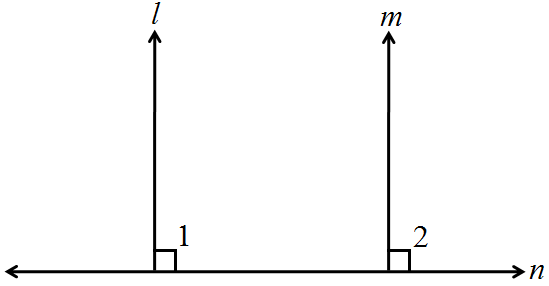
Two lines l and m are perpendicular to the same line n. Are l and m perpendicular to each other? Give reason for your answer.
Answer
No, since, lines l and m are perpendicular to the line n. $\angle1=\angle2=90^\circ[\therefore\ \text{l}\perp\text{n}\ \text{and}\ \text{min}]$ It implies that these are corresponding angles. Hence, $\text{l}||\text{m}$
View full question & answer
Question 23 Marks
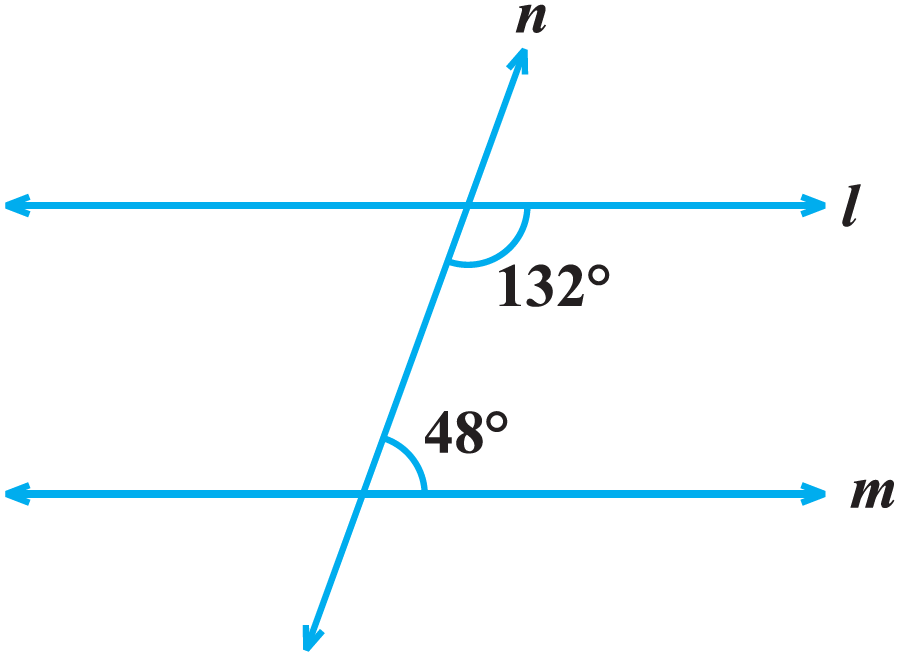
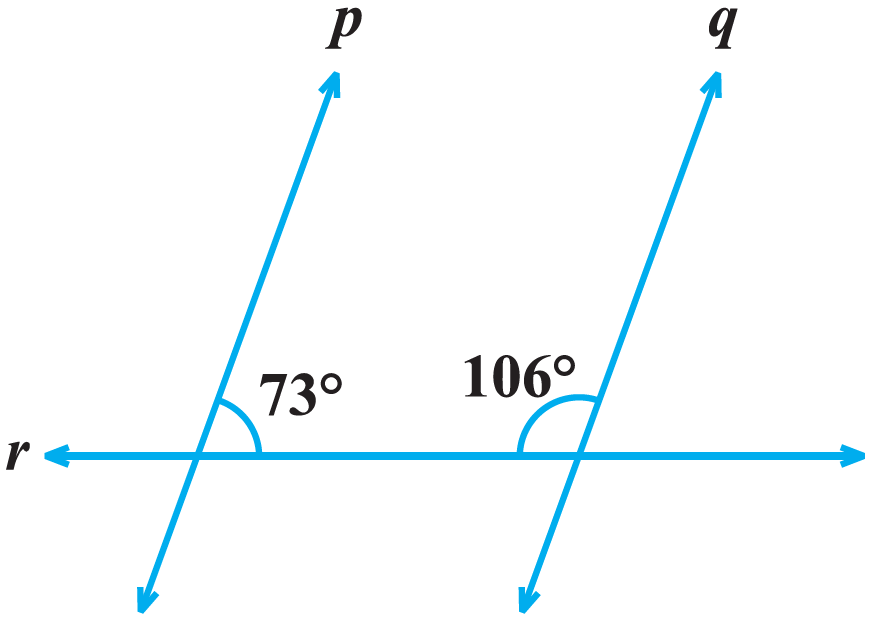
In Fig.which of the two lines are parallel and why?
Answer
$i.$ Sum of two interior angles $132^{\circ}+48^{\circ}=180^{\circ}\left[\therefore\right.$ equal to $\left.180^{\circ}\right]$
Here, we see that the sum of two interior angles on the same side of $n$ is $180^{\circ}$, then they are the parallel line.
$ii.$ The sum of two interior angles $73^{\circ}+106^{\circ}=179^{\circ} \neq 180^{\circ}$.
Here, we see that the sum of two interior angles on same side of $r$ is not equal to $180^{\circ}$, then they are not the parallel lines.
View full question & answer
Question 33 Marks
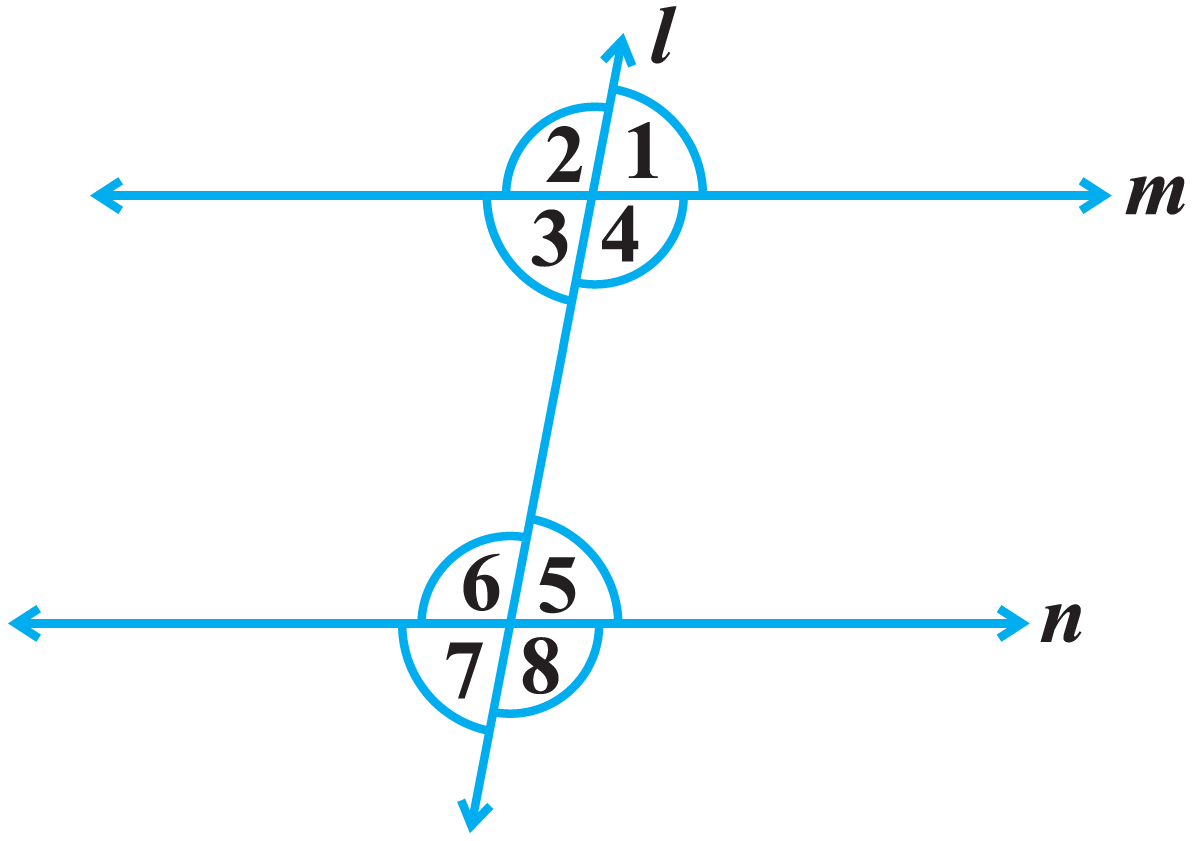
In Fig.$\angle1=60^\circ$ and $\angle6=120^\circ$ Show that the lines m and n are parallel.
Answer
We have, $\angle5+\angle6=180^\circ$ [linear pair Angles]
$\Rightarrow \angle5+120^\circ=180^\circ$
$\Rightarrow \angle5=180^\circ-120^\circ=60^\circ$ Now, $\angle1=\angle5$
$[\text{Each}=60^\circ]$ But, these are corresponding angles.
Therefore, the lines m and n are parallel.
View full question & answer
Question 43 Marks
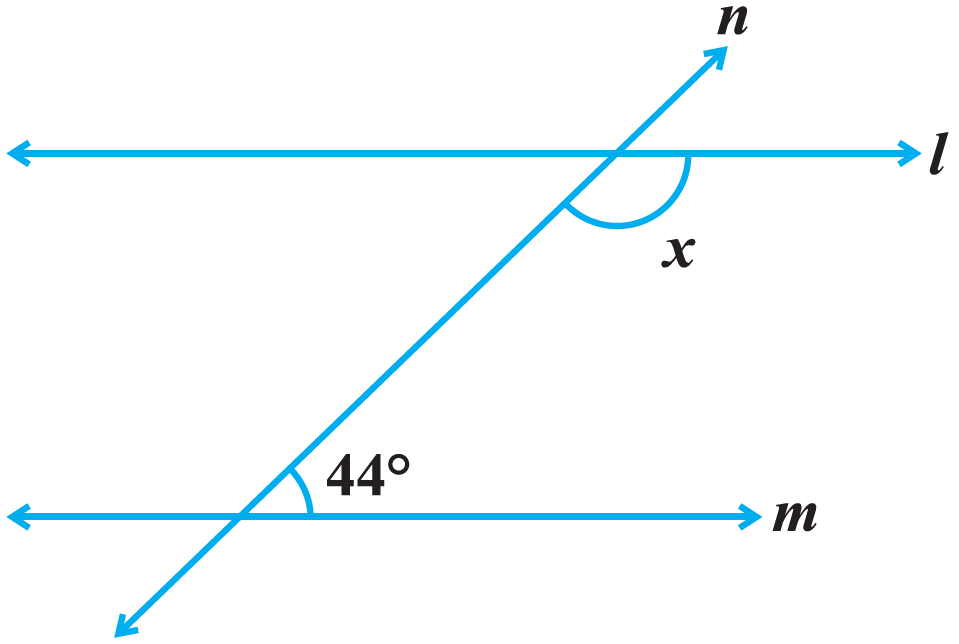
In Fig. find the value of $x$ for which the lines l and m are parallel.
Answer
If a transversal intersects two parallel lines, then each pair of consecutive interior angles are supplementary. Here, the two given lines I and m are parallel. Angles x and $44^{\circ}$, are consecutive interior angles on the same side of the transversal. Therefore, $x +$ $44^{\circ}=180^{\circ}$ Hence, $x=180^{\circ}-44^{\circ}=136^{\circ}$
View full question & answer
Question 53 Marks
Prove that a triangle must have atleast two acute angles.
Answer
If the triangle is an acute angled triangle, then all its three angles are acute angle. Each of these angles is less than $90^{\circ}$, so they can make three angles sum equal to $180^{\circ}$.
If a triangle is a right triangle, then one angle which is right angle will be equal to $90^{\circ}$ and the other two acute angles can make the three angles sum equal to $180^{\circ}$.
View full question & answer
3 Marks Question - MATHS STD 9 Questions - Vidyadip