Questions

M.C.Q (1 Marks)

Take a timed test

156 questions · auto-graded multiple-choice test.

MCQ 11 Mark
An important criterion for modern day classification is:
  • A
    Resemblances in Morphology.
  • Anatomical and physiological traits.
  • C
    Breeding habits.
  • D
    Presence or absence of notochord.
Answer
Correct option: B.
Anatomical and physiological traits.
View full question & answer
MCQ 21 Mark
Which of the following is an indicator of air pollution?
  • A
    Mycorrhiza.
  • B
    Agaricus.
  • Lichens.
  • D
    Common mushrooms.
Answer
Correct option: C.
Lichens.
Lichens are the indicators of air pollution. Lichens are the association between fungi and algae. They do not grow in polluted areas.
View full question & answer
MCQ 31 Mark
Viruses are non$-$cellular organisms but replicate themselves once they infect the host cell. To which of the following kingdom do viruses belong to?
  • A
    Monera.
  • B
    Protista.
  • C
    Fungi.
  • None of the above.
Answer
Correct option: D.
None of the above.
Since viruses are considered as borderline case between living and non$-$living things; no kingdom has been specified for them.
View full question & answer
MCQ 41 Mark
Reverse transcriptase is:
  • A
    $\text{RNA}$ dependent $\text{RNA}$ polymerase.
  • B
    $\text{DNA}$ dependent $\text{RNA}$ polymerase.
  • C
    $\text{DNA}$ dependent $\text{DNA}$ polymerase.
  • $\text{RNA}$ dependent $\text{DNA}$ polymerase.
Answer
Correct option: D.
$\text{RNA}$ dependent $\text{DNA}$ polymerase.
View full question & answer
MCQ 51 Mark
Which amongst kingdom animalia has become recently extinct?
  • A
    Snow leopard.
  • B
    Indian macaque.
  • Cheetah.
  • D
    Tiger.
Answer
Correct option: C.
Cheetah.
View full question & answer
MCQ 61 Mark
Potato spindle tuber disease is caused by:
  • A
    Phycobionts.
  • B
    Virus.
  • C
    Bacteria.
  • Viroids.
Answer
Correct option: D.
Viroids.
View full question & answer
MCQ 71 Mark
Rhizopus belongs to:
  • Zygomycetes
  • B
    Basidiomycetes
  • C
    Ascomycetes
  • D
    Deuteromycetes
Answer
Correct option: A.
Zygomycetes
View full question & answer
MCQ 81 Mark
Most of the lichens consist of:
  • A
    Blue$-$green algae and Basidomycetes.
  • Blue$-$green algae and Ascomycetes.
  • C
    Red algae and Ascomycetes.
  • D
    Brown algae and Phycomycetes.
Answer
Correct option: B.
Blue$-$green algae and Ascomycetes.
View full question & answer
MCQ 91 Mark
In prokaryotes, the genetic material is:
  • Linear $\text{DNA}$ without histones.
  • B
    Circular $\text{DNA}$ with histones.
  • C
    Circular $\text{DNA}$ without histones.
  • D
    Linear $\text{DNA}$ with histones.
Answer
Correct option: A.
Linear $\text{DNA}$ without histones.
View full question & answer
MCQ 101 Mark
Which of the following is used in biochemical and genetic work?
  • A
    Claviceps.
  • B
    Aspergillus.
  • Neurospora.
  • D
    Mucor.
Answer
Correct option: C.
Neurospora.
Neurospora is used in biochemical and genetic work, it belongs to class Ascomycetes.
View full question & answer
MCQ 111 Mark
Which is the correct word for relationship between algae and fungi in lichens?
  • A
    Parasitism.
  • Symbiosis.
  • C
    Commensals.
  • D
    Pathogens.
Answer
Correct option: B.
Symbiosis.
View full question & answer
MCQ 121 Mark
A dikaryon is formed when.
  • A
    Meiosis is arrested.
  • B
    The two haploid cells do not fuse immediately.
  • C
    Cytoplasm does not fuse.
  • None of the above.
Answer
Correct option: D.
None of the above.
View full question & answer
MCQ 131 Mark
All eukaryotic unicellular organisms belong to:
  • A
    Monera.
  • B
    Protista.
  • Fungi.
  • D
    Bacteria.
Answer
Correct option: C.
Fungi.
View full question & answer
MCQ 141 Mark
Absorptive heterotrophic nutrition is exhibited by:
  • A
    Algae
  • Fungi.
  • C
    Bryophytes.
  • D
    Pteridophytes.
Answer
Correct option: B.
Fungi.
View full question & answer
MCQ 151 Mark
What is true about Trypanosoma?
  • Polymorphic.
  • B
    Monogenetic.
  • C
    Facultative parasite.
  • D
    Non$-$pathogenic.
Answer
Correct option: A.
Polymorphic.
View full question & answer
MCQ 161 Mark
Bacteria that live in hot springs are called:
  • A
    Halophiles.
  • Thermoacidophiles.
  • C
    Methanogens.
  • D
    None of the above.
Answer
Correct option: B.
Thermoacidophiles.
View full question & answer
MCQ 171 Mark
Which one of the following character was not used by $R.H.$ Whittaker for biological classification?
  • Physiological characters.
  • B
    Thallus organisation.
  • C
    Phylogenetic relationships.
  • D
    Cell structure.
Answer
Correct option: A.
Physiological characters.
View full question & answer
MCQ 181 Mark
Nuclear dimorphism is shown by:
  • A
    Plasmodium.
  • Paramecium.
  • C
    Amoeba.
  • D
    Trypanosoma.
Answer
Correct option: B.
Paramecium.
View full question & answer
MCQ 191 Mark
Which one of the following micro$-$organisms is used for production of citric acid in industries?
  • A
    Penicillium citrinum.
  • Aspergillus niger.
  • C
    Rhizopus nigricans.
  • D
    Lactobacillus bulgaricus.
Answer
Correct option: B.
Aspergillus niger.
View full question & answer
MCQ 201 Mark
Which of the following is true for viruses?
  • A
    They invariably contain $\text{DNA}$.
  • They multiply only inside the host cell.
  • C
    They occur only inside bacteria.
  • D
    Their genetic material is $\text{RNA}$.
Answer
Correct option: B.
They multiply only inside the host cell.
View full question & answer
MCQ 211 Mark
Genetic information in Paramecium is contained in:
  • Micronucleus.
  • B
    Macronucleus.
  • C
    Both $(a)\ \& \ (b).$
  • D
    Mitochondria.
Answer
Correct option: A.
Micronucleus.
View full question & answer
MCQ 221 Mark
Taxonomy without phylogeny is similar to bones without flesh” is the statement of:
  • A
    Oswald Tippo.
  • B
    John Hutchinson.
  • Takhtajan.
  • D
    Bentham and Hooker.
Answer
Correct option: C.
Takhtajan.
View full question & answer
MCQ 231 Mark
Phylogenetic classification is based on:
  • A
    Utilitarian system.
  • B
    Habits.
  • C
    Overall similarities.
  • Common evolutionary descent.
Answer
Correct option: D.
Common evolutionary descent.
View full question & answer
MCQ 241 Mark
A non$-$photosynthetic aerobic nitrogen fixing soil bacterium is:
  • A
    Rhizobium.
  • B
    Clostridium.
  • Azotobacter.
  • D
    Klebsiella.
Answer
Correct option: C.
Azotobacter.
View full question & answer
MCQ 251 Mark
Plant decomposers are:
  • Monera and Fungi.
  • B
    Fungi and Plants.
  • C
    Protista and Animalia.
  • D
    Animalia and Monera .
Answer
Correct option: A.
Monera and Fungi.
View full question & answer
MCQ 271 Mark
If two or more species occupy overlapping areas, they are:
  • A
    Sibling.
  • B
    Allochronic.
  • C
    Keystone.
  • Sympatric.
Answer
Correct option: D.
Sympatric.
View full question & answer
MCQ 281 Mark
Match the columns:
Basidiomycetes $– A$. Agaricus.
Ascomycetes $– B$. Albugo.
Phycomycetes $– C$. Trichoderma.
Deuteromycetes $– D$. Saccharomyces.  
  • A
    $\text{1-D, 2-A, 3-B, 4-C.}$
  • $\text{1-A, 2-D, 3-B, 4-C.}$
  • C
    $\text{1-A, 2-B, 3-D, 4-C.}$
  • D
    $\text{1-C, 2-D, 3-A, 4-B.}$
Answer
Correct option: B.
$\text{1-A, 2-D, 3-B, 4-C.}$
View full question & answer
MCQ 291 Mark
Cauliflower mosaic virus contains:
  • A
    $\text{ssRNA.}$
  • B
    $\text{dsRNA.}$
  • $\text{dsDNA}$.
  • D
    $\text{dsDNA.}$
Answer
Correct option: C.
$\text{dsDNA}$.
View full question & answer
MCQ 301 Mark
A taxon is:
  • A
    A group of related families.
  • B
    A group of related species.
  • C
    A type of living organisms.
  • A taxonomic group of any ranking.
Answer
Correct option: D.
A taxonomic group of any ranking.
View full question & answer
MCQ 311 Mark
Organisms living in salty areas are called as.
  • A
    Methanogens.
  • Halophiles.
  • C
    Heliophytes.
  • D
    Thermoacidophiles.
Answer
Correct option: B.
Halophiles.
View full question & answer
MCQ 321 Mark
Associations between Mycobiont and Phycobiont are found in.
  • A
    Mycorrhiza.
  • B
    Root.
  • Lichens.
  • D
    $\text{BGA}.$
Answer
Correct option: C.
Lichens.
View full question & answer
MCQ 331 Mark
Proteins of capsomeres are made up of:
  • A
    Nucleic acids
  • B
    Carbohydrates
  • C
    Fats
  • Amino acids
Answer
Correct option: D.
Amino acids
View full question & answer
MCQ 341 Mark
Binomial Nomenclature was given by:
  • A
    Aristotle.
  • Linnaeus.
  • C
    John Ray.
  • D
    Huxley.
Answer
Correct option: B.
Linnaeus.
View full question & answer
MCQ 351 Mark
African sleeping sickness is due to:
  • A
    Plasmodium vivax transmitted by tse$-$tse fly.
  • B
    Trypanosoma lewsii transmitted by bed bug.
  • Trypanosoma gambiense transmitted by Glossina palpalis.
  • D
    Entamoeba gingivalis spread by house fly.
Answer
Correct option: C.
Trypanosoma gambiense transmitted by Glossina palpalis.
View full question & answer
MCQ 361 Mark
Which of the following is not correctly matched?
  • A
    Late blight of potato $-$ Phytophthora infestans.
  • Covered smut of barley $-$ Ustilago nuda.
  • C
    Root knot disease $-$ Meloidogyne javanica.
  • D
    Smut of bajra $-$ Tolysporium penicillariae
Answer
Correct option: B.
Covered smut of barley $-$ Ustilago nuda.
View full question & answer
MCQ 371 Mark
In bacterial chromosomes, the nucleic acid polymers are:
  • A
    Linear $\text{DNA}$ molecule.
  • Circular $\text{DNA}$ molecule.
  • C
    Of two types$\text{-DNA}$ and $\text{RNA}$.
  • D
    Linear $\text{RNA}$ molecule.
Answer
Correct option: B.
Circular $\text{DNA}$ molecule.
View full question & answer
MCQ 381 Mark
A system of classification in which a large number of traits are considered, is:
  • A
    Artificial system.
  • B
    Synthetic system.
  • Natural system.
  • D
    Phylogenetic system.
Answer
Correct option: C.
Natural system.
View full question & answer
MCQ 391 Mark
Choose the correct pair.
  • A
    Parasitic fungi $–$ feeds on plants and animals.
  • B
    Saprotrophic fungi $–$ feeds on dead and decaying organic matter.
  • C
    Symbiotic fungi $–$ mycorrhiza.
  • All of the above are true.
Answer
Correct option: D.
All of the above are true.
View full question & answer
MCQ 401 Mark
Influenza virus has:
  • A
    $\text{DNA}.$
  • $\text{RNA}.$
  • C
    Both $(a)$ and $(b).$
  • D
    Only proteins and no nucleic acids.
Answer
Correct option: B.
$\text{RNA}.$
View full question & answer
MCQ 411 Mark
Rickettsiae constitute a group under:
  • Bacteria.
  • B
    Viruses.
  • C
    Independent group between bacteria and viruses.
  • D
    Fungi.
Answer
Correct option: A.
Bacteria.
View full question & answer
MCQ 421 Mark
Tobacco mosaic virus is a tubular filament of size:
  • A
    $700 \times 30\ nm.$
  • B
    $300 \times 10\ nm.$
  • C
    $300 \times 5\ nm.$
  • $300 \times 18\ nm.$
Answer
Correct option: D.
$300 \times 18\ nm.$
View full question & answer
MCQ 431 Mark
On the basis of attack of host, viruses are classified into:
  • A
    Two types
  • Three types
  • C
    Four types
  • D
    Five types
Answer
Correct option: B.
Three types
View full question & answer
MCQ 441 Mark
The five kingdom classification was proposed by.
  • $R.H.$ Whittaker.
  • B
    $C.$Linnaeus.
  • C
    $A.$ Roxberg.
  • D
    Virchow.
Answer
Correct option: A.
$R.H.$ Whittaker.
$R. H$. Whittaker proposed five kingdom classification in $1959$. Monera, Protista, Fungi, Plantae and Animalia are the five kingdoms according to $R. H$. Whittaker.
View full question & answer
MCQ 451 Mark
Adhesive pad of fungi penetrates the host with the help of:
  • Mechanical pressure and enzymes.
  • B
    Hooks and suckers.
  • C
    Softening by enzymes.
  • D
    Only by mechanical pressure.
Answer
Correct option: A.
Mechanical pressure and enzymes.
View full question & answer
MCQ 461 Mark
During the formation of bread it becomes porous due to release of $CO_2$ by the action of:
  • Yeast.
  • B
    Bacteria.
  • C
    Virus.
  • D
    Protozoans.
Answer
Correct option: A.
Yeast.
View full question & answer
MCQ 471 Mark
Members of phycomycetes are found in.
  1. Aquatic habitats.
  2. On decaying wood.
  3. Moist and damp places.
  4. As obligate parasites on plants.
Choose from the following options.
  • A
    None of the above.
  • B
    $i$ and $iv$
  • C
    $ii$ and $iii$
  • All of the above.
Answer
Correct option: D.
All of the above.
Phycomycetes is the group of fungi which is characterized by aseptate and coenocytic mycelium. They can live in a wide variety of habitat. They can be aquatic or saprotrophic or parasitic or could be living in moist and damp places. Some examples of phycomycetes are Rhizopns $($black bread mould$)$, Mucor $($dung mould$)$, Albugo $($parasitic fungi$)$.
View full question & answer
MCQ 481 Mark
The closely related morphologically similar sympatric populations, but reproductively isolated, are designated as:
  • A
    Clines.
  • B
    Demes.
  • C
    Demes.
  • Sibling species.
Answer
Correct option: D.
Sibling species.
View full question & answer
MCQ 491 Mark
Ustilago caused plant diseases are called smuts because:
  • A
    They parasitise cereals.
  • B
    Mycelium is black.
  • They develop sooty masses of spores.
  • D
    Affected parts become completely black.
Answer
Correct option: C.
They develop sooty masses of spores.
View full question & answer
MCQ 501 Mark
Yeast$-$Saccharomyces cerevisiae is used in the industrial production of:
  • A
    Citric acid.
  • B
    Tetracycline.
  • Ethanol.
  • D
    Butanol.
Answer
Correct option: C.
Ethanol.
View full question & answer
MCQ 511 Mark
Which of the following can be made into crystal?
  • A
    Bacterium
  • B
    Amoeba
  • Virus
  • D
    None of these
Answer
Correct option: C.
Virus
View full question & answer
MCQ 521 Mark
Difference between Virus and Viroid is.
  • Absence of protein coat in viroid but present in virus.
  • B
    Presence of low molecular weight $\text{RNA}$ in virus but absent in viroid.
  • C
    Both $a$ and $b.$
  • D
    None of the above.
Answer
Correct option: A.
Absence of protein coat in viroid but present in virus.
View full question & answer
MCQ 531 Mark
Puccinia forms:
  • A
    Uredia and aecia on wheat leaves.
  • Uredia and telia on wheat leaves.
  • C
    Uredia and aecia on barbery leaves.
  • D
    Uredia and pycnia on barbery leaves
Answer
Correct option: B.
Uredia and telia on wheat leaves.
View full question & answer
MCQ 541 Mark
Quinine is obtained from:
  • Puccinia.
  • B
    Neurospora.
  • C
    Gonyaulax.
  • D
    Cinchona.
Answer
Correct option: A.
Puccinia.
Quinine is obtained from Cinchona officinalis.
View full question & answer
MCQ 551 Mark
With respect to fungal sexual cycle, choose the correct sequence of events:
  • A
    Karyogamy, Plasmogamy and Meiosis.
  • B
    Meiosis, Plasmogamy and Karyogamy.
  • C
    Plasmogamy, Karyogamy and Meiosis.
  • Meiosis, Karyogamy and Plasmogamy.
Answer
Correct option: D.
Meiosis, Karyogamy and Plasmogamy.
View full question & answer
MCQ 561 Mark
Which one belongs to Monera?
  • A
    Amoeba.
  • Escherichia.
  • C
    Gelidium.
  • D
    Spirogyra.
Answer
Correct option: B.
Escherichia.
View full question & answer
MCQ 571 Mark
Viruses that infect bacteria, multiply and cause their lysis, are called:
  • A
    Lysozymes.
  • Lytic.
  • C
    Lipolytic.
  • D
    Lysogenic.
Answer
Correct option: B.
Lytic.
View full question & answer
MCQ 581 Mark
Which one of the following statements about viruses is correct?
  • A
    Nucleic acid of viruses is known as capsid.
  • B
    Viruses possess their own metabolic system.
  • C
    All viruses contain both $\text{RNA}$ and $\text{DNA}.$
  • Viruses are obligate parasites.
Answer
Correct option: D.
Viruses are obligate parasites.
View full question & answer
MCQ 591 Mark
With respect to fungal sexual cycle, choose the correct sequence of events.
  • A
    Karyogamy, Plasmogamy and Meiosis.
  • B
    Meiosis, Plasmogamy and Karyogamy.
  • Plasmogamy, Karyogamy and Meiosis.
  • D
    Meiosis, Karyogamy and Plasmogamy.
Answer
Correct option: C.
Plasmogamy, Karyogamy and Meiosis.
View full question & answer
MCQ 601 Mark
Basic unit or smallest taxon of taxonomy/ classification is:
  • Species.
  • B
    Kingdom.
  • C
    Family.
  • D
    Variety
Answer
Correct option: A.
Species.
View full question & answer
MCQ 611 Mark
The vector for sleeping sickness is:
  • A
    House fly.
  • Tse$-$tse fly.
  • C
    Sand fly.
  • D
    Fruit fly.
Answer
Correct option: B.
Tse$-$tse fly.
View full question & answer
MCQ 621 Mark
Sequence of taxonomic categories is:
  • A
    Class$-$phylum$-$tribe$-$order$-$family$-$genusspecies
  • B
    Division$-$class$-$family$-$tribe$-$order$-$genusspecies
  • Division$-$class$-$order$-$family$-$tribe$-$genusspecies.
  • D
    Phylum$-$order$-$class$-$tribe$-$family$-$genusspecies.
Answer
Correct option: C.
Division$-$class$-$order$-$family$-$tribe$-$genusspecies.
View full question & answer
MCQ 651 Mark
Name the organisms which do not derive energy directly or indirectly from sun:
  • Chemosynthetic bacteria.
  • B
    Pathogenic bacteria.
  • C
    Symbiotic bacteria.
  • D
    Mould.
Answer
Correct option: A.
Chemosynthetic bacteria.
View full question & answer
MCQ 661 Mark
If all ponds and puddles are destroyed, the organism likely to be destroyed is:
  • A
    Leishmania.
  • B
    Trypanosoma.
  • C
    Ascaris.
  • Plasmodium.
Answer
Correct option: D.
Plasmodium.
View full question & answer
MCQ 671 Mark
Contagium vivum fluidum was proposed by fungal:
  • A
    $D.J.$ Ivanowsky.
  • $M.W.$ Beijerinek.
  • C
    Stanley $S.$
  • D
    Robert Hooke.
Answer
Correct option: B.
$M.W.$ Beijerinek.
View full question & answer
MCQ 681 Mark
Malaria fever coincides with liberation of:
  • A
    Cryptomerozoites.
  • B
    Metacryptomerozoites.
  • Merozoites.
  • D
    Trophozoites.
Answer
Correct option: C.
Merozoites.
View full question & answer
MCQ 691 Mark
A system of classification in which a large number of traits are considered, is:
  • A
    Synthetic system.
  • Natural system.
  • C
    Artificial system.
  • D
    Phylogenetic system.
Answer
Correct option: B.
Natural system.
View full question & answer
MCQ 701 Mark
The chemical compounds produced by the host plants to protect themselves against fungal infection is:
  • A
    Phytotoxin.
  • B
    Pathogen.
  • Phytoalexins.
  • D
    Hormone.
Answer
Correct option: C.
Phytoalexins.
View full question & answer
MCQ 711 Mark
Which of the following is a fungal infection?
  • Ringworm.
  • B
    $\text{AIDS}.$
  • C
    Cholera.
  • D
    Typhoid.
Answer
Correct option: A.
Ringworm.
View full question & answer
MCQ 721 Mark
Food is stored in Rhizopus$/$ Mucor as:
  • A
    Protein and steriods
  • B
    Sugar and oil
  • C
    Protein and starch
  • Glycogen and oil
Answer
Correct option: D.
Glycogen and oil
View full question & answer
MCQ 731 Mark
Linnaeus evolved a system of nomenclature called:
  • A
    Mononomial.
  • B
    Vernacular.
  • Binomial.
  • D
    Polynomial.
Answer
Correct option: C.
Binomial.
View full question & answer
MCQ 741 Mark
Who discovered Plasmodium in $\text{RBC}$ of human beings?
  • A
    Ronald Ross.
  • B
    Mendel.
  • Laveran.
  • D
    Stephen.
Answer
Correct option: C.
Laveran.
View full question & answer
MCQ 751 Mark
Trypanosoma causes:
  • A
    Dysentry.
  • B
    Mumps.
  • Sleeping sickness.
  • D
    Cholera.
Answer
Correct option: C.
Sleeping sickness.
Trypanosoma causes sleeping sickness.
View full question & answer
MCQ 761 Mark
Three domain classification has:
  • Six kingdoms.
  • B
    Four kingdoms.
  • C
    Five kingdoms.
  • D
    Three kingdom.
Answer
Correct option: A.
Six kingdoms.
View full question & answer
MCQ 771 Mark
Associations between Mycobiont and Phycobiont are found in:
  • A
    Mycorrhiza.
  • B
    Root.
  • Lichens.
  • D
    $\text{BGA}.$
Answer
Correct option: C.
Lichens.
View full question & answer
MCQ 781 Mark
Two organisms of the same class, but different families, will be kept under the same:
  • A
    Genera.
  • B
    Species.
  • Order.
  • D
    Family.
Answer
Correct option: C.
Order.
View full question & answer
MCQ 791 Mark
In the five$-$kingdom system of classification, which single kingdom out of the following can include blue$-$green algae, nitrogen$-$fixing bacteria and methanogenic archaebacteria?
  • A
    Fungi
  • B
    Plantae.
  • C
    Protista
  • Monera.
Answer
Correct option: D.
Monera.
View full question & answer
MCQ 801 Mark
Bacteria lack alternation of generation because there is:
  • Neither syngamy nor reduction division.
  • B
    Distinct chromosomes are absent.
  • C
    No conjugation.
  • D
    No exchange of genetic material.
Answer
Correct option: A.
Neither syngamy nor reduction division.
View full question & answer
MCQ 811 Mark
Which among the following includes the most closely related organisms?
  • Species.
  • B
    Genus.
  • C
    Family.
  • D
    Order.
Answer
Correct option: A.
Species.
View full question & answer
MCQ 821 Mark
On how many criteria living organisms have been classified into five kingdoms ?
  • A
    Three.
  • Four.
  • C
    Five.
  • D
    Two.
Answer
Correct option: B.
Four.
View full question & answer
MCQ 831 Mark
The infective state of malarial parasite Plasmodium that enters human body is:
  • A
    Merozoite.
  • B
    Sporozoite.
  • Trophozoite.
  • D
    Minuta form.
Answer
Correct option: C.
Trophozoite.
View full question & answer
MCQ 841 Mark
The viruses contain :
  • A
    Proteins only
  • B
    $\text{DNA}$ only
  • C
    Nucleic acids only
  • Proteins, $\text{DNA}$ or $\text{RNA} ($nucleic acids$)$
Answer
Correct option: D.
Proteins, $\text{DNA}$ or $\text{RNA} ($nucleic acids$)$
Viruses are ultramicroscopic and can cause diseases in plants and animals.
They are very simple in their structure.
They are composed of nucleic acid surrounded by a protein coat.
The nucleic acid can be either $\text{RNA}$ or $\text{DNA}$, but never both.
View full question & answer
MCQ 851 Mark
Binomial nomenclature consists of two words:
  • Genus and species.
  • B
    Order and family.
  • C
    Family and genus.
  • D
    Species and variety.
Answer
Correct option: A.
Genus and species.
View full question & answer
MCQ 861 Mark
Amoebiasis is prevented by:
  • A
    Eating balanced food.
  • B
    Eating plenty of fruits.
  • Drinking boiled water.
  • D
    Using mosquito nets.
Answer
Correct option: C.
Drinking boiled water.
View full question & answer
MCQ 871 Mark
White rust disease is caused by:
  • A
    Claviceps.
  • B
    Alternaria.
  • C
    Phytophthora.
  • Albugo candida.
Answer
Correct option: D.
Albugo candida.
View full question & answer
MCQ 881 Mark
Phenetic classification of organisms is based on:
  • A
    Sexual characteristics
  • Observable characteristics of existing organisms.
  • C
    The ancestral lineage of existing organisms.
  • D
    Dendogram based on $\text{DNA}$ characteristics.
Answer
Correct option: B.
Observable characteristics of existing organisms.
View full question & answer
MCQ 891 Mark
Temperature tolerance of thermal blue$-$green algae is due to:
  • Cell wall structure.
  • B
    Cell organization.
  • C
    Mitochondrial structure.
  • D
    Homopolar bonds in their proteins.
Answer
Correct option: A.
Cell wall structure.
View full question & answer
MCQ 901 Mark
First true phylogenetic system of classification was given by:
  • A
    Eichler.
  • B
    De Candolle.
  • C
    Engler and Prantl.
  • De Jussiaeu.
Answer
Correct option: D.
De Jussiaeu.
View full question & answer
MCQ 911 Mark
Small proteins produced by vertebrate cells naturally in response to viral infections and which inhibit multiplication of viruses are called:
  • A
    Immunoglobulins.
  • Interferons.
  • C
    Antitoxins.
  • D
    Lipoproteins.
Answer
Correct option: B.
Interferons.
View full question & answer
MCQ 921 Mark
Choose the correct match:
  • Desmids $–$ Chrysophytes.
  • B
    Gymnodinium $–$ Hemicellulosic plates in wall.
  • C
    Euglena $–$ Chlorophyll $a\ \& \ c.$
  • D
    Gonyaulax $–$ Red sea.
Answer
Correct option: A.
Desmids $–$ Chrysophytes.
View full question & answer
MCQ 931 Mark
Difference between Virus and Viroid is:
  • Absence of protein coat in viroid but present in virus.
  • B
    Presence of low molecular weight $\text{RNA}$ in virus but absent in viroid.
  • C
    Both $a$ and $b.$
  • D
    None of the above.
Answer
Correct option: A.
Absence of protein coat in viroid but present in virus.
View full question & answer
MCQ 941 Mark
In Rhizopus, hyphae are:
  • A
    Branched, septate and antinuclear.
  • Branched, aseptate and multi nucleate.
  • C
    Unbranched, aseptate and multi nucleate.
  • D
    Unbranched, septate and coenocytic.
Answer
Correct option: B.
Branched, aseptate and multi nucleate.
View full question & answer
MCQ 951 Mark
Red tides in sea appear due to:
  • A
    Euglena.
  • B
    Chrysophytes.
  • Dinoflagellates.
  • D
    Diatoms.
Answer
Correct option: C.
Dinoflagellates.
Red tides in sea appear is due to red dinoflagellates. Gonyaulax undergoes rapid multiplication and makes the sea apear red.
View full question & answer
MCQ 961 Mark
Which of the following statements is not true for retroviruses?
  • $\text{DNA}$ is not present at any stage in the life cycle of retroviruses.
  • B
    Retroviruses carry gene for $\text{RNA}$ dependent $\text{DNA}$ polymerase.
  • C
    The genetic material in mature retroviruses is $\text{RNA}.$
  • D
    Retroviruses are causative agents for certain kinds of cancer in man.
Answer
Correct option: A.
$\text{DNA}$ is not present at any stage in the life cycle of retroviruses.
View full question & answer
MCQ 971 Mark
Trypanosoma belongs to class.
  • A
    Sarcodina.
  • Zooflagellata.
  • C
    Ciliata.
  • D
    Sporozoa.
Answer
Correct option: B.
Zooflagellata.
View full question & answer
MCQ 981 Mark
Malignant tertian malaria is caused by:
  • Plasmodium falciparum.
  • B
    $P.$ vivax.
  • C
    $P.$ ovale.
  • D
    $P.$ malariae.
Answer
Correct option: A.
Plasmodium falciparum.
View full question & answer
MCQ 991 Mark
The scientist who created the group protista for both unicellular plants and animals is:
  • Haecke.
  • B
    Pasteur.
  • C
    Lister
  • D
    Koch.
Answer
Correct option: A.
Haecke.
View full question & answer
MCQ 1001 Mark
All viruses contain:
  • Protein coat
  • B
    Cell membrane
  • C
    Endoplasmic Reticulum
  • D
    Mitochondrial $\text{DNA}$
Answer
Correct option: A.
Protein coat
View full question & answer
MCQ 1011 Mark
The plasmid:
  • A
    Helps in respiration.
  • B
    Genes found inside nucleus.
  • C
    Is a component of cell wall of bacteria.
  • Is the genetic part in addition to $\text{DNA}$ in micro$-$organisms.
Answer
Correct option: D.
Is the genetic part in addition to $\text{DNA}$ in micro$-$organisms.
View full question & answer
MCQ 1021 Mark
Black rust of wheat is caused by:
  • Puccinia.
  • B
    Mucor.
  • C
    Aspergillus.
  • D
    Rhizopus.
Answer
Correct option: A.
Puccinia.
View full question & answer
MCQ 1031 Mark
The two kingdom Classification was given by:
  • A
    Clinnaeus.
  • B
    John ray.
  • Huxley.
  • D
    Whittaker.
Answer
Correct option: C.
Huxley.
View full question & answer
MCQ 1051 Mark
Which one of the following statements about viruses is correct?
  • A
    Viruses possess their own metabolic system.
  • Viruses contain either $\text{DNA}$ or $\text{RNA}.$
  • C
    Viruses are facultative parasites.
  • D
    Viruses are readily killed by antibiotics.
Answer
Correct option: B.
Viruses contain either $\text{DNA}$ or $\text{RNA}.$
View full question & answer
MCQ 1061 Mark
The asexual spores are not found, vegetative reproduction occurs by fragmentation and sexual organs are absent. Identify the class of fungi.
  • A
    Phycomycetes.
  • B
    Ascomycetes.
  • Basidiomycetes.
  • D
    Deuteromycetes.
Answer
Correct option: C.
Basidiomycetes.
In basidiomycete asexual spores are not found, and vegetative reproduction occurs by fragmentation.
Sex organs are absent in this class of fungi.
View full question & answer
MCQ 1071 Mark
The natural system of Classification is based on:
  • A
    Morphology.
  • B
    Evolutionary trend.
  • C
    Anatomy.
  • All of the above.
Answer
Correct option: D.
All of the above.
View full question & answer
MCQ 1081 Mark
Azotobacter and Bacillus polymyxa are the examples of:
  • A
    Symbiotic nitrogen$-$fixers.
  • Non$-$symbiotic nitrogen$-$fixers.
  • C
    Ammonifying bacteria.
  • D
    Disease$-$causing bacteria.
Answer
Correct option: B.
Non$-$symbiotic nitrogen$-$fixers.
View full question & answer
MCQ 1091 Mark
In Amoeba and Paramecium osmoregulation occurs through:
  • A
    Pseudopodia.
  • B
    Nucleus.
  • Contractile vacuole.
  • D
    General surface.
Answer
Correct option: C.
Contractile vacuole.
View full question & answer
MCQ 1101 Mark
The practical purpose of classification of living organisms is to:
  • Facilitate identification of unknown organisms.
  • B
    Name the living organisms.
  • C
    Trace the evolution of living organisms.
  • D
    Explain the origin of living organisms.
Answer
Correct option: A.
Facilitate identification of unknown organisms.
View full question & answer
MCQ 1111 Mark
Eubacteria can be differentiated from archaebacteria on the basis of:
  • A
    Nutrition.
  • B
    Ribosomes.
  • C
    Gene of $\text{tRNA}.$
  • Cell wall.
Answer
Correct option: D.
Cell wall.
View full question & answer
MCQ 1121 Mark
Which is the most acceptable system of biological classification?
  • A
    Two Kingdom Classification.
  • B
    Three Kingdom Classification.
  • Five Kingdom Classification.
  • D
    Six Kingdom Classification.
Answer
Correct option: C.
Five Kingdom Classification.
View full question & answer
MCQ 1131 Mark
Which of the following is the smallest virus?
  • Foot and mouth virus
  • B
    Tobacco mosaic virus
  • C
    Coliphage lambda virus
  • D
    Wound tumor virus
Answer
Correct option: A.
Foot and mouth virus
View full question & answer
MCQ 1141 Mark
Interferons are synthesized in response to:
  • A
    Mycoplasma.
  • B
    Bacteria.
  • Viruses.
  • D
    Fungi
Answer
Correct option: C.
Viruses.
View full question & answer
MCQ 1151 Mark
The part of life cycle of malarial parasite Plasmodium vivax, that is passed in female Anopheles is:
  • Sexual cycle.
  • B
    Pre$-$erythrocytic schizogony.
  • C
    Exo$-$erythrocytic schizogony.
  • D
    Post$-$erythroeytic schizogony.
Answer
Correct option: A.
Sexual cycle.
View full question & answer
MCQ 1161 Mark
Which of the following is not a viral disease?
  • A
    $\text{AIDS}.$
  • B
    Herpes.
  • Tuberculosis.
  • D
    Smallpox.
Answer
Correct option: C.
Tuberculosis.
$\text{AIDS},$ herpes and smallpox are viral diseases. Tuberclosis is a bacterial disease.
View full question & answer
MCQ 1171 Mark
Tobacco Mosaic Virus $\text{(TMV)}$ genes are.
  • A
    Double stranded $\text{RNA}.$
  • Single stranded $\text{RNA}.$
  • C
    Polyribonucleotides.
  • D
    Proteinaceous.
Answer
Correct option: B.
Single stranded $\text{RNA}.$
View full question & answer
MCQ 1181 Mark
Entamoeba coli causes:
  • A
    pyorrhoea.
  • diarrhoea.
  • C
    dysentery.
  • D
    None of these.
Answer
Correct option: B.
diarrhoea.
View full question & answer
MCQ 1191 Mark
Nitrogen fixer soil organisms belong to:
  • A
    Mosses.
  • Bacteria.
  • C
    Green algae.
  • D
    Soil fungi
Answer
Correct option: B.
Bacteria.
View full question & answer
MCQ 1201 Mark
Naked cytoplasm, multinucleated and saprophytic are the characteristics of:
  • A
    Monera.
  • B
    Protista.
  • C
    Fungi.
  • Slime moulds.
Answer
Correct option: D.
Slime moulds.
View full question & answer
MCQ 1211 Mark
In which kingdom would you classify the archaebecteria and nitrogen-fixing organisms. If the five$-$kingdom system of classification is used?
  • Monera.
  • B
    Fungi.
  • C
    Plantae.
  • D
    Protista.
Answer
Correct option: A.
Monera.
View full question & answer
MCQ 1221 Mark
The term “Phylum” was given by:
  • Cuvier.
  • B
    Haeckel.
  • C
    Theophrastus.
  • D
    Linnaeus.
Answer
Correct option: A.
Cuvier.
View full question & answer
MCQ 1231 Mark
Who discovered virus?
  • A
    Miller
  • Ivanovsky
  • C
    Herelle
  • D
    Mendel
Answer
Correct option: B.
Ivanovsky
Dmitri Ivanovsky reported in $1892$ that sap from a diseased tobacco plant remained infectious to healthy tobacco plants despite having been filtered.
Then, in $1898$, Martinus Beijerinck called the filtered, infectious substance a virus.
View full question & answer
MCQ 1241 Mark
The pathogen Microsporum responsible for ringworm disease in humans belongs to the same Kingdom of organisms as that of:
  • Rhizopus, a mould
  • B
    Ascaris, a round worm
  • C
    Taenia, a tapeworm
  • D
    Wuchereria, a filarial worm
Answer
Correct option: A.
Rhizopus, a mould
View full question & answer
MCQ 1251 Mark
Prion consists of $.........$
  • A
    $\text{DNA}$
  • B
    $\text{RNA}$
  • C
    Both $\text{DNA}$ and $\text{RNA}$
  • Protein
Answer
Correct option: D.
Protein
A prion is an abnormal form of a normally harmless protein found in the brain that is responsible for a variety of fatal neurodegenerative diseases of animals including humans.
All prion diseases in mammals affect the structure of the brain or other neural tissue and have no known effective treatment.
Prion diseases are always fatal.
Creutzfeldt Jakob disease is the prion disease in humans.
View full question & answer
MCQ 1261 Mark
Viruses are no more “alive” than isolated chromosomes because?
  • Both require the environment of a cell to replicate.
  • B
    They require both $\text{RNA}$ and $\text{DNA}.$
  • C
    They both need food molecules.
  • D
    They both require oxygen for respiration.
Answer
Correct option: A.
Both require the environment of a cell to replicate.
View full question & answer
MCQ 1271 Mark
Human Immunodeficiency Virus $\text{(HIV)}$ has a protein coat and a genetic material which is:
  • A
    Single stranded $\text{DNA}.$
  • Single stranded $\text{RNA}.$
  • C
    Double stranded $\text{RNA}.$
  • D
    Double stranded $\text{DNA}.$
Answer
Correct option: B.
Single stranded $\text{RNA}.$
View full question & answer
MCQ 1281 Mark
All eukaryotic unicellular organisms belong to.
  • A
    Monera.
  • Protista.
  • C
    Fungi.
  • D
    Bacteria.
Answer
Correct option: B.
Protista.
View full question & answer
MCQ 1291 Mark
Escherichia coli is used extensively in biological research as it is:
  • Easily cultured.
  • B
    Easily available.
  • C
    Easy to handle.
  • D
    Easily multiplied in host.
Answer
Correct option: A.
Easily cultured.
View full question & answer
MCQ 1301 Mark
In five kingdom system, the main basis of classification is:
  • A
    Structure of nucleus.
  • B
    Asexual reproduction.
  • Mode of nutrition.
  • D
    Structure of cell wall.
Answer
Correct option: C.
Mode of nutrition.
View full question & answer
MCQ 1311 Mark
Claviceps purpurea is causal organism of:
  • A
    Smut of barley.
  • B
    Rust of wheat.
  • Ergot of rye.
  • D
    Powdery mildew of pea.
Answer
Correct option: C.
Ergot of rye.
View full question & answer
MCQ 1321 Mark
Species is:
  • Basic unit of classification.
  • B
    Unit in the evolutionary history of a tree.
  • C
    Specific class of evolution.
  • D
    Not related to evolution.
Answer
Correct option: A.
Basic unit of classification.
View full question & answer
MCQ 1331 Mark
Binomial nomenclature means:
  • A
    One name given by two scientists.
  • One scientific name consisting of a generic and a specific name.
  • C
    Two names, one Latinised, other of a person.
  • D
    None of the above.
Answer
Correct option: B.
One scientific name consisting of a generic and a specific name.
View full question & answer
MCQ 1341 Mark
Most common type of genetic material present in bacteriophages is:
  • $\text{DS DNA}.$
  • B
    $\text{DS RNA}$
  • C
    $\text{SS RNA}.$
  • D
    $\text{SS DNA}.$
Answer
Correct option: A.
$\text{DS DNA}.$
View full question & answer
MCQ 1351 Mark
Which of the following organisms is a good indicator of pollution in an environment?
  • A
    Bacteria.
  • B
    Fungis.
  • C
    Algae.
  • Lichens.
Answer
Correct option: D.
Lichens.
View full question & answer
MCQ 1361 Mark
In which one of the following pairs of diseases both are caused by viruses?
  • A
    Tetanus and typhoid.
  • B
    Whooping cough and sleeping sickness.
  • C
    Syphilis and $\text{AIDS}.$
  • Measles and rabies.
Answer
Correct option: D.
Measles and rabies.
View full question & answer
MCQ 1371 Mark
Non$-$symbiotic nitrogen fixers are:
  • Azotobacter.
  • B
    Pseudomonas.
  • C
    Soil fungi.
  • D
    Blue$-$green algae.
Answer
Correct option: A.
Azotobacter.
View full question & answer
MCQ 1381 Mark
According to five$-$kingdom classification, which of the following does not contain nuclear membrane?
  • A
    Protista.
  • Monera.
  • C
    Fungi.
  • D
    Animalia.
Answer
Correct option: B.
Monera.
According to five kingdom classification, Monera does not contain nuclear membrane.
View full question & answer
MCQ 1391 Mark
Genophore bacterial genome or nucleoid is made of:
  • A
    Histones and nonhistones.
  • B
    $\text{RNA}$ and histones.
  • A single double stranded $\text{DNA}.$
  • D
    A single stranded $\text{DNA}.$
Answer
Correct option: C.
A single double stranded $\text{DNA}.$
View full question & answer
MCQ 1401 Mark
Naked cytoplasm, multinucleated and saprophytic are the characteristics of.
  • A
    Monera.
  • B
    Protista.
  • C
    Fungi.
  • Slime molds.
Answer
Correct option: D.
Slime molds.
Slime molds were earlier kept under kingdom fungi but due to multinucleate character and naked protoplasm, they are now considered as belonging to monera.
View full question & answer
MCQ 1411 Mark
The term antibiotic was first used by:
  • A
    Fleming.
  • B
    Pasteur.
  • Waksman.
  • D
    Lister.
Answer
Correct option: C.
Waksman.
View full question & answer
MCQ 1421 Mark
Which of the following is the correct sequence in the order of increasing complexity?
  • A
    Molecules Tissues Community Population
  • B
    Cells Tissues Community Population
  • Tissues Organisms Population Community
  • D
    Molecules Tissues Community Cells.
Answer
Correct option: C.
Tissues Organisms Population Community
View full question & answer
MCQ 1431 Mark
Which of the following statement about Mycoplasma is true:
  • They differ from viruses in being cellular in organisation.
  • B
    Insensitive to several antibiotics as they have $70\text{S}$ ribosomes.
  • C
    They can survive without photosynthetic pigments and genetic material.
  • D
    They are smallest, disease causing thin walled organisms
Answer
Correct option: A.
They differ from viruses in being cellular in organisation.
View full question & answer
MCQ 1441 Mark
Choose the correct match.
  • A
    Photosynthetic autotrophs $–$ Nutrient recycling.
  • B
    Chemosynthetic autotrophs $–$ Nitrogen fixation.
  • Heterotrophic bacteria $–$ Production of antibiotics.
  • D
    Mycoplasma $–$ Production of curd.
Answer
Correct option: C.
Heterotrophic bacteria $–$ Production of antibiotics.
Photosynthetic autotrophs helps in fixing atmospheric nitrogen. Chemosynthetic autotrophs helps in nutrient recycling. Heterotrophic bacteria helps in making curd, production of antibiotics, etc.
View full question & answer
MCQ 1451 Mark
Bacteria is a group of prokaryotic organisms which is characterised by:
  • A
    Simple structure and complex behaviour.
  • B
    $70\text{S}$ ribosomes.
  • C
    Peptidoglycan cell wall.
  • All of the above.
Answer
Correct option: D.
All of the above.
View full question & answer
MCQ 1461 Mark
The main difference in Gram $(+) \ ve$ and Gram $(-) \ ve$ bacteria resides in their:
  • Cell wall.
  • B
    Cell membrane.
  • C
    Cytoplasm.
  • D
    Flagella.
Answer
Correct option: A.
Cell wall.
View full question & answer
MCQ 1471 Mark
If a scientist has to names a similar species, he should study the:
  • A
    Holotype.
  • B
    Syntype.
  • C
    Mesotype.
  • Isotype.
Answer
Correct option: D.
Isotype.
View full question & answer
MCQ 1481 Mark
Who was the first scientist to classify living beings?
  • Aristotle Hac.
  • B
    Linnaeus.
  • C
    Whittaker.
  • D
    Robert Hook.
Answer
Correct option: A.
Aristotle Hac.
View full question & answer
MCQ 1491 Mark
Decomposers are organisms that:
  • A
    Elaborate chemical substances, causing death of tissues.
  • B
    Operate in living body and simplifying organic substances of cells step by step.
  • C
    Attack and kill plants as well as animals.
  • Operate in relay terms, simplifying step by step the organic constituents of dead body.
Answer
Correct option: D.
Operate in relay terms, simplifying step by step the organic constituents of dead body.
View full question & answer
MCQ 1501 Mark
What may be a 'photosynthetic protistian' to one biologist may be 'a plant' to another? Which of the given below features of slime moulds shows linkage with plant?
  • A
    Formation of fruiting bodies.
  • Slime moulds have cellulosic spore wall.
  • C
    Presence of holozoic nutrition.
  • D
    Presence of diverse sexual reproduction.
Answer
Correct option: B.
Slime moulds have cellulosic spore wall.
View full question & answer
MCQ 1511 Mark
Contagium vivum fluidum was proposed by.
  • A
    $D.J.$ Ivanowsky.
  • $M.W.$ Beijerinek.
  • C
    Stanley.
  • D
    Robert Hook.
Answer
Correct option: B.
$M.W.$ Beijerinek.
View full question & answer
MCQ 1521 Mark
An association between roots of higher plants and fungi is called.
  • A
    Lichen.
  • B
    Fern.
  • Mycorrhiza.
  • D
    $\text{BGA}.$
Answer
Correct option: C.
Mycorrhiza.
View full question & answer
MCQ 1531 Mark
Phenetic classification is based on:
  • A
    Sexual characteristics.
  • B
    The ancestral lineage of existing organisms
  • C
    Dendograms based on $\text{DNA}$ characteristics.
  • Observable characteristics of existing organisms.
Answer
Correct option: D.
Observable characteristics of existing organisms.
View full question & answer
MCQ 1541 Mark
Plasmodium, the malarial parasite, belongs to class:
  • A
    Sarcodina.
  • B
    Ciliata.
  • Sporozoa.
  • D
    Dinophyceae.
Answer
Correct option: C.
Sporozoa.
View full question & answer
MCQ 1551 Mark
The primary ventral cell give rises to:
  • A
    Jacket
  • B
    Tapetum
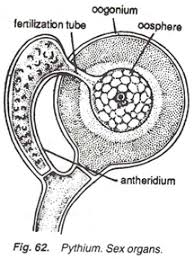
  • Oosphere
  • D
    Oospore
Answer
Correct option: C.
Oosphere
The correct answer is 'oosphere'
The primary ventral cell in a fungus leads to formation of oosphere formed after fertilisation from oogonium.
View full question & answer
MCQ 1561 Mark
Interferons are:
  • Antiviral protein.
  • B
    Antibacterial proteins.
  • C
    Anticancer proteins.
  • D
    Complex proteins.
Answer
Correct option: A.
Antiviral protein.
View full question & answer