MCQ 11 Mark
Which is the correct sequence of mitotic cell division?
- A
Prophase Anaphase Metaphase Telophase.
- B
Prophase Telophase Metaphase Anaphase.
- C
Prophase Anaphase Telophase Metaphase.
- ✓
Prophase Metaphase Anaphase Telophase.
AnswerCorrect option: D. Prophase Metaphase Anaphase Telophase.
Prophase Metaphase Anaphase Telophase.
View full question & answer→MCQ 21 Mark
Between mitosis, a cell is said to be in the:
AnswerInterphase is a complex of changes that occur in a newly formed cell before it is able to divide.
Interphase is also called preparatory phase, inter$-$mitosis or energy phase.
Previously, it was known as a resting phase.
It is characterized by three substages, $G1 ($growth phase $1$ or gap $1), S ($ synthesis $)$ and $G2 ($ growth phase $2$ or gap $2).$ It is an active part of a cell's life cycle and in $G1$ many metabolic reactions occur including protein synthesis.
During $S$ phase, $\text{DNA}$ replication occurs and $G2$ is marked by synthesis of $\text{RNA}$ and proteins.
View full question & answer→MCQ 31 Mark
Meiosis occurs for the human female in $.............$
View full question & answer→MCQ 41 Mark
Which of the following constituent protein are present in mitotic spindle:
AnswerThe mitotic spindle is made up of the protein tubulin.
A spindle fiber consists of $4 - 20$ microtubules formed of the protein tubulin.
It is a cytoskeleton protein composed of two types of subunits called as $\alpha$ and $\beta$ subunits.
View full question & answer→MCQ 51 Mark
In which phase of cell cycle, proteins are synthesised?
AnswerIn $G_2$ phase of cell cycle, proteins are synthesised for mitosis and cell growth continues.
View full question & answer→MCQ 61 Mark
Extra nuclear chromosomes occur in:
- A
- ✓
Chloroplast, mitochondria.
- C
- D
AnswerCorrect option: B. Chloroplast, mitochondria.
Chloroplast, mitochondria.
View full question & answer→MCQ 71 Mark
Four daughter cells formed after meiosis are:
MCQ 81 Mark
The point, at which polytene chromosomes appear to be attached together, is called:
MCQ 91 Mark
If a diploid cell is treated with colchicine then it becomes.
MCQ 101 Mark
Lampbrush chromosomes are seen in which typical stage?
MCQ 111 Mark
Cells which are not dividing are likely to be at:
- A
$G_1$.
- B
$G_2$.
- ✓
$G_0$.
- D
$S$ phase.
AnswerCorrect option: C. $G_0$.
Cells that do not divide further and exit $G_1$ phase to enter an inactive stage called quiescent stage $(G_0)$ of the cell cycle. Cells in this stage remain metabolically active but do not grow and differentiate unless stimulated by appropriate signal depending on the requirement of the organism.
View full question & answer→MCQ 121 Mark
Which of the following cells usually do not undergo cell division?
MCQ 131 Mark
Which of the following characters is not related to telophase:
- A
Formation of nuclear membrane
- B
- ✓
Increase in the number of chromosome
- D
Formation of two daughter nuclei
AnswerCorrect option: C. Increase in the number of chromosome
Telophase stage is the stage of reconstitution of nuclei.
Chromosomes uncoil, elongate, lose their stainability and form chromatin fibers.
Nucleoplasm and nuclear envelope appear so that two daughter nuclei are formed.
View full question & answer→MCQ 141 Mark
During anaphase$-I$ of meiosis.
AnswerCorrect option: A. Homologous chromosomes separate.
During anaphase $I,$ from each tetrad, two chromatids of a chromosome move as a unit $($dyad$)$ to one pole of a spindle, and the remaining two chromatids of its homologue migrate to the opposite pole. ‘Thus, the homologous chromosomes of each pair, rather than the chromatids of a chromosome, are separated. As a result, half of the chromosomes, which appear in early prophase, go to each pole. It is in the anaphase $I$ that the actual reduction in the number of chromosomes occurs.
View full question & answer→MCQ 151 Mark
Which phase marks the splitting of chromatids during meiosis?
- A
Anaphase $I.$
- B
Telophase $I.$
- ✓
Anaphase $II.$
- D
Telophase $II.$
AnswerCorrect option: C. Anaphase $II.$
Anaphase $II.$
View full question & answer→MCQ 161 Mark
AnswerDiploid cells have two sets of chromosomes one inherited from a female parent and one inherited from a male parent.
This chromosomal constitution is designated $2n,$ where n denotes basic haploid chromosome set.
View full question & answer→MCQ 171 Mark
Chiasmata formation takes place during:
- ✓
Prophase $I$
- B
Metaphase $I$
- C
Anaphase $II$
- D
Telophase $I$
AnswerCorrect option: A. Prophase $I$
The chiasmata formation occurs during diplotene phase of prophase $I$ of meiosis $I.$
Chiasmata are the points of attachment between non$-$sister chromatids of two homologous chromosomes.
It leads to an exchange of segments and creates variation.
View full question & answer→MCQ 181 Mark
During cell division, the spindle fibres attach to of the chromosomes.
MCQ 191 Mark
Which of the following is true of kineto$-$chores?
- A
They are localized at the centromere of each chromosome.
- B
They are the sites where microtubules attach to separate the chromosomes.
- C
They are organized so that there is one per sister chromatid in meiosis.
- ✓
View full question & answer→MCQ 201 Mark
Which is correct w.r.t. anaphase?
- ✓
Centromeres split and chromatids separate.
- B
Chromosomes are moved to spindle equator.
- C
Chromatid splits by recombinase activity.
- D
AnswerCorrect option: A. Centromeres split and chromatids separate.
Centromeres split and chromatids separate.
View full question & answer→MCQ 211 Mark
Which event does not occur during prophase in an animal cell:
- A
Nuclear envelope disperses
- ✓
- C
- D
AnswerThe prophase is the first phase of mitosis or cell division.
In the prophase, the nuclear membrane disappears.
It is followed by the initiation of condensation of the thread chromatid material into chromosomes.
The spindle fibres begin to appear.
In the metaphase, the chromosomes then align at the equatorial plane with their centromeres on the spindle fibres.
$\text{DNA}$ replication takes place in the $S$ phase of the interphase.
View full question & answer→MCQ 221 Mark
View full question & answer→MCQ 231 Mark
In meiosis, the chromosomes replicate during.
- A
Prophase $I.$
- ✓
- C
Prophase $II.$
- D
View full question & answer→MCQ 241 Mark
- ✓
$\text{DNA}$ replication takes place in $S-$phase.
- B
$G,$ phase follows mitotic phase.
- C
A short interphase is followed by a long mitotic phase.
- D
In $G,$ phase, the $\text{DNA}$ content is double the amount of $\text{DNA}$ in the mother cell.
AnswerCorrect option: A. $\text{DNA}$ replication takes place in $S-$phase.
$\text{DNA}$ replication takes place in $S-$phase.
View full question & answer→MCQ 251 Mark
Number of chromatids at metaphase is:
- ✓
Two each in mitosis and meiosis.
- B
Two in mitosis and one in meiosis.
- C
Two in mitosis and four in meiosis.
- D
One in mitosis and two in meiosis.
AnswerCorrect option: A. Two each in mitosis and meiosis.
Two each in mitosis and meiosis.
View full question & answer→MCQ 261 Mark
Which one ensures maintainance of chromosome number from generation to generation:
AnswerMeiosis occurs in the life cycle of all organisms that reproduce sexually. In meiosis, four daughter cells are produced, each with one member of each homologous pair of the chromosomes of the parent cell, known as the haploid $(n)$ state.Meiosis ensures the maintenance of the chromosome number in body cells from generation to generation.It is a source of variation.
View full question & answer→MCQ 271 Mark
Nucleoproteins are synthesized in:
MCQ 281 Mark
What are those structures that appear as ‘beads$-$on$-$string’ in the chromosomes, when viewed under electron microscope?
View full question & answer→MCQ 291 Mark
The term eumitosis is used for:
- ✓
- B
- C
Mitosis where spindle is extranuclear
- D
Mitosis with intranuclear spindle
AnswerEumitosis is a type of mitosis in which the nuclear membrane dissolves during prometaphase so that there remains no distinction between cytoplasm and nucleoplasm.
The chromosomes remain attached to the spindles through their centromeres.
Mitosis, where the spindle is extranuclear, occurs in the case of true eumitosis or mitosis.
View full question & answer→MCQ 301 Mark
AnswerCorrect option: B. Two homologous chromosomes.
Two homologous chromosomes.
View full question & answer→MCQ 311 Mark
The meiosis is involved in:
AnswerMeiosis is the process of nuclear division which takes place in reproductive cells.
The daughter nuclei formed by this process contain only half the number of chromosomes present in the parent nucleus.
View full question & answer→MCQ 321 Mark
The $3'-5'$ phosphodiester linkages inside a polynucleotide chain serve to join.
AnswerCorrect option: B. One nucleotide with another nucleotide.
One nucleotide with another nucleotide.
View full question & answer→MCQ 331 Mark
Crossing over is advantageous because it brings about:
AnswerMeiosis is the type of cell division in which homologous chromosomes separate after exchange of fragments.
As a result, of meiosis four haploid cells are produced which are all genetically different from each other.
This is due to the process of crossing over or exchange of segments between homologous chromosomes.
View full question & answer→MCQ 341 Mark
Which of the following occurs only in meiosis:
- ✓
Pairing of homologous chromosomes.
- B
Separation of duplicated strand.
- C
- D
Disappearance of nucleolus.
AnswerCorrect option: A. Pairing of homologous chromosomes.
Organisms show two types of cell division$-$Mitosis and Meiosis.
Meiosis is a specialized cell division which occurs in germ cells and produces haploid gametes.
The meiosis is characterised by pairing of homologous chromosomes, exchange of segments between homologous chromosomes and reduction in chromosome number to half.
View full question & answer→MCQ 351 Mark
- ✓
Two nuclear and two cell divisions.
- B
Two nuclear and one cell division.
- C
One nuclear and two cell divisions.
- D
One nuclear and four cell divisions.
AnswerCorrect option: A. Two nuclear and two cell divisions.
Two nuclear and two cell divisions.
View full question & answer→MCQ 361 Mark
In mitosis, nuclear envelope and nucleolus disappear during:
MCQ 371 Mark
In which stage of the cell cycle histone proteins synthesized in a eukaryotic cell?
AnswerCorrect option: A. During $S-$phase.
During $S-$phase.
View full question & answer→MCQ 381 Mark
Cytoskeleton is made up of:
- A
- ✓
- C
Calcium carbonate granules.
- D
View full question & answer→MCQ 391 Mark
- A
Two chromatids and one centromere.
- B
Two chromatids and two centromeres.
- ✓
Four chromatids and two centromeres.
- D
Four chromatids and four centromeres.
AnswerCorrect option: C. Four chromatids and two centromeres.
Four chromatids and two centromeres.
View full question & answer→MCQ 401 Mark
Chromosomes can be counted best at the stage of:
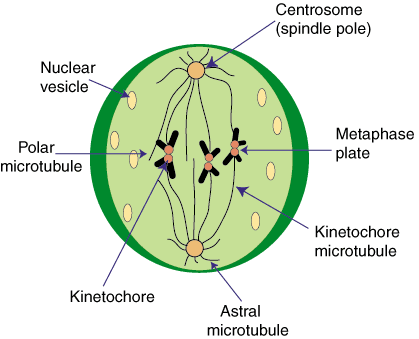
AnswerMetaphase is the best stage to count the total number of chromosomes in any species and to establish a detailed study of the morphology of the chromosomes.
As mitotic cells are easy to obtain, morphological studies are generally based on mitotic metaphase chromosomes.
In this stage, the centrioles are at opposite poles of the cell.
The homologous chromosome pairs $($the bivalents$)$, are tightly coiled and condensed and become arranged on a plane called the metaphase plate or equatorial plate.
This plate is equidistant from the poles.
Discontinuous fibres radiate out from the two poles and get connected to kinetochores at the surface of the centromere.
A kinetochore is complex protein structure and a point where microtubules attach themselves to the chromosome.
When the chromosomes get arranged at the metaphase plate, smaller chromosomes get directed towards the centre while the larger ones are peripheral in position on the equator.
The centromeres of all the chromosomes lie on the equator forming an apparent plate called metaphasic or equatorial plate while arms are directed towards the poles.
View full question & answer→MCQ 411 Mark
The two chromatids of a metaphase chromosome represent.
AnswerCorrect option: A. Replicated chromosomes to be separated at anaphase.
Replicated chromosomes to be separated at anaphase.
View full question & answer→MCQ 421 Mark
During which stages $($or prophase $I$ substages$)$ of meiosis do you expect to find the bivalents and $\text{DNA}$ replication respectively?
AnswerCorrect option: A. Zygotene and $S$ phase $($of interphase prior to prophase $I).$
Zygotene and $S$ phase $($of interphase prior to prophase $I).$
View full question & answer→MCQ 431 Mark
$\text{DNA}$ is mainly found in:
- ✓
- B
- C
Both $(a)$ and $(b)$.
- D
View full question & answer→MCQ 441 Mark
During which stage of meiosis the recombination of genes takes place?
- ✓
Prophase $I.$
- B
Prophase $II.$
- C
Metaphase $I.$
- D
Metaphase $II.$
AnswerCorrect option: A. Prophase $I.$
Prophase $I.$
View full question & answer→MCQ 451 Mark
Choose the correct sequence.
- Pachytene
- Zygotene
- Leptotene
- Diakinesis
- Diplotene
- A
$\text{C, B, A, D, E}$
- ✓
$\text{C, A, B, E, D}$
- C
$\text{C, B, A, E, D}$
- D
$\text{D, B, C, E, A}$
AnswerCorrect option: B. $\text{C, A, B, E, D}$
Duplication of centrioles occurs in $S-$phase. Protein synthesis occurs in $G_2$ phase. Chromatin condensation is followed by centrioles movement towards the poles. $($Prophase$)$
View full question & answer→MCQ 461 Mark
AnswerMegaspore is a spore which develops into a female gametophyte and forms egg.
A cell that differentiates into a gamete through the process of meiosis is known as meiocyte.The resulting cell is a haploid.
Conidia are asexually produced spores that are borne on the conidiophores which is a specialized hyphal structure.
In sponges, a part of parent body produces internal buds known as gemmule which separates from the parent body and forms a new organism.The gemmules are formed in the mesoglea layer of the body wall.
View full question & answer→MCQ 471 Mark
During the meiotic division, the:
- ✓
Homologous chromosomes are separated.
- B
The linkage is disturbed.
- C
The homologous chromosomes do not segregate.
- D
AnswerCorrect option: A. Homologous chromosomes are separated.
Meiosis is a type of division in which mother cell divides twice after one round of $\text{DNA}$ replication.
In meiosis $I$ homologous chromosomes pair, exchange segments and then separate, i.e., each chromosome of a homologous pair goes to opposite pole.
Thus, reducing the number of chromosomes to one half.
Second division or meiosis $II$ is normal equational division like mitosis.
View full question & answer→MCQ 481 Mark
The plant material suited for studying mitosis is:
MCQ 491 Mark
The process by which the chromosomes are separated in the sex cells and their number reduced from the diploid to haploid condition is known as:
AnswerMeiosis is the type of cell division in which homologous chromosomes separate after the exchange of fragments.
As a result of meiosis, four haploid cells are produced which are all genetically different from each other.
It mainly occurs in reproductive cell.
View full question & answer→MCQ 501 Mark
The major event that occurs during the anaphase of mitosis, which brings about the equal distribution of chromosomes, is:
- ✓
Splitting of the centromeres.
- B
Splitting of the chromatids.
- C
Replication of the genetic material.
- D
Condensation of the chromatin.
AnswerCorrect option: A. Splitting of the centromeres.
Splitting of the centromeres.
View full question & answer→MCQ 511 Mark
How many mitotic divisions are involved in the formation of $128$ cells from a single cell?
View full question & answer→MCQ 521 Mark
In the somatic cell cycle.
- A
In $G_1-$phase $\text{DNA}$ content is double the amount of $\text{DNA}$ present in the original cell.
- ✓
$\text{DNA}$ replication takes place in $S-$phase.
- C
A short interphase is followed by a long mitotic phase.
- D
$G_2-$phase follows mitotic phase.
AnswerCorrect option: B. $\text{DNA}$ replication takes place in $S-$phase.
$\text{DNA}$ replication takes place in $S-$phase.
View full question & answer→MCQ 531 Mark
Experiments on Acetabularia by Hammerling proved the role of:
MCQ 541 Mark
During cell cycle, the $\text{DNA}$ replication occurs in:
- A
$M-$phase.
- ✓
$S-$phase.
- C
$G_1-$phase.
- D
$G_2-$phase.
AnswerCorrect option: B. $S-$phase.
$S-$phase.
View full question & answer→MCQ 551 Mark
If you are provided with root$-$tips of onion in your class and are asked to count the chromosomes which of the following stages can you most conveniently look into:
View full question & answer→MCQ 561 Mark
Synaptonemal complex dissolves in $.............$ stage.
AnswerSynaptonemal complex dissolves in diplotene stage of Prophase $I.$
View full question & answer→MCQ 571 Mark
How many chromosomes are there in onion root tip cell?
AnswerThere are $16$ chromosomes in onion root tip cell.
View full question & answer→MCQ 581 Mark
The exchange of genetic material between chromatids of paired homologous chromosomes during first meiotic division is called:
MCQ 591 Mark
The post mitotic phase in which active synthesis of $\text{RNA}$ and proteins takes place, is:
- A
$I,$ phase.
- ✓
$G,$ phase.
- C
$H,$ phase.
- D
$S,$phase.
AnswerCorrect option: B. $G,$ phase.
$G, $phase.
View full question & answer→MCQ 601 Mark
The pairing of homologous chromosomes that occurs during zygotene is called:
MCQ 611 Mark
Meiosis$-II$ performs:
AnswerCorrect option: D. Separation of chromatids.
Separation of chromatids.
View full question & answer→MCQ 621 Mark
Bacterium divides every $35$ minutes. If a culture containing $105$ cells per $mL$ is grown for $175$ minutes, what will be the cell concentration per $mL$ after $175$ minutes?
- A
$5 \times 10^5$ cells.
- B
$35 \times 10^5$ cells.
- ✓
$32 \times 10^5$ cells.
- D
$175 \times 10^5$ cells.
AnswerCorrect option: C. $32 \times 10^5$ cells.
$32 \times 10^5$ cells.
View full question & answer→MCQ 631 Mark
The stage between two meiotic divisions is called interkinesis and.
AnswerCorrect option: A. Is generally short lived and followed by prophase $II.$
Is generally short lived and followed by prophase $II.$
View full question & answer→MCQ 641 Mark
Mitotic anaphase differs from metaphase in possessing.
- A
Same number of chromosomes and same number of chromatids.
- B
Half number of chromosomes and half number of chromatids.
- C
Half number of chromosomes and same number of chromatids.
- ✓
Same number of chromosomes and half number of chromatids.
AnswerCorrect option: D. Same number of chromosomes and half number of chromatids.
Same number of chromosomes and half number of chromatids.
View full question & answer→MCQ 651 Mark
During which stage the chromosomes first become visible.
MCQ 661 Mark
Crossing over that results in genetic recombination in higher organisms occur between.
AnswerCorrect option: B. Non$-$sister chromatids of a bivalent.
Non$-$sister chromatids of a bivalent.
View full question & answer→MCQ 671 Mark
Pairing of homologous chromosomes into tetrads occurs during:
AnswerCorrect option: D. Prophase of meiosis $I$
The pairing of homologous chromosomes before crossing over is called as Synapsis.
It takes place in the prophase $1$ of meiosis $1$ where subsequently crossing over also takes place in the pachytene phase.
View full question & answer→MCQ 681 Mark
Meiosis is also known as:
- A
- B
Mulitplicational division
- ✓
- D
Both $A$ and $C$
AnswerMeiosis is a reductional cell division which occurs mostly in reproductive cell.
The daughter cell produced after meiosis has half the number of chromosomes as compared to the parent cell.
It occurs in two stage they are meiosis $I$ and meiosis $II.$ Meiosis $I$ is a reductional division while meiosis $II$ is an equational division.
View full question & answer→MCQ 691 Mark
Mitotic spindle is mainly composed of which protein?
MCQ 701 Mark
Which of the following cellular structures always disappears during mitosis and meiosis?
- A
- ✓
Nucleolus and nuclear envelope.
- C
- D
AnswerCorrect option: B. Nucleolus and nuclear envelope.
Nucleolus and nuclear envelope.
View full question & answer→MCQ 711 Mark
Which one of the following statements about the particular entity is true?
AnswerCorrect option: A. The gene for producing insulin is present in every body cell.
The gene for producing insulin is present in every body cell.
View full question & answer→MCQ 721 Mark
The number of chromosomes after phase I of meiotic division:
AnswerIn meiosis, $I$ homologous chromosomes pair, exchange segments and then separate, i.e., each chromosome of a homologous pair goes to the opposite pole.
Thus, reducing the number of chromosomes to half.
Second division or meiosis $II$ is normal equational division like mitosis.
View full question & answer→MCQ 731 Mark
Recombination of genes occur at:
AnswerCorrect option: A. Prophase $I$ in meiosis.
Prophase $I$ in meiosis.
View full question & answer→MCQ 741 Mark
Which of the events listed below is not observed during mitosis?
- A
- B
Movement of centrioles to opposite poles.
- C
Appearance of chromosomes with two chromatids joined together at the centromere.
- ✓
AnswerCrossing over occurs in pachytene $($it is a phase of meiosis$-I)$. Crossing over is the exchange of genetic material $($genes$)$ between two homologous chromosomes. Crossing over is also an enzyme$-$mediated process and the enzyme involved is called recombinase. Crossing over leads to recombination of genetic material on the two chromosomes. Exchange of paternal and maternal chromosome material during pachytene is called crossing over.
View full question & answer→MCQ 751 Mark
At which stage of meiosis does the genetic constitution of gametes is finally decided
- A
Metaphase $I$
- B
Anaphase $II$
- C
Metaphase $II$
- ✓
Anaphase $I$
AnswerCorrect option: D. Anaphase $I$
In anaphase $I$ of meiosis, each homologous chromosome with its two chromatids and undivided centromere; moves to the opposite poles of the cell. So the actual reduction occurs in this stage which decides the genetic constitution of gamete.
View full question & answer→MCQ 761 Mark
The eukaryotic genome differs from the prokaryotic genome because.
AnswerCorrect option: B. Repetitive sequences are present in eukaryotes.
Repetitive sequences are present in eukaryotes.
View full question & answer→MCQ 771 Mark
Meiosis occurs in organisms during.
- ✓
- B
- C
Both sexual and vegetative reproduction.
- D
AnswerMeiosis is a cell division which ensures production of haploid phase in life cycle of sexually reproducing organisms. It reduces the chromosome number to half, so that each daughter nuclei receives only one set of each kind of chromosome.
View full question & answer→MCQ 781 Mark
Which one of the following structures will not be common to mitotic cells of higher plants?
MCQ 791 Mark
AnswerCell plate grows during cytokinesis from centre to the walls.
View full question & answer→MCQ 801 Mark
Arrange the following events of meiosis in the correct sequence:
- Terminalization
- Crossing over
- Synapsis
- Disjunction of genomes
The correct sequences:
- A
$\text{II, I, IV, III}$
- ✓
$\text{III, II, I, IV}$
- C
$\text{IV, III, II, I}$
- D
$\text{I, IV, III, II}$
AnswerCorrect option: B. $\text{III, II, I, IV}$
View full question & answer→MCQ 811 Mark
Crossing over in diploid organism is responsible for:
- A
- B
- C
- ✓
Recombination of linked alleles.
AnswerCorrect option: D. Recombination of linked alleles.
Recombination of linked alleles.
View full question & answer→MCQ 821 Mark
In meiosis, the daughter cells differ from parent cell as well as amongst themselves due to:
- A
Segregation, independent assortment and crossing over.
- ✓
Segregation and crossing over.
- C
Independent assortment and crossing over.
- D
Segregation and independent assortment.
AnswerCorrect option: B. Segregation and crossing over.
Segregation and crossing over.
View full question & answer→MCQ 831 Mark
In salivary gland chromosomes/ polytene chromosomes pairing is:
AnswerCorrect option: D. Formed between homologous chromosomes.
Formed between homologous chromosomes.
View full question & answer→MCQ 841 Mark
Division of the nucleus of the cell is called as:
AnswerThe process by which the division of the nucleus takes place during the cell cycle is known as karyokinesis.
It is usually followed by cytokinesis. It can take place by mitosis, meiosis, and amitosis.
Mitosis is an equational division, meiosis is a reductional division while amitosis, is an indirect division of nucleus.
View full question & answer→MCQ 851 Mark
During cell division, the spindle fibres attach to the chromosome at a region called:
MCQ 861 Mark
Which one of the following events is incorrect for cell cycle?
- ✓
All events are under genetic control.
- B
Maximum cell growth occurs in $M-$phase.
- C
$\text{DNA}$ synthesis occurs only during one specific.
- D
Centriole duplication occurs in $S-$phase.
AnswerCorrect option: A. All events are under genetic control.
All events are under genetic control.
View full question & answer→MCQ 871 Mark
Meiosis occurs in which of the following:
- ✓
- B
Mostly haploid cells but occasionally diploid cells
- C
Mostly diploid cells but occasionally haploid cells
- D
AnswerMeiosis is a type of cell division in which chromosome number is reduced by half to produces gamete cells.
It is required to produce egg and sperm cells necessary for sexual reproduction.
View full question & answer→MCQ 881 Mark
Meiosis has evolutionary significance because it results in:
- A
Genetically similar daughters.
- B
- C
- ✓
View full question & answer→MCQ 891 Mark
$.............$ is/are best suited for studying mitosis in classroom?
AnswerThe meristematic tissues are present in the root tips.
These tissues have the meristematic cells which divide at a rapid pace and has the ability to divide throughout life.
These cells are the ideal specimen to observe the process of cell division.
The cells from the root tips are used to observe the various stages in the mitotic cell division.
View full question & answer→MCQ 901 Mark
Which one of the following precedes reformation of the nuclear envelope during $M-$phase of the cell cycle?
- ✓
Decondensation from chromosomes and reassembly of the nuclear lamina.
- B
Transcription from chromosomes and reassembly of the nuclear lamina.
- C
Formation of the contractile ring and formation of the phragmoplast.
- D
Formation of the contractile ring and transcription from chromosomes.
AnswerCorrect option: A. Decondensation from chromosomes and reassembly of the nuclear lamina.
Decondensation from chromosomes and reassembly of the nuclear lamina.
View full question & answer→MCQ 911 Mark
During cell division, sometimes there will be failure of separation of sister chromatids. This event is called:
AnswerCorrect option: A. Non$-$disjunction.
Non$-$disjunction.
View full question & answer→MCQ 921 Mark
Which of the following does not take place in $G$ phase?
- ✓
$\text{DNA}$ synthesis.
- B
$\text{RNA}$ synthesis.
- C
- D
Both $(b)$ and $(c).$
AnswerCorrect option: A. $\text{DNA}$ synthesis.
$\text{DNA}$ synthesis
View full question & answer→MCQ 931 Mark
The centromere is situated close to its ends and forming one extremely short and one very long arm in:
MCQ 941 Mark
Which phase of cell cycle is shown in the above picture?
AnswerChromosomes are positioning towards the equator. Nuclear envelope is disintegrated.
View full question & answer→MCQ 951 Mark
Segregation of Mendelian factor $(Aa)$ occurs during.
- A
- ✓
Anaphase$-I.$
- C
- D
Anaphase$-II.$
AnswerCorrect option: B. Anaphase$-I.$
Anaphase$-I.$
View full question & answer→MCQ 961 Mark
Balbiani rings $($puffs$)$ are sites of:
AnswerCorrect option: B. $\text{RNA}$ and protein synthesis.
$\text{RNA}$ and protein synthesis.
View full question & answer→MCQ 971 Mark
Meiosis is found in which of the following option:
AnswerDuring mitosis, chromosome number remains the same and cells increase in number.
Mitosis is the cell division that occurs in the meristematic tissue.
Daughter cells produced after meiosis are haploid.
Meiosis is the cell division that occurs in gametangia or reproductive parts to produce gametes.
View full question & answer→MCQ 981 Mark
Chromosome movement during anaphase is the result of:
- ✓
The molecular motors at the kinetochores that move the chromosomes toward the poles.
- B
Shortening of the microtubules at the centrosome that pull the chromosomes toward the poles.
- C
- D
AnswerCorrect option: A. The molecular motors at the kinetochores that move the chromosomes toward the poles.
The molecular motors at the kinetochores that move the chromosomes toward the poles.
View full question & answer→MCQ 991 Mark
What is the function of meiosis?
- A
Halving the number of chromosomes in daughter cells.
- ✓
Maintaining inheritance in progeny.
- C
Segregate gametic cells from somatic cells.
- D
AnswerCorrect option: B. Maintaining inheritance in progeny.
Maintaining inheritance in progeny.
View full question & answer→MCQ 1001 Mark
Select the correct statement about $G_1$ phase.
Answer$G_1$ belongs to interphase of cell cycle which is metabolically active stage. During $G_1$, synthesis of $\text{ATP,}$ nucleotides, amino acids, $\text{RNAs}$ and proteins take place. $\text{DNA}$ replicate in $S-$phase of the cell cycle and not in $G_1$ phase.
View full question & answer→MCQ 1011 Mark
During anaphase$-I$ of meiosis:
AnswerCorrect option: A. Homologous chromosomes separate.
Homologous chromosomes separate.
View full question & answer→MCQ 1021 Mark
Chromosome duplication without nuclear division refers to:
MCQ 1031 Mark
During which stage the cell organelles reappear in cell division?
MCQ 1041 Mark
Centromere is a constituent of:
MCQ 1051 Mark
The sequence of events by which a cell duplicates its genome, synthesises other constituents of the cell and eventually divide into two daughter cell is termed as:
AnswerCorrect option: A. $M-$phase.
$M-$phase.
View full question & answer→MCQ 1061 Mark
In cell cycle, $\text{DNA}$ replication takes place in:
- A
$G_1-$phase.
- B
$G_2-$phase.
- C
- ✓
$S-$phase.
AnswerCorrect option: D. $S-$phase.
$S-$phase.
View full question & answer→MCQ 1071 Mark
Which of the following occurs more than one and less than five in a chromosome?
MCQ 1081 Mark
Division of cytoplasm after completion of nuclear division is called$.............$?
View full question & answer→MCQ 1091 Mark
Mitosis is characterised by.
- A
- ✓
- C
Both reduction and equal division.
- D
Paining of homologous chromosomes.
AnswerMitosis is a type of cell division in which chromosomes replicate and get equally distributed $($quantitatively and qualitatively$)$ into two daughter nuclei so that the diploid daughter cells have equal and identical genetic complement as the parent cell.
View full question & answer→MCQ 1101 Mark
Which of the following is the longest stage during meiosis?
- ✓
Prophase $I.$
- B
Prophase $II.$
- C
Metaphase $I.$
- D
Metaphase $II.$
AnswerCorrect option: A. Prophase $I.$
Prophase $I.$
View full question & answer→MCQ 1111 Mark
During cell division in apical meristem the nuclear membrane appears in:
MCQ 1121 Mark
Which of the following enzymes is responsible for recombination of genes?
MCQ 1131 Mark
Meiosis is not observed in:
AnswerSomatic cells are the normal body cell other than reproductive cells and take part in the formation of body structure and thus require mitosis cell division which increases the diploid cell numbers.
Whereas meiosis occurs in reproduction cells in which it produces the haploid cells from diploid mother cells.
View full question & answer→MCQ 1141 Mark
In telophase of mitosis, the mitotic spindle breaks down and nuclear membranes form. This is essentially the opposite of what happens in:
MCQ 1151 Mark
Centromere is required for:
- ✓
Movement of chromosomes towards poles.
- B
- C
- D
AnswerCorrect option: A. Movement of chromosomes towards poles.
Movement of chromosomes towards poles.
View full question & answer→MCQ 1161 Mark
Identify the wrong statement about meiosis.
AnswerCorrect option: D. Two cycle of $\text{DNA}$ replication occurs.
Since number of chromosomes in daughter cells is going to become half, there is no need for an additional cycle of $\text{DNA}$ replication.
View full question & answer→MCQ 1171 Mark
A bivalent of meiosis$-I$ consists of.
- A
Two chromatids and one centromere.
- B
Two chromatids and two centromere.
- ✓
Four chromatids and two centromere.
- D
Four chromatids and four centromere.
AnswerCorrect option: C. Four chromatids and two centromere.
Bivalent is formed by pairing of two chromosomes. Thus, bivalent contains four chromatids and four centromeres.
View full question & answer→MCQ 1181 Mark
Which kind of cell division takes place in the apical meristem?
- ✓
- B
- C
Mitosis in root and meiosis in flowers.
- D
View full question & answer→MCQ 1191 Mark
The salivary gland chromosomes in the dipteran larvae are useful in gene mapping because.
- A
These are much longer in size.
- B
- C
- ✓
They have endoreduplicated chromosomes.
AnswerCorrect option: D. They have endoreduplicated chromosomes.
They have endoreduplicated chromosomes.
View full question & answer→MCQ 1201 Mark
The number of chromatids in a chromosome at anaphase is:
- ✓
$1$ in mitosis and $2$ in meiosis.
- B
$2$ each in mitosis and meiosis.
- C
$2$ in mitosis and $4$ in meiosis.
- D
$2$ in mitosis and $1$ in meiosis.
AnswerCorrect option: A. $1$ in mitosis and $2$ in meiosis.
$1$ in mitosis and $2$ in meiosis.
View full question & answer→MCQ 1211 Mark
- A
Four chromatids and four centromeres.
- ✓
Four chromatids and two centromeres.
- C
Two chromatids and two centromeres.
- D
Two chromatids and one centromeres.
AnswerCorrect option: B. Four chromatids and two centromeres.
Four chromatids and two centromeres.
View full question & answer→MCQ 1221 Mark
The stage at which cytokinesis begins in plant cells is:
AnswerDuring cell division after karyokinesis, the cytoplasm of the parent cell divides equally into daughter cell by the process of cytokinesis.
This occurs in telophase.
The process of cytokinesis takes place by formation of a furrow in an animal cell while in plant cell it takes by phragmoplast which further develops into the cell wall.
View full question & answer→MCQ 1231 Mark
Best material for the study of mitosis in laboratory is:
MCQ 1241 Mark
Which of the following carry the same genetic information?
- ✓
- B
$X$ and $Y$ chromosomes.
- C
- D
View full question & answer→MCQ 1251 Mark
Ribosomes are produced in:
MCQ 1261 Mark
Choose the correct sequence.
- Chromatin condensation.
- Protein synthesis.
- Duplication of centrioles.
- Centrioles moves towards opposite poles.
- A
$\text{C, A, B, D}$
- B
$\text{C, B, A, D}$
- ✓
$\text{C, D, B, A}$
- D
$\text{A, C, D, B}$
AnswerCorrect option: C. $\text{C, D, B, A}$
These are the five phases of prophase $I$ of Meiosis $I$ based on the chromosomal behaviour.
View full question & answer→MCQ 1271 Mark
View full question & answer→MCQ 1281 Mark
Best stage to observe shape, size and number of chromosomes is:
MCQ 1291 Mark
What type of plant is formed when colchicine is used in the process of development of Raphanobrassica?
MCQ 1301 Mark
Golgi complex and endoplasmic reticulum cannot be seen during:
AnswerCells, when viewed under microscope at the end of prophase, do not show golgi complex, endoplasmic reticulum, nucleolus and nuclear envelope.
View full question & answer→MCQ 1311 Mark
Extra nuclear $\text{DNA} ($genes$)$ are located in:
- A
Lysosomes and chloroplasts.
- B
Golgi complex and ribosomes.
- ✓
Chloroplasts and mitochondria.
- D
Ribosomes and mitochondria.
AnswerCorrect option: C. Chloroplasts and mitochondria.
Chloroplasts and mitochondria.
View full question & answer→MCQ 1321 Mark
Hammerling’s experiments of Acetabularia involved exchanging.
MCQ 1331 Mark
Lampbrush chromosomes are observed in:
MCQ 1341 Mark
At what stage of the cell cycle are histone proteins synthesized in a eukaryotic cell?
AnswerCorrect option: B. During $S-$phase.
During $S-$phase.
View full question & answer→MCQ 1351 Mark
In animal cells, cytokinesis involves.
- ✓
The contraction of the contractile ring of microfilament.
- B
Depolymerisation of kinetochore microtubules.
- C
A protein kinase that phosphorylates other enzymes.
- D
The separation of sister chromatids.
AnswerCorrect option: A. The contraction of the contractile ring of microfilament.
The contraction of the contractile ring of microfilament.
View full question & answer→MCQ 1361 Mark
Genes located on mitochondrial $\text{DNA.}$
- ✓
Generally show maternal inheritance.
- B
Are always inherited from the male parent.
- C
Show biparental inheritance like the nuclear genes.
- D
AnswerCorrect option: A. Generally show maternal inheritance.
Generally show maternal inheritance.
View full question & answer→MCQ 1371 Mark
What is true about telophase stage?
MCQ 1381 Mark
In meiosis, the centromeres divide during.
- A
Anaphase $I$
- ✓
Anaphase $II$
- C
Telophase $I$
- D
Telophase $II$
AnswerCorrect option: B. Anaphase $II$
Anaphase $II$
View full question & answer→MCQ 1391 Mark
Genophore/bacterial genome or nucleoid is made of:
- A
Histones and non$-$histones.
- B
$\text{RNA}$ and histones.
- ✓
A single double stranded $\text{DNA.}$
- D
A single stranded $\text{DNA.}$
AnswerCorrect option: C. A single double stranded $\text{DNA.}$
A single double stranded $\text{DNA.}$
View full question & answer→MCQ 1401 Mark
The time gap between Meiosis $I$ and Meiosis $II,$ is
- A
$G,$ phase.
- B
- C
$H$ phase.
- ✓
View full question & answer→MCQ 1411 Mark
How many mitotic divisions are needed for a single cell to make $128$ cells?
View full question & answer→MCQ 1421 Mark
Mitotic stages are not observed in:
AnswerCorrect option: B. $E.$ coli
Mitosis is shown by eukaryotes.
It is not observed in $E.$ coli.
This is a prokaryote as it lacks a well$-$defined nucleus.
In these organisms the nuclear membrane is absent and the genetic material is present floating in the cytoplasm.
Hence these organisms divide by binary fission in which the parent body divides to form the daughter cells in which the genetic material and cytoplasm is divided between the offsprings.
View full question & answer→MCQ 1431 Mark
Programmed cell death $($apoptosis$).$
- ✓
Is a natural process during development.
- B
Is signaled by the initiated of mitosis.
- C
Occurs in cells that have been deprived of essential nutrients.
- D
AnswerCorrect option: A. Is a natural process during development.
Is a natural process during development.
View full question & answer→MCQ 1441 Mark
Lampbrush chromosomes occur during.
MCQ 1451 Mark
Meiosis results in in diploid organisms.
- A
- B
Reduction in the number of chromosomes.
- C
Introduction of variation.
- ✓
AnswerMeiosis is cell division responsible for production of gametes through reduction division, during which the number of chromosomes is reduced to half. The crossing over that takes place in pachytene $($Prophase$–I,$ Meiosis $-1)$ results in introduction of variation.
View full question & answer→MCQ 1461 Mark
The stage in which daughter chromosomes move toward the poles of the spindle is:
MCQ 1471 Mark
During mitosis $ER$ and nucleolus begin to disappear at:
View full question & answer→MCQ 1481 Mark
What would be the number of chromosomes of the aleurone cells of a plant with $42$ chromosomes in its root tip cells?
View full question & answer→MCQ 1491 Mark
Karyokinesis is the term used for:
- A
- B
- C
- ✓
Separation of daughter chromosomes.
AnswerCorrect option: D. Separation of daughter chromosomes.
Karyokinesis means separation of daughter chromosomes. Cytokinesis means division of cytoplasm.
View full question & answer→MCQ 1501 Mark
What is the function of mitosis?
MCQ 1511 Mark
The complex formed by a pair of synapsed chromosomes is called as:
AnswerMeiosis occurs in two stages, meiosis $I$ and meiosis $II.$Crossing over occurs during meiosis $I.$ Homologous chromosomes pair during meiosis $I,$ this is called as synapsis.
The synapsis occurs between homologous chromosomes and facilitates crossing over.
Each synapsed pair is comprised of two sister chromatids and hence is a bivalent.
Each chromosome of a bivalent, in turn, is made up of two sister chromatids.
Hence each pair is actually a tetrad of chromatids.
View full question & answer→