Questions

3 Marks Question

Take a timed test

15 questions · self-marked practice — reveal the answer and mark yourself.

Question 13 Marks
Answer briefly: Why are villi present in the intestine and not in the stomach?
Answer
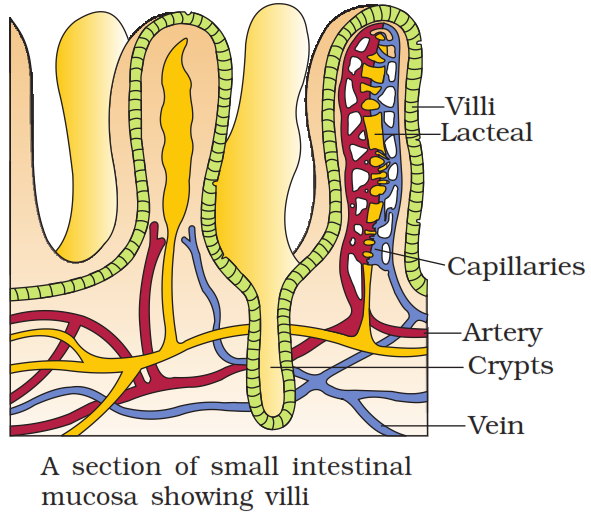
The major portion of absorption takes place in the small intestines. In the stomach, simple sugars, water and alcohol are absorbed. Villi are specialised projections in the small intestine which have a large surface area for absorption. Food is fit to be absorbed only after complete digestion, so the function of villi begins after all the digestive processes are complete.
View full question & answer
Question 23 Marks
Answer briefly: What are the basic layers of the wall of alimentary canal?
Answer
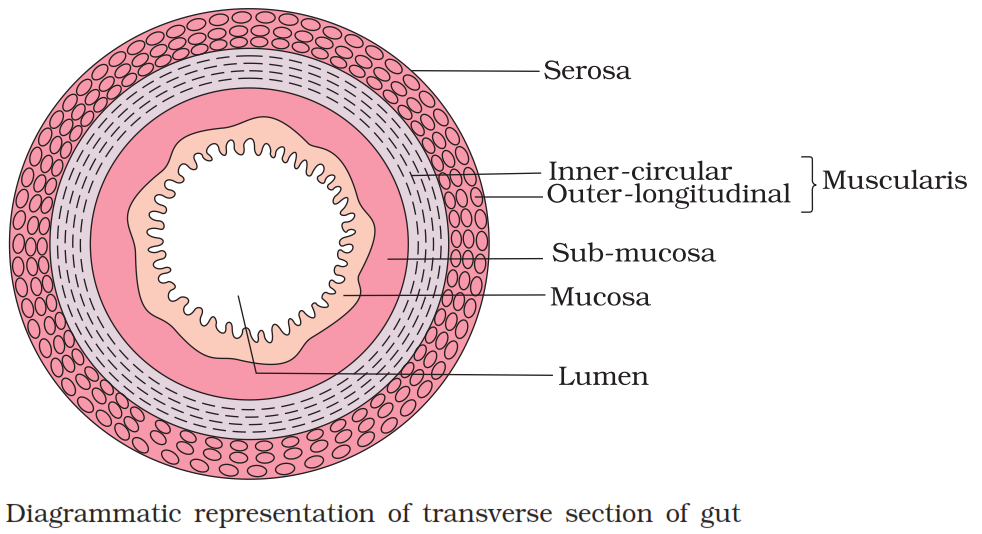
The alimentary canal is composed of the following basic layers:
  1. Serosa: It is the outermost layer and is made of a thin mesothelium with some connective tissues.
  2. Muscularis: It is formed by smooth muscles usually arranged into an inner circular and outer longitudinal layer.
  3. Sub-mucosa: It is formed of loose connective tissues containing nerves, blood and lymph vessels.
  4. Mucosa: It forms irregular folds in the stomach and small finger-like folding called villi in the small intestine.
View full question & answer
Question 33 Marks
Bile juice contains no digestive enzymes, yet it is important for digestion. Why?
Answer
Bile has no enzymes but contains bile salts, namely, sodium bicarbonate, sodium glycocholate and sodium taurocholate that reduce the surface tension of large fat drop¬lets and break them into many small droplets by a process known as emulsification. These small fat droplets present large surface area for lipase (fat digesting enzyme) to act upon them. Moreover, bile also activates lipases.$\text{Fat(triglyceride)}\xrightarrow[]{\text{Bile}}\text{Emulsified fat}$
View full question & answer
Question 43 Marks
Describe the accessory digestive glands in human.
Answer
The accessory digestive glands include the salivary glands, the liver and the pancreas.
  1. Humans have three pairs of salivary glands, i.e., the parotids, subinandibulars and sublinguals. They secrete major amount (about 1L) of the saliva, each day. The parotids are the largest glands in the cheek region near the ears. The submandibular glands are located towards the posterior end of the lower jaw. Sublingual glands are the smallest, present at the anterior part of the floor of the mouth.
  2. The liver is the largest gland in the body. It weighs about 1.5 kg. It lies immediately under the diaphragm. The gall bladder is a small and elongated muscular sac situated below the liver.
  3. The pancreas is an elongated gland, that is situated near the junction of the stomach and the duodenum. Both the liver and pancreas act as glands whereas, the gall bladder acts as a storing organ.
View full question & answer
Question 53 Marks
What is marasmus? What is its cause? Mention six symptoms characteristic of it.
Answer
  • Marasmus is a form of protein-energy malnutrition (PEM) resulting from simultaneous deficiency of proteins and calories.
  • It is caused in infants less than a year of age, when mother's milk is replaced by other foods poor in proteins and energy content; it happens when mother has a second pregnancy and child birth, when the first child is less than a year of age.
  • Its symptoms include the following:
  1. Protein deficiency impairs growth and replacement of tissue proteins.
  2. Thinning of limbs.
  3. Skin becomes thin, dry and wrinkled.
  4. Growth and development of brain and mental faculties are impaired.
  5. Growth rate and body weight decline rapidly.
  6. Extreme emaciation of body parts.
View full question & answer
Question 63 Marks
Explain how the activities of the gastro-intestinal tract are regulated for proper coordination of its different parts.
Answer
  • The neutral system and the hormones control the activities of the gastro-instestinal tract.
  • The neutral system controls:
  1. The secretion of saliva at the sight or smell or taste of food in the buccal cavity.
  2. The secretion of gastric and intestinal glands.
  3. The muscular activities of the different parts of the alimentary canal.
  4. The hormones produced by the gastric and intestinal mucosa control the secretion of digestive juices and release of bile.
View full question & answer
Question 73 Marks
What is the role of gall bladder? What may happen if it stops functioning or is removed?
Answer
Role of gall bladder is to store the bile juice produced by liver the gall bladder stops functioning when gall stones gets formed over the cystic duct then the bile stored is unable to discharge its juice into the duodenum and thus the bile juice is then diffused into the nearby artery coming and causes paleness which we call it as jaundice the gall bladder is removed and the bile then cannot be stored in the gall bladder so it is advised to the patient no to eat too fat containing food as emulsification of fat is done in the liver.
View full question & answer
Question 83 Marks
Different types of teeth are responsible for different steps of mastication. This is similar to which of these? Why should we take good care of our teeth?
  1. We need different types of tools to carry out different tasks.
  2. We need different modes of transport to travel.
Answer
  1. We need different types of tools to carry out different tasks.
The role of teeth in digestion is very important. Teeth help in breaking the food into smaller particles so that it becomes easy for digestive enzymes to act on them. Moreover, swallowing the food also becomes easier after the food is properly chewed. Improper tooth-care can lead to tooth decay in the long run. Once a tooth is gone, it cannot be replaced by the body. Artificial teeth are never as good as natural teeth. Once all the teeth are gone from a person's mouth, he will not be in a position to enjoy most of the food. This will result in diminished nutrition for the person. A person may get some nutritional supplement in liquid or semi-liquid form but the fact that he cannot enjoy many of the food, would be quite depressing for him.
View full question & answer
Question 103 Marks
Mention the role of the following enzymes in digestion of food:
  1. Salivary amylase.
  2. Pepsin.
  3. Lipase.
Answer
  1. Salivary amylase catalyses the digestion of about 30% starch into maltose in the buccal cavity.
  2. Pepsin acts on the proteins in the food and converts them into peptones and proteoses in the stomach.
  3. Lipase digests the fats into glycerol and fatty acids in the duodenum.
View full question & answer
Question 113 Marks
What are three major types of cells found in the gastric glands? Name their secretions.
Answer
The mucosa of stomach has gastric glands. Gastric glands have three major types of cells namely.
  1. Mucus neck cells which secrete mucus;
  2. Peptic or chief cells which secrete the proenzyme pepsinogen; and
  3. Parietal or oxyntic cells which secrete $\mathrm{HC}_1$ and intrinsic factor (factor essential for absorption of vitamin $\mathrm{B}_{12}$).
View full question & answer
Question 123 Marks
Name any three enzymes secreted by pancreas. Specify the substrate and product of each.OR
Name three enzymes secreted by pancreas and their action on proteins, fats and starch.
Answer
Trypsin, lipase and amylase are enzymes secreted by pancreas.
  • Trypsin acts on proteins, proteoses and peptones and converts them into shorter peptides.
  • Lipase acts on triglycerides and converts them into diglycerides and monoglycerides along with the release of a fatty acid at every step.
  • Amylase acts on starch and converts it into maltose.
View full question & answer
Question 133 Marks
How is the intestinal mucosa protected from the acidic food entering from stomach?
Answer
Goblet cells (secrete mucus) are present in the intestinal mucosa. The secretion of these cells along with the secretions of the brush border cells of the mucosa constitutes the intestinal juice. The bicarbonate ions from the pancreas and the mucus protect the intestinal mucosa from the acidic food or chyme.
View full question & answer
Question 143 Marks
Stomach is the right place where hydrochloric acid is required to be secreted in the gastric juice. Describe any three points to justify this statement.
Answer
Stomach, serves as a right place due to the following reasons:
  1. HCI inactivates the salivary amylase and prevents further breakdown of disaccharide carbohydrate.
  2. It kills microorganisms and lower the pH of stomach
    between 1.5-2.5 (very acidic).
  3. Pepsinogen (inactive precursor of pepsin) in the presence of HCl is converted into pepsin (principal protease of stomach).
View full question & answer
Question 153 Marks
Alka and Anita were good neighbours and classmates too. They used to study and play together in the school and at home. Alka always gets up early in the morning and takes her breakfast properly. Anita on the contrary, used to get up late and rushes to the school in a hurry everyday. Due to her eating habits, Anita often complaint about stomachache during the School hours and also after coming back to home. All this was affecting her studies too. One day on parent's-teacher meeting, Anita's mother discussed this problem with her biology teacher, she explained that it might be due to her eating habits, skipping breakfast, playing just after lunch and also due to improper chewing of food.
  1. What according to you, went wrong with Anita as she continuously complained about stomachache?
  2. What is the importance of chewing food? How is it related to digestion of food?
  3. How does food move forward in the alimentary canal?
  4. What values, do you get from Anita's mother's behaviour?
Answer
  1. Anita often complains for stomachache as she does not chew her food properly.
  2. Chewing has its own importance in digestion of food, as it helps in proper breakdown of food and mixing it with saliva on which enzyme ptyaline acts. If food is not chewed properly, complete breakdown of food will not take place in the mouth first of all and large pieces will enter the stomach which might cause trouble and damage to the stomach and hence, the digestive system.
  3. Food moves forward through the muscle contraction movement called peristalsis.
  4. Anita's mother is conscious about her daughter's health and believes in taking initiative.
View full question & answer