Questions

3 Marks Question

Take a timed test

31 questions · self-marked practice — reveal the answer and mark yourself.

Question 13 Marks
Differentiate between dendrites and axons.
Answer
Dendrites and axons:
  Dendrites   Axons
1. Dendrite is a small projection arising from the neuron. It conducts the nerve impulse toward the cell body. 1. Axon is a single, long projection that conducts the nerve impulse away from cell body to the next neuron.
2. Nissl’s granules are present in dendrites. 2. Nissl’s granules are absent from axons.
3. Dendrites are always non-myelinated. 3. Axons can be myelinated or non-myelinated.
View full question & answer
Question 23 Marks
Compare the following: Resting potential and action potential
Answer
Resting potential and action potential:
  Resting potential   Action potential
1. It is the potential difference across the nerve fibre when there is no conduction of nerve impulse. 1. It is the potential difference across nerve fibre when there is conduction of nerve impulse.
2. The membrane is more permeable to $\mathrm{K}^{+}$ ions than to $\mathrm{Na}^{+}$ ions. 2. The membrane is more permeable to $\mathrm{Na}^{+}$ions than to $\mathrm{K}^{+}$ ions.
View full question & answer
Question 33 Marks
Write short note on ear ossicles.
Answer
The middle ear contains a flexible chain of three middle bones called ear ossicles. The three ear ossicles are as follows.
  1. Malleus
  2. Incus
  3. Stapes
The malleus is attached to tympanic membrane on one side and to incus on the other side. The incus is connected with stapes. Stapes, in turn, are attached with an oval membrane, fenestra ovalis, of internal ear. The ear ossicles act as a lever that transmits sound waves from external ear to internal ear.
View full question & answer
Question 43 Marks
Distinguish between blind spot and yellow spot.
Answer
Blind spot and yellow spot:
  Blind spot   Yellow spot
1. Blind spot is a spot on the retina present at the point of origin of the optic nerve. 1. Yellow spot is a small area on the retina present at the posterior pole of the eye, lateral to the blind spot.
2. Photoreceptor cells are absent from this region. 2. Only cones are present in this region.
3. They are insensitive to light as both rods and cones are absent. 3. They are sensitive to bright light as cones are present.
View full question & answer
Question 53 Marks
Differentiate between rods and cones.
Answer
Rods and cones:
  Rods   Cones
1. Rods help in twilight vision. 1. Cones help in colour vision.
2. They have visual purple pigment called rhodopsin. 2. They have visual violet pigment called iodopsin.
3. Rods are the photoreceptor cells of the retina that are sensitive to dim light. 3. Cones are the photoreceptor cells of the retina that are sensitive to bright light.
View full question & answer
Question 63 Marks
Compare the following: Central neural system (CNS) and Peripheral neural system (PNS)
Answer
Central neural system (CNS) and Peripheral neural system (PNS):
  Central neural system   Peripheral neural system
1. It is the main coordinating centre of the body. 1. It is not the main coordinating centre of the body.
2. It includes brain and spinal cord. 2. It includes cranial and spinal nerves that connect central nervous system to different parts of the body.
View full question & answer
Question 73 Marks
While travelling at a higher altitude, a person complains of dizziness and vomiting sensation. Which part of the inner ear is disturbed during the journey?
Answer
The symptoms of dizziness and vomiting, faced by a person travelling at higher altitude is because of the following reasons The function of Eustachian tube is to equalise the pressure on either sides of the ear drum; sudden elevation in height causes disturbance in maintaining pressure by this area of ear. The semicircular ducts, the anterior, posterior and lateral semicircular ducts, are enlarged at one end to give rise to ampulla. Each ampulla contains sensory path of hairs, the cristae, which is concerned with the balancing of the body, Change in altitude brings changes in the reorientation and adjustments in these structures of internal ear causing the above said symptoms.
View full question & answer
Question 83 Marks
Differentiate between dendrites and axons.
Answer
Dendrites and axons:
  Dendrites   Axons
1. Dendrite is a small projection arising from the neuron. It conducts the nerve impulse toward the cell body. 1. Axon is a single, long projection that conducts the nerve impulse away from cell body to the next neuron.
2. Nissl’s granules are present in dendrites. 2. Nissl’s granules are absent from axons.
3. Dendrites are always non-myelinated. 3. Axons can be myelinated or non-myelinated.
View full question & answer
Question 93 Marks
During a college tour, while travelling at a higher altitude of maintains, Vijay complains of dizziness and vomiting sensation. The guide took him to the doctor. The doctor after diagnosing him gave some medicines and explained that it happened due to the change in air pressure, as we go towards the higher altitude.
  1. What is the cause of Vijay's sickness?
  2. Which of the sensory organ get disturbed during the journey?
  3. Name the part of the ear that maintains the air pressure.
  4. What values did the guide possess?
Answer
  1. The cause of Vijay's sickness is the change of altitude in which there is change in the physiology of the body.
  2. Internal ear gets affected which control balancing of body.
  3. Eustachian tube maintains the air pressure in the ear.
  4. The guide is a very sensible person and is caring too.
View full question & answer
Question 103 Marks
What do grey and white matter in the brain represent?
Answer
The human brain is made up of two types of matter the outer grey matter and inner white matter. Grey matter is nothing but it is due to collection of cytons/ cell bodies/ soma of neurons and non-myelinated neurons which appears grey in colour hence called grey matter. White matter is due to collection of myelinated neurons hence called white matter. Outer grey matter and inner white matter is present in cerebrum, cerebellum while outer white matter and inner grey matter is present in pons, medulla oblongata and spinal cord.
View full question & answer
Question 113 Marks
Describe the three types of neurons based on the number of axons and dendrons, and their locations in human body.
Answer
  1. Multipolar neurons:
  1. A multipolar neuron has one axon and many dendrons.
  2. They are found in the cerebral cortex.
  1. Bipolar neurons:
  1. A bipolar neuron has one axon and one Dendron.
  2. They are found in retina.
  1. Unipolar neurons:
  1. Cell body has only one axon.
  2. They are found in the embryonic stage.
View full question & answer
Question 123 Marks
Rearrange the following in the correct order of involvement in electrical impulse movement- Synaptic knob, dendrites, cell body, Axon terminal, Axon.
Answer
The correct order of involvement in electrical impulse movement.
  1. Dendrites.
  2. Cell body.
  3. Axon.
  4. Axon terminal.
  5. Synaptic knob.
View full question & answer
Question 133 Marks
During a painting class, the teacher asked students to draw a sketch and paint it by using only green colour. Ravi could not find green colour in his colour box and was scolded by the teacher who could easily see the green colour in the box. Suddenly teacher realised that Ravi was not able to identify the green colour and he could realise the fact that Ravi may be lacking the ability to differentiate colours. After school was over, teacher reported this matter to Ravi's parents.
  1. Did Ravi lack knowledge of colours?
  2. How do you perceive the colour of an object?
  3. Discuss the function of cones.
  4. What values did teacher possess?
Answer
  1. No, actually he was not able to differentiate colours.
  2. In human, colours vision results from the activity of cone cells of retina of eyes as these contain three different pigments each absorbing light of different wavelength. The sensation of different colours are produced by various combination of these cones and their pigments.
  3. The daylight vision and colour vision are functions of cones cells of retina.
  4. The teacher showed his concerns about his student.
View full question & answer
Question 143 Marks
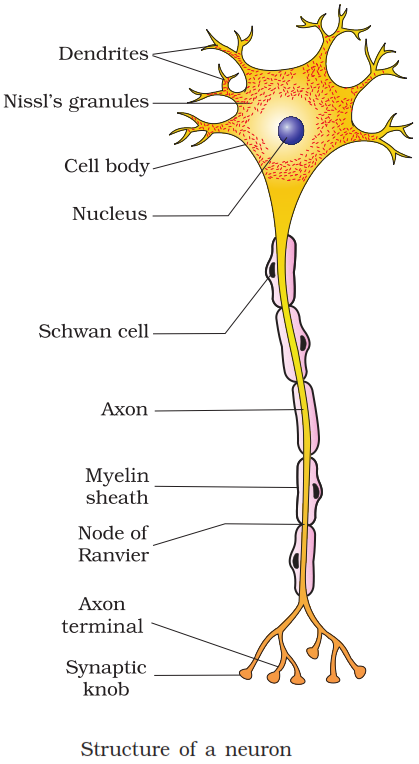
Give a description of the structure of neuron.
Answer
A neuron is a microscopic structure composed of three major parts, namely, cell body, dendrites and axon Cell Body. The cell body contains cytoplasm with typical cell organelles and certain granular bodies called Nissi's granules.
  • Dendrites: Short fibres which branch repeatedly and project out of the cell body also contain Nissi's granules and are called dendrites. These fibres transmit impulses towards the cell body.
  • Axon: The axon is a long fibre, the distal end of which is branched. Each branch terminates as a bulb-like structure called synaptic knob which possess synaptic vesicles containing chemicals called neurotransmitters. The axons transmit nerve impulses away from the cell body to a synapse or to a neuro-muscular junction.
View full question & answer
Question 153 Marks
Compare the following: Resting potential and action potential
Answer
Resting potential and action potential:
  Resting potential   Action potential
1. It is the potential difference across the nerve fibre when there is no conduction of nerve impulse. 1. It is the potential difference across nerve fibre when there is conduction of nerve impulse.
2. The membrane is more permeable to $K ^{+}$ions than to $Na ^{+}$ions. 2. The membrane is more permeable to $Na ^{+}$ions than to $K ^{+}$ions.
View full question & answer
Question 163 Marks
  1. Name the cranial meninges that cover the brain.
  2. Give one function of the following:
  1. Cerebrum.
  2. Hypothalamus.
  3. Medulla.
  4. Cerebellum.
Answer
  1. The cranial meninges has three layers:
  1. The outermost, dura mater.
  2. The middle, arachnoid.
  3. The innermost, pia mater.
  1.  
  1. Cerebrum is concoined with memory, intelligence and motor signalling to skeletal muscles.
  2. Hypothalamus has centres to control body temperature, thirst and hunger and secretes neurohormones.
  3. Medulla has centres which control cardiovascular reflexes, gastric secretions and respiration.
  4. Cerebellum controls the coordination of muscular activities and the posture of the body.
View full question & answer
Question 173 Marks
Raju has recently joined the gym. The very first day, while doing exercise, he felt increased rate of respiration, heartbeat, sweating, etc. He got worried as he experienced the sudden changes in his body. He discussed it with his brother who is a biology student. His brother smiled and explained him that these are the normal activities of the organs/ organ systems that occur during exercise for the maintenance of normal physiology of the human body.
  1. Name the processes that are necessary for maintaining normal physiology of the human body.
  2. Define coordination and integration.
  3. Explain the functions of various organs of the by body that are coordinated and integrated during exercise.
  4. What values did Raju's brother possess?
Answer
  1. Coordination and integration of body organs by neural system. Which regulate normal physiology of human body.
  2. Coordination is the process through which two or more organs interact and complement the functions of one another. On the other hand, integration is a process, which makes two or more organs to work as a functional unit in harmony.
  3. When we do exercise, we observe significant increase in the rate of respiration, heartbeat, bloodflow, sweating, etc., to meet enhanced needs of nutrients and energy for increased activities of lungs, hearts, muscles and many other body organs. When we stop exercising, we witness that the increased activities of lungs, heart, nerves, kidneys, muscles, etc., gradually return to normal. Thus, during exercise, functions of various organs of the body are coordinated and integrated.
  4. He has a good knowledge of biology. He has the ability to apply his learning to the practical life.
View full question & answer
Question 183 Marks
What is resting membrane potential? Give the role of sodium-potassium pumps in maintaining it. How does resting potential change into action potential?
Answer
  1. The electrical potential difference across the plasma membrane of a resting neuron, is called resting potential.
  2. At rest, the membrane of the axon is more permeable to potassium and almost impermeable to sodium; hence the axoplasm has more potassium ions and the extra cellular fluid has more sodium ions.
  3. The sodium-potassium pump transports actively three sodium ions to the outside and only two potassium ions enter the axoplasm, making the axoplasm negatively charged and the exterior positively charged.
  4. When the membrane is stimulated by a threshold stimulus, the membrane becomes freely permeable to $\mathrm{Na}^{+}$; the rapid influx of $\mathrm{Na}^{+}$​​​​​​​ causes depolarisation, i.e. the interior/axoplasm becomes positively charged and the exterior negatively charged.
  5. The electrical potential difference across the membrane at the depolarised state, is called action potential.
View full question & answer
Question 193 Marks
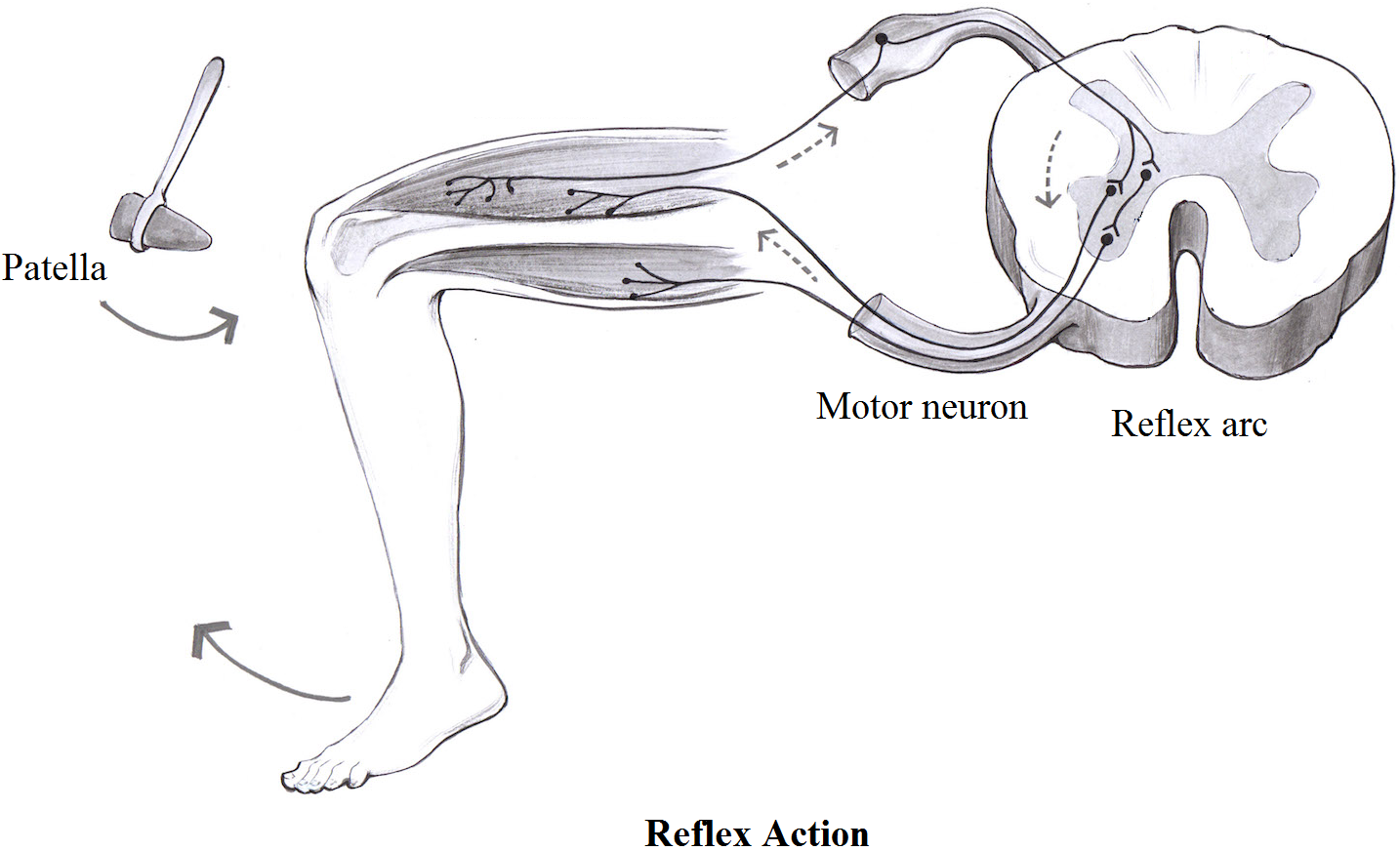
Describe reflex action.
Answer
The entire process of response to a peripheral neural stimulation, that occurs involuntarily, i.e., without conscious effort or thought and requires the involvment of a part of the central neural system is called a reflex action. The reflex pathway comprises at least one afferent neuron (receptor) and one efferent effector or excitor neuron appropriately arranged in a series. The afferent neuron receives signal from a sensory organ and transmits the impulse via a dorsal nerve root into the CNS (at the level of spinal cord). The efferent nueuron then carries signals from CNS to the effector. The stimulus and response thus forms a reflex arc as shown below in the knee jerk reflex.
View full question & answer
Question 203 Marks
During resting potential, the axonal membrane is polarised, indicate the movement of +ve and –ve ions leading to polarisation diagrammatically.
View full question & answer
Question 213 Marks
Write short note on ear ossicles.
Answer
The middle ear contains a flexible chain of three middle bones called ear ossicles. The three ear ossicles are as follows.
  1. Malleus
  2. Incus
  3. Stapes
The malleus is attached to tympanic membrane on one side and to incus on the other side. The incus is connected with stapes. Stapes, in turn, are attached with an oval membrane, fenestra ovalis, of internal ear. The ear ossicles act as a lever that transmits sound waves from external ear to internal ear.
View full question & answer
Question 223 Marks
  1. Name the cranial meninges that cover the brain.
  2. Write down one function of cerebellum and cerebrum each.
Answer
  1. The cranial meninges consists of three layers:
  1. The outer pia mater.
  2. The middle arachnoid.
  3. The inner dura mater.
  1.  
  1. The cerebellum integrates the information from semicircular canals of the ear and the auditory system.
  2. The cerebrum is responsible for memory, communication and intersensory associations.
View full question & answer
Question 233 Marks
Distinguish between blind spot and yellow spot.
Answer
Blind spot and yellow spot:
  Blind spot   Yellow spot
1. Blind spot is a spot on the retina present at the point of origin of the optic nerve. 1. Yellow spot is a small area on the retina present at the posterior pole of the eye, lateral to the blind spot.
2. Photoreceptor cells are absent from this region. 2. Only cones are present in this region.
3. They are insensitive to light as both rods and cones are absent. 3. They are sensitive to bright light as cones are present.
View full question & answer
Question 243 Marks
Differentiate between rods and cones.
Answer
Rods and cones:
  Rods   Cones
1. Rods help in twilight vision. 1. Cones help in colour vision.
2. They have visual purple pigment called rhodopsin. 2. They have visual violet pigment called iodopsin.
3. Rods are the photoreceptor cells of the retina that are sensitive to dim light. 3. Cones are the photoreceptor cells of the retina that are sensitive to bright light.
View full question & answer
Question 253 Marks
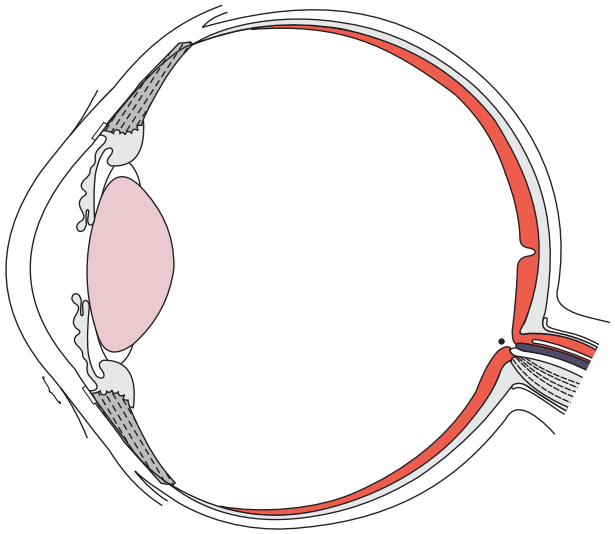
Label the following parts in the given diagram using arrow.
  1. Aqueous chamber.
  2. Cornea.
  3. Lens.
  4. Retina.
  5. Vitreous chamber.
  6. Blind spot.
​​​​​​​
View full question & answer
Question 263 Marks

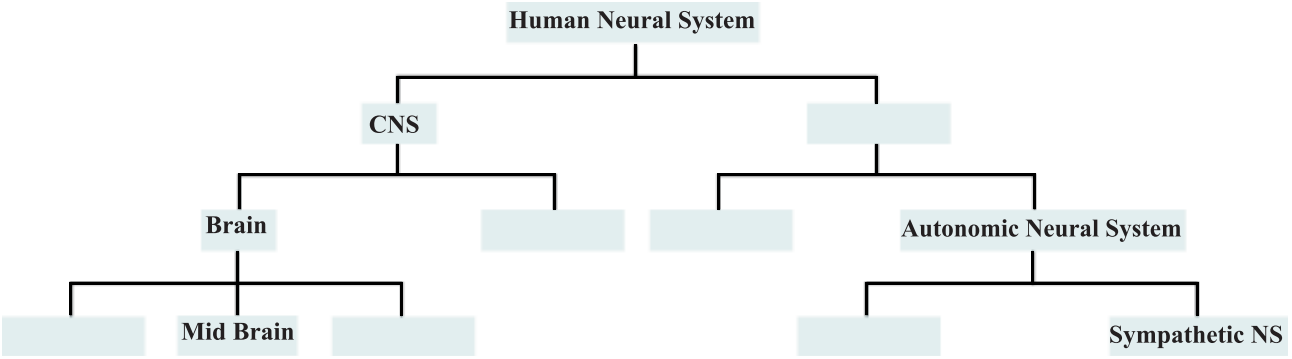
The major parts of the human neural system is depicted below. Fill in the empty boxes with appropriate words.
View full question & answer
Question 273 Marks
What is limbic system composed of? Mention its functions.
Answer
The limbic system is constituted by the inner part of the while matter of cerebral hemispheres) and deep seated structures like amygdala and hippocampus.Limbic system:
  1. The regulation of sexual behaviour.
  2. Expression of emotional reactions.
  3. Motivation.
  4. Olfaction.
  5. Autonomic responses.
View full question & answer
Question 283 Marks
Compare the following: Central neural system (CNS) and Peripheral neural system (PNS)
Answer
Central neural system (CNS) and Peripheral neural system (PNS):
  Central neural system   Peripheral neural system
1. It is the main coordinating centre of the body. 1. It is not the main coordinating centre of the body.
2. It includes brain and spinal cord. 2. It includes cranial and spinal nerves that connect central nervous system to different parts of the body.
View full question & answer
Question 293 Marks
How is an action potential achieved during impulse conduction through an axon? Explain.
Answer
  1. When the polarised membrane of a resting axon is stimulated at a site (A), the permeability of the membrane is changed at that site; it becomes more permeable to sodium ions.
  2. So, there is a rapid influx of $\mathrm{Na}^{+}$ ions that leads to the reversal of the polarity, i.e. the exterior of the membrane becomes negatively charged and the interior/axoplasm becomes positively charged.
  3. The electrical potential difference across the membrane at the stimulated site (A), is called action potential.
  4. The site (B) ahead of A, is in the polarised state, i.e. it is positively charged on the outside and negatively charged on the inside.
  5. Consequently, there is a flow of current from site A to B in the axoplasm and from B to A on the extracellular fluid and an action potential is generated at B.
  6. These events are repeated all along the length of the axon and the impulse/ action potential is conducted.
View full question & answer
Question 303 Marks
The biology teacher asked the students to verify the Pavlov's experiment in dogs to establish the conditioned response (reflex). The class was divided into two groups. The teacher asked them to submit the reports. Group 2 did not repeat the experiment. The teacher praised group 1 and also gave another chance to group 2 students.
  1. Which experiment was performed by students?
  2. Explain the experiment in brief.
  3. What is conditioned reflex?
  4. What values did group 1 exhibit?
Answer
  1. Pavlov's experiment.
  2. Pavlov's Experiment: The concept for which Pavlov experiment is done is to check the conditioned reflexes. Students conduct this experiment to know this concept of conditioned reflex, to examine the rate of salivations among dogs. Everytime when bell is rung they fed the dog. He learned that when the bell was rung without food being presented to the dog. The dog will subsequently initiate salivation. The dog had associated the sound of the bell with the feeding time. This shows to the association of an expected response (drool) to an unlikely stimulus (the bell).
  3. Conditioned reflex is acquired after birth, i.e., they are adopted during the course of lifetime.
  4. Scientific attitude, awareness and sense of responsibility.
View full question & answer
Question 313 Marks
A man is admitted to a hospital. He is suffering from an abnormal low body temperature, loss of appetite and extreme thirst. The doctor consoled him and also prescribed brain scan as he suspected, there would be a tumour in his brain.
  1. Mention the reason behind the abnormalities of the patient.
  2. Which part of the brain would probably show a tumour?
  3. Identify the location of hypothalamus.
  4. What values of life were reflected by the doctor?
Answer
  1. Tumour in hypothalamus.
  2. Hypothalamus.
  3. The hypothalamus lies at the base of thalamus in the forebrain.
  4. Humanity and responsibility towards the patient. He is devoted to his duties and has professional ethics.
View full question & answer