Questions · Page 1 of 4

M.C.Q (1 Marks)

🎯

Test yourself on this topic

50 questions · timed · auto-graded

MCQ 11 Mark
Frog is
  • A
    Homoeothermic
  • Poikilothermic
  • C
    Homeostatic
  • D
    Warm$-$blooded
Answer
Correct option: B.
Poikilothermic
Poikilothermic
View full question & answer
MCQ 21 Mark
In frogs, urine is temporarily stored in
  • A
    Kidneys
  • Urinary bladder
  • C
    Ureters
  • D
    Cloaca
Answer
Correct option: B.
Urinary bladder
Urinary bladder
View full question & answer
MCQ 31 Mark
Pancreatic juice helps in digestion of
  • A
    Fats
  • B
    Carbohydrates
  • C
    Protein
  • All of these
Answer
Correct option: D.
All of these
All of these
View full question & answer
MCQ 51 Mark
The liquefied semi-digested acidic food is known as
  • A
    Bile
  • B
    Bolus
  • Chyme
  • D
    Faeces
Answer
Correct option: C.
Chyme
Chyme
View full question & answer
MCQ 71 Mark
In male frog, vasa efferentia enter the kidney and open into
  • A
    Ureter
  • B
    Urinogenital duct
  • C
    Cloaca
  • Bidder's canal
Answer
Correct option: D.
Bidder's canal
Bidder's canal
View full question & answer
MCQ 81 Mark
Autonomic nervous system in frog is divided into
  • A
    Brain and spinal cord
  • B
    Cranial and spinal nerves
  • Sympathetic and parasympathetic
  • D
    Forebrain, midbrain and hindbrain
Answer
Correct option: C.
Sympathetic and parasympathetic
View full question & answer
MCQ 91 Mark
Central nervous system is divided in frog in
  • Brain and spinal cord
  • B
    Cranial and spinal nerves
  • C
    Sympathetic and parasympathetic
  • D
    Forebrain, midbrain and hindbrain
Answer
Correct option: A.
Brain and spinal cord
View full question & answer
MCQ 101 Mark
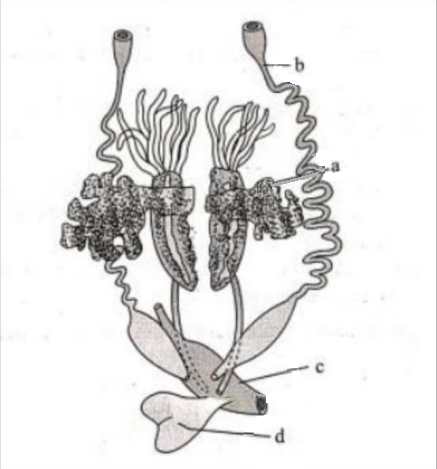
Recognise the figure and find out the correct matching.
Image
  • A
    $a-$cloaca, $b-$rectum, $c-$urinary bladder, $d-$urino genital duct
  • B
    $c-$cloaca, $d-$rectum, $a-$urinary bladder, $b-$urino$-$genital duct
  • $b-$cload, $c-$rectam, duringý blader, $a-$urino$-$genital duct
  • D
    $d-$cloaca, $a-$rectum, $b-$urinary bladder, $c-$urino$-$genital duct
Answer
Correct option: C.
$b-$cload, $c-$rectam, duringý blader, $a-$urino$-$genital duct
View full question & answer
MCQ 111 Mark
The nervous system of frog is organized into
  • Central nervous system and peripheral nervous system
  • B
    Central nervous system and autonomic nervous system
  • C
    Central nervous system, peripheral nervous system and autonomic nervous system
  • D
    Brain and spinal cord
Answer
Correct option: A.
Central nervous system and peripheral nervous system
View full question & answer
MCQ 121 Mark
Read the following statements and find out the incorrect statement about frog
  • A
    Frog never drinks water.
  • B
    In frog, neck and tail are absent.
  • The duodenum receives bile from gall blader and pancreatic juices from the pancreas through the hepato pancreatic duct.
  • D
    Eyes of frog are covered by nictitating membrane that protects them while in water
Answer
Correct option: C.
The duodenum receives bile from gall blader and pancreatic juices from the pancreas through the hepato pancreatic duct.
View full question & answer
MCQ 131 Mark
A triangular structure that joins the right atrium of heart in frog is called
  • Sinus venosus and receives blood from vena cava
  • B
    Conus arteriosus and receives blood from vena cave
  • C
    Sinus venosus and receives blood from pulmonary artery
  • D
    Conus arteriosus and receives blood from pulmonary vein.
Answer
Correct option: A.
Sinus venosus and receives blood from vena cava
View full question & answer
MCQ 141 Mark
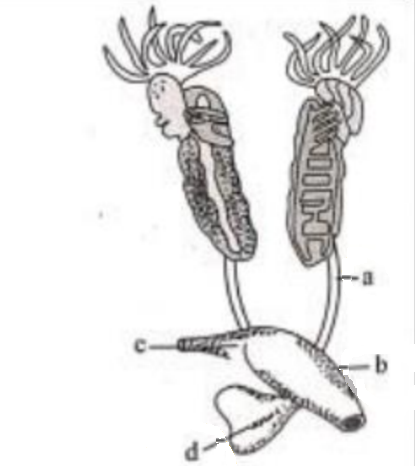
Recognise the figure and find out the correct matching.
Image
  • A
    $a-$cloaca, $b-$ovary, $d-$oviduct, $c-$urinary bladder
  • $c-$cloaca, $a-$ovary, $b-$oviduct, $d-$urinary bladder
  • C
    $b-$cloaca, $d-$ovary, $c-$oviduct, $a-$urinary bladder
  • D
    $d-$cloaca, $c-$ovary, $a-$oviduct, $b-$urinary blader
Answer
Correct option: B.
$c-$cloaca, $a-$ovary, $b-$oviduct, $d-$urinary bladder
View full question & answer
MCQ 151 Mark
Read the following statements and find out the incorrect statement about frogs.
  • A
    Frog respire on land and in water by two different methods..
  • B
    Liver secrets bile that is stored in the gall bladder
  • C
    Three chambered heart is situated in the upper part of body cavity
  • $\text{RBCS}$ Are enucleated and contain red coloured pigment called haemoglobin.
Answer
Correct option: D.
$\text{RBCS}$ Are enucleated and contain red coloured pigment called haemoglobin.
View full question & answer
MCQ 161 Mark
In water, the aquatic respiratory organ$(s)$ of frog is/are
  • Skin $($cutaneous respiration$)$
  • B
    Skin, lungs $($pulmonary respiration$)$ and buccal cavity
  • C
    Lungs and buccal cavity
  • D
    Skin and buccal cavity
Answer
Correct option: A.
Skin $($cutaneous respiration$)$
View full question & answer
MCQ 171 Mark
During the peak summer and winter the frogs take shelter in deep burrows to protect them from extreme heat and cold. This is called as
  • Summer sleep $($aestivation$)$ and winter sleep $($hibernation$)$
  • B
    Summer sleep $($hibernation$)$ and winter sleep $($aestivation$)$
  • C
    Summer sleep $($diapause$)$ and winter sleep $($suspend$)$
  • D
    Summer sleen $($dormancy$)$ and winter sleep $($diapause$)$
Answer
Correct option: A.
Summer sleep $($aestivation$)$ and winter sleep $($hibernation$)$
View full question & answer
MCQ 181 Mark
In frog, the duodenum receives bile from gall bladder and pancreatic juices from the pancreas through a
  • Common bile duct
  • B
    Hepato-pancreatic duct
  • C
    Cystic duct
  • D
    Hepatic duct
Answer
Correct option: A.
Common bile duct
Common bile duct
View full question & answer
MCQ 191 Mark
Frogs have the ability to change the colour to hide them from their enemies. This protective coloration is called
  • A
    Aestivation
  • B
    Metamorphosis
  • camouflage
  • D
    Metagenesis
Answer
Correct option: C.
camouflage
camouflage
View full question & answer
MCQ 201 Mark
Respiratory organs of frog are:
  • A
    Skin
  • B
    Lungs
  • Both $(A)$ and $(B)$
  • D
    Flame cells
Answer
Correct option: C.
Both $(A)$ and $(B)$
View full question & answer
MCQ 221 Mark
Where are the copulatory pads in male frog present?
  • A
    Second digit of the hindlimbs
  • B
    First digit of the hindlimbs
  • First digit of the forelimbs
  • D
    Second digit of the forelimbs
Answer
Correct option: C.
First digit of the forelimbs
View full question & answer
MCQ 231 Mark
How many ova are laid by a female frog at a time?
  • A
    $100-200$
  • B
    $500-1000$
  • $2500-3000$
  • D
    $5000-6000$
Answer
Correct option: C.
$2500-3000$
$2500-3000$
View full question & answer
MCQ 241 Mark
Male frogs can be distinguished from female frogs by the presence of
  • A
    Sound producing vocal sacs
  • B
    Copulatory pad
  • C
    Pair of nostrils
  • Both $(A)$ and $(B)$
Answer
Correct option: D.
Both $(A)$ and $(B)$
View full question & answer
MCQ 251 Mark
Which of these structures in frog receive sound signals?
  • A
    Webbed feet
  • B
    Skin
  • C
    Nictitating membrane
  • Tympanum
Answer
Correct option: D.
Tympanum
Tympanum
View full question & answer
MCQ 261 Mark
The chief nitrogenous waste material present in the urine of frog
  • Urea
  • B
    Uric acid
  • C
    Ammonia
  • D
    Allantois
Answer
Correct option: A.
Urea
Urea
View full question & answer
MCQ 271 Mark
Which of these structures protects the eyes of the frog in water?
  • Nictitating membrane
  • B
    Tympanum
  • C
    Bidder's canal
  • D
    Cloaca
Answer
Correct option: A.
Nictitating membrane
View full question & answer
MCQ 281 Mark
Which of these methods are utilized by frogs for protection?
  • A
    Speed
  • B
    Spikes
  • Mimicry
  • D
    Playing dead
Answer
Correct option: C.
Mimicry
Mimicry
View full question & answer
MCQ 291 Mark
Which of these statement is true about frog?
  • A
    It lives both on land and in sea water
  • B
    They cannot survive in freshwater
  • C
    Rana tigrine is a rare species
  • They belong to class Amphibia
Answer
Correct option: D.
They belong to class Amphibia
View full question & answer
MCQ 301 Mark
Histamine is secreted by:
  • Mast cells.
  • B
    Fibroblast.
  • C
    Melanocytes.
  • D
    Histocytes.
Answer
Correct option: A.
Mast cells.
Mast cells.
View full question & answer
MCQ 311 Mark
Haemophilia is:
  • A
    Royal disease.
  • B
    Faulty blood clotting.
  • Both $(a)$ and $(b)$.
  • D
    Mosquito having haemocoel.
Answer
Correct option: C.
Both $(a)$ and $(b)$.
Both $(a)$ and $(b).$
View full question & answer
MCQ 321 Mark
Columnar epithelium is found in the lining of which organ?
  • A
    Lungs.
  • Stomach.
  • C
    Liver.
  • D
    Nasal Cavity.
Answer
Correct option: B.
Stomach.
Stomach.
View full question & answer
MCQ 331 Mark
The head capsule of a cockroach is made of:
  • A
    Four segments.
  • B
    Five segments.
  • Six segments.
  • D
    One segment.
Answer
Correct option: C.
Six segments.
Six segments.
View full question & answer
MCQ 341 Mark
Brush border is characteristic of:
  • A
    Neck of nephron.
  • B
    Collecting tube.
  • Proximal convoluted tubule.
  • D
    All of the above.
Answer
Correct option: C.
Proximal convoluted tubule.
View full question & answer
MCQ 351 Mark
Choose the incorrect statement.
  • A
    Vascular system of frog is closed type.
  • Frogs have $4-$chambered heart.
  • C
    During aestivation and hibernation, skin acts as respiratory organ.
  • D
    All the statements are correct.
Answer
Correct option: B.
Frogs have $4-$chambered heart.
Vascular system of frogs is closed and they have $4-$chambered heart.
View full question & answer
MCQ 361 Mark
Which of the following is not exclusively supplied with involuntary muscles?
  • A
    Muscular coats of blood vessels.
  • Muscles of the ducts of glands.
  • C
    Muscles of iris.
  • D
    Muscles of urethra.
Answer
Correct option: B.
Muscles of the ducts of glands.
View full question & answer
MCQ 371 Mark
Which of the following is not a connective tissue?
  • A
    Bone.
  • B
    Cartilage.
  • C
    Blood.
  • Muscles.
Answer
Correct option: D.
Muscles.
Muscular tissue consists of muscle fibers, it is not a connective tissue. Bone and cartilage are specialized connective tissue and blood is fluid connective tissue.
View full question & answer
MCQ 381 Mark
Which of the following is the most abundant tissue in our body?
  • A
    Epithelial tissue.
  • B
    Muscular tissue.
  • Connective tissue.
  • D
    Neural tissue.
Answer
Correct option: C.
Connective tissue.
Connective tissue.
View full question & answer
MCQ 391 Mark
Male and female cockroaches can be distinguished externally through.
  • Anal styles in male.
  • B
    Anal cerci in female.
  • C
    Anal style and antennae in females.
  • D
    None of these.
Answer
Correct option: A.
Anal styles in male.
View full question & answer
MCQ 401 Mark
Which of the following organs will not have ciliated epithelium?
  • A
    Nasal Cavity.
  • B
    Small Intestine.
  • C
    Middle Ears.
  • All of the above.
Answer
Correct option: D.
All of the above.
All of the above.
View full question & answer
MCQ 411 Mark
The main function of the skin of frog is:
  • The exchange of respiratory gases.
  • B
    The storage of fat.
  • C
    The storage of energy.
  • D
    To convert light vitamin $D.$
Answer
Correct option: A.
The exchange of respiratory gases.
View full question & answer
MCQ 421 Mark
Ligament is a:
  • A
    Modified yellow elastic fibrous tissue.
  • Inelastic white fibrous tissue.
  • C
    Modified white fibrous tissue.
  • D
    None of the above.
Answer
Correct option: B.
Inelastic white fibrous tissue.
View full question & answer
MCQ 431 Mark
Which system transmits impulses between different parts of the body?
  • A
    Musculoskeletal system
  • B
    Endocrine system
  • C
    Circulatory System
  • Nervous system
Answer
Correct option: D.
Nervous system
A complex network of nerve cells or neurons forms the nervous system.
This system is responsible for transmitting electrical impulses throughout the body.
View full question & answer
MCQ 441 Mark
Haemoglobin is a type of:
  • A
    Carbohydrate.
  • B
    Vitamin.
  • C
    Skin pigment.
  • Respiratory pigment.
Answer
Correct option: D.
Respiratory pigment.
View full question & answer
MCQ 451 Mark
Excretory organs of Cockroach are:
  • Malpighian tubules.
  • B
    Hreen glands.
  • C
    Both.
  • D
    None of these.
Answer
Correct option: A.
Malpighian tubules.
Malpighian tubules.
View full question & answer
MCQ 461 Mark
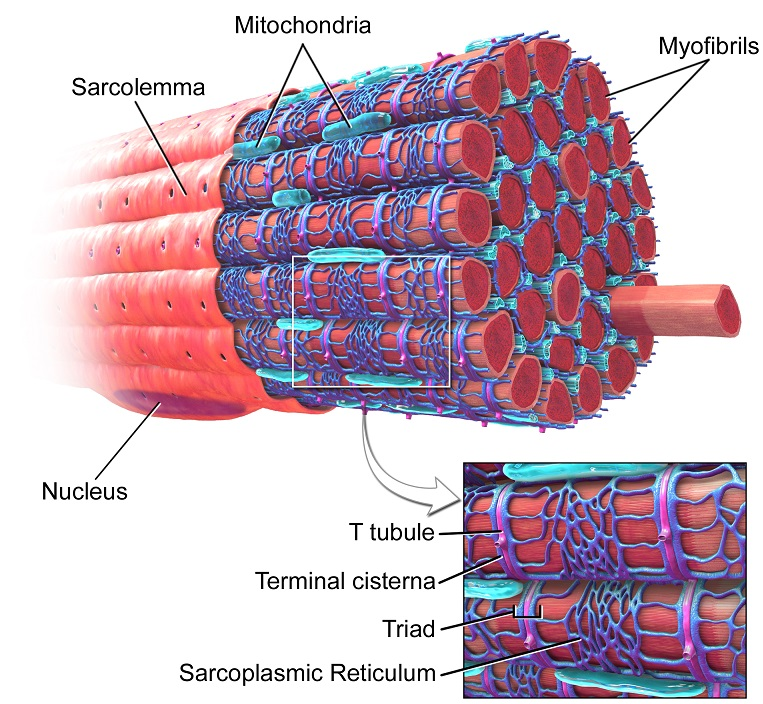
Movement of human body parts is due to$............$
  • Muscle cells
  • B
    Nerve cells
  • C
    Gland cells
  • D
    Skin cells
Answer
Correct option: A.
Muscle cells

Muscle cells aid in the movement of body parts in humans.
These cells have the ability to contract and relax, which causes the movement of body parts.
Nerve cells send and receive signals from the brain.
Glandular cells secrete sweat, saliva, breast milk, digestive enzymes and hormones, among other substances.
Skin cell functions in protection, secretion, sensation, etc.
View full question & answer
MCQ 471 Mark
Which one of the following is a scent gland of mammals?
  • A
    Bartholin
  • Anal
  • C
    Prostate
  • D
    Adrenal
Answer
Correct option: B.
Anal
Anal
View full question & answer
MCQ 481 Mark
Formation of cartilage bones involves:
  • A
    Deposition of bony matter by osteoblasts and resorption by chondroclasts.
  • B
    Deposition of bony matter by osteoclasts and resorption by chondroblasts.
  • C
    Deposition of bony matter by osteoclasts only.
  • Deposition of bony matter by osteoblasts only.
Answer
Correct option: D.
Deposition of bony matter by osteoblasts only.
View full question & answer
MCQ 491 Mark
A person with blood group $A$ requires blood. The blood group which can be given is:
  • A
    $A$ and $B.$
  • B
    $A$ and $AB.$
  • $A$ and $O.$
  • D
    $A, B, AB$ and $O.$
Answer
Correct option: C.
$A$ and $O.$
$A$ and $O$.
View full question & answer
MCQ 501 Mark
Which cartilage is present at the end of long bones?
  • A
    Calcified cartilage.
  • Hyaline cartilage.
  • C
    Elastic cartilage.
  • D
    Fibrous cartilage.
Answer
Correct option: B.
Hyaline cartilage.
Hyaline cartilage.
View full question & answer
M.C.Q (1 Marks) - Biology STD 11 Science Questions - Vidyadip