Questions

3 Marks Question

Take a timed test

42 questions · self-marked practice — reveal the answer and mark yourself.

Question 13 Marks
Define a taxon. Give some examples of taxa at different hierarchical levels.
Answer
Each unit or category of classification is termed as a taxon. It represents a rank. For example, the basic level of classification is species, followed by genus, family, order, class, phylum or division, in ascending order. The highest level of classification is known as kingdom. So each of these categories can be called as a taxon.
 
Phylum/ Division
Class
Order
Family
Genus
Species
1.
Seed Plant
Flowering Plant
Yeast
Orchid
Citrus
Banyan
2.
Green Alga
Fern
Mushroom
Grass
Eucalyptus
Neem
3.
Flatworm
Insect
Spider
Bear
Crow
Tiger
4.
Roundworm
Bird
Lizard
Elephant
Wolf
Dog
View full question & answer
Question 23 Marks
How does biodiversity of a geographical location influence the classification of plant and animal species present in that location?
Answer
The biodiversity of a geographical location may influence the classification in following ways:
  • If there is rich biodiversity then it means number of characters will be in plenty to study.
  • More characters will give scientists more clues about possible variations.
  • Similarity in characters would indicate towards phylogenetic relation between two or more species.
  • On the other hand if a given geographical area is poor in biodiversity then it becomes difficult to study more characters and one has to rely on limited set of characters.
  • Rich biodiversity means more resources and more reproduction leading to increased competition for survival. This can lead to emergence of certain new variations. These variations can lead to emergence of an altogether new species.
  • One example can be recent discovery of a frog species from the Himalayan region. As Himalayan region is rich in biodiversity so it gives fertile ground for a new species to emerge.
View full question & answer
Question 33 Marks
What is the difference between flora, fauna and vegetation? Eichhornia crassipes is called as an exotic species while Rauwolfia serpentina is an endemic species in India. What do these terms exotic and endemic refer to?
Answer
Difference between flora, fauna an vegetation:
Flora
Fauna
Vegetation
The term flora is used to denote plants of a particular region or period.
The species of animals of a particular region are referred to as fauna.
The grasses,shrubs and trees growing in a particular region is called its vegetation.
Endemic species refer to those species of plants and animals which are restricted to a prticular area. Anything which is striking or mysteriously different or unusual, it is called as exotic.
View full question & answer
Question 43 Marks
How will you define life as a biologist? What features make you different from non-living things?
Answer
The earth hosts a vast variety of living organisms. According to a survey, the number of species that are known and described range between 1.7-1.8 million. This number refers to the known biodiversity on the earth. Although the actual biodiversity present on earth is far more than this number. The term Biodiversity or Biological diversity means the entire number and types of organisms present on the earth. The living world includes all the living organisms, such as microorganisms, plants, animals and humans.
View full question & answer
Question 53 Marks
List out the functions of a museum.
Answer
Museum is a place for collection of preserved plants and animal specimens for study and reference. The universities and educational institutes maintain their own museums in their botany and zoology departments. Plants which cannot be kept in herbaria are preserved in museums, e.g., algae, fungi, mosses, ferns, fruits, etc. Specimens are preserve in containers or jars in preservative solutions. Plant and animal specimens may also be preserved as dry specimens. Insects are preserved in insect boxes after collecting, killing and pinning while, the larger animals are either stuffed or preserved in skeletal forms.
View full question & answer
Question 63 Marks
In a given habitat we have 20 plant species and 20 animal species. Should we call this as ‘diversity’ or ‘biodiversity’? Justify your answer.
Answer
Biodiversity is the occurrence of a wide variety of life forms differing in morphology, size, colour, anatomy, habitats and habits. In a gixjen habitat, the 20 plant species and 20 animal species habitat, shows biodiversity of that given habitat. Diversity is broader term habitat which can be applied to any area.
View full question & answer
Question 73 Marks
Write any three advantages of scientific names.
Answer
Advantages of scientific names are:
  1. These are acceptable in every part of the world.
  2. These are assigned on agreed principles by scientists.
  3. These are very specific. It means no two organisms can have the same name.
View full question & answer
Question 83 Marks
What is the difference between two stages of metabolism?
Answer
Metabolism is an another characteristic and defining feature of all living things. All living organisms are made of chemicals which are constantly being formed or changed into some other biomolecules. The important differences between anabolism and catabolism are:
 
Anabolism
Catabolism
i.
It is the sum total of constructive processes.
it is the sum total of destructive processes.
ii.
Complex substances are formed from simpler ones.
Simpler substances are formed from complex ones.
iii.
Energy is stored.
Energy is released.
iv.
Anabolism is required for growth and maintenance.
Catabolism is required for performance of activities.
 
View full question & answer
Question 93 Marks
A plant may have different names in different regions of the country or world. How do botanists solve this problem?
Answer
There are many languages and even more dialects being spoken in different parts of the world. This means a plant may have different names in different regions of the country or world. This compounds the problem for anybody because nobody can remember all those names. To solve this problem, botanists have devised the system of binomial nomenclature so that a particular species can have unique name for the purpose of scientific study. A botanical name is usually composed of two terms, viz. genus name and species name. Care is taken to make a unique name for a particular species.
View full question & answer
Question 103 Marks
Why reproduction is necessary? Is it essential for survival? If a living organism does not reproduce, in which category it will belong, living or non-living? How is sexual reproduction different from asexual reproduction.
Answer
Reproduction is required for the perpetuation of a population. It is not necessary for the survival of living organisms. Many organisms, e.g., mules, sterile worker bees, infertile human couples are not able to reproduce, while they have all other defining properties of life, so they can be called as living. Sexual reproduction involves the formation and fusion of two kinds of gametes to produce an offspring. In asexual reproduction, new individuals can arise by the specialised parts of body or without the fusion of gametes.
View full question & answer
Question 113 Marks
The number and kinds of organism is not constant. How do you explain this statement?
Answer
This question needs to be looked upon from two perspectives, i.e number and variety. For any organism; the population can not remain constant. In some of the generations, pollution can be more because of favourable condition. In some other generations, population can be less because of unfavourable conditions. The kinds of organism cannot be constant because evolution is a never ending process. In every era new species come into origin and some old species become extinct.
View full question & answer
Question 123 Marks

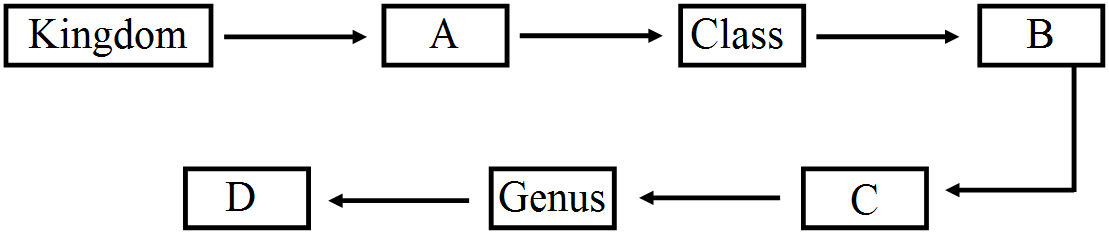
Write the relation between taxonomic category and taxonomic hierarchy. Fill in the missing category in following hierarchical arrangement in ascending order.
Answer
The category is a part of overall taxonomic arrangement called taxonomic category. All the categories together constitute the taxonomic hierarchy.A-Phylum, B-Order, C-Family and D-Species.
View full question & answer
Question 133 Marks
Mention the basis of a (biological) classification. What educative advantage do we get from r botanical garden and r zoological park?
Answer
  1. Classification is based on certain easily observable characters.
  2. A botanical garden has a collection of living plants, which are grown for identification and reference purposes; each of them is labelled with its scientific/ botanical name and the family.
  3. A zoological park enables us to learn about the behavior and food habits of animals and also about their habitats, as they are kept in conditions very similar to their natural habitats.
View full question & answer
Question 143 Marks
In which fields taxonomical aids are helpful? Why taxonomic aids are used in these studies? Which different taxonomical aids are used by the biologists?
Answer
Taxonomical aids are helpful in various fields such as agriculture, forestry, industry and in knowing our bioresources. All the above mentioned studies need correct identification and classification of organisms. Identification of organisms require intensive laboratory and field studies. Biologists use herbarium, botanical gardens, museum, zoological parks and taxonomical keys while doing taxonomical studies.
View full question & answer
Question 153 Marks
Name the multiple levels of body organization in living things.
Answer
Physical and Biological Hierarchies: There is a physical (non-living) hierarchy and biological (living) hierarchy in the organisation of living body. In physical hierarchy, various non-living components (atoms and molecules) aggregate to form compounds, which finally enter the living world in the form of cells. Each cell is made up of many compartmentalised cell organelles, each of which has specific intracellular function. These cells organise to form tissues, that form organs and several organs combine to form organ systems. Finally, many organ systems organise and form a living organism. The properties of tissues are not present in the constituent cells, but arise as a result of interactions among the constituent cells. For example, bone is a hard tissue, which provides framework to the body, but the cells present inside it do not have this property. This phenomenon of interactions between various components of the body results in the hierarchy of organisation.
View full question & answer
Question 163 Marks
On the basis of characteristics describe how closely or distantly related following species are: Human, Chimpanzee, Cats, Tigers, Rabbits, Mouse, Crocodiles and Lizards.
Answer
Related Animals
Common Characters
Human and Chimpanzee
Similar structure of skull, upright walking, digits can be used for manipulating objects.
Cat and Tiger
Similar body architecture, eating habit, Presence of strong canine teeth.
Rabits and Mouse
Similar body architecture, incisor teeth keep on growing, both can dig burroughs.
Crocodiles and Lizards
Crawling animals, rough skin, oviparous.
Additional comments
All are having four limbs for locomotion.
View full question & answer
Question 173 Marks
Brinjal and potato belong to the same genus Solanum, but to two different species. What defines them as seperate species?
Answer
Genus is a group or assemblage of related species which resemble one another in certain correlated characters. Brinjal and potato belongs to same genus Solanum but they are different species Solanum melongena and Solanum tuberosum respectively. The basic criterion for defining two different species is that they cannot interbreed and produce fertile offspring. Potato and brinjal neither actually nor potentially interbreed, thus they are defined as separate species.
View full question & answer
Question 183 Marks
International Code of Botanical Nomenclature (ICBN) has provided a code for classification of plants. Give hierarchy of units of classification botanists follow while classifying plants and mention different ‘Suffixes’ used for the units.
Answer
ICBN has specified certain rules and principles in order to facilitate the study of plants by botanists. Hierarchy of units of classification botanists follow while classifying plants and different ‘Suffixes’ used for the units are as follows:
Category
Standard Suffix
Kingdom
Plantae (No fixed suffix)
Division
-phyta
Class
-ae
Order
-ales
Family
-aceae
Genus
No fixed suffix
Species
No fixed suffix
View full question & answer
Question 193 Marks
A plant species shows several morphological variations in response to altitudinal gradient. When grown under similar conditions of growth, the morphological variations disappear and all the variants have common morphology. What are these variants called?
Answer
Such plants variants are known as Biotypes. All the biotypes are similar genetically but are different morphologically. The difference in the morphology is due to the abiotic factors like temperature, soil quality, climate, water availability etc. The difference in the abiotic conditions is due to the altitudinal gradient. Therefore the plant species show differences in morphology due to the altitude gradient. When these plants are grown in similar conditions, there is no difference in the abiotic factors and hence all are similar in morphology.
View full question & answer
Question 203 Marks
Write the scientific names of following organisms?
  1. Cat.
  2. Rose.
  3. Sparrow.
Answer
  1. Cat - Felis catus.
  2. Rose - Rosa indica.
  3. Sparrow - Passer domestica.
View full question & answer
Question 213 Marks
List out the advantages of binomial nomenclature.
Answer
Advantages of Binomial Nomenclature:
  1. There is a single specific name for every species.
  2. All the organisms, irrespective of their utility, have been provided scientific names.
  3. The scientific names are universally accepted and used, irrespective of the local language of the people or a region.
  4. The 'species' part of the scientific name of an organism indicates its relationship and common characteristics with other organisms placed in the same genus.
  5. The scientific names are usually descriptive, indicating some important characteristics of the organism.
  6. A newly discovered organism can easily be described and named using binomial nomenclature.
  7. An incorrect name can easily be set right.
  8. The scientific names are usually derived from Latin or Greek languages, therefore, there is no possibility of any change in meaning of their words.
View full question & answer
Question 223 Marks
Differentiate between obligate categories and intermediate categories. Demonstrate with the help of a flowchart.
Answer
The taxonomic categories from species to kingdom are broad categories or obligate categories. However, taxonomists have also developed sub-categories in this hierarchy to facilitate more sound and scientific placement of various taxa. These sub-categories are sub-species (or varieties), sub-genera, sub-families, sub-orders, sub-classes and sub-phyla. These sub-categories are referred to as intermediate categories.
Obligate categories Intermediate categories
Kingdom Subkingdom
Phylum or Division Subphylum or subdivision and superclass
Class lnfra class and subclass
Orde Superorder and suborder
Family Subfamily and tribe
Genus Subgenus
Species Subspecies, variety or race
View full question & answer
Question 233 Marks
List the information that should be shown on the label of a herbarium sheet.
Answer
A label on the herbarium sheet must have the following information:
  1. Locality/ Place (Habitat).
  2. Name of the collector.
  3. Date and time of collection.
  4. Common English name.
  5. Vernacular name.
  6. Scientific name with the author's name.
  7. Name of the family.
View full question & answer
Question 243 Marks
Do you consider a person in coma-living or dead?
Answer
Consciousness is the defining property of living organisms. The word coma comes from the greek word coma which means “deep sleep”. Coma is a state of unconsciousness in which a person cannot be awakened and fails to respond to any stimuli or perform any voluntary action. The person is still alive, but the brain is functioning at its lowest stage of alertness. The various causes of coma are severe injury to head, infection in brain, overdose of some medicine, stroke or some illness. A person in coma has brain dead but , they are living, as they require nourishment and maintenance Glassgow coma scale is a numerical system to estimate a patient’s level of consciousness. The higher the score, the greater the level of consciousness.
View full question & answer
Question 253 Marks
Write a brief note on flora, monograph and manual.
Answer
  1. Flora: Flora are the important resource that provides information on the taxonomy, nomenclature and descriptive data for the plant newly discovered. The flora also include information on the biology, distribution and habitat preferences of the taxa, as well as illustrations, identification keys and other notes on plants. These provide index to the plant species found in a particular area.
  2. Monograph: A monograph is a comprehensive treatment of a taxon in biological taxonomic studies. These contain information on any one taxon. Monographs revise all known species within only a group, add any newly discovered species, collect and organise available information on the ecological associations, geographic distributions and morphological variations within the group.
  3. Manuals and Catalogues: These are other means of recording descriptions. They also help in correct identification. Manuals are useful in providing information for identification of names of species found in an area.
View full question & answer
Question 263 Marks
How does hierarchical system of classification help scientist to unravel the mystery of living world?
Answer
It is the science of identification, classification and nomenclature. Based on their special characteristics, all living organisms can be classified into different categories. The scientific term for these categories is taxa. This process of classification is called taxonomy. Carolus Linnaeus is known as father of taxonomy. The basis of modern taxonomic studies are external and internal structures (comparative morphology), along with the structure of cells (cytology), development process (embryology) and ecological information of organisms (ecology). It provides information according to similarities, dissimilarities and evolutionary relationships of various organisms. The concept of classical or old taxonomy exists, since the time of Aristotle and Theophrastus till the time of Linnaeus. On the other hand, the concept of modern taxonomy was given by Julian Huxley (1940).The basic processes for taxonomic studies are local:
  1. Organisms are described on the basis of morphology and other characteristics.
  2. The description of characteristics helps in the placement of the organisms in various taxa.
  3. A new taxon can be framed if the organism is different from the existing taxa.
  4. The correct naming of an organism can be done after placing it in appropriate taxon. A new organism can be given a new name after following standardised rules.
View full question & answer
Question 273 Marks
What is consciousness and which are the stimuli for living things to become conscious?
Answer
All living organisms, from the simplest prokaryotes to the most complex eukaryotes, have excellent ability to sense their environment. They respond to various physical, chemical and biological stimuli. The various external factors to which living organisms respond are light, water, temperature, pollutants, other organisms, etc. The various life processes are the result of this interaction and coordination. The complexity in organisation enables living organisms to self-replicate, evolve, self-regulate and respond to external stimuli. All living organisms along with their ancestors and descendants are linked to one another by sharing of common genetic material in the form of DNA in varying degrees. This DNA is responsible for the expression of specific traits in organisms.
View full question & answer
Question 283 Marks
Why biologists do not favour common names? Discuss briefly.
Answer
  1. All the organisms cannot be named by this method as there are organisms of different sizes and shapes, some of which are not directly perceived by man and thus remain unnamed, e.g., microbes.
  2. An organism may have several names in a given language, e.g., there are 8 Hindi names of prickly poppy and water lily has 15 English names.
  3. One common name may have different meanings in different countries, e.g., maize, means wheat and other grains in USA and it is called corn in common wealth countries.
View full question & answer
Question 293 Marks
Write a short account on herbarium as a taxonomic aid.
Answer
  1. A herbarium is defined as collection of plants which have been dried, pressed and preserved on sheets.
  2. These sheets are arranged according to an accepted system of classification.
  3. They form a repository for future use and serve as quick referral systems for taxonomic studies.
View full question & answer
Question 303 Marks
Ria went to see the zoo in her town with her parents and saw many wild animals, their food habits, behaviour, etc. She saw that there was a wide variety of animal life in the zoo. But she was amazed to see that the board placed in front of lion cage and monkey place which tells that both were mammals. However, she thought that they were totally different in appearance.
  1. Why lions and monkeys are considered to be mammals?
  2. Explain the scientific reason to maintain a zoological park.
  3. Is there any similar place to see a variety of plants? If any, then name some.
  4. What values are shown by Ria?
Answer
  1. Lion and monkeys possess the mammalian characters.
  2. Maintaining zoological parks conserver the endangered and critically endangered species.
  3. The natural biosphere reserves have variety of plants.
  4. Ria is a good observer, enthusiastic and nature loving.
View full question & answer
Question 313 Marks
Can you identify the correct sequence of taxonomical categories?
  1. Species → Order → Phylum → Kingdom
  2. Genus → Species → Order → Kingdom
  3. Species → Genus → Order → Phylum
Answer
He correct hierarchical arrangement of taxonomic categories in ascending order is Species → Genus → Family → Order → Class → Phylum → Kingdom Therefore, both (a) and (c) represent correct sequences of taxonomic categories. In sequence (b), species should be followed by genus. Therefore, it does not represent the correct sequence.
View full question & answer
Question 323 Marks
Explain the guidelines/ principles for nomenclature.
Answer
  1. Scientific or biological names are generally in Latin; they are derived from latin or are Latinised irrespective of their origin.
  2. Both the words in a biological name are written in Italics or are separately underlined.
  3. The first word in a biological name denotes the name of the genus and the second word denotes the specific epithet.
  4. The first word or the generic name starts with a capital letter, while the specific epithet starts with a small letter.
  5. The name of the author is written in an abbreviated form after the specific epithet. e.g., Mangifera indicia LInn, it indicates that this species was first described by Linnaeus.
View full question & answer
Question 333 Marks
Try to collect all the currently accepted meanings for the word ‘species’. Discuss with your teacher the meaning of species in case of higher plants and animals on one hand, and bacteria on the other hand.
Answer
Species occupies a key position in classification. It is the lowest taxonomic category. It is a natural population of individuals or group of populations which resemble one another in all essential morphological and reproductive characters so that they are able to interbreed freely and produce fertile offsprings. Each species is also called genetically distinct and reproductively isolated natural population. May (1964) has defined species as “a group of actually or potentially interbreeding populations that are reproductively isolated from other such groups”. In higher plants and animals the term ‘species’ refers to a group of individuals that are able to interbreed freely and produce fertile offsprings. But, in case of bacteria interbreeding cannot serve as the best criteria for delimiting species because bacteria usually reproduce asexually. Conjugation, transformation and transduction, which are termed as sexual reproduction methods in bacteria, also do not correspond to true interbreeding. Thus, for bacteria many other characters such as molecular homology, biochemical, physiological, ecological and morphological characters are taken into consideration while classifying them.
View full question & answer
Question 343 Marks
A student of taxonomy was puzzled when told by his professor to look for a key to identify a plant. He went to his friend to clarify what ‘Key’ the professor was refering to? What would the friend explain to him?
Answer
Identification of a plant is a scientific process. His friend explained that his professor was referring to biological keys. Key or taxonomic key is an artificial analytic device having a list of statements with dichotomic table of alternate characteristics which is used for identifying organisms. Usually a couplet or two contrasting characters are used. The one present in the organism is chosen while the other is rejected. Each statement of the key is called lead. The concept of key was introduced by Lamarck. Separate taxonomic keys are used for each taxonomic category like Fatnily, Genus and Species. Keys are used as reference to help in identification of a newly discovered plant.
View full question & answer
Question 353 Marks
Illustrate the taxonomical hierarchy with suitable examples of a plant and an animal.
Answer
The arrangement of various taxa in a hierarchical order is called taxonomic hierarchy. The hierarchy indicates the various levels of kinship. The number of similar characters of categories decreases from lowest rank to highest rank. The hierarchical system of classification was introduced by Linnaeus. The hierarchy of major categories is: Species Genus Family Order Class Kingdom - 4 — Phylum or Division Increasing specificity Decreasing specificity Classification of a plant (Wheat):
Kingdom – Plantae
Division – Angiospermae
Class – Monocotyledonae
Order – Poales
Family – Poaceae
Genus – Triticum
Species – aestivum
Classification of an animal (Housefly):
Kingdom – Animalia
Phylum – Chordata
Class – Insecta
Order – Diptera
Family – Muscidae
Genus – Musca
Species – domestica
View full question & answer
Question 363 Marks
Metabolism is a defining feature of all living organisms without exception. Isolated metabolic reactions in vitro are not living things but surely living reactions. Comment.
Answer
Metabolism is defined as the sum total of all chemical reactions occurring in the body of all living organism be it at a plant or an animal, fungi or microbe, exhibit metabolism. An Isolated metabolism reaction occur in-vitro as it includes the same environment required to carry out reaction within a cell. Here the reaction can also be carried out outside the body in a cell free system and includes building cell components, taking up of raw material and converting into the energy that is available with the molecule and finally releasing the end product. Hence, it shows that in-vitro reactions represent non living things but living reactions.
View full question & answer
Question 373 Marks
During biology class, the teacher was explaining the characteristics of living things. Abhay became confused after knowing, that all the characteristics of human beings are similar to other animals. He asked his teacher about any characteristic that is exclusively found only in human beings. The teacher smiled appreciated Abhay for his attentiveness and explained him about it.
  1. What is the characteristic exclusively found in humans?
  2. What are the characteristics of living things?
  3. Why viruses are not considered as living?
  4. What values are shown by Abhay?
Answer
  1. Human beings have the ability to express themselves through a proper language or script, which makes them different from other living things. They are also the only organisms that are self-conscious.
  2. The characteristics of living things are growth, reproduction, metabolism, consciousness, etc.
  3. Due to the absence of metabolism in viruses, they cannot be regarded as living. They are considered a connecting link between living and non-living.
  4. Abhay is intelligent, inquisitive and has a scientific attitude.
View full question & answer
Question 383 Marks
Which of the following would have a rich biodiversity; a metropolitan city; like Mumbai or a village in the hills of Meghalaya?
  1. Give reasons in support of your answer.
  2. Suggest some ways to maintain or enrich biodiversity in your neighbourhood.
Answer
Compared to a metropolitan city; a village in the hills of Meghalaya would have a richer biodiversity. This is because Meghalaya has better forest cover and least vehicular population. This creates a good ambience for different living beings to thrive in the region. We can do following to maintain and enrich biodiversity in our neighbourhood:
  • Plant more trees to increase the green cover. Those trees would provide shelter to many creatures.
  • Reduction of environmental pollution by stopping any polluting unit in the locality.
  • Reducing water pollution in the nearby water bodies by taking adequate steps. It will help in providing cleaner water for all living beings in the area.
View full question & answer
Question 393 Marks
Discuss uses of key in taxonomic studies.
Answer
It is the science of identification, classification and nomenclature. Based on their special characteristics, all living organisms can be classified into different categories. The scientific term for these categories is taxa. This process of classification is called taxonomy. Carolus Linnaeus is known as father of taxonomy. The basis of modern taxonomic studies are external and internal structures (comparative morphology), along with the structure of cells (cytology), development process (embryology) and ecological information of organisms (ecology). It provides information according to similarities, dissimilarities and evolutionary relationships of various organisms.The concept of classical or old taxonomy exists, since the time of Aristotle and Theophrastus till the time of Linnaeus. On the other hand, the concept of modern taxonomy was given by Julian Hukley (1940).The basic processes for taxonomic studies are local:
  1. Organisms are described on the basis of morphology and other characteristics.
  2. The description of characteristics helps in the placement of the organisms in various taxa.
  3. A new taxon can be framed if the organism is different from the existing taxa.
  4. The correct naming of an organism can be done after placing it in appropriate taxon. A new organism can be given a new name after following the standardised rules.
View full question & answer
Question 403 Marks
Properties of cell organelles are not always found in the molecular constituents of cell organelles. Justify.
Answer
Cell, the basic structural and functional unit is composed of many cell organelles, i.e., ER, Golgi apparatus, ribosomes, mitochondria, and chloroplasts etc, each with a specific function. Each of these organelles are made up of various molecules such as proteins, lipids, enzymes, metallic ions like $Mg ^{2+}, Ca ^{2+}, Mn ^{2+}, Na +$ etc. which helps in the functioning, of cell organelles. Molecular constituent like proteins ( $60-70 \%$ ), lipids ( $25-30 \%$ ), RNA ( $5-7 \%$ ), DNA, Mn ${ }^{2+}$, ETS, ATP synthetase etc. found in mitochondria function together in a coordinated way to carry out cellular respiration and release energy, thus making it power house of the cell. Thus, the molecular constituents of a cell organelle, forms the basis of its functioning irrespective of its individual molecular properties.
View full question & answer
Question 413 Marks
During a visit to a botanical garden, the teacher showed students an old tree which was on the verge of extinction. As soon as the teacher left, some notorious students climbed up the tree and started cutting the branches, collecting its leaves as previous collection. Saumya instead took photographs from various angles. The boys mocked at Saumya, while the teacher appreciated her.
  1. Why should we conserve biodiversity?
  2. What role is played by botanical garden in the conservation of biodiversity?
  3. Who besides botanists look after plants in botanical gardens?
  4. What values did Saumya possess?
Answer
  1. We should conserve biodiversity as it provides us source of food, drugs and medicines, aesthetic, cultural value, gene pool, etc.
  2. Botanical gardens play an important role in fait conservation by growing a wide variety of plants and protecting them from any harm, both from humans, animals and save them from extinction.
  3. It is the gardeners who look after the plants in botanical gardens besides botanists.
  4. Respect for nature, care for biodiversity and scientific attitude with a vision for future.
View full question & answer
Question 423 Marks
What is the benefit of classification of living beings?
Answer
This is a very big world and there is huge diversity of animals and plants in this world. People of different parts of the world speak different languages. Even in a country, like India, a simple bird, like crow is known by hundreds of names. Think of a scientist's difficulty in understanding about crows in different languages. Moreover, there can be thousands of species of birds. It is practically impossible to study each and every species of plants and animals. Classification makes it easy to study living beings, by keeping them under various groups and subgroups.So, all animals which are capable of flying and have beaks are kept under Aves. Similarly, all animals, having body hair and external ears are kept under mammalia. This makes our task to study them, far easier. An easy way to study helps us in understanding the living world in a better way. It can be said that classification definitely helps in a better and systematic study of living beings.
View full question & answer