MCQ 11 Mark
Directions: In the following questions, a statement of assertion $(A)$ is followed by a statement of reason $(R).$ Mark the correct choice as:
Assertion: The range of the function $f(x) = 2 -3x, \text{x}\in\text{R}, x > 0$ is $R.$
Reason: The range of the function $f(x) = x^2 + 2$ is $(2,\infty).$
- A
$A$ is true, $R$ is true; $R$ is a correct explanation of $A.$
- B
$A$ is true, $R$ is true; $R$ is not a correct explanation of $A$.
- C
$A$ is true; $R$ is false.
- ✓
$A$ is false; $R $ is true.
AnswerCorrect option: D. $A$ is false; $R $ is true.
Assertion: We have,
f$(x) = 2 - 3x, \text{x}\in\text{R}, x > 0$
Let $f(x) = y$, then $y = 2 - 3x$
$\Rightarrow 3x = 2 - y$
$\Rightarrow\text{x}=\frac{2-\text{y}}{3}$
$\because\text{x}>0$
$\Rightarrow\frac{2-\text{y}}{3}>0$
$\Rightarrow2-\text{y}>0$
$\Rightarrow2>\text{y}$
$\therefore\text{y}<2$
Hence, range of $\text{f}=(-\infty,2)$
Reason: Now, $f(x) = x^2 + 2$
Let $y = f(x),$ then
$y = x^2 + 5$
$\Rightarrow\text{x}=\sqrt{\text{y}-2}$
x assumes real values, if $\text{y}-2\geq0$
$\Rightarrow\text{y}\geq2$
$\Rightarrow\text{y}\in[2,\infty)$
$\therefore$ Range of $\text{f}=[2,\infty)$
View full question & answer→MCQ 21 Mark
Directions: In the following questions, a statement of assertion $(A)$ is followed by a statement of reason $(R).$ Mark the correct choice as:
Assertion: If $(x, 1), (y, 2)$ and $(z, 1)$ are in $A - B$ and $n(A) = 3, n(B) = 2,$ then $A = \{x, y, z\}$ and $B = \{1, 2\}.$
Reason: If $n(A) = 3$ and $n(B) = 2,$ then $n(A . B) = 6.$
- A
$A$ is true, $R$ is true; $R$ is a correct explanation of $A.$
- ✓
$A$ is true, $R$ is true; $R$ is not a correct explanation of $A.$
- C
$A$ is true; $R$ is false.
- D
$A$ is false; $R$ is true.
AnswerCorrect option: B. $A$ is true, $R$ is true; $R$ is not a correct explanation of $A.$
Assertion: $A =$ Set of first elements $= \{x, y, z\}$
$B =$ Set of second elements $= \{1, 2\}$
$\therefore A$ is correct.
Reason: $n( A) = 3, n(B) = 2 n(A . B) = n(A) . n(B) = 3 . 2 = 6$
View full question & answer→MCQ 31 Mark
Directions: In the following questions, a statement of assertion $(A)$ is followed by a statement of reason $(R)$. Mark the correct choice as:
Assertion: $(A)$ Let $A = \{1, 2, 3, 5\}, B = \{4, 6, 9\}$ and $R = {(\text{x},\text{y}):\mid\text{x}-\text{y}\mid}$ is odd, $\text{x}\in\text{A},\text{y}\in\text{B}$. Then, domain of $R$ is $\{1, 2, 3, 5\}.$
Reason: $\mid\text{x}\mid$ is always positive $\forall\ \text{x}\in\text{R}.$
- A
$A$ is true, $R$ is true; $R$ is a correct explanation of $A.$
- ✓
$A$ is true, $R$ is true; $R$ is not a correct explanation of $A.$
- C
$A$ is true; $R$ is false.
- D
$A$ is false; $R$ is true.
AnswerCorrect option: B. $A$ is true, $R$ is true; $R$ is not a correct explanation of $A.$
Assertion: Given, $R = (\text{x},\text{y}):\mid\text{x}-\text{y}\mid$ is odd, $\text{x}\in\text{A},\text{y}\in\text{B}$
The relation $R $in Roster form is $R = \{(1, 4), (1, 6), (2 9), (3, 4), (3, 6), (5, 4), (5, 6)\}$
$\therefore$ Domain of $R = \{1, 2, 3, 5\}$
So, $A$ is true.
Reason: It is also true $\mid\text{x}\mid$ is always positive.
View full question & answer→MCQ 41 Mark
Directions: In the following questions, a statement of assertion $(A)$ is followed by a statement of reason $(R).$ Mark the correct choice as:
Assertion: The cartesian product of two non $-$ empty sets $P$ and $Q$ is denoted as $P . Q$ and $\text{P}\cdot\text{Q}=\{(\text{p},\text{q}):\text{p}\in\text{P},\text{q}\in\text{Q}\}.$
Reason: If $A = \{$red, blue$\}$ and $B = \{b, c, s\},$ then $A . B = \{($red, $b), ($red, $c), ($red, $s), ($blue, $5), ($blue, $c), ($blue, $s)\}.$
- ✓
$A$ is true, $R$ is true; $R$ is a correct explanation of $A.$
- B
$A$ is true, $R$ is true; $R$ is not a correct explanation of $A.$
- C
$A$ is true; $R$ is false.
- D
$A$ is false; $R$ is true.
AnswerCorrect option: A. $A$ is true, $R$ is true; $R$ is a correct explanation of $A.$
Assertion: $P$ and $Q$ are two non $-$ empty sets.
The cartesian product $P . Q$ is the set of all ordered pairs of elements from $P$ and $Q$,
i.e. $\text{P}\cdot\text{Q}=\{(\text{p},\text{q}):\text{p}\in\text{P}$ and $\text{q}\in\text{Q}\}.$
Reason: Now, $A = \{$ red, blue$\}, B = \{b, c, s\} A . B =$ set of all ordered pairs
$= \{($red, $5), ($red, $c), ($red, $s), ($blue, $3), ($blue, $c), ($blue, $s)\}$
View full question & answer→MCQ 51 Mark
Directions: In the following questions, a statement of assertion $(A)$ is followed by a statement of reason $(R).$ Mark the correct choice as:
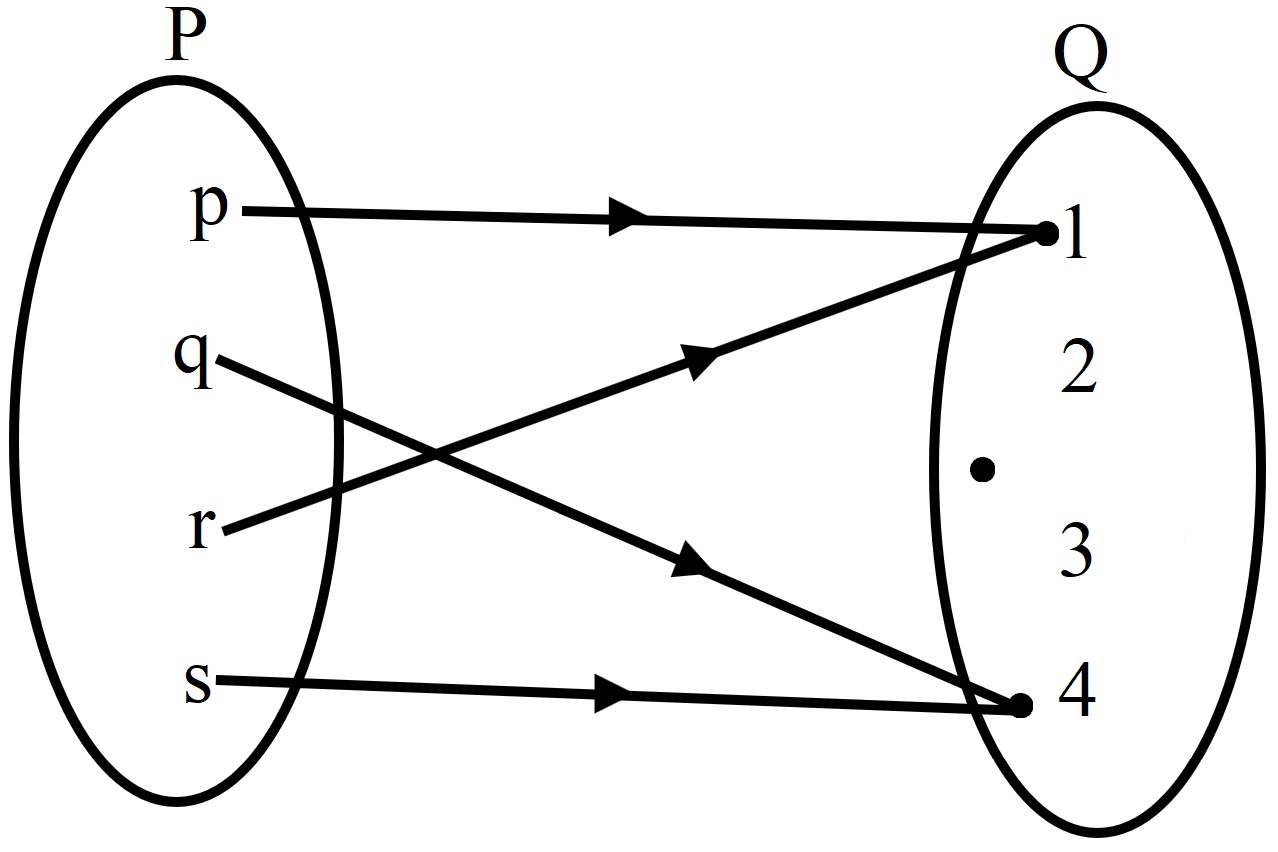
Assertion: The following arrow diagram represents a function.
Reason: Let $f : R - {2} \rightarrow R$ be defined by $\text{f}(\text{x})=\frac{\text{x}^{2}-4}{\text{x}-2}$ and $g : R \rightarrow R$ be defined by $g(x) = x + 3,$ Then, $f = g.$ - A
$A$ is true, $R$ is true; $R$ is a correct explanation of $A.$
- B
$A$ is true, $R$ is true; $R$ is not a correct explanation of $A.$
- ✓
$A$ is true; $R$ is false.
- D
$A$ is false; $R$ is true.
AnswerCorrect option: C. $A$ is true; $R$ is false.
Assertion: In arrow diagram, every element of $P$ has its unique image in $Q.$
So, it represent a function.
Reason: Domain of $f = R - \{2\}.$
Domain of $g = R$
$\therefore\text{D}_{\text{f}}\neq\text{D}_{\text{g}}$
We know that, two functions are equal when their domain and range are equal and same element in their domain produce same image.
$\therefore\text{f}\neq\text{g}$
View full question & answer→MCQ 61 Mark
Directions: In the following questions, a statement of assertion $(A)$ is followed by a statement of reason $(R).$ Mark the correct choice as:
Let $R$ be a relation defined by $\text{R}={\{(\text{x},\text{x}+5):\text{x}\in\{0, 1, 2, 3, 4, 5\}}\}$ Then, consider the following
Assertion: The domain of $R$ is $\{0, 1, 2, 3, 4, 5\}.$
Reason: The range of $R$ is $\{0, 1, 2, 3, 4, 5\}.$
- A
$A$ is true, $R$ is true; $R$ is a correct explanation of $A.$
- B
$A$ is true, $R$ is true; $R$ is not a correct explanation of $A.$
- ✓
$A$ is true; $R$ is false.
- D
$A$ is false; $R$ is true.
AnswerCorrect option: C. $A$ is true; $R$ is false.
Assertion: The given relation in Roster form is
$R = \{(0, 5), (1, 6), (2, 7), (3, 8), (4, 9), (5, 10)\}$
Domain of $R = \{0, 1, 2, 3, 4, 5\}$
Reason: Range of $R = \{5, 6, 7, 8, 9, 10\}$
View full question & answer→MCQ 71 Mark
Directions: In the following questions, a statement of assertion $(A)$ is followed by a statement of reason $(R)$. Mark the correct choice as:
Assertion: If $\text{f}(\text{x})=\text{x}+\frac{1}{\text{x}},$ then $[\text{f}(\text{x})]^{3}=\text{f}(\text{x}^{3})+3\text{f}\mid\big(\frac{1}{\text{x}}\big)\mid.$
Reason: If $f(x) = (x - a)^2 (x - b)^2,$ then $f(a + b)$ is $0.$
- A
$A$ is true, $R$ is true; $R$ is a correct explanation of $A.$
- B
$A$ is true, $R$ is true; $R$ is not a correct explanation of $A$.
- ✓
$A$ is true; $R$ is false.
- D
$A$ is false; $R$ is true.
AnswerCorrect option: C. $A$ is true; $R$ is false.
Assertion: Given,
$\text{f}(\text{x})=\text{x}+\frac{1}{\text{x}}$
$\text{f}(\text{x}^{3})=\text{x}^{3}+\frac{1}{\text{x}^{3}}$
$[\text{f}(\text{x})]^{3}=\Big(\text{x}+\frac{1}{\text{x}}\Big)^{3}$
$=\text{x}^{3}+\frac{1}{\text{x}^{3}}+3\Big(\text{x}+\frac{1}{\text{x}}\Big)$
$=\text{f}(\text{x}^{3})+3\text{f}(\text{x})$
$=\text{f}(\text{x}^{3})+3\text{f}\big(\frac{1}{\text{x}}\big)$$\big[\because\text{f}\big(\frac{1}{\text{x}}\big)=\frac{1}{\text{x}}+\text{x}=\text{f}(\text{x})\big]$
Reason: Now, we have,
$f(x) = (x - a)^2 (x - b)^2$
$f(a + b) = (a + b - a)^2 (a + b - b)^2 = b^2a^2$
View full question & answer→MCQ 81 Mark
Directions: In the following questions, a statement of assertion $(A)$ is followed by a statement of reason $(R).$ Mark the correct choice as: Consider the following statements
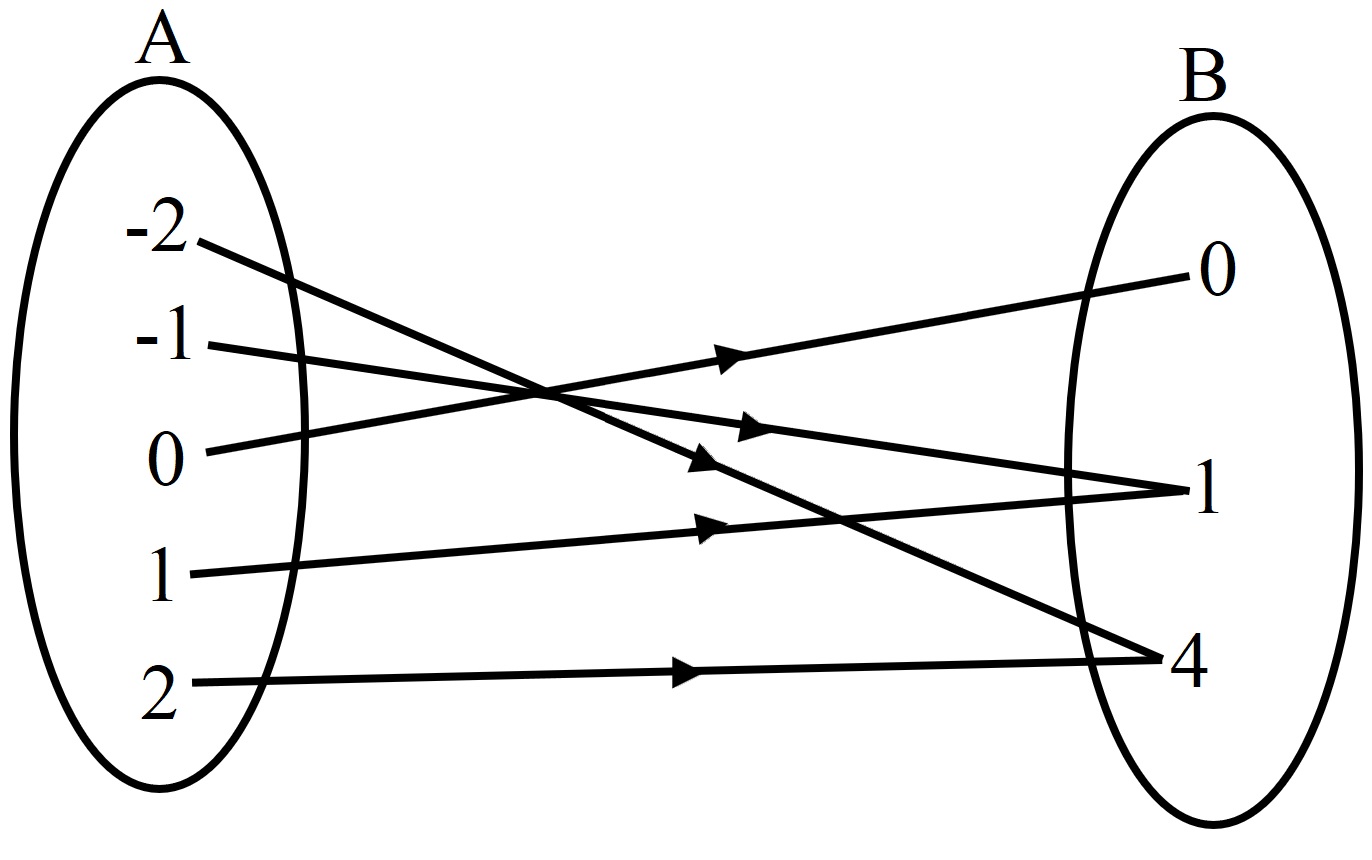
Assertion: The figure shows a relationship between the sets $A$ and $B.$ Then, the relation in Set - builder form is $ \{(x, y) : y = x^2, x, \text{y}\in\text{N}$ and $-2,\leq\text{x}\leq2\}.$
Reason: The above Relation in Roster form is $\{(-1, 1), (2, 4), (0, 0), (1, 1), (2, 4)\}.$ - A
$A$ is true, $R$ is true; $R$ is a correct explanation of $A.$
- B
$A$ is true, $R$ is true; $R$ is not a correct explanation of $A.$
- C
$A$ is true; $R$ is false.
- ✓
$A$ is false; $R$ is true.
AnswerCorrect option: D. $A$ is false; $R$ is true.
Assertion: In Set $-$ builder form,
$R = \{(x, y) : y = x^2, x, \text{y}\in\text{N}$ and $-2,\leq\text{x}\leq2\}$
$[\therefore0\in\text{N}]$
Reason: The relation shown in figure is represented in Roster form as
$R = \{(-2, 4), (-1, 1), (0, 0), (1, 1), (2, 4)\}$
We observe that, second element of each ordered pair is the square of first element.
View full question & answer→MCQ 91 Mark
Directions: In the following questions, a statement of assertion $(A)$ is followed by a statement of reason $(R).$ Mark the correct choice as:
Assertion: If $f : R \rightarrow R$ and $g : R \rightarrow R$ are defined by $f(x) = 2x + 3$ and $g(x) = x^2 + 7,$ then the values of $x$ such that $g\{f(x)\} = 8$ are $-1$ and $2.$
Reason: If $f : R \rightarrow R$ be given by $\text{f}(\text{x})=\frac{4^{\text{x}}}{4^{\text{x}}+2}$ for all $\text{x}\in\text{R},$ then $f(x) + f(1 - x) = 1.$
- A
$A$ is true, $R$ is true; $R$ is a correct explanation of $A.$
- B
$A$ is true, $R$ is true; $R$ is not a correct explanation of $A.$
- C
$A$ is true; $R$ is false.
- ✓
$A$ is false; $R$ is true.
AnswerCorrect option: D. $A$ is false; $R$ is true.
Assertion: We have,
$f (x) = 2x + 3, g(x) = x^2 + 7$
$g [f(x)] = 8$
$\Rightarrow g(2x + 3) = 8$
$\Rightarrow (2x + 3)^2 + 7 = 8$
$\Rightarrow (2x + 3)^2 = 1$
$\Rightarrow2\text{x}+3=\pm1,$
$2x + 3 = -1$
or $2x + 3 = 1$, then
$\Rightarrow x = -1, x = -2$
Reason: Now, $\text{f}(\text{x})=\frac{4^{\text{x}}}{4^{\text{x}}+2}$
$\text{f}(1-\text{x})=\frac{4^{1-\text{x}}}{4^{1-\text{x}}+2}$
$\therefore\text{f}(\text{x})+\text{f}(1-\text{x})$
$=\frac{4^{\text{x}}}{4^{\text{x}}+2}+\frac{4^{1-\text{x}}}{4^{1-\text{x}}+2}$
$=\frac{4^{\text{x}}}{4^{\text{x}}+2}+\frac{\frac{4}{4^{\text{x}}}}{4+2\cdot4^{\text{x}}}$
$=\frac{4^{\text{x}}}{4^{\text{x}}+2}+\frac{2}{4^{\text{x}}+2}$
$=\frac{4^{\text{x}}+2}{4^{\text{x}}+2}=1.$
View full question & answer→MCQ 101 Mark
Directions: In the following questions, a statement of assertion $(A)$ is followed by a statement of reason $(R).$ Mark the correct choice as:
Assertion: The domain of the real function $f$ defined by $\text{f}(\text{x})=\sqrt{\text{x}-1}$ is $R - \{1\}.$
Reason: The range of the function defined by $\text{f}(\text{x})=\sqrt{\text{x}-1}$ is $[0,\infty).$
- A
$A$ is true, $R$ is true; $R$ is a correct explanation of $A.$
- B
$A$ is true, $R$ is true; $R$ is not a correct explanation of $A.$
- C
$A$ is true; $R$ is false.
- ✓
$A$ is false; $R$ is true.
AnswerCorrect option: D. $A$ is false; $R$ is true.
Assertion: We have, $\text{f}(\text{x})=\sqrt{\text{x}-1}$
$f(x)$ is defined, if $\text{x}-1\geq0$
i. e. $\text{x}\geq0$
$\therefore$ Domain of $\text{f}=[1,\infty)$
Hence, $A$ is incorrect.
Reason: Let $f(x) = y$
Then, $\text{y}=\sqrt{\text{x}-1}$
$\because\text{x}\geq1$
$\therefore$ Range of $\text{f}=[0,\infty).$
View full question & answer→MCQ 111 Mark
Directions: In the following questions, a statement of assertion $(A)$ is followed by a statement of reason $(R).$ Mark the correct choice as:
Assertion: If $(4x + 3, y) = (3x + 5, -2),$ then $x = 2$ and $y = -2.$
Reason: If $A = \{-1, 3, 4\},$ then $A . A$ is $\{(-1, -1), (-1, 3), (-1, 4), (3, -1), (4, -1), (3, 4)\}.$
- A
$A$ is true, $R$ is true; $R$ is a correct explanation of $A.$
- B
$A$ is true, $R$ is true; $R$ is not a correct explanation of $A.$
- ✓
$A$ is true; $R$ is false.
- D
$A$ is false; $R$ is true.
AnswerCorrect option: C. $A$ is true; $R$ is false.
Assertion Given, $(4x + 3, y) = (3x + 5, -2)$
Two ordered pairs are equal when their corresponding elements are equal.
$4x + 3 = 3x + 5$ and $y = -2$
$4x - 3x = 5 - 3$
$x = 2$
Reason: Now, $A = \{-1, 3, 4\}$
$\therefore A . A = \{(-1, -1), (-1, 3), (-1, 4), (3, -1), (3, 3), (3, 4), (4, -1), (4, 3), (4, 4)\}$
$\therefore$ Assertion is true and Reason is false.
View full question & answer→MCQ 121 Mark
Directions: In the following questions, a statement of assertion $(A)$ is followed by a statement of reason $(R).$ Mark the correct choice as:
Assertion: The domain of the relation $R = \{(x + 2, x + 4) : \text{x}\in\text{N}, x < 8\}$ is $(3, 4, 5, 6, 7, 8, 9).$
Reason: The range of the relation $R = \{(x + 2, x + 4) : \text{x}\in\text{N}, x < 8\}$ is $(1, 2, 3, 4, 5, 6, 7).$
- A
$A$ is true, $R$ is true; $R$ is a correct explanation of $A.$
- B
$A$ is true, $R$ is true; $R$ is not a correct explanation of $A.$
- ✓
$A$ is true; $R$ is false.
- D
$A$ is false; $R$ is true.
AnswerCorrect option: C. $A$ is true; $R$ is false.
Assertion: The given relation in Roster form is,
$R = \{(3, 5), (4, 6), (5, 7), (6,8), (7, 9), (8, 10), (9, 11)\}.$
Domain of $R = \{3, 4, 5, 6, 7, 8, 9\}.$
So, $A$ is true.
Reason: Range of $R = \{5, 6, 7, 8, 9, 10, 11\}$
So, $R$ is false.
View full question & answer→MCQ 131 Mark
Directions: In the following questions, a statement of assertion $(A)$ is followed by a statement of reason $(R).$ Mark the correct choice as:
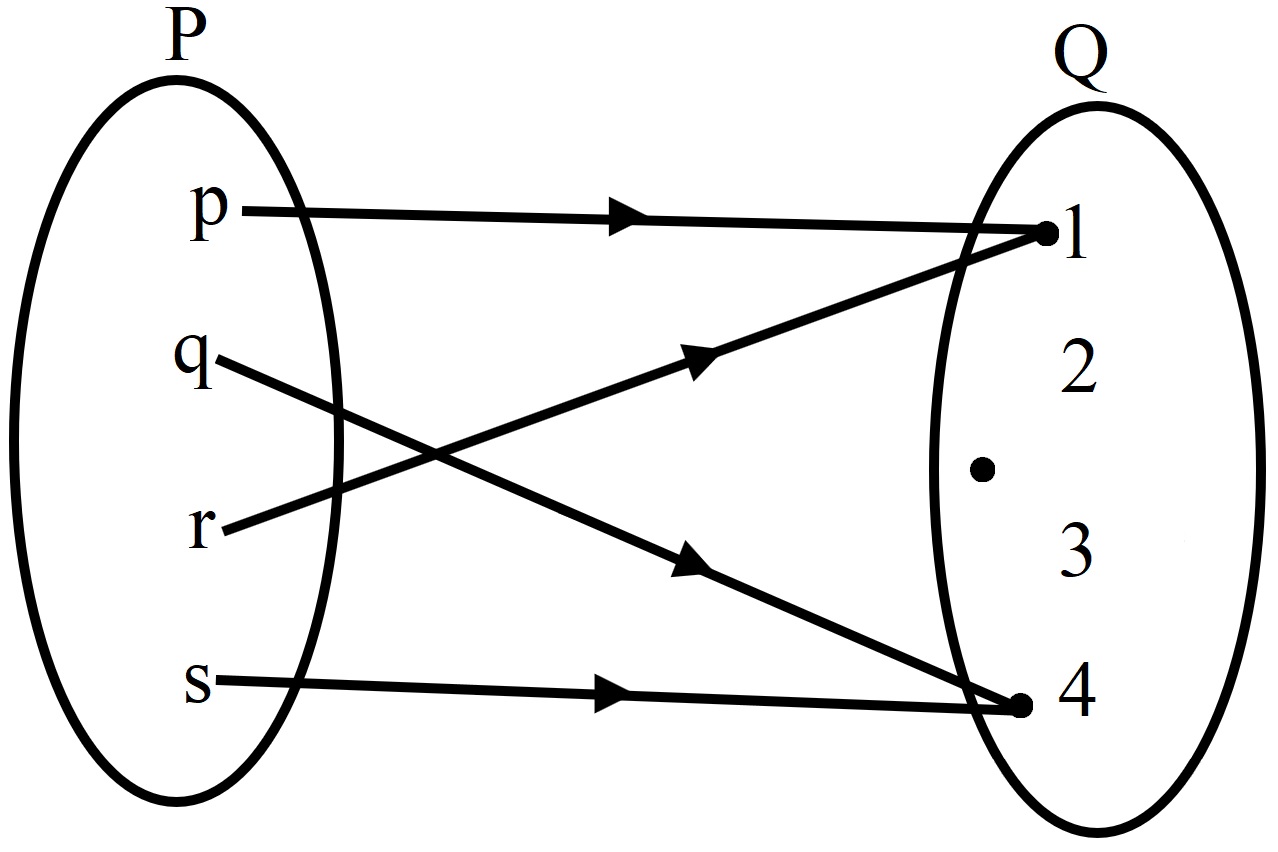
Assertion: The following arrow diagram represents a function.
Reason: Let $f : R - {2} \rightarrow R$ be defined by $\text{f}(\text{x})=\frac{\text{x}^{2}-4}{\text{x}-2}$ and $g : R \rightarrow R$ be defined by $g(x) = x + 3,$ Then, $f = g.$ - A
$A$ is true, $R$ is true; $R$ is a correct explanation of $A.$
- B
$A$ is true, $R$ is true; $R$ is not a correct explanation of $A.$
- ✓
$A$ is true; $R$ is false.
- D
$A$ is false; $R$ is true.
AnswerCorrect option: C. $A$ is true; $R$ is false.
View full question & answer→MCQ 141 Mark
Directions: In the following questions, a statement of assertion $(A)$ is followed by a statement of reason $(R).$ Mark the correct choice as:
Assertion: Let $A = \{1, 2\}$ and $B = \{3, 4\}.$ Then, number of relations from $A$ to $B$ is $16.$
Reason: If $n(A) = p$ and $n(B) = q,$ then number of relations is $2^{pq}.$
- ✓
$A$ is true, $R$ is true; $R$ is a correct explanation of $A.$
- B
$A$ is true, $R$ is true; $R$ is not a correct explanation of $A.$
- C
$A$ is true; $R$ is false.
- D
$A$ is false; $R$ is true.
AnswerCorrect option: A. $A$ is true, $R$ is true; $R$ is a correct explanation of $A.$
Assertion: The total number of relation that can be defined from a set $A$ to a set $B$ is the number of possible subset of $A . B.$
If $n( A) = p$ and $n(B) = q,$ then $n(A . B) = pq$ and the total number of relation is $2^{pq}.$
Given, $A = \{1, 2\}$ and $B = \{3, 4\}$
$\therefore A . B = ((1, 3), (1, 4), (2 3), (2, 4))$
Since, $n (A . B) = 4,$ the number of subsets of $A . B$ is $2^4.$
Therefore, the number of relation from $A$ to $B$ will be $2^4 = 16.$
View full question & answer→MCQ 151 Mark
Directions: In the following questions, a statement of assertion $(A)$ is followed by a statement of reason $(R).$ Mark the correct choice as:
Assertion: If $(x + 1, y - 2) = (3, 1),$ then $x = 2$ and $y = 3.$
Reason: Two ordered pairs are equal, if their corresponding elements are equal.
- ✓
$A$ is true, $R$ is true; $R$ is a correct explanation of $A.$
- B
$A$ is true, $R$ is true; $R$ is not a correct explanation of $A.$
- C
$A$ is true; $R$ is false.
- D
$A$ is false; $R$ is true.
AnswerCorrect option: A. $A$ is true, $R$ is true; $R$ is a correct explanation of $A.$
Assertion: Two ordered pairs are equal, if and only if the corresponding first elements are equal and the second elements are also equal.
Given, $(x + 1, y - 2) = (3, 1).$
Then, by the definition
$x + 1 = 3$ and $y - 2 = 1$
$x = 2$ and $y = 3$
View full question & answer→MCQ 161 Mark
Directions: In the following questions, a statement of assertion $(A)$ is followed by a statement of reason $(R).$ Mark the correct choice as:
Let $A = \{1, 2, 3, 4, 6\}.$ If $R$ is the relation on $A$ defined by $\{(a, 4) : a, \text{b}\in\text{A}, b$ is exactly divisible by $a\}.$
Assertion: The relation Rin Roster form is $\{(6, 3), (6, 2), (4, 2)\}.$
Reason: The domain and range of $R$ is $\{1, 2, 3, 4, 6\}.$
- A
$A$ is true, $R$ is true; $R$ is a correct explanation of $A.$
- B
$A$ is true, $R$ is true; $R$ is not a correct explanation of $A.$
- C
$A$ is true; $R$ is false.
- ✓
$A$ is false; $R$ is true.
AnswerCorrect option: D. $A$ is false; $R$ is true.
Assertion: In Roster form $R = \{(1, 1), (1, 2), (1, 3), (1, 4), (1, 6), (2, 4), (2, 6), (2, 2), (4, 4), (6, 6), (3, 3), (3, 6)\}.$
Reason: Domain of $R =$ set of first element of ordered pairs in $R = \{1, 2, 3, 4, 6\}$
Range of $R =\{1, 2, 3, 4, 6\}$
View full question & answer→