Sample QuestionsSequences and Series questions
One sample from each question group in this chapter. Select any group above to see the full set with answer keys.
If an $A.P.$ is $1,7,13, 19, ………$ Find the sum of $22$ terms.
- A
$127$
- B
$1204$
- ✓
$1408$
- D
$1604$
Answer: C.
View full solution →If the decreasing $\text{GP}$ is considered, then the sum of infinite terms is:
Answer: B.
View full solution →if an $A.P.$ is $3,5,7,9…….$ Find the $12^{th}$ term of the $A.P.$
Answer: D.
View full solution →If in an infinite $G.P.,$ first term is equal to $10$ times the sum of all successive terms, the its common ratio is:
- A
$\frac{1}{10}$
- ✓
$\frac{1}{11}$
- C
$\frac{1}{9}$
- D
$\frac{1}{20}$
Answer: B.
View full solution →If $a, b, c$ are in $A.P.$ and $x, y, z$ are in $G.P.,$ then the value of $x^{b-c}y^{c-a}z^{a-b}$ is:
- A
$0$
- ✓
$1$
- C
$x y z$
- D
$x^ay^bz^c$
Answer: B.
View full solution →Directions: In the following questions, the Assertions $(A)$ and Reason(s) $(R)$ have been put forward. Read both the statements carefully and choose the correct alternative from the following:
Assertion $(A)$ The fourth term of a $GP$ is the square of its second term and the first term is $-3,$ then its $7^{th}$ term is equal to $2187.$
Reason $(R)$ Sum of first $10$ terms of the $AP\ 6, 8, 10, .....$ is equal to $150.$
- A
$A$ is true, $R$ is true; $R$ is acorrect explanation of $A.$
- B
$A$ is true, $R$ is true; $R$ is not a correct explanation of $A.$
- C
$A$ is true; $R$ is false
- ✓
$A$ is false; $R$ is true.
Answer: D.
View full solution →Directions: In the following questions, the Assertions $(A)$ and Reason $(s)(R)$ have been put forward. Read both the statements carefully and choose the correct alternative from the following:
Assertion $;(A)$ The sum of first $n$ terms of the series $0.6 + 0.66 + 0.666 +......$ is $\frac{3}{2}\Big[\text{n}-\frac{1}{9}\Big(1-\frac{1}{10}\Big)\Big].$
Reason $;(R)$ General term of a $GP$ is $T_n = ar^{n-1}$, where $a =$ first term and $r =$common ratio.
- A
$A$ is true, $R$ is true; $R$ is acorrect explanation of $A.$
- ✓
$A$ is true, $R$ is true; $R$ is not a correct explanation of $A.$
- C
$A$ is true; $R$ is false
- D
$A$ is false; $R$ is true.
Answer: B.
View full solution →Directions: In the following questions, the Assertions $(A)$ and Reason $(s)(R)$ have been put forward. Read both the statements carefully and choose the correct alternative from the following: If $n^{th} $ term of a sequence is $a_n = 2n^2 - n + 1.$
Assertion $(A)$ First and second terms of same sequence are $2$ and $7$ respectively.
Reason $(R)$ Third and fourth terms of same sequence are $16$ and $29,$
- ✓
$A$ is true, $R$ is true; $R$ is acorrect explanation of $A.$
- B
$A$ is true, $R$ is true; $R$ is not a correct explanation of $A.$
- C
$A$ is true; $R$ is false
- D
$A$ is false; $R$ is true.
Answer: A.
View full solution →Directions: In the following questions, the Assertions $(A)$ and Reason$(s) (R)$ have been put forward. Read both the statements carefully and choose the correct alternative from the following:
Assertion $(A)$ The first three terms of the sequence are $\frac{3}{2},\text{x},\frac{21}{2}$ whose $n^{th}$ term is $\text{a}_\text{n}=\frac{\text{n}(\text{n}^2+5)}{4}.$Then $\text{x}=\frac{9}{2}$
Reason $(R)$ The third term of the sequence whose nth term is $\text{a}_\text{n}=(-1)^\text{n-1}5^\text{n+1}$ is $620.$
- A
$A$ is true, $R$ is true; $R$ is acorrect explanation of $A.$
- B
$A$ is true, $R$ is true; $R$ is not a correct explanation of $A.$
- ✓
$A$ is true; $R$ is false
- D
$A$ is false; $R$ is true.
Answer: C.
View full solution →Directions: In the following questions, the Assertions $(A)$ and Reason$(s) (R)$ have been put forward. Read both the statements carefully and choose the correct alternative from the following:
Assertion $(A)$ first and second terms of same sequence are $2$ and $7$ repectively.
Reason $(R)$ Third and fourt terms of same sequence are $16$ and $29.$ respectively.
- A
Both assertion and reason are true and reason is the correct explanation of assertion.
- ✓
Both assertion and reason are true but reason is not the correct explanation of assertion.
- C
Assertion is true but reason is false.
- D
Assertion is false but reason is true
Answer: B.
View full solution →State whether statement are True or False.
If the sum of $n$ terms of a sequence is quadratic expression, then it always represents an A.P.
View full solution →State whether statement are True or False.
Any term of an A.P. (except first) is equal to half the sum of terms which are equidistant from it.
State whether statement are True or False.
The sum or difference of two G.P.s, is again a G.P.
State whether statement are True or False.
Two sequences cannot be in both A.P. and G.P. together.
State whether statement are True or False.
Every progression is a sequence but the converse i.e., every sequence is also a progression need not necessarily be true.
Find the 10th and nth terms of the G.P. $5, 25,125,….$
View full solution →Insert $6$ numbers between $3$ and $24$ such that the resulting sequence is an A.P.
View full solution →The income of a person is ₹3,00,000, in the first year and he receives an increase of ₹10,000 to his income per year for the next 19 years. Find the total amount, he received in 20 years.
The sum of n terms of two Arithmetic Progression are in the ratio $(3n + 8) : (7n + 15).$ Find the ratio of their $12^{th}$ terms.
View full solution →If the sum of $n$ terms of an A.P. is $n \mathrm{P}+\frac{1}{2} n(n-1) \mathrm{Q}$, where $P$ and $Q$ are constants, find the common difference.
View full solution →A manufacturer reckons that the value of a machine, which cost him $₹\ 15625$ will depreciate each year by $20\%.$ Find the estimated value at the end of $5$ years.
View full solution →For what values of x, the numbers $ \frac { - 2 } { 7 } , x , \frac { - 7 } { 2 }$ are in G.P.?
View full solution →Which term of the sequence $\frac { 1 } { 3 } , \frac { 1 } { 9 } , \frac { 1 } { 27 }$, ... is $\frac { 1 } { 19683 }$?
View full solution →Which term of the sequence $2, 2\sqrt 2, 4, .... is 128?$
View full solution →The $4^{th}$ term of a G.P. is square of its second term and the first term $-3.$ Determine its $7^{th}$ term.
View full solution →The first term of a G.P. is 1. The sum of the third term and fifth term is $90.$ Find the common ratio of G.P.
View full solution →The sum of some terms of G.P. is $315$ whose first term and the common ratio are $5$ and $2$ respectively. Find the last term and the number of terms.
View full solution →If $f$ is a function satisfying $f (x+y) = f (x) f (y)$ for all $x, y \in N $ such that $f (1) = 3$ and $\sum\limits_{x = 1}^n f (x) = 120$ find the value of $n.$
View full solution →Find the sum of all two digit numbers which when divided by $4,$ yield $1$ as remainder.
View full solution →Find the sum of integers from $1$ to $100$ that are divisible by $2$ or $5.$
View full solution →Each side of an equilateral triangle is $24 \mathrm{~cm}$. The mid-point of its sides are joined to form another triangle. This process is going continuously infinite.
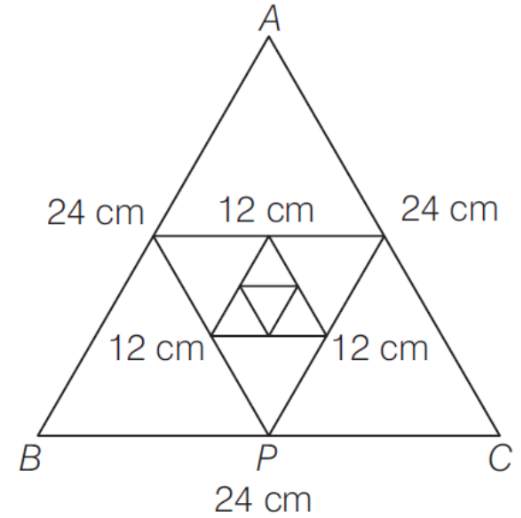
Based on above information, answer the following questions.
(i) The side of the 5th triangle is (in $\mathrm{cm}$)
(a) 3 (b) 6 (c) 1.5 (d) 0.75
(ii) The sum of perimeter of first 6 triangle is (in $\mathrm{cm}$)
(a) $\frac{569}{4}$ (b) $\frac{567}{4}$ (c) 120 (d) 144
(iii) The area of all the triangle is (in sq $\mathrm{cm}$ )
(a) 576 (b) $192 \sqrt{3}$ (c) $144 \sqrt{3}$ (d) $169 \sqrt{3}$
(iv) The sum of perimeter of all triangle is (in $\mathrm{cm}$ )
(a) 144 (b) 169 (c) 400 (d) 625
(v) The perimeter of 7 th triangle is (in $\mathrm{cm}$ )
(a) $\frac{7}{8}$ (b) $\frac{9}{8}$ (c) $\frac{5}{8}$ (d) $\frac{3}{4}$ View full solution →A company produces 500 computers in the third year and 600 computers in the seventh year. Assuming that the production increases uniformly by a constant number every year.
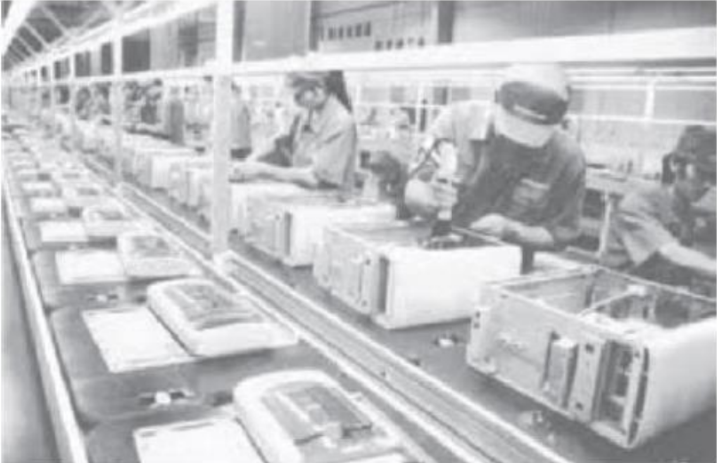 Based on the above information, answer the following questions.
(i) The value of the fixed number by which production is increasing every year is
(a) 25 (b) 20 (c) 10 (d) 30
(ii) The production in first year is
(a) 400 (b) 250 (c) 450 (d) 300
(iii) The total production in 10 years is
(a) 5625 (b) 5265 (c) 2655 (d) 6525
(iv) The number of computers produced in 21 st year is
(a) 650 (b) 700 (c) 850 (d) 950
(v) The difference in number of computers produced in 10th year and 8th year is
(a) 25 (b) 50 (c) 100 (d) 75
Show that $\frac { 1 \times 2 ^ { 2 } + 2 \times 3 ^ { 2 } + \ldots \ldots + n \times ( n + 1 ) ^ { 2 } } { 1 ^ { 2 } \times 2 + 2 ^ { 2 } \times 3 + \ldots \ldots + n ^ { 2 } ( n + 1 ) } = \frac { 3 n + 5 } { 3 n + 1 }$
View full solution →Find the sum of the following series up to n terms: $\frac { 1 ^ { 3 } } { 1 } + \frac { 1 ^ { 3 } + 2 ^ { 3 } } { 1 + 3 } + \frac { 1 ^ { 3 } + 2 ^ { 3 } + 3 ^ { 3 } } { 1 + 3 + 5 } + \ldots \ldots$
View full solution →If $S_1, S_2, S_3$ are the sum of first n natural no. their squares and their cubes respectively, show that $9 S _ { 2 } ^ { 2 } = S _ { 3 } \left( 1 + 8 S _ { 1 } \right)$.
View full solution →If $a, b, c$ are in $A.P.; b, c, d$ are in G.P. and $\frac { 1 } { c } , \frac { 1 } { d } , \frac { 1 } { e }$ are in A.P., prove that $a, c, e$ are in G.P.
View full solution →The ratio of the A.M. and G.M. of two positive numbers a and b is  Show that $a : b = \left( \begin{array} { c } { m + \sqrt { m ^ { 2 } - n ^ { 2 } } } \end{array} \right) : \left( m - \sqrt { m ^ { 2 } - n ^ { 2 } } \right)$
View full solution →