Sample QuestionsSets questions
One sample from each question group in this chapter. Select any group above to see the full set with answer keys.
If $A = (6, 7, 8, 9), B = (4, 6, 8, 10)$ and $C = \{x : x \in N : 2 < x ≤ 7\} ;$ find $: B − C$
- A
$\{4, 6\}$
- B
$\{4, 6, 8\}$
- C
$\{6, 8, 10\}$
- ✓
$\{8, 10\}$
Answer: D.
View full solution →How many elements has $P(A),$ if $A = f ?$
Answer: B.
View full solution →In a class of $50$ students, $10$ did not opt for math, $15$ did not opt for science and $2$ did not opt for either. How many students of the class opted for both math and science.
Answer: D.
View full solution →The set $\text{(A}\cup\text{B}')'\cup\text{B}\cap\text{C}$ is equal to:
Answer: B.
View full solution →The cardinality of the set $P(P(P(f)))$ is.
Answer: D.
View full solution →Directions: In the following questions, a statement of assertion $(A)$ is followed by a statement of reason $(R).$ Mark the correct choice as:
Assertion: If $\text{A}\subset\text{B}$ for any two sets $A$ and $B.$
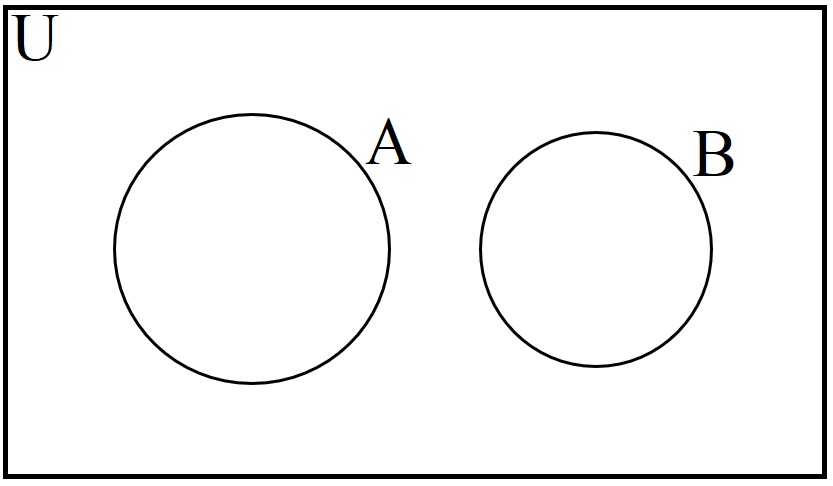
Then, above Venn diagram represents correct relationship between $A$ and $B.$
Reason: If $\text{A}\subset\text{B},$ then all elements of $A$ is also in $B.$ - A
$A$ is true, $R$ is true; $R$ is a correct explanation of $A.$
- B
$A$ is true, $R$ is true; $R$ is not a correct explanation of $A.$
- C
$A$ is true; $R$ is false.
- ✓
$A$ is false; $R$ is true.
Answer: D.
View full solution →Directions: In the following questions, a statement of assertion $(A)$ is followed by a statement of reason $(R).$ Mark the correct choice as:
Assertion: The set $D = \{x : x$ is a prime number which is a divisor of $60\}$ in roster form is $\{1, 2, 3, 4, 5\}.$
Reason: The set $E =$ the set of all letters in the word $‘\text{TRIGONOMETRY}’,$ in the roster form is $\text{\{T, R, I, G, O, N, M, E, Y\}}.$
- A
$A$ is true, $R$ is true; $R$ is a correct explanation of $A.$
- B
$A$ is true, $R$ is true; $R$ is not a correct explanation of $A.$
- C
$A$ is true; $R$ is false.
- ✓
$A$ is false; $R$ is true.
Answer: D.
View full solution →Directions: In the following questions, a statement of assertion $(A)$ is followed by a statement of reason $(R)$. Mark the correct choice as:
Assertion: The set $A = \{x : x$ is an even prime number greater than $2\}$ is the empty set.
Reason: The set $B = \{x : x^2 = 4, x$ is odd$\} $ is not an empty set.
- A
$A $ is true, $R$ is true; $R$ is a correct explanation of $A.$
- B
$A$ is true, $R$ is true; $R$ is not a correct explanation of $A$.
- ✓
$A $ is true; $R$ is false.
- D
$A$ is false; $R$ is true.
Answer: C.
View full solution →Directions: In the following questions, a statement of assertion $(A)$ is followed by a statement of reason $(R).$ Mark the correct choice as:
Assertion: If $n(A) = 3, n(B) = 6$ and $\text{A}\subset\text{B},$ then the number of elements in $\text{A}\cup\text{B}$ is $9.$
Reason: If $A$ and $B$ are disjoint, then $\text{n}(\text{A}\cup\text{B})$ is $\text{n(A) + n(B).}$
- A
$A$ is true, $R$ is true; $R$ is a correct explanation of $A.$
- B
$A$ is true, $R$ is true; $R$ is not a correct explanation of $A.$
- C
$A$ is true; $R$ is false.
- ✓
$A$ is false; $R$ is true.
Answer: D.
View full solution →Directions: In the following questions, a statement of assertion $(A)$ is followed by a statement of reason $(R).$ Mark the correct choice as:
Assertion: The interval $\{\text{x}:\text{x}\in\text{R},-4<\text{x}\leq6\}$ is represented by $(-4, 6).$
Reason: The interval $\{\text{x}:\text{x}\in\text{R}, -12 -4 < x < 10\}$ is represented by $[-12, -10].$
- A
$A$ is true, $R$ is true; $R$ is a correct explanation of $A.$
- B
$A$ is true, $R$ is true; $R$ is not a correct explanation of $A.$
- ✓
$A$ is true; $R$ is false.
- D
$A$ is false; $R$ is true.
Answer: C.
View full solution →If A $\subset$ B and x $\notin$ B, then x $\notin$ A. If it is true, prove it. If it is false, give an example.
View full solution →If x $\in$ A and A $\not \subset$ B , then x $\in$ B. If it is true, prove it. If it is false, give an example.
View full solution →If $A \not \subset B$ and $B \not \subset C$ , then $A \not \subset C$. If it is true, prove it. If it is false, give an example.
View full solution →If $A \not \subset B$ and $B \not \subset C$ , then $A \not \subset C$. If it is true, prove it. If it is false, give an example.
View full solution →If A $\subset$ B and B $\subset$ C , then A $\subset$ C. If it is true, prove it. If it is false, give an example.
View full solution →Using properties of sets, show that: $A \cap (A \cup B) = A$
View full solution →Using properties of set, show that: $A \cup (A \cap B) = A$
View full solution →Show that if $A \subset B$ then $C - B \subset C - A.$
View full solution →Show that $A \cap B = A \cap C$ need not imply B = C.
View full solution →Let U be the set of all triangles in a plane. If A is the set of all triangles with at least one angle different from 60° what is ${A'}$?
View full solution →Is it true that for any sets A and B, $P(A) \cup P(B) = P(A \cup B)?$Justify your answer.
View full solution →Assume that P(A) = P(B) show that A = B.
Let A, B and C be the sets such that $A \cup B = A \cup C$ and $A \cap B = A \cap C$ Show that B = C.
View full solution →In a survey of 60 people, it was found that 25 people read newspaper H, 26 read newspaper T, 26 read newspaper I, 9 read both H and I, 11 read both H and T, 8 read both T and I, 3 read all three newspapers.
Find the number of people who read exactly one newspaper.
In a survey of 60 people, it was found that 25 people read newspaper H, 26 read newspaper T, 26 read newspaper I, 9 read both H and I, 11 read both H and T, 8 read both T and I, 3 read all three newspapers.
Find the number of people who read at least one of the newspaper.
Show that for any sets A and B, A = ( A $\cap$ B ) $\cup$ ( A – B ) and A $\cup$ ( B – A ) = ( A $\cup$ B )
View full solution →Show that the following four conditions are equivalent :
- $A \subset B$
- $A – B = \phi$
- $A \cup B = B$
- $A \cap B = A$
View full solution →In a survey it was found that 21 people liked product A, 26 liked product B and 29 liked product C. If 14 people liked products A and B, 12 people liked products C and A, 14 people liked products B and C and 8 liked all the three products. Find how many liked product C only?
Let A and B are sets. If $A \cap X = B \cap X = \phi $ and $A \cup X = B \cup X$ for some set X. Show that A = B.
[Hints A = A $\cap$ ( A $\cup$ X ) , B = B $\cap$ ( B $\cup$ X ) and use Distributive law ]
View full solution →Decide among the following sets which sets are subsets of each another:
A = {X : X $\in$ R} and x satisfies x2 - 8x + 12 = 0}, B = {2, 4, 6} , C = {2, 4, 6, 8, ...}, D = {6}
View full solution →A class teacher Mamta Sharma of class $XI$ write three sets $A, B$ and Care such that $A = \{1, 3, 5, 7, 9\}, B = \{2, 4, 6, 8\}$ and $C = \{2, 3, 5, 7, 11\}.$
Answer the following questions which are based on above sets.
- Find $\text{A}\cap\text{B}.$
- $\{3, 5, 7\}$
- $\phi$
- $\{1, 5, 7\}$
- $\{2, 5, 7\}$
- Find $\text{A}\cap\text{C}.$
- $\{3, 5, 7\}$
- $\{1, 5, 7\}$
- $\phi$
- $\{3, 4, 7\}$
- Which of the following is correct for two sets $A$ and $B$ to be disjoint?
- $\text{A}\cap\text{B}=\phi$
- $\text{A}\cap\text{B}\neq\phi$
- $\text{A}\cup\text{B}=\phi$
- $\text{A}\cup\text{B}\neq\phi$
- Which of the following is correct for two sets $A$ and $C$ to be intersecting?
- $\text{A}\cap\text{C}=\phi$
- $\text{A}\cap\text{C}\neq\phi$
- $\text{A}\cup\text{C}=\phi$
- $\text{A}\cup\text{C}\neq\phi$
- Write the $n[P(B)].$
- $8$
- $4$
- $16$
- $12$
View full solution →The school organised a farewell party for $100$ students and school management decided three types of drinks will be distributed in farewell party ie. Milk $(M),$ Coffee $(C)$ and Tea $(T)$. Organiser reported that $10$ students had all the three drinks $M, C, T. 20$ students had $M$ and $C; 30$ students had $C$ and $T; 25$ students had $M$ and $T. 12$ students.had $M$ only; $5$ students had $C$ only; $8$ students had $T$ only.
Based on the above information, answer the following questions.
- The number of students who did not take any drink, is
- $20$
- $30$
- $10$
- $25$
- The number of students who prefer Milk is
- $47$
- $45$
- $53$
- $50$
- The number of students who prefer Coffee is
- $47$
- $53$
- $45$
- $50$
- The number of students who prefer Tea is
- $51$
- $53$
- $50$
- $47$
- The number of students who prefer Milk and Coffee but not tea is
- $12$
- $10$
- $15$
- $20$
View full solution →In a library, $25$ students read physics, chemistry and mathematics books. It was found that $15$ students read mathematics, $12$ students read physics while $11$ students read chemistry. $5$ students read both mathematics and chemistry, $9$ students read physics and mathematics. $4$ students read physics and chemistry and $3$ students read all three subject books.
Based on the above information, answer the following questions.
- The number of students who reading only chemistry is:
- $5$
- $4$
- $2$
- $1$
- The number of students who reading only mathematics is:
- $4$
- $3$
- $5$
- $11$
- The number of students who reading only one of the subjects is:
- $5$
- $11$
- $8$
- $6$
- The number of students who reading atleast one of the subject is:
- $20$
- $22$
- $23$
- $21$
- The number of students who reading none of the subject is:
- $2$
- $4$
- $3$
- $5$
View full solution →In a company, $100$ employees offered to do a work. In out of them, $10$ employees offered ground floor only, $15$ employees offered first floor only, $10$ employees offered second floor only, $30$ employees offered second floor and ground floor to work, $25$ employees offered first and second floor, $15$ employees offered ground and first floor, $60$ employees offered second floor.

Based on the above information answer the following questions.
- The number of employees who offered all three floors.
- $5$
- $3$
- $4$
- $6$
- The number of employees who offered ground floor.
- $50$
- $60$
- $65$
- $70$
- The number of employees who offered first floor.
- $40$
- $45$
- $50$
- $55$
- The number of employees who offered ground and first floor but not second floor.
- $10$
- $15$
- $20$
- $25$
- The number of employees who did not offer any of the above three floors.
- $15$
- $10$
- $5$
- $0$
View full solution →In an University, out of $100$ students $15$ students offered Mathematics only, $12$ students offered Statistics only, $8$ students offered only Physics, $40$ students offered Physics and Mathematics, $20$ students offered Physics and Statistics, $10$ students offered Mathematics and Statistics, $65$ students offered Physics.
Based on the above information answer the following questions.
- The number of students who offered all the three subjects is:
- $4$
- $3$
- $2$
- $5$
- The number of students who offered Mathematics is:
- $62$
- $65$
- $55$
- $60$
- The number of students who offered statistics is:
- $31$
- $35$
- $39$
- $34$
- The number of students who offered mathematics and statistics but not physics is:
- $7$
- $6$
- $5$
- $4$
- The number of students who did not offer any of the above three subjects is:
- $4$
- $1$
- $5$
- $3$
View full solution →