Questions

5 Marks Questions

Take a timed test

6 questions · self-marked practice — reveal the answer and mark yourself.

Question 15 Marks
Find the area of the triangle formed by the lines $y - x = 0, x + y = 0$ and $x - k = 0.$
Answer
The equation of lines are
$y - x = 0 …..(i)$
$x + y = 0…..(ii)$
$x -k = 0 ….(iii)$
By solving $(i)$ and $(ii)$, we get the coordinates of point $C.$
$\therefore $ Coordinate of $C$ are $(0, 0).$
By solving $(ii)$ and $(iii),$ we get the coordinates of point $A.$
$\therefore $ Coordinate of $A$ are $(k, -k).$
By solving $(i)$ and $(iii),$ we get the coordinates of point $B.$
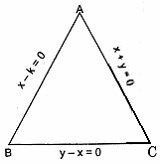
$\therefore $ coordinates of $B$ are $(k, k)$
$\therefore $ Area of $\Delta ABC = \frac{1}{2}\left| {\begin{array}{*{20}{c}} k&{ - k}&1 \\ k&k&1 \\ 0&0&1 \end{array}} \right|$
$ = \frac{1}{2}\left[ {({k^2} + {k^2} + (0 - 0) + (0 - 0)} \right]$
$ = \frac{1}{2} \times 2{k^2}$
$= k^2$  sq. unit
View full question & answer
Question 25 Marks
Find the direction in which a straight line must be drawn through the point $(-1, 2)$ so that its point of intersection with the line $x + y = 4$ may be at a distance of $3$ units from this point.
Answer
Let the required line makes an angle \theta with the positive direction of $x-$axis. Then equation of line is
$\frac{{x - ( - 1)}}{{\cos \theta }} = \frac{{y - 2}}{{\sin \theta }} = r \Rightarrow \frac{{x + 1}}{{\cos \theta }} = \frac{{y - 2}}{{\sin \theta }} = r$
It is given that $r = 3$
$\therefore \frac{{x + 1}}{{\cos \theta }} = \frac{{y - 2}}{{\sin \theta }} = 3$
$\therefore x + 1 = 3 \cos \theta \Rightarrow x = 3 \cos \theta - 1$
and $y - 2 = 3 \sin \theta \Rightarrow y = 3 \sin \theta + 2$
Since this point on the line $x + y = 4$
$\therefore 3 \cos \theta - 1 + 3 \sin \theta + 2 = 4$
$\therefore 3 \cos \theta + 3 \sin \theta = 3 \Rightarrow \cos \theta + \sin \theta = 1$
Squaring both sides, we have
$\cos^2 \theta + \sin^2 \theta + 2 \sin \theta \cos \theta = 1$
$\Rightarrow 1 + \sin 2 \theta = 1 \Rightarrow \sin 2\theta = 0 \Rightarrow 2\theta = 0 \Rightarrow \theta = 0$
Which shows that required line is parallel to $x-$axis .
View full question & answer
Question 35 Marks
Show that the equation of the line passing through the origin and making an angle $\theta$ with the line $y = mx + c$ is $\frac{y}{x} = \frac{{m \pm \tan \theta }}{{1 \mp m\tan \theta }}$.
Answer
Let $m_1 $ be the slope of required line which passes through $(0, 0).$
Then equation of line is $y - 0 = m_1 (x - 0) \Rightarrow y = m_1x$
Now $\theta$ is the angle between $y = mx + c$ and $y = m_1x$
$\therefore \tan \theta = \left| {\frac{{{m_1} - m}}{{1 + {m_1}m}}} \right| \Rightarrow \tan \theta = \pm \frac{{{m_1} - m}}{{1 + {m_1}m}}$
$\Rightarrow \tan \theta = \frac{{{m_1} - m}}{{1 + {m_1}m}}{\text{or}}\tan \theta = - \frac{{{m_1} - m}}{{1 + {m_1}m}}$
$\Rightarrow \tan \theta + {m_1}m\tan \theta = {m_1} - m$ or $\tan \theta + {m_1}m\tan \theta = m - {m_1}$
$\Rightarrow {m_1}(1 - m\tan \theta ) = m + \tan \theta $ or ${m_1}(1 + m\tan \theta ) = m - \tan \theta$
$\Rightarrow {m_1} = \frac{{m + \tan \theta }}{{1 - m\tan \theta }}{\text{or }}{m_1} = \frac{{m - \tan \theta }}{{1 + m\tan \theta }}$
$\Rightarrow {m_1} = \frac{{m \pm \tan \theta }}{{1 \mp m\tan \theta }}$
Putting value of $m_1 $ in $(i),$ we have
$y = \pm \frac{{m + \tan \theta }}{{1 - m\tan \theta }} \cdot x$
$\Rightarrow \frac{y}{x} = \frac{{m \pm \tan \theta }}{{1 \mp m\tan \theta }}$.
View full question & answer
Question 45 Marks
Find the equation of the line passing through the point of intersection of the lines 4x + 7y - 3 = 0 and 2x - 3y + 1 = 0 that has equal intercepts on the axis.
Answer
The equation of given lines are 4x + 7y - 3 = 0 and 2x - 3y + 1 = 0.
Now the equation of any line through intersection of these lines is
4x + 7y - 3 + k(2x - 3y + 1) = 0. . . (i)
$\Rightarrow$ (1 + 2k)x + (7 - 3k)y = 3 - k
$\Rightarrow \frac{{(4 + 2k)x}}{{3 - k}} + \frac{{(7 - 3k)y}}{{3 - k}} = 1$
$\Rightarrow \frac{x}{{\frac{{3 - k}}{{4 - 2k}}}} + \frac{y}{{\frac{{3 - k}}{{7 - 3k}}}} = 1$
It is given that $\frac{{3 - k}}{{4 + 2k}} = \frac{{3 - k}}{{7 - 3k}}$
$\Rightarrow (3 - k)\left[ {\frac{1}{{4 + 2k}} - \frac{1}{{7 - 3k}}} \right] = 0$
$\Rightarrow$ 3 - k = 0 and $\frac{1}{{4 + 2k}} - \frac{1}{{7 - 3k}} = 0$
$\Rightarrow$ 3 = k or 7 - 3k - 4 - 2k = 0
$\Rightarrow$ k =3 or -5k = - 3
$\Rightarrow$ k = 3 or $k = \frac{3}{5}$
Putting k = 3 in (i) , we have
4x + 7y - 3 + 3(2x - 3y + 1) = 0
$\Rightarrow$ 4x + 7y - 3 + 6x - 9y + 3 = 0
$\Rightarrow$ 10x - 2y = 0 $\Rightarrow$ 5x - y = 0
Putting $k = \frac{3}{5}$ in (i), we have
$4x + 7y - 3 + \frac{3}{5}(2x - 3y + 1) = 0$
$\Rightarrow$ 20x + 35y - 15 + 6x - 9y + 3 = 0.
$\Rightarrow$ 26x + 26y - 12 = 0 $\Rightarrow$ 13x + 13y - 6 = 0.
View full question & answer
Question 55 Marks
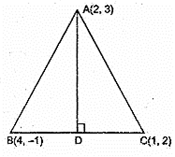
In the triangle ABC with vertices A(2, 3), B (4, -1) and C (1, 2) find the equation and length of altitude from the vertex A.
Answer
Slope of $BC = \frac{{2 - ( - 1)}}{{1 - 4}} = \frac{{2 + 1}}{{ - 3}} = \frac{3}{{ - 3}} = - 1$
Since AD$\bot$BC, so slope of AD = 1.
$\therefore$ Equation of AD is

y - 3 = 1 (x - 2) $\Rightarrow$ x - y + 1 = 0
Equation of line BC is
y + 1 = -1(x - 4) $\Rightarrow$ x + y - 3 = 0
$\therefore$ Length of $AD = \left| {\frac{{2 + 3 - 3}}{{\sqrt {{{(1)}^2} + {{(1)}^2}} }}} \right| = \left| {\frac{2}{{\sqrt 2 }}} \right| = \sqrt 2$ units
View full question & answer
Question 65 Marks
Find equation of the line through the point (0, 2) making an angle $\frac{{2\pi }}{3}$ with the positive x-axis. Also, find the equation of line parallel to it an crossing the y-axis at a distance of 2 units below the origin.
Answer
Here $m = \tan \frac{{2\pi }}{3}$ = tan 120° = tan (90 + 30) = -cot 30° = $ - \sqrt 3$
Equation of the line passing through point (0, 2) having slope $ - \sqrt 3$ is
y - 2 = $-\sqrt 3$(x - 0) $\Rightarrow$ $\sqrt 3$ + y - 2 = 0
Now the line parallel to this line has slope $ - \sqrt 3$
Here c= -2
Putting these values in y = mx + c, we have
y = $-\sqrt 3$ - 2 $\Rightarrow$ $-\sqrt 3$ - y - 2 = 0
View full question & answer