Question 11 Mark
Write the coordinates of the orthocentre of the triangle formed by the lines $x^2 - y^2 = 0$ and $x + 6y = 18.$
AnswerThe equation $x^2 - y^2 = 0$ represents a pair of straight line, which can be written in the following way:
$(x + y)(x - y) = 0$
So, the lines can be written separately in the following manner:
$x + y = 0 ...(1)$
$x - y = 0 ...(2)$
The third line is
$x + 6y = 18 ... (3)$
Lines (1) and (2) are perpendicular to each other as their slopes are $-1$ and $1$, respectively
$\Rightarrow -1 \times 1 = −1$
Therefore, the triangle formed by the lines (1), (2) and (3) is a right-angled triangle.
Thus, the orthocentre of the triangle formed by the given lines is the intersection of $x + y= 0$ and $x - y = 0$, which is $(0, 0)$.
View full question & answer→Question 21 Mark
Write the locus of a point the sum of whose distances from the coordinates axes is unity.
AnswerLet (h, k) be the locus.
It is given that the sum of distances of (h, k) from the coordinate axis is unity.
$\therefore$ |h| + |k| = 1
Taking locus of (h, k), we get:
|x| + |y| = 1
This represents a square.
View full question & answer→Question 31 Mark
Determine the distance between the following pair of parallel lines:
$4x - 3y - 9 = 0$ and $4x - 3y - 24 = 0$
AnswerDetermine between parallel lines
$ax + by +c_1 = 0$ and $ax + by + c_2 = 0$ is
$\Big|\frac{\text{c}_2-\text{c}_1}{\sqrt{\text{a}^2+\text{b}^2}}\Big|$
$4x - 3y - 9 = 0$ and $4x - 3y - 24 = 0$
Distance between the two parallel lines is
$\Big|\frac{-24-(-9)}{\sqrt{4^2+3^2}}\Big|=\Big|\frac{-24+9}{5}\Big|$
$= 3$ units.
View full question & answer→Question 41 Mark
Find the equation of the straight line which passes through (1, -2) and cuts off equal intercepts on the axes.
AnswerThe equation of straight line in the intercepts form is$\frac{\text{x}}{\text{a}}+\frac{\text{y}}{\text{b}}=1 \ ...(\text{i})$
If (i) passes through point (1, -2) ans has equal intercepts (a = b = k), we get,
$\frac{1}{\text{k}}+\frac{(-2)}{\text{k}}=1$
$\frac{-1}{\text{k}}-\frac{2}{\text{k}}=1$
$1-2 =\text{k}$
$\text{k}=-1$
$\Rightarrow\text{a}=\text{b}=-1$
Putting in (i)
$\frac{\text{x}}{-1}+\frac{\text{y}}{-1}=1$
$\text{x}+\text{y}=-1$
View full question & answer→Question 51 Mark
Write the integral values of m for which the x-coordinate of the point of intersection of the lines y = mx + 1 and 3x + 4y = 9 is an integer.
AnswerThe given lines can be written as
mx - y + 1 = 0 ...(1)
3x + 4y - 9 = 0 ...(2)
Solving (1) and (2) by cross multiplication, we get:
$\frac{\text{x}}{9-4}=\frac{\text{y}}{3+9\text{m}}=\frac{1}{4\text{m}+3}$
$\Rightarrow\text{x}=\frac{5}{4\text{m}+3},\text{y}=\frac{9\text{m}+3}{4\text{m}+3}$
For x to be integer we have, 4m + 3 = 1,-1, 5 and -5
$\Rightarrow \ \text{m}=\frac{-1}{2},-1,\frac{1}{2}$ and $-2.$
Hence, the integral values of m are -1 and -2.
View full question & answer→Question 61 Mark
Find the slope of a line passing through the following points:
(3, 5), and (1, 2)
Answer(3, 5), and (1, 2)
slope of line $=\frac{\text{y}_2-\text{y}_1}{\text{x}_2-\text{x}_1}=\frac{2-(-5)}{1-3}=\frac{7}{-2}=\frac{-7}{2}$
View full question & answer→Question 71 Mark
If a, b, c are in A.P., then the line ax + by + c = 0 passes through a fixed point. Write the coordinates of that point.
AnswerIf, a, b, c are in A.P, then
a + c = 2b
⇒ a - 2b + c = 0
Comparing the coefficient of ax + by + c = 0 and a - 2b + c = 0, we get
x = 1 and y = -2
So, the the coordinates of that point is (1, -2)
View full question & answer→Question 81 Mark
Write an equation representing a pair of lines through the point (a, b) and parallel to the coordinate axes.
AnswerThe lines passing through (a, b) and parallel to the x-axis and y-axis are y = b and x = a respectively.Therefore, their combined equation is given below:
(x - a)(y - b) = 0
View full question & answer→Question 91 Mark
Find the equation to the straight line:Cutting off intercepts -5 and 6 from the axes.
AnswerIf (a, 0) and (0, b) are the intercepts of a line then the intercept form of equation is $\frac{\text{x}}{\text{a}}+\frac{\text{y}}{\text{b}}=1$Here, a = -5, b = 6
$\therefore$ The required equation is
$\frac{\text{x}}{-5}+\frac{\text{y}}{6}=1$
$\Rightarrow6\text{x}-5\text{y}=-30$
View full question & answer→Question 101 Mark
If the centroid of a triangle formed by the points (0, 0), $(\cos \theta, \sin \theta)$ and $\sin \theta, - \cos \theta$ lies on the line y = 2x, then write the value of $\tan\theta.$
AnswerThe centroid of a triangle with vertices $(x_1, y_1), (x_2, y_2)$ and $(x_3, y_3)$ is given below:
$\Big(\frac{\text{x}_1+\text{x}_2+\text{x}_3}{3},\frac{\text{y}_1+\text{y}_2+\text{y}_3}{3}\Big)$
Therefore, the centre of the triangle having vertices (0, 0), $(\cos \theta, \sin \theta)$ and $\sin \theta, - \cos \theta$ is
$\Big(\frac{0+\cos\theta+\sin\theta}{3},\frac{0+\sin\theta-\cos\theta}{3}\Big)\equiv\Big(\frac{\cos\theta+\sin\theta}{3},\frac{\sin\theta-\cos\theta}{3}\Big)$
This point lies on the line y = 2x
$\frac{\sin\theta-\cos\theta}{3}=2\times\frac{\cos\theta+\sin\theta}{3}$
$\Rightarrow\sin\theta-\cos\theta=2\cos\theta+2\sin\theta$
$\Rightarrow\tan\theta=-3$
$\therefore\tan\theta=-3$
View full question & answer→Question 111 Mark
If the diagonals of the quadrilateral formed by the lines $l_1x + m_1y + n_1 = 0, l_2x + m_2y + n_2= 0, l_1x + m_1y + n_1' = 0$ and $l_2x + m_2y + n_2' = 0$ are perpendicular, then write the value of $l_1^2 - l_2^2 + m_1^2 - m_2^2.$
AnswerThe given lines are
$l_1x + m_1y + n_1 = 0 ...(1)$
$l_2x + m_2y + n_2 = 0 ...(2)$
$l_1x + m_1y + n_1' = 0 ...(3)$
$l_2x + m_2y + n_2' = 0 ...(4)$
Let $(1), (2), (3)$ and $(4)$ represent the sides $AB, BC, CD$ and $DA,$ respectively.
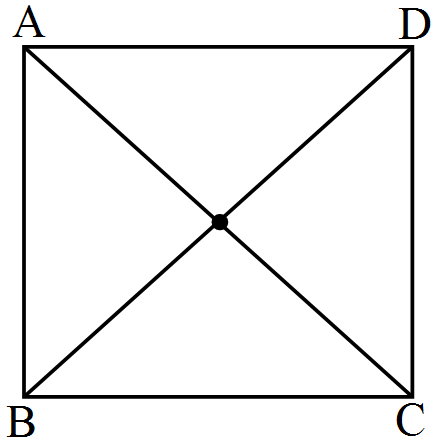
The equation of diagonal AC passing through the intersection of $(2)$ and $(3)$ is given by $\text{l}_1\text{x} + \text{m}_1\text{y} + \text{n}_1' +\lambda(\text{l}_2\text{x} + \text{m}_2\text{y} + \text{n}_2) = 0$
$\Rightarrow(\text{l}_2+\lambda\text{l}_2)\text{x}+(\text{m}_1+\lambda\text{m}_2)\text{y}+(\text{n}_1'+\lambda\text{n}_2)=0$
⇒ Slope of diagonal $\text{AC}=-\Big(\frac{\text{l}_1+\lambda\text{l}_2}{\text{m}_1+\lambda\text{m}_2}\Big)$
Also, the equation of diagonal BD, passing through the intersection of $(1)$ and $(2),$ is given by $\text{l}_1\text{x}+\text{m}_1\text{y}+\text{n}_1+\mu(\text{l}_2\text{x}+\text{m}_2\text{y}+\text{n}_2)=0$
$\Rightarrow(\text{l}_1+\mu\text{l}_2)\text{x}+(\text{m}_1+\mu\text{m}_2)\text{y}+(\text{n}_1+\mu\text{n}_2)=0$
⇒ Slope of diagonal $\text{BD}=-\Big(\frac{\text{l}_1+\mu\text{l}_2}{\text{m}_1+\mu\text{m}_2}\Big)$
The diagonals are perpendicular to each other.
$\therefore\Big(\frac{\text{l}_1+\lambda\text{l}_2}{\text{m}_1+\lambda\text{m}_2}\Big)\Big(\frac{\text{l}_1+\mu\text{l}_2}{\text{m}_1+\mu\text{m}_2}\Big)=-1$
$\Rightarrow(\text{l}_1-\text{l}_2)(\text{l}_1+\text{l}_2)=-(\text{m}_1-\text{m}_2)(\text{m}_1+\text{m}_2)$ $\Rightarrow\Big(\text{l}_1^2-\text{l}_2^2\Big)=-\Big(\text{m}_1^2-\text{m}_2^2\Big)$
$\Rightarrow\Big(\text{l}_1^2-\text{l}_2^2\Big)+\Big(\text{m}_1^2-\text{m}_2^2\Big)=0$ View full question & answer→Question 121 Mark
Write the distance between the lines $4x + 3y - 11 = 0$ and $8x + 6y - 15 = 0.$
AnswerThe distance between the two parallel lines $ax + by + c_1= 0$ and $ax + by + c_2= 0$ is $\Big|\frac{\text{c}_1-\text{c}_2}{\sqrt{\text{a}^2+\text{b}^2}}\Big|$
The given lines can be written as
$4\text{x} + 3\text{y} - 11 = 0 \ ...(1)$
$8\text{x} + 6\text{y} - 15 = 0 ⇒ 4\text{x} + 3\text{y} - \frac{15}{2}=0 \ ...(2)$
Let d be the distance between the lines (1) and (2)
$\text{d}=\Big|\frac{-11-\big(-\frac{15}{2}\big)}{\sqrt{4^2+3^2}}\Big|=\frac{7}{10} \text{units}$
View full question & answer→Question 131 Mark
Write the value of $\theta\in\Big(0,\frac{\pi}{2}\Big)$ for which area of the triangle formed by points $\text{O}(0,0),\text{A} (\text{a} \cos \theta, \text{b} \sin \theta)$ and $\text{B} (\text{a} \cos \theta, − \text{b} \sin \theta)$ is maximum.
AnswerLet A be the area of the triangle formed by the points $\text{O}(0,0),\text{A} (\text{a} \cos \theta, \text{b} \sin \theta)$ and $\text{B} (\text{a} \cos \theta, − \text{b} \sin \theta)$
$\text{A}=\frac{1}{2}\begin{vmatrix}0&0&1\\\text{a}\cos\theta&\text{b}\sin\theta&1\\\text{a}\cos\theta&-\text{b}\sin\theta&1\end{vmatrix}$
$\Rightarrow\text{A}=\frac{1}{2}|(-\text{ab}\sin\theta\cos\theta-\text{ab}\sin\theta\cos\theta)|$
$\Rightarrow\text{A}=\frac{1}{2}=\text{ab}\sin\theta\cos\theta=\frac{1}{2}\sin2\theta$
Now,
$\therefore \ \text{A}_\text{max}=\frac{1}{2},$ when $\sin2\theta=1$
$\Rightarrow\therefore\text{A}_\text{max}=\frac{1}{2},$ when $2\theta=\frac{\pi}{2}\Rightarrow\theta=\frac{\pi}{4}$
Hence, the area of the triangle formed by the given points is maximum when $\theta=\frac{\pi}{4}.$
View full question & answer→Question 141 Mark
Write the area of the triangle formed by the coordinate axes and the line $(\sec \theta - \tan \theta) \text{x}+ (\sec \theta + \tan \theta) \text{y} = 2.$
AnswerThe point of intersection of the coordinate axes is (0, 0).
Let us find the intersection of the line $(\sec \theta - \tan \theta) \text{x}+ (\sec \theta + \tan \theta) \text{y} = 2.$ and the coordinate axis.
For x-axis:
$\text{y}=0,\text{x}=\frac{2}{\sec\theta-\tan\theta}$
For x-axis:
$\text{x}=0,\text{y}=\frac{2}{\sec\theta+\tan\theta}$
Thus, the coordinates of the triangle formed by the coordinate axis and the line $(\sec \theta - \tan \theta) \text{x}+ (\sec \theta + \tan \theta) \text{y} = 2.$ are $(0, 0),$ $\Big(\frac{2}{\sec\theta-\tan\theta},0\Big)$ and $\Big(0,\frac{2}{\sec\theta+\tan\theta}\Big)$
Let A be the area of the required triangle.
$\therefore\text{A}=\frac{1}{2}\begin{vmatrix}0&0&1\\\frac{2}{\sec\theta-\tan\theta}&0&1\\0&\frac{2}{\sec\theta+\tan\theta}&1\end{vmatrix}$
$\Rightarrow\text{A}=\frac{1}{2}\times\frac{2}{\sec\theta-\tan\theta}\times\frac{2}{\sec\theta+\tan\theta}$
$\Rightarrow\text{A}=\frac{2}{(\sec\theta-\tan\theta)(\sec\theta+\tan\theta)}=\frac{2}{(\sec^2\theta+\tan^2\theta)}=2$
Hence, the area of the triangle is 2 square units.
View full question & answer→Question 151 Mark
Determine the distance between the following pair of parallel lines: $y = mx + c$ and $y = mx + d$
AnswerDetermine between parallel lines $ax + by +c_1 = 0$ and $ax + by + c_2 = 0$ is $\Big|\frac{\text{c}_2-\text{c}_1}{\sqrt{\text{a}^2+\text{b}^2}}\Big|$
$y = mx + c$ and $y = mx + d$
Distance between the two parallel lines is $\Big|\frac{\text{c}-\text{d}}{\sqrt{\text{m}^2+1}}\Big|$
View full question & answer→Question 161 Mark
Find the slopes of the lines which make the following angles with the positive direction of x-axis:
$\frac{2\pi}{3}$
AnswerAngle made with positive x axis is $\frac{2\pi}{3}$
$\therefore \text{m}=\tan\theta=\tan\Big(\frac{2\pi}{3}\Big)=-\sqrt3$
View full question & answer→Question 171 Mark
Find the equation to the straight line:
Cutting off intercepts 3 and 2 from the axes.
AnswerIf (a, 0) and (b, 0) are the intercepts of the line then the intercept form the equation is $\frac{\text{x}}{\text{a}}+\frac{\text{y}}{\text{b}}=1$Here, a = 3, b = 2
$\therefore$ The required equation is
$\frac{\text{x}}{\text{3}}+\frac{\text{y}}{2}=1$
$\Rightarrow2\text{x}+3\text{y}=6$
View full question & answer→Question 181 Mark
State whether the two lines in the following are parallel, perpendicular or neither.
Through $(3, 15)$ and $(16, 6)$; through $(-5, 3)$ and $(8, 2)$
AnswerSlope of line joining $(3, 15)$ and $(16, 6)$ $\text{m}_1=\frac{6-5}{16-3}=\frac{-9}{13}$ Slope of the line joining $(-5, 3)$ and $(8, 2)$f$\text{m}_2=\frac{2-3}{8-(-5)}=\frac{-1}{13}$
Here, neither $m_1 = m_2$ nor $m_1 \times m_2 = -1$
$\therefore$ The lines are neither parallel nor perpendicular.
View full question & answer→Question 191 Mark
Find the slopes of the lines which make the following angles with the positive direction of x-axis:
$\frac{3\pi}{4}$
AnswerAngle made with positive x axis is $\frac{3\pi}{4}$
$\therefore\text{m}=\tan\theta=\tan\Big(\frac{3\pi}{4}\Big)=\tan\Big(\pi-\frac{\pi}{4}\Big)=-1$
View full question & answer→Question 201 Mark
Write the coordinates of the orthocentre of the triangle formed by the lines xy = 0 and x + y = 1.
AnswerThe equation xy = 0 represents a pair of straight lines.
The lines can be written separately in the following way:
x = 0 ...(1)
y = 0 ...(2)
The third line is
= x + y = 1 ...(3)
Lines (1) and (2) are perpendicular to each other as they are coordinate axes.
Therefore, the triangle formed by the lines (1), (2) and (3) is a right-angled triangle.
Thus, the orthocentre of the triangle formed by the given lines is the intersection of x = 0 and y = 0, which is (0, 0)
View full question & answer→Question 211 Mark
Find the slope of a line passing through the following points:
$\big(\text{at}_1^2,2\text{at}_1\big)$ and $\big(\text{at}_2^2,2\text{at}_2\big)$
Answer$\big(\text{at}_1^2,2\text{at}_1\big)$ and $\big(\text{at}_2^2,2\text{at}_2\big)$
slope of line $=\frac{\text{y}_2-\text{y}_1}{\text{x}_2-\text{x}_1}=\frac{2\text{at}_2-2\text{at}_1}{\text{at}_2^2-\text{at}_1^2}=\frac{2}{\text{t}_2+\text{t}_1}$
View full question & answer→Question 221 Mark
Find the slope of a line passing through the following points:
(-3, 2) and (1, 4)
Answer(-3, 2) and (1, 4)
slope of line $=\frac{\text{y}_2-\text{y}_1}{\text{x}_2-\text{x}_1}=\frac{4-2}{1-(-3)}=\frac{2}{3}=\frac{1}{2}$
View full question & answer→Question 231 Mark
Write the equation of the line passing through the point (1, -2) and cutting off equal intercepts from the axes.
AnswerLet the equation of the required line be
$\frac{\text{x}}{\text{a}}+\frac{\text{y}}{\text{b}} \ \big[\because$ the line has equal intercepts$\big]$
Now, it is passing through (1, -2)
$\therefore \ \frac{1}{\text{a}}-\frac{2}{\text{a}}=1$
$\Rightarrow\text{a}=-1$
Hence, the required equation is given by
$\frac{\text{x}}{-1}+\frac{\text{y}}{-1}=1$
$\Rightarrow\text{x}+\text{y}+1=0$
View full question & answer→Question 241 Mark
State whether the two lines in the following are parallel, perpendicular or neither.
Through $(9, 5)$ and $(-1, 1)$; through $(3, -5)$ and $(8, -3)$
AnswerSlope of line joining $(-1, 1)$ and $(9, 5)$
$\text{m}_1=\frac{5-1}{9-(-1)}=\frac{4}{10}=\frac{2}{5}$
Slope of line joining $(3, -5)$ and $(9, 5)$
$\text{m}_2=\frac{-3-(-5)}{8-3}=\frac{-3+5}{5}=\frac{2}{5}$
Here $m_1 = m_2$
$\therefore$ The two lines are parallel.
View full question & answer→Question 251 Mark
Find the slopes of the lines which make the following angles with the positive direction of x-axis:
$\frac{\pi}{3}$
AnswerAngle made with positive x axis is $\frac{\pi}{3} $
$\therefore\text{m}=\tan\theta=\tan\Big(\frac{\pi}{3}\Big)=\sqrt3$
View full question & answer→Question 261 Mark
Write the area of the figure formed by the lines a |x| + b |y| + c = 0.
AnswerThe given lines can be written separately in the following way:
$\text{ax}+\text{by}+\text{c}=0; \ \text{x},\text{y}\geq0 \ ...(1)$
$-\text{ax}+\text{by}+\text{c}=0; \ \text{x}<\text{y}\geq0 \ ...(2)$
$-\text{ax}-\text{by}+\text{c}=0; \ \text{x}<\text{y}<0 \ ...(3)$
$\text{ax}-\text{by}+\text{c}=0; \ \text{x}\geq0 \ \text{y}<0 \ ...(4)$
The lines and the region enclosed between them is shown below.
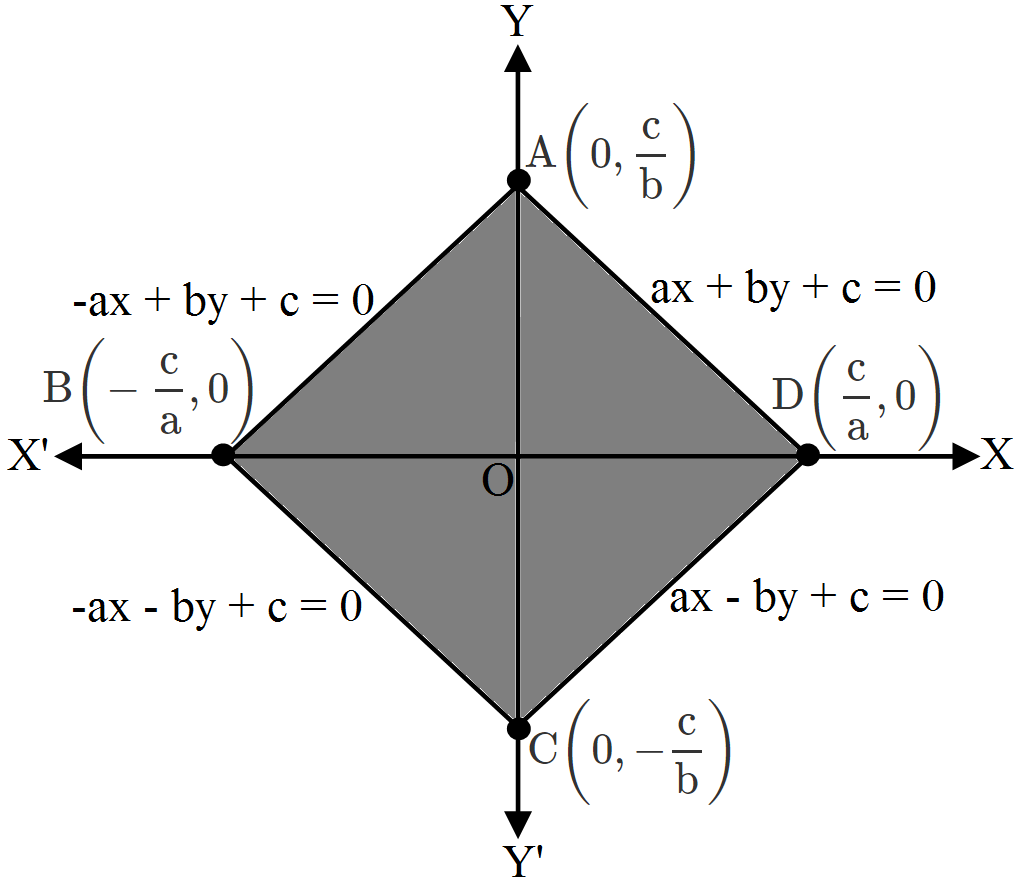 So, the area of the figures formed by the lines a|x| + b|y| + c = 0 is
$4\times\frac{1}{2}\big|\frac{\text{c}}{\text{a}}\times\frac{\text{c}}{\text{b}}\big|=\frac{2\text{c}^2}{|\text{ab}|}\text{squnits}$ View full question & answer→Question 271 Mark
The equations of two sides of a square are 5x - 12y - 65 = 0 and 5x - 12y + 26 = 0. Find the area of the square.
AnswerThe two sides of square are
5x - 12y - 65 = 0 and 5x - 12y + 26 = 0
The distance between these two parallel sides $\Big($as both have slpoe $\frac{5}{12}\Big)$ is
$\Big|\frac{-65-26}{\sqrt{5^2+12^2}}\Big|=\Big|\frac{-91}{13}\Big|$
= 7 units.
And all sides of square are equal.
$\therefore$ Area of the square is 7 × 7 = 49 sq units.
View full question & answer→Question 281 Mark
If the lines x + ay + a = 0, bx + y + b = 0 and cx + cy + 1 = 0 are concurrent, then write the value of 2abc - ab - bc - ca.
AnswerThe given lines are x + ay + a = 0 ...(1) bx + y + b = 0 ...(2) cx + cy + 1 = 0 ...(3) It is given that the lines (1), (2) and (3) are concurrent.$\therefore\begin{vmatrix}1&\text{a}&\text{a} \\ \text{b}&1&\text{b}\\\text{c}&\text{c}&1\end{vmatrix}=0$
$\Rightarrow(1-\text{bc})-\text{a}(\text{b}-\text{bc})+\text{a}(\text{bc}-\text{c})=0$ $\Rightarrow1-\text{bc}-\text{ab}+\text{abc}+\text{abc}-\text{ac}=0$ $\Rightarrow2\text{abc}-\text{ab}-\text{bc}-\text{ca}=-1$ Hence, the value of 2abc - ab - bc - ca is -1
View full question & answer→Question 291 Mark
If a, b, c are in G.P. write the area of the triangle formed by the line ax + by + c = 0 with the coordinates axes.
AnswerThe point of intersection of the line ax + by + c = 0 with the coordinate axis are $\Big(-\frac{\text{c}}{\text{a}},0\Big)$ and $\Big(0,-\frac{\text{c}}{\text{b}}\Big)$
So, the vertices of the triangle are (0, 0), $\Big(-\frac{\text{c}}{\text{a}},0\Big)$ and $\Big(0,-\frac{\text{c}}{\text{b}}\Big)$
Let A be the area of the required triangle.
$\text{A}=\frac{1}{2}\begin{vmatrix}0&0&1\\\frac{\text{-c}}{\text{a}}&0&1\\0&\frac{\text{-c}}{\text{b}}&1\end{vmatrix}$
$\text{A}=\frac{1}{2}\big|-\frac{\text{c}}{\text{a}}\times\frac{\text{-c}}{\text{a}}\big|=\frac{1}{2}\big|\frac{\text{c}^2}{\text{ab}}\big|$
It is given that a, b and c are in GP.
$\therefore \ \text{b}^2=\text{ac}$
$\Rightarrow\text{A}=\frac{1}{2}\big|\frac{\text{b}^4}{\text{a}^2\times\text{ab}}\big|=\frac{1}{2}\big|\frac{\text{b}}{\text{a}}\big|^3 \ \text{sq units}$
View full question & answer→Question 301 Mark
Determine the distance between the following pair of parallel lines:
$4x + 3y - 11 = 0$ and $8x + 6y = 15$
AnswerDetermine between parallel lines $ax + by +c_1 = 0$ and $ax + by + c_2 = 0$ is $\Big|\frac{\text{c}_2-\text{c}_1}{\sqrt{\text{a}^2+\text{b}^2}}\Big|$
$4x + 3y - 11 = 0$ and $8x + 6y = 15$
Distance between the two parallel lines is $\Big|\frac{-11-15}{\sqrt{4^2+3^2}}\Big|=\frac{7}{10}\text{units}$
View full question & answer→Question 311 Mark
Find the locus of the mid-points of the portion of the line $\text{x}\sin\theta+ \text{y}\cos\theta =\text{p}$ intercepted between the axes.
AnswerWe have $\text{x}\sin\theta+ \text{y}\cos\theta =\text{p}$
$\Rightarrow\frac{\text{x}}{\frac{\text{p}}{\sin\theta}}+\frac{\text{y}}{\frac{\text{p}}{\cos\theta}}=1$
So, the x and y intercepts are given by
$\Big(\frac{\text{p}}{\sin\theta},0\Big)$ and $\Big(0,\frac{\text{p}}{\cos\theta}\Big)$
Now, let the coordinates of the mid point be (h, k)
$\therefore\text{h}=\frac{\frac{\text{p}}{\sin\theta}+0}{2}$ and $\text{k}=\frac{0+\frac{\text{p}}{\cos\theta}}{2}$
$\Rightarrow\text{h}=\frac{\text{p}}{2\sin\theta}$ and $\text{k}=\frac{\text{p}}{2\cos\theta}$
$\Rightarrow\sin\theta=\frac{\text{p}}{2\text{h}}$ and $\cos\theta=\frac{\text{p}}{2\text{k}}$
$\Rightarrow\sin^2\theta=\frac{\text{p}^2}{2\text{h}^2}$ and $\cos^2\theta=\frac{\text{p}^2}{2\text{k}^2}$
Now, squaring and adding, we get
$\sin^2\theta+\cos^2\theta=\frac{\text{p}^2}{4\text{h}^2}+\frac{\text{p}^2}{4\text{k}^2}$
$\Rightarrow1=\frac{\text{p}^2}{4\text{h}^2}+\frac{\text{p}^2}{4\text{k}^2}$
$\Rightarrow\frac{4}{\text{p}^2}=\frac{1}{\text{h}^2}+\frac{1}{\text{k}^2}$
since, (h, k) is the mid point, so it will also pass through xsinθ+ ycosθ = p.
Hence, the given equation of locus can also be written as:
$\frac{4}{\text{p}^2}=\frac{1}{\text{x}^2}+\frac{1}{\text{y}^2}$
View full question & answer→Question 321 Mark
Find the slopes of the lines which make the following angles with the positive direction of x-axis:
$-\frac{\pi}{4}$
AnswerAngle made with positive x axis is $-\frac{\pi}{4}.$
$\therefore\text{m}=\tan\theta=\tan\Big(-\frac{\pi}{4}\Big)=-1$
View full question & answer→Question 331 Mark
State whether the two lines in the following are parallel, perpendicular or neither.
Through (6, 3) and (1, 1); through (-2, 5) and (2, -5)
AnswerSlope of line joining (6, 3) and (1, 1)
$\text{m}_1 =\frac{1-3}{1-6}=\frac{-2}{-5}=\frac{2}{5}$
Slope of line joining (-2, 5) and (2, -5)
$\text{m}_2=\frac{\text{5}-{5}}{2-(-2)}=\frac{-10}{4}=\frac{-5}{2}$
Here $\text{m}_1\times\text{m}_2=\frac{2}{5}\times\frac{-5}{2}=-1$
$\therefore$ The lines are perpendicular to each other.
View full question & answer→Question 341 Mark
Write the coordinates of the image of the point (3, 8) in the line x + 3y - 7 = 0.
AnswerLet the given point be A(3, 8) and its image in the line x + 3y - 7 = 0 is B(h, k).
The midpoint of AB is $\Big(\frac{3+\text{h}}{2},\frac{8+\text{k}}{2}\Big)$ that lies on the line x + 3y - 7 = 0
$\therefore\frac{ 3+\text{h}}{2}+3\times\frac{8+\text{k}}{2}-7=0$
$\text{h}+3\text{k}+13=0 \ ...(1)$
AB and the line x + 3y - 7 = 0 are perpendicular.
$\therefore$ Slope of AB × Slope of the line = -
$\Rightarrow\frac{\text{k}-8}{\text{h}-3}\times\frac{-1}{3}=-1$
$\Rightarrow3\text{h}-\text{k}-1 \ ...(2)$
Solving (1) and (2), we get:
(h, k) = (-1, -4)
Hence, the image of the point (3, 8) in the line x + 3y - 7 = 0 is (-1, -4).
View full question & answer→Question 351 Mark
Determine the distance between the following pair of parallel lines:
$8x + 15y - 34 = 0$ and $8x + 15y + 31 = 0$
AnswerDetermine between parallel lines
$ax + by +c_1 = 0$ and $ax + by + c_2 = 0$ is
$\Big|\frac{\text{c}_2-\text{c}_1}{\sqrt{\text{a}^2+\text{b}^2}}\Big|$
$8x + 15y - 34 = 0$ and $8x + 15y + 31 = 0$
Distance between the two parallel lines is
$\Big|\frac{-34-31}{\sqrt{8^2+15^2}}\Big|=\frac{65}{17}\text{units}$
View full question & answer→Question 361 Mark
If $a ≠ b ≠ c$, write the condition for which the equations $(b - c) x + (c - a) y + (a - b) = 0$ and $(b^3 - c^3)x + (c^3 - a^3)y + (a^3 - b^3) = 0$ represent the same line.
AnswerThe given lines are
$(b - c)x + (c - a)y + (a - b) = 0 ...(1)$
$(b^3 - c^3)x + (c^3 - a^3)y + (a^3 - b^3) = 0 ...(2)$
The lines (1) and (2) will represent the same lines if
$\frac{\text{b}-\text{c}}{\text{b}^3-\text{c}^3}=\frac{\text{c}-\text{a}}{\text{c}^3-\text{a}^3}=\frac{\text{a}-\text{b}}{\text{a}^3-\text{b}^3}$
$\Rightarrow\frac{\text{b}-\text{c}}{(\text{b}-\text{c})(\text{b}^2+\text{bc}+\text{c}^2)}=\frac{\text{c}-\text{a}}{(\text{c}-\text{a})(\text{c}^2+\text{ac}+\text{a}^2)}=\frac{\text{a}-\text{b}}{(\text{a}-\text{b})(\text{a}^2+\text{ab}+\text{b}^2)}$
$\Rightarrow\frac{1}{(\text{b}^2+\text{bc}+\text{c}^2)}=\frac{1}{(\text{c}^2+\text{ac}+\text{a}^2)}=\frac{1}{(\text{a}^2+\text{ab}+\text{b}^2)} \ (\because\text{a}\neq\text{b}\neq \text{c})$
$\Rightarrow\text{b}^2+\text{bc}+\text{c}^2=\text{c}^2+\text{ac}+\text{a}^2$ and $\text{c}^2+\text{ac}+\text{a}^2=\text{a}^2+\text{ab}+\text{b}^2$
$\Rightarrow(\text{a}-\text{b})(\text{a}+\text{b}+\text{c})=0$ and $(\text{b}-\text{c})(\text{b}+\text{c}+\text{a})=0$
$\Rightarrow\text{a}+\text{b}+\text{c} \ (\because\text{a}\neq\text{b}\neq\text{c})$
Hence, the given lines will represent the same lines if $a + b + c = 0.$
View full question & answer→