Question 13 Marks
Find the equation of the straight line which makes a triangle of area $96\sqrt{3}$ with the axes and perpendicular from the origin to it makes an angle of 30° with Y-axis.
AnswerPerpendicular from origin makes an angle of 30° with y axis, thus making 60° worth x axis Area of triangle is $=96\sqrt3$
$\frac{1}{2}\times2\text{p}\times\frac{2\text{p}}{\sqrt{3}}=96\sqrt3$
$\text{p}^2=\frac{96\sqrt3\times\sqrt3}{2}=48\times3=2\times2\times2\times2\times3\times3$
$\text{p}=12$
$\text{x}\cos\alpha+\text{y}\sin\alpha=\text{p}$
$\text{x}\cos60^\circ+\text{y}\sin60^\circ=12$
$\text{x}\times\frac{1}{2}+\text{y}\frac{\sqrt3}{2}=12$
$\text{x}+\sqrt3\text{y}=24$
View full question & answer→Question 23 Marks
Find the equations of the sides of the triangles the coordinates of whose angular points are respectively:
(1, 4), (2, -3) and (-1, -2)
AnswerLet A(1, 4), B(2, -3) and C(-1, -2)Then the equation of AB is
$\text{y}-\text{y}_=\frac{\text{y}_2-\text{y}_1}{\text{x}_2-\text{x}_1}(\text{x}-\text{x}_1)$
$\text{y}-4=\frac{-3-4}{2-1}(\text{x}-1)$
$\text{y}-4=\frac{-7}{1}(\text{x}-1)$
$\text{7x}+\text{y}=11$
Equation of side BC is
$\text{y}-\text{y}_2=\frac{\text{y}_3-\text{y}_2}{\text{x}_3-\text{x}_2}(\text{x}-\text{x}_2)$
$\text{y}-(-3)=\frac{-2-(-3)}{-1-2}(\text{x}-2)$
$\text{y}+3=\frac{1}{-3}(\text{x}-2)$
$\text{x}+\text{3y}+7=0$
Equation of side AC is
$\text{y}-\text{y}_1=\frac{\text{y}_3-\text{y}_1}{\text{x}_3-\text{x}_1}(\text{x}-\text{x}_1)$
$\text{y}-4=\frac{-2-4}{-1-1}(\text{x}-1)$
$\text{y}-4=3(\text{x}-1)$
$\text{y}-\text{3x}=1$
View full question & answer→Question 33 Marks
Find the area of the triangle formed by the lines:
$y = m_1x + c_1, y = m_2x + c_2$ and $x = 0$
Answer$y = m_1x + c_1...(1)$
$y = m_2x + c_2...(2)$
$x = 0 ...(3)$
Solving 1 and 2 gives $\bigg(\frac{\text{c}_2-c_1}{\text{m}_1-\text{m}_2},\frac{\text{m}_1c_2-\text{m}_2c_1}{\text{m}_1-\text{m}_2}\bigg)$
Solving 2 and 3 gives $(0, c_2)$
Solving 1 and 3 gives $(0, c_1)$
Area of traingle formed by above vertices is
$=\frac{1}{2}\Bigg[\bigg(\frac{c_2-c_1}{\text{m}_1-\text{m}_2}\times{}\text{c}_1\bigg)-\bigg(\frac{\text{c}_2-c_1}{\text{m}_1-\text{m}_2}\times\text{c}_2\bigg)\Bigg]$
$=\frac{(\text{c}_1-c_2)^2}{2(\text{m}_1-\text{m}_2)}$
View full question & answer→Question 43 Marks
Find the orthocentre of the triangle the equations of whose sides are x + y = 1, 2x + 3y = 6 and 4x - y + 4 = 0.
Answerx + y = 1, AB ...(1)
2x + 3y = 6 and BC ...(2)
4x - y + 4 AC ...(3)
Solving 1 and 2 gives B(-3, 4)
Solving 1 and 3 gives $\text{A}\Big(\frac{-3}{5},\frac{8}{5}\Big)$
Altitude from A to BC is given by
$\text{y}-\frac{8}{5}=\frac{3}{2}\Big(\text{x}+\frac{3}{5}\Big)$
$10\text{y}-16=15\text{x}+9$
$15\text{x} - 10\text{y} + 25 = 0$
$3\text{x} - 2\text{y} + 5 = 0 \ ...(4)$
Similarly Altitude fram B to AC is given by
$\text{y}-4=\frac{-1}{4}(\text{x}+3)$
$4\text{y} - 16 = - \text{x} - 3$
$\text{x} + 4\text{y} - 13 = 0 \ ...(5)$
Solving 4 and 5 gives orthocentre
$\text{O}\Big(\frac{3}{7},\frac{22}{7}\Big)$
View full question & answer→Question 53 Marks
Prove that the lines $\sqrt{3}\text{x}+\text{y}=0,\sqrt{3}\text{y}+\text{x}=0,\sqrt{3}\text{x}+\text{y}=1$ and $\sqrt{3}\text{y}+\text{x}=1$ form a rhombus.
AnswerLet ABCD be a quadrilateral with sides AB, BC, CD, BA as $\sqrt3\text{x+y} = 0, \sqrt3\text{y}+\text{x}=0,\sqrt3\text{x+y}=1$ and $\sqrt{3}\text{y}+\text{x}=1$ respectively.
The slope of $\text{AB}=-\sqrt3 \ ...(1)$
The slope of $\text{BC}=\frac{-1}{\sqrt3} \ ...(2)$
The slope of $\text{CD}=-\sqrt3 \ ...(3)$
The slope of $\text{DA}=\frac{-1}{\sqrt3} \ ...(4)$
From (1), (2), (3) and (4) we observe the slope of opposite sides of quadrilateral are equal.
$\therefore$ Opposite sides are parrallel.
$\therefore$ ABCD is a parallelogram.
We observe that distance between (AD and BC) and (DC and AB) is equal = 1 unit
$\therefore$ Sides AD = AB = BC = DC
$\therefore$ The given figure ABCD is a rhombus
Hence, proved
View full question & answer→Question 63 Marks
Classify the following pairs of lines as coincident, parallel or intersecting:
3x + 2y - 4 = 0 and 6x + 4y - 8 = 0.
Answer3x + 2y - = 0, 6x + 4y - 8 = 0
$\text{y}=\frac{-3}{2}\text{x}+\frac{4}{2}, \ \text{y}=\frac{-6}{4}\text{x}+\frac{8}{4}$
$\text{y}=\frac{-3}{2}\text{x}+2, \ \text{y}=\frac{-3}{2}\text{x}+2$
⇒ Lines are coincident
Because $\text{m}_1=\text{m}_2=\frac{-3}{2}$
Intercept = 2 in both line
View full question & answer→Question 73 Marks
Find the equation of the straight line on which the length of the perpendicular from the origin is 2 and the perpendicular makes an angle α with x-axis such that sin $\alpha=\frac{1}{3}.$
AnswerHere $\text{p}=2,\ \sin\alpha=\frac{1}{3}$$\Rightarrow\cos\alpha=\frac{2\sqrt2}{3}$
The equation of straight line is
$\text{x}\cos\alpha+\text{y}\sin\alpha=\text{p}$
$\text{x}\Big(\frac{2\sqrt2}{3}\Big)+\text{y}\Big(\frac{1}{3}\Big)=2$
$2\sqrt2\text{x}+\text{y}=6$
View full question & answer→Question 83 Marks
Find the value of x for which the points (x, -1), (2, 1) and (4, 5) are collinear.
AnswerThe given points are A(x, -1), B(2, 1) and C(4, 5)
It is given that the points are collinear. So, the area of triangle that they form must be zero.
Hence,
$\text{x}_1(\text{y}_1-\text{y}_3)+\text{x}_2(\text{y}_3-\text{y}_1)+\text{x}_3(\text{y}_1-\text{y}_2)=0 \ ...(\text{i})$
Putting the value of $(\text{x}_1\text{y}_1),(\text{x}_2\text{y}_2),(\text{x}_3\text{y}_3)$ in ...(i)
$\text{x}(1-5)+(2)(5-(-1))+4(-1-1)=0$
$-4\text{x}+2(5+1)+4(-2)=0$
$-4\text{x}+12-8=0$
$-4\text{x}=-12+8$
$-4\text{x}=-4$
$\text{x}=1$
View full question & answer→Question 93 Marks
Find the value of $\theta$ and p, if the equation $\text{x} \cos\theta + \text{y} \sin \theta = \text{p}$ is the normal form of the line $\sqrt{3}\text{x}+\text{y}+2=0.$
AnswerWe have,$\sqrt{3\text{x}}+\text{y}+2=0$
$-\sqrt{3\text{x}}-\text{y}=2$
$\Big(-\frac{\sqrt3}{2}\Big)\text{x}+\Big(\frac{-1}{2}\Big)\text{y}=1$
This same as $\text{x}\cos\theta+\text{y}\sin\theta=\text{p}$
Therefore, $\cos\theta=\frac{-\sqrt3}{2},\ \sin\theta=-\frac{1}{2}$ and $\text{p}=1$
$\theta=210^\circ $ and $\text{p}=1$
$\theta=\frac{7\pi}{6}$ and $\text{p}=1$
View full question & answer→Question 103 Marks
Show that the perpendiculars let fall from any point on the straight line 2x + 11y - 5 = 0 upon the two straight lines 24x + 7y = 20 and 4x - 3y - 2 = 0 are equal to each other.
AnswerLet (h, k) be the point on the line 2x + 11y - 5 = 0
⇒ 2h + 11k - 5 = 0 ...(1)
Let p and q be length of perpendicular from (h, k) on lines 24x + 7y - 20 = 0 and 4x - 3y - 2 = 0 So,
p = q
$\frac{24\text{h}+7\text{k}-20}{\sqrt{(24)^2+(7)^2}}=\frac{4\text{h}-3\text{k}-2}{\sqrt{(4)^2+(-3)^2}}$
$\frac{24\text{h}+7\text{k}-20}{\sqrt{576+49}}=\frac{4\text{h}-3\text{k}-2}{\sqrt{25}}$
$\frac{24\text{h}+7\text{k}-20}{25}=\frac{4\text{h}-3\text{k}-2}{25}$
$24\text{h}+7\text{k}-20=20\text{h}-15\text{K}-10$
$4\text{h}=-22\text{k}+10$
$4\Big(\frac{5-11\text{k}}{2}\Big)=-22\text{k}+10$ [Using equation (1)]
$10-22\text{k}=-22\text{k}+10$
LHS = RHS
So,
Distance 24x + 7y - 20 = 0 and 4x - 3y - 2 = 0 from any point on the line 2x + 11y - 5 = 0 is equal.
View full question & answer→Question 113 Marks
Find the equation of the straight lines passing through the following pair of points:
(a, b) and (a + b, a - b)
AnswerLet $\text{A}(\text{a},\text{b})$ be $(\text{x}_1,\text{y}_1)$$\text{B}(\text{a}+\text{b},\text{a}-\text{b})$ be $(\text{x}_2\text{y}_2)$
Then equation of line AB is
$\Rightarrow \text{y}-\text{y}_1=\frac{\text{y}_2-\text{y}_1}{\text{x}_2-\text{x}_1}(\text{x}-\text{x}_1)$
$\Rightarrow \text{y}-\text{b}=\frac{\text{a}-\text{b}-\text{b}}{\text{a}+\text{b}-\text{a}}(\text{x}-\text{a})$
$\Rightarrow \text{y}-\text{b}=\frac{\text{a}-\text{2b}}{\text{b}}(\text{x}-\text{a})$
$\Rightarrow\text{by}-\text{b}^2=\text{ax}-\text{a}^2-\text{2bx}+\text{2ba}$
$\Rightarrow(\text{a}-\text{2b})\text{x}-\text{by}+\text{b}^2-\text{a}^2+\text{2ab}=0$
$\therefore$ The equation of the line joining the points (a, b) and (a + b, a - b) is $(\text{a}-\text{2b})\text{x}-\text{by}+\text{b}^2-\text{a}^2+\text{2ab}=0$
View full question & answer→Question 123 Marks
Find the coordinates of the vertices of a triangle, the equations of whose sides are:
$y(t_1 + t_2) = 2x + 2at_1t_2, y(t_2 + t_3) = 2x + 2at_2t_3$ and, $y(t_3 + t_1) = 2x + 2at_1t_3.$
Answer$y(t_1+ t_2) = 2x + 2at_1t_{2 ...}(1)$
$y(t_2 + t_3) = 2x + 2at_2t_3 and ...(2)$
$y(t_3 + t_1)= 2x + 2at_1t_3 ...(3)$
Solving 1 and 2 gives $(\text{x}_1,\text{y}_1)=(\text{at}_2^2,2\text{at}_2)$
Solving 2 and 3 gives $(\text{x}_2,\text{y}_2)=\text{(at}^2_3,2\text{at}_3)$
Solving 1 and 3 gives $\text{(x}_3,\text{y}_3)=\text{(at}_1^2,2\text{at}_1)$
Above points are the vertices of the triangle
View full question & answer→Question 133 Marks
Find the point of intersection of the following pairs of lines:
bx + ay = ab and ax + by = ab.
Answer$\text{bx+ay}=\text{ab}\Rightarrow\text{x}=\frac{\text{ab}-{\text{ay}}}{b}$
Putting this value in the second equation, we get
$\text{ax} + \text{by} = \text{ab}$
$\text{a}\Big(\frac{\text{ab}-\text{ay}}{b}\Big)+\text{by}=\text{ab}$
$\text{a}^2\text{b}-\text{a}^2\text{y}+\text{b}^2\text{y}=\text{a}\text{b}^2$
$\text{y}(\text{b}^2-\text{a}^2)=\text{ab}(\text{b}-\text{a})$
$\text{y}=\frac{\text{ab(b-a)}}{\text{b}^2-\text{a}^2}=\frac{\text{ab}}{\text{b+a}}$
Putting this value in the first equation, we get
$\Rightarrow\text{x}=\frac{\text{ab}-\frac{\text{a(ab)}}{\text{a+b}}}{\text{b}}=\frac{\text{ab}}{\text{a+b}}$
$\therefore$ point is $\Big(\frac{\text{ab}}{\text{a+b}},\frac{\text{ab}}{\text{a+b}}\Big)$
View full question & answer→Question 143 Marks
Find the equation of the perpendicular bisector of the line joining the points (1, 3) and (3, 1).
AnswerAny line which is perpendicular bisector menas line is perpendicular to the given line and one end point is the mid-point of that line.
The line joining $(1,3)\$\text{x}_1\text{y}_1)$ and $(3,1)\$\text{x}_2\text{y}_2)$
Has the mid-point
$\text{x}=\frac{\text{x}_1+\text{x}_2}{2},\text{y}=\frac{\text{y}_1+\text{y}_2}{2}$
$\Rightarrow(\text{x}_1\text{y}_1)=\Big(\frac{1+3}{2},\frac{3+2}{2}\Big)=(2,2)$
Also slope of line is
$\text{m}=\frac{\text{y}_2-\text{y}_1}{\text{x}_2-\text{x}_1}=\frac{1-3}{3-1}=\frac{-2}{2}=-1$
So, the slope of required line is 1 (negative reciprocal of slope)
Thus, the equation of perpendicular bisector is
$\text{y}-\text{y}_1=\frac{-1}{\text{m}}(\text{x}-\text{x}_1)$
$\text{y}-2=1(\text{x}-2)$
$\text{y}-2=\text{x}-2$
$\text{y}=\text{x}$
View full question & answer→Question 153 Marks
Find the equation of the right bisector of the line segment joining the points (3, 4) and (-1, 2).
AnswerThe right bisector PQ of AB bisects AB at C ans is perpendicular to AB.The coordinates of C are $=\Big(\frac{3-1}{2},\frac{4+2}{2}\Big)=(1,3)$
And the slope of PQ $=\frac{-1}{\text{slope of AB}}=\frac{-1}{2-4}(-1-3)=\frac{4}{-2}=-2$
The equation of PQ is
$(\text{y}-3)=-2(\text{x}-1)$
$\text{y}-3=-2\text{x}+2$
$\text{y}+2\text{x}=5$
View full question & answer→Question 163 Marks
Line through the points (-2, 6) and (4, 8) is perpendicular to the line through the points (8, 12) and (x, 24). Find the value of x.
AnswerThe slope of the line joining (-2, 6) and (4, 8) is
$\text{m}_1=\frac{8-6}{4-(-2)}=\frac{2}{6}=\frac{1}{3}$
The slope of the line joining (8, 12) and (x, 24) is
$\text{m}_2=\frac{24-12}{\text{x}-8}=\frac{12}{\text{x}-8}$
Since the lines are perpendikular two each other
$\text{m}_1\times\text{m}_2=-1$
$\frac{1}{3}\times\frac{12}{\text{x}-8}=-1$
$\Rightarrow4=8-\text{x}$
$\Rightarrow\text{x}=4$
View full question & answer→Question 173 Marks
Show that the diagonals of the parallelogram whose sides are lx + my + n = 0, lx + my + n' = 0, mx + ly + n = 0 and mx + ly + n' = 0 include an angle $\frac{\pi}{2}.$
AnswerLet ABCD be a parallelogram as shown in the following figure.
We observe that the following parallelogram is a rhombus, as distance between opposite sides (AB and CD) and (AD and BC) is equal = (n - n)'.
And in a Rhombus, diagnals are perpendicular to each other.
$\therefore$ Angle between the two diagnals is $\frac{17}{2}.$
View full question & answer→Question 183 Marks
Three sides AB, BC and CA of a triangle ABC are 5x - 3y + 2 = 0, x - 3y - 2 = 0 and x + y - 6 = 0 respectively. Find the equation of the altitude through the vertex A.
AnswerOn solving the equation of AB, BC and CA we get
B = (-1, -1)
A = (2, 4)
C = (5, 1)
The slope of $\text{BC}=\frac{1}{3}$ then slope of AE = - 3
slope of AC = -1 then slope of BD = 1
slope of $\text{AB}=\frac{5}{3}$ then slope of $\text{CF}=\frac{-3}{5}$
Where AD, BE, CF are altitude of $\Delta\text{ABC}$
The equation of AD, BE and CF are
BD = y + 1 = 1 (x + 1) ⇒ x - y = 0
AE = y - 4 = -3 (x - 2) ⇒ 3x + y = 10
CF = y - 1 $=\frac{-3}{5}(\text{x}- 5)$ ⇒ 3x + 5y = 20
Are the required equation, then equation through A is 3x + y =10.
View full question & answer→Question 193 Marks
Find the equation of the line passing through $\Big(2,2\sqrt{3}\Big)$ and inclined with x-axis at an angle of $75^\circ .$
AnswerThe required equation of the line is
$y - y_1 = m(x - x_1)$
Since the line makes an angle $75^\circ $ with x-axis
$\text{m}=\tan75^\circ=3.73$
$(\text{x}_1,\text{y}_1)=\Big(2,2\sqrt{3}\Big)$
Therefore, $y - y_1 = m(x - x_1)$
$\text{y}-2\sqrt{3}=(2+\sqrt{3})(\text{x}-2)$
$\text{y}-2\sqrt{3}=(2+\sqrt{3})\text{x}-7.46$
$\Big(2,2\sqrt{3}\Big)\text{x}-\text{y}-4=0$
View full question & answer→Question 203 Marks
Find the ratio in which the line $3x + 4y + 2 = 0$ divides the distance between the line $3x + 4y + 5 = 0$ and $3x + 4y - 5 = 0$
AnswerClearly, the slope of each of the given lines is same equal to $-\frac{3}{4}.$
Hence, the line 3x + 4y + 2 = 0 is parallel to each of the given lines.
Putting y = 0 in 3x + 4y + 2 = 0, we get $\text{x}=\frac{2}{3}.$
So, the coordinates of a point on $3x + 4y + 2 = 0$ are $\Big(-\frac{2}{3},0\Big).$
The distance $d_1$ between the lines $3x + 4y + 2 = 0$ and 3x + 4y + 5 = 0 is given by $\text{d}_1=\Bigg|\frac{3\big(-\frac{2}{3}\big)+4(0)+5}{\sqrt{3^2+4^2}}\Bigg|=\frac{3}{5}$
The distance $d_1$ between the lines $3x + 4y + 2 = 0$ and $3x + 4y - 5 = 0$ is given by $\text{d}_2=\Bigg|\frac{3\big(-\frac{2}{3}\big)+4(0)-5}{\sqrt{3^2+4^2}}\Bigg|=\frac{7}{5}$
$\frac{\text{d}_1}{\text{d}_2}=\frac{\frac{3}{5}}{\frac{7}{5}}=\frac{3}{7}$
So $3x + 4y + 2 = 0$ divides the distance between the lines $3x + 4y + 5 = 0$ and $3x + 4y - 5 = 0$ in the ratio $3 : 7.$
View full question & answer→Question 213 Marks
Prove that the line y -x + 2 = 0 divides the join of points (3, -1) and (8, 9) in the ratio 2 : 3.
AnswerLet AB be the line segment
Let P at any point which divides the line segment in the ratio 2 : 3 then using section formula
$\text{x}=\frac{\text{lx}_2+\text{mx}_1}{\text{l}+\text{m}}, \text{y}=\frac{\text{ly}_2+\text{my}_1}{\text{l}+\text{m}}$
Where l : m :: 2 : 3
$\Rightarrow\text{x}=\frac{2(8)+3(3)}{2+3}=\frac{16+9}{5}=\frac{25}{5}=5$
$\text{y}=\frac{2(9)+3(-1)}{2+3}=\frac{18-3}{5}=\frac{15}{5}=3$
Now P must lie on the line, where P is (5, 3)
y - x + 2 = 0
⇒ 3 - (5) + 2 = 0
-2 + 2 = 0
0 = 0
Hence, proved
View full question & answer→Question 223 Marks
Find the coordinates of the orthocentre of the triangle whose vertices are (-1, 3), (2, -1) and (0, 0).
Answer$\text{AD}\perp\text{BC},\text{CF}\perp\text{AB},\text{BE}\perp\text{AC}$
Let G be the orthocentre of triangle
Let G (h, k)
$\text{Now},\text{AG}\perp\text{BC}$
$\therefore$ (slope of AG) × (slope of BC) = -1
$\Big(\frac{\text{k}-3}{\text{h}+1}\Big)\Big(\frac{0+1}{0-2}\Big)=-1$
k - 3 = 2(h + 1)
k - 2h = 5 ...(1)
and $\text{BG}\perp\text{AC}$
⇒ (slope of BG) × (slope of AC) = -1
$\Big(\frac{\text{k}+1}{\text{h}-2}\Big)\Big(\frac{0-3}{0+1}\Big)=-1$
3(k + 1) = h - 2
3k - h = -5 ...(2)
from (1) and (2)
Orthocenter (h, k) = (-4, -3)
View full question & answer→Question 233 Marks
Find the equation of the line which passes through the point (-4, 3) and is such that the portion of it between the axes is divivded by the point in the ratio 5 : 3.
AnswerLet equation of line be $\frac{\text{x}}{\text{a}}+\frac{\text{y}}{\text{b}}=1$It is given (-4, 3)divides the line joining A(a, 0) and B(0, b)in ratio 5 : 3
$\therefore\Big(\frac{3\text{a}}{8},\frac{5\text{b}}{8}\Big)=(-4,3)$
$\Rightarrow\frac{3\text{a}}{8}=-4\ \Rightarrow\text{a}=\frac{-32}{3}$
And
$\frac{5\text{b}}{8}=3\ \Rightarrow\text{b}=\frac{24}{5}$
$\therefore$ The equation of line is
$\frac{3\text{x}}{-32}+\frac{\text{5y}}{24}=1$
or $\text{9x}-\text{20y}+96=0$
View full question & answer→Question 243 Marks
Find the values of $\theta$ and p, if the equation $\text{x} \cos θ + \text{y} \sin \theta = \text{p}$ is the normal form of the line $\sqrt{3}\text{x}+\text{y}+2=0.$
View full question & answer→Question 253 Marks
What are the points on y-axis whose distance from the line $\frac{\text{x}}{3}+\frac{\text{y}}{4}=1$ is 4 units?
AnswerLet the required point be (0, a)
Given, distnace of (0, a) from line 4x + 3y - 12 = 0 is 4units.
$\text{D}=\Big|\frac{\text{ax}_1+\text{by}+\text{c}}{\sqrt{\text{a}^2+\text{b}^2}}\Big|$
$4=\Big|\frac{4(0)+3(\text{a})-12}{\sqrt{4^2+3^2}}\Big|$
$4=\Big|\frac{-3\text{a}+12}{5}\Big|$
$\Rightarrow4=\frac{-3\text{a}+12}{5}$
$\Rightarrow-3\text{a}=20-12$
$\text{a}=-\frac{8}{3}$
And $4=\frac{3\text{a}-12}{5}$
$\Rightarrow3\text{a}=20+12$
$\Rightarrow\text{a}=\frac{32}{3}$
So, Required points are
$\Big(0,\frac{32}{3}\Big),\Big(0,\frac{-8}{3}\Big)$
View full question & answer→Question 263 Marks
Find the equation of the line mid-way between the parallel lines 9x + 6y - 7 = 0 and 3x + 2y + 6 = 0.
AnswerThe equation of lines are
$3\text{x}+2\text{y}-\frac{7}{3}=0 \ ...(\text{i})$
$3\text{x}+2\text{y}+6=0 \ ...(\text{ii})$
Let equation of mid way be $3\text{x}+2\text{y}+\lambda=0 \ ...(\text{iii})$
Then, distance between (i) and (iii) and (ii) and (iii) should be equal.
$\Bigg|\frac{\lambda+\frac{7}{3}}{\sqrt{9+4}}\Bigg|=\Big|\frac{\lambda-6}{\sqrt{9+4}}\Big|$
$\Rightarrow\lambda+\frac{7}{3}=-\pi+6$
$\Rightarrow\lambda=\frac{11}{6}$
$\therefore$ The required line is $3\text{x}+2\text{y}+\frac{11}{6}=0$ or $18\text{x}+12\text{y}+11=0.$
View full question & answer→Question 273 Marks
Find the point of intersection of the following pairs of lines:
2x - y + 3 = 0 and x + y - 5 = 0
Answer2x - y + 3 = 0 ⇒ y = 2x + 3
Putting this value in the second equetion, we get
x + y - 5 = 0
x + (2x + 3) - 5 = 0
x + 2x + 3 - 5 = 0
3x - 2 = 0
$\text{x}=\frac{2}{3}$
Putting this value in the first equation, we get
$\Rightarrow\text{y}=2\text{x+3}=\frac{2\times2}{3}+3=\frac{4}{3}+3=\frac{13}{3}$
$\therefore$ Point of intersection is $\Big(\frac{2}{3},\frac{13}{3}\Big)$
View full question & answer→Question 283 Marks
Find the distance of the point (3, 5) from the line 2x + 3y = 14 measured parallel to the line x - 2y = 1.
AnswerIf m is the slope of the line x - 2y = 1, then$\text{m}=\tan\theta=\frac{-1}{-2}=\frac{1}{2}$
$\therefore\sin\theta=\frac{1}{\sqrt5}$ and $\cos\theta=\frac{2}{\sqrt5}$
Then the equation of line is
$\frac{\text{x}-3}{\cos\theta}=\frac{\text{y}-5}{\sin\theta}=\pm\text{r}$
$\Rightarrow\ \text{x}=\pm\frac{2}{\sqrt5}\text{r}+3$ and $\text{y}=\pm\frac{1}{\sqrt5}\text{r}+5$
$\text{P}\Big(\pm\frac{2}{\sqrt5}\text{r}+3,\ \pm\frac{\text{r}}{\sqrt5}+5\Big)$ lie in $2\text{x}+3\text{y}=14$
$2\Big(\pm\frac{2}{\sqrt5}\text{r}+3\Big)+3\Big(\pm\frac{1}{\sqrt5}\text{r}+5\Big)=14$
$4\text{r}+6\sqrt5+\text{3r}+15\sqrt5=14\sqrt5$
$7\text{r}=-7\sqrt5$
$\text{r}=|\sqrt5|$
View full question & answer→Question 293 Marks
Put the equation $\frac{\text{x}}{\text{a}}+\frac{\text{y}}{\text{b}}=1$ to the slope intercept form and find its slope and y-intercept.
Answer$\frac{\text{x}}{\text{a}}+\frac{\text{y}}{\text{b}}=1$The slope intercept form is
$\text{y}=\text{mx}+\text{c}$ $\frac{\text{x}}{\text{a}}+\frac{\text{y}}{\text{b}}=1$ $\text{bx}+\text{ay}=\text{ab}$ $\text{ay}=-\text{bx}+\text{ab}$ $\text{y}=\frac{-\text{bx}}{\text{a}}+\text{b}$ Thus y-intercept is b. Slope $=\frac{\text{-b}}{\text{a}}$
View full question & answer→Question 303 Marks
Find the equation of the line which intercepts a length 2 on the positive direction of the x-axis and is inclined at an angle of $135^\circ $ with the positive direction of y-axis.
AnswerThe line passes through the point $(2,0)$.
Also its inclination to $y$-axis is $135^{\circ}$.
That is, the inclination jof the given line with the $x$-axis is $180^{\circ}-135^{\circ}$.
That is, the slope of the given line is $45^{\circ}$
The equation of the line having slope 'm' and passing through the point $(x_1, y_1)$ is $y - y_1 = m(x - x_1)$
Therefore, the required equation is
$\text{y}-0=\tan45^\circ(\text{x}-2)$
$\Rightarrow y = 1 \times (x - 2)$
$\Rightarrow y = x - 2$
$\Rightarrow x - y - 2 = 0$
View full question & answer→Question 313 Marks
Find the equation of the line passing through $(0, 0)$
with slope m.
AnswerThe required equation of the line is
$y - y_1 = m(x - x_1)$
$(x_1, y_1) = (0, 0)$ and slope is m
Therefore, $y - y_1 = m(x - x_1)$
$y - 0 = m(x - 0)$
$y = mx$
View full question & answer→Question 323 Marks
Reduce the following equations to the normal form and find p and $\alpha$ in each case:
$\text{x}-3=0$
Answer$\text{x}-3=0$
$\text{x}=3$
Comparing with $\text{x}\cos\alpha+\text{y}\sin\alpha=\text{p}$
$\cos\alpha=1$
$=\cos0$
$\Rightarrow\alpha=0$
$\text{p}=3$
View full question & answer→Question 333 Marks
Find the equation of the straight lines passing through the following pair of points:
$\text{(a, b)}$ and $(\text{a + c}\sin\alpha, \ \text{b + c} \ \cos\alpha)$
AnswerLet $A(a, b)= (x_1y_1)$$\text{B}(\text{a}+\text{c}\sin\alpha,\text{b}+\text{c}\sin\alpha)=(\text{x}_2,\text{y}_2)$
Then equation of line AB is
$\Rightarrow\text{y}-\text{y}_1=\frac{\text{y}-\text{y}_1}{\text{x}-\text{x}_1}(\text{x}-\text{x}_1)$
$\Rightarrow \text{y}-\text{b}=\frac{\text{b}+\text{c}\cos\alpha-\text{b}}{\text{a}+\text{c}\sin\alpha-\text{a}}(\text{x}-\text{a})$
$\Rightarrow \text{y}-\text{b}=\frac{\text{c}\cot\alpha}{\text{c}\sin\alpha}(\text{x}-\text{a})$
$\Rightarrow\text{y}-\text{b}=\cot\alpha(\text{x}-\text{a})$
$\therefore$ The equation of the line joining the points $(a, b)$ and
$(\text{a}+\text{c}\sin\alpha,\text{b}+\text{c}\cos\alpha)$ is $\text{y}-\text{b}=\cot\alpha(\text{x}-\text{a})$
View full question & answer→Question 343 Marks
Find the equations of the altitudes of a $\triangle\text{ABC}$ whose vertices are $A (1, 4), B (-3, 2)$ and $C(-5, -3).$
AnswerLet the perpendicular of the triangle on the side $AB , BC$ and $AC$ be $CF, AD$ and $FB$ respectively.
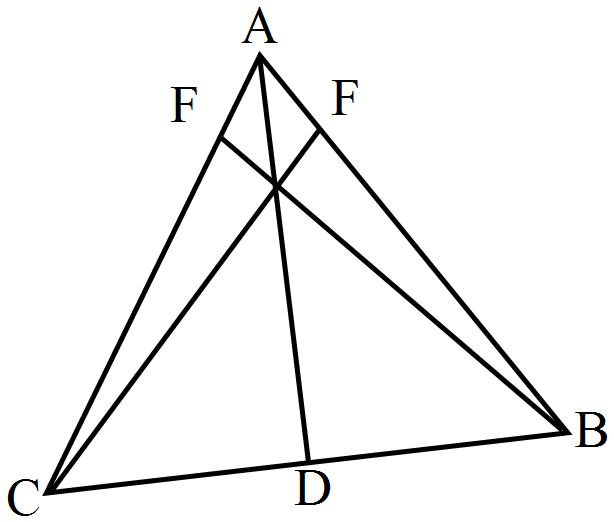
Slope of the side $\text{AB}=\frac{4-2}{1+3}=\frac{2}{4}=\frac{1}{2}$
Corresponding slope of $\text{CF}=-\frac{1}{\frac{1}{2}}=-2$ [Since $m_1 \times m_2 = -1]$
Equation of CF,
$y - y_1 = m(x - x_1)$
$y + 3 = -2(x + 5)$ [Putting co-ordinates of C in place of $x_1$ and $y_1]$
$y + 3 = -2x - 10$
$y = -2x - 13$
Slope of the side $\text{BC}=\frac{2+3}{-3+5}=\frac{5}{2}$
Corresponding slope of $\text{AD}=-\frac{1}{\frac{5}{2}}=-\frac{2}{5}$
Equation of AD,
$\text{y} - \text{y}_1 = \text{m}(\text{x} - \text{x}_1)$
$\text{y}-4=-\frac{2}{5}(\text{x}-1)$
$5\text{y}-20=-2\text{x}+2$
$5\text{y}=-2\text{x}-22$
Slope of the side $\text{AC}=\frac{4+3}{1+5}=\frac{7}{6}$
Corresponding slope of $\text{FB}=-\frac{1}{\frac{7}{6}}=-\frac{6}{7}$
Equation of FB,
$\text{y} - \text{y}_1 = \text{m}(\text{x} - \text{x}_1)$
$\text{y}-2=\frac{-6}{7}(\text{x}+3)$
$7\text{y}-14=-6\text{x}-18$
$7\text{y}=-6\text{x}-4$
Equation of $AD, 2x + 5y + 22 = 0$
Equation of $CF, 2x + y + 13 = 0$
Equation of $FB, 6x + 7y + 4 = 0$ View full question & answer→Question 353 Marks
Find the equation of a line which is equidistant from the lines x = -2 and x = 6.
Answer Let $\text{x}=\lambda$ be the line equidistant from$\text{x}=-2$ and $\text{x}=6$
so $\Bigg|\frac{-2-\lambda}{\sqrt1}\Bigg|=\Bigg|\frac{\lambda-6}{\sqrt1}\Bigg|$$-2-\lambda=\lambda-6$
$4=2\lambda$ $\therefore\lambda=2$ $\therefore$ The line equdistant from x = -2 and x = 6 is x = 2
View full question & answer→Question 363 Marks
Find the angle between X-axis and the line joining the points (3, -1) and (4, -2).
AnswerLet the given points be (3, -1) and (4, -2).
$\therefore$ Slope of $\text{AB}=\frac{-2+1}{4-2}=-1$
Let $\theta$ be the angle between the x axis and AB.
$\therefore \tan\theta =-1$
$\Rightarrow\theta=\tan^{-1}(-1)=\frac{3\pi}{4}$
Hence, the angle between the x axis and the line joining the points (3, -1) and (4, -2) is $\frac{3\pi}{4}.$
View full question & answer→Question 373 Marks
Find the equation of the straight line passing through the point (2, 1) and bisecting the portion of the straight line 3x - 5y = 15 lying between the axes.
AnswerThe equation of the given line is $\text{3x}-\text{5y}=15$
$\frac{\text{x}}{5}-\frac{\text{y}}{3}=1$
It cuts axis at (5, 0) and (-3, 0).
The position AB intercepted between the axis is 1 : 1
$\therefore\text{p}=\Big(\frac{5}{2},\frac{-3}{2}\Big)$
The equation of line passing through point (2, 1)
$\text{y}-1=\frac{1+\frac{3}{2}}{2-\frac{5}{2}}(\text{x}-2)$
$\text{y}-1=-5(\text{x}-2)$
$\text{5x}+\text{y}=11$
View full question & answer→Question 383 Marks
Reduce the following equations to the normal form and find p and $\alpha$ in each case:
$\text{x}-\text{y}+2\sqrt{2}=0$
Answer$\text{x}-\text{y}+2\sqrt{2}=0$
$-\text{x}+\text{y}=2\sqrt{2}$
Dividing each term by $\sqrt{(1)^2+(1)^2}=\sqrt{2}$
$\frac{-\text{x}}{\sqrt{2}}+\frac{\text{y}}{\sqrt{2}}=2$
Comparing with $\text{x}\cos\alpha_\text{y}\sin\alpha=\text{p}$
$\cos\alpha=\frac{-1}{\sqrt{2}},\sin\alpha=\frac{-1}{\sqrt{2}},\text{p}=2$
$\alpha$ is in II quadrant
$\Rightarrow\alpha=\frac{\pi}{4}+\frac{\pi}{2}=\frac{3\pi}{4}=135^\circ,\text{p}=2$
View full question & answer→Question 393 Marks
The length of the perpendicular from the origin to a line is 7 and the line makes an angle of 150° with the positive direction of Y-axis. Find the equation of the line.
AnswerHere, P = perpendicular distance from the origin = 7 Angle made with y axis is 150°,$\therefore$ Angle made with x axis is 30°
$\cos\alpha=\cos30^\circ=\frac{\sqrt3}{2}$
$\sin\alpha=\sin30^\circ=\frac{1}{2}$
The equation of line is
$\text{x}\cos\alpha+\text{y}\sin\alpha=\text{p}$
$\text{x}\Big(\frac{\sqrt3}{2}\Big)+\text{y}\Big(\frac{1}{2}\Big)=7$
$\sqrt{3\text{x}}+\text{y}=14$
View full question & answer→Question 403 Marks
Find the perpendicular distance of the line joining the points $\big(\cos\theta, \sin \theta\big) $ and $\big(\cos \phi, \sin \phi\big)$ from the origin.
AnswerEquation of line passing through $\big(\cos\theta, \sin \theta\big) $ and $\big(\cos \phi, \sin \phi\big)$ is
$\text{y}-\sin\phi=\Big(\frac{\sin\phi-\sin\theta}{\cos\phi-\cos\theta}\Big)(\text{x}-\cos\phi)$
$\text{y}-\sin\phi=\Bigg(\frac{2\cos\frac{\theta+\phi}{2}\sin\frac{\phi-\theta}{2}}{-2\sin\frac {\theta+\phi} {2}\sin\frac{\phi-\theta}{2}}\Bigg)(\text{x}-\cos\phi)$
$\text{y}-\sin\phi=-\cot\Big(\frac{\theta+\phi}{2}\Big)(\text{x}-\cos\phi)$
$\text{x}\cot\Big(\frac{\theta+\phi}{2}\Big)+\text{y}-\sin\phi-\cos\phi\cot\Big(\frac{\theta+\phi}{2}\Big)=0$
Distance of this line from origin,
$=\Big|\frac{\text{ax}_1+\text{by}_1+\text{c}}{\text{a}^2+\text{b}^2}\Big|$
$=\Bigg|\frac{0+0-\sin\phi-\cos\phi\cot\big(\frac{\theta+\phi}{2}\big)}{\sqrt{\Big(\cos\Big(\frac{\theta+\phi}{2}\Big)\Big)^2+1}}\Bigg|$
$=\Bigg|\frac{\sin\phi+\cos\phi\cot\big(\frac{\theta+\phi}{2}\big)}{{\text{cosec}\Big(\frac{\theta+\phi}{2}\Big)}}\Bigg|$
$=\sin\phi\sin\Big(\frac{\theta+\phi}{2}\Big)+{{\cos\phi\cos\Big(\frac{\theta+\phi}{2}}}\Big)$
$=\cos\Big(\frac{\theta+\phi}{2}-\phi\Big)$
$=\cos\Big(\frac{\theta+\phi-2\phi}{2}\Big)$
$\text{D}=\cos\Big(\frac{\theta-\phi}{2}\Big)$
View full question & answer→Question 413 Marks
Find the equation of the straight line upon which the length of the perpendicular from the origin is 2 and the slope of this perpendicular is $\frac{5}{12}.$
AnswerGiven:$\text{p}=\pm2$
$\tan\alpha=\frac{5}{12}$
The equation of line is
$\text{x}\cos\alpha+\text{y}\sin\alpha=\pm\text{p}$
$\text{x}\frac{12}{13}+\text{y}\frac{5}{13}=\pm2$
$\text{12x}+\text{5y}\pm26=0$
View full question & answer→Question 423 Marks
Find the equation of a straight line passing through the point of intersection of $x + 2y + 3 = 0$ and $3x + 4y + 7 = 0$ and perpendicular to the straight line $x - y + 9 = 0.$
AnswerThe equation of the required line is
$(\text{x}+2\text{y}+3)+\lambda(3\text{x}+4\text{y}+7)=0$
or, $\text{x}(1+3\lambda)+\text{y}(2+4\lambda)+3+7\lambda=0$
$m_1$ = slope of the line $=-\Big(\frac{1+3\lambda}{2+4\lambda}\Big)$
The line is perpendicular to $x - y + 9 = 0$ whose slope $(m_2 = 1)$
$\therefore \ \text{m}_1\times\text{m}_2=-1$
$\Rightarrow=-\Big(\frac{1+3\lambda}{2+4\lambda}\Big)\times1=-1$
$\Rightarrow \ 1+3\lambda=2+4\lambda$
$\Rightarrow \ \lambda=-1$
$\therefore$ The required line is
$\text{x}+2\text{y}+3-(3\text{x}+4\text{y}+7)=0$
$-2\text{x}-2\text{y}-4=0$
or, $\text{x}+\text{y}+2=0$
View full question & answer→Question 433 Marks
Find the equation of the straight lines passing through the following pair of points:
(0, -a) and (b, 0)
AnswerLet $\text{A}(\text{a},-\text{a})$ be $(\text{x}_1\text{y}_1)$$\text{B}(\text{b},0)$ be $(\text{x}_2,\text{y}_2)$
Then equation of line AB is
$\Rightarrow \text{y}-\text{y}_1=\frac{\text{y}_2-\text{y}_1}{\text{x}_1-\text{x}_2}(\text{x}-\text{x}_1)$
$\Rightarrow\text{y}-(-\text{a})=\frac{0-(-\text{a})}{\text{b}-0}(\text{x}-0)$
$\Rightarrow \text{y}+\text{a}=\frac{\text{a}}{\text{b}}(\text{x}-0)$
$\Rightarrow \text{ax}-\text{by}=\text{ab}$
$\therefore$ The equation of the line joining the points (0,-a) and (b,0) is $\text{ax}-\text{by}=\text{ab}$
View full question & answer→Question 443 Marks
Classify the following pairs of lines as coincident, parallel or intersecting:
x - y = 0 and 3x - 3y + 5 = 0
Answerx - y = 0, 3x - 3y + 5= 0
⇒ y = mx + c , 3x - 3y + 5 = 0
$\text{y}=\text{x}, \ \text{y}=\text{x}+\frac{5}{3}$
$\Rightarrow\text{m}=1, \ \text{m}'=1$
Slopes of both lines are equal
$\therefore$ Lines are parallel
View full question & answer→Question 453 Marks
Find the equation of the straight lines passing through the following pair of points:
(0, 0) and (2, -2)
AnswerHere, $(\text{x}_1,\text{y}_1)=(0,0)$$(\text{x}_2,\text{y}_2)=(2,-2)$
The equation of the given straight line is:
$\text{y}-\text{y}_1=\text{m}(\text{x}-\text{x}_1)$
$\Rightarrow\text{y}-\text{y}_1=\frac{\text{y}_2-\text{y}_1}{\text{x}_2-\text{x}_2}(\text{x}-\text{x}_1)$
$\Rightarrow\text{y}-0=\frac{-2-0}{2-0}(\text{x}-0)$
$\Rightarrow\text{y}=\frac{\text{-2x}}{2}$
$\Rightarrow\text{y}=-\text{x}$
$\therefore$ The equation of the line joining the points (0, 0) and (2, -2) is y = -x
View full question & answer→Question 463 Marks
Find the equation of the straight line at a distance of 3 units from the origin such that the perpendicular from the origin to the line makes an angle $\tan^{-1}\Big(\frac{5}{12}\Big)$ with the positive direction of x-axis.
AnswerHere $\text{p}=3$and $\alpha=\tan^{-1}\Big(\frac{5}{12}\Big)$
$\Rightarrow\cos\alpha=\frac{12}{13},\ \sin\alpha=\frac{5}{13}$
Equation of straight line is:
$\text{x}\cos\alpha+\text{y}\sin\alpha=\text{p}$
$\text{x}\Big(\frac{12}{13}\Big)+\text{y}\Big(\frac{5}{13}\Big)=3$
$12\text{x}+\text{5y}=39$
View full question & answer→Question 473 Marks
Find the angle between the X-axis and the line joining the points (3, -1) and (4, -2).
AnswerSlope of the line segment joining the points (3, -1) and (4, -2) is
$\text{m}_1=\frac{\text{y}_2-\text{y}_1}{\text{x}_2-\text{x}_1}=\frac{-2-(-1)}{4-3}=\frac{-2+1}{4-3}=\frac{-1}{1}=-1$
Slope of x axis is 0
$\Rightarrow\text{m}_2=0$
If $\theta$ is the angle between x axis and the line segment then
$\tan\theta=\Big|\frac{\text{m}_1-\text{m}_2}{1+\text{m}_1\text{m}_2}\Big|$
$=\Big|\frac{-1-0}{1+(-1)(0)}\Big|$
$=\frac{-1}{1}=-1$
$\therefore\theta=135^\circ$
View full question & answer→Question 483 Marks
Find the equation of the straight line which passes through the point $(1, 2)$ and makes such an angle with the positive direction of x-axis whose sine is $\frac{3}{5}.$
AnswerLet $\sin\theta=\frac{3}{4}$
Then,
$\Rightarrow m =$ slpoe $=\tan\theta=\frac{3}{4}$
The equation of straight line with slope m and passing through $(1, 2)$ is
$y - y_1 = m(x - x_1)$
$\text{y}-2=\frac{3}{4}(\text{x}-1)$
$4y - 8 = 3x - 3$
$3x -4y + 5 = 0$
View full question & answer→Question 493 Marks
Find the equation of the straight line on which the length of the perpendicular from the origin makes an angle of 30° with x-axis and which forms a triangle of area $\frac{50}{\sqrt3}$ with the axes.
Answer$\alpha=30^\circ$Area of triangle = $\frac{50}{\sqrt3}$
Area of triangle = $\frac{1}{2}\text{r}^2\sin\theta=\frac{50}{\sqrt3}$
$\sin30=\frac{1}{2}$
$\frac{1}{2}\times2\text{p}\times\frac{2\text{p}}{\sqrt3}=\frac{50}{\sqrt3}$
$\text{p}^2=\frac{50}{\sqrt3}\times\frac{\sqrt3}{2}=25$
$\text{p}\pm5$
$\text{x}\cos\alpha+\text{y}\sin\alpha=\pm5$
$\text{x}\cos30^\circ+\text{y}\sin30^\circ=\pm5$
$\text{x}\frac{\sqrt3}{2}+\frac{\text{y}}{2}=\pm5$
$\sqrt3\text{x}+\text{y}=\pm10$
View full question & answer→Question 503 Marks
Find the equation of a line drawn perpendicular to the line $\frac{\text{x}}{4}+\frac{\text{y}}{6}=1$ through the point where it meets the y-axis.
AnswerThe required line is perpendicular to the given line $6x + 4y = 24$
$\therefore$ (Slope of required line) $\times $ (Slope of given line) $= -1$
$\text{m}_1=\frac{-1}{\Big(\frac{-6}{4}\Big)}=\frac{4}{6}$
and
The required line passes through the point $(x_1,y_1)$ where it meets the y-axis
$\therefore$ $x$ coordinate at that point is zero, i.e; $x_1 = 0$
$(\text{y}-\text{y}_1)=\frac{4}{6}(\text{x}-0)$
$6\text{y}-6\text{y}_1=4\text{x}$
$2\text{x}-3\text{y}=-3\text{y}_1\Rightarrow\text{y}_1=6$
$2\text{x}-3\text{y}=-18$
$2\text{x}-3\text{y}+18=0$
View full question & answer→Question 513 Marks
Find the distance of the point (1, 2) from the straight line with slope 5 and passing through the point of intersection of x + 2y = 5 and x - 3y = 7.
AnswerOn solving x + 2y = 5 and x - 3y = 7 we get a point $\text{A}\Big(\frac{29}{5},\frac{-2}{5}\Big)$
The line passing through $\text{A}\Big(\frac{29}{5},\frac{-2}{5}\Big)$ and slope 5 is
$\text{y}+\frac{2}{5}=5\Big(\text{x}-\frac{29}{5}\Big)$
$5\text{y}+2=25\text{x}-145$
$25\text{x}-5\text{y}-147=0$
The distance of (1, 2) from 25x -5y - 147 = 0 is
$\Rightarrow\Big|\frac{25(1)-5(2)-147}{\sqrt{25^2+5^2}}\Big|$ [using distance formula]
$\Rightarrow\Big|\frac{-132}{\sqrt{650}}\Big|$
$\Rightarrow\Big|\frac{132}{\sqrt{650}}\Big|$
View full question & answer→Question 523 Marks
Find the equation of the right bisector of the line segment joining the points A(1, 0) and B(2, 3).
AnswerThe right bisector PQ of AB bisects AB at C and is also perpendicular to AB.Slope of $\text{AB}=\frac{3-0}{2-1}=3$
Now,
(slope of AB) × (slope of PQ)= -1
$\therefore$ slope of $\text{PQ}=\frac{-1}{3}$
co-ordinates of C are = $\Big(\frac{1+2}{2},\frac{3+0}{2}\Big)=\Big(\frac{3}{2},\frac{3}{2}\Big)$
$\therefore$ Equation of right bisector PQ is
$\Big(\text{y}-\frac{3}{2}\Big)=\frac{-1}{3}\Big(\text{x}-\frac{3}{2}\Big)$
$6\text{y}-9=-2\text{x}+3$
$\text{x}+\text{3y}=6$
View full question & answer→Question 533 Marks
Reduce the following equations to the normal form and find p and $\alpha$ in each case:
$\text{y}-2=0$
Answer$\text{y}-2=0$
$\text{y}=3$
Comparing with $\text{x}\cos\alpha+\text{y}\sin\alpha=\text{p}$
$\sin\alpha=1$
$=\cos0$
$\Rightarrow\alpha=\frac{\pi}{2},$
$\text{p}=2$
View full question & answer→Question 543 Marks
Find the equation of the straight line which passes through the point $P (2, 6)$ and cuts the coordinate axes at the point $A$ and $B$ respectively so that $\frac{\text{AB}}{\text{BP}}=\frac{2}{3}.$
Answer$P(2, 6)$ let A be the point on $x$ axis $(x, y)\Rightarrow A(a, 0)$
$(x_1, y_1)$
B be a point on y axis
$\Rightarrow B(0, b)$
$(x_2, y_2)$
Using section formula $\text{x}=\frac{\text{lx}_2+\text{mx}_1}{\text{l}+\text{m}},\frac{\text{ly}_2+\text{my}_1}{\text{l}+\text{m}}$
$l : m = 2 : 3$
$2=\frac{2(\text{a}) + 3(0)}{2+3 }$
$\Rightarrow10=3\text{a}$
$\Rightarrow\text{a}=\frac{10}{3}$
$6=\frac{2(\text{b})+3(0)}{2+3}$
$\Rightarrow30=2\text{b}$
$\text{b}=15$
$\therefore$ Point A is $\Big(\frac{10}{3},0\Big),(0,15)$
equation of line AB is
$\text{y}-\text{y}_1=\frac{\text{y}_2-\text{y}_1}{\text{x}_2-\text{x}_1}(\text{x}-\text{x}_1)$
$\text{y}-0=\frac{15-0}{0-\frac{10}{3}}\Big(\text{x}-\frac{10}{3}\Big)$
$\text{y}=\frac{-15\times3}{10}\Big(\text{x}-\frac{10}{3}\Big)$
$\text{2y}=-\text{9x}+\frac{90}{3}$
$\text{9x}+\text{2y}=30$
View full question & answer→Question 553 Marks
Find the equation of a line equidistant from the lines $y = 10$ and $y = -2.$
AnswerA line is equidistant from two other lines, must have the same slope.
The slope of $y = 10$ and $y = -2$ is $0$, ie line parallel to x axis.
The required line is also parallel to $y = 10$ and $y = -2$
$\therefore$ $m = 0$
Also the required line will be pass from the mid point of the line joining $(0, 2)$ and $(0, 10)$
coordinates of this point will be $\Big(0,\frac{10-2}{2}\Big)=\Big(0,\frac{8}{2}\Big)=(0,4)$
$\therefore$ The equation of require line is:
$y - 4 = 0(x - x_1)$
$\Rightarrow y = 4$
View full question & answer→Question 563 Marks
Find the equation to the straight line which passes through the point (5, 6) and has intercepts on the axes Equal in magnitude and both positive,Equal in magnitude but opposite in sign.
AnswerIntercepts are equal positive⇒ a = b = k
The equation of straight line is
$\frac{\text{x}}{\text{a}}+\frac{\text{y}}{\text{b}}=1 \ ...(\text{i})$
Since this line passes through (5, 6) and a = b = k, we get:
$\frac{5}{\text{k}}+\frac{6}{\text{k}}=1$
$\text{k}=1$
$\therefore\frac{\text{x}}{11}+\frac{\text{y}}{11}=1$
$\Rightarrow\text{x}+\text{y}=11$
Intercepts are equal but opposite in sing
Let, a = k, b = -k
Putting in (i), we get,
$\frac{5}{\text{k}}+\frac{6}{-\text{k}}=1$
$\frac{5}{\text{k}}-\frac{6}{\text{k}}=1$
$\Rightarrow\text{k}=-1$
thus from (i)
$\text{x}-\text{y}=-1$
View full question & answer→Question 573 Marks
Find the distance of the point (3, 5) from the line 2x + 3y = 14 measured parallel to a line having slope $\frac{1}{2}.$
AnswerEquation of the required line is $\frac{\text{x}-3}{\cos\alpha}=\frac{\text{y}-5}{\sin\alpha}=\text{r}\dots(1)$
$\tan\alpha=\frac{1}{2}\ \Rightarrow\ \cos\alpha=\frac{2}{\sqrt5}$ and $\sin\alpha=\frac{1}{\sqrt5}$
$\therefore$ equation is
$\frac{\text{x}-3}{\frac{2}{\sqrt5}}=\frac{\text{y}-5}{\frac{1}{5}}=\text{r}$
or $\text{x}=\frac{2}{\sqrt5}\text{r}+3,\ \text{y}=\frac{1}{\sqrt5}\text{r}+5$
$\text{p}\Big(\frac{2\text{r}}{\sqrt5}+3,\ \frac{\text{r}}{\sqrt5}+5\Big)$ lie on $2\text{x}+3\text{y}=14$
$\therefore\frac{4\text{r}}{\sqrt5}+6+\frac{3\text{r}}{\sqrt5}+15=1\pm14$
$\frac{7\text{r}}{\sqrt5}=\pm17$
$\text{r}=\pm\sqrt5$
$\text{r}=\sqrt5\ (\text{r}\neq-\sqrt5)$
$\therefore$ Distance of (3, 5) from 2x + 3y = 14 is $\sqrt5$ units.f
View full question & answer→Question 583 Marks
Find the equation of the line whose perpendicular distance from the origin is 4 units and the angle which the normal makes with the positive direction of x-axis is 15°.
AnswerHere,$\text{P}=4$ and $\alpha=15^\circ$
The equation of line is
$\text{x}\cos\alpha +\text{y}\sin\alpha=\text{p}\dots(1)$
$\text{x}\cos15^\circ+\text{y}\sin15^\circ=4$
$\cos15^\circ=\cos(45-30)=\cos45\cos30+\sin45\sin30$
$(\because \cos(\theta-\phi)=\cos\theta\cos\phi+\sin\theta\sin\phi)$
$=\frac{1}{\sqrt2}\times\frac{\sqrt3}{2}\times\frac{1}{\sqrt2}\times\frac{1}{2}$
$=\frac{1}{2\sqrt2}(\sqrt3+1)$
$\sin15^\circ=\sin(45-30)=\sin45\cos30+\cos45\sin30$
$=\frac{1}{\sqrt2}\times\frac{\sqrt3}{2}-\frac{1}{\sqrt2}\times\frac{1}{2}$
$=\frac{1}{2\sqrt2}(\sqrt3-1)$
Putting in (1)
$\text{x}\times\frac{1}{2\sqrt2}(\sqrt3+1)+\text{y}\times\frac{1}{2\sqrt2}(\sqrt3-1)=4$
$\text{x}(\sqrt3+1)+\text{y}(\sqrt3-1)=8\sqrt2$
View full question & answer→Question 593 Marks
The length L (in centimeters) of a copper rod is a linear function of its celsius temperature C. In an experiment, if L = 124.942 when C = 20 and L = 125.134 when C = 110, express L in terms of C.
Answer$\text{L}_1=124.942, \text{C}_1=20 $$\text{L}_1=125.134,\text{C}_2=110$
Equation of line passing through
$(\text{L}_1,\text{C}_1)$ and $(\text{L}_2,\text{C}_2)$
$\text{L}-\text{L}_1=\Bigg(\frac{\text{L}_2-\text{L}_1}{\text{C}_2-\text{C}_1}\Bigg)\Big(\text{C}-\text{C}_1\Big)$
$\text{L}-124.942=\Big(\frac{125.134-124.942}{110-20}\Big)(\text{C}-20)$
$\text{L}-124.942=\frac{0.192}{90}(\text{C}-20)$
$\text{L}-124.92=\frac{192}{90000}(\text{C}-20)$
$\text{L}-124.942=\frac{4}{1875}(\text{C}-20)$
$\text{L}=\frac{4}{1875}\text{C}+124.942-4\times\frac{20}{1875}$
$\Rightarrow\text{L}=\frac{4}{1875}\text{C}+124.899$
View full question & answer→Question 603 Marks
The slope of a line is double of the slope of another line. If tangents of the angle between them is $\frac{1}{3},$ find the slopes of the other line.
AnswerLet $\text{m}_{1}=\text{x, }\text{m}_2=\text{2x}$ $\tan\theta=\Big|\frac{\text{m}_1-\text{m}_2}{1+\text{m}_1\text{m}_2}\Big|$ $\frac{1}{3}=\Big|\frac{\text{x}-\text{2x}}{1+\text{2x}^2}\Big|$Case I:
$\frac{1}{3}=\frac{\text{x}-\text{2x}}{1+\text{2x}^2}$ $\text{2x}^2+1=-\text{3x}$ $\text{2x}^2+3\text{x}+1=0$ $2\text{x}^2+\text{2x}+\text{x}+1=0$ $\text{2x}(\text{x}+1)+1(\text{2x}+1)=0$ $(\text{x}+1)(\text{2x}+1)=0$ $\text{x}=-1,-\frac{1}{2}$Case II:
$\frac{1}{3}=\Big(\frac{\text{-x}}{1+\text{2x}^2}\Big)$ $\frac{1}{3}=\frac{\text{x}}{\text{1}+\text{2x}^2}$ $\text{2x}^2+1=3\text{x}$ $\text{2x}^2-\text{3x}+1=0$ $\text{2x}^2-\text{2x}-\text{x}+1=0$ $\text{2x}(\text{x}-1)-1(\text{x}-1)=0$ $(\text{x}-1)(\text{2x}-1)=0$ $\text{x}=1,\frac{1}{2}$ Slope of the line is $1,\frac{1}{2}$ or $-1,-\frac{1}{2}$
View full question & answer→Question 613 Marks
Point R (h, k) divides a line segment between the axes in the ratio 1 : 2. Find the equation of the line.
Answer
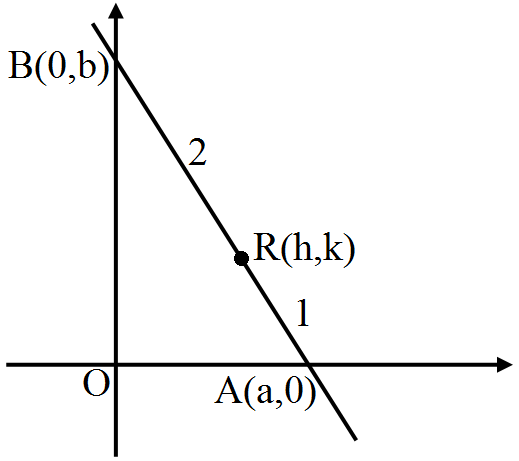 Point (h, k) divides the line segment in the ratio 1 : 2
Thus, using section point formula, we have
$\text{h}=\frac{2\times\text{a}+1\times0}{1+2}$
and
$\text{k}=\frac{2\times0+1\times\text{b}}{1+2}$
Therefore, we have,
$\text{h}=\frac{2\text{a}}{3}$ and $\text{k}=\frac{\text{b}}{3}$
$\Rightarrow\text{a}=\frac{3\text{h}}{2}$and $\text{b}=\text{3k}$
Thus, the correspoinding point of A and B are $\Big(\frac{\text{3h}}{2},0\Big)$ and (0, 3k)
Thus, the equation of line joining the points A and B is
$\frac{\text{y}-\text{3k}}{\text{3k}-0}=\frac{\text{x}-0}{0-\frac{3\text{h}}{2}}$
$\Rightarrow-\frac{3\text{h}}{2}(\text{y}-\text{3k})=\text{x}\times\text{3k}$
$\Rightarrow-3\text{hy}+\text{9hk}=\text{6kx}$
$\Rightarrow2\text{kx}+\text{hy}=\text{3kh}$ View full question & answer→Question 623 Marks
Find the distance of the point (2, 5) from the line 3x + y + 4 = 0 measured parallel to a line having slope $\frac{3}{4}.$
AnswerSlope of the line $=\tan\alpha=\frac{3}{4}$
$\therefore\sin\alpha=\frac{3}{5}$ and $\cos\alpha=\frac{4}{5}$
$\therefore$ Equation of line is
$\frac{\text{x}-2}{\cos\alpha}=\frac{\text{y}-5}{\sin\alpha}=\text{r}$
$\Rightarrow\ \frac{\text{x}-2}{\frac{4}{5}}=\frac{\text{y}-5}{\frac{3}{5}}=\text{r}$
or $\text{x}=\frac{4\text{r}}{5}+2$ and $\text{y}=\frac{3\text{r}}{5}+5$
then $\text{p}\Big(\frac{4\text{r}}{5}+2,\ \frac{3\text{r}}{5}+5\Big)$ lie on $3\text{x}+\text{y}+4=0$
$\therefore3\Big(\frac{4\text{r}}{5}+2\Big)+\Big(\frac{3\text{r}}{5}+5\Big)+4=0$
$\frac{15}{5}\text{r}=\pm15$
$\text{r}=\pm\frac{15\times5}{15}$
= 5 units.
View full question & answer→Question 633 Marks
Find the equation of the line passing through the intersection of the lines 2x + y = 5 and x + 3y + 8 = 0 and parallel to the line 3x + 4y = 7.
Answer2x + y = 5 and x + 3y + 8 = 0
Intersection point of above lines is $\Big(\frac{23}{5},\frac{-21}{5}\Big)$
Required line is parallel to 3x + 4y = 7 and passing through above point
So required line equation is
$\text{y}+\frac{21}{5}=\frac{-3}{4}\Big(\text{x}-\frac{23}{5}\Big)$
20y + 84 = -15x + 69
15x + 20y + 15 = 0
3x + 4y + 3 = 0
View full question & answer→Question 643 Marks
If the straight line $\frac{\text{x}}{\text{a}}+\frac{\text{y}}{\text{b}}=1$ passes through the point of intersection of the lines $x + y = 3$ and $2x - 3y = 1$ and is parallel to $x - y - 6 = 0$, find $a$ and $b$.
AnswerIf point of intersection of lines $x + y = 3$ and $2x - 3y = 1$ is
$x = 3 - y$
$2(3 - y) - 3y = 1$
$6 - 2y - 3y = 1$
$-5y = - 5$
$y = 1$
$\Rightarrow x = 3 - 1 = 2$
$\therefore$ Point is $(2,1)$
Any line parallel to $x - y - 6 = 0$
Will have the same slope $= 1$
$\therefore$ Equation of line parring through $(2, 1)$ and having slope $= 1$
is $y - y_1= m(x - x_1)$
$y - 1 = 1(x - 2)$
$y - 1 = x - 2$
$y - x = -2 + 1$
$y - x = -1$
$x - y = 1$
$\therefore$ $a = 1, b = -1$ $\Big($ Comparring with $\frac{\text{x}}{\text{a}}+\frac{\text{y}}{\text{b}}=1\Big)$
View full question & answer→Question 653 Marks
Find the equation of the straight lines passing through the origin and making an angle of 45° with the straight line $\sqrt{3}\text{x}+\text{y}=11.$
AnswerLet the required equation be ax + by = c but here it passes through origin (0, 0)
$\therefore$ c = 0
$\therefore$ Equation is ax + by = 0
Slope of the line $(\text{m}_1)=\frac{\text{-a}}{\text{b}}$ and $\text{m}_2=\frac{-\sqrt3}{1}$
⇒ Angle between $\sqrt3\text{x+y}=11$ and $\text{ax+by}=0$ is 45°
$\therefore\ \tan45^\circ=\frac{\text{m}_1\pm\text{m}_2}{1\pm\text{m}_1\text{m}_2}$
$1=\frac{\frac{\text{-a}}{\text{b}}\pm(-\sqrt3)}{1\mp\frac{\text{a}}{\text{b}}\times\sqrt3}$
$1-\frac{\sqrt3\text{a}}{\text{b}}=\frac{-\text{a}}{\text{b}}-\sqrt{3}$ and $1+\frac{\text{a}}{\text{b}}\sqrt3=\frac{-\text{a}}{\text{b}}+\sqrt3$
$\text{b}-\sqrt3\text{a}=-\text{a}-\sqrt{3}\text{b}$ and $\text{b}+\text{a}\sqrt{3}=-\text{a}+\text{b}\sqrt3$
$\text{a}(1-\sqrt{3})=\text{b}(-\sqrt3-1)$ and $\text{a}(\sqrt{3+1})=\text{b}(\sqrt{3-1})$
$\frac{\text{a}}{\text{b}}-\frac{1-\sqrt3}{\sqrt3-1}=\frac{(\sqrt3-1)^2}{2}=2-\sqrt3$
or
$\frac{\text{a}}{\text{b}}=\frac{\sqrt3-1}{\sqrt3-1}=-2-\sqrt3$
$\therefore$ Required lines are $ \frac{\text{y}}{\text{x}}=\sqrt3\pm2\text{ or y}=(\sqrt3\pm2)\text{x}$
View full question & answer→Question 663 Marks
Find the equation of the straight line passing through $(-2, 3)$ and inclined at an angle of $45^\circ$ with the x-axis.
AnswerLet the required equation of the line be
$y - y_1 = m(x - x_1)$
Now,
The line is inclined at an angle of $45^\circ$ with the x-axis
$\therefore \text{m}=\tan45^\circ=1$
$(x_1y_1) = (-2, 3)$
$\therefore$ $y - y_1 = m(x - x_1)$
$\Rightarrow y - 3 = 1(x - (-2))$
$\Rightarrow y - 3 = x + 2$
$\Rightarrow x - y = -5$
$\therefore$ Equation of required line is $x - y + 5 = 0$
View full question & answer→Question 673 Marks
Find the equation of the straight line passing through the point $(6, 2)$ and having slope $-3.$
AnswerLet the required equation of the line be
$y - y_1 = m(x - x_1)$
Now,
m = slope $= -3$
$(x_1y_1) = (6, 2)$
$\therefore$ $y - y_1 = m(x - x_1)$
$\Rightarrow y - 2 = -3(x - 6)$
$\Rightarrow y - 2 = -3x + 18$
$\Rightarrow 3x + y = +20$
$\Rightarrow 3x + y - 20 = 0$
$\therefore$ The eqution of the given line is $3x + y -20 = 0.$
View full question & answer→Question 683 Marks
Find the equation of the straight line which passes through the point (-3, 8) and cuts off positive intercepts on the coordinate axes whose sum is 7.
AnswerLet equation of line be$\frac{\text{x}}{\text{a}}+\frac{\text{y}}{\text{b}}=1$
then a + b = 7 and $\text{a}\ge0$ and $\text{b}\ge0$
$\therefore\frac{\text{x}}{\text{a}}=\frac{\text{y}}{7-\text{a}}=1\dots(1)$
The line passes through (-3, 8)
$\Rightarrow\frac{-3}{\text{a}}+\frac{8}{7-\text{a}}=1$
$\Rightarrow-21+\text{3a}+8\text{a}=\text{7a}-\text{a}^2$
$\Rightarrow-21+11\text{a}=\text{7a}-\text{a}^2$
$\Rightarrow\text{a}^2+\text{4A}-21=0$
⇒ A = 3 or -7
$\text{a}\neq-7($as $\text{a}\ge0)$
$\therefore$ a = 3 and b = 4
$\therefore$ Equation of line is
$\frac{\text{x}}{3}+\frac{\text{y}}{4}=1$
or $\text{4x}+\text{3y}=12$
View full question & answer→Question 693 Marks
Find the equation of the straight line passing through $(3, -2)$ and making an angle of $60^\circ$ with the positive direction of y-axis.
AnswerThe required equation of the line is
$y - y_1 = m(x - x_1)$
Since the lline makes an angle $60^\circ$ with the positive direction of y-axis, it makes $30^\circ$ with the positive direction of x-axis.
$\therefore\text{m}=\tan{30}^\circ=\frac{1}{\sqrt{3}}$ (angle with y-axis)
A point on the line is $(x_1y_1) = (3, -2)$
Therefore, the equation of the line is:
$y - y_1 = m(x - x_1)$
$\text{y}-(-2)=\frac{1}{\sqrt{3}}(\text{x}-3)$
$\text{x}-\sqrt{3}\text{y}-3-2\sqrt{3}=0$
View full question & answer→Question 703 Marks
Find the length of the perpendicular from the origin to the straight line joining the two points whose coordinates are $(\text{a} \cos \alpha, \text{a} \sin \alpha)$ and $(\text{a} \cos \beta, \text{a} \sin\beta).$
AnswerLine formed from joining $(\text{a} \cos \alpha, \text{a} \sin \alpha)$ and $(\text{a} \cos \beta, \text{a} \sin\beta)$$\Rightarrow\text{y}-\text{a}\sin\beta=\frac{\text{a}\sin\beta-\text{a}\sin\alpha}{\text{a}\cos\beta-\text{a}\cos\alpha}\times\text{x}-\cos\beta$
$\Rightarrow\text{y}-\text{a}\sin\beta=\frac{2\sin\Big(\frac{\beta-\alpha}{2}\Big)\cos\Big(\frac{\beta+\alpha}{2}\Big)}{-2\sin\Big(\frac{\beta-\alpha}{2}\Big)\sin\Big(\frac{\beta+\alpha}{2}\Big)}\times(\text{x}-\text{a}\cos\beta)$
$\Rightarrow\text{y}-\text{a}\sin\beta=-\cot\Big(\frac{\beta+\alpha}{2}\Big)(\text{x}-\text{a}\cos\beta)$
$\Rightarrow\text{y}+\cot\Big(\frac{\alpha+\beta}{2}\Big)\text{x}-\text{a}-\cos\beta\cot\Big(\frac{\beta+\alpha}{2}\Big)-\text{a}\sin\beta=0$
The, the length of perpendicular
$\Rightarrow\Bigg|\frac{0(\text{y})+0-\text{a}\cos\beta\cot\Big(\frac{\beta+\alpha}{2}\Big)-\text{a}\sin\beta}{\sqrt{1+\cot^2\Big(\frac{\alpha+\beta}{2}\Big)}}\Bigg|$
$\Rightarrow\frac{\text{a}\cos\beta\cot\Big(\frac{\alpha+\beta}{2}\Big)+\text{a}\sin\beta}{\text{cosec}\Big(\frac{\alpha+\beta}{2}\Big)}$
$\Rightarrow\text{a}\cos\beta\cos\Big(\frac{\alpha+\beta}{2}\Big)+{{\text{a}\sin\beta\sin\Big(\frac{\alpha+\beta}{2}}}\Big)$
$\Rightarrow\text{a}\cos\Big(\frac{\alpha-\beta}{2}\Big) \ \big[\text{using} \ \cos\text{A}\cos\text{B}+\sin\text{A}\sin\text{B}=\cos(\text{A-B})\big]$
Hence, proved.
View full question & answer→Question 713 Marks
Reduce the following equations to the normal form and find p and $\alpha$ in each case:
$\text{x}+\text{y}+\sqrt{2}=0$
Answer$\text{x}+\text{y}+\sqrt{2}=0$
$\Rightarrow-\text{x}-\text{y}=\sqrt{2}$
$\Rightarrow-\frac{\text{x}}{\sqrt{(-1)^2+(-1)^2}}-\frac{\text{y}}{\sqrt{(-1)^2+(-1)^2}}$
$\frac{\sqrt2}{\sqrt{(-1)^2+(-1)^2}} \ \Big[$ Dividing both sides by $\sqrt{(\text{cofficient of x})^2+(\text{cofficient of y})^2}\Big]$
This is the normal form of the given line, where p = 1, $\cos\alpha=-\frac{1}{\sqrt2}$ and $\sin\alpha=-\frac{1}{\sqrt2}$
$\Rightarrow\alpha=225^\circ \ \big[\because$ The coefficent of x and y are negative. So, $\alpha$ lies in third quadrant $\big]$
View full question & answer→