Questions

1 Marks Question

Take a timed test

8 questions · self-marked practice — reveal the answer and mark yourself.

Question 11 Mark
A capacitor has capacitance C. Is this information sufficient to know what maximum charge the capacitor can contain? If yes, what is this charges? If no, what other information is needed?
Answer
No, This information is not sufficient. Since the charge is proportional to the potential difference across the capacitor, we need to know the potential difference applied across the capacitor.$\text{q}\propto\text{V}$
$\Rightarrow\text{q}=\text{CV}$
Here, q is the charge, V is the potential difference applied and C is the proportionality constant, i.e. capacitance.
View full question & answer
Question 21 Mark
The dielectric constant decreases if the temperature is increased. Explain this in terms of polarization of the material.
Answer
The amount of polarisation can be understood as the extent of perfect alignment of the molecules of a dielectric with an external electric field. The more aligned the molecules are with the external magnetic field, the more is the polarisation and the more will be the dielectric constant.
But with increase in temperature, the thermal agitation of the molecules or the randomness in their alignment with the field increases.
Thus, we can say that increase in temperature results in reduced polarisation and reduced dielectric constant.
View full question & answer
Question 31 Mark
Suppose a charge $+Q_1$ is given to the positive plate and a charge $-Q_2$ to the negative plate of a capacitor. What is the ''charge on the capacitor''?
Answer

Given:
Charge on the positive plane = $+Q_1$
Charge on the negative plate = $-Q_2$
To calculate: Charge on the capacitor
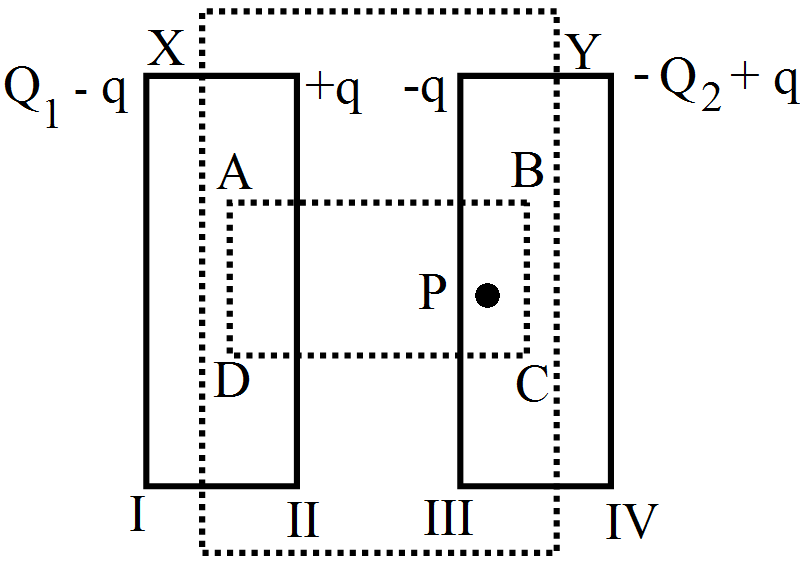
Let ABCD be the Gaussian surface such that faces AD and BC lie inside plates X and Y, respectively.
Let q be the charge appearing on surface II. Then, the distribution of the charges on faces I, III and IV will be in accordance with the figure.
Let the area of the plates be A and the permittivity of the free space be∈0∈0.
Now, to determine q​ in terms of $Q_1$ and $Q_2$, we need to apply Gauss's law to calculate the electric field due to all four faces of the capacitor at point P. Also, we know that the electric field inside a capacitor is zero.
Electric field due to face I at point P, $\text{E}_1=\frac{\text{Q}_1-\text{q}}{2\in_0\text{A}}$
Electric field due to face II at point P, $\text{E}_2=\frac{+\text{q}}{2\in_0\text{A}}$
Electric field due to face III at point P, $\text{E}_3=\frac{-\text{q}}{2\in_0\text{A}}$
Electric field due to face IV at point P, $\text{E}_4=-\Big(\frac{-\text{Q}_2+\text{q}}{2\in_0\text{A}}\Big)$ (Negative sign is used as point P lies on the LHS of face IV.)
Since point P lies inside the conductor,
$\text{E}_1+\text{E}_2+\text{E}_3+\text{E}_4=0$
$\therefore\text{Q}_1-\text{q}+\text{q}-\text{q}-(-\text{Q}_2+\text{q})=0$
$\Rightarrow\text{q}=\frac{\text{Q}_1+\text{Q}_2}{2}$
Thus, the charge on the capacitor is $\frac{\text{Q}_1+\text{Q}_2}{2},$ which is the charge on faces II and III.
View full question & answer
Question 41 Mark
A capacitor with stored energy 4.0J is connected with an identical capacitor with no electric field in between. Find the total energy stored in the two capacitors.
Answer
Stored energy of capacitor $C_1 = 4.0J =\frac{1}{2}\frac{\text{q}^2}{\text{c}^2}=4.0\text{J}$
When then connected, the charge shared$=\frac{1}{2}\frac{\text{q}^2_1}{\text{c}^2}=\frac{1}{2}\frac{\text{q}^2_2}{\text{c}^2}$
$\Rightarrow\text{q}_1=\text{q}_2$
So, that the energy should divided.$\therefore$ The total energy stored in the two capacitors each is 2J.
View full question & answer
Question 51 Mark
A hollow metal sphere and a solid metal sphere of equal radii are given equal charges. Which of the two will have higher potential?
Answer
The potential of a metal sphere is directly proportional to the charge q given to it and inversely proportional to its radius r.
i.e. $\text{V}=\frac{\text{q}}{4\pi\in_0\text{r}}$
Since both the spheres are conductors with the same radius and charge, the charge given to them appears on the surface evenly. Thus, the potential on the surface or within the sphere will be the same, no matter the sphere is hollow or solid.
View full question & answer
Question 61 Mark
The plates of a parallel-plate capacitor are given equal positive charges. What will be the potential difference between the plates? What will be the charges on the facing surfaces and on the outer surfaces?
Answer
It is given that the plates of the capacitor have the same charges. In other words, they are at the same potential, so the potential difference between them is zero.(Figure)
Let us consider that the charge on face II is q so that the induced charge on face III is -q and the distribution is according to the figure. Now, if we consider Gaussian surface ABCD, whose faces lie inside the two plates, and calculate the field at point P due to all four surfaces, it will be$\text{E}_1=\frac{\text{Q}-\text{q}}{2\in_0\text{A}}$
$\text{E}_2=\frac{\text{q}}{2\in_0\text{A}}$
$\text{E}_3=-\frac{\text{q}}{2\in_0\text{A}}$
$\text{E}_4=-\frac{\text{Q}+\text{q}}{2\in_0\text{A}}$ (It is -ve because point P is on the left side of face IV.)
Now, as point P lies inside the conductor, the total field must be zero.$\therefore\text{E}_1+\text{E}_2+\text{E}_3+\text{E}_4=0$
$\text{Q}-\text{q}+\text{q}-\text{q}+\text{Q}+\text{q}=0$
$\therefore\text{q}=0$
Hence, on faces II and III, the charge is equal to zero; and on faces I and IV, the charge is Q. Thus, it seems that the whole charge given is moved to the outer surfaces, with zero charge on the facing surfaces.
View full question & answer
Question 71 Mark
When a dielectric slab is gradually inserted between the plates of an isolated parallel-plate capacitor, the energy of the system decreases. What can you conclude about the force on the slab exerted by the electric field?
Answer
As the energy of the system decreases, the change in the energy is negative. Force is defined as a negative rate of change of energy with respect to distance.$\text{F}=-\frac{\delta\text{U}}{\delta\text{x}}$
So, as the energy decreases, the force due to the electric field of the capacitor increases when the dielectric is dragged into the capacitor.
View full question & answer
Question 81 Mark
As $\text{C}=\Big(\frac{1}{\text{V}}\Big)\text{Q},$ can you say that the capacitance C is proportional to the charge Q?
Answer
No, Since capacitance is a proportionality constant, it depends neither on the charge on the plates nor on the potential. It only depends upon the size and shape of the capacitor and on the dielectric used between the plates. The formula that shows its dependence on the size and shape of the capacitor is as follows:$\text{C}=\frac{\in_0\text{A}}{\text{d}}$
Here, A is the area of the plates of the capacitor and d is the distance between the plates of the capacitor.
View full question & answer