Question 15 Marks
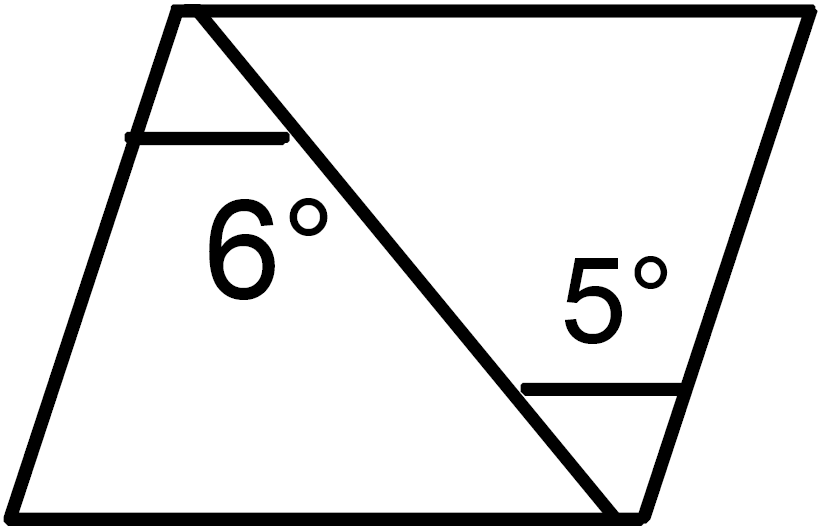
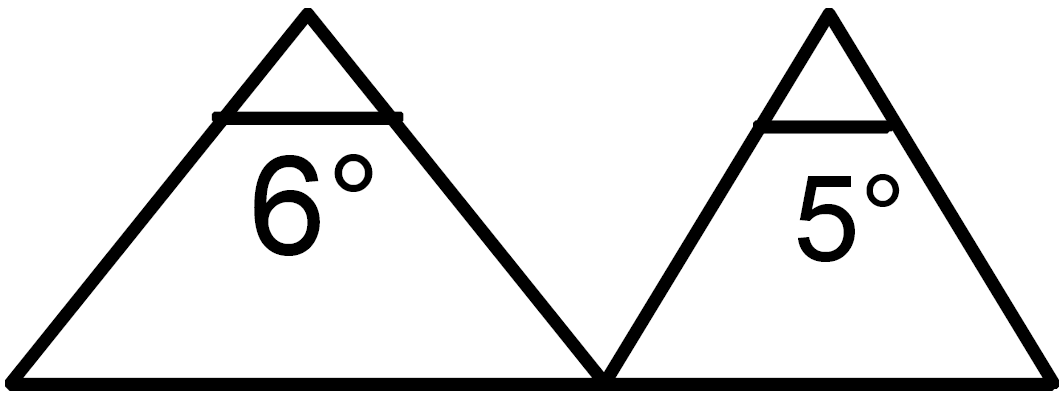
The refractive index of a material $M_1$ changes by $0.014$ and that of another material $M_2$ changes by $0.024$ as the colour of the light is changed from red to violet. Two thin prisms one made of $M_1(A = 5.3^\circ)$ and other made of $M_2(A = 3.7^\circ)$ are combined with their refracting angles oppositely directed.
- Find the angular dispersion produced by the combination.
- The prisms are now combined with their refracting angles similarly directed. Find the angular dispersion produced by the combination.
Answer
View full question & answer→Given that, $\mu'_\text{v}-\mu'_\text{r}=0.014$ and $\mu_\text{v}-\mu_\text{r}=0.024$ $\text{A}' = 5.3^\circ\ \text{and A} = 3.7^\circ$
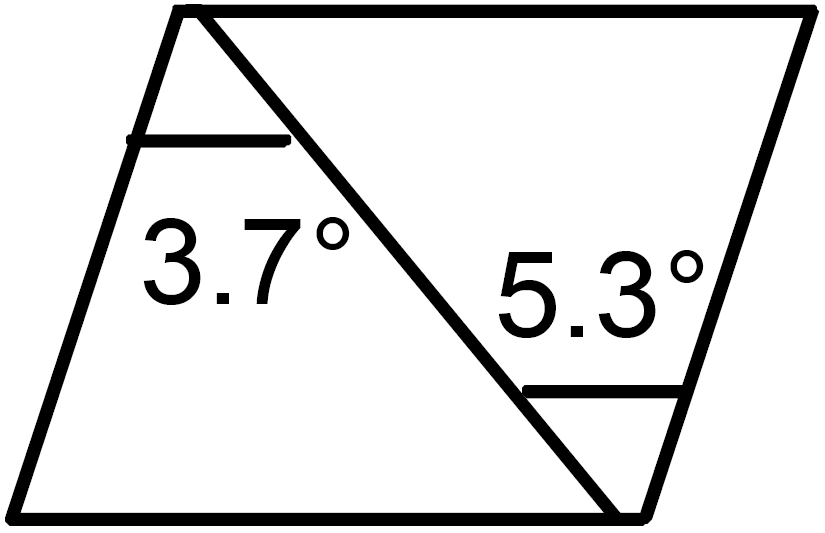
angular dispersion $=(\mu_\text{v}-\mu_\text{r})\text{A}-(\mu'_\text{v}-\mu'_\text{r})\text{A}'$
$=0.024\times3.7^\circ-0.014\times5.3^\circ=0.0146^\circ$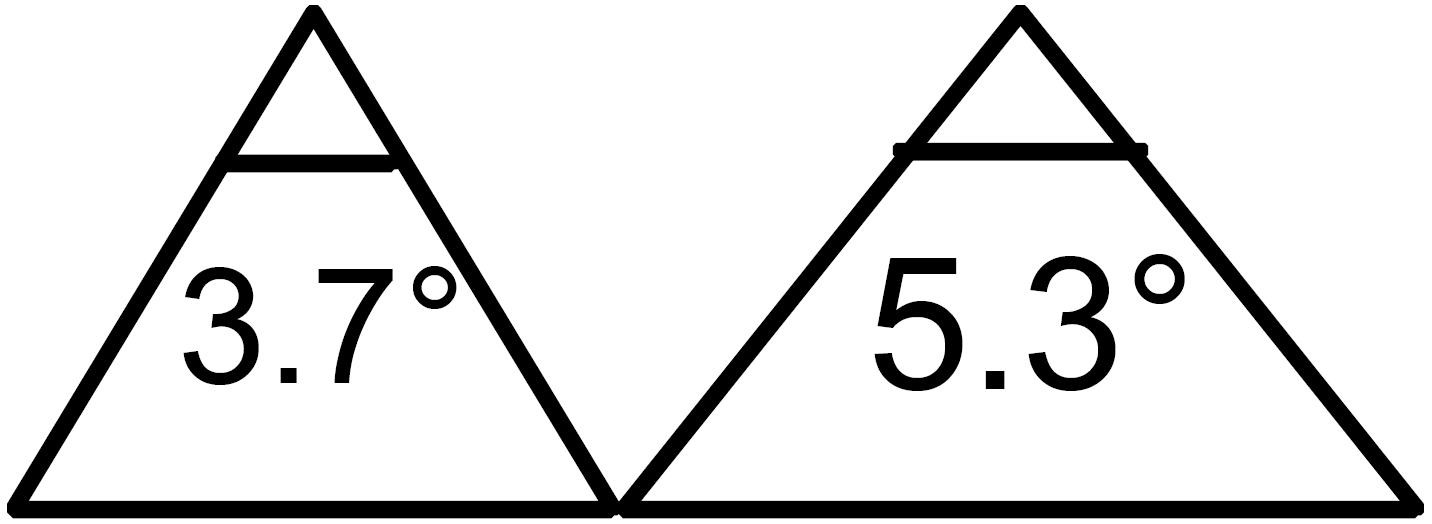
angular dispersion $=(\mu_\text{v}-\mu_\text{r})\text{A}+(\mu'_\text{v}-\mu'_\text{r})\text{A}'$
$=0.024\times3.7^\circ+0.014\times5.3^\circ=0.163^\circ$
- When the prisms are oppositely directed,
angular dispersion $=(\mu_\text{v}-\mu_\text{r})\text{A}-(\mu'_\text{v}-\mu'_\text{r})\text{A}'$
$=0.024\times3.7^\circ-0.014\times5.3^\circ=0.0146^\circ$
- When they are similarly directed,
angular dispersion $=(\mu_\text{v}-\mu_\text{r})\text{A}+(\mu'_\text{v}-\mu'_\text{r})\text{A}'$
$=0.024\times3.7^\circ+0.014\times5.3^\circ=0.163^\circ$
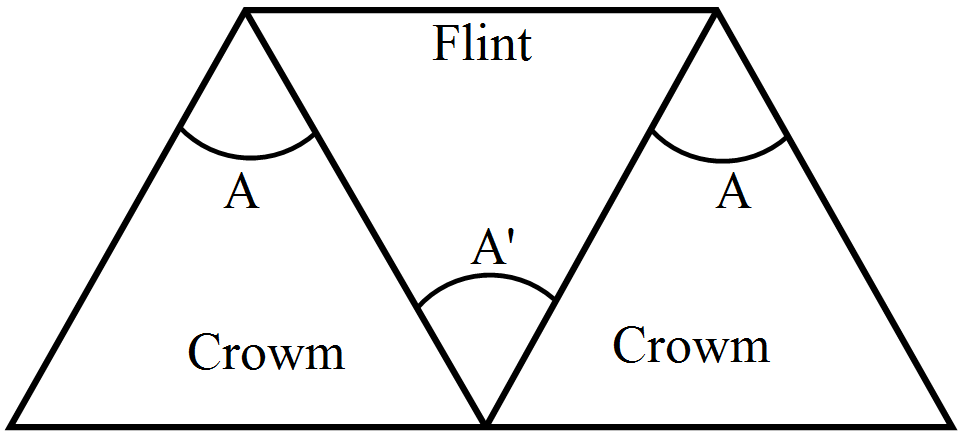
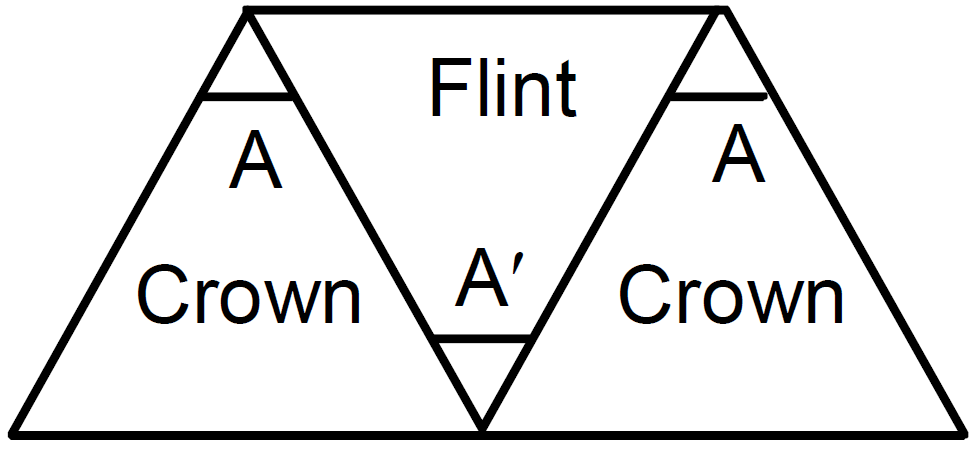 $\delta_\text{y}=\delta_\text{cy}-\delta_\text{fy}+\delta_\text{cy}=2\delta_\text{cy}-\delta_\text{fy}$ $=2(\mu_\text{cy}-1)\text{A}-(\mu_\text{cy}-1)\text{A}'$