Questions

2 Marks Questions

Take a timed test

5 questions · self-marked practice — reveal the answer and mark yourself.

Question 12 Marks
We can shield a charge from electric fields by putting it inside a hollow conductor. Can we shield a body from the gravitational influence of nearby matter by putting it inside a hollow sphere or by some other means?
Answer
The gravitational force does not depend upon the nature of the medium, but the electric force depends on the intervening medium between the charge and the electric field. So we cannot shield a body from the gravitational force.
View full question & answer
Question 22 Marks
Give one example each of central force and non - central force.
Answer
Gravitational force, electrostatic force due to point mass and point charges are the examples of central force. Spin dependent nuclear force, magnetic force between two current carrying loops are the examples of non - central forces.
View full question & answer
Question 32 Marks
An astronaut inside a small spaceship orbiting around the earth cannot detect gravity. If the space station orbiting around the earth has a large size, can he hope to detect gravity?
Answer
Astronaut inside a small spaceship experience a very small negligible constant acceleration and hence astronaut feel weight less ness. If the space station has too much large mass and size then he can only experience acceleration due to gravity in the proximity of moon or on the moon.
View full question & answer
Question 42 Marks
How is the gravitational force between two point masses affected when they are dipped in water keeping the separation between them the same?
Answer
The Newton’s Universal law of gravitational force of attraction (F) between two bodies of masses $m_1, m_2$ separated by distance r is $\text{F}=\frac{\text{Gm}_1\text{m}_2}{\text{r}^2}$ G does not depend upon the medium. So force of attraction does not change if the masses are kept in water or any other medium.
View full question & answer
Question 52 Marks
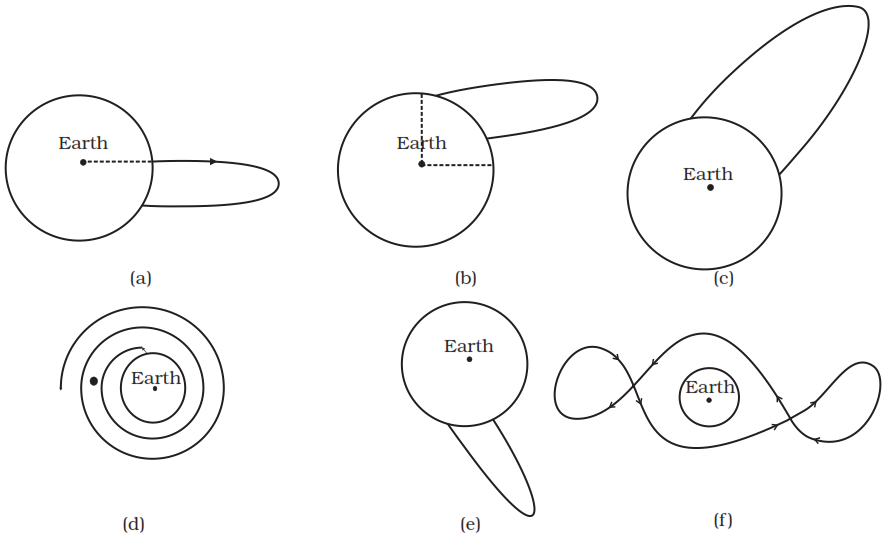
Shown are several curves. Explain with reason, which ones amongst them can be possible trajectories traced by a projectile (neglect air friction).
Answer
The trajectory of a projectile under gravitational force of earth is a conic section or parabolic or elliptical or its part whose focus must be the centre of the earth. Only (c) option amongst the given curves show the centre of the earth as the focus of trajectory.
View full question & answer