Question types

Kinetic Theory question types

33 questions across 4 question groups — pick any mix to generate a Physics paper with step-by-step answer keys.

33
Questions
4
Question groups
5
Question types
Sample Questions

Kinetic Theory questions

One sample from each question group in this chapter. Select any group above to see the full set with answer keys.

In a diatomic molecule, the rotational energy at a given temperature.
  1. Obeys Maxwell’s distribution.
  2. Have the same value for all molecules.
  3. Equals the translational kinetic energy for each molecule.
  4. Is $(2/3)^{rd}$ the translational kinetic energy for each molecule.
  • A
    $A$ and $B$
  • B
    $A$ and $C$
  • $A$ and $D$
  • D
    $B$ and $C$

Answer: C.

View full solution
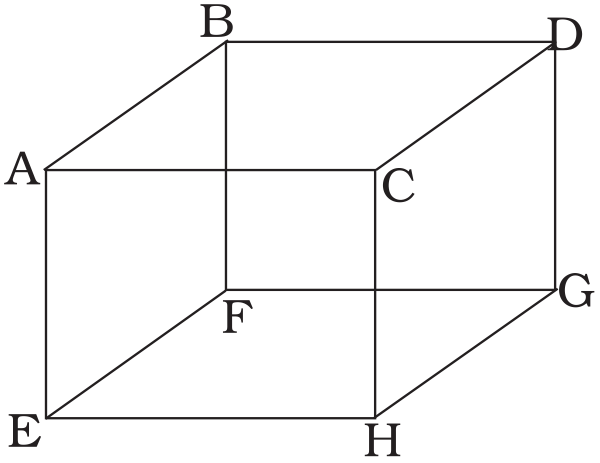
1 mole of an ideal gas is contained in a cubical volume V, ABCDEFGH at 300K (figure). One face of the cube (EFGH) is made up of a material which totally absorbs any gas molecule incident on it. At any given time,
  • A
    The pressure on EFGH would be zero.
  • B
    The pressure on all the faces will be equal.
  • C
    The pressure of EFGH would be double the pressure on ABCD.
  • The pressure on EFGH would be half that on ABCD.

Answer: D.

View full solution
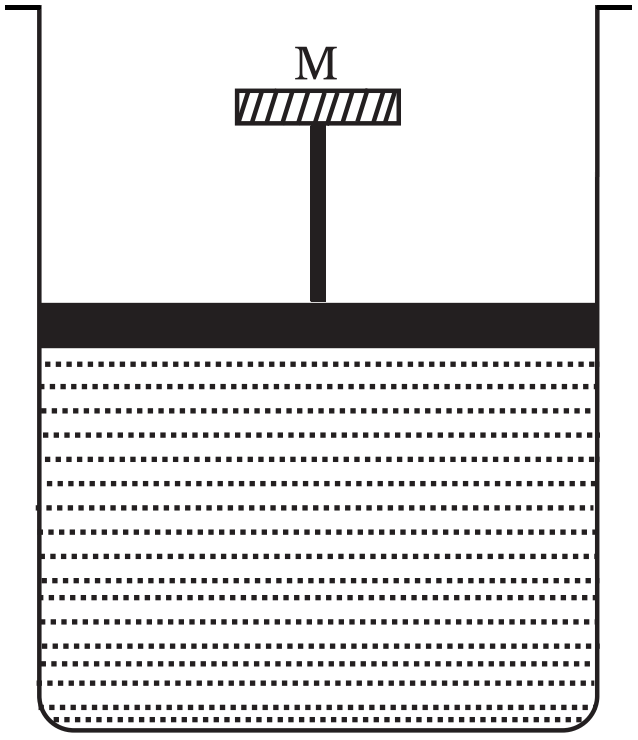
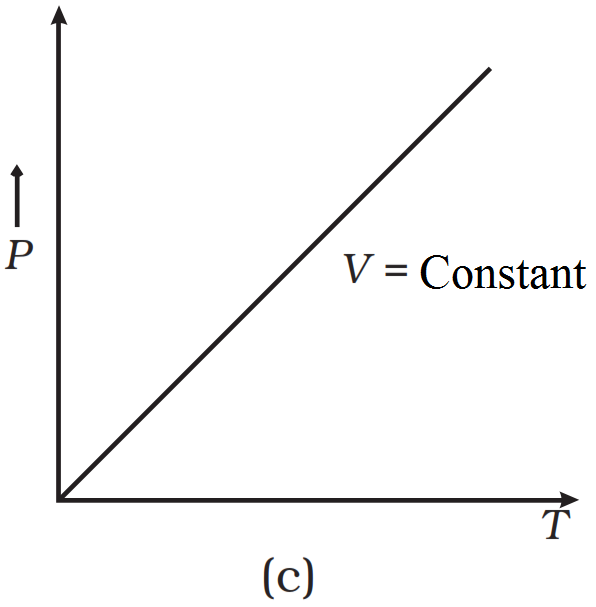
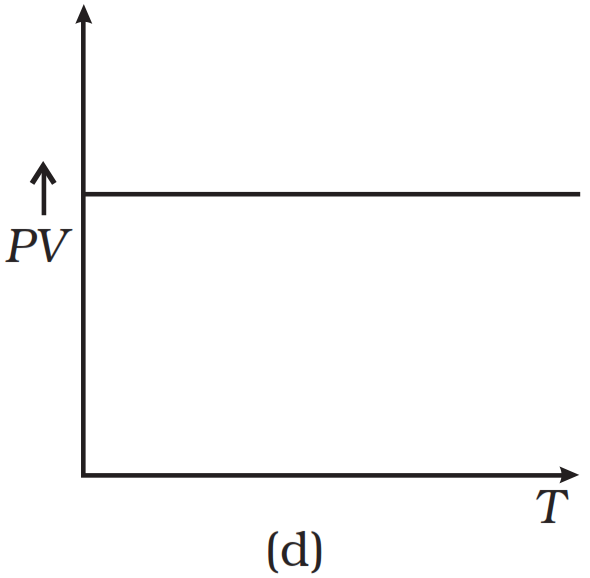
A cylinder containing an ideal gas is in vertical position and has a piston of mass $M$ that is able to move up or down without friction $($ figure$)$. If the temperature is increased.
  • A
    Both $P$ and $V$ of the gas will change.
  • B
    Only $P$ will increase according to Charles’ law.
  • C
    $V$ will change but not $P.$
  • $P$ will change but not $V.$

Answer: D.

View full solution
An inflated rubber balloon contains one mole of an ideal gas, has a pressure P. volume V and temperature T. If the temperature rises to 1.1 T, and the volume is increased to 1.05V, the final pressure will be:
  • A
    1.1 P
  • B
    P
  • C
    Less than P
  • Between P and 1.1

Answer: D.

View full solution
Calculate the ratio of the mean free paths of the molecules of two gases having molecular diameters 1 A and 2 A. The gases may be considered under identical conditions of temperature, pressure and volume.
View full solution
A gas mixture consists of $2.0$ moles of oxygen and $4.0$ moles of neon at temperature T. Neglecting all vibrational modes, calculate the total internal energy of the system. (Oxygen has two rotational modes.)
View full solution
A ballon has $5.0g$ mole of helium at $7^\circ C$. Calculate.
  1. The number of atoms of helium in the balloon,
  2. The total internal energy of the system.
View full solution
Two molecules of a gas have speeds of $9 \times 10^{16} ms^{-1}$ and $1 \times 10^6ms^{-1}$ respectively. What is the root mean square speed of these molecules?
View full solution
Consider an ideal gas with following distribution of speeds.
Speed m/s
200
400
600
800
1000
% of molecules
10
20
40
20
10
Calculate $V_{rms}$ and hence T. $(m = 3.0 \times 10^{-26}kg)$
View full solution

Generate a Kinetic Theory paper free

Pick question groups from the list above, set marks and difficulty, and export a branded PDF with step-by-step answer keys. First 3 chapters free — no signup.

Download App