Questions

1 Marks Question

Take a timed test

62 questions · self-marked practice — reveal the answer and mark yourself.

Question 11 Mark
Read the following two statements below carefully and state, with reasons, if it is true or false. The stretching of a coil is determined by its shear modulus.
Answer
True, because the change takes place in the shape of the coil spring. Therefore, stretching is determined by its shear modulus.
View full question & answer
Question 21 Mark
Read the following two statements below carefully and state, with reasons, if it is true or false. The Young’s modulus of rubber is greater than that of steel.
Answer
False, because the modulus of elasticity is inversely proportional to the strain for a given stress. If steel and rubber are under the same stress, then strain in steel is less than rubber. Hence steel is more elastic than rubber.
View full question & answer
Question 31 Mark
What is Bulk modulus for a perfectly rigid body?
Answer
Bulk modulus $(\text{B})=\frac{\rho}{\frac{\Delta\text{V}}{\text{V}}}=\frac{\rho\text{V}}{\Delta\text{V}}$ For perfectly rigid body, change iin volume $\Delta\text{V}=0$ $\therefore\text{B}=\frac{\rho\text{V}}{0}=\infty$ Therefore, Bulk modulus for a perfectly rigid body is $\infty.$
View full question & answer
Question 41 Mark
Bridges are declared unsafe after long use. Why?
Answer
A bridge undergoes alternating stress and strain for a large number of times during its use. When bridge is used for long time, it loses its elastic strength. Therefore, the amount of strain in the bridge for a given stress will become large and ultimately, the bridge will collapse. So, they are declared unsafe after long use.
View full question & answer
Question 51 Mark
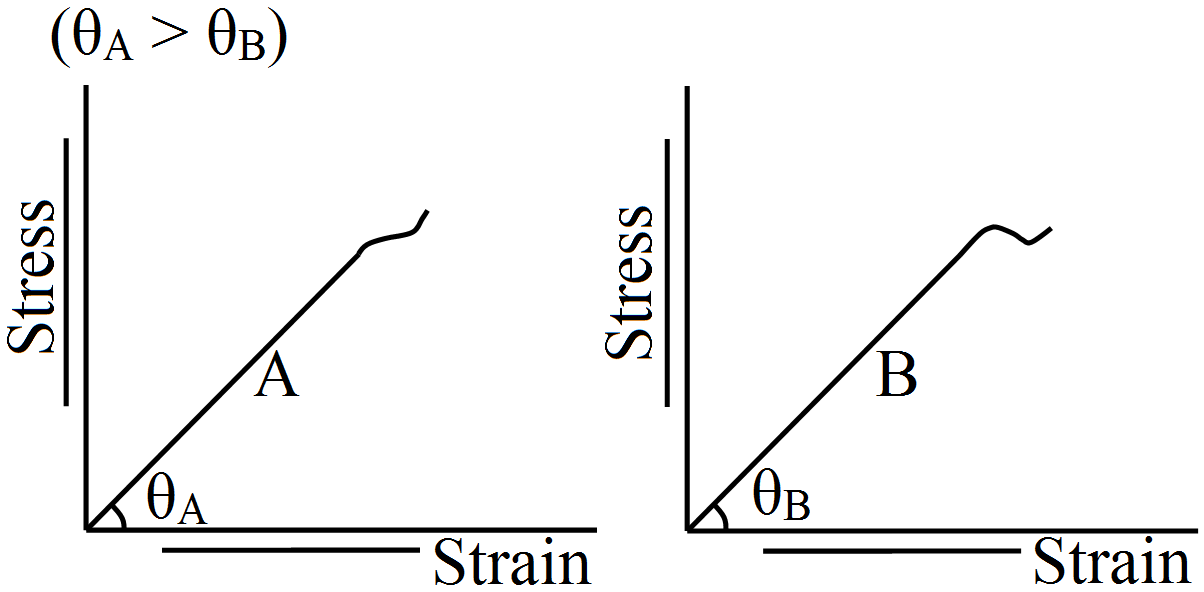
The stress-strain graph for material A and B are shown in the figure (drawn on same scale). Which of the two is stronger material? Justify your answer.
Answer
Material A is stronger because for producing the same strain, more stress is required in case of material A.
View full question & answer
Question 61 Mark
Which is more elastic: water or air? Why?
Answer
Water is more elastic than air because bulk modulus of elasticity is reciprocal of compressibility and air is more compressible than water.
View full question & answer
Question 81 Mark
A metal bar of length L, area of cross-section A, Young's modulus Y and coefficient of linear expansion $\alpha$ is clamped between two stout pillars. What is the force exerted by the bar when it is heated through t°C?
Answer
$\text{YA}\ \alpha\ \text{t}.$
View full question & answer
Question 91 Mark
Which type of strain is there, when a spiral spring is stretched by a force?
Answer
Longitudinal strain and shear strain.
View full question & answer
Question 101 Mark
Write copper, steel, glass and rubber in the order of increasing coefficient of elasticity.
Answer
Rubber, glass, copper and steel.
View full question & answer
Question 111 Mark
Why do molecules possess potential energy?
Answer
The interaction among the molecules binding them together leads to the potential energy.
View full question & answer
Question 121 Mark
What is the Young's modulus for a perfect rigid body?
Answer
Young's modulus (Y) $=\frac{\text{F}}{\text{A}}\times\frac{\text{l}}{\Delta\text{l}}$ For a perfectly rigid body, change in length $\Delta\text{l}=0$ $\therefore\text{Y}=\frac{\text{F}}{\text{A}}\times\frac{\text{l}}{0}=\infty$ Therefore, Young's modulus for a perfectly rigid body is $\infty.$
View full question & answer
Question 131 Mark
A wire is stretched by a certain amount under a load. If the load and radius both are increased to four times, find the stretch caused in the wire.
Answer
$\Delta\text{l}\propto\frac{\text{F}}{\text{A}}$ $\frac{\Delta\text{l}}{\Delta\text{l}}=\frac{4\text{F}}{\text{F}}\times\frac{\text{A}}{16\text{A}}=\frac{1}{4}$
View full question & answer
Question 141 Mark
A metal bar of length L, area of cross-section A, Young's modulus Y and coefficient of linear expansion a, is clamped between two stout pillars. What is the force exerted by the bar when it is heated through t°C?
Answer
$\text{Y}=\frac{\text{FL}}{\text{Al}},$ where $\text{l}=\text{L}\alpha\Delta\text{t}$ and l = change in length. $\text{Y}=\frac{\text{FL}}{\text{AL}\alpha\Delta\text{t}}=\frac{\text{F}}{\text{A}\alpha\Delta\text{t}}=\frac{\text{F}}{\text{A}\alpha\Delta\text{t}}$ $\therefore\text{F}=\text{YA}\alpha.\Delta\text{t}.$
View full question & answer
Question 151 Mark
Crystalline solids are called true solids. Why?
Answer
Because they have a well defined, regularly repeated three dimensional arrangement of ions/ atoms/ molecules.
View full question & answer
Question 161 Mark
Name three physical properties which can have different values in different directions.
Answer
Thermal conductivity, electrical conductivity and compressibility.
View full question & answer
Question 171 Mark
The Young's modulus of a wire of length L and radius r is Y. If the length is reduced to $\frac{\text{r}}{2}$ and radius $\frac{\text{r}}{2}.$ What will be its Young's modulus?
Answer
Y, since it is a material constant.
View full question & answer
Question 181 Mark
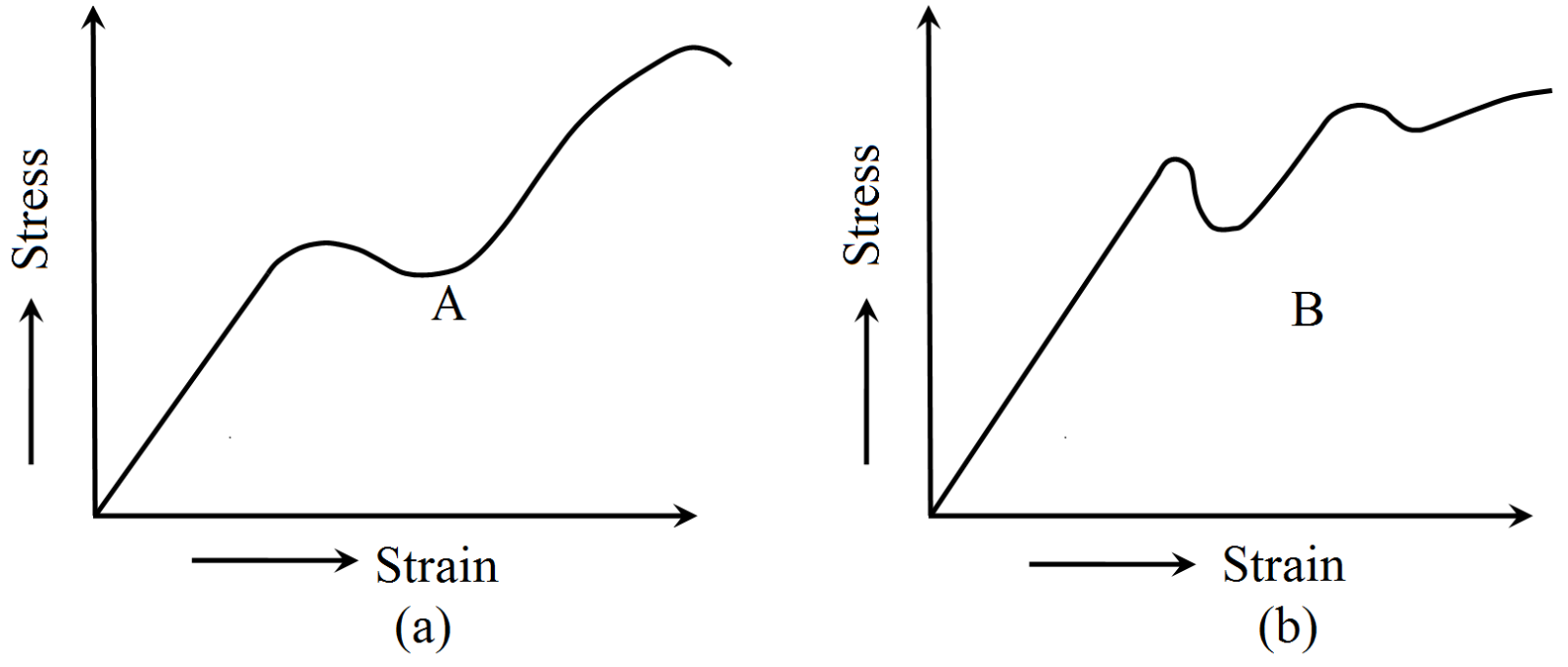
The stress versus strain graphs for two materials $A$ and $B$ are shown below: $($The graphs are to the same scale$)$.
  1. Which material has greater Young's modulus?
  2. Which material is more ductile?
  3. Which is more brittle?
Answer
  1. $A$, because for producing the same strain, more stress is required in case of the material $A.$
  2. $A,$ because it has a greater plastic range.
  3. $B,$ because it has a lesser plastic range.
View full question & answer
Question 211 Mark
Why does a spring balance show wrong measure after long use?
Answer
The spring will lose its elastic character after to long use.
View full question & answer
Question 231 Mark
How does Young's modulus change with rise in temperature?
Answer
Young's modulus of a material decreases with rise in temperature.
View full question & answer
Question 241 Mark
What are the factors that may affect elasticity of a material?
Answer
It is a material constant. So all the physical quantities that might alter the nature like density can alter it.
View full question & answer
Question 251 Mark
The breaking force for a wire is $F$. What will be the breaking forces for :
  1. Two parallel wires of this size,
  2. For a single wire of double thickness?
Answer
  1. $2F$
  2. $4F.$
View full question & answer
Question 261 Mark
Does the nature of forces differ in solids and liquids? If yes, what is the difference there?
Answer
Yes, in case of liquids, there is a force of attraction between the atoms and molecules whereas in case of solids, there is a strong force of repulsion between them.
View full question & answer
Question 271 Mark
Two identical solid balls, one of ivory and the other of wet-clay, are dropped from the same height on the floor. Which will rise to a greater height after striking the floor and why?
Answer
The ball of ivory will rise to a greater height because, ivory is more elastic than wet-clay.
View full question & answer
Question 281 Mark
Why strain has no units?
Answer
Since strain is the ratio of two similar quantities, therefore it has no units.
View full question & answer
Question 291 Mark
Is it possible to double the length of a metallic wire by applying a force over it?
Answer
No, it is not possible because within elastic limit, strain is only order of $10^{-3}$, wires actually break much before it is stretched to double the length.
View full question & answer
Question 301 Mark
of the three Young's modulus of elasticity, Bulk modulus and shear modulus is possible in all the three states of matter (solid, liquid and gas)?
Answer
Bulk modulus of elasticity only.
View full question & answer
Question 311 Mark
Which type of substances are called elastomers? Give one example.
Answer
Those materials for which stress-strain variation is not a straight line within elastic limit e.g. Rubber.
View full question & answer
Question 321 Mark
How is shear modulus related to Young's modulus?
Answer
For any material shear modulus is less than Young's modulus. For most materials shear modulus $=\frac{1}{3}\times\text{Young's modulus}.$
View full question & answer
Question 331 Mark
How is compressibility related to bulk modulus?
Answer
Compressibility is defined as the reciprocal of bulk modulus (B) i.e., $\text{K}=\frac{1}{\text{B}}.$
View full question & answer
Question 361 Mark
What will happen to the potential energy if a wire is:
  1. Compressed,
  2. Stretched?
Answer
In both the cases, the potential energy of the wire increases as work has to be done on the wire.
View full question & answer
Question 371 Mark
What is Poisson's ratio?
Answer
The ratio of lateral strain to the longitudinal strain is called Poisson's ratio.
View full question & answer
Question 381 Mark
Why do spring balance shows wrong readings after they have been used for a long time?
Answer
Because of elastic fatigue.
View full question & answer
Question 391 Mark
Which type of elasticity is possessed by liquids and gases?
Answer
Liquids and gases possessed only the bulk modulus (i.e., the volume elasticity).
View full question & answer
Question 401 Mark
Which is more elastic: rubber or steel?
Answer
Steel is more elastic than rubber as the Young's modulus of elasticity of steel is more than rubber. $\because\text{Y}_\text{r}=\frac{\text{Fl}}{\text{a}\Delta\text{l}_\text{r}}\ \text{and}\ \text{Y}_\text{S}=\frac{\text{F}}{\text{a}}\frac{\text{l}}{\Delta\text{l}_\text{S}}$ $\therefore\frac{\text{Y}_\text{S}}{\text{Y}_\text{r}}=\frac{\Delta\text{l}_\text{r}}{\Delta\text{l}_\text{S}}>1$ Since for the same applied force, the extension in rubber is more than the extension in steel.
View full question & answer
Question 441 Mark
What does the slope of stress versus strain graph indicate?
Answer
The slope of stress (on y-axis) and strain (on x-axis) gives modulus of elasticity.
View full question & answer
Question 451 Mark
A wire increases by $10^{-3}$ of its length when a stress of $10^8Nm^{-2}$ is applied to it. What is the Young's modulus of the material of the wire?
Answer
Given, $\Delta\text{L}=10^{-3}\text{L},$ with L as the original length, $\text{Strain}=\frac{\Delta\text{L}}{\text{L}}=10^{-3}$ $\text{Stress}=\frac{\text{F}}{\text{A}}=10^8\text{Nm}^2$ $\because\text{Y}=\frac{\text{Stress}}{\text{Strain}}=\frac{\frac{\text{F}}{\text{A}}}{\frac{\Delta\text{L}}{\text{L}}}$ $\text{Y}=\frac{1\times10^8}{10^{-3}}=10^{11}\text{Nm}^2$
View full question & answer
Question 461 Mark
Stress and pressure are both forces per unit area. Then, in what respect does stress differ from pressure?
Answer
Pressure is an external force per unit area, while stress is the internal restoring force which comes into play in a deformed body acting transversely per unit area of a body.
View full question & answer
Question 471 Mark
Within elastic limit, what is the slope of stress-strain curve?
Answer
Within elastic limit, the slope of stress-strain curve gives the value of modulus of elasticity of the given material.
View full question & answer
Question 491 Mark
A wire of length L and cross-sectional area A is made of material of Young's modulus Y. What is the work done in stretching the wire by an amount x?
Answer
Work done = Elastic potential energy of stretched wire, $=\frac{1}{2}\times\text{Y}\times(\text{strain})^2\times\text{volume}$ $=\frac{1}{2}\times\text{Y}\times\Big(\frac{\text{x}}{\text{L}}\Big)^2\times(\text{A}\times\text{L})$ $=\frac{\text{YAx}^2}{2\text{L}}$
View full question & answer
Question 511 Mark
A wire is replaced by another wire of same length and material but of twice diameter.
  1. What will be the effect on the increase in its length under a given load?
  2. What will be the effect on the maximum load which it can bear?
Answer
  1. Increase in length will be reduced to one fourth as,
$\Delta\text{l}\propto\frac{1}{\text{r}^2}.$
  1. Maximum bearable load becomes four times as breaking force,
$\propto\text{area}(\pi\text{r}^2)$
View full question & answer
Question 521 Mark
The breaking force for a wire is $F.$ What will be the breaking force for
  1. Two parallel wires of this size,
  2. For a single wire of double thickness?
Answer
  1. $2F$
  2. $4F$.
View full question & answer
Question 531 Mark
The length of a wire is reduced by half. What will be the effect on the increase in its length under a given load?
Answer
Increase in length will be reduced to half since $\Delta\text{l}\propto\text{l}_\text{i}$ where $\text{l}_\text{i}$ is initial length.
View full question & answer
Question 541 Mark
When the pressure on a sphere is increased by 80 atmospheres, then its volumes decreases by 0.01%. Find the bulk modulus of elasticity of the material of sphere.
Answer
Here P = 80 atmospheres, $=80\times1.013\times10^5\text{Nm}^{-2}$ $\because\frac{\Delta\text{V}}{\text{V}}=\frac{0.01}{100}$ $\text{B}=\frac{\text{PV}}{\Delta\text{V}}=\frac{80\times1.013\times10^5}{\frac{(0.01)}{100}}$ $=8.1\times10^{10}\text{Nm}^{-2}$
View full question & answer
Question 551 Mark
A thick wire is suspended from a rigid support, but no load is attached to its free end. Is this wire under stress?
Answer
Yes, the wire is under stress due to its own weight.
View full question & answer
Question 561 Mark
A wire is suspended from a roof but no weight is attached to the wire. Is the wire under stress?
Answer
Yes. The weight of the wire itself acts as the deforming force.
View full question & answer
Question 571 Mark
What do you mean by anisotropy? Name the solid that shows anisotropy.
Answer
It refers to the condition under which the physical properties (namely thermal, electrical, mechanical and optical) are different in different directions. (Calcite or any crystalline solid).
View full question & answer
Question 581 Mark
How are the atoms and molecules arranged in a crystalline solid?
Answer
They are arranged in a definite and regular manner throughout the body of the crystal.
View full question & answer
Question 591 Mark
Why are springs made of steel and not of copper?
Answer
Under a given deforming force, the steel spring is stretched lesser than copper spring. Moreover, the steel spring recovers its original state quicker than copper after the removal of deforming force.
View full question & answer
Question 601 Mark
Amorphous solids are not true solids. What are they called then?
Answer
Amorphous solids are called glassy solids and they are super cooled liquid of high viscosity.
View full question & answer
Question 621 Mark
The average depth of Indian Ocean is about $3000 m$. Calculate the fractional compression, $\Delta V / V$, of water at the bottom of the ocean, given that the bulk modulus of water is $2.2 \times 10^9 N m ^{-2}$. (Take $g=10 m s ^{-2}$)
Answer
The pressure exerted by a $3000 m$ column of water on the bottom layer
$
\begin{aligned}
p=h \rho g & =3000 m \times 1000 kg m ^{-3} \times 10 m s ^{-2} \\
& =3 \times 10^7 kg m ^{-1} s ^{-2} \\
& =3 \times 10^7 N m ^{-2}
\end{aligned}
$

Fractional compression $\Delta V / V$, is
$
\begin{aligned}
\Delta V / V=\text { stress } / B & =\left(3 \times 10^7 N m ^{-2}\right) /\left(2.2 \times 10^9 Nm ^{-2}\right) \\
& =1.36 \times 10^{-2} \text { or } 1.36 \%
\end{aligned}
$
View full question & answer