Questions

3 Marks Question

Take a timed test

8 questions · self-marked practice — reveal the answer and mark yourself.

Question 13 Marks
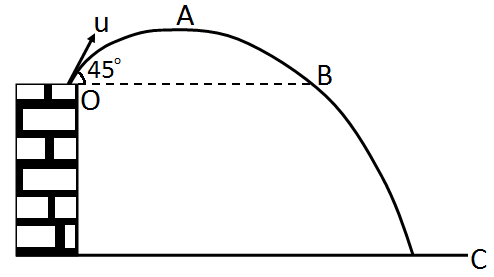
A ball is thrown from a roof top at an angle of $45^\circ$ above the horizontal. It hits the ground a few seconds later. At what point during its motion, does the ball have. Explain?
  1. greatest speed.
  2. smallest speed.
  3. greatest acceleration?
Answer

In this problem total mechanical energy of the ball is conserved. As the ball is projected from point $O$, and covering the path $\text{OABC}$.
At point $A$ it has both kinetic and potential energy.
But at point $C$ it have only kinetic energy, $($keeping the ground as reference where $PE$ is zero.$)$
  1. At point $B$, it will gain the same speed $u$ and after that speed increases and will be maximum just before reaching $C$.
  2. During upward journey from $O$ to $A$ speed decreases and smallest speed attained by it is at the highest point, i.e., at point $A$.
  3. Acceleration is always constant throughout the journey and is vertically downward equal to $g$.
View full question & answer
Question 23 Marks
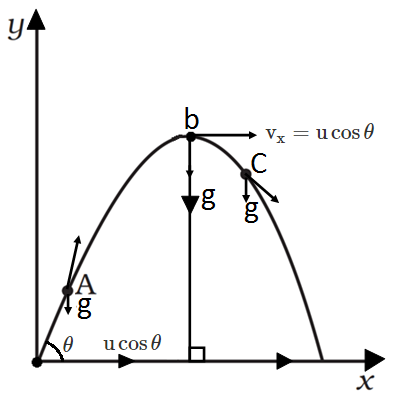
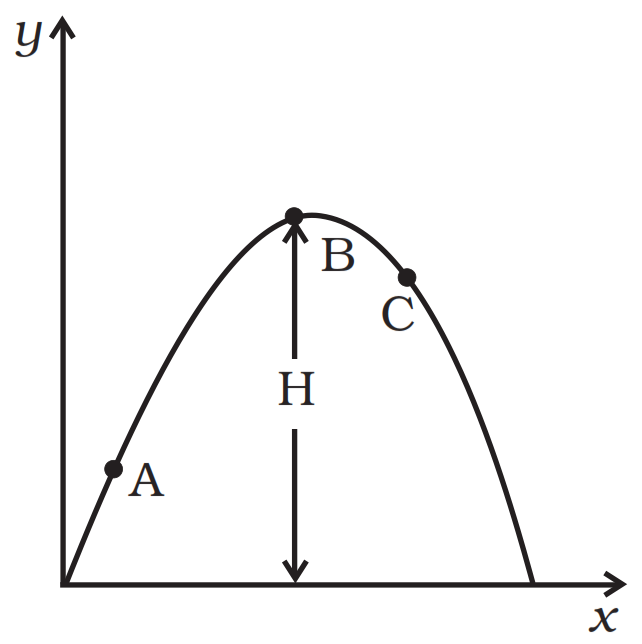
A particle is projected in air at some angle to the horizontal, moves along parabola as shown in Fig., where x and y indicate horizontal and vertical directions, respectively. Show in the diagram, direction of velocity and acceleration at points A, B and C.
Answer
The motion of projectile is always parabolic or its part. Its velocity at any point of its path is always tangentially toward the direction of motion so velocities at points A, B and C are tangentially shown,
The point B is at its maximum height of trajectory. So the vertical component of B $V_y = 0$ and horizontal component is $\text{u}\cos\theta.$

As the direction of acceleration is always in the direction of the force acting on it. The gravitational force is acting on the body hence the direction of acceleration is always vertically downward equal to acceleration to gravity (g).
View full question & answer
Question 33 Marks
Earth can be thought of as a sphere of radius 6400km. Any object (or a person) is performing circular motion around the axis of earth due to earth’s rotation (period 1 day). What is acceleration of object on the surface of the earth (at equator) towards its centre? what is it at latitude $\theta?$ How does these accelerations compare with $g = 9.8m/ s^2?$
Answer
According to the problem, Radius of the earth $(R) = 6400km = 6.4 \times 10^6m.$
Time period $(T) = 1 day = 24 \times 60 \times 60s = 86400s$ Centripetal acceleration,$(\text{a}_\text{c})=\omega^2\text{R}=\frac{4\pi^2\text{R}}{\text{T}}=\frac{4\times\big(\frac{22}{7}\big)^2\times6.4\times10^6}{(24\times60\times60)^2}$
$=\frac{4\times484\times6.4\times10^6}{49\times(24\times3600)^2}=0.034\text{m/s}^2$
At equator, latitude $\theta=0^\circ$$\therefore\ \frac{\text{a}_\text{c}}{\text{g}}=\frac{0.034}{9.8}=\frac{1}{288}$
View full question & answer
Question 43 Marks
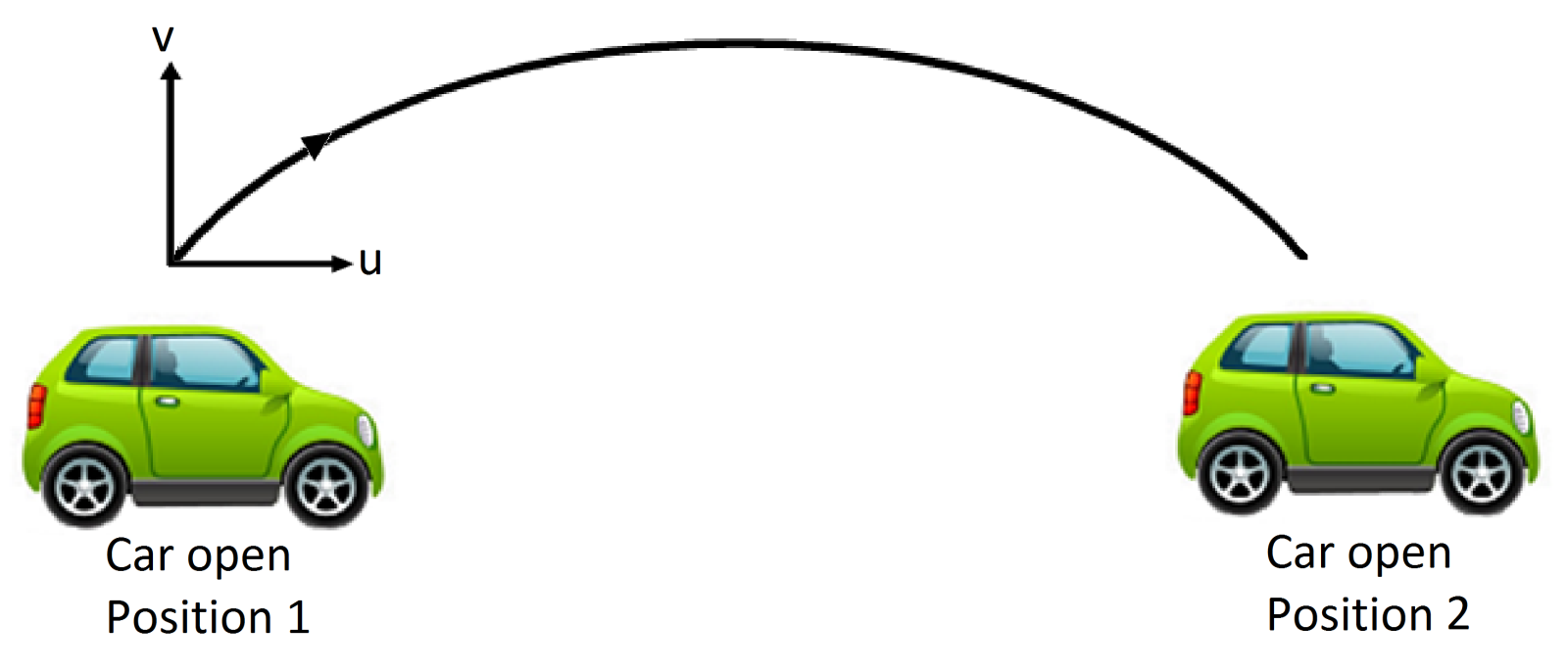
A boy travelling in an open car moving on a levelled road with constant speed tosses a ball vertically up in the air and catches it back. Sketch the motion of the ball as observed by a boy standing on the footpath. Give explanation to support your diagram.
Answer
v = vertical velocity of the ball given by the boy u = velocity of the car which is equal to the horizontal velocity of the ball. As the ball has both vertical and horizontal components of velocities it’s path will be parabolic as observed by a person standing on the footpath.

Path of the ball as seen by the boy sitting in the same car will be only vertically up-down under gravity and will catch up by the boy if car if moving with constant velocity.
View full question & answer
Question 53 Marks
A football is kicked into the air vertically upwards. What is its
  1. acceleration, and
  2. velocity at the highest point?
Answer
  1. As the motion of body is under gravity and no any external force acts on the body, so the direction of force $($gravitational$)$. Hence, the direction of acceleration is always towards the centre of earth i.e, downward.
  2. As the ball is thrown vertically upward so its component of horizontal velocity become zero. At the highest point, the velocity of the body $= 0$. Hence, net velocity of the body at the highest point is zero.
View full question & answer
Question 63 Marks
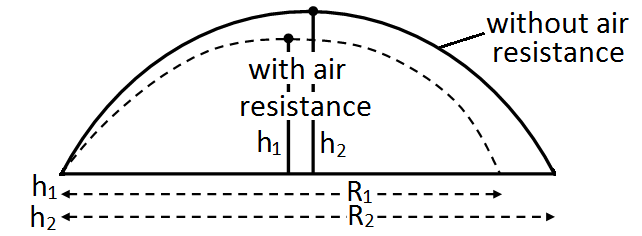
In dealing with motion of projectile in air, we ignore effect of air resistance on motion. This gives trajectory as a parabola as you have studied. What would the trajectory look like if air resistance is included? Sketch such a trajectory and explain why you have drawn it that way.
Answer
When air resistance acts on projectile then its vertical and horizontal both velocity will decrease due to air resistance. Hence its maximum height becomes smaller than when there is no force of friction (resistance) of air. By formula $\text{R}=\frac{\text{u}^2}{\text{g}}\sin2\theta$ and $\text{H}_\text{max}=\frac{\text{u}^2\sin^2\theta}{2\text{g}}$
$\therefore\ \text{h}_1<\text{h}_2\text{ and }\text{R}_1<\text{R}_2$
But time of flight for both will remain same as the body in case II (with air resistance) $h_1< h_2$ takes smaller time to rise.
View full question & answer
Question 73 Marks
QUESTION Earth also moves in circular orbit around sun once every year with on orbital radius of $1.5 \times 10^{11} m$. What is the acceleration of earth (or any object on the surface of the earth) towards the centre of the sun? How does this acceleration compare with $g =9.8 m / s ^2$ ? $\Big(\text{Hint: acceleration}\frac{\text{V}^2}{\text{R}}=\frac{4\pi^2\text{R}}{\text{T}^2}\Big)$
Answer
Orbital radius of the earth around the sun $(R) = 1.5 \times 10^{11}m$
Time period = 1 year $= 365 days = 365 \times 24 \times 60 \times 60s = 3.15 \times 10^7s$
Centripetal acceleration
$(\text{a}_\text{c})=\text{R}\omega^2=\frac{4\pi^2\text{R}}{\text{T}^2}=\frac{4\times\big(\frac{22}{7}\big)^2\times1.5\times10^{11}}{(3.15\times10^7)^2}$
$=5.97\times10^{-3}\text{m/s}^2$
$\frac{\text{a}_\text{C}}{\text{g}}=\frac{5.97\times10^{-3}}{9.8}=\frac{1}{1642}$
View full question & answer
Question 83 Marks
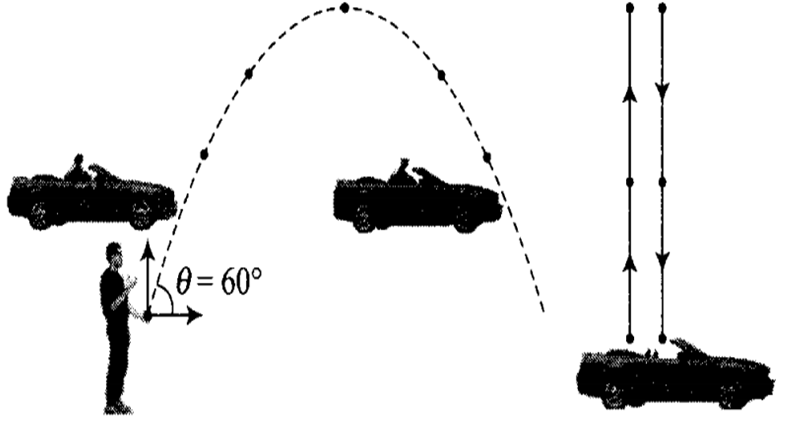
A boy throws a ball in air at 60° to the horizontal along a road with a speed of 10m/ s (36km/ h). Another boy sitting in a passing by car observes the ball. Sketch the motion of the ball as observed by the boy in the car, if car has a speed of (18km/ h). Give explanation to support your diagram.
Answer
The situation is shown in the below diagram. According to the problem the boy standing on ground throws the ball at an angle of 60° with horizontal at a speed of 10m/ s.$\therefore$ Horizontal component of velocity, $\text{u}_\text{x}=10\cos\theta$
$\text{u}_\text{x}=(10\text{m/s})\cos60^\circ=10\times\frac{1}2=5\text{m/s}$
Vertical component of velocity, $\text{u}_\text{y}=10\sin\theta$$\text{u}_\text{y}=(10\text{m/s})\sin60^\circ=10\times\frac{\sqrt{3}}{2}=5\sqrt3\text{m/s}$
Speed of the car = 18km/ h = 5m/ s As horizontal speed of ball and car is same, hence relative velocity of ball w.r.t car in the horizontal direction will be zero. Only vertical motion of the ball will be observed by the boy in the car, as shown in above diagram.
View full question & answer