Questions

M.C.Q (1 Marks)

Take a timed test

11 questions · auto-graded multiple-choice test.

MCQ 11 Mark
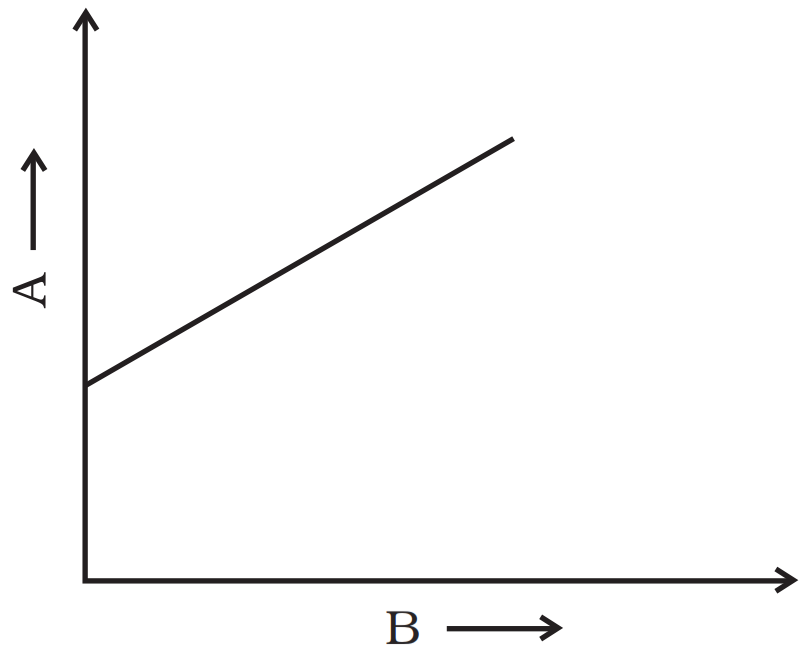
The variation of quantity $A$ with quantity $B$, plotted in Fig. describes the motion of a particle in a straight line.
  • A
    Quantity $B$ may represent time.
  • B
    Quantity $A$ is velocity if motion is uniformly accelerated.
  • C
    Quantity $A$ is displacement if motion is uniform.
  • All of the above
Answer
Correct option: D.
All of the above
If $B$ represents velocity then graph become the $v-t$ graph is a straight line so it is uniformly accelerated motion, so motion is not uniform. Verifies option $(a), (c)$. If $B$ represents time and $A$ represents displacement, then graph become $(s - t)$ graph.
Here $s - t$ graph is a straight line which represents uniform motion, so verifies the option $(c).$
View full question & answer
MCQ 21 Mark
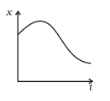
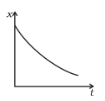
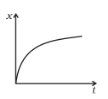
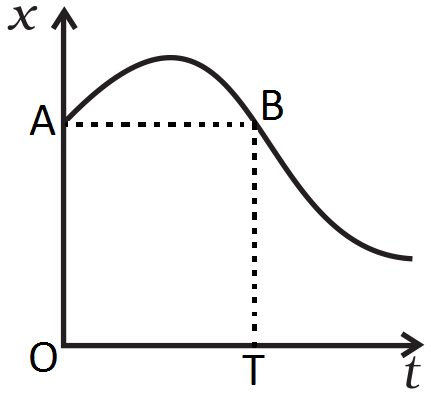
Among the four graphs Fig. there is only one graph for which average velocity over the time intervel (0, T ) can vanish for a suitably chosen T. Which one is it?
  • A
  • C
  • D
Answer
Correct option: B.
We need to identify the graph in which there is one displacement for different timings. it means that these displacements would be in opposite directions and when we add these opposite displacements, net displacement would be zero or average velocity would be zero. This thing is only possible in the graph (b).


If we draw a line parallel to time axis from the point (A) on the graph at t = 0 sec. This line can intersect graph again at B. At this point, the change in displacement (O - T) time is zero i.e., displacement at A and B are equal so as the change in displacement is zero so the average velocity of body vanishes to zero.
View full question & answer
MCQ 31 Mark
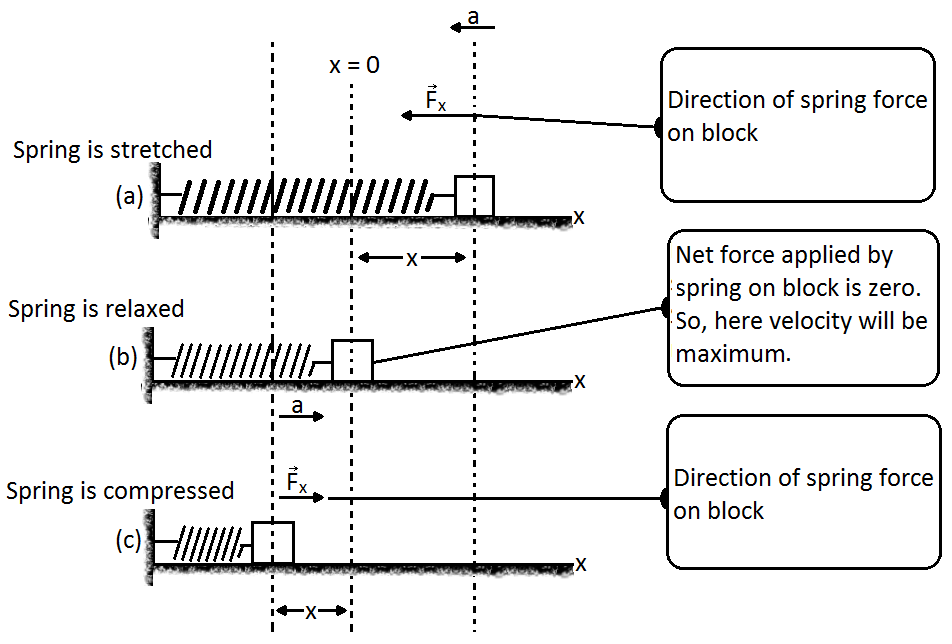
A spring with one end attached to a mass and the other to a rigid support is stretched and released.
  • A
    Magnitude of acceleration, when just released is maximum.
  • B
    Magnitude of acceleration, when at equilibrium position, is maximum.
  • C
    Speed is maximum when mass is at equilibrium position.
  • Both $A$ and $C$
Answer
Correct option: D.
Both $A$ and $C$

As shown in the figure above when spring is stretched by length $x,$ restoring force will be $F = -kx (-ve$ sigh shows that the force is always is the direction opposite to displacement $x).$ Then the potential energy of the stretched spring.
$=\text{PE}=\frac{1}{2}\text{kx}^2$
The restoring force is central, hence when particle is released it will execute Simple Harmonic Motion about equilibrium position.
Acceleration will be $\text{a}=\frac{\text{F}}{\text{m}}=\frac{\text{-kx}}{\text{m}}$
At equilibrium position, $\text{x}=0\Rightarrow\text{a}=0$
Hence, when just released $\text{x}=\text{x}_\text{max}$
Hence, acceleration is maximum. Thus option $(a)$ is correct.
At equilibrium whole $PE$ will be converted to $KE,$
so $KE$ will be maximum and hence, speed will be maximum. Thus option $(c)$ is correct.
View full question & answer
MCQ 41 Mark
A ball is bouncing elastically with a speed $1m/s$ between walls of a railway compartment of size $10m$ in a direction perpendicular to walls. The train is moving at a constant velocity of $10m/s$ parallel to the direction of motion of the ball. As seen from the ground,
  • A
    The acceleration of ball is the same as from the train.
  • B
    Speed of ball changes every $10$ seconds.
  • C
    Average speed of ball over any $20$ second interval is fixed.
  • All of the above
Answer
Correct option: D.
All of the above
As the motion is observed from ground, time to strike ball with walls will be after every $10$ seconds. As, the ball is moving with very small speed in the moving train,the direction of ball is same as that of train.
Hence direction of motion of ball does not change with respect to observer on Earth.
But, speed of ball changes after collision so option $(a)$ is incorrect and $(b)$ is correct.
As speed of ball is uniform so average speed at any time remain same or $1m/s$ with respect to train or ground.
So option $(c)$ is correct.
Speed of ball changes when it strike to wall initial speed of ball in the direction of moving train with respect to ground $\text{V}_\text{TG}=10+1=11\text{m/s}.$
Speed of ball after collision with side of train $= \text{VBG} ($opposite to the direction of train$) = 10 - 1 = 9\ m/s.$
Change in velocity on collision will be in magnitude $= 11 - 9 = 2m/s.$
So magnitude of acceleration on both walls of compartment is same but direction will be opposite.
Hence, right option are $(a, b, c).$
View full question & answer
MCQ 51 Mark
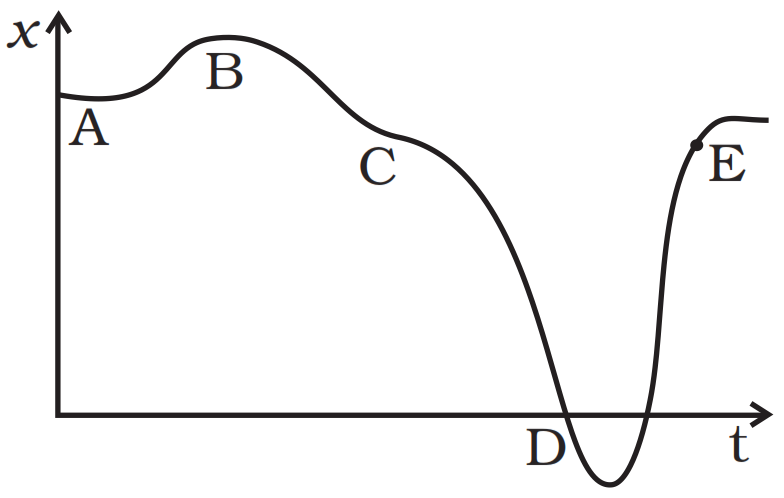
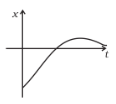
A graph of $x$ versus $t$ is shown in Fig. Choose correct alternatives from below:
  1. The particle was released from rest at $t = 0.$
  2. At $B, $the acceleration $a > 0.$
  3. At $C,$ the velocity and the acceleration vanish.
  4. Average velocity for the motion between $A$ and $D$ is positive.
  5. The speed at $D$ exceeds that at $E.$
  • A
    Only $A$
  • $A , C$ and $E$
  • C
    $A ,B$ and $D$
  • D
    All of the above
Answer
Correct option: B.
$A , C$ and $E$
Main concept used: Slope of $x - t$ graph gives $\text{v}=\frac{\text{dx}}{\text{dt}}$
At A graph $(x - t)$ is parallel to the time axis,
so $\frac{\text{dx}}{\text{dt}}$ is zero or particle is at rest.
After $A$, slope $\frac{\text{dx}}{\text{dt}}$ increases,
so velocity increases. Verifies option $(a).$
Tangent at $B$ and $C$ is a graph $(x - t),$ that is parallel to the time axis,
so $\frac{\text{dx}}{\text{dt}}=0$ or $v = 0.$
It implies that acceleration $a = 0$
so it discards option $(b)$ and verifies the option $(c).$
From graph the slope at $D$ is greater than at $E$.
So speed at $D$ is greater than at $E.$
Verifies the option $(e)$. Velocity at $A$ is Zero as $x - t$ parallel to time axis so average velocity at $A$ is zero. At $D$ displacement or slope is negative.
So, the average velocity at $D$ is negative not positive discards option $(d).$
View full question & answer
MCQ 61 Mark
In one dimensional motion, instantaneous speed $v$ satisfies $0\le\text{v}<\text{v}_0.$
  • A
    The displacement in time $T$ must always take non$-$negative values.
  • The displacement $x$ in time $T$ satisfies $\text{v}_0\text{ T}<\text{x}<\text{v}_0\text{ T}.$
  • C
    The acceleration is always a non$-$negative number.
  • D
    The motion has no turning points.
Answer
Correct option: B.
The displacement $x$ in time $T$ satisfies $\text{v}_0\text{ T}<\text{x}<\text{v}_0\text{ T}.$
Key concept: Instantaneous speed: It is the speed of a particle at a particular instant of time.
When we say “speed”, it usually means instantaneous speed.
The instantaneous speed is average speed for infinitesimally small time interval $($i.e., $\Delta>0).$
Thus, Instantaneous speed $\text{v}=\DeclareMathOperator*{\median}{\text{lim}} \median\limits_{\Delta\text{t}\rightarrow0}\frac{\Delta\text{s}}{\Delta\text{t}}=\frac{\text{ds}}{\text{dt}}$
As instantaneous speed is less than maximum speed.
Then either the velocity is increasing or it is decreasing.
For maximum and minimum displacement we have to keep in mind the magnitude and direction of maximum velocity.
As maximum velocity in positive direction is $v_0$, magnitude of maximum velocity in opposite direction is also $v_0$.
Maximum displacement in one direction $=\text{v}_0\text{T}$ Maximum displacement in opposite directions $=-\text{v}_0\text{T}$
Hence, $-\text{v}_0\text{T}<\text{x}<\text{v}_0\text{T}.$
View full question & answer
MCQ 71 Mark
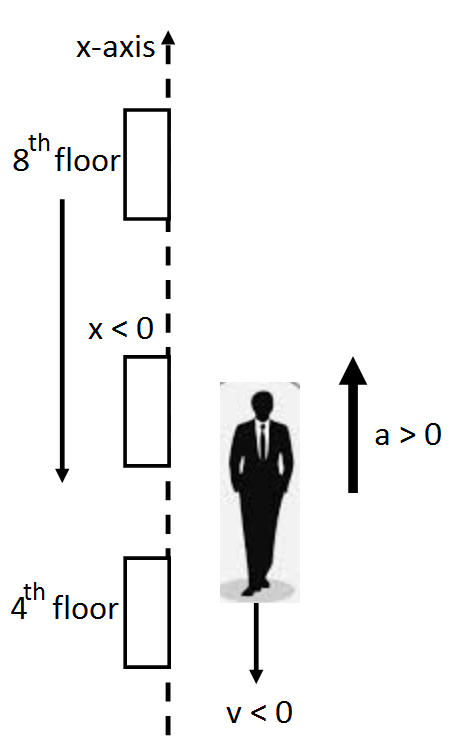
A lift is coming from $8^{th}$ floor and is just about to reach $4^{th}$ floor. Taking ground floor as origin and positive direction upwards for all quantities, which one of the following is correct?
  • $x < 0, v < 0, a > 0.$
  • B
    $x > 0, v < 0, a < 0.$
  • C
    $x > 0, v < 0, a > 0.$
  • D
    $x > 0, v > 0, a < 0.$
Answer
Correct option: A.
$x < 0, v < 0, a > 0.$
Key concept: The time rate of change of velocity of an object is called acceleration of the object.
It is a vector quantity. Its direction is same as that of change in velocity $($Not of the velocity$).$
In the table: Possible ways of velocity change.
When only direction of velocity changes.
When only magnitude of velocity changes.
When both magnitude and direction of velocity change.
Acceleration perpendicular to velocity.
Acceleration parallel or anti­parallel to velocity.
Acceleration has two components-one is perpendicular to velocity and another parallel or anti­parallel to velocity.
E.g.: Uniform circular motion
E.g.: Motion under gravity.
E.g.: Projectile motion.
Here we will take upward direction positive. As. the lift is coming in downward direction, the displacement will be negative. We have to see whether the motion is accelerating or retarding.
We know that due to downward motion displacement will be negative. When the lift reaches $4^{th}$ floor and is about to stop velocity is decreasing with time, hence motion is retarding in nature. Thus, $x < 0; a > 0.$
Asdisplacementisinnegativedirection, velocity will also be negative, i.e. $v < 0.$
The motion of lift will be shown like this.

View full question & answer
MCQ 81 Mark
The displacement of a particle is given by $x = (t - 2)^2$ where $x$ is in metres and $t$ in seconds. The distance covered by the particle in first $4$ seconds is:
  • A
    $4m.$
  • $8m.$
  • C
    $12m.$
  • D
    $16m.$
Answer
Correct option: B.
$8m.$
Key concept: Instantaneous velocity : Instantaneous velocity is defined as the rate of change of position vector of particles with time at a certain instant of time.
Instantaneous velocity $\vec{\text{v}}=\DeclareMathOperator*{\median}{\text{lim}} \median\limits_{\Delta\text{t}\rightarrow0}\frac{\Delta\vec{\text{r}}}{\Delta\text{t}}=\frac{\text{d}\vec{\text{r}}}{\text{dt}}$
Instantaneous acceleration $=\vec{\text{a}}=\DeclareMathOperator*{\median}{\text{lim}} \median\limits_{\Delta\text{t}\rightarrow0}\frac{\Delta\vec{\text{v}}}{\Delta\text{t}}=\frac{\text{d}\vec{\text{v}}}{\text{dt}}$
By definition $\vec{\text{a}}=\frac{\text{d}\vec{\text{v}}}{\text{dt}}=\frac{\text{d}^2\vec{\text{x}}}{\text{dt}^2}\Big[\text{As}\ \vec{\text{v}}=\frac{\text{d}\vec{\text{x}}}{\text{dt}}\Big]$
i.e., if $x$ is given as a function of time, second time derivative of displacement gives acceleration.
In such type of problems we have to analyze whether the motion is accelerating or retarding. When acceleration is parallel to velocity, velocity of particle increases with time, i.e. motion is accelerated. And when acceleration is anti-parallel to velocity, velocity of particle decreases with time, i.e. motion is retarded. During retarding journey, particle will stop in between.
According to the problem, displacement of the particle is given as a function of time.
$\text{x}=(\text{t}-2)^2$
By differentiating this equation w.r.t. time we get velocity of the particle as a function of time.
$\text{v}=\frac{\text{dx}}{\text{dt}}=\frac{\text{d}}{\text{dt}}(\text{t}-2)^2=2(\text{t}-2)\text{m/s}$
If we again differentiate this equation w.r.t. time we will get acceleration of the particle as a function of time.
Acceleration, $\text{a}=\frac{\text{dv}}{\text{dt}}=\frac{\text{d}}{\text{dt}}[2(\text{t}-2)]$
$=2[1-0]=2\text{m/s}^2$
When $\text{t}=0;\ \ \text{v}=-4\text{m/s}$
$\text{t}=2\text{s};\ \ \text{v}=0\text{m/s}$
$\text{t}=4\text{s};\ \ \ \text{v}=4\text{m/s}$
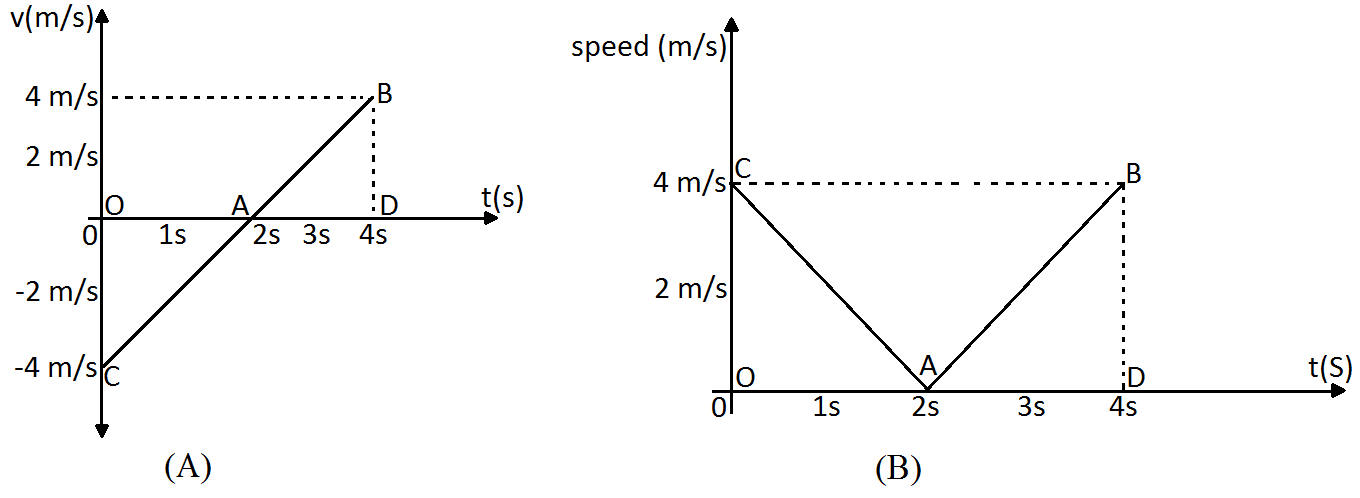
That means particle starts moving towards negative axis, then $at = 0$, with a speed $4m/s$, at $t = 2$ it stops and start coming backward. At $t = 4$ its speed is $+4m/s.$

$v - t$ graph is shown in graph $(a)$ and speed$-$time graph of the same situation is shown in graph $(b).$
Distance travelled $=$ Area of the speed$-$time graph
$=$ area $\text{OAC} +$ area $\text{ABD}$
$=\frac{4\times2}{2}+\frac{1}{2}\times2\times4$
​​​​​​​$=8\text{m}$
View full question & answer
MCQ 91 Mark
At a metro station, a girl walks up a stationary escalator in time $t_1$. If she remains stationary on the escalator, then the escalator take her up in time $t_2$​​​​​​​. The time taken by her to walk up on the moving escalator will be:
  • A
    $\frac{(\text{t}_1+\text{t}_2)}{2}.$
  • B
    $\frac{\text{t}_1\text{t}_2}{(\text{t}_2-\text{t})}.$
  • $\frac{\text{t}_1\text{t}_2}{(\text{t}_2+\text{t}_1)}.$
  • D
    $\text{t}_1-\text{t}_2.$
Answer
Correct option: C.
$\frac{\text{t}_1\text{t}_2}{(\text{t}_2+\text{t}_1)}.$
Let $L$ be the length of the escalator.
Velocity of girl w.r.t. ground $\text{v}_\text{g}=\frac{\text{L}}{\text{t}_1}$
Velocity of escalator w.r.t. ground $\text{v}_\text{e}=\frac{\text{L}}{\text{t}_2}$
Effective Velocity of girl on moving escalator with respect to ground $=\text{v}_\text{g}+\text{v}_\text{e}=\frac{\text{L}}{\text{t}_1}+\frac{\text{L}}{\text{t}_2}=\text{L}\Big[\frac{1}{\text{t}_1}+\frac{1}{\text{t}_2}\Big]$
$\text{v}_\text{ge}=\text{L}\Big[\frac{\text{t}_1+\text{t}_2}{\text{t}_1\text{t}_2}\Big]$
$\therefore$ Time $t$ taken by girl on moving escalator in going up the distance $L$ is
$\text{t}=\frac{\text{distance}}{\text{speed}}=\frac{\text{L}}{\text{L}\Big(\frac{\text{t}_1+\text{t}_2}{\text{t}_1\text{t}_2}\Big)}=\frac{\text{t}_1\text{t}_2}{\text{t}_1+\text{t}_2}$
Hence, verifies the option $(c).$
View full question & answer
MCQ 101 Mark
A vehicle travels half the distance $L$ with speed $V_1$ and the other half with speed $V_2$​​​​​​​, then its average speed is:
  • A
    $\frac{\text{V}_1+\text{V}_2}{2}$
  • B
    $\frac{2\text{V}_1+\text{V}_2}{\text{V}_1+\text{V}_2}$
  • $\frac{2\text{V}_1\text{V}_2}{\text{V}_1+\text{V}_2}$
  • D
    $\frac{\text{L}(\text{V}_1+\text{V}_2)}{\text{V}_1\text{V}_2}$
Answer
Correct option: C.
$\frac{2\text{V}_1\text{V}_2}{\text{V}_1+\text{V}_2}$
Time $t_1$ taken in half distance $=\text{t}_1=\frac{\text{L}}{\text{v}_1}$
Time $t_2$ taken in half distance $=\text{t}_2=\frac{\text{L}}{\text{v}_2}$
Total time $(t)$ taken in distance $(\text{L}+\text{L})=\frac{\text{L}}{\text{v}_1}+\frac{\text{L}}{\text{v}_2}=\frac{\text{L}(\text{v}_2+\text{v}_1)}{\text{v}_1\text{v}_2}$
Total distance $=\text{L}+\text{L}=2\text{L}$
$\therefore$ Average speed $\text{v}_{\text{av}}=\frac{\text{Total distance}}{\text{Total time}}=\frac{\frac{2\text{L}}{\text{L}(\text{v}_2+\text{v}_1)}}{\text{v}_1\text{v}_2}=\frac{2\text{v}_1\text{v}_2}{(\text{v}_1+\text{v}_2)}$
View full question & answer
MCQ 111 Mark
For the one$-$dimensional motion, described by $\text{x}=\text{t}-\sin\text{t}.$
  • A
    $v (t)$ lies between $0$ and $2.$
  • B
    $v (t) > 0$ for all $t > 0.$
  • C
    $a (t) > 0$ for all $t > 0.$
  • $A$ and $C$
Answer
Correct option: D.
$A$ and $C$
Position of the particle is given as a function of time i.e. $\text{x}=\text{t}-\sin\text{t}$ By differentiating this equation w.r.t. time we get velocity of the particle as a function of time.
Velocity $\text{v}=\frac{\text{dx}}{\text{dt}}=\frac{\text{d}}{\text{dt}}[\text{t}-\sin\text{t}]=1-\cos\text{t}$
If we again differentiate this equation w,r,t, time we will get will get acceleration of the particle as a function of time.
Acceleration $\text{a}=\frac{\text{dv}}{\text{dt}}=\frac{\text{d}}{\text{dt}}[1-\cos\text{t}]=\sin\text{t}$
As acceleration $a > 0$ for all $t > 0$
Hence, $x(t) > 0$ for all $t > 0$
Velocity $\text{v}=1-\cos\text{t}$
When, $\cos\text{t}-1,$ velocity $v = 0$
$\text{v}_\text{max}=1-(\cos\text{t})_\text{min}=1-(-1)=2$
$\text{v}_\text{min}=1-(\cos\text{t})_\text{max}=1-1=0$
Hence, $v$ lies between $0$ and $2.$
Acceleration $\text{a}=\frac{\text{dv}}{\text{dt}}=-\sin\text{t}$
When $t = 0; x = 0, v = 0, a = 0$
When $\text{t}=\frac{\pi}{2}; x =$ positive, $v = 0, a = -1 ($negative$)$
When $\text{t}=2\pi,\text{x}=0,\text{v}=0,\text{a}=0$
View full question & answer