Question 15 Marks
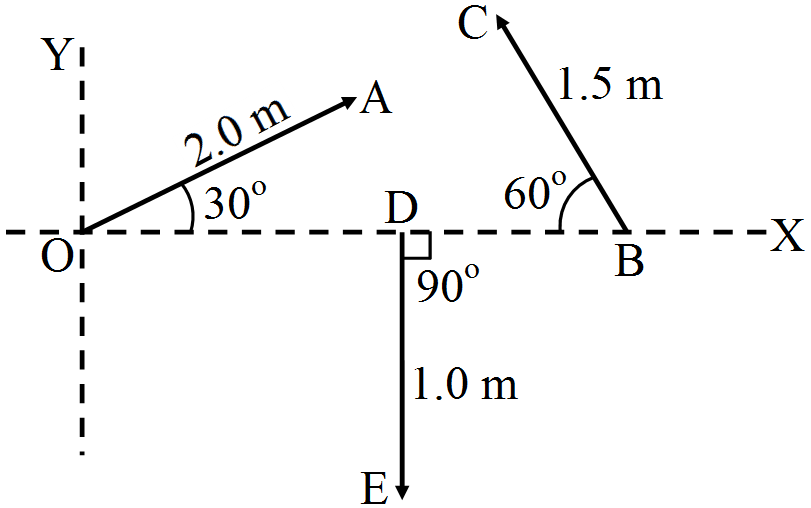
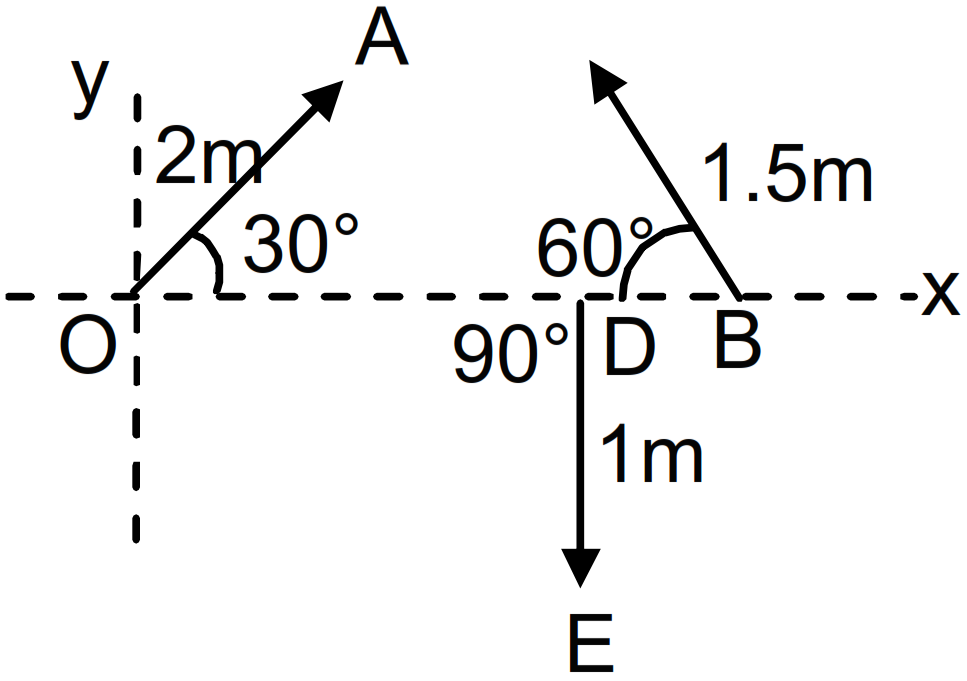
Refer to figure. Find
- The magnitude.
- x and y components
- The angle with the X-axis of the resultant of $\overrightarrow{\text{OA}},\overrightarrow{\text{BC}}$ and $\overrightarrow{\text{DE}}.$
Answer
View full question & answer→x component of $\overrightarrow{\text{OA}}=2\cos30^{\circ}=\sqrt{3}$ x component of $\overrightarrow{\text{BC}}=1.5\cos120^{\circ}=-0.75$ x component of $\overrightarrow{\text{DE}}=1\cos270^{\circ}=0$ y component of $\overrightarrow{\text{OA}}=2\sin30^{\circ}=1$ y component of $\overrightarrow{\text{BC}}=1.5\sin120^{\circ}=1.3$ y component of $\overrightarrow{\text{DE}}=1\sin270^{\circ}=-1$ $R_x = x$ component of resultant $=\sqrt{3}-0.75+0=0.98\text{m}$ $R_y$ = resultant y component $=1+1.3-1=1.3\text{m}$$\therefore\ \text{Resultant, R}=\sqrt{(\text{R}_\text{x})^2+(\text{R}_\text{y})^2}$
$=\sqrt{(0.98)^2+(1.3)^2}$
$=\sqrt{0.96+1.69}$
$=\sqrt{2.65}$
$=1.6\text{m}$
So, R = Resultant $=1.6\text{m}$ If it makes and angle $\alpha$ with positive x-axis$\tan\alpha=\frac{\text{y component}}{\text{x component}}$
$\Rightarrow\tan\alpha=\frac{1.3}{0.98}=1.332$
$\Rightarrow\alpha=\tan^{-1}1.32$
$=\sqrt{(0.98)^2+(1.3)^2}$
$=\sqrt{0.96+1.69}$
$=\sqrt{2.65}$
$=1.6\text{m}$
So, R = Resultant $=1.6\text{m}$ If it makes and angle $\alpha$ with positive x-axis$\tan\alpha=\frac{\text{y component}}{\text{x component}}$
$\Rightarrow\tan\alpha=\frac{1.3}{0.98}=1.332$
$\Rightarrow\alpha=\tan^{-1}1.32$