Questions

5 Marks Questions

Take a timed test

10 questions · self-marked practice — reveal the answer and mark yourself.

Question 15 Marks
A stone is thrown vertically upward with a speed of $28m/s$.
  1. Find the maximum height reached by the stone.
  2. Find its velocity one second before it reaches the maximum height.
  3. Does the answer of part.
  4. Change if the initial speed is more than $28m/s$ suchas $40m/s$ or $80m/s$?
Answer
$u = 28m/s, v = 0, a = -g = -9.8m/s^2$
  1. $\text{S}=\frac{\text{v}^2-\text{u}^2}{2\text{a}}=\frac{0^2-28^2}{2(9.8)}=40\text{m}$
  2. time $\text{t}=\frac{\text{v}-\text{u}}{\text{a}}=\frac{0-28}{-9.8}=2.85$
$t' = 2.85 - 1 = 1.85$
$v' = u + at' = 28 - (9.8)(1.85) = 9.87m/s.$
$\therefore$ The velocity is 9.87m/s.
  1. No it will not change. As after one second velocity becomes zero for any initial velocity and deceleration is $g = 9.8m/s^2$ remains same. Fro initial velocity more than 28m/s max height increases.
View full question & answer
Question 25 Marks
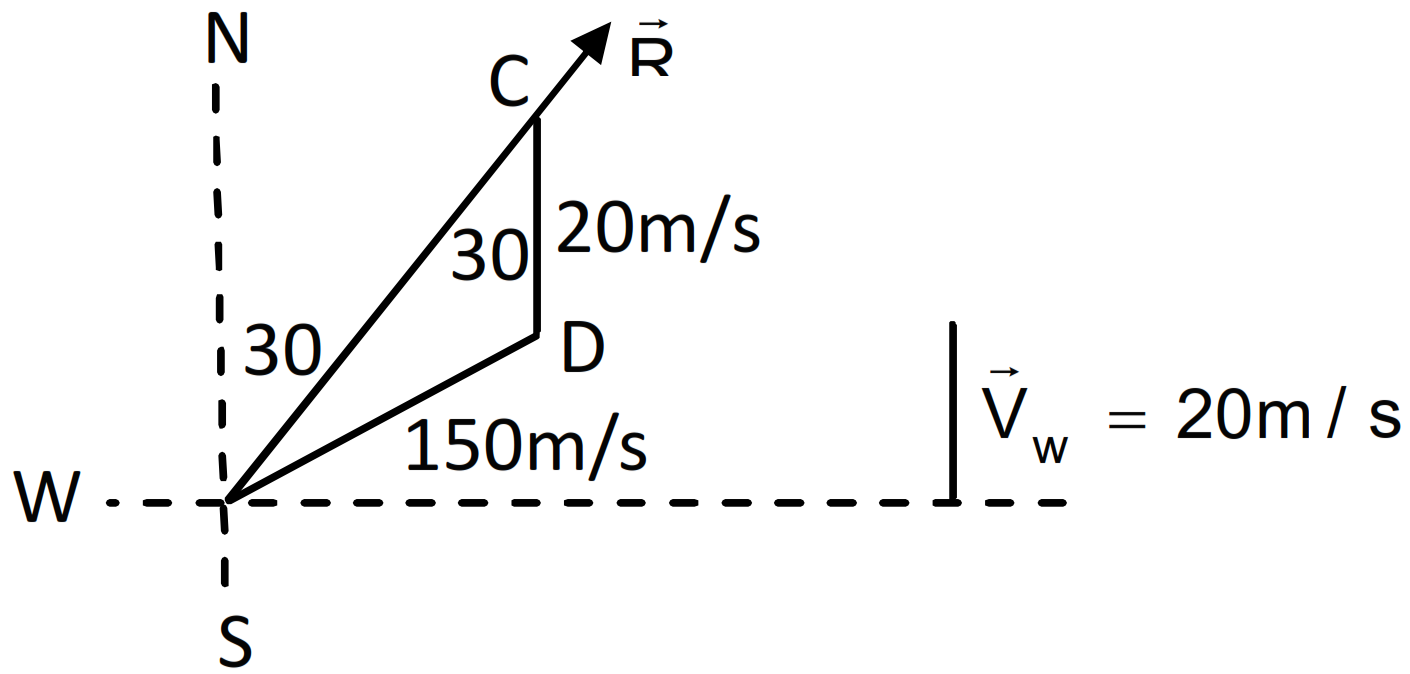
An aeroplane has to go from a point A to another point B, 500km away due 30° east of north. A wind is blowing due north at a speed of 20m/s. The air-speed of the
plane is 150m/s.
  1. Find the direction in which the pilot should head the plane to reach the point B.
  2. Find the time taken by the plane to go from A to B.
Answer
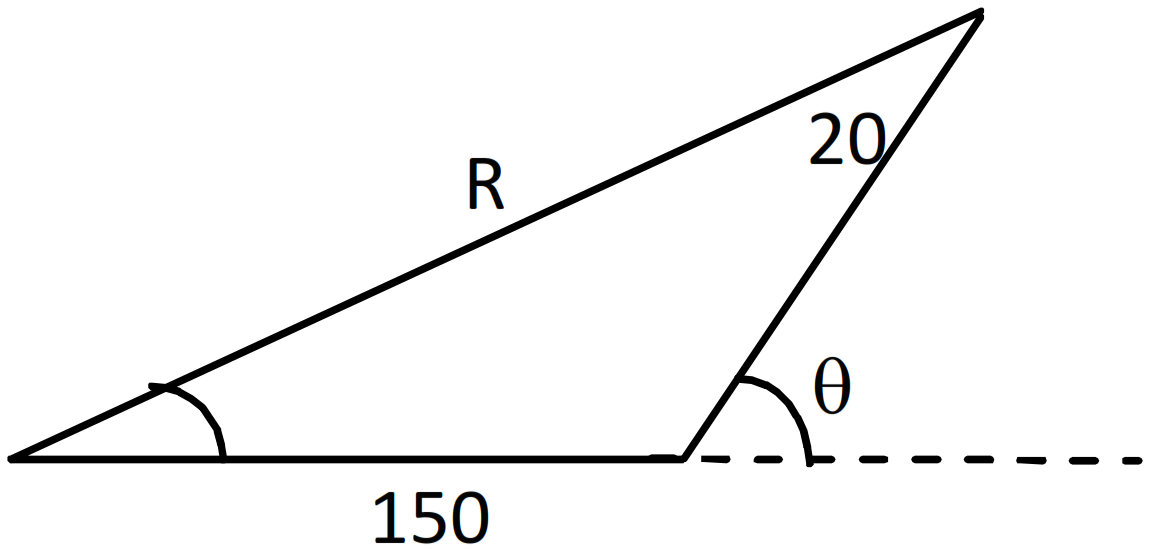
In resultant direction $\vec{\text{R}}$ the plane reach the point B. Velocity of wind $\vec{\text{V}}_{\text{w}}=20\text{m/s}$ Velocity of aeroplane $\vec{\text{V}}_{\text{a}}=150\text{m/s}$
In $\triangle\text{ABC}$ according to sine formula $\therefore\frac{20}{\sin\text{A}}=\frac{150}{\sin30^{\circ}}$
$\Rightarrow\sin\text{A}=\frac{20}{150}\sin30^{\circ}=\frac{20}{150}\times\frac{1}{2}=\frac{1}{15}$
$\Rightarrow\text{A}=\sin^{-1}\Big(\frac{1}{15}\Big)$
The direction is $\sin^{-1}\Big(\frac{1}{15}\Big)$ east of the line AB.$\sin^{-1}\Big(\frac{1}{15}\Big)=3^{\circ}48'$
$\Rightarrow30^{\circ}+3^{\circ}48'=33^{\circ}48'$
$\Rightarrow\text{R}\sqrt{150^2+20^2+2(150)20\cos33^{\circ}48'}=167\text{m/s}.$
$\text{Time}=\frac{\text{s}}{\text{v}}=\frac{500000}{167}=2994\text{sec}=49=50\text{min}.$
View full question & answer
Question 35 Marks
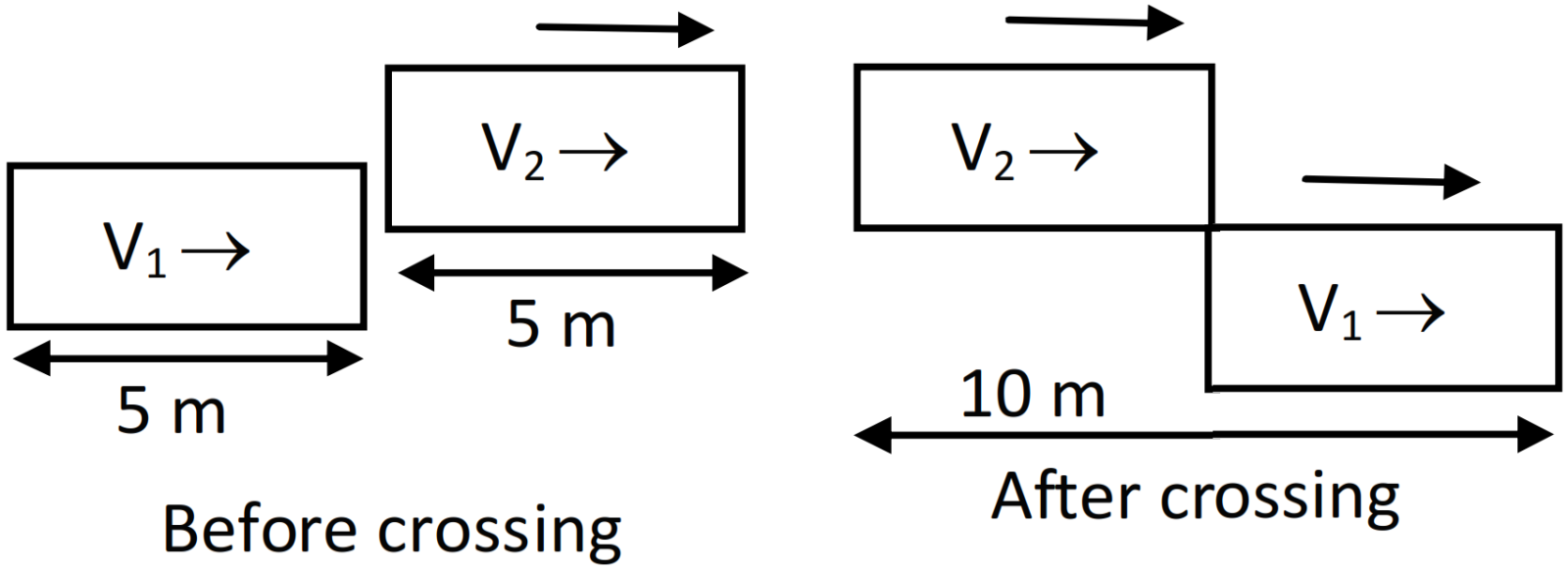
A car travelling at 60km/h overtakes another car travelling at 42km/h. Assuming each car to be 5.0m long, find the time taken during the overtake and the total road distance used for the overtake.
Answer
$v_1 = 60km/hr = 16.6m/s. v_2 = 42km/h = 11.6m/s$. Relative velocity between the cars = (16.6 - 11.6) = 5m/s. Distance to be travelled by first car is 5 + t = 10m. Time $=\text{t}=\frac{\text{s}}{\text{v}}=\frac{0}{5}=2\sec.$ to cross the $2^{nd}$ car. In 2 sec the $1^{st}$ car moved = 16.6 × 2 = 33.2m H also covered its own length 5m.$\therefore$ Total road distance used for the overtake = 33.2 + 5 = 38m.
View full question & answer
Question 45 Marks
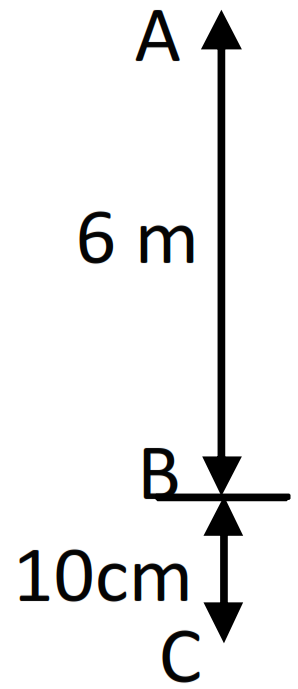
A ball is dropped from a height of $5m$ onto a sandy floor and penetrates the sand up to $10cm$ before coming to rest. Find the retardation of the ball in sand assuming it to be uniform.
Answer
Consider the motion of ball form A to B. B → just above the sand (just to penetrate) $u = 0, a = 9.8m/s^2, s =$ 5m$\text{S}=\text{ut}+\frac{1}{2}\text{at}^2$
$\Rightarrow5=0+\frac{1}{2}(9.8)\text{t}^2$
$\Rightarrow\text{t}^2=\frac{5}{4.9}=1.02$
$\Rightarrow\text{t}=1.01$
$\therefore$ velocity at B, v = u + at = 9.8 × 1.01 (u = 0) = 9.89m/s.
From motion of ball in sand $u_1 = 9.89m/s, v_1 = 0, a = ?, s = 10cm = 0.1m$.$\text{a}=\frac{\text{v}^2_1-\text{u}^2_1}{2\text{S}}=\frac{0-(9.89)^2}{2\times0.1}=-490\text{m/s}^2$
The retardation in sand is $490m/s^2$.

 
View full question & answer
Question 55 Marks
Consider the situation of the previous problem. The man has to reach the other shore at the point directly opposite to his starting point. If he reaches the other shore somewhere else, he has to walk down to this point. Find the minimum distance that he has to walk.
Answer
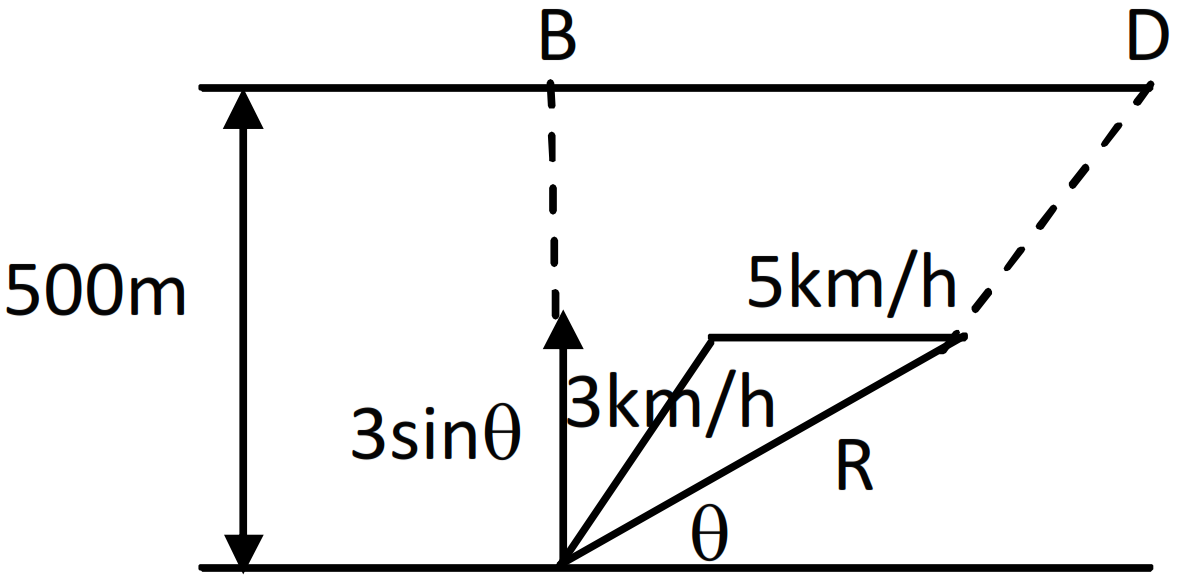
Velocity of man $\overrightarrow{\text{V}}_{\text{m}}=3\text{km/hr}$ BD horizontal distance for resultant velocity R. X-component of resultant $\text{R}_{\text{x}}=5+3\cos\theta$$\text{t}=\frac{0.5}{3\sin\theta}$
which is same for horizontal component of velocity.$\text{H = BD}=(5+3\cos\theta)\Big(\frac{0.5}{3\sin\theta}\Big)=\frac{5+3\cos\theta}{6\sin\theta}$
For H to be min $\Big(\frac{\text{dH}}{\text{d}\theta}\Big)=0$$\Rightarrow\frac{\text{d}}{\text{d}\theta}\Big(\frac{5+3\cos\theta}{6\sin\theta}\Big)=0$
$\Rightarrow-18(\sin^2\theta+\cos^2\theta)-30\cos\theta=0$
$\Rightarrow-30\cos\theta=18$
$\Rightarrow\cos\theta=-\frac{18}{30}=-\frac{3}{5}$
$\sin\theta=\sqrt{1-\cos^2\theta}=\frac{4}{5}$
$\therefore\text{H}=\frac{5+3\cos\theta}{6\sin\theta}$
$=\frac{5+3\big(-\frac{3}{5}\big)}{6\times\big(\frac{4}{5}\big)}=\frac{2}{3}\text{km.}$
View full question & answer
Question 65 Marks
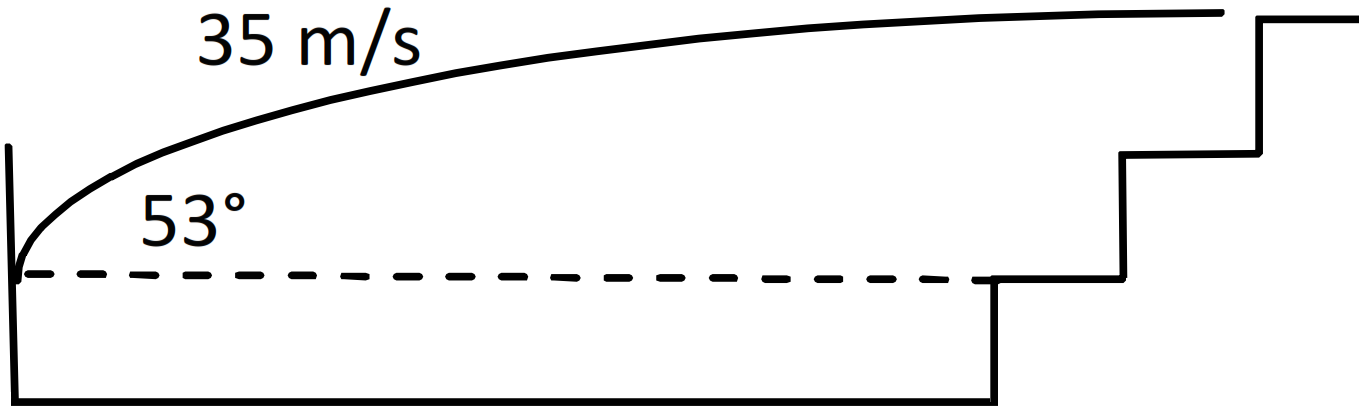
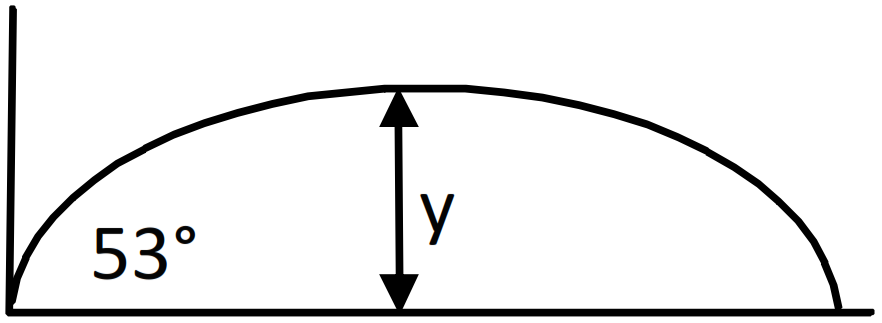
The benches of a gallery in a cricket stadium are 1m wide and 1m high. A batsman strikes the ball at a level one metre above the ground and hits a mammoth sixer. The ball starts at 35m/s at an angle of 53° with the horizontal. The benches are perpendicular to the plane of motion and the first bench is 110m from the batsman. On which bench will the ball hit?
Answer
$\theta=53^{\circ},$ so $\cos53^{\circ}=\frac{3}{5}$$\sec^2\theta=\frac{25}{9}$ and $\tan\theta=\frac{4}{3}$
Suppose the ball lands on nth bench
So, y = (n - 1)1 …(1) [ball starting point 1m above ground]
Again $\text{y = x}\tan\theta-\frac{\text{gx}^2\sec^2\theta}{2\text{u}^2}$ [x = 110 + n - 1 = 110 + y]
$\Rightarrow\text{y}=(110+\text{y})\Big(\frac{4}{3}\Big)-\frac{10(110+\text{y})^2\big(\frac{25}{9}\big)}{2\times35^2}$
$\Rightarrow\frac{440}{3}+\frac{4}{3}\text{y}-\frac{250(110+\text{y})^2}{18\times35^2}$
From the equation, y can be calculated.
$\therefore\text{y}=5$
$\Rightarrow\text{n}-1=5$
$\Rightarrow\text{n}=6.$
The ball will drop in sixth bench.
View full question & answer
Question 75 Marks
It is 260km from Patna to Ranchi by air and 320km by road. An aeroplane takes 30 minutes to go from Patna to Ranchi whereas a delux bus takes 8 hours.
  1. Find the average speed of the plane.
  2. Find the average speed of the bus.
  3. Find the average velocity of the plane.
  4. Find the average velocity of the bus.
Answer
  1. $\text{V}_{\text{ave}}\text{ of plane}\Big(\frac{\text{Distance}}{\text{Time}}\Big)$
$=\frac{260}{0.5}=520\text{km/hr}.$
  1. $\text{V}_{\text{ave}}\text{ of bus}=\frac{320}{8}=40\text{km/hr}.$
  2. plane goes in straight path
$\text{velocity}=\overrightarrow{\text{V}}_{\text{ave}}=\frac{260}{0.5}=520\text{km/hr}.$
  1. Straight path distance between plane to Ranchi is equal to the displacement of bus.
$\therefore\text{Velocity}=\overrightarrow{\text{V}}_{\text{ave}}=\frac{260}{8}=32.5\text{km/hr}.$
View full question & answer
Question 85 Marks
A ball is thrown horizontally from a point $100m$ above the ground with a speed of $20m/s$. Find:
  1. The time it takes to reach the ground.
  2. The horizontal distance it travels before reaching the ground.
  3. The velocity (direction and magnitude) with which it strikes the ground.
Answer
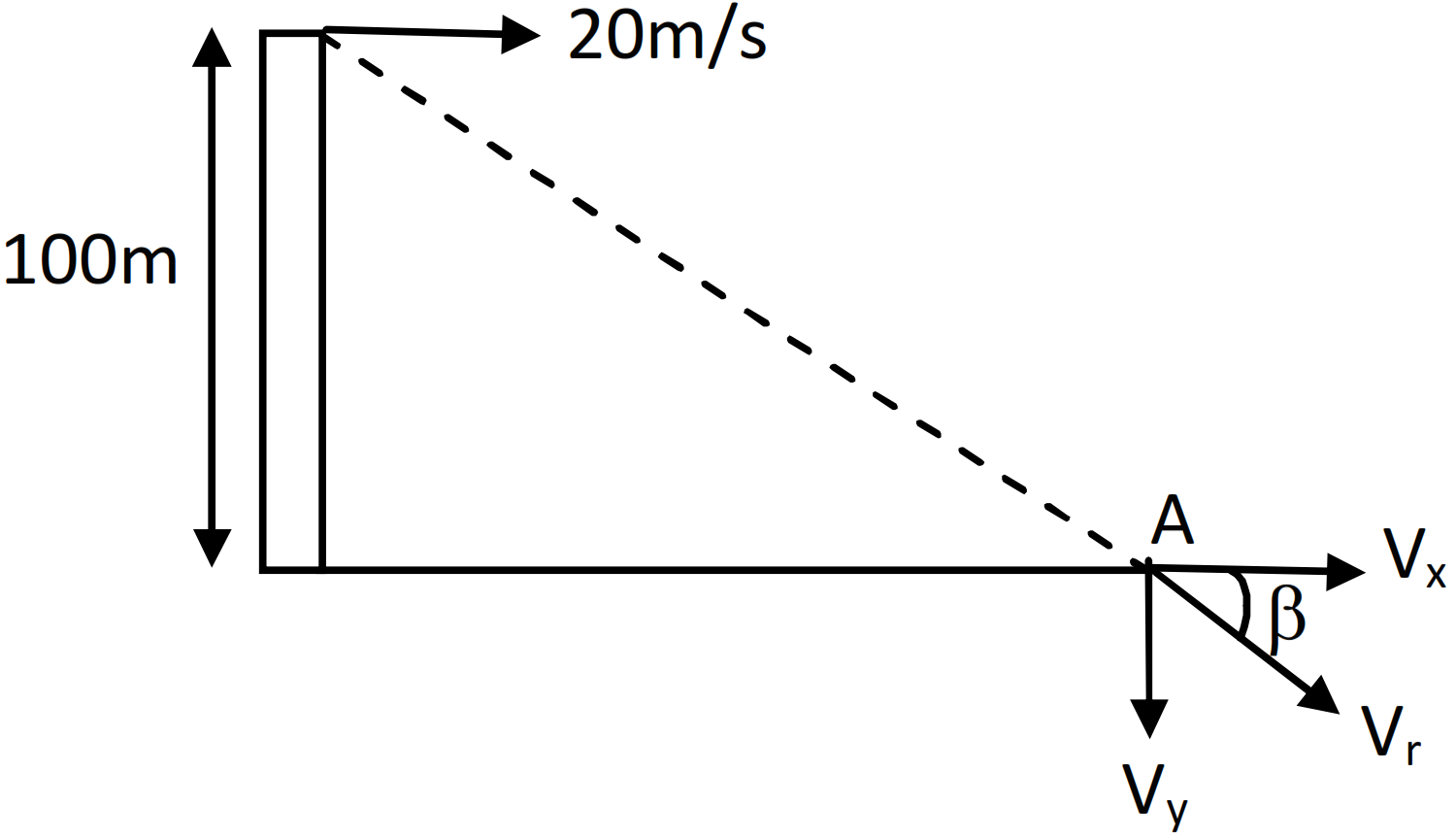
It is a case of projectile fired horizontally from a height.
$h = 100m, g = 9.8m/s^2$
  1. Time taken to reach the ground $\text{t}=\sqrt{(2\text{h/g})}$
$=\sqrt{\frac{2\times100}{9.8}}=4.51\text{sec}.$
  1. Horizontal range x = ut = 20 × 4.5 = 90m.
  2. Horizontal velocity remains constant through out the motion.
At $A, V_x = 20m/s$
$A V_y = u + at = 0 + 9.8 \times 4.5 = 44.1m/s.$
Resultant velocity $\text{V}_{\text{r}}=\sqrt{(44.1)^2+20^2}=48.42\text{m/s}.$
$\tan\beta=\frac{\text{V}_{\text{y}}}{\text{V}_{\text{x}}}=\frac{44.1}{20}=2.205$
$\Rightarrow\beta=\tan^{-1}(2.205)=60^{\circ}.$
The ball strikes the ground with a velocity 48.42m/s at an angle $66°$ with horizontal.
View full question & answer
Question 95 Marks
A person is standing on a truck moving with a constant velocity of 14.7m/s on a horizontal road. The man throws a ball in such a way that it returns to the truck after the truck has moved 58.8m. Find the speed and the angle of projection:
  1. As seen from the truck.
  2. As seen from the road.
Answer
  1. As seen from the truck the ball moves vertically upward comes back. Time taken = time taken by truck to cover 58.8m.
$\therefore\text{time}=\frac{\text{s}}{\text{v}}=\frac{58.8}{14.7}=4\sec.$ (V = 14.7m/s of truck)
$u = ?, v = 0, g = -9.8m/s^2$ (going upward), $\text{t}=\frac{4}{2}=2\sec.$
$v = u + at$
$\Rightarrow 0 = u - 9.8 \times 2$
$\Rightarrow u = 19.6m/s$. (vertical upward velocity).
  1. From road it seems to be projectile motion.
Total time of flight = 4 sec
In this time horizontal range covered 58.8m = x
$\therefore\text{X = u}\cos\theta\text{t}$
$\Rightarrow\text{u}\cos\theta=14.7 \ ...(1)$
Taking vertical component of velocity into consideration.
$\text{y}=\frac{0^2-(19.6)^2}{2\times(-9.8)}=19.6\text{m}$ [from(a)]
$\therefore\text{y = u}\sin\theta\text{ t}-\frac{1}{2}\text{gt}^2$
$\Rightarrow19.6=\text{u}\sin\theta(2)-\frac{1}{2}(9.8)2^2$
$\Rightarrow2\text{u}\sin\theta=19.6\times2$
$\Rightarrow\text{u}\sin\theta=19.6 \ ...(2)$
$\Rightarrow\frac{\text{u}\sin\theta}{\text{u}\cos\theta}=\tan\theta$
$\Rightarrow\frac{19.6}{14.7}=1.333$
$\Rightarrow\theta=\tan^{-1}(1.333)=53^{\circ}$
Again $\text{u}\cos\theta=14.7$
$\Rightarrow\text{u}=\frac{14.7}{\text{u}\cos53^{\circ}}=24.42\text{m/s}.$
The speed of ball is 42.42m/s at an angle 53° with horizontal as seen from the road.
View full question & answer
Question 105 Marks
A train starts from rest and moves with a constant acceleration of $2.0m/s^2$ for half a minute. The brakes are then applied and the train comes to rest in one minute. Find:
  1. The total distance moved by the train.
  2. The maximum speed attained by the train.
  3. The position(s) of the train at half the maximum speed.
Answer
Initial velocity u = 0
Acceleration $a = 2m/s^2$. Let final velocity be v (before applying breaks)
$t = 30$ sec
$v = u + at \Rightarrow 0 + 2 \times 30 = 60m/s$
  1. $\text{S}_1=\text{ut}+\frac{1}2{}\text{at}^2=900\text{m}$
when breaks are applied u' = 60m/s

v' = 0, t = 60 sec (1 min)

Declaration $\text{a}'=\frac{(\text{v}-\text{u})}{\text{t}}=\frac{0-16}{60}=-1\text{m/s}^2.$

$\text{S}_2=\frac{\text{v}'^2-\text{u}'^2}{2\text{a}'}=1800\text{m}$

Total $S = S_1 + S_2 = 1800 + 900 = 2700m = 2.7km.$
  1. The maximum speed attained by train v = 60m/s
  2. Half the maximum speed $=\frac{60}{2}=30\text{m/s}$
Distance $\text{A}=\frac{\text{v}^2-\text{u}^2}{2\text{a}}=\frac{30^2-0^2}{2\times2}=225\text{m}$ from starting point

When it accelerates the distance travelled is 900m. Then again declarates and attain 30m/s

$\therefore u = 60m/s, v = 30m/s, a = -1m/s^2$

Distance $=\frac{\text{v}^2-\text{u}^2}{2\text{a}}=\frac{30^2-60^2}{2(-1)}=1350\text{m}$

Position is 900 + 1350 = 2250 = 2.25km from starting point.
View full question & answer