Questions

M.C.Q (1 Marks)

Take a timed test

19 questions · auto-graded multiple-choice test.

MCQ 11 Mark
Which of the following time measuring devices is most precise? Give reason for your answer.
  • A
    A wall clock.
  • B
    A stop watch.
  • C
    A digital watch.
  • An atomic clock.
Answer
Correct option: D.
An atomic clock.
The least count of a wall clock, stop watch, digital watch and atomic clock are 1 sec, $\frac{1}{10}\text{sec},\frac{1}{100}\text{sec and}\ \frac{1}{10^{13}}\text{sec}$ respectively. So atomic clock is most precise.
View full question & answer
MCQ 21 Mark
If $\text{P, Q, R}$ are physical quantities, having different dimensions, which of the following combinations can never be a meaningful quantity?
  • A
    $\frac{(\text{P}-\text{Q})}{\text{R}}$
  • B
    $\text{PQ}-\text{R}$
  • C
    $\frac{(\text{R}+\text{Q})}{\text{P}}$
  • Both $A$ and $C$
Answer
Correct option: D.
Both $A$ and $C$

In option $(a)$ and $(c)$ there is term $(P - Q)$ and $(R + Q)$ as different physical quantities can never be added or subtracted so option $(a)$ and $(c)$ can never be meaningful.
In option $(b),$ the dimension of $PQ$ may be equal to dimension of $R$ so option $(b)$ can be possible. Similarly dimensions of $PR$ and $Q^2$ may be equal and gives the possibility of option $(d).$
In option $(c)$, there is no addition subtraction gives the possibilities of option $(c).$
Hence, verifies the right option $(a)$ and $(c).$

View full question & answer
MCQ 31 Mark
Which of the following are not a unit of time?
  • A
    Second.
  • Parsec and Light year.
  • C
    Year.
  • D
    None of these
Answer
Correct option: B.
Parsec and Light year.
Parsec and light year are those practical units which are used to measure large distances.
For example:
The distance between sun and earth or other celestial bodies.
So they are the units of length not time. Here, second and year represent time.
$1$ light year $($distance that light travels in $1$ year with speed $=3 \times 10^8 \mathrm{~m} / \mathrm{s}.)$
$=9.46 \times 10^{11} \mathrm{~m}$ And $1$ parsee
$=3.08 \times$ $10^{16} \mathrm{~m}$
View full question & answer
MCQ 41 Mark
The number of significant figures in 0.06900 is:
  • A
    5.
  • 4.
  • C
    2
  • D
    3.
Answer
Correct option: B.
4.
Explanation:
In the number 0.06900, two zeroes before six are not significant figure and two zero on right side of 9 are significant figures. Significant figures are underlined, so verifies option (b).
View full question & answer
MCQ 51 Mark
The numbers $2.745$ and $2.735$ on rounding off to $3$ significant figures will give:
  • A
    $2.75$ and $2.74.$
  • B
    $2.74$ and $2.73.$
  • C
    $2.75$ and $2.73.$
  • $2.74$ and $2.74.$
Answer
Correct option: D.
$2.74$ and $2.74.$
Key concept: While rounding off measurements, we use the following rules by convention:
If the digit to be dropped is less than $5$, then the preceding digit is left unchanged.
If the digit to be dropped is more than $5$, then the preceding digit is raised by one.
If the digit to be dropped is $5$ followed by digits other than zero, then the preceding digit is raised by one.
If digit to be dropped is $5$ or $5$ followed by zeros, then preceding digit is left unchanged, if it is even.
If digit to be dropped is $5$ or $5$ followed by zeros, then the preceding digit is raised by one, if it is odd.
Units and Measurements,
Let us round off $2.745$ to $3$ significant figures.
Here the digit to be dropped is $5$, then preceding digit is left unchanged, if it is even.
Hence on rounding off $2.745$, it would be $2.74$.
Now consider $2.737$, here also the digit to be dropped is $5$, then the preceding digit is raised by one, if it is odd. Hence on rounding off $2.735$ to $3$ significant figures, it would be $2.74.$
View full question & answer
MCQ 61 Mark
Which of the following measurements is most precise?
  • 5.00mm.
  • B
    5.00cm.
  • C
    5.00m.
  • D
    5.00km.
Answer
Correct option: A.
5.00mm.
All the measurements are upto two places of decimal, least unit is mm. so 5.00mm measurement is most precise. Hence, verifies answer (a).
View full question & answer
MCQ 71 Mark
The mean length of an object is 5cm. Which of the following measurements is most accurate?
  • 4.9cm.
  • B
    4.805cm.
  • C
    5.25cm.
  • D
    5.4cm.
Answer
Correct option: A.
4.9cm.
Error or absolute error
$|\Delta\text{a}_1|=|5-4.9|=0.1\text{cm},\ |\Delta\text{a}_2|=|5-4.805|=0.195\text{cm}$
$|\Delta\text{a}_3|=|5-5.25|=0.25\text{cm},\ |\Delta\text{a}_4|=|5-5.4|=0.4\text{cm}$
$|\Delta\text{a}_1|$ is minimum. Hence verifies option (a).
View full question & answer
MCQ 81 Mark
On the basis of dimensions, decide which of the following relations for the displacement of a particle undergoing simple harmonic motion is not correct:
  • A
    $\text{y}=\frac{\text{a}\sin2\pi\text{t}}{\text{T}}.$
  • B
    $\text{y}=\text{a}\sin\text{vt}.$
  • C
    $\text{y}=\frac{\text{a}}{\text{T}}\sin\Big(\frac{\text{t}}{\text{a}}\Big).$
  • Both $B$ and $C$
Answer
Correct option: D.
Both $B$ and $C$
The argument of trigonometric functions $(\sin, \cos$ etc.$)$ should be di mensionless.
$y$ is displacement and according to the principle of homegeneity of dimensions $\text{LHS}$ and $\text{RHS.}$
$[\text{Y}]=[\text{L}],[\text{a}]=[\text{L}]$
$\Big[\frac{2\pi\text{t}}{\text{T}}\Big]=\frac{[\text{T}]}{[\text{T}]}=[\text{T}^0]$
$[\text{vt}]=[\text{v}][\text{t}]=[\text{LT}^{-1}][\text{T}]=[\text{L}]$
$\Big[\frac{\text{a}}{\text{T}}\Big]=\frac{[\text{a}]}{[\text{T}]}=\frac{[\text{L}]}{[\text{T}]}=[\text{LT}^{-1}]$
$\Big[\frac{\text{t}}{\text{a}}\Big]=[\text{L}^{-1}\text{T}]$
$[\text{LHS}]\neq[\text{RHS}]$
Hence, $(c)$ is not the correct option.
$\Rightarrow\text{LHS}\neq\text{RHS}.$
So, option $(b)$ is also not correct.
View full question & answer
MCQ 91 Mark
If momentum (P), area (A) and time (T) are taken to be fundamental quantities, then energy has the dimensional formula:
  • A
    $(\text{P}^1\text{A}^{-1}\text{T}^1).$
  • B
    $(\text{P}^2\text{A}^{1}\text{T}^1).$
  • C
    $(\text{P}^1\text{A}^\frac{-1}{2}\text{T}^1).$
  • $(\text{P}^1\text{A}^\frac{1}{2}\text{T}^{-1}).$
Answer
Correct option: D.
$(\text{P}^1\text{A}^\frac{1}{2}\text{T}^{-1}).$
According to the problem, fundamental quantities are momentum (p), area (A) and time (T) and we have to express energy in these fundamental quantities.
Let energy E,
$\text{E}\propto\text{p}^\text{a}\text{A}^\text{A}\text{T}^\text{c}\Rightarrow\text{E}=\text{kp}^\text{a}\text{A}^\text{A}\text{T}^\text{c}$
where, k is dimensionless constant of proportionality.
Dimensional formula of energy, $[\text{E}]=[\text{ML}^2\text{T}^{-2}]\ \text{and}\ [\text{p}]=[\text{MLT}^{-1}]$
$[\text{A}]=[\text{L}^2],\ [\text{T}]=[\text{T}]\ \text{and}\ [\text{E}]=[\text{K}][\text{p}]^\text{a}[\text{A}]^\text{b}[\text{T}]^\text{c}$
Putting all the dimensions, we get
$\text{ML}^2\text{T}^2=[\text{MLT}^{-1}]^\text{a}[\text{L}^2]^\text{b}[\text{T}]^\text{c}$
$\text{M}^\text{a}\text{L}^{\text{a}+2\text{b}}\text{T}^{\text{-a}+\text{c}}$
According to the principle of homogeneity of dimensions, we get,
$\text{a}=1\ \ \ ...(\text{i)}$
$\text{a}+2\text{b}=2\ \ \ ...(\text{ii)}$
$-\text{a}+\text{c}=-2\ \ \ ...(\text{iii)}$
By solving these equations (i), (ii) and (iii), we get
$\text{a}=1,\ \text{b}=\frac{1}{2},\ \text{c}=-1$
Dimensional formula for E is $[\text{p}^1\text{A}^\frac{1}{2}\text{t}^{-1}].$
View full question & answer
MCQ 101 Mark
Which of the following pairs of physical quantities does not have same dimensional formula?
  • A
    Work and torque.
  • B
    Angular momentum and Planck’s constant.
  • Tension and surface tension.
  • D
    Impulse and linear momentum.
Answer
Correct option: C.
Tension and surface tension.
  1. $\text{Work}=\text{F}\times\Delta\text{x}=[\text{MLT}^2][\text{L}]=[\text{ML}^2\text{T}^2]$
$\text{Torque}=\text{force}\times\text{distance}=[\text{ML}^2\text{T}^2]$
  1. Angular momentum $=\text{mvr}=[\text{M}][\text{LT}^1][\text{L}]=[\text{ML}^2\text{T}^1]$
Planck's constant $=\frac{\text{E}}{\text{V}}=\frac{[\text{ML}^2\text{T}^{-2}]}{[\text{T}^{-1}]}=[\text{ML}^2\text{T}^{-1}]$
  1. Tension $($force$) = [\text{MLT}^{-2}]$
Surface tension $=\frac{\text{force}}{\text{length}}=\frac{[\text{MLT}^{-2}]}{[\text{L}]}=[\text{ML}^0\text{T}^{-2}]$
  1. $\text{Impulse}=\text{F}\times\Delta\text{t}=[\text{MLT}^{-2}][\text{T}]=[\text{MLT}^{-1}]$
$\text{Momentum}=\text{mass}\times\text{velocity}=[\text{M}][\text{LT}^{-1}]=[\text{MLT}^{-1}]$
So, among the above pairs only tension and surface tension does not have same dimensional formula. They both sound similar but they both have different meaning and different applications.
View full question & answer
MCQ 111 Mark
Photon is quantum of radiation with energy $E = hν$ where $ν$ is frequency and $h$ is Planck’s constant. The dimensions of $h$ are the same as that of:
  • A
    Linear impulse.
  • Angular impulse and Angular momentum.
  • C
    Linear momentum.
  • D
    None of these
Answer
Correct option: B.
Angular impulse and Angular momentum.
We know that energy of radiation, $E = hv.$
So, we have to compare $h$ with dimensional formula of each option.
$[\text{h}]=\frac{[\text{E}]}{[\text{v}]}=\frac{\text{force}\times\text{displacement}}{\text{frequency}}$
$=\frac{[\text{ML}^2\text{T}^{-2}]}{[\text{T}^{-1}]}=[\text{ML}^2\text{T}^{-1}]$
  1. Dimension of linear impulse,
$[\text{I}]=[\text{Ft}]=[\text{MLT}^{-2}][\text{T}]=[\text{MLT}^{-1}]$

where, t is the time interval.
  1. Dinmension of angular impulse,
$[\text{J}]=[\text{I}\omega]=[\text{ML}^2][\text{T}^{-1}]=[\text{ML}^2\text{T}^{-1}]$
  1. Dimension of angular momentum,
$[\text{P}]=[\text{mv}]=[\text{M}][\text{LT}^{-1}]=[\text{ML}\text{T}^{-1}]$
  1. Dimension of angular momentum,
$[\text{L}]=[\text{mvr}]=[\text{M}][\text{LT}^{-1}][\text{L}]=[\text{ML}^2\text{T}^{-1}]$

Hence, dimension of angular impulse and angular momentum is same as Planck's constant $(h).$
View full question & answer
MCQ 121 Mark
The mass and volume of a body are $4.237g$ and $2.5 \mathrm{~cm}^3$, respectively. The density of the material of the body in correct significant figures is:
  • A
    $1.6048 \mathrm{gcm}^{-3}$.
  • B
    $1.69 \mathrm{gcm}^{-3}$.
  • $1.7 \mathrm{gcm}^{-3}$.
  • D
    $1.695 \mathrm{gcm}^{-3}$.
Answer
Correct option: C.
$1.7 \mathrm{gcm}^{-3}$.
The significant figures in given numbers $4.237 g$ and $2.5 \mathrm{~cm}^3$ are four and two respectively so result must have only two significant figures.
Density $=\frac{\text { mass }}{\text { volume }}=\frac{4.237}{2.5}$,
Density $=1.6948=1.7 \mathrm{gcm}^{-3}$ rounding off upto $2$ significant figures.
View full question & answer
MCQ 131 Mark
Measure of two quantities along with the precision of respective measuring instrument is:$\text{A} = 2.5\text{ms}^{-1} \pm 0.5\text{ms}^{-1}$
$\text{B} = 0.10\text{s} \pm 0.01\text{s}$
The value of A B will be,
  • $(0.25 \pm 0.08)\text{m}.$
  • B
    $(0.25 \pm 0.5)\text{m}.$
  • C
    $(0.25 \pm 0.05)\text{m}.$
  • D
    $(0.25 \pm 0.135)\text{m}$
Answer
Correct option: A.
$(0.25 \pm 0.08)\text{m}.$
$\text{A}=(2.5\pm0.5)\text{ms}^{-1}$
$\text{B}=(0.10\pm0.01)\text{s}$
$\text{X}=\text{AB}=2.5\times0.10=0.25$
$\frac{\Delta\text{x}}{\text{x}}=\frac{\Delta\text{A}}{\text{A}}+\frac{\Delta\text{B}}{\text{B}}$
$\frac{\Delta\text{x}}{\text{x}}=\frac{0.5}{2.5}+\frac{0.01}{0.10}$
$\frac{\Delta\text{x}}{\text{x}}=\frac{0.075}{0.25},\Delta\text{x}=0.007\cong0.008$
(Rounding off upto 2 significant figures)
$\therefore\text{AB}=(2.5\pm0.08)\text{m}.$
Hence, verifies the option (a).
View full question & answer
MCQ 141 Mark
Young's modulus of steel is $1.9 \times 10^{11} \mathrm{~N} / \mathrm{m}^2$. When expressed in CGS units of dynes $/ \mathrm{cm}^2$, it will be equal to $(1 \mathrm{~N}=$ $10^5$ dyne, $1 \mathrm{~m}^2=10^4 \mathrm{~cm}^2)$.
 
  • A
    $1.9 \times 10^{10}$.
  • B
    $1.9 \times 10^{11}$.
  • $1.9 \times 10^{12}$.
  • D
    $1.9 \times 10^{13}$.
Answer
Correct option: C.
$1.9 \times 10^{12}$.
$1.9 \times 10^{12}$
Explanation:
According to the problem,
Young's modulus, $Y=1.9 \times 10^{11} \mathrm{~N} / \mathrm{m}^2$
1 N in SI system of units $=10^5$ dyne in C.G.S system.
Hence, $Y=1.9 \times 10^{11} \times 10^5$ dyne $/ \mathrm{m}^2$
In C.G.S. length is measured in unit ' cm ', so we should also convert m into cm .
$\therefore Y=1.9 \times 10^{11}\left(\frac{10^5 \text { dyne }}{10^4 \mathrm{~cm}^2}\right)[\because 1 \mathrm{~m}=100 \mathrm{~cm}]$
$=1.9 \times 10^{12} \text { dyne } / \mathrm{cm}^2$
View full question & answer
MCQ 151 Mark
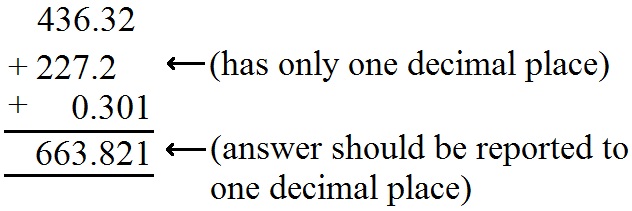
The sum of the numbers 436.32, 227.2 and 0.301 in appropriate significant figures is:
  • A
    663.821.
  • 664.
  • C
    663.8.
  • D
    663.82.
Answer
Correct option: B.
664.
The result of an addition or subtraction in the number having different precisions should be reported to the same number of decimal places as present in the number having the least number of decimal places.


The final result should, therefore, be rounded off to one decimal place, i.e. 664.
View full question & answer
MCQ 161 Mark
You measure two quantities as $\text{A} = 1.0 \text{m}\pm 0.2 \text{m},\ \text{B} = 2.0 \text{m}\pm 0.2 \text{m}.$ We should report correct value for $\sqrt{\text{AB}}$ as:
  • A
    $1.4 \text{m}\pm 0.4\text{m.}$
  • B
    $1.41\text{m} \pm 0.15 \text{m}.$
  • C
    $1.4\text{m} \pm 0.3 \text{m}.$
  • $1.4\text{m} \pm 0.2 \text{m}.$
Answer
Correct option: D.
$1.4\text{m} \pm 0.2 \text{m}.$
According to the problem, $\text{A}=1.0\text{m}\pm0.2\text{m},\ \text{B}=2.0\text{m}\pm0.2\text{m}$
Let, $\text{Z}=\sqrt{\text{AB}}=\sqrt{(1.0)(2.0)}=1.414\text{m}$
Rounding off to two significant digits Z = 1.4m
$\text{AS}\ \frac{\Delta\text{Z}}{\text{Z}}=\frac{1}{2}\frac{\Delta\text{A}}{\text{A}}+\frac{1}{2}\frac{\Delta\text{B}}{\text{B}}$
$=\frac{1}{2}\Big(\frac{0.2\text{m}}{1\text{m}}\Big)+\frac{1}{2}\Big(\frac{0.2\text{m}}{2\text{m}}\Big)=0.15$
$\Rightarrow\Delta\text{Z}=\text{Z}(0.15)=1.4\text{m}(0.15)=0.212$
Rounding off to one significant digit, $\Delta\text{Z}=0.2\text{m}$
The correct value for $\sqrt{\text{AB}}=1.4\pm0.2\text{m}.$
View full question & answer
MCQ 171 Mark
Which of the following ratios express pressure?
  • A
    $\frac{\text{Force}}{\text{Area}}.$
  • B
    $\frac{\text{Energy}}{\text{Volume}}.$
  • Both $A$ and $B$
  • D
    $\frac{\text{Force}}{\text{Volume}}.$
Answer
Correct option: C.
Both $A$ and $B$
Let us first express the relation of pressure with other physical quantities one by one with the help of dimensional analysis.
We know that pressure,
  1. $\frac{\text{Force}}{\text{Area}}=\frac{[\text{MLT}^{-2}]}{[\text{L}^2]}=[\text{ML}^{-1}\text{T}^{-2}]$
So, this ratio express pressure $($In fact this ratio actually represents pressure$).$
  1. $\frac{\text{Energy}}{\text{Area}}=\frac{[\text{ML}^{2}\text{T}^{-2}]}{[\text{L}^2]}=[\text{MT}^{-2}]$
Dimensions of this ratio are not same as pressure, so this ratio does not express pressure.
  1. $\frac{\text{Energy}}{\text{Volume}}=\frac{[\text{ML}^{2}\text{T}^{-2}]}{[\text{L}^3]}=[\text{ML}^{-1}\text{T}^{-2}]$
Dimensions of this ratio is the same as pressure, so this ratio also express pressure.
  1. $\frac{\text{Force}}{\text{Volume}}=\frac{[\text{ML}\text{T}^{-2}]}{[\text{L}^3]}=[\text{ML}^{-2}\text{T}^{-2}]$
Dimensions of this ratio are not same as pressure, so this ratio does not express pressure.
View full question & answer
MCQ 181 Mark
If Planck’s constant $(h)$ and speed of light in vacuum $(c)$ are taken as two fundamental quantities, which one of the following can, in addition, be taken to express length, mass and time in terms of the three chosen fundamental quantities?
  • A
    Mass of electron $(m_e).$
  • B
    Universal gravitational constant $(G).$
  • C
    Mass of proton $(m_p).$
  • All of the above
Answer
Correct option: D.
All of the above
Dimension of
$\text{h}=\frac{\text{E}}{\text{v}}=\frac{[\text{ML}^2\text{T}^{-1}]}{[\text{T}^{-1}]}=[\text{ML}^2\text{T}^{-1}]$
$\text{c}=\frac{\text{s}}{\text{t}}=[\text{LT}^{-1}]$
$\text{G}=\frac{\text{Fr}^2}{\text{M}_1\text{M}_2}=\frac{[\text{ML}^3\text{T}^{-2}]}{[\text{M}][\text{M}]}=[\text{M}^{-1}\text{L}^3\text{T}^{-2}]$
$\text{hc}=[\text{ML}^2\text{T}^{-1}]\times[\text{LT}^{-1}]=[\text{ML}^3\text{T}^{-2}]$
$\frac{\text{hc}}{\text{G}}=\frac{[\text{ML}^3\text{T}^{-2}]}{[\text{M}^{-1}\text{L}^3\text{T}^{-1}]}=[\text{M}^2]$
$\text{M}=\sqrt{\frac{\text{hc}}{\text{G}}}=\Big[\text{h}^\frac{1}{2}\text{c}^\frac{1}{2}\text{G}^\frac{-1}{2}\Big]$
$\frac{\text{h}}{\text{c}}=\frac{[\text{ML}^2\text{T}^{-1}]}{[\text{LT}^{-1}]}=[\text{ML}]=\sqrt{\frac{\text{hc}}{\text{G}}}\times\text{L}$
$\text{L}=\frac{\text{h}}{\text{c}}\times\sqrt{\frac{\text{G}}{\text{hc}}}=\frac{\sqrt{\text{Gh}}}{\text{C}^\frac{3}{2}}=\Big[\text{G}^\frac{1}{2}\text{h}^\frac{1}{2}\text{c}^\frac{-3}{2}\Big]$
$\text{c}=[\text{LT}^{-1}]=\Big[\text{G}^\frac{1}{2}\text{h}^\frac{1}{2}\text{c}^\frac{-3}{2}\text{T}^{-1}\Big]$
$\text{T}=\Big[\text{G}^\frac{1}{2}\text{h}^\frac{1}{2}\text{c}^{-\frac{3}{2}-1}\Big]=\Big[\text{G}^\frac{1}{2}\text{h}^\frac{1}{2}\text{c}^{\frac{-5}{2}}\Big]$
Hence, physical quantities $(a, b$ and $d)$ can be used to represent $\text{L, M, T}$ in terms of the choosen fundamental quantities.
View full question & answer
MCQ 191 Mark
The length and breadth of a rectangular sheet are 16.2cm and 10.1cm, respectively. The area of the sheet in appropriate significant figures and error is:
  • $164 \pm 3 \text{cm}^2$.
  • B
    $163.62 \pm 2.6 \text{cm}^2.$
  • C
    $163.6 \pm 2.6 \text{cm}^2.$
  • D
    $163.62 \pm 3 \text{cm}^2.$
Answer
Correct option: A.
$164 \pm 3 \text{cm}^2$.
$1=16.2\text{cm }\Delta^1=0.1$
$\text{b}=10.1\text{cm}\ \Delta\text{b}=0.1$
$1=16.2\pm0.1$
$\text{b}=10.1\pm0.1$
$\text{A}=\text{Area}=1\times\text{b}=16.2\times10.1=163.62\text{cm}^2$
$=164\text{cm}^2\ (\text{in significant figures)}$
$\frac{\Delta\text{A}}{\text{A}}=\frac{\Delta\text{l}}{\text{l}}+\frac{\Delta\text{b}}{\text{b}}=\frac{0.1}{16.2}+\frac{0.1}{10.1}$
$\frac{\Delta\text{A}}{164}=\frac{10.1\times0.1+16.2\times0.1}{16.2\times10.1}$
$\Delta\text{A}=164\Big(\frac{1.01+1.62}{163.62}\Big)$
$\Delta\text{A}=2.63\text{cm}^2$
Now rounding off upto significant figures in $\Delta^1$ and $\Delta^\text{b}$ i.e., one
$\Delta\text{A}=3\text{cm}^2$
$\text{A}=(164\pm3)\text{cm}^2$. Hence, verifies the option (a).
View full question & answer