Questions

1 Marks Question

Take a timed test

9 questions · self-marked practice — reveal the answer and mark yourself.

Question 11 Mark
Show that the particle speed can never be equal to the wave speed in a sine wave if the amplitude is less than wavelength divided by $2\pi.$
Answer
Equation of the wave is given by,$\text{y}=\text{A}\sin (\omega\text{t}-\text{kx})$
Where, A is the amplitude$\omega$ is the angular frequency
k is the wave number Velocity of wave, $\upsilon=\frac{\omega}{\text{k}}$ Velocity of particle, $\upsilon_\text{p}=-\frac{\text{dy}}{\text{dt}}=\text{A}\omega\cos(\omega\text{t}-\text{kx})$ Max velocity of particle, $\upsilon_{\text{p}_{\text{max}}}=\text{A}\omega$ As given$\text{A}<\frac{\lambda}{2\pi}$
$\upsilon_{\text{p}_{\text{max}}}=\frac{\lambda}{2\pi}$
$\upsilon_{\text{p}_{\text{max}}}<\frac{\omega}{\text{k}}$ $\Big[\therefore \frac{2\pi}{\lambda}=\text{k}\Big]$
View full question & answer
Question 21 Mark
A string clamped at both ends vibrates in its fundamental mode. Is there any position (except the ends) on the string which can be touched without disturbing the motion? What if the string vibrates in its first overtone?
Answer
Yes, at the centre. The centre position is a node. If the string vibrates in its first overtone, then there will be two positions, i.e., two nodes, one at x = 0 and the other at x = L.
View full question & answer
Question 31 Mark
What is the smallest positive phase constant which is equivalent to $7.5\pi?$
Answer
Equation of the wave:$\text{y}=\text{A}\sin (\text{kx}-\omega\text{t}+\phi)$
Here, A is the amplitude, k is the wave nunumber, $\omega$ is the angular frequency and $\phi$ is the initial phase. The argument of the sine is a phase, so the smallest positive phase constant should be.$\sin(7.5\pi)=\sin (3\times2\pi+1.5\pi)$
$=\sin (1.5\pi)$
Therefore, the smallest positive phase constant is $1.5 \pi.$
View full question & answer
Question 41 Mark
Show that for a wave travelling on a string:$\frac{\text{y}_\text{max}}{\text{u}_\text{max}}=\frac{\text{v}_\text{max}}{\text{a}_\text{max}},$
Where the symbols have usual meanings. Can we use componendo and dividendo taught in algebra to write,$\frac{\text{y}_\text{max}+\text{v}_\text{max}}{\text{y}_\text{max}-\text{v}_\text{max}}=\frac{\text{v}_\text{max}+\text{a}_\text{max}}{\text{v}_\text{max}-\text{a}_\text{max}}?$
Answer
$\frac{\text{y}_\text{max}}{\text{u}_\text{max}}=\frac{\text{v}_\text{max}}{\text{a}_\text{max}}$$\text{y}=\text{A}\sin(\omega\text{t}-\text{kx})$
$\text{v}=\frac{\text{dy}}{\text{dt}}=\text{A}\cos(\omega\text{t}-\text{kx})$
$\text{v}_{\text{max}}=\text{A}\omega$
$\text{a}=\frac{\text{dv}}{\text{dt}}=-\text{A}\omega^2\sin(\omega\text{t}-\text{kx})$
$\text{a}_{\text{max}}=\omega^2\text{A}$
To prove,
$\frac{\text{y}_\text{max}}{\text{u}_\text{max}}=\frac{\text{v}_\text{max}}{\text{a}_\text{max}}$
LHS
$\frac{\text{y}_\text{max}}{\text{u}_\text{max}}=\frac{\text{A}}{\text{A}\omega}=\frac{1}{\omega}$
RHS
$\frac{\text{v}_\text{max}}{\text{a}_\text{max}}=\frac{\text{A}\omega}{\omega^2\text{A}}=\frac{1}{\omega}$
No, componendo and dividendo is not applicable. We cannot add quantities of different dimensions.
View full question & answer
Question 51 Mark
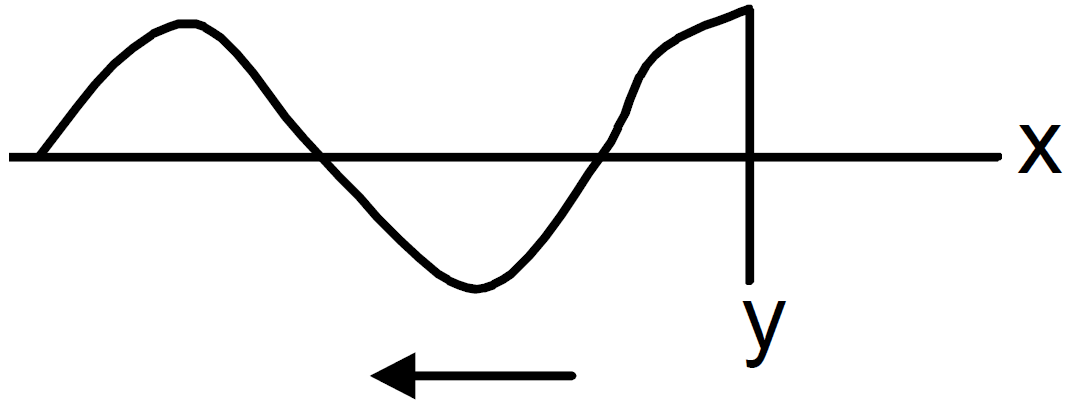
A wave pulse passing on a string with a speed of 40cm/s in the negative x-direction has its maximum at x = 0 at t = 0. Where will this maximum be located at t = 5s?
Answer
v = 40cm/sec
As velocity of a wave is constant location of maximum after 5sec

= 40 × 5 = 200cm along negative x-axis.
View full question & answer
Question 61 Mark
If the speed of a transverse wave on a stretched string of length 1m is 60m/s, what is the fundamental frequency of vibration?
Answer
$\text{l}=1\text{m},\text{v}=60\text{m/s}$$\therefore\ $fundamental frequency, $\text{f}_0=\frac{\text{v}}{2\text{l}}=30\text{sec}^{-1}=30\text{Hz}.$
View full question & answer
Question 71 Mark
You are walking along a seashore and a mild wind is blowing. Is the motion of air a wave motion?
Answer
No, in wave motion there is no actual transfer of matter but transfer of energy between the points where as when wind blows air particles moves with it.
View full question & answer
Question 81 Mark
A wave is represented by an equation $\text{y}=\text{c}_1\sin(\text{c}_2\text{x}+\text{c}_3\text{t}).$ In which direction is the wave going ? Assume that $c_1, c_2$ and $c_3$ are all positive.
Answer
Equation of the wave is.$\text{y}=\text{c}_1\sin(\text{c}_2\text{x}+\text{c}_3\text{t})$
When the variable of the equation is ($\text{c}_2\text{x}+\text{c}_3\text{t}$), then the wave must be moving in the negative x-axis with time t.
View full question & answer
Question 91 Mark
Two wave pulses identical in shape but inverted with respect to each other are produced at the two ends of a stretched string. At an instant when the pulses reach the middle, the string becomes completely straight. What happens to the energy of the two pulses?
Answer
When two wave pulses identical in shape but inverted with respect to each other meet at any instant, they form a destructive interference. The complete energy of the system at that instant is stored in the form of potential energy within it. After passing each other, both the pulses regain their original shape.
View full question & answer