Questions

Case study (4 Marks)

Take a timed test

5 questions · self-marked practice — reveal the answer and mark yourself.

Question 14 Marks
Read the passage given below and answer the following questions from 1 to 5. Beat The phenomenon of regular variation in intensity of sound with time at a particular position due to superposition of two sound waves of slightly different frequencies is called beats. For waves
$\therefore\text{y}=2\text{a}\cos\pi(\text{v}_1-\text{v}_2)\text{t}.\sin\pi(\text{v}_1-\text{v}_2)\text{t}$ is the required equation of beats. Beat frequency is given by $\text{v}_{\text{beat}}=\text{v}_1-\text{v}_2$ Beat period is given by
$\text{T}=\frac{1}{\text{Beat frequency}}=\frac{1}{\text{v}_1-\text{v}_2}$
  1. Which of the following phenomenon is used by the musicians to tune their musical instruments?
  1. Interference
  2. Diffraction
  3. Beats
  4. Polarisation
  1. The phenomenon of beats can take place
  1. For longitudinal waves only
  2. For transverse wave only
  3. For sound waves only
  4. For both longitudinal and transverse waves
  1. When two waves of almost equal frequencies $v_1$ and $v_2$ reach at a point simultaneously, the time interval between successive maxima is:
  1. $\text{v}_1+\text{v}_2$
  2. $\text{v}_1-\text{v}_2$
  3. $\frac{1}{\text{v}_1+\text{v}_2}$
  4. $\frac{1}{\text{v}_1-\text{v}_2}$
  1. Two turning forks of frequencies $n_1$ and $n_2$ produces n beats per second. If $n_2$ and n are known, $n_1$ may be given by:
  1. $\frac{\text{n}_2}{\text{n}}+\text{n}_2$
  2. $\text{n}_2\text{n}$
  3. $\text{n}_2\pm\text{n}$
  4. $\frac{\text{n}_2}{\text{n}}-\text{n}_2$
  1. P and Q are two wires whose fundamental frequencies are 256 Hz and 382 Hz respectively. How many beats in two seconds will be heard by the third harmonic of A and second harmonic of B?
  1. 4
  2. 8
  3. 16
  4. zero
Answer
  1. (c) Beats
  2. (d) For both longitudinal and transverse waves
Explanation:

The phenomenon of beats can take place for both longitudinal and transverse waves.
  1. (d) $\frac{1}{\text{v}_1-\text{v}_2}$
Explanation:

When two waves of almost equal frequencies $v_1$ and $v_2$ reach at a point simultaneously, beats are produced.
Beat frequency, $\text{v}_{\text{beat}}=\text{v}_1-\text{v}_2$ Time interval between successive maxima
$=\frac{1}{\text{v}_{\text{beat}}}=\frac{1}{\text{v}_1-\text{v}_2}$
  1. (c) $\text{n}_2\pm\text{n}$
Explanation:
Beat frequency = number of beats/sec.
$n = n_2 - n_1$ or $n_1 - n_2$
$\therefore\text{n}_1=\text{n}_2\pm\text{n}$
  1. (b) 8
Explanation:
Beat frequency = $3v_1 - 2v_2 = 3 \times 256 - 2 \times 382 = 768 - 764 = 4 s^{-1}$
Number of beats produced in 2 seconds = 4 × 2 = 8
View full question & answer
Question 24 Marks
Read the passage given below and answer the following questions from 1 to 5.
What happens if a pulse or a wave meets a boundary? If the boundary is rigid, pulse travelling along a stretched string and being reflected by the boundary. Assuming there is no absorption of energy by the boundary, the reflected wave has the same shape as the incident pulse i.e. crest is reflected as crest and trough as trough but it suffers a phase change of π or $180^0$ on reflection. This is because the boundary is rigid and the disturbance must have zero displacement at all times at the boundary. By the principle of superposition, this is possible only if the reflected and incident waves differ by a phase of π, so that the resultant displacement is zero. This reasoning is based on boundary condition on a rigid wall. If on the other hand, the boundary point is not rigid but completely free to move (such as in the case of a string tied to a freely moving ring on a rod), the reflected pulse has the same phase and amplitude (assuming no energy dissipation) as the incident pulse. The net maximum displacement at the boundary is then twice the amplitude of each pulse. An example of non- rigid boundary is the open end of an organ pipe. To summaries, a travelling wave or pulse suffers a phase change of π on reflection at a rigid boundary and no phase change on reflection at an open boundary. We considered above reflection at one boundary. But there are familiar situations (a string fixed at either end or an air column in a pipe with either end closed) in which reflection takes place at two or more boundaries. In a string, for example, a wave travelling in one direction will get reflected at one end, which in turn will travel and get reflected from the other end. This will go on until there is a steady wave pattern set up on the string. Such wave patterns are called standing waves or stationary waves.
  1. A travelling wave or pulse suffers a phase change of π on reflection at:
  1. A rigid boundary
  2. Open boundary
  1. A travelling wave or pulse suffers no phase change on reflection at:
  1. A rigid boundary
  2. Open boundary
  1. What are stationary waves?
  1. Write a note on reflection of travelling wave from rigid boundary.
  1. Write a note on reflection of travelling wave from open boundary.
Answer
  1. (a) A rigid boundary
  1. (b) Open boundary
  1. A wave travelling in one direction will get reflected at one end, which in turn will travel and get reflected from the other end. This will go on until there is a steady wave pattern set up on the string. This wave remains steady in medium and does not travel further such wave patterns are called standing waves or stationary waves.
  1. If the boundary is rigid, a pulse travelling along a stretched string and being reflected by the boundary. The reflected wave has the same shape as the incident pulse i.e. crest is reflected as crest and trough as trough but it suffers a phase change of π or 180° on reflection. This is because the boundary is rigid and the disturbance must have zero displacement at all times at the boundary. By the principle of superposition, this is possible only if the reflected and incident waves differ by a phase of π, so that the resultant displacement is zero. This reasoning is based on boundary condition on a rigid wall.
  1. If the boundary point is not rigid but completely free to move the reflected pulse has the same phase and amplitude (assuming no energy dissipation) as the incident pulse. The net maximum displacement at the boundary is then twice the amplitude of each pulse. An example of non- rigid boundary is the open end of an organ pipe
View full question & answer
Question 34 Marks
Read the passage given below and answer the following questions from 1 to 5.
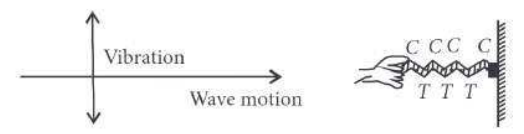
Transverse and Longitudinal Waves Transverse waves forms if the particles of the medium vibrate at right angle to the direction of wave motion energy propagation, the wave is called transverse wave. These are propagated as crests and troughs.

Longitudinal waves forms if the particles of the medium vibrate in the direction of wave motion, the wave is called longitudinal. These are propagated as compressions and rarefactions and wave is also known as pressure or compressional wave. Wave on spring or sound waves in air are examples of longitudinal waves.
  1. In a transverse wave, the particles of the medium:
  1. Vibrate in a direction perpendicular to the direction of the propagation.
  2. Vibrate in a direction parallel to the direction of the propagation.
  3. Move in circle.
  4. Move in ellipse.
  1. A transverse wave consists of:
  1. Only crests
  2. Only troughs
  3. Both crests and troughs
  4. Rarefactions and compressions
  1. Ultrasonic waves produced by a vibrating quartz crystal are:
  1. Only longitudinal.
  2. Only transverse.
  3. Both longitudinal and transverse.
  4. Neither longitudinal nor transverse.
  1. Sound waves travel fastest in:
  1. Solids
  2. Liquids
  3. Gases
  4. Vacuum
  1. Sound waves in air cannot be polarized because:
  1. Their speed is small
  2. They require medium
  3. They are longitudinal
  4. Their speed is temperature dependent
Answer
  1. (a) Vibrate in a direction perpendicular to the direction of the propagation.
Explanation:

In a transverse wave, the particles of the medium vibrate in a direction perpendicular to the direction of the propagation.
  1. (c) Both crests and troughs
Explanation:

A transverse wave travels through a medium in the form of crests and troughs.
  1. (a) Only longitudinal.
Explanation:

Ultrasonic waves produced by a vibrating quartz crystal are longitudinal.
  1. (a) Solids
Explanation:

Sound waves travel fastest in solids.
  1. (c) They are longitudinal
Explanation:

Sound waves are longitudinal waves that is why in air they cannot be polarized.
View full question & answer
Question 44 Marks
Read the passage given below and answer the following questions from 1 to 5.
When we speak, the sound moves outward from us, without any flow of air from one part of the medium to another. The disturbances produced in air are much less obvious and only our ears or a microphone can detect them. These patterns, which move without the actual physical transfer or flow of matter as a whole, are called waves. The most familiar type of waves such as waves on a string, water waves, sound waves, seismic waves, etc. is the so-called mechanical waves. These waves require a medium for propagation, they cannot propagate through vacuum. They involve oscillations of constituent particles and depend on the elastic properties of the medium. The electromagnetic waves that you will learn in Class XII are a different type of wave. Electromagnetic waves do not necessarily require a medium – they can travel through vacuum. Light, radio waves, X-rays, are all electromagnetic waves. We have seen that motion of mechanical waves involves oscillations of constituents of the medium. If the constituents of the medium oscillate perpendicular to the direction of wave propagation, we call the wave a transverse wave. If they oscillate along the direction of wave propagation, we call the wave a longitudinal wave. In transverse waves, the particle motion is normal to the direction of propagation of the wave. Therefore, as the wave propagates, each element of the medium undergoes a shearing strain. Transverse waves can, therefore, be propagated only in those media, which can sustain shearing stress, such as solids and not in fluids. Fluids, as well as, solids can sustain compressive strain; therefore, longitudinal waves can be propagated in all elastic media.
For example, in medium like steel, both transverse and longitudinal waves can propagate, while air can sustain only longitudinal waves. Answer the following.
  1. Air can sustain:
  1. Transverse waves
  2. Longitudinal waves
  3. Both a and b
  4. None of these
  1. The electromagnetic waves can pass through
  1. Solids only
  2. Fluids only
  3. Any medium even through vacuum
  4. None of these
  1. Define Transverse waves
  1. Define longitudinal waves
  1. Differentiate between Transverse waves and longitudinal waves
Answer
  1. (b) Longitudinal waves
  1. (c) Any medium even through vacuum
  1. If the constituents of the medium oscillate perpendicular to the direction of wave propagation, wave is called as transverse wave.
  1. If oscillations of constituents of the medium are along the direction of wave propagation that is parallel to direction of propagation we call the wave a longitudinal wave.
  1. Following are differentiation points:
Sr No.
Transverse waves
longitudinal waves
1
If the constituents of the medium oscillate perpendicular to the direction of wave propagation, wave is called as transverse wave
If oscillations of constituents of the medium are along the direction of wave propagation that is parallel to direction of propagation we call the wave a longitudinal wave.
2
Can passs trough solids only
Can pass through both solids and fluids
3
Example electromagnetic waves
Example sound wave
View full question & answer
Question 54 Marks
Read the passage given below and answer the following questions from 1 to 5.
Beats is an interesting phenomenon arising from interference of waves. When two harmonic Sound waves of slightly different frequencies and comparable amplitude are heard at the same time, we hear a sound of similar frequency (the average of two close frequencies), but we hear something else also. We hear audibly distinct waxing and waning of the intensity of the sound, with a frequency equal to the difference in the two close frequencies. Beat frequency is given by
$u = u_1 - u_2$
Artists use this phenomenon often while tuning their instruments with each other. They go on tuning until their sensitive ears do not detect any beats.
Doppler Effect is a wave phenomenon, it holds not only for sound waves but also for electromagnetic waves. However, here we shall consider only sound waves. Doppler Effect is defined as increase or decrease in frequency of sound due to relative motion between source of sound and observer. Frequency increases when source and observer comes towards each other and frequency decreases when source and observer go away from each other .For sound the observed frequency n is given in terms of the source frequency $v_0$ by
$\text{u}=\text{v}_0\frac{\text{v}+\text{v}_0}{\text{v}+\text{vs}}$
Here v is the speed of sound through the medium, is the velocity of observer relative to the medium, and is the source velocity relative to the medium. In using this formula, velocities in the direction OS should be treated as positive and those opposite to it should be taken to be negative. The change in frequency caused by a moving object due to Doppler Effect is used to measure their velocities in diverse areas such as military, medical science, astrophysics, etc. It is also used by police to check over-speeding of vehicles. A sound wave or electromagnetic wave of known frequency is sent towards a moving object. Some part of the wave is reflected from the object and its frequency is detected by the monitoring station. This change in frequency is called Doppler shift. It is used at airports to guide aircraft, and in the military to detect enemy aircraft. Astrophysicists use it to measure the velocities of stars. Doctors use it to study heart beats and blood flow in different parts of the body. Here they use ultrasonic waves, and in common practice, it is called sonography. Ultrasonic waves enter the body of the person, some of them are reflected back, and give information about motion of blood and pulsation of heart valves, as well as pulsation of the heart of the foetus. In the case of heart, the picture generated is called echocardiogram. Answer the following
  1. Beats are heard after superposition of two waves with beat frequency.
  1. $υ = υ_1 - υ_2$
  2. $υ = υ_1 + υ_2$
  3. $υ = (υ_1 - υ_2)/_2$
  4. None of these
  1. When source and observer comes towards each other then frequency heard will.
  1. Increase
  2. Decrease
  3. Remains same
  4. None of these
  1. Define beats.
  1. Define Doppler effect in sound.
  1. Note on applications of Doppler Effect in sound.
Answer
  1. (a) $υ = υ_1 - υ_2$
  1. (2) Increase
  1. Beats is an interesting phenomenon arising from interference of waves. When two harmonic Sound waves of slightly different frequencies and comparable amplitude are heard at the same time, we hear audibly distinct waxing and waning of the intensity of the sound, with a frequency equal to the difference in the two close frequencies. Beat frequency is given by $= υ = υ_{1 -} υ_2$
  1. Doppler Effect is defined as increase or decrease in frequency of sound due to relative motion between source of sound and observer. Frequency increases when source and observer comes towards each other and frequency decreases when source and observer go away from each other .For sound the observed frequency n is given in terms of the source frequency $v_0$ by
$\text{u}=\text{v}_0\frac{\text{v}+\text{v}_0}{\text{v}+\text{vs}}$

Here v is the speed of sound through the medium, is the velocity of observer relative to the medium, and is the source velocity relative to the medium.
  1. The change in frequency caused by a moving object due to Doppler Effect
  1. It is used to measure their velocities in diverse areas such as military, medical science, astrophysics, etc
  2. It is also used by police to check over-speeding of vehicles.
  3. A sound wave or electromagnetic wave of known frequency is sent towards a moving object. Some part of the wave is reflected from the object and its frequency is detected by the monitoring station. This change in frequency is called Doppler shift. It is used at airports to guide aircraft, and in the military to detect enemy aircraft.
  4. Astrophysicists use it to measure the velocities of stars. Doctors use it to study heart beats and blood flow in different parts of the body.
  5. Doctors use it to study heart beats and blood flow in different parts of the body. Here they use ultrasonic waves, and in common practice, it is called sonography. Ultrasonic waves enter the body of the person, some of them are reflected back, and give information about motion of blood and pulsation of heart valves, as well as pulsation of the heart of the foetus. In the case of heart, the picture generated is called echocardiogram.
View full question & answer
