Questions

M.C.Q (1 Marks)

Take a timed test

19 questions · auto-graded multiple-choice test.

MCQ 11 Mark
Consider two observers moving with respect to each other at a speed v along a straight line. They observe a bock of mass m moving a distancel on a rough surface. The following quantities will be same as observed by the two observers.
  • A
    Kinetic energy of the block at time t.
  • B
    Work done by friction.
  • C
    Total work done on the block.
  • Acceleration of the block.
Answer
Correct option: D.
Acceleration of the block.
Acceleration of the block will be the same to both the observers. The respective kinetic energies of the observers are different, because the block appears to be moving with different velocities to both the observers. Work done by the friction and the total work done on the block are also different to the observers.
View full question & answer
MCQ 21 Mark
A block of mass m slides down a smooth vertical circular track. During the motion, the block is in:
  • A
    Vertical equilibrium.
  • B
    Horizontal equilibrium.
  • C
    Radial equilibrium.
  • None of these.
Answer
Correct option: D.
None of these.
The net force on the block is not zero, therefore the block will not be in any given equilibrium.
View full question & answer
MCQ 31 Mark
The total work done on a particle is equal to the change in its kinetic energy:
  • Always.
  • B
    Only if the forces acting on it are conservative.
  • C
    Only if gravitational force alone acts on it.
  • D
    Only if elastic force alone acts on it.
Answer
Correct option: A.
Always.
According to the work-energy theorem, the total work done on a particle is equal to the change in kinetic energy of the particle.
View full question & answer
MCQ 41 Mark
The kinetic energy force on the particle continuously increases with time.
  1. The resultant force on the particle must be parallel to the velocity at all instants.
  2. The resultant force on the particle must be at an angle less than $90^\circ$ all the time.
  3. Its height above the ground level must continuously decrease.
  4. The magnitude of its linear momentum is increasing continuously.
  • A
    $A$ and $D$
  • $B$ and $D$
  • C
    $B$ and $C$
  • D
    $C$ and $D$
Answer
Correct option: B.
$B$ and $D$
Kinetic energy of a particle is directly proportional to the square of its velocity.
The resultant force on the particle must be at an angle less than $90^\circ$ with the velocity all the time so that the velocity or kinetic energy of the particle keeps on increasing.
The kinetic energy is also directly proportional to the square of its momentum,
therefore it continuously increases with the increase in momentum of the particle.
View full question & answer
MCQ 51 Mark
A particle is acted upon by a force of constant magnitude which is always perpendicular to the velocity of the particle. The motion of the particle takes place in a plane. It follows that:
  1. Its velocity is constant.
  2. Its acceleration is constant.
  3. Its kinetic energy is constant.
  4. It moves in a circular path.
  • A
    $A$ and $B$
  • B
    $A$ and $C$
  • C
    $C$ and $D$
  • $C$ and $D$
Answer
Correct option: D.
$C$ and $D$
When the force on a particle is always perpendicular to its velocity, the work done by the force on the particle is zero, as the angle between the force and velocity is $90^\circ$ .
So, kinetic energy of the particle will remain constant.
The force acting perpendicular to the velocity of the particle provides centripetal acceleration that causes the particle to move in a circular path.
View full question & answer
MCQ 61 Mark
A particle is rotated in a vertical circle by connecting it to a string of length l and keeping the other end of the string fixed. The minimum speed of the particle when the string is horizontal for which the particle will complete the circle is:
  • A
    $\sqrt{\text{gl}}$
  • B
    $\sqrt{2\text{gl}}$
  • $\sqrt{3\text{gl}}$
  • D
    $\sqrt{5\text{gl}}$
Answer
Correct option: C.
$\sqrt{3\text{gl}}$
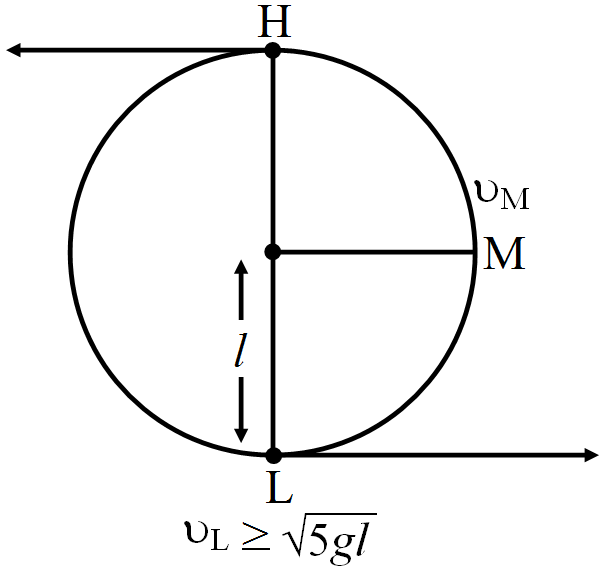
Suppose that one end of an extensible string is attached to a mass m, while the other end is fixed. The mass moves with a velocity v in a vertical circle of radius R. At some instant, the string makes an angle $\theta$ with the vertical as shown in the figure.

For a complete circle, the minimum velocity at L must be $\nu_\text{L}=\sqrt{5\text{gl}}.$
Applying the law of conservation of energy, we have:
Total energy at M = total energy at L
i.e., $\frac{1}{2}\text{m}\nu_{\text{M}^2}+\text{mgl}=\frac{1}{2}\text{m}\nu_{\text{L}^2}$
$\Rightarrow\frac{1}{2}\text{m}\nu_{\text{M}^2}=\frac{1}{2}\text{m}\nu_{\text{L}^2}-\text{mgl}$
Using $\nu_\text{L}\geq\sqrt{5\text{gl}},$ we have:
$\frac{1}{2}\text{m}\nu_{\text{M}^2}\geq\frac{1}{2}\text{m}(5\text{gl})-\text{mgl}$
$\therefore\ \nu_\text{M}=\sqrt{3\text{gl}}$
View full question & answer
MCQ 71 Mark
Two springs $A$ and $B(k_A = 2k_B)$ are stretched by applying forces of equal magnitudes at the four ends. If the energy stored in $A$ is $E,$ that in $B$ is:
  • A
    $\frac{\text{E}}{2}$
  • $2\text{E}$
  • C
    $\text{E}$
  • D
    $\frac{\text{E}}{4}$
Answer
Correct option: B.
$2\text{E}$
Let $x_A$ and $x_B$ be the extensions produced in springs $A$ and $B$, respectively.
Restoring force on spring $A, F=k_A x_A . .(1)$
Restoring force on spring $B, F=k_B x_B \ldots(2)$
From $(1)$ and $(2),$ we get:
$k_A x_A=k_B x_B$
It is given that $k_A=2 k_B$
$\therefore\ \text{x}_\text{B}=2\text{x}_\text{A}$
Energy stored in spring $A:$
$\text{E}=\frac{1}{2}\text{k}_\text{A}\text{x}_\text{A}^2\ \dots(3)$
Energy stored in spring $B:$
$\text{E}'=\frac{1}{2}\text{k}_\text{B}\text{x}_\text{B}^2=\frac{1}{2}\Big(\frac{\text{k}_\text{A}}{2}\Big)(2\text{x}_\text{A})^2$
$\therefore\ \text{E}'=2\times\Big(\frac{1}{2}\text{k}_\text{A}\text{x}_\text{A}^2\Big)=2\text{E} [$From $(3)]$
View full question & answer
MCQ 81 Mark
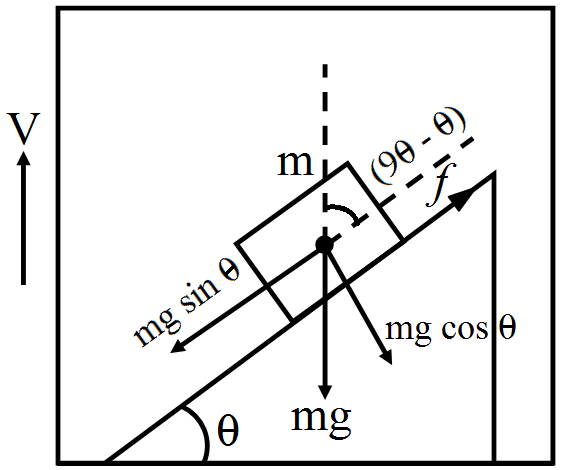
A small block of mass m is kept on a rough inclined surface of inclination $\theta$ fixed in an elevator. The elevator goes up with a uniform velocity v and the block does not slide on the wedge. The work done by the force of friction on the block in time t will be:
  • A
    zero
  • B
    $\text{mgvt}\cos^2\theta$
  • $\text{mgvt}\sin^2\theta$
  • D
    $\text{mgvt}\sin2\theta$
Answer
Correct option: C.
$\text{mgvt}\sin^2\theta$
Distance (d) travelled by the elevator in time t = vt
The block is not sliding on the wedge.
Then friction force $(\text{f})=\text{mg}\sin\theta$
Work done by the friction force on the block in time t is given by,
$\text{W}=\text{Fd}\cos(90-\theta)$
$\Rightarrow\text{W}=\text{mg}\sin\theta\times\text{d}\times\cos(90-\theta)$
$\Rightarrow\text{W}=\text{mgd}\sin^2\theta$
$\therefore\ \text{W}=\text{mg}\nu\text{t}\sin^2\theta$
View full question & answer
MCQ 91 Mark
______ of a two particle system depends only on the separation between the two particles. The most appropriate choice for the blank space in the above sentence is:
  • A
    Kinetic energy.
  • B
    Total mechanical energy.
  • Potential energy.
  • D
    Total energy.
Answer
Correct option: C.
Potential energy.
The potential energy of a two particle system depends only on the separation between the particles.
View full question & answer
MCQ 101 Mark
One end of a light spring of spring constant $k$ is fixed to a wall and the other end is tied to a block placed on a smooth horizontal surface. In a displacement, the work done by the spring is $\frac{1}{2}\text{kx}^2.$ The possible cases are:
  1. At spring was initially compressed by a distance $x$ and was finally in its natural length.
  2. It was initially stretched by a distance $x$ and and finally was in its natural length.
  3. It was initially in its natural length and finally in a compressed position.
  4. It was initially in its natural length and finally in a stretched position.
  • $A$ and $B$
  • B
    $B$ and $C$
  • C
    $B$ and $D$
  • D
    $C$ and $D$
Answer
Correct option: A.
$A$ and $B$
For an elastic spring, the work done is equal to the negative of the change in its potential energy.
When the spring was initially compressed or stretched by a distance $x$, its potential energy is given by,
$(\text{P.E.})_\text{i}=\frac{1}{2}\text{kx}^2$
When it finally comes to its natural length, its potential energy is given by,
$(\text{P.E.})_\text{f}=0$
$\therefore$ Work done $=-[(\text{P.E.})_\text{f}-(\text{P.E.})_\text{i}]$
$=-\Big[0-\frac{1}{2}\text{kx}^2\Big]$
$=\frac{1}{2}\text{kx}^2$
View full question & answer
MCQ 111 Mark
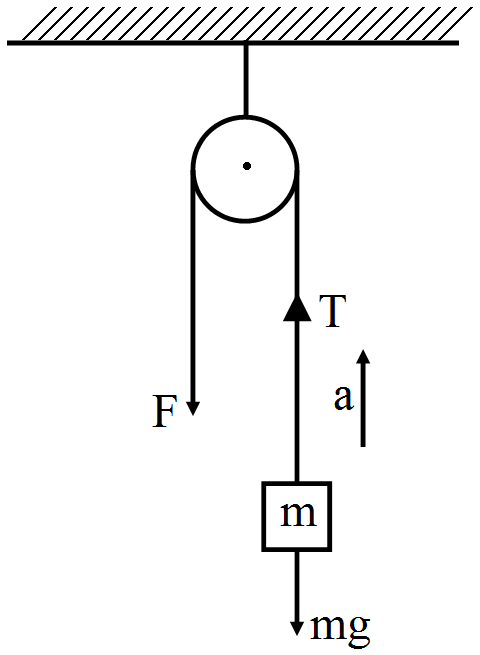
A block of mass M is hanging over a smooth and light pulley through a light string. T he other end of the string is pulled by a constant force F. The kinetic energy of the block increases by 20J in 1s.
  • A
    The tension in the string is Mg.
  • The tension in the string is F.
  • C
    The work one by the tension on the block is 20J in the above 1s.
  • D
    The work done by the force of gravity is -20J in the above 1s.
Answer
Correct option: B.
The tension in the string is F.
Tension in the string is equal to F, as tension on both sides of a frictionless and massless pulley is the same.
i.e., T - Mg = Ma
⇒ T = Mg + Ma
So, the tension in the string cannot be equal to Mg.
The change in kinetic energy of the block is equal to the work done by gravity.
Hence, the work done by gravity is 20J in 1s, while the the work done by the tension force is zero.
 
 
View full question & answer
MCQ 121 Mark
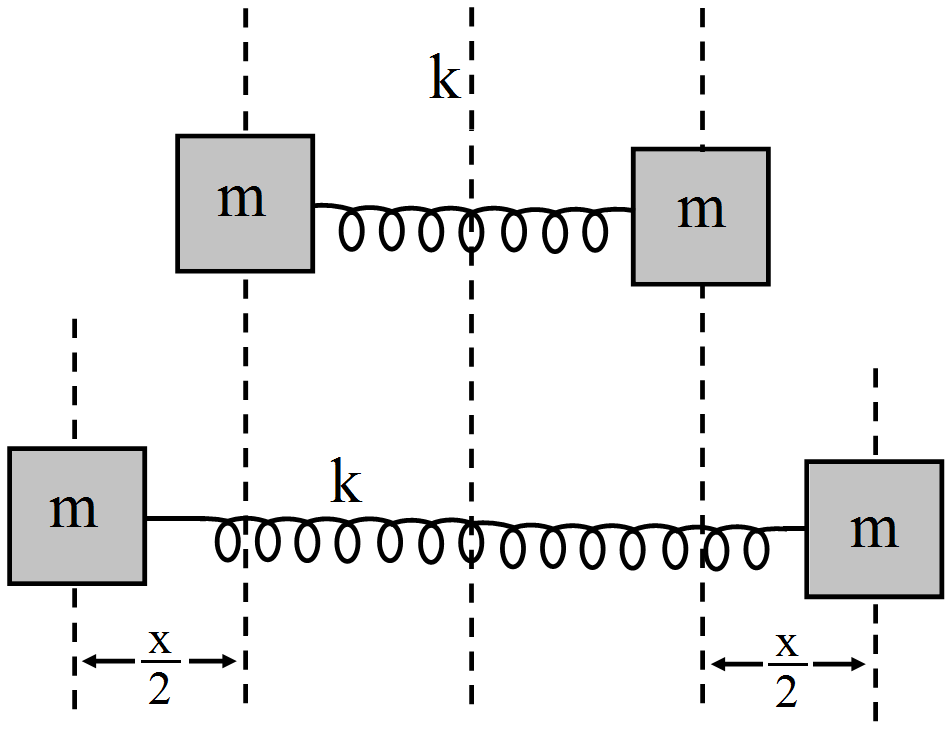
Two equal masses are attached to the two ends of a spring of spring constant k. The masses are pulled out symmetrically to stretch the spring by a length x over its natural length. The work done by the spring on each mass is:
  • A
    $\frac{1}{2}\text{kx}^2$
  • B
    $-\frac{1}{2}\text{kx}^2$
  • C
    $\frac{1}{4}\text{kx}^2$
  • $-\frac{1}{4}\text{kx}^2$
Answer
Correct option: D.
$-\frac{1}{4}\text{kx}^2$
The work done by the spring on both the masses is equal to the negative of the increase in the elastic potential energy of the spring.
The elastic potential energy of the spring is given by $\text{E}_\text{p}=\frac{1}{2}\text{kx}^2.$
Work done by the spring on both the masses $=-\frac{1}{2}\text{kx}^2$
$\therefore$ Work done by the spring on each mass $=\frac{1}{2}\Big(-\frac{1}{2}\text{kx}^2\Big)$
$=-\frac{1}{4}\text{kx}^2$
View full question & answer
MCQ 131 Mark
A heavy stone is thrown in from a cliff of height h in a given direction. The speed with which it hits the ground:
  • A
    Must depend on the speed of projection.
  • B
    Must be larger than the speed of projectio.
  • C
    Must be independent of the speed of projection.
  • Both $A$ and $B.$
Answer
Correct option: D.
Both $A$ and $B.$
Consider that the stone is projected with initial speed $v.$
As the stone is falls under the gravitational force, which is a conservative force, the total energy of the stone remains the same at every point during its motion.
From the conservation of energy, we have:
Initial energy of the stone = final energy of the stone
i.e., $(K.E.)_i + (P.E.)_i= (K.E.)_f+ (P.E.)_f$
$=\frac{1}{2}\text{mv}_\text{r}^2+\text{mgh}=\frac{1}{2}\text{m}(\text{v}_\text{max})^2$
$\Rightarrow\text{v}_\text{max}=\sqrt{\text{v}^2+2\text{gh}}$
From the above expression, we can say that the maximum speed with which the stone hits the ground depends on the speed of projection and greater than it.
View full question & answer
MCQ 141 Mark
The work done by the external forces on a system equals the change in:
  • Total energy.
  • B
    Kinetic energy.
  • C
    Potential energy.
  • D
    None of these.
Answer
Correct option: A.
Total energy.
When work is done by an external forces on a system, the total energy of the system will change.
View full question & answer
MCQ 151 Mark
The work done by all the forces (external and internal) on a system equals the change in:
  • Total energy.
  • B
    Kinetic energy.
  • C
    Potential energy.
  • D
    None of these.
Answer
Correct option: A.
Total energy.
The work done by all the forces (external and internal) on a system is equal to the change in the total energy.
View full question & answer
MCQ 161 Mark
A heavy stone is thrown from a cliff of height $h$ with a speed $\nu.$ The stone will hit the ground with maximum speed if it is thrown:
  • A
    Vertically downward.
  • B
    Vertically upward.
  • C
    Horizontally.
  • The speed does not depend on the initial direction.
Answer
Correct option: D.
The speed does not depend on the initial direction.
As the stone falls under the gravitational force, which is a conservative force, the total energy of the stone remains the same at every point during its motion.
From the conservation of energy, we have:
Initial energy of the stone $=$ final energy of the stone
i.e., $(\text { K.E. })_i+(\text { P.E. })_i=(\text { K.E. })_f+(\text { P.E. })_f$
$=\frac{1}{2}\text{mv}^2+\text{mgh}=\frac{1}{2}\text{m}(\text{v}_\text{max})^2$
$\Rightarrow\text{v}_\text{max}=\sqrt{\text{v}^2+2\text{gh}}$
From the above expression, we can say that the maximum speed With which stone hits the ground does not depend on the initial direction.
View full question & answer
MCQ 171 Mark
The negative of the work done by the conservative internal forces on a system equals the change in:
  • A
    T​​​​​otal energy.
  • B
    Kinetic energy.
  • Potential energy.
  • D
    None of these.
Answer
Correct option: C.
Potential energy.
The negative of the work done by the conservative internal forces on a system is equal to the changes in potential energy.
i.e. $\text{W}=-\triangle\text{ P.E.}$
View full question & answer
MCQ 181 Mark
A particle of mass $m$ is attached to a light string of length $l$, the other end of which is fixed. Initially the string is kept horizontal and the particle is given an upward velocity $v.$ The particle is just able to complete a circle.
  1. The string becomes slack when the particle reaches its highest point.
  2. The velocity of the particle become zero at the highest point.
  3. The kinetic energy of the ball in initial position was $\frac{1}{2}\text{m}\nu^2=\text{mgl}.$
  4. The particle again passes through the initial position.
  • A
    $A$ and $B$
  • B
    $B$ and $D$
  • $A$ and $D$
  • D
    $C$ and $D$
Answer
Correct option: C.
$A$ and $D$

The string becomes slack when the particle reaches its highest point. This is because at the highest point, the tension in the string is minimum. At this point, potential energy of the particle is maximum, while its kinetic energy is minimum. From the law of conservation of energy, we can see that the particle again passes through the initial position where its potential energy is minimum and its kinetic energy is maximum.

View full question & answer
MCQ 191 Mark
No work is done by a force on an object if:
  • A
    The force is always perpendicular to its velocity.
  • B
    The object moves in such a way that the point of application of the force remains fixed.
  • C
    The object is stationary but the point of application of the force moves on the object.
  • All of the above
Answer
Correct option: D.
All of the above
No work is done by a force on an object if the force is always perpendicular to its velocity. Acceleration does not always provide the direction of motion, so we cannot say that no work is done by a force on an object if it is always perpendicular to the acceleration. Work done is zero when the displacement is zero.
In a circular motion, force provides the centripetal acceleration. The angle between this force and the displacement is $90^\circ $, so work done by the force on an object is zero.
View full question & answer