Questions · Page 3 of 3

1 Marks Question

Question 1021 Mark
Cervix contains the largest and the strongest sphincter in its wall. Give reason.
Answer
Cervix can hold about 7kg of foetus and fluid in the uterus against the pull of gravity for several days during pregnancy. Thus, it contains the largest and strongest sphincter.
View full question & answer
Question 1031 Mark
Why are menstrual cycles absent during pregnancy.
Answer
High level of progesterone and estrogens during pregnancy suppress the gonadotropins which is required for the development of new follicles. Therefore, a new cycle cannot be initiated.
View full question & answer
Question 1061 Mark
The corona radiata of an ovum acts as a barrier for the penetration of sperms. How do sperms overcome this barrier?
Answer
The acrosome of the sperm contains sperm lysin (hyaluronidase) which dissolve the mucopolysaccharide, hyaluronic acid by which the cells of corona radiata glued together.
View full question & answer
Question 1071 Mark
Mark the odd one the following groups.
Bulbourethral gland, Prostate, Seminal vesicle, Seminiferous tubule.
Answer
Seminiferous tubule.
View full question & answer
Question 1081 Mark
State where the signals for parturition arise from, in humans.
Answer
The signals for parturition arise from the fully-developed foetus and the placenta.
View full question & answer
Question 1091 Mark
Define Lactation.
Answer
Lactation is the process of feeding the new born baby with the milk secreted by the mammary glands.
Endometrium is the inner most glandular layer of the uterine wall that undergoes cyclical changes during menstrual cycle, where implantation occurs; it also forms a part of the placenta.
View full question & answer
Question 1101 Mark
What is the role of cervix of the human female system in reproduction?
Answer
Cervix helps in regulating the passage of sperms into the uterus and forms the birth canal to facilitate parturition.
View full question & answer
Question 1111 Mark
What name is given to the cells of inner cell mass, that have the potential to give rise to all tissues and organs in a human being?
Answer
Stem cells.
View full question & answer
Question 1121 Mark
How many ova will be produced by one fully grown primary oocyte?
Answer
One ova is produced by one fully grown primary oocyte.
View full question & answer
Question 1131 Mark
How is a primary spermatocyte different from a secondary spermatocyte?
Answer
  1. A primary spermatocyte is diploid and has 46 chromosomes; it undergoes meiosis I and forms two secondary spermatocytes.
  2. A secondary spermatocyte is haploid and has 23 chromosomes; it undergoes meiosis II and forms two spermatids.
View full question & answer
Question 1151 Mark
Observe the relationship between first two words and suggest suitable word for the fourth one:
  1. Ovary : Mesovarium :: Uterus: A.
  2. Male : Penis :: Female : B.
  3. Male gametes: Sperms:: Female gametes: C.
Answer
  1. A - Pelvic wall.
  2. B - Clitoris.
  3. C - Ova.
View full question & answer
Question 1161 Mark
What is urethral meatus?
Answer
The urethra originates from the urinary bladder and extends through penis to its external opening called urethral meatus.
View full question & answer
Question 1181 Mark
How does the sperm penetrate through the zona pellucida in human ovum?
Answer
The sperm penetrates through zona pellucida with the help of secretions from acrosome.
View full question & answer
Question 1201 Mark
State the function of trophoblast in human embryo.
Answer
Trophoblast forms chorionic villi, which become part of the placenta.
View full question & answer
Question 1211 Mark
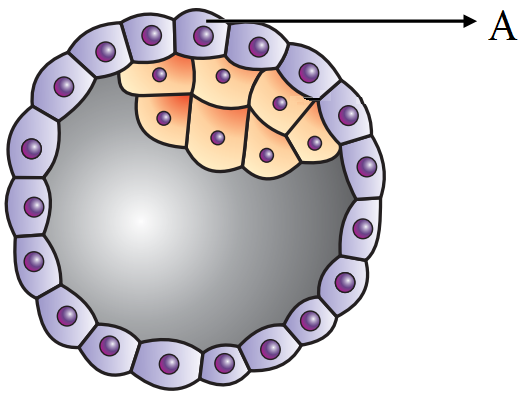
Identify the figure given and the part labelled “A”.
Answer
It is a mammalian blastocyst.
A is trophoblast.
View full question & answer
Question 1221 Mark
Define spermiogenesis. Where does it occur?
Answer
Spermiogenesis is the formation of haploid, microscopic and functional spermatozoa (male gametes) from the spermatids. It takes place in the testes (male reproductive organ).
View full question & answer
Question 1231 Mark
State the functions of acrosome.
Answer
Acrosome contains hydrolytic enzymes used to penetrate the egg during fertilisation.
View full question & answer
Question 1271 Mark
The basal parts of the endometrium remain intact during menstruation. Give reason.
Answer
The basal parts of endometrium remain intact as they form the source of new endometrial lining and glands for the next cycle.
View full question & answer
Question 1291 Mark
What is meant by gestation period?
Answer
The time period between implantation and parturition, when the embryo completes its growth and development, is called gestation period.
View full question & answer
Question 1301 Mark
Which part of the blastula is destinated to form germ layers of the developing embryo in humans?
Answer
ICM (Inner Cell Mass).
View full question & answer
Question 1311 Mark
Write the physiological reason, why a woman generally cannot conceive a child after 50 years of age.
Answer
Menopause, i.e. stoppage of menstrual cycles occurs around 50 years of age; since no ovulation occurs, the woman cannot conceive after this age.
View full question & answer
Question 1321 Mark
Name any two hormones found in the blood of a pregnant female only.
Answer
Relaxin and human chorionic gonadotropin.
View full question & answer
Question 1331 Mark
What is the function of umbilical cord?
Answer
Placenta is connected to embryo through umbilical cord and helps in transport of substance to and from the embryo.
View full question & answer
Question 1341 Mark
Mention the functions of trophoblast in human embryo.
Answer
Trophoblast is cells forming the outer layer of a blastocyst, which provide nutrients to the embryo and develop into a large part of the placenta. They are formed during the first stage of pregnancy and are the first cells to differentiate from the fertilized egg.
View full question & answer
Question 1351 Mark
What are chorionic villi?
Answer
Chorionic villi are the finger-like projections formed by the trophoblast immediately after implantation; they form the foetal part of the placenta.
View full question & answer
Question 1361 Mark
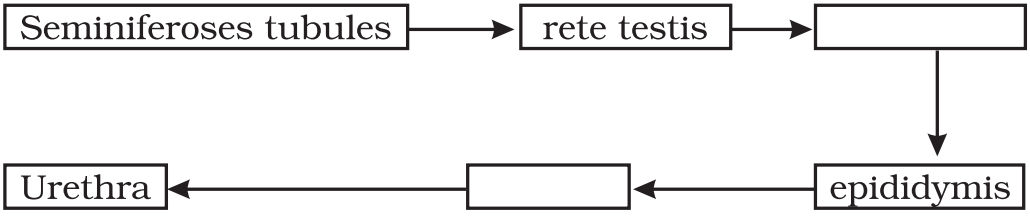
What is the name of network formed by the fusion of open ends of seminiferous tubules? Where does this network lead to?
Answer
Rete testis. It leads to vas deference.
View full question & answer
1 Marks Question - Page 3 - Biology STD 12 Science Questions - Vidyadip