MCQ 11 Mark
Zoospores are the reproductive units to carry asexual reproduction in:
MCQ 21 Mark
In yeast cell division results in a small cell called.
MCQ 31 Mark
The male gametes of rice plant have $12$ chromosomes in their nucleus. The chromosome number in the female gamete, zygote and the cells of the seedling will be, respectively:
- A
$12, 24, 12.$
- B
$24, 12, 12.$
- ✓
$12, 24, 24.$
- D
$24, 12, 24.$
AnswerCorrect option: C. $12, 24, 24.$
Gametophytic structure $(n)$ of rice plant contain $12$ chromosomes and sporophytic structure $(2n)$ of rice contain $24$ chromosomes.
Female gamete $(n) = 12,$
Zygote $(2n) = 24,$
The cells of the seedling $(2n) = 24.$
View full question & answer→MCQ 41 Mark
The terms homothallic and monoecious are used to denote:
MCQ 51 Mark
A few statements with regard to sexual reproduction are given below:
- Sexual reproduction does not always require two individuals.
- Sexual reproduction generally involves gametic fusion.
- Meiosis never occurs during sexual reproduction.
- External fertilisation is a rule during sexual reproduction.
Choose the correct statements from the options below:
- A
$ii$ and $iii$
- B
$i$ and $iv$
- ✓
$i$ and $ii$
- D
$ii$ and $iv$
AnswerCorrect option: C. $i$ and $ii$
View full question & answer→MCQ 61 Mark
Budding and fission are processes used by:
- A
- B
Hermaphroditic organisms.
- C
Organisms requiring new gene combinations for each generation.
- ✓
Asexually reproducing species.
AnswerCorrect option: D. Asexually reproducing species.
Asexual reproduction is a mode of reproduction by which offspring arise from a single organism, and inherit the genes of that parent only.
Dioecious $($has either male or female sex organ$)$ or hermaphroditic species $($has both male and female sexes$)$ undergo sexual reproduction.
Budding and fission are types of asexual reproduction.
View full question & answer→MCQ 71 Mark
Meiosis is best observed in dividing.
- A
Cells of apical meristem.
- B
Cells of lateral meristem.
- C
Microspores and anther wall.
- ✓
View full question & answer→MCQ 81 Mark
In the egg of bird, shell and shell membranes are:
AnswerCorrect option: A. Permeable to $O_2$ and $CO_2$
Reptiles and birds and some insects have developed eggs with a shell impermeable to water.
These shells allow oxygen to diffuse into the egg and carbon dioxide to diffuse out.
Such eggs which does not allow the transport except for gas exchange are called as cleidoic eggs.
View full question & answer→MCQ 91 Mark
In the list of organisms given below, those that reproduce by the asexual methods are:
AnswerBanana reproduce asexually by 'suckers' formation.
Yeast reproduce asexually by budding and amoeba by binary fission, multiple fission, sporulation and regeneration.
View full question & answer→MCQ 101 Mark
- ✓
Transfer of pollen grain from anther to stigma.
- B
Germination of pollen grain.
- C
Growth of pollen tube in ovule.
- D
Visits of insects in flower.
AnswerCorrect option: A. Transfer of pollen grain from anther to stigma.
Pollination is the process by which pollen is transferred from the anther to the stigma of the plant of the same species, thereby enabling fertilization and reproduction.
This transfer can be accomplished by abiotic agents such as wind and water, but animal pollinators affect the majority of pollination such as insects, birds, and bats. Insects are the most common of the
View full question & answer→MCQ 111 Mark
How many moulting occur, from egg laying to the development of adult cockroach?
- ✓
$10 - 12$ times
- B
$9$ times
- C
$6$ times
- D
$3 - 4$ times
AnswerCorrect option: A. $10 - 12$ times
Each time the molting process is completed the cockroach will get bigger, change in color, and look more like an adult cockroach.
The nymph stage of the cockroach life cycle can take anywhere from a month and a half to several years, depending on the environment, the type of cockroach, and the prevalence of cockroach disease and parasites.
When the cockroach reaches its adult size it will not moult again.
Many types of cockroaches will complete their transformation into adulthood with a pair of wings.
Young adults may look almost exactly like a nymph, with the wings being the one characteristic that easily sets the two apart.
The number of moultings in cockroach after hatching and development of a complete animal are more than $10$ and they vary from one cockroach type to another.
View full question & answer→MCQ 121 Mark
Vegetative propagation in Pistia occurs by:
MCQ 131 Mark
In binary fission, the parent cell divides by the process:
- A
Nucleus and cytoplasm divide simultaneously.
- B
Cytoplasm first divides then nucleus.
- C
Nucleus and cytoplasm do not divide.
- ✓
Nucleus first divides then cytoplasm.
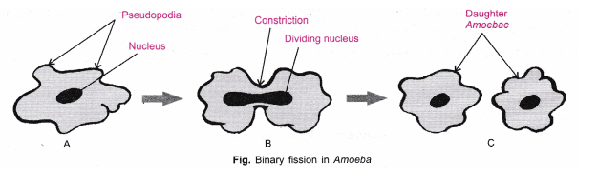
AnswerCorrect option: D. Nucleus first divides then cytoplasm.
During the process of binary division first, the parent cell enlarges and then nuclear division takes place, followed by cytoplasm division as in Amoeba.
View full question & answer→MCQ 141 Mark
The end of vegetative phase in plants which marks the beginning of the reproductive phase can be easily seen in the higher plants when they come to:
MCQ 151 Mark
Reptile and bird eggs are:
AnswerReptiles and birds are terrestrial animals.
They lay large yolk$-$rich eggs which are covered with a porous shell.
As the eggs are rich in yolk they can support the development of an embryo.
Hence, embryogenesis occurs outside the body of the animal inside the egg.
Such yolk$-$rich eggs are called as macrolecithal eggs.
View full question & answer→MCQ 161 Mark
The fusion of male and female gametes is termed as:
AnswerSexual reproduction involves the formation and fusion of germ cells or gametes of both males and females.
This fusion of male and female gamete is termed as fertilization or syngamy.
Fertilization can either occur externally $($outside the body of a female$)$ or internally $($inside the body of a female$)$ to form a diploid zygote which will further develop to form the embryo and later a complete individual.
View full question & answer→MCQ 171 Mark
During the fourth and sixth cleavage of the zygote:
- A
Mesomeres give rise to endoderm.
- ✓
Mocromeres give rise to ectoderm.
- C
Mesomeres give rise to mesoderm.
- D
Macromeres give rise toe ectoderm.
AnswerCorrect option: B. Mocromeres give rise to ectoderm.
View full question & answer→MCQ 181 Mark
Transversely placed syncarpous ovary occurs in:
AnswerIn Cruciferae $($Brassicaceae$)$ gynoecium consisting of twocarpels placed transversely syncarpous.
View full question & answer→MCQ 191 Mark
Appearance of vegetative propagules from the nodes of plants such as sugarcane and ginger is mainly because:
AnswerCorrect option: A. Nodes are located near the soil.
View full question & answer→MCQ 201 Mark
The development of root and shoot in tissue culture is determined by $........$
- A
- ✓
Auxin and cytokinin ratio.
- C
- D
AnswerCorrect option: B. Auxin and cytokinin ratio.
View full question & answer→MCQ 211 Mark
The term ‘clone’ cannot be applied to offspring formed by sexual reproduction because:
- ✓
Offspring do not possess exact copies of parental $\text{DNA}.$
- B
$\text{DNA}$ of only one parent is copied and passed on to the offspring.
- C
Offspring are formed at different times.
- D
$\text{DNA}$ of parent and offspring are completely different.
AnswerCorrect option: A. Offspring do not possess exact copies of parental $\text{DNA}.$
Gametogenesis takes place through meiosis and crossing over takes place during meiosis. Crossing over is responsible for some alteration in genotype. Moreover, fertilization results in gene pools from two different individuals and thus zygote has a somewhat different genotype than both the presents. Hence, the term clone cannot be applied to offspring formed by sexual reproduction.
View full question & answer→MCQ 221 Mark
In sexual reproducing animals, the union of male and female gamete forms a cell, which is called as:
AnswerOvarian cell is the cells of ovary.
Oocyte is the female gametocyte or germ cell. It is involved in reproduction.
Zygote is the diplod cell, formed by the fusion of two gametes $i.e.,$ by the fusion of male gamete $($sperm$)$ or female gamete $($ovum$).$
Graafian follicle is the mature follicle in the ovary of mammals.
It contains cavity, which is filled by liquid and it ruptures during ovulation to release ovum.
View full question & answer→MCQ 231 Mark
In flowering plants both male and female gametes are non-motile. The method to bring them together for fertilization is:
MCQ 241 Mark
In which of the following pairs the plants can be vegetative propagated by leaf buds?
- ✓
Bryophyllum and Kalanchoe.
- B
- C
- D
Asparagus and Bryophyllum.
AnswerCorrect option: A. Bryophyllum and Kalanchoe.
View full question & answer→MCQ 251 Mark
AnswerEstrous cycle is a reproductive cycle of females of non$-$primate vertebrates.
The gap between two estrus periods is known as estrous cycle.
The females are highly receptive during estrus period.
It is an indication of breeding period because one or more periods of estrus may occur during the breeding season of a species.
Polyoestrus are the animals which ovulates more than once in each breeding season.
For example, rabbit. Cats are polyestrous but experience a seasonal anestrus in autumn and late winter.
Horses are seasonal polyestrous.
Humans have menstrual cycle they lack estrous cycle.
View full question & answer→MCQ 261 Mark
The phenomenon of fertilization was first perceived by:
AnswerThe phenomenon of fertilization was first perceived by the German biologist Oscar Hertwig in sea urchin eggs in $1876.$
Hertwig observed that the sperm nuclei and egg fused during fertilization resulting in the generation of new organism.
View full question & answer→MCQ 271 Mark
Which of the following statements, support the view that elaborate sexual reproductive process appeared much later in the organic evolution,
- Lower groups of organisms have simpler body design.
- Asexual reproduction is common in lower groups.
- Asexual reproduction is common in higher groups of organisms.
- The high incidence of sexual reproduction in angiosperms and vertebrates.
Choose the correct answer from the options given below:
- A
$i$ and $iii.$
- B
$i$ and $ii.$
- ✓
$ii$ and $iv.$
- D
$ii$ and $iii.$
AnswerCorrect option: C. $ii$ and $iv.$
Elaborate sexual reproductive process appeared much later in the organic evolution because of Lower groups of organisms have simpler body design. Asexual reproduction is common in lower groups. Asexual reproduction is common in lower groups of organisms. The high incidence of sexual reproduction in angiosperms and vertebrates.
Lower groups of organisms have simpler body design. Asexual reproduction is common in lower groups of organisms. High incidence of sexual reproduction in angiosperms and vertebrates.
View full question & answer→MCQ 281 Mark
Appearance of vegetative propagules from the nodes of plants such as sugarcane and ginger is mainly because:
AnswerCorrect option: B. Nodes have meristematic cells.
Presence of meristematic cells gives the ability of vegetative propagation.
View full question & answer→MCQ 291 Mark
In oogamy, fertilization involves.
- A
A small non$-$motile female gamete and a large motile male gamete.
- ✓
A large non$-$motile female gamete and a small motile male gamete.
- C
A large non$-$motile female gamete and a small non motile male gamete.
- D
A large motile female gamete and a small non$-$motile gamete.
AnswerCorrect option: B. A large non$-$motile female gamete and a small motile male gamete.
View full question & answer→MCQ 301 Mark
Process of formation of an individual without contribution of father is called as:
AnswerThe process of sexual reproduction usually involves gametogenesis, which generates haploid gametes $($sperm and ovum$)$ and their fusion during fertilization.
Sometimes an embryo can develop without participation of male gamete $($sperm$).$
Parthenogenesis is a type of asexual reproduction in which females produce offspring from unfertilized eggs $i.e.,$ the development of an unfertilized egg into an adult organism.
It is common among honeybees, wasps, and certain other arthropods.
View full question & answer→MCQ 311 Mark
External fertilisation occurs in majority of:
MCQ 321 Mark
A sexual reproduction by fragmentation takes place in$-$
View full question & answer→MCQ 331 Mark
Identify the incorrect statement.
- A
In asexual reproduction, the offspring produced are morphologically and genetically identical to the parent.
- B
In asexual reproduction, a single parent produces offspring with or without the formation of gametes.
- ✓
Zoospores are sexual reproductive structures.
- D
In asexual reproduction, a single parent produces offspring with or without the formation of gametes.
AnswerCorrect option: C. Zoospores are sexual reproductive structures.
View full question & answer→MCQ 341 Mark
Which of the following is a post$-$fertilisation event in flowering plants?
- A
Transfer of pollen grains.
- ✓
- C
- D
Formation of pollen grains.
View full question & answer→MCQ 351 Mark
The statements given below describe certain features that are observed in the pistil of flowers:
- Pistil may have many carpels.
- Each carpel may have more than one ovule.
- Each carpel has only one ovule.
- Pistil have only one carpel.
Choose the statements that are true from the options below,
- ✓
$i$ and $ii.$
- B
$i$ and $iii.$
- C
$ii$ and $iv.$
- D
$iii$ and $iv$
AnswerCorrect option: A. $i$ and $ii.$
Pistil may have many carpels. Each carpel may have more than one ovule.
View full question & answer→MCQ 361 Mark
AnswerThe yolk is a part of an egg, that feeds the developing embryo in animals.
It is composed of carbohydrates $(3.5\%),$ protein $(16\%)$ and fats $($phospholipids $26.5\%)$ of total yolk.
The main fatty acids present in the yolk is oleic acid, linoleic acid, palmitic acid etc.
Phosvitins and Lipovitellins are the major proteins present in the yolk.
Apart from that yolk is also composed of vitamins $- \ce{A, D, E},$ and $\ce{K}.$
View full question & answer→MCQ 371 Mark
Offspring formed by sexual reproduction exhibit more variation than those formed by Asexual reproduction because:
AnswerCorrect option: C. Gametes of parents have qualitatively different genetic composition.
View full question & answer→MCQ 381 Mark
Sexual reproduction can be grouped into $........$ distinct states.
View full question & answer→MCQ 391 Mark
An example of a dioecious plant is
MCQ 401 Mark
The process of development of organism like itself is called$-$
AnswerReproduction can be defined as the biological process by which new individuals or offsprings are produced from their 'parents'.
Since the off springs contain the genetic material obtained from their parents, they are similar to their parents.
View full question & answer→MCQ 411 Mark
In oogamy, fertilization involves:
- A
A large non $-$ motile female gamete and a small non$-$motile male gamete.
- B
Large motile female gamete and a small non$-$motile male gamete.
- C
A small non $-$ motile female gamete and a large motile male gamete.
- ✓
A large non $-$ motile female gamete and a small motile male gamete.
AnswerCorrect option: D. A large non $-$ motile female gamete and a small motile male gamete.
Oogamy is the common type of heterogamaous sexual reproduction in which the female gamete or egg cell is non$-$motile and significantly larger than the male gamete.
The male gametes on the other hand are motile spermatozoa that compete for fertilizing the non$-$motile egg.
Oogamy occurs in both plant and animals but also found in some protists.
View full question & answer→MCQ 421 Mark
There is no natural death in single celled organisms like Amoeba and bacteria because:
- A
- ✓
Parental body is distributed among the offspring.
- C
They reproduce by binary fission.
- D
They cannot reproduce sexually.
AnswerCorrect option: B. Parental body is distributed among the offspring.
View full question & answer→MCQ 431 Mark
$........$ refers to the process of asexual reproduction by multiplication of genetically identical copies of individual plants.
View full question & answer→MCQ 441 Mark
When living tissue from a plant is extracted and placed in a medium, it is called $........$
View full question & answer→MCQ 451 Mark
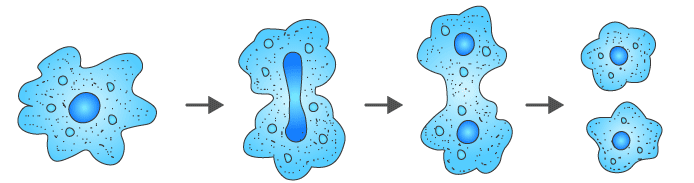
The following figure illustrates:
- ✓
- B
Longitudinal fission in Amoeba
- C
Multiple fission in Amoeba
- D
AnswerThe above given figure shows the binary fission in amoeba.
We know that Amoeba is a unicellular prokaryotic organism which undergoes asexual reproduction.
Amoeba reproduces through binary fission in which the cells are divided which give rise to to daughter Amoeba cells.
Through this replicating method the genetic materials undergo mitosis division and the cell divides as well as the nucleus into two equal sized cells which are genetically clones.
View full question & answer→MCQ 461 Mark
The term ‘Terror of Bengal’ is used for:
MCQ 471 Mark
AnswerThe egg of birds and reptiles is rich in yolk and supports the full development of an embryo.
They lay eggs and are called oviparous animals.
The human egg is not rich in yolk and cannot support the development of an embryo.
Hence, the development of embryo occurs inside the body of the female parent.
Humans are thus viviparous animals giving birth to young ones.
The process of development of an embryo from an unfertilized egg is known as parthenogenesis. It occurs in bees, aphids, water fleas, etc.
Ovo vivipary is the phenomenon when an embryo develops inside an egg and remains in the body of the mother until hatching
View full question & answer→MCQ 481 Mark
Eggs of which one of these can develop parthenogenetically by chemicals?
AnswerArtificial parthenogenesis can be induced in eggs of both frog and sea urchin but chemical $($hypertonic sea water$)$ induction occurs in sea urchin, whereas, frog eggs when pricked with a needle can undergo parthenogenesis.
View full question & answer→MCQ 491 Mark
Ginger multiplies vegetatively by $........$
View full question & answer→MCQ 501 Mark
Fusion of unrelated gametes is called.
MCQ 511 Mark
Amoeba and Yeast reproduce asexually by fission and budding respectively, because they are.
MCQ 521 Mark
Planaria’s most remarkable characteristics are its ability to:
- ✓
- B
Generate bioluminescence.
- C
- D
View full question & answer→MCQ 531 Mark
- ✓
Gametes are invariably haploid.
- B
Spores are invariably haploid.
- C
Gametes are generally haploid.
- D
Both $(a)$ and $(b).$
AnswerCorrect option: A. Gametes are invariably haploid.
View full question & answer→MCQ 541 Mark
Asexual reproduction is common among.
- A
Single celled organisms only.
- B
- C
Animals with simple organization.
- ✓
Single celled animals, plants and animals with simple organizations.
AnswerCorrect option: D. Single celled animals, plants and animals with simple organizations.
View full question & answer→MCQ 551 Mark
Without any exception, all birds:
- A
- B
- C
Forms nests and care them
- ✓
AnswerBirds belong to the class Aves and phylum Chordata.
All the birds have feathers, a lightweight skeleton with hollow bones, beaks and wings.
Although there are certain birds that cannot fly though they have wings.
But all the birds are known to lay eggs.
View full question & answer→MCQ 561 Mark
Diploid parthenogenesis is characteristics of $........$
View full question & answer→MCQ 571 Mark
Which ot the following has the longest life span?
MCQ 581 Mark
- ✓
Oviparous with internal fertilization
- B
Oviparous with external fertilization
- C
- D
AnswerCorrect option: A. Oviparous with internal fertilization
Oviparous animals are those organisms that lay eggs, with little or no other embryonic development within the mother.
In some oviparous animals, fertilization is external $($in fishes, most of the frogs$)$ while in some fertilization is internal, the female lays zygotes as eggs $($typically birds$).$
View full question & answer→MCQ 591 Mark
There are various types of reproduction. The type of reproduction adopted by an organism depends on.
- A
Morphology and physiology of the organism.
- B
Morphology of the organism.
- ✓
The organism’s habitat, physiology, and genetic makeup.
- D
AnswerCorrect option: C. The organism’s habitat, physiology, and genetic makeup.
View full question & answer→MCQ 601 Mark
The process of regeneration of new individual of the same kind is called as:
AnswerOption $A)$
Conversion of food material into energy is said to be metabolism.
There can be catabolism or anabolism.
Option $B)$
Differentiation results in changes in morphology and becoming different.
Option $C)$
Reproduction is a fundamental feature of all living organisms and is a biological process by which living organisms produce offspring similar to them.
View full question & answer→MCQ 611 Mark
Fusion of dissimilar gametes is:
AnswerCross $-$ pollination in a crop plant is known as allogamy.
Allogamy is defined as fertilization of ovum of a flower by the pollen of another flower on the different plant.
The pollen is transferred from the anther of a male flower to the stigma of a female flower.
Allogamy takes place because of the male and female part of a particular flower mature at a different time.
Dichogamy is a condition when the stamens and pistils of a flower mature at different times to prevent self $-$ fertilization.
Autogamy is the phenomena of fusion of gametes produced from the same individual.
It involves the transfer of pollen from the anther to the stigma of the same flower.
It is avoided when the number of seed is less, or the produced pollen is not able to fuse and germinate with the ovule of the same flower or the produced pollen are not healthy.
Fusion of dissimilar gametes is fertilization.
It takes place during sexual reproduction where the male and female gametes fuse to form a zygote.
View full question & answer→MCQ 621 Mark
Development of an egg without fertilization is called.
MCQ 631 Mark
In ginger vegetative propagation occurs through:
MCQ 641 Mark
Vegetative propagation in mint and Chrysanthemum occurs by:
AnswerVegetative propagation involves artificial and natural means by which plants reproduce.
Natural means of vegetative propagation involves sucker which is found in mint as well as banana.
In this case, underground branches arise from the underground stem and protrude upward.
Once branch gets matured, it separates from the parent plant and survives as an individual.
View full question & answer→MCQ 651 Mark
Identify the correct sequence of events:
- A
Gametogenesis $\rightarrow$ Syngamy $\rightarrow$ Embryogenesis $\rightarrow$ Zygote.
- B
Gametogenesis $\rightarrow$ Zygote $\rightarrow$ Syngamy $\rightarrow$ Embryogenesis.
- C
Gametogenesis $\rightarrow$ Embryogenesis Zygote $\rightarrow$ Syngamy.
- ✓
Gametogenesis $\rightarrow$ Syngamy $\rightarrow$ Zygote $\rightarrow$ Embryogenesis.
AnswerCorrect option: D. Gametogenesis $\rightarrow$ Syngamy $\rightarrow$ Zygote $\rightarrow$ Embryogenesis.
View full question & answer→MCQ 661 Mark
There are various types of reproduction. The type of reproduction adopted by an organism depends on:
- A
The habitat and morphology of the organism.
- B
Morphology of the organism.
- C
Morphology and physiology of the organism.
- ✓
The organism’s habitat, physiology and genetic makeup.
AnswerCorrect option: D. The organism’s habitat, physiology and genetic makeup.
The organism's habitat, its internal physiology and several other factors $($genetic makeup$)$ are collectively responsible for how it reproduces. When offspring is produced by a single parent with or without the involvement of gamete formation, the reproduction is asexual.
View full question & answer→MCQ 671 Mark
Consider the following statements and choose the correct option.
- A
The genetic constitution of a plant is unaffected in vegetative propagation.
- B
Rhizome in ginger serves as an organ of vegetative reproduction.
- C
Totipotency of cells enables us to micropropagate plants.
- ✓
AnswerIn vegetative propagation new plant arise from vegetative parts of plant so offspring is clone of parent and have same genetic constituent.
Vegetative propagation in ginger occur from underground stem called as Rhizome.
Totipotency is important in plant cell and tissue culture.
Totipotency means whole plant can be regenerate from single cell.
In tissue culture we produce new plant from single cell by giving plant hormones and required nutrients.
View full question & answer→MCQ 681 Mark
Offspring formed by sexual reproduction exhibit more variation than those formed by Asexual reproduction because:
AnswerCorrect option: C. Gametes of parents have qualitatively different genetic composition.
View full question & answer→MCQ 691 Mark
The migration of pollen grains to stigma is called as $........$
AnswerPollination is the process by which pollen is transferred from the anther or the male part to the stigma or the female part of the plant thereby enabling fertilization and reproduction.
Fertilization is the fusion of male and female gametes.
Reproduction is the biological process by which an individual organism is produced from their parents.
View full question & answer→MCQ 701 Mark
Gametes of similar morphology fuse in:
AnswerIsogamy is a form of sexual reproduction that involves gametes of similar morphology.
The gametes differ in their allele expression.
As they look alike they cannot be classified as male and female gametes.
View full question & answer→MCQ 711 Mark
Vegetative propagation by $...........$ occurs in sweet potato.
AnswerThe vegetative propagation of sweet potato can be done by roots.
Sweet potato is a modification of adventitious roots which grow from the nodes of a running stem and they are irregularly swollen due to storage of food.
They can give rise to adventitious buds which when detached can give rise to new plants thus performing the function of vegetative propagation.
View full question & answer→MCQ 721 Mark
Which of the following organisms reproduce by budding?
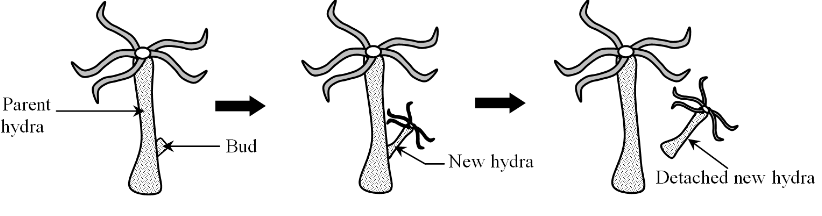
AnswerBudding is a mode of asexual reproduction seen in Hydra.
First, a bud begins to form on the tubular parent body.
The bud then develops a mouth and tentacles and detaches from its parent.
The new Hydra is fully developed and will find a substrate for its attachment.
View full question & answer→MCQ 731 Mark
The property of an undifferentiated cell that has the potential to develop into an entire plant is called.
MCQ 741 Mark
Animals who give birth to young ones are:
AnswerAnimals giving birth to young ones are called viviparous animals.
The egg of these animals typically contains less yolk insufficient to support the development of the zygote into an embryo.
Hence, development proceeds inside the body of the female animal, and the fully developed embryo is delivered.
Oviparous animals lay eggs.
Their egg typically has more amount of yolk and can support the development of the zygote into an embryo outside the body of the mother.
Ovoviviparous animals lay eggs and develop the eggs inside the mother's body.
View full question & answer→MCQ 751 Mark
Identify the incorrect statement:
- A
In asexual reproduction, the offspring produced are morphologically and genetically identical to the parent.
- ✓
Zoospores are sexual reproductive structures.
- C
In asexual reproduction, a single parent produces offspring with or without the formation of gametes.
- D
Conidia are asexual structures in Penicillium.
AnswerCorrect option: B. Zoospores are sexual reproductive structures.
View full question & answer→MCQ 761 Mark
Which type of stimulus is used to achieve parthenogenetic development?
- A
- B
Change in $pH$
- C
Pricking with microneedle
- ✓
AnswerThe stimulus which are used to induce artificial parthenogenesis are chemicals like salts, weak acids, organic solvents$, ($chloroform$)$ urea, sucrose, strychnine and physical stimuli like temperature, electric shock or mere shaking, a needle smeared with blood $($egg of frog$)$ and saline solution $($egg of sea urchin$).$
View full question & answer→MCQ 771 Mark
$.........$ is a common method of multiplication of Yeast and Hydra.
AnswerBudding is a form of asexual reproduction in which a new organism develop from an outgrowth or bud due to cell division at one particular site.
In Hydra, a bud develops as outgrowth due to repeated cell division at a particular site.
Yeast also splits via budding and it results in a 'mother' and a smaller 'daughter' cell.
View full question & answer→MCQ 781 Mark
Which of the following is a hermaphrodite animal?
AnswerOrganisms having a male as well as female reproductive organs are called hermaphrodite animals.
It is common in most of the invertebrates like flatworms, arrow worms, sea slugs, land snails, barnacles, earthworms, and leeches.
Though they have both male and female organs, self $-$ fertilization does not occur in most of them.
View full question & answer→MCQ 791 Mark
Which of the following is a post$-$fertilisation event in flowering plants?
- A
- B
Formation of pollen grains.
- ✓
- D
Transfer of pollen grains.
View full question & answer→MCQ 801 Mark
Which of the following describes the development of an egg without a sperm?
AnswerExplanation: (D) Parthenogenesis
Parthenogenesis may be defined as the development of female gamete into a new individual without fertilization.
The megaspore mother cell undergoes the usual meiotic division to form haploid egg and embryo develops from the egg without fertilization.
View full question & answer→MCQ 811 Mark
Development of an unfertilized egg is called:
AnswerThe process of development of an embryo from an unfertilized egg is known as parthenogenesis.
It is a natural form of asexual reproduction.
They are considered as the clone of the parent.
Paedogenesis is the process of reproduction by larval animals.
Fertilization do not take place and the development take place due to metamorphosis.
Metamorphosis is the process of development of organism after birth or hatching.
It mainly takes place in the presence of thyroid hormone.
Gametogenesis is the process by which gametes are formed.
View full question & answer→MCQ 821 Mark
Cellular totipotency was demonstrated by:
- A
- B
$A \ v$ Leeuwenhoek.
- ✓
$F \ C$ Steward.
- D
AnswerCorrect option: C. $F \ C$ Steward.
View full question & answer→MCQ 831 Mark
AnswerOviparous animals are the animals which lay eggs.
Viviparous animals produce living young ones instead of eggs.
Rats give birth to young ones.
Ovoviviparous animals produce eggs that develop within the maternal body and hatch within or immediately after extrusion from the parent.
Parthenogenetic is the reproduction by development of an unfertilized female gamete or egg that occurs especially among lower plants and invertebrates.
View full question & answer→MCQ 841 Mark
Answer
- The reproductive phase of primate animals is called Menstrual cycle.
- The reproductive phase of nonprimate animals is called Oestrus cycle.
- The seasons in which animals mate and produce offspring are called breeding seasons.
- The seasons in which animals do not mate and produce offspring are called non$-$breeding seasons.
Hence, nonprimate mammals have oestrus cycle. View full question & answer→MCQ 851 Mark
Given below are a few statements related to external fertilization. Choose the correct statements:
- The male and female gametes are formed and released simultaneously.
- Only a few gametes are released into the medium.
- Water is the medium in a majority of organisms exhibiting external fertilization.
- Offspring formed as a result of external fertilization have better.
Chance of survival than those formed inside an organism,
- A
$iii$ and $iv.$
- ✓
$i$ and $iii.$
- C
$ii$ and $iv.$
- D
$i$ and $iv.$
AnswerCorrect option: B. $i$ and $iii.$
Release of both the gametes simultaneously is necessary to ensure fertilization.
The male gametes need some medium through which they can travel up to the female gamete. Water is the medium for most the cases; while air is a medium in some cases.
View full question & answer→MCQ 861 Mark
In markets, eggs of birds are available but never of dogs, because:
- ✓
Birds lays eggs but dogs do not.
- B
Bird's eggs are large but dog's eggs are very small.
- C
Bird's eggs are covered but dog's eggs are not.
- D
Bird's eggs are strong but eggs of dogs are not.
AnswerCorrect option: A. Birds lays eggs but dogs do not.
Birds are oviparous animals which means that they lay eggs.
On the other hand, dogs do not lay eggs and are viviparous animals which means that dogs give birth to young ones directly.
View full question & answer→MCQ 871 Mark
A multicellular, filamentous alga exhibits a type of sexual life cycle in which the meiotic division occurs after the formation of zygote. The adult filament of this alga has:
- A
Diploid vegetative cells and haploid gametangia.
- ✓
Haploid vegetative cells and haploid gametangia.
- C
Diploid vegetative cells and diploid gametangia.
- D
Haploid vegetative cells and diploid gametangia.
AnswerCorrect option: B. Haploid vegetative cells and haploid gametangia.
View full question & answer→MCQ 881 Mark
Microlecithal eggs are found in:
- A
- B
Amphibia, Aves and Reptilia
- C
Reptilia, Aves and Chiroptera
- ✓
View full question & answer→MCQ 891 Mark
An animal either male or female is known as $........$
AnswerThe animal which has either the male or the female reproductive organs are known as unisexual organisms.
These organisms exhibit the property of sexual dimorphism.
Sexual dimorphism are the differences in appearance between males and females of the same species.
The lizards are the reptiles which are bisexual.
There are no different sexes but both the sexes are present in the same organism. Humans are unisexual.
View full question & answer→MCQ 901 Mark
Pick out the monoecious plant from the following$-$
View full question & answer→MCQ 911 Mark
Viviparity is observed in:
AnswerViviparity means giving birth to young ones.
Viviparous animals produce young ones instead of laying eggs.
The female animal gives birth to the young ones which are just like little adults.
Rabbits give birth to young ones.
Frogs, lizards, and snakes lay eggs which later develop into young ones.
View full question & answer→MCQ 921 Mark
In which one pair both the plants can be vegetatively propagated by leaf pieces?
- A
- ✓
Bryophyllum and Kalanchoe.
- C
Asparagus and Bryophyllum.
- D
AnswerCorrect option: B. Bryophyllum and Kalanchoe.
View full question & answer→MCQ 931 Mark
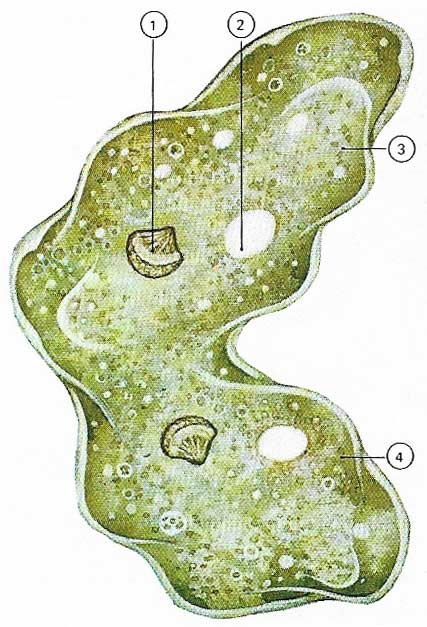
The diagram given below illustrates
- A
- ✓
- C
Formation of daughter cells in yeast
- D
Pseudopodia formation in Amoeba
AnswerWe can identify amoeba by its pseudopodia that is clearly visible in the given diagram, apart from that nucleus is also shown dividing.
View full question & answer→MCQ 941 Mark
Arrhenotoky is related to:
AnswerParthenogenesis can be complete or incomplete $($cyclic$).$
Arrhenotoky is the type of parthenogenesis where only males are produced from the unfertilized eggs.
For example, rotifers, bees.
View full question & answer→MCQ 951 Mark
There are various types of reproduction. The type of reproduction adopted by an organism depends on:
- ✓
The organism’s habitat, physiology and genetic makeup.
- B
Morphology and physiology of the organism.
- C
Morphology of the organism.
- D
The habitat and morphology of the organism.
AnswerCorrect option: A. The organism’s habitat, physiology and genetic makeup.
View full question & answer→MCQ 961 Mark
The term clone is used to describe such $........$ and $........$ similar individual.
- A
- B
Physiologically, chemically.
- ✓
Morphologically, genetically.
- D
Morphologically, metabolically.
AnswerCorrect option: C. Morphologically, genetically.
View full question & answer→MCQ 971 Mark
A common character found in all plants with underground stem is:
- ✓
- B
- C
A stem covered with scales.
- D
A stem that grows horizontal to the earth.
AnswerThese plants produce stems modified to store energy and preserve a location of potential growth to survive a cold or dry period which normally is a period of inactive growth, and when that period is over the plants resume new growth from the underground stems.
$[4]$ Being underground protects the stems from the elements during the dormancy period, such as freezing and thawing in winter or extreme heat and drought in summer or fire.
View full question & answer→MCQ 981 Mark
Answer$\rightarrow$The reproductive cycle of the non $-$ primate females is called oestrous cycle.
$\rightarrow$For example, in rats, horse etc.
$\rightarrow$It can be divided into four phases proestrus, estrus, metestrus and diestrus.
$\rightarrow$The word estrus means heat.
$\rightarrow$It is a sign of sexual receptivity and fertility.
View full question & answer→MCQ 991 Mark
- A
Shedding of pollen from anther.
- B
Similar to fertilization of animals.
- ✓
Transfer of pollen from anther to stigma.
- D
Transfer of pollen from anther to ovule.
AnswerCorrect option: C. Transfer of pollen from anther to stigma.
The transfer of pollen grain from the anther to the stigma of a pistil is called pollination.
It is a mechanism by which non $-$ motile male and female gametes are brought together for the fertilization.
Following are the types of pollination:
Autogamy: The transfer of pollen grain from the anther to the stigma of the same flower.
Geitonogamy: The transfer of pollen grains from the anther to the stigma of another flower of the same plant.
This transfer involved an agent of pollination, hence functionally it is cross $-$ pollination.
Genetically, it is similar to autogamy since the pollen grains come from the same plant.
Xenogamy: The transfer of pollen grains from the anther to the stigma of another flower of different plants of the same species.
This is the only type of pollination which brings generally different types of pollen grains to stigma.
View full question & answer→MCQ 1001 Mark
Purpose of tubectomy is to prevent:
AnswerTubectomy is a surgical procedure for sterilization in which a woman's fallopian tubes are clamped and blocked, or severed and sealed, which prevents eggs from reaching the uterus for implantation, thereby no fertilization can takes place.
It is considered the permanent method of birth control.
View full question & answer→MCQ 1011 Mark
In animals, juvenile phase is followed by:
- A
- B
- C
- ✓
In animals, juvenile phase is followed by.
AnswerCorrect option: D. In animals, juvenile phase is followed by.
View full question & answer→MCQ 1021 Mark
Sexually reproducing larva shows $........$
View full question & answer→MCQ 1031 Mark
Vegetative propagation in mint occurs by:
MCQ 1041 Mark
In many invertebrate organisms, both sexes are found in the same individual. This is called as:
AnswerA hermaphrodite is an organism which consists both male and female sexes in the same individual.
Pleiotropy occurs when one gene influences multiple, unrelated phenotypic traits.
Incomplete dominance and codominance are different forms of inheritance.
Codominance is a form of dominance where the allele of the heterozygous pair is fully expressed.
View full question & answer→MCQ 1051 Mark
Which one of the following is correctly matched?
AnswerCorrect option: A. Onion $-$ Bulb
A bulb is a specialized underground bud of monocotyledon plants.
It consists of short, fleshy storage leaves and vertical stem axis enclosed by thick scales.
They are modified for storage and reproduction.
Arial miniature bulbs are called as bulbils$, e.g.,$ onion.
View full question & answer→MCQ 1061 Mark
In some species, parthenogenesis may alternate with sexual reproduction. This process is called as:
- A
Complete parthenogenesis.
- ✓
Incomplete or cyclic parthenogenesis.
- C
Both $A$ and $B.$
- D
AnswerCorrect option: B. Incomplete or cyclic parthenogenesis.
Incomplete parthenogenesis or cyclic parthenogenesis is a process where sexual generation alternates with parthenogenesic generation.
For example, in bees and wasps, some eggs develop without fertilization and produce males, while those eggs that are fertilized developed into females.
View full question & answer→MCQ 1071 Mark
$.........$ shows totipotency.
View full question & answer→MCQ 1081 Mark
Fertilization can be correctly defined as fusion of:
- A
Male and female pronuclei.
- B
Cytoplasm of male and female gametes.
- C
- ✓
Male and female gametes of the same species.
AnswerCorrect option: D. Male and female gametes of the same species.
Sexual reproduction is a characteristic of animals, although many animals reproduce sexually as well asexually. Reproduction is essential to the survival of any species. Most animals are involved in some variety of sexual reproduction.
The methods vary greatly from the simultaneous release of sperm and eggs into the water for many marine organisms, to fertilization inside the body for most terrestrial organisms and high degrees of parental care in birds and mammals.
Fertilization is defined as a process of fusion of male and female gametes.
The gametes are special haploid cells.
The most widely accepted definition of species is the biological species$-$according to which members of same species alone can carry on the process of sexual reproduction $($including fertilization$)$ and produce fertile off spring.
View full question & answer→MCQ 1091 Mark
Which of the following statements is true of date palm?
- A
It is monoecious producing staminate flowers in one tree and pistillate flowers in another tree.
- B
It is monoecious producing both staminate flowers and pistillate flowers in the same plant.
- ✓
It is dioecious producing staminate flowers in one tree and pistillate flowers in another tree.
- D
AnswerCorrect option: C. It is dioecious producing staminate flowers in one tree and pistillate flowers in another tree.
View full question & answer→MCQ 1101 Mark
Identify the correct sequence of events.
- A
Gametogenesis $\rightarrow$ Embryogenesis $\rightarrow$ Zygote $\rightarrow$ Syngamy.
- B
Gametogenesis $\rightarrow$ Zygote $\rightarrow$ Syngamy $\rightarrow$ Embryogenesis.
- C
Gametogenesis $\rightarrow$ Syngamy Embryogenesis $\rightarrow$ Zygote.
- ✓
Gametogenesis $\rightarrow$ Syngamy $\rightarrow$ Zygote.
AnswerCorrect option: D. Gametogenesis $\rightarrow$ Syngamy $\rightarrow$ Zygote.
View full question & answer→MCQ 1111 Mark
Endogamy in plants is the term, where:
- A
Actual fusion never occur.
- B
Gametes tend to fuse but fusion product never survives.
- ✓
Pollination between two flowers on the same plant.
- D
Such term is never known in fungi..
AnswerCorrect option: C. Pollination between two flowers on the same plant.
Endogamy is the type of pollination in which the pollen from the anthers of a flower reaches the stigma of another flower of the same plant.
View full question & answer→MCQ 1121 Mark
Fleshy buds produced in the axil of leaves, which grow to form new plants when shed and fall on ground are called.
MCQ 1131 Mark
Birds are considered oviparous because $.........$
- A
- B
Forelimbs are modified into wings
- ✓
- D
AnswerOvipary is the phenomenon in which an adult organism reproduces and lays eggs which later hatch and give rise to young ones.
Since, birds lay eggs they are known as oviparous.
Flight or wing modifications are not related to the process of reproduction.
View full question & answer→MCQ 1141 Mark
Budding is a common method of asexual reproduction in yeast and
AnswerBudding is a form of asexual reproduction in which a new organism develops from an outgrowth or bud due to cell division at one particular site.
Yeast splits via budding resulting in a 'mother' and a smaller 'daughter' cell.
Hydra also undergoes budding.
In Hydra, a bud develops as an outgrowth due to repeated cell division at one specific site.
View full question & answer→MCQ 1151 Mark
In honey bees, males $($drones$)$ are formed from:
AnswerThe male honey bees are called drones.
Drones are formed from the unfertilized eggs $i.e.$ haploid eggs of the queen bee.
Fertilized eggs form queens and female workers.
Drones are meant for mating with the queen bee and soon die after mating.
View full question & answer→MCQ 1161 Mark
A universal phenomenon in sexually reproducing organisms is the formation of:
AnswerDuring sexual reproduction in all eukaryotes $($plants and animals$)$ the male and female gametes fuse leading to the formation of zygote.
Generally, gamete formation is not a part of asexual reproduction.
But in haploid parthenogenesis, a rare form of parthenogenesis that occurs in a few species of bees, nematodes, and plants, offspring develop from haploid eggs to produce haploid adults.
We still consider this a type of asexual reproduction as gametes are formed but there is no fusion of gametes to form zygote, .
View full question & answer→MCQ 1171 Mark
Sometime prothallus of fern give rise to a fern plant. It is an example of:
AnswerApogamy is a type of reproduction occurring in some ferns, in which the sporophyte develops from the gametophyte without fusion of gametes.
Prothallus is a green, photosynthetic, haploid gametophytic stage of fern.
It is developed from germination of spore and at maturity gives rise into sexual organs, the antheridia and archegonia.
View full question & answer→MCQ 1181 Mark
The statements given below describe certain features that are observed in the pistil of flowers.
- Pistil may have many carpels.
- Each carpel may have more than one ovule.
- Each carpel has only one ovule.
- Pistil have only one carpel.
Choose the statements that are true from the options below:
- A
$i$ and $iii$
- B
$ii$ and $iv$
- C
$iii$ and $iv$
- ✓
$i$ and $ii$
AnswerCorrect option: D. $i$ and $ii$
View full question & answer→MCQ 1191 Mark
The process of fragmentation takes place in $.........$
AnswerWhen a flatworm gets cut into pieces, each piece can regenerate into a complete organism.
Cells at the point of the cut grow to form a blastema that will differentiate into new tissues and regenerate the missing parts of the piece of the cut flatworm.
View full question & answer→MCQ 1201 Mark
Which of the following situations correctly describe the similarity between an angiosperm egg and a human egg?
- Eggs of both are formed only once in a lifetime.
- Both the angiosperm egg and human egg are stationary.
- Both the angiosperm egg and human egg are motile transported.
- Syngamy in both results in the formation of zygote.
Choose the correct answer from the options given below.
- ✓
$iv$ only
- B
$iii$ and $iv$
- C
$i$ and $iv$
- D
$ii$ and $iv$
AnswerCorrect option: A. $iv$ only
View full question & answer→MCQ 1211 Mark
The number of chromosomes in the shoot tip cells of a maize plant is $20.$ The number of chromosomes in the microspore mother cells of the same plant shall be:
View full question & answer→MCQ 1221 Mark
In amphibians, syngamy occurs in:
MCQ 1231 Mark
Development of animal embryo from an unfertilized egg is called $.........$
View full question & answer→MCQ 1241 Mark
By which method, asexual reproduction occurs in Amoeba$-$
View full question & answer→MCQ 1251 Mark
Fertilization is depicted by which of the following condition?
- ✓
$n \rightarrow 2n$
- B
$2n \rightarrow 3n$
- C
$2n \rightarrow 4n$
- D
$4n \rightarrow 8n$
AnswerCorrect option: A. $n \rightarrow 2n$
Fertilization is the process of fusion of male and female gametes.
Gametes are haploid $(n)$ in nature and the fusion of the two results in the diploid $(2n)$ product called as zygote.
Zygote is the universal diploid cell.
View full question & answer→MCQ 1261 Mark
In animals, juvenile phase is followed by:
MCQ 1271 Mark
The general method of asexual reproduction, in Yeast is $-$
View full question & answer→MCQ 1281 Mark
Budding, in hydra, is a form $.........$
View full question & answer→MCQ 1291 Mark
Binary fission is a type of:
AnswerBinary fission is an asexual mode of reproduction in which the bacteria divides into two equal halves.
The process starts with the duplication of genetic contents of a parent cell by the process of replication.
After the duplication, the duplicated genetic material moves apart by the process of karyokinesis.
A furrow or cleavage appears in the plasma membrane which deepens and causes division of cytoplasm by cytokinesis and lead to the formation of daughter cell.
The daughter cell is identical to the parent cell and has the same number of chromosome.
View full question & answer→MCQ 1301 Mark
Appearance of vegetative propagules from the nodes of plants such as sugarcane and ginger is mainly because:
AnswerCorrect option: A. Nodes are located near the soil.
View full question & answer→MCQ 1311 Mark
Menstruation is caused by:
AnswerCorrect option: C. Fall in progesterone level
The level of progesterone hormone decreases after the regression of corpus luteum, causes the uterus to shed its lining and egg in a process termed as menstruation.
View full question & answer→MCQ 1321 Mark
There is no natural death in single celled organisms like Amoeba and bacteria because:
- ✓
Parental body is distributed among the offsprin.
- B
- C
They reproduce by binary fission.
- D
They cannot reproduce sexually.
AnswerCorrect option: A. Parental body is distributed among the offsprin.
View full question & answer→MCQ 1331 Mark
The process of propagation of new individual from the existing one is called as:
AnswerReproduction refers to the production or propogation of new individuals by an organism.
Syngamy of fertilisation refers to the fusion of gametes which may or may not be similar.
View full question & answer→MCQ 1341 Mark
AnswerDeutoplasm is the nutritive material present in the egg for development and nourishment of embryo.
It is a non$-$living portion of the egg.
Deutoplam is present in the yolk of eggs.
Sometimes yolk and deutoplasm are used synonymously.
View full question & answer→MCQ 1351 Mark
- A
Union of diploid spermatozoon with diploid ovum to form diploid zygote.
- B
Union of haploid sperm with haploid ovum to form haploid zygote.
- ✓
Union of haploid sperm with haploid ovum to form diploid zygote.
- D
Union of diploid sperm with haploid ovum to form triploid zygote.
AnswerCorrect option: C. Union of haploid sperm with haploid ovum to form diploid zygote.
Hence, fertilization is the union of haploid sperm with the haploid ovum to form a diploid zygote.
Fertilization is the process in which we observe the fusion of male and female gamete.
The parent organism produces a haploid sex gamete called sperm in males and ova or ovum in females.
When these haploid gametes fuse, It brings out fertilization and forms a diploid zygote, which further undergoes division to become an organism.
View full question & answer→MCQ 1361 Mark
A few statements describing certain features of reproduction are given below:
- Gametic fusion takes place.
- Transfer of genetic material takes place.
- Reduction division takes place.
- Progeny have some resemblance with parents.
Select the options that are true for both asexual and sexual reproduction from the options given below:
- A
$i$ and $iii$
- ✓
$ii$ and $iv$
- C
$ii$ and $iii$
- D
$i$ and $ii$
AnswerCorrect option: B. $ii$ and $iv$
View full question & answer→MCQ 1371 Mark
Fertilization is fusion of:
- A
Diploid spermatozoan with diploid ovum to form a diploid zygote.
- B
Haploid spermatozoan with diploid ovum to form a diploid zygote.
- C
Diploid spermatozoan with haploid ovum to form a diploid zygote.
- ✓
Haploid spermatozoan with haploid ovum to form a diploid zygote.
AnswerCorrect option: D. Haploid spermatozoan with haploid ovum to form a diploid zygote.
Fertilization is the process of union of a haploid sperm cell with haploid ovum to form a diploid zygote.
So the correct answer is 'Haploid spermatozoan with haploid ovum to form a diploid zygote.'
View full question & answer→MCQ 1381 Mark
Which of the following statements is true of Bryophyllum?
- ✓
Geminating bud appears from the notch at the leaf margin.
- B
Germinating bud appears from the node of the rhizome.
- C
Germinating bud appears from the eye of the stem tuber.
- D
AnswerCorrect option: A. Geminating bud appears from the notch at the leaf margin.
View full question & answer→MCQ 1391 Mark
The animals in which complete embryo develops in the mother's body through placenta are:
AnswerOviparous animals are the animals that lay eggs.
Viviparous animals give birth to the living offspring that develop within the mother's body $($as in the case of most of the mammals$).$
Ovo$-$viviparous give birth to the young ones in eggs which are hatched within the female body $($as in some reptiles and fishes$).$
Herbivorous animals are those that feed exclusively on vegetable food.
View full question & answer→MCQ 1401 Mark
Normally the number of chromosomes in the nuclei of gametes, that fuse at fertilization are
AnswerSperms and eggs are special cells, called as gametes.
They have nuclei containing half the normal number of genes.
For example, if the cell has total $46$ chromosomes, then the nuclei of the gamete contains $23$ chromosomes.
During fusion, the nuclei will have the same number of chromosome as in the gamete.
View full question & answer→MCQ 1411 Mark
Sugarcane is propagated by:
MCQ 1421 Mark
$.........$ is not a method of vegetative propagation.
View full question & answer→MCQ 1431 Mark
Vegetative propagation in mint occurs.
MCQ 1441 Mark
Seedless fruits in Banana are produced through:
AnswerSeedless fruits in the banana are produced through parthenocarpy which is a type of parthenogenesis.
The inflorescence contains clusters of flowers.
The ovary of flower develops into a seedless fruit by parthenocarpy.
The female flowers of the inflorescence present on the true stem mature and develop into fruit without fertilization of gametes while the male flowers produce pollen which may or may not be sterile.
View full question & answer→MCQ 1451 Mark
The terms homothallic and monoecious are used to denote.
MCQ 1461 Mark
Vegetative propagation in Pistia occurs by:
MCQ 1471 Mark
AnswerBulbs are underground buds with reduced stems on which short and fleshy storage leaves grow.
Thick scales enclose these leaves.
Bulbs are produced by monocotyledon plants in which the usual structure is modified for storage and reproduction.
The continuous sheathing leaf bases are called bulb scales.
The outer scales are dry and thin and the inner scales are generally fleshy and contain reserve food material.
View full question & answer→MCQ 1481 Mark
Development of an embryo without fertilization is called:
AnswerDevelopment of an embryo directly from an egg cell without fertilization is called parthenogenesis. It is of two types:
In certain animals, parthenogenesis occurs naturally in their life cycles.
This is known as natural parthenogenesis
The fertilised eggs might sometimes develop parthenogenetically by various chemical and physical means.
This is known as artificial parthenogenesis.
View full question & answer→MCQ 1491 Mark
A multicellular, filamentous alga exhibits a type of sexual life cycle in which the meiotic division occurs after the formation of zygote. The adult filament of this alga has:
- A
Diploid vegetative cells and diploid gametangia.
- B
Haploid vegetative cells and diploid gametangia.
- ✓
A multicellular, filamentous alga exhibits a type of sexual life.
- D
A population of genetically identical individuals, obtained from asexual reproduction is:
AnswerCorrect option: C. A multicellular, filamentous alga exhibits a type of sexual life.
View full question & answer→MCQ 1501 Mark
Tubers help in the vegetative reproduction in:
AnswerIn potato, underground stem stores starch and becomes fleshy tuber.
The eyes of tuber represent nodes and adventitious buds are present in their axil.
The buds may germinate to produce new plantlets.
Onion and garlic also show stem modifications but in these plants stem is modified to bulb having fleshy leaves.
Tomato reproduces sexually and produces berry fruit.
View full question & answer→MCQ 1511 Mark
The phase of menstrual cycle in humans, that lasts for $3 - 5$ days is:
AnswerThe rhythmic reproductive cycle in the female primates is called as the menstrual cycle.
The first menstruation begins at puberty and is called as menarche and is repeated at an average interval of about $28/ 29$ days.
The major phases of the menstrual cycle are$-$menstrual phase, follicular phase and luteal phase.
The cycle starts with the menstrual phase, when menstrual flow occurs and it lasts for $3 - 5$ days.
The menstrual flow results due to breakdown of endometrial lining of the uterus and its blood vessels, which forms liquid, that comes out through vagina.
Menstruation only occurs if the released ovum is not fertilised.
Lack of menstruation may be indicative of pregnancy.
View full question & answer→MCQ 1521 Mark
Offspring formed by sexual reproduction exhibit more variation than those formed by Asexual reproduction because:
AnswerCorrect option: B. Gametes of parents have qualitatively different genetic composition.
Fertilization during sexual reproduction results in gene pools from two different individuals and thus zygote has a some what different genotype than both the parents and show more variation.
View full question & answer→MCQ 1531 Mark
Which of the followings is a post$-$fertilization event in flowering plants?
- A
Transfer of pollen grains.
- ✓
- C
- D
Formation of pollen grains.
View full question & answer→MCQ 1541 Mark
- A
- ✓
Germination of seed on mother plant.
- C
Formation of fruits directly by embryo.
- D
Production of fruitless plant.
AnswerCorrect option: B. Germination of seed on mother plant.
Vivipary is the condition, where the embryo grows first to break through the seed coat and then out of the fruit wall while still attached to the parent plant.
This condition is found in Bruguiera, Ceriops, Kandelia and Rhizophora species.
View full question & answer→MCQ 1551 Mark
In sexual reproduction, offsprings resemble the parents.
- A
Structurally but not functionally.
- ✓
Functionally but not structurally.
- C
Both structurally and functionally.
- D
Neither structurally nor functionally.
AnswerCorrect option: B. Functionally but not structurally.
View full question & answer→MCQ 1561 Mark
In all the methods of asexual reproduction.
- ✓
Offsprings produced are genetically identical to the parents.
- B
Offsprings produced are genetically different from the parents.
- C
Offsprings produced may or may not be identical to the parents.
- D
AnswerCorrect option: A. Offsprings produced are genetically identical to the parents.
View full question & answer→MCQ 1571 Mark
A slide showing several amoeba was given to a student and was asked to focus the Amoeba undergoing binary fission. What will the student look for to correctly focus on a dividing Amoeba?
- A
An Amoeba with many pseudopodia and a small nucleus.
- B
A rounded Amoeba with rounded nucleus.
- C
An Amoeba covered by a cyst and many nuclei.
- ✓
An Amoeba with elongated nucleus and a constriction in the middle.
AnswerCorrect option: D. An Amoeba with elongated nucleus and a constriction in the middle.
View full question & answer→MCQ 1581 Mark
Which one among the following reason for the appearance of variations among the progeny formed by sexual reproduction?
- A
Sexual reproduction involves two parents with different sets of characters.
- B
The gene combinations are different in gametes which are fertilised.
- C
Asexual reproduction involves two parents with different sets of characters.
- ✓
Both $A$ and $B.$
AnswerCorrect option: D. Both $A$ and $B.$
The process of sexual reproduction involved two parents, each contributing one gamete.
As two parents with different sets of characters are involved, it results in variations.
As there are two gametes, they virtually never have exactly the same combination of genes and hence, this results in the formation of different gene combination once fertilized.
View full question & answer→MCQ 1591 Mark
A multicellular, filamentous alga exhibits a type of sexual life cycle in which the meiotic division occurs after the formation of zygote. The adult filament of this alga has:
- A
haploid vegetative cells and diploid gametangia.
- B
diploid vegetative cells and diploid gametangia.
- C
diploid vegetative cells and haploid gametangia.
- ✓
haploid vegetative cells and haploid gametangia.
AnswerCorrect option: D. haploid vegetative cells and haploid gametangia.
Adult filament of a multicellular, filamentous alga have haplontic life cycle in which the meiotic division occurs after the formation of zygote. So, the filament of this alga have haploid vegetative cells and haploid gametangia.
View full question & answer→MCQ 1601 Mark
- ✓
- B
- C
Fusion of two similar spores.
- D
Fusion of two dissimilar spores.
View full question & answer→MCQ 1611 Mark
AnswerEstrous cycle comprises of the recurring physiologic changes, that are induced by reproductive hormones in females of mammals.
Monoestrous means having one estrous cycle per year.
Diestrous means having two estrous cycles per year.
Whereas polyestrous means having many estrous cycles per year.
A female rabbit is an example of polyestrous.
View full question & answer→MCQ 1621 Mark
In the figure of budding in Yeast, structures $a, b, c$ and $d$ should be labelled respectively as:
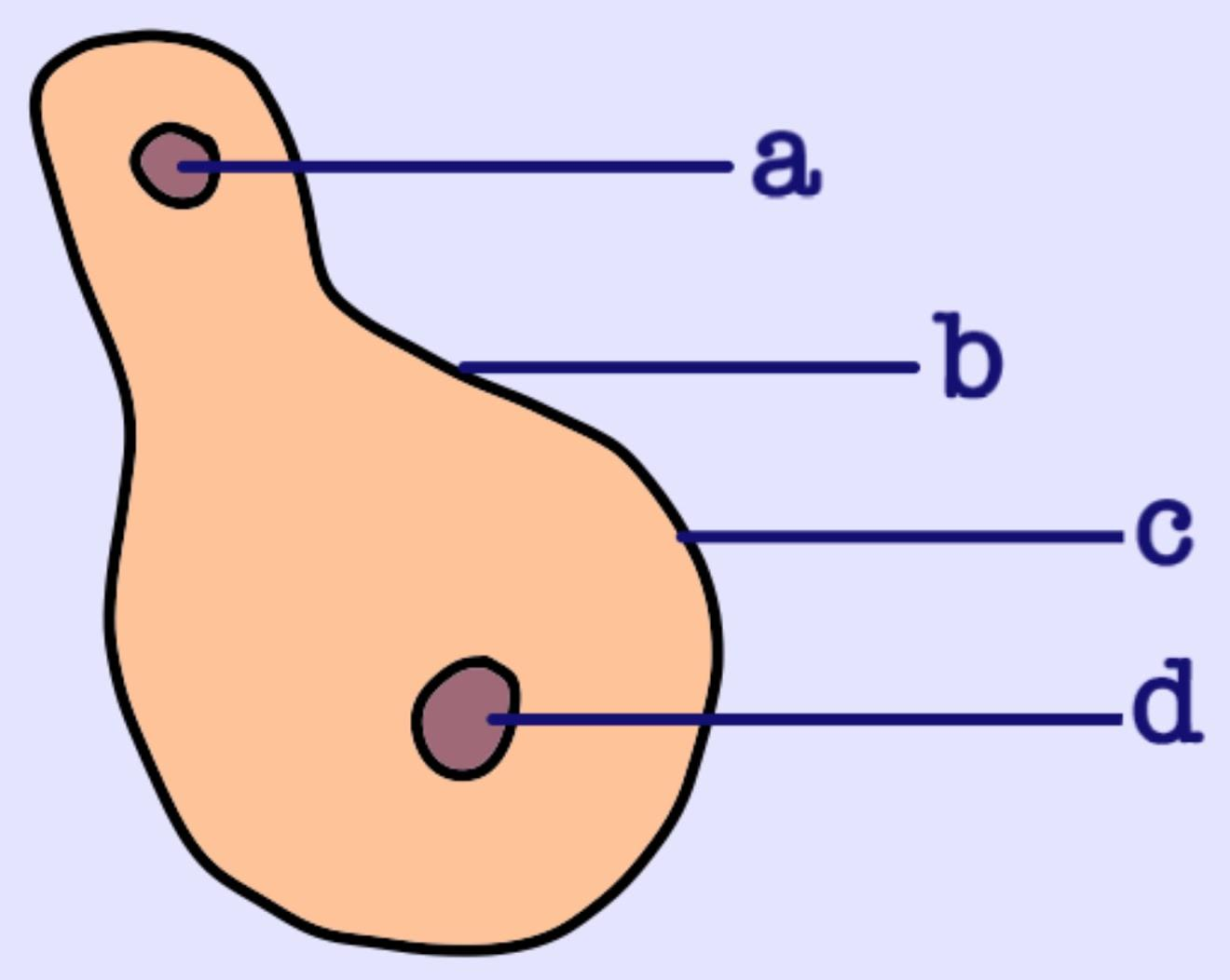
- ✓
Nucleus of bud, bud, yeast, nucleus.
- B
Dividing nucleus of bud, bud, Yeast, nucleus.
- C
Nucleus of bud, bud, Yeast, dividing nucleus of yeast.
- D
Dividing nucleus of Yeast, Yeast, bud, nucleus of bud.
AnswerCorrect option: A. Nucleus of bud, bud, yeast, nucleus.
View full question & answer→MCQ 1631 Mark
Choose the correct statement from amongst the following:
AnswerCorrect option: C. Dioecious organisms are seen in both plants and animals.
Dioecious organisms are seen in both plants $($like papaya$)$ and animals $($like cockroach$).$
View full question & answer→MCQ 1641 Mark
The term ‘clone’ cannot be applied to offspring formed by sexual reproduction because:
- A
$\text{DNA}$ of only one parent is copied and passed on to the offspring.
- B
Offspring are formed at different times.
- C
$\text{NA}$ of parent and offspring are completely different.
- ✓
Offspring do not possess exact copies of parental $\text{DNA}.$
AnswerCorrect option: D. Offspring do not possess exact copies of parental $\text{DNA}.$
View full question & answer→MCQ 1651 Mark
Sugarcane is propagated by:
MCQ 1661 Mark
The terms homothallic and monoecious are used to denote.
MCQ 1671 Mark
In Amorphophallus and Colocasia, vegetative reproduction is carried out through:
AnswerAll of the structures given in different options are used for vegetative propagation.
The corm is vertically growing underground stem, which carries on vegetative propagation as in Amorphophallus and Colocasia.
View full question & answer→MCQ 1681 Mark
Vegetative reproduction occurs by bulbils in:
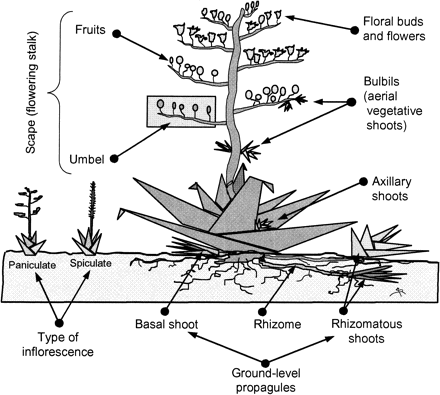
AnswerAgave macroacantha is a group of succulent rosette plants that propagate vegetatively by aerial bulbils and ground $-$ level basal shoots and rhizomes.
In vegetative propagation the new plant is originated from the meristem.
Development of shoots occurs in different parts of the rosette including aerial bulbils which are still on inflorescence.
View full question & answer→MCQ 1691 Mark
The most significant feature of vegetative propagation is that:
- A
It is a method of producing a large number of individuals genetically different from the parent.
- B
It ensures that the progeny individuals are resistant to diseases and pests.
- ✓
It is a method of producing a large number of individuals genetically identical to the parent.
- D
It is an age old practice.
AnswerCorrect option: C. It is a method of producing a large number of individuals genetically identical to the parent.
View full question & answer→MCQ 1701 Mark
Reproduction is essential for living organisms in order to:
- A
Keep the individual organism alive.
- B
Fulfill their energy requirement.
- C
- ✓
Continue the species generation after generation.
AnswerCorrect option: D. Continue the species generation after generation.
Reproduction is important because, with the help of reproduction, a new generation of species are produced.
With the help of reproduction, genetic traits of that species are transferred from one generation to another.
View full question & answer→MCQ 1711 Mark
In mammals egg are microlecithal and isolecithal because these are:
AnswerMammalian eggs have very little yolk $($microlecithal$)$ because the embryo obtains maternal nutritional support throughout its development.
Isolecithal refers to the even distribution of yolk in the cytoplasm of the ovum in mammals and other vertebrates. In mammals, because the isolecithal cells have only a small amount of yolk, they require immediate implantation onto the uterine wall to receive nutrients.
View full question & answer→MCQ 1721 Mark
Which of the following statements is true of yeast?
- A
The cell divides by binary fission. One of them develops into a bud.
- B
The cell produces conidia, which develop into a bud.
- ✓
The cell divides unequally. The smaller cell develops into a bud.
- D
AnswerCorrect option: C. The cell divides unequally. The smaller cell develops into a bud.
View full question & answer→MCQ 1731 Mark
In Yeast, budding occurs in:
AnswerBudding is form of asexual reproduction.
It takes place in yeast in favourable conditions.
Reproduction by sporulation takes place in yeast in unfavourable condition.
View full question & answer→MCQ 1741 Mark
A few statements describing certain features of reproduction are given below:
- Gametic fusion takes place.
- Transfer of genetic material takes place.
- Reduction division takes place.
- Progeny have some resemblance with parents.
Select the options that are true for both asexual and sexual reproduction from the options given below:
- A
$i$ and $iii$
- B
$ii$ and $iv$
- ✓
$ii$ and $iii$
- D
$i$ and $ii$
AnswerCorrect option: C. $ii$ and $iii$
Transfer of genetic material and progeny have some resemblance with parents are the phenomenon, common in both asexual and sexual reproduction while gametic fusion and reduction division takes place in sexual reproduction only.
View full question & answer→MCQ 1751 Mark
There is no natural death in single celled organisms like Amoeba and bacteria because:
- A
They cannot reproduce sexually.
- B
They reproduce by binary fission.
- ✓
Parental body is distributed among the offspring.
- D
AnswerCorrect option: C. Parental body is distributed among the offspring.
Binary fission results in culmination of parental generation and beginning of the next generation but the mother cell does not die in the process rather it gets divided into two daughter cells.
View full question & answer→MCQ 1761 Mark
What is the basic difference between binary fission and budding?
- A
In budding, the parent's identity is lost, while in binary fission, it is maintained.
- ✓
In binary fission, the parent's identity is lost, while it is maintained in budding.
- C
There is a fusion of daughter cells in binary fission while in budding, genetically non $-$ identical daughter cells are produced.
- D
In binary fission, two dissimilar individuals $($daughter cells$)$ are formed while in budding, daughter and parent cells are similar
AnswerCorrect option: B. In binary fission, the parent's identity is lost, while it is maintained in budding.
Binary fission and budding both are the modes of asexual reproduction.
But in binary fission, the parent cell splits into two daughter cells and loses its identity.
Whereas in budding, the parent cell first produces an outgrowth or bud which gets detached after maturity and survives as an individual.
The parent identity is thus retained.
In binary fission, the cytoplasm divides evenly whereas in budding cytoplasm divides unevenly.
View full question & answer→MCQ 1771 Mark
The period from birth to the natural death of an organism represents.
MCQ 1781 Mark
AnswerSome animals give birth to young ones.
This characteristic is called vivipary.
Some animals lay eggs and this habit is called ovipary.
In viviparous animals, the fertilization is internal and the zygote develops inside the body of female animals.
These animals generally produce eggs with very little yolk which cannot support the development of the embryo and hence the zygote develops into an embryo inside the body of female.
Cartilaginous fishes like shark are an example of viviparous animals.
View full question & answer→MCQ 1791 Mark
External fertilisation occurs in majority of:
MCQ 1801 Mark
What is common between vegetative reproduction and apomixis?
- ✓
Both produces progeny identical to the parent.
- B
Both are applicable to only dicot plants.
- C
Both bypass the flowering phase.
- D
Both occur round the year.
AnswerCorrect option: A. Both produces progeny identical to the parent.
View full question & answer→MCQ 1811 Mark
Type of fertilization $($external or internal$)$ depends on:
- A
- B
Site of embryo development
- C
- ✓
Both $A$ and $B$
AnswerCorrect option: D. Both $A$ and $B$
Aquatic animals like fishes and amphibia usually show external fertilisation, whereas terrestrial animals like reptiles, birds and mammals show internal fertilisation.
Egg of animal showing external fertilization is not covered by a hard, protective shell and after fertilisation the embryo develops into larva in water.
In terrestrial birds and reptiles the egg is covered with a hard, protective shell and development of embryo occurs inside egg.
In mammals the egg is not covered by protective shell and fertilization is internal.
After fertilization the zygote forms within the body of female animal and stays there till the formation of embryo.
View full question & answer→MCQ 1821 Mark
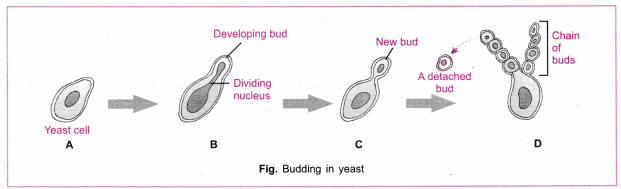
A chain of yeast cells forms because:
- ✓
yeast cells do not separate immediately after budding.
- B
Daughter cells are unable to survive without parent calls.
- C
Buds reproduce as soon as they are formed.
- D
Daughter cells stick together with the help of mucus.
AnswerCorrect option: A. yeast cells do not separate immediately after budding.
Newly formed bud on parent yeast can detach from the parent body and grows independently as a new individual or may remain attached to parent body, forming chain of cells.
View full question & answer→MCQ 1831 Mark
Which of the following situations correctly describe the similarity between an angiosperm egg and a human egg?
- Eggs of both are formed only once in a lifetime.
- Both the angiosperm egg and human egg are stationary.
- Both the angiosperm egg and human egg are motile transported.
- Syngamy in both results in the formation of zygote.
Choose the correct answer from the options given below:
- A
$ii$ and $iv.$
- ✓
$iv$ only.
- C
$iii$ and $iv.$
- D
$i$ and $iv$
AnswerCorrect option: B. $iv$ only.
In angiosperms, eggs are formed several times in the lifetime, hence option$, (i)$ is incorrect. In humans, eggs travel from ovary to fallopian tubes$;$ so, option$. (ii)$ is incorrect. In angiosperms, eggs are stationary and hence option$. (iii)$ is incorrect.
View full question & answer→MCQ 1841 Mark
A few statements with regard to sexual reproduction are given below:
- Sexual reproduction does not always require two individuals.
- Sexual reproduction generally involves gametic fusion.
- Meiosis never occurs during sexual reproduction.
- External fertilisation is a rule during sexual reproduction.
Choose the correct statements from the options below:
- A
$i$ and $iv.$
- ✓
$i$ and $ii.$
- C
$ii$ and $iii.$
- D
$i$ and $iv.$
AnswerCorrect option: B. $i$ and $ii.$
Sexual reproduction requires male and female gametes $($either by same individual are by different individual of the opposite sex$).$ Sexual reproduction generally involves gametic fusion. Meiosis occurs during sexual reproduction only External fertilisation is a rule during sexual and asexual reproduction both.
View full question & answer→MCQ 1851 Mark
Propagation of ginger is generally done using:
AnswerCorrect option: B. Stem $($rhizome$)$
Vegetative propagation is defined as the production of new plants from the vegetative plant parts like leaf, stem, roots of the parent plant.
In ginger, the vegetative propagation occurs through the underground stem called rhizome.
A rhizome is an underground horizontal stem, with stored foods and buds.
Manufactured foods are transported down to enable the growth of the rhizome.
The lower portion of the rhizome develops roots and helps in the conduction of water and minerals.
View full question & answer→MCQ 1861 Mark
In protists and monerans, asexual reproduction occurs by:
MCQ 1871 Mark
A common trait between fishes, amphibians and reptiles is:
AnswerFishes, amphibians, and reptiles all lay eggs, but only reptiles lay shelled eggs as they are terrestrial animals.
Fish possess gills and scales. Scales are the outer covering of fish and reptiles.
Reptiles respire through the lungs.
Amphibians do not have scales.
View full question & answer→MCQ 1881 Mark
Given below are a few statements related to external fertilization. Choose the correct statements.
- The male and female gametes are formed and released simultaneously.
- Only a few gametes are released into the medium.
- Water is the medium in a majority of organisms exhibiting external fertilization.
- Offspring formed as a result of external fertilization have better chance of survival than those formed inside an organism.
- ✓
$i$ and $iii$
- B
$ii$ and $iv$
- C
$i$ and $iv$
- D
$iii$ and $iv$
AnswerCorrect option: A. $i$ and $iii$
View full question & answer→MCQ 1891 Mark
In asexual reproduction$, ..........$ parent$/s$ is$/$are involved.
AnswerAsexual reproduction is the production of offspring by single parent without the formation or fusion of gametes.
The offspring produced are genetically similar to their parents and are called clones.
View full question & answer→MCQ 1901 Mark
Formation of an organism from a single, male gamete without fusion with egg is an example of:
AnswerParthenogenesis is the development of female gamete or sometimes male gamete, without fertilization.
Apogamy is the formation of a sporophyte from the gametophyte without the fusion of gametes.
Apospory is the formation of gametophyte from the sporophytic cells without the formation of spores.
Parthenocarpy is the formation of fruits without fertilization in which unfertilized egg develops into a fruit.
Hence, the formation of an organism from single male gamete without fusion with the egg is called parthenocarpy.
View full question & answer→MCQ 1911 Mark
Both hens and frogs are $.........$ animals.
- ✓
- B
- C
- D
Hens oviparous and frog ovoviviparous
AnswerOviparous animals are animals that reproduce by laying eggs.
Hens and frogs both lay eggs and hence are oviparous.
Viviparous animal gives directly birth to young ones$, eg.$ humans.
The ovoviviparous animal lays eggs but the embryo within the egg is developed in the mother's body$, eg.$ snakes.
View full question & answer→MCQ 1921 Mark
The most significant feature of vegetative propagation is that:
- ✓
It is a method of producing a large number of individuals genetically identical to the parent.
- B
It is a method of producing a large number of individuals genetically different from the parent.
- C
It ensures that the progeny individuals are resistant to diseases and pests.
- D
It is an age old practice.
AnswerCorrect option: A. It is a method of producing a large number of individuals genetically identical to the parent.
View full question & answer→MCQ 1931 Mark
- ✓
Underground stems with buds.
- B
Stems running above and along the ground.
- C
- D
The result of sexual reproduction.
AnswerCorrect option: A. Underground stems with buds.
Vegetative propagation or vegetative reproduction is the growth and development of the plant by asexual means.
- Rhizome is a vegetative plant structure which arises from the modified stem that grows horizontally along the underground or ground surface with buds.
- This is known as Runners. They originate from existing stem and have horizontal growth at or just below the soil surface.
- Spores are the agents for asexual reproduction in nonflowering plants, bacteria, fungi, and algae.
- Sexual reproduction is the production of gamete and fertilization.
- Stems with woody trunk and are underground.
View full question & answer→MCQ 1941 Mark
In the figure of budding in yeast given structure$, \text{A, B, C}$ and $\text{D}$ should be labeled respectively as:
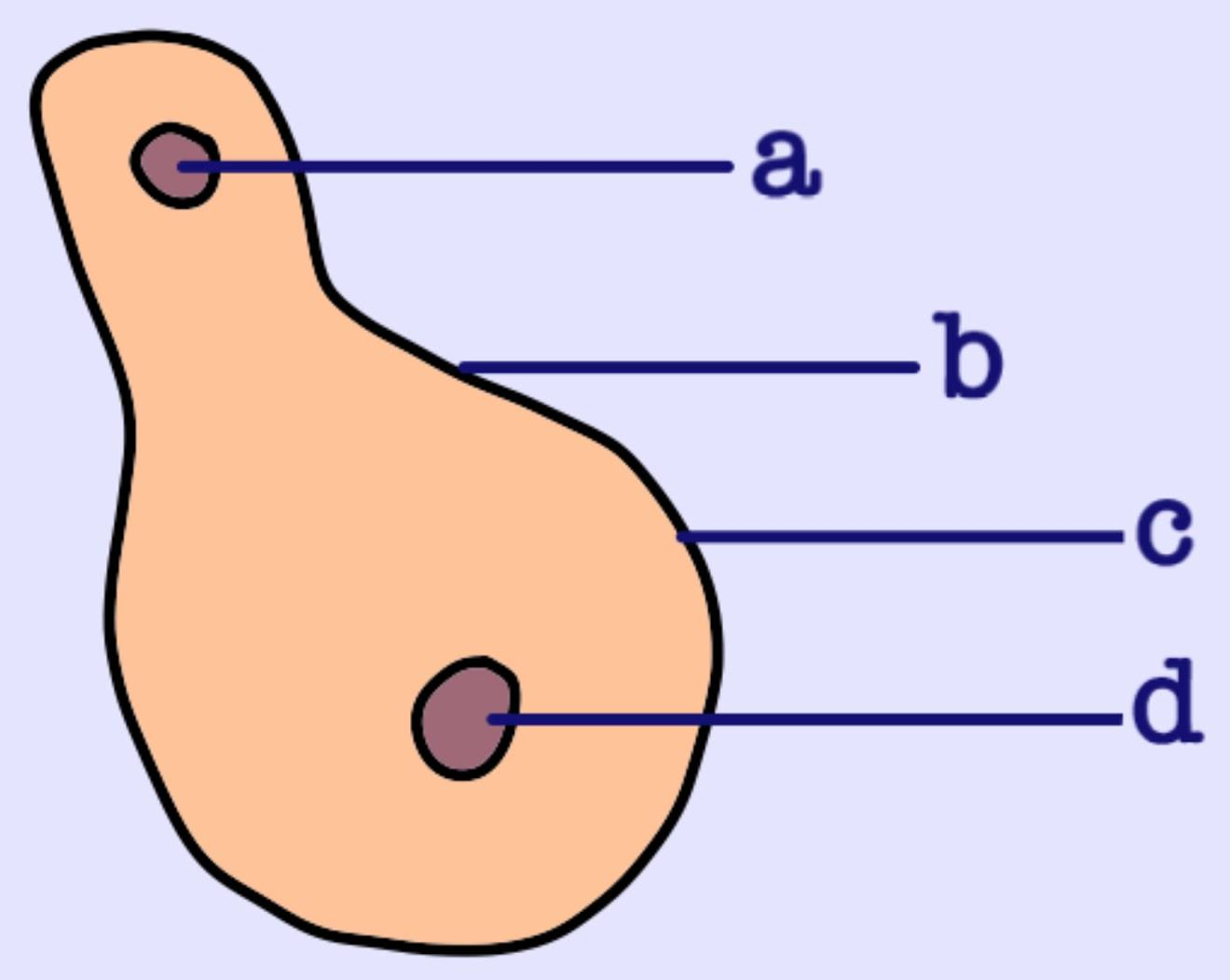
- ✓
Nucleus of bud, bud, yeast, nucleus of yeast.
- B
Dividing nucleus of bud, bud, yeast, nucleus.
- C
Dividing nucleus of bud, bud, yeast, dividing nucleus of yeast.
- D
Dividing nucleus of yeast, yeast, bud, nucleus of bud.
AnswerCorrect option: A. Nucleus of bud, bud, yeast, nucleus of yeast.
View full question & answer→MCQ 1951 Mark
Bulb helps the vegetative reproduction in:
AnswerBulb is a stem modification. It has reduced stem and fleshy storage leaves.
Bulb is used for vegetative propagation in plants like onion.
Tomato and Rye predominantly reproduce sexually.
Potato has a fleshy stem or tuber, which can also propagate vegetatively.
View full question & answer→MCQ 1961 Mark
Choose the correct statement from amongst the following.
AnswerCorrect option: D. Dioecious organisms are seen in both plants and animals.
View full question & answer→MCQ 1971 Mark
Amoeba and Yeast reproduce asexually by fission and budding respectively, because they are:
AnswerMany single$-$celled organisms reproduce by binary fission $(eg.:$ Amoeba, Paramecium$),$ where a cell divides into two halves and each rapidly grows into an adult.
In yeast, the division is unequal and small buds are produced that remain attached initially to the parent cell which eventually gets seperated and mature into new yeast organism $($cells$).$ Budding also found in Hydra.
View full question & answer→MCQ 1981 Mark
- A
Fusion of similar spores.
- ✓
- C
Fusion of dissimilar spores.
- D
View full question & answer→MCQ 1991 Mark
Regarding fertilization which among the following statements is incorrect:
- A
It restores diploid condition in the zygote.
- B
It activates egg both physiologically and metabolically.
- ✓
Paternal and maternal sets contribute to the diploid number without causing any variation.
- D
It determines the sex of the offspring.
AnswerCorrect option: C. Paternal and maternal sets contribute to the diploid number without causing any variation.
The process of fusion between haploid male nucleus and egg nucleus is known as amphimixis. It is also known as syngamy.
The process is known as fertilization which leads to formation of a diploid zygote and restores diploid condition in zygote. The statement is true.
Fertilization activates the egg physically and leads to formation of fertilization cone to prevent polyspermy.
It also brings changes in permeability.
The eggs become metabolically active and allows division of nucleus and forms embryo. The statement is true.
Sexual reproduction leads to the recombination of character in the pachytene stage of the meiosis which causes variation. So, the statement is false.
Fertilization determines the sex. Men have an $X$ and a $Y.$ So, each of their sperm carries one of the $2$ sex chromosomes, which sex chromosome is in the sperm that fertilizes the egg dictates the baby's sex. The statement is true.
View full question & answer→MCQ 2001 Mark
Ootheca of cockroach has $.........$ fertilized eggs.
AnswerCockroaches are oviparous.
The egg hatches at specific conditions to give birth to young ones.
The eggs are carried by the mother cockroach around in a sac called an ootheca, which is attached to her abdomen.
The number of eggs in each ootheca are about $16$ and varies from species to species.
Many female cockroaches drop or hide their ootheca shortly before the eggs are ready to hatch.
Others continue to carry the hatching eggs and care for their young after they are born.
But regardless of how long the mother and her eggs stay together the ootheca.
View full question & answer→MCQ 2011 Mark
Oestrus cycle is seen in:
MCQ 2021 Mark
Which plant will lose its economic value if its fruits are produced by induced parthenocarpy?
MCQ 2031 Mark
In mammals, except primates, heat condition develops in:
AnswerEstrous cycle, or oestrous cycle, is the reproductive cycle found in most mammalian placental females, whereby there are recurring periods when the female is fertile and sexually receptive $($estrus$)$ interrupted by periods in which the female is not fertile and not sexually receptive $($anestrus$).$
Animals that have estrous cycles reabsorb the endometrium $($inner membrane of the mammalian uterus$)$ if conception does not occur during that cycle.
During the estrous period also known as heat period, mature eggs are released from the ovaries.
View full question & answer→MCQ 2041 Mark
Asexual reproduction takes place through budding in:
AnswerSaccharomyces cerevisiae commonly known as yeast, reproduces both asexually as well as sexually.
Yeast reproduce asexually through a process known as budding.
View full question & answer→MCQ 2051 Mark
Which of the following statements, support the view that elaborate sexual reproductive process appeared much later in the organic evolution.
- Lower groups of organisms have simpler body design.
- Asexual reproduction is common in lower groups.
- Asexual reproduction is common in higher groups of organisms.
- The high incidence of sexual reproduction in angiosperms and vertebrates.
Choose the correct answer from the options given below.
- A
$ii$ and $iii$
- ✓
$ii$ and $iv$
- C
$i$ and $iii$
- D
$i$ and $iii$
AnswerCorrect option: B. $ii$ and $iv$
View full question & answer→MCQ 2061 Mark
Cinchona plant is also known as:
MCQ 2071 Mark
Natural parthenogenesis occurs in:
- A
- ✓
Honeybee to produce drones
- C
- D
AnswerCorrect option: B. Honeybee to produce drones
Parthenogenesis is the process of developing an unfertilized egg into an adult animal species.
It naturally occurs in is insects like honeybees, wasps and also in crustaceans.
Sexual reproduction is seen in frogs, eggs are released from female and fertilization takes place outside the body $i.e.,$ external fertilization occurs.
Sea urchins also reproduce through sexual reproduction.
They send clouds of eggs and sperm into the water and external fertilization occurs to form larvae.
View full question & answer→MCQ 2081 Mark
The shape of yeast cell is:
AnswerThe shapes of yeast cells may be spherical, globose, ellipsoidal, elongate to cylindrical with rounded ends.
View full question & answer→MCQ 2091 Mark
Conidia of Albugo are arranged $.........$
View full question & answer→MCQ 2101 Mark
Bryophyllum daigremontianum reproduces by:
MCQ 2111 Mark
A clone is a group of individuals obained through.
- A
Self$-$pollination.
- B
- ✓
- D
Cross$-$pollination.
View full question & answer→MCQ 2121 Mark
The male gametes of rice plant have $12$ chromosomes in their nucleus. The chromosome number in the female gamete, zygote and the cells of the seedling will be, respectively,
- A
$24, 12, 24$
- ✓
$12, 24, 24$
- C
$24, 12, 12$
- D
$12, 24, 12$
AnswerCorrect option: B. $12, 24, 24$
View full question & answer→MCQ 2131 Mark
The number of chromosomes in the shoot tip cells of a maize plant is $20.$ The number of chromosomes in the microspore mother cells of the same plant shall be:
AnswerMicrospore mother cell has same ploidy as the vegetative parts.
View full question & answer→MCQ 2141 Mark
Find out the false statement.
- A
Aves are warm blooded, egg laying and have four chambered heart.
- B
Aves have feather covered body, forelimbs are modified as wing and breathe through lungs.
- C
Most of the mammals are viviparous.
- ✓
Fishes, amphibians and reptiles are oviparous.
AnswerCorrect option: D. Fishes, amphibians and reptiles are oviparous.
Many members of class Chondrichthyes and most of the mammals are viviparous and class Osteichthyes, Reptilia and Amphibia are oviparous. Aves are oviparous.
They have four chambered heart filled with warm blood, feather covered body, respiration by lungs and supplemented by air sacs and forelimbs modified into wings.
View full question & answer→MCQ 2151 Mark
Which of the following statements is not true about budding in yeast?
- A
A bud may arise from any part of the parent cell.
- B
Before detaching from the parent body a bud may form another bud.
- C
A bud may separate from the parent body and develops into a new individual.
- ✓
A bud arises from a particular region on a parent body.
AnswerCorrect option: D. A bud arises from a particular region on a parent body.
In this type of asexual reproduction, a small outgrowth can arise from any part of the parent body called a bud.
The nucleus divides to form two daughter nuclei, of which one passes into the bud.
The bud can now detach from the parent body and grow independently as a new individual or may remain attached to the parent body, forming a chain of cells.
View full question & answer→MCQ 2161 Mark
The fusion of male and female gametes which are similar in size, shape, structure and behaviour is termed as:
AnswerOogamy is a form of anisogamy $($heterogamy$)$ in which the female gamete $(e.g.,$ egg cell$)$ is significantly larger than the male gamete and is non $-$ motile.
The male gametes are typically highly motile spermatozoa competing for the fertilization of the immobile egg.
Anisogamous refers to a form of sexual reproduction involving the union or fusion of two dissimilar gametes.
Conjugation is the transfer of genetic material between bacterial cells by direct cell $-$ to $-$ cell contact or by a bridge$-$like connection between two cells.
Isogamous is a form of sexual reproduction that involves gametes of similar morphology $($similar shape and size$),$ differing in general only in allele expression in one or more mating $-$ type regions.
View full question & answer→MCQ 2171 Mark
Which of the following plant cells will show totipotency?
MCQ 2181 Mark
Which is the mode of reproduction in Amoeba?
- A
- ✓
Binary fission and multiple fission
- C
Binary fission and conjugation
- D
AnswerCorrect option: B. Binary fission and multiple fission
Binary fission is the asexual form of reproduction in which a single $-$ celled organism divides itself into two cells, in favourable conditions.
Multiple fission is the asexual form of reproduction where the parent Amoeba cell divides to give many daughter cells in unfavourable conditions.
But, Amoeba may divide in binary or multiple fission modes of reproduction.
View full question & answer→MCQ 2191 Mark
Gemmules are also known as:
MCQ 2201 Mark
Parthenogenesis occurs in which of the following animal?
AnswerParthenogenesis is a form of asexual reproduction where an egg develops into an offspring without being fertilized.
Many insects like aphid, ant, bee, parasitic wasp reproduce parthenogenetically.
View full question & answer→MCQ 2211 Mark
Why is vivipary an undesirable character for annual crop plants?
- A
It reduces the vigour of the plant.
- B
It adversely affects the fertility of the plant.
- C
The seeds exhibit long dormancy.
- ✓
The seeds cannot be stored under normal conditions for the next season.
AnswerCorrect option: D. The seeds cannot be stored under normal conditions for the next season.
View full question & answer→MCQ 2221 Mark
Which of the following statements is true of Hydra?
- ✓
It produces multicellular bud.
- B
It produces unicellular bud.
- C
- D
It produces asexual gemmules.
AnswerCorrect option: A. It produces multicellular bud.
View full question & answer→