Question 11 Mark
Write the IUPAC name of $\mathrm{CH}_3 \mathrm{COCH}_2 \mathrm{COCH}_3$.
View full question & answer→Question 21 Mark
Write the IUPAC name of the following ketone and aldehyde. Wherever possible, give also common name.$\mathrm{CH}_3\left(\mathrm{CH}_2\right)_5 \mathrm{CHO}$
Answer$\mathrm{CH}_3\left(\mathrm{CH}_2\right)_5 \mathrm{CHO}$
IUPAC name: Heptanal.
View full question & answer→Question 31 Mark
Draw the structure of the following compound.
4-Methylpent-3-en-2-one.
Answer $\ \ \ \ \ \ \ \ \ \ \ \ \ \text{O}\ \ \ \ \ \ \ \ \ \ \ \ \ \ \ \ \text{CH}_3\\\ \ \ \ \ \ \ \ \ \ \ \ \ \ ||\ \ \ \ \ \ \ \ \ \ \ \ \ \ \ \ \ |\\\ \text{H}_3\text{C}-\text{C}-\text{CH}=\text{C}-\text{CH}_3$
View full question & answer→Question 41 Mark
What is meant by the following term? Give an example of the reaction in each case.Oxime.
Answer
Oxime: Oximes are a class of organic compounds having the general formula $RR“^2$ CNOH, where R is an organic side chain and $R“^2$ is either hydrogen or an organic side chain. If $R“^2$ is H, then it is known as aldoxime and if $R“^2$ is an organic side chain, it is known as ketoxime.
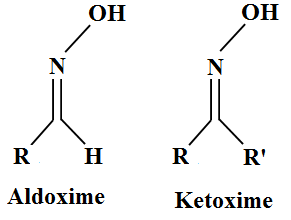
On treatment with hydroxylamine in a weakly acidic medium, aldehydes or ketones form oximes.

View full question & answer→Question 51 Mark
How will you convert ethanal into the following compound?Butane-1,3-diol.
AnswerOn treatment with dilute alkali, ethanal produces 3-hydroxybutanal gives butane-1, 3-diol on reduction.
$\ \ \ \ \ \ \ \ \ \ \ \ \ \ \ \ \ \ \ \ \ \ \ \ \ \ \ \ \ \ \ \ \ \ \ \ \ \ \ \ \ \ \ \ \ \ \ \text{OH}\ \ \ \ \ \ \ \ \ \ \ \ \ \ \ \ \ \ \ \ \ \ \ \ \ \ \ \ \ \ \ \ \ \ \ \ \ \ \ \ \ \ \ \ \ \ \ \ \ \ \ \ \ \ \ \ \ \ \text{OH}\\\ \ \ \ \ \ \ \ \ \ \ \ \ \ \ \ \ \ \ \ \ \ \ \ \ \ \ \ \ \ \ \ \ \ \ \ \ \ \ \ \ \ \ \ \ \ \ \ |\ \ \ \ \ \ \ \ \ \ \ \ \ \ \ \ \ \ \ \ \ \ \ \ \ \ \ \ \ \ \ \ \ \ \ \ \ \ \ \ \ \ \ \ \ \ \ \ \ \ \ \ \ \ \ \ \ \ \ \ \ \ \ |\\ \text{CH}_3\text{CHO}\xrightarrow{\ \text{dil} \text{ NaOH }}\text{CH}_3-\text{CH}-\text{CH}_2-\text{CHO}\xrightarrow[(\text{Reduction})]{\text{ NaBH}_4\ \ }\text{CH}_3-\text{CH}-\text{CH}_2-\text{CH}_2-\text{OH}\\ \text{Ethanal}\ \ \ \ \ \ \ \ \ \ \ \ \ \ \ \ \ \ \ \ \ \ \ \ \ \ \text{3 - Hydroxybutanal}\ \ \ \ \ \ \ \ \ \ \ \ \ \ \ \ \ \ \ \ \ \ \ \ \ \ \ \ \ \text{Butane - 1, 3 - diol}$
View full question & answer→Question 61 Mark
What is meant by the following term? Give an example of the reaction in each case.Ketal.
Answer
Ketal: Ketals are gem - dialkoxyalkanes in which two alkoxy groups are present on the same carbon atom within the chain. The other two bonds of the carbon atom are connected to two alkyl groups.
$\ \ \ \ \ \ \ \ \text{R}'\\\ \ \ \ \ \ \ \ \ |\\\text{R}-\text{C}-\text{OR}''\\\ \ \ \ \ \ \ \ \ |\\\ \ \ \ \ \ \ \ \text{OR}'''\\\text{General structure of a ketal}$
Ketones react with ethylene glycol in the presence of dry HCl gas to give a cyclic product known as ethylene glycol ketals.
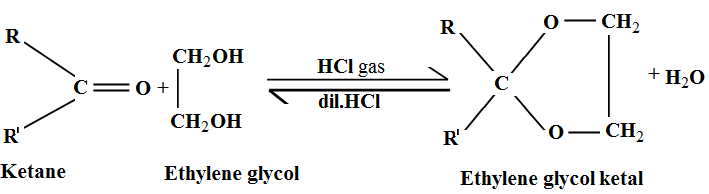
View full question & answer→Question 71 Mark
Draw the structure of the following compound. p-Methylbenzaldehyde.
Question 81 Mark
Arrange the following compound in increasing order of their property as indicated:Benzoic acid, 4-Nitrobenzoic acid, 3, 4-Dinitrobenzoic acid, 4-Methoxybenzoic acid (acid strength)
AnswerSince electron-donating groups decreases the acidic strength, therefore, 4-methoxy benzoic acid is a weaker acid than benzoic acid. Further since electron withdrawing groups increase the acidic strength, therefore, both 4-nitrobenzoic acid and 3, 4-dinitrobenzoic acid are stronger acids than benzoic acid. Further due to the presence of an additional $-N0_2$ group at /w-position with respect to -COOH group, 3, 4- dinitrobenzoic acid is a stronger acid than 4-nitrobenzoic acid. Thus, the overall acidic strength increases in the order: 4-rnethoxy benzoic acid < benzoic acid < 4-nitrobenzoic acid < 3, 4-dinitrobenzoic acid.
View full question & answer→Question 91 Mark
Describe the following:Cross aldol condensation.
Answer Cross aldol condensation: Aldol condensation between two different aldehydes is called cross aldol condensation. If both aldehydes contain a-hydrogens, It gives a mixture of four products.$\ \ \ \ \ \ \ \ \ \ \ \ \ \text{O}\ \ \ \ \ \ \ \ \ \ \ \ \ \ \ \ \ \ \ \ \text{O}\ \ \ \ \ \ \ \ \ \ \ \ \ \ \ \ \ \ \ \ \ \ \ \ \ \ \ \ \ \ \ \ \ \ \ \ \ \ \ \ \ \ \ \ \ \ \ \ \ \ \ \ \ \ \ \ \ \ \ \ \ \ \text{O}\\\ \ \ \ \ \ \ \ \ \ \ \ \ ||\ \ \ \ \ \ \ \ \ \ \ \ \ \ \ \ \ \ \ \ \ \ ||\ \ \ \ \ \ \ \ \ \ \ \ \ \ \ \ \ \ \ \ \ \ \ \ \ \ \ \ \ \ \ \ \ \ \ \ \ \ \ \ \ \ \ \ \ \ \ \ \ \ \ \ \ \ \ \ \ \ \ \ \ \ || \\ \text{CH}_3-\text{C}-\text{H}+\text{H}-\text{C}-\text{H}\xrightarrow{\text{Dil. NaOH}}\text{HO}-\text{CH}_2-\text{CH}_2-\text{C}-\text{H}$
View full question & answer→Question 101 Mark
Name the following compound according to IUPAC system of nomenclature: $\left(\mathrm{CH}_3\right)_3 \mathrm{CCH}_2 \mathrm{COOH}$
Answer3, 3-Dimethylbutanoic acid.
View full question & answer→Question 111 Mark
Draw structure of the following derivative.The 2, 4-dinitrophenylhydrazone of benzaldehyde.
Question 121 Mark
How will you bring about the following conversion in not more than two step?Ethanol to 3-Hydroxybutanal.
Answer Ethanol to 3-Hydroxybutanal:$\ \ \ \ \ \ \ \ \ \ \ \ \ \ \ \ \ \ \ \ \ \ \ \ \ \ \ \ \ \ \ \ \ \ \ \ \ \ \ \ \ \ \ \ \ \ \ \ \ \ \ \ \ \ \ \ \ \ \ \ \ \ \ \ \ \ \ \ \ \ \ \ \ \ \ \ \ \ \ \ \ \ \ \ \ \ \ \text{OH}\\\ \ \ \ \ \ \ \ \ \ \ \ \ \ \ \ \ \ \ \ \ \ \ \ \ \ \ \ \ \ \ \ \ \ \ \ \ \ \ \ \ \ \ \ \ \ \ \ \ \ \ \ \ \ \ \ \ \ \ \ \ \ \ \ \ \ \ \ \ \ \ \ \ \ \ \ \ \ \ \ \ \ \ \ \ \ \ \ |\\\text{CH}_3\text{CH}_2\text{OH}\xrightarrow{\ \text{Cu/573k}\ \ }\text{CH}_3\text{CHO}\xrightarrow{ \ \text{Dil NaOH}\ \ \ }\text{CH}_3-\text{CH}-\text{CH}_2\text{CHO}$
View full question & answer→Question 131 Mark
Arrange the following compound in increasing order of their property as indicated:$CH_3CH_2CH(Br)COOH,$ $CH_3CH(Br)CH_2COOH, (CH_3)_2CHCOOH, CH_3CH_2CH_2COOH$ (acid strength)
AnswerWe know that +I-effect decreases while -l-effect increases the acidic strength of carboxylic acids. Since +I-effect of isopropyl group is more than that of propyl group, therefore, $(CH_3)_2CHCOOH$ is a weaker acid than $CH_3CH_2CH_2COOH$. Further since -l-eftect decreases with distance, therefore $CH_3CH_2CHBrCOOH$ is a stronger acid than $CH_3CHBrCH_2COOH.$ Thus, the overall acid strength increases in the order:

View full question & answer→Question 141 Mark
Give simple chemical tests to distinguish between the following pairs of compound.Benzoic acid and Ethyl benzoate.
AnswerBenzoic acid and Ethyl benzoate- By $\mathrm{NaHCO_3}$ test.$\text{C}_6\text{H}_5\text{COOH}+\text{NaHCO}_3\xrightarrow{\ \ \ \ \ \ }\text{C}_6\text{H}_5\text{COONa}+\text{H}_2\text{O}+\text{CO}_2\uparrow\\ \ \text{Benzoic acid}\ \ \ \ \ \ \ \ \ \ \ \ \ \ \ \ \ \ \ \ \ \ \ \ \ \ \text{Sodiumbenzoate}$
$\text{C}_6\text{H}_5\text{COOC}_2\text{H}_5+\text{NaHCO}_3\xrightarrow{\ \ \ \ \ }\text{No}\text{ CO}_2\text{ is formed}$
View full question & answer→Question 151 Mark
What is meant by the following term? Give an example of the reaction in each case.Imine.
Answer
Imine: Imines are chemical compounds containing a carbon nitrogen double bond.
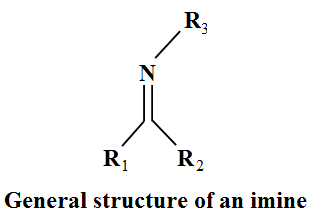
Imines are produced when aldehydes and ketones react with ammonia and its derivatives.

View full question & answer→Question 161 Mark
Complete each synthesis by giving missing starting material, reagent or product.
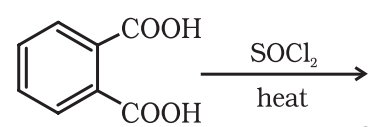
Question 171 Mark
Give the IUPAC name of the following compound: $\mathrm{Ph} \mathrm{~CH}_2 \mathrm{CH}_2 \mathrm{COOH}$.
View full question & answer→Question 181 Mark
What is meant by the following term? Give an example of the reaction in each case.Cyanohydrin.
Answer
Cyanohydrin: Cyanohydrins are organic compounds having the formula $RR“^2$ C(OH)CN, where R and $R“^2$ can be alkyl or aryl groups.
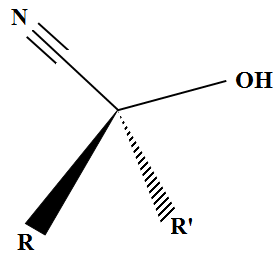
Aldehydes and ketones react with hydrogen cyanide (HCN) in the presence of excess sodium cyanide (NaCN) as a catalyst to field cyanohydrin. These reactions are known as cyanohydrin reactions.
$\text{R}\text{R}'\text{C}=\text{O}+\text{HCN}\xrightarrow{ \ \ \text{Na}\text{CN}\ \ \ }\text{R}\text{R}'\text{C}(\text{OH})\text{CN}\\\text{Ketone}\ \ \ \ \ \ \ \ \ \ \ \ \ \ \ \ \ \ \ \ \ \ \ \ \ \ \ \ \ \ \ \ \ \ \ \ \ \text{Cyanohydrin}$
Cyanohydrins are useful synthetic intermediates. View full question & answer→Question 191 Mark
Write the structure of the following compound.4-Fluoroacetophenone.
Question 201 Mark
Complete each synthesis by giving missing starting material, reagent or product.

Question 211 Mark
Arrange the following compound in increasing order of their reactivity in nucleophilic addition reaction.Ethanal, Propanal, Propanone, Butanone.
[Hint: Consider steric effect and electronic effect.]
AnswerButanone < Propanone < Propanal < Ethanal. This is because as the no. of alkyl groups attached to carbonyl carbon increases, +I-effect increases. As a result, $e^-$ densityon C-atom of 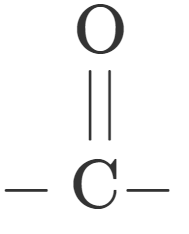 group decreases and hence attack by $Nu^-$ becomes slower and slower.
 View full question & answer→Question 221 Mark
Predict the product of the following reaction:
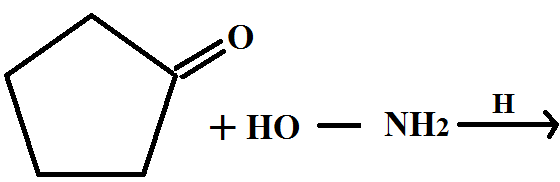
Question 231 Mark
Show how each of the following compound can be converted to benzoic acid.Phenylethene (Styrene).
Question 241 Mark
Complete each synthesis by giving missing starting material, reagent or product.
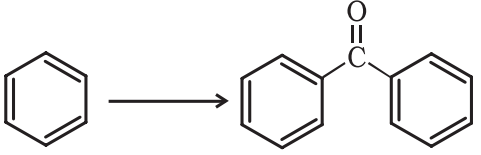
Question 251 Mark
How will you bring about the following conversion in not more than two step?Benazaldehyde to $\alpha$-Hydroxyphenylacetic acid.
AnswerBenazaldehyde to $\alpha$-Hydroxyphenylacetic acid:$\ \ \ \ \ \ \ \ \ \ \ \ \ \ \ \ \ \ \ \ \ \ \ \ \ \ \ \ \ \ \ \ \ \ \ \ \ \ \ \ \ \ \text{OH}\ \ \ \ \ \ \ \ \ \ \ \ \ \ \ \ \ \ \ \ \ \ \ \ \ \ \ \ \ \ \ \ \ \ \ \ \ \ \ \ \text{OH}\\\ \ \ \ \ \ \ \ \ \ \ \ \ \ \ \ \ \ \ \ \ \ \ \ \ \ \ \ \ \ \ \ \ \ \ \ \ \ \ \ \ \ \ |\ \ \ \ \ \ \ \ \ \ \ \ \ \ \ \ \ \ \ \ \ \ \ \ \ \ \ \ \ \ \ \ \ \ \ \ \ \ \ \ \ \ \ \ \ |\\ \text{C}_6\text{H}_5\text{CHO}\xrightarrow[\text{pH. 9-10}]{\text{HCN}}\text{C}_6\text{H}_5\text{CH}-\text{CN}\xrightarrow{\text{H}^+/\text{H}_2\text{O}}\text{C}_6\text{H}_5-\text{CH}-\text{COOH}$
View full question & answer→Question 261 Mark
Draw structure of the following derivative.Acetaldehydedimethylacetal.
Question 271 Mark
Predict the product formed when cyclohexanecarbaldehyde reacts with following reagent.Zinc amalgam and dilute hydrochloric acid.
Question 281 Mark
Give simple chemical tests to distinguish between the following pairs of compound.Acetophenone and Benzophenone.
AnswerAcetophenone and Benzophenone can be distinguished by iodoform test. $\text{C}_6\text{H}_5\text{COCH}_3+\text{3NaOI}\xrightarrow{ \ \ \ \ \ \ \ \ \ }\text{C}_6\text{H}_5\text{COONa}+\text{CH}_3\text{I}\downarrow+\text{2NaOH}\\\ \ \ \ \ \ \ \ \ \ \ \ \ \ \ \ \ \ \ \ \ \ \ \ \ \ \ \ \ \ \ \ \ \ \ \ \ \ \ \ \ \ \ \ \ \ \ \ \ \ \ \ \ \ \ \ \ \ \ \ \ \ \ \ \ \ \ \ \ \ \ \ \ \ \ \ \ \ \text{Iodoform}\\ \ \ \ \ \ \ \ \ \ \ \ \ \ \ \ \ \ \ \ \ \ \ \ \ \ \ \ \ \ \ \ \ \ \ \ \ \ \ \ \ \ \ \ \ \ \ \ \ \ \ \ \ \ \ \ \ \ \ \ \ \ \ \ \ \ \ \ \ \ \ \ \ \ \ \ (\text{Yellow ppt.})$ $\text{C}_6\text{H}_5\text{COC}_6\text{H}_5\xrightarrow{\ \ \text{NaOI}\ \ \ }\text{No yellow ppt.}$This test is given by aldehydes and ketones containing $-COCH_3$ group.
View full question & answer→Question 291 Mark
Give simple chemical tests to distinguish between the following pairs of compound.Benzaldehyde and Acetophenone.
AnswerBenzaldehyde and Acetophenone can be distinguished by iodoform test.$\text{C}_6\text{H}_5\text{COCH}_3+\text{3NaOI}\xrightarrow{\ \ \ \ \ }\text{C}_6\text{H}_5\text{COONa}+\text{CH}_3\text{I}\downarrow+\text{2NaOH}\\ \ \ \ \ \ \ \ \ \ \ \ \ \ \ \ \ \ \ \ \ \ \ \ \ \ \ \ \ \ \ \ \ \ \ \ \ \ \ \ \ \ \ \ \ \ \ \ \ \ \ \ \ \ \ \ \ \ \ \ \ \ \ \ \ \ \ \ \ \ \ \ \ (\text{Yellow ppt.})$
$\text{C}_6\text{H}_5\text{CHO}+\text{NaOI}\xrightarrow{\ \ \ \ \ \ }\text{No yellow ppt.}$
View full question & answer→Question 301 Mark
Name the following compound according to IUPAC system of nomenclature: $\mathrm{CH}_3 \mathrm{CH}_2 \mathrm{COCH}\left(\mathrm{C}_2 \mathrm{H}_5\right) \mathrm{CH}_2 \mathrm{CH}_2 \mathrm{Cl}$
Answer6-Chloro-4-ethylhexan-3-one.
View full question & answer→Question 311 Mark
How will you prepare the following compound from benzene? You may use any inorganic reagent and any organic reagent having not more than one carbon atom.Phenylacetic acid.
Question 321 Mark
How will you prepare the following compound from benzene? You may use any inorganic reagent and any organic reagent having not more than one carbon atom.m-Nitrobenzoic acid.
Question 331 Mark
Draw the structure of the following compound. p-Nitropropiophenone.
Question 341 Mark
How will you bring about the following conversion in not more than two step?Propanone to Propene.
AnswerPropanone to propene:$\ \ \ \ \ \ \ \ \ \ \ \ \ \text{O}\ \ \ \ \ \ \ \ \ \ \ \ \ \ \ \ \ \ \ \ \ \ \ \ \ \ \ \ \ \ \ \ \ \ \ \ \ \ \ \ \ \text{OH}\\\ \ \ \ \ \ \ \ \ \ \ \ \ \ ||\ \ \ \ \ \ \ \ \ \ \ \ \ \ \ \ \ \ \ \ \ \ \ \ \ \ \ \ \ \ \ \ \ \ \ \ \ \ \ \ \ \ |\\\ \text{CH}_3-\text{C}-\text{CH}_3\xrightarrow{\ \ \text{NaBH}_4\ }\text{CH}_3-\text{CH}-\text{CH}_3\xrightarrow[\text{_H}_2\text{O}]{\text{Conc. }\text{H}_2\text{SO}_4,\text{433-443K}}\text{CH}_3-\text{CH}=\text{CH}_2$
View full question & answer→Question 351 Mark
Give plausible explanation for each of the following:During the preparation of esters from a carboxylic acid and an alcohol in the presence of an acid catalyst, the water or the ester should be removed as soon as it is formed.
Answer
The formation of esters from a carboxylic acid and an alcohol in presence of an acid catalyst is a reversible reaction.

Thus to shift the equilibrium in the forward direction, the water or the ester formed should be removed as fast as it is formed.
View full question & answer→Question 361 Mark
Which acid of each pair shown here would you expect to be stronger?
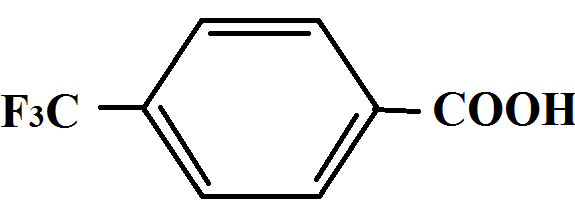
or
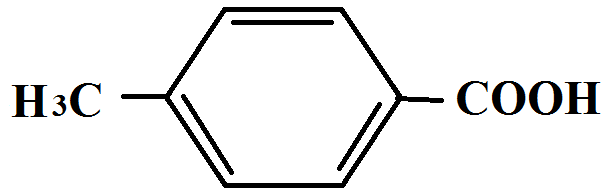
Answer
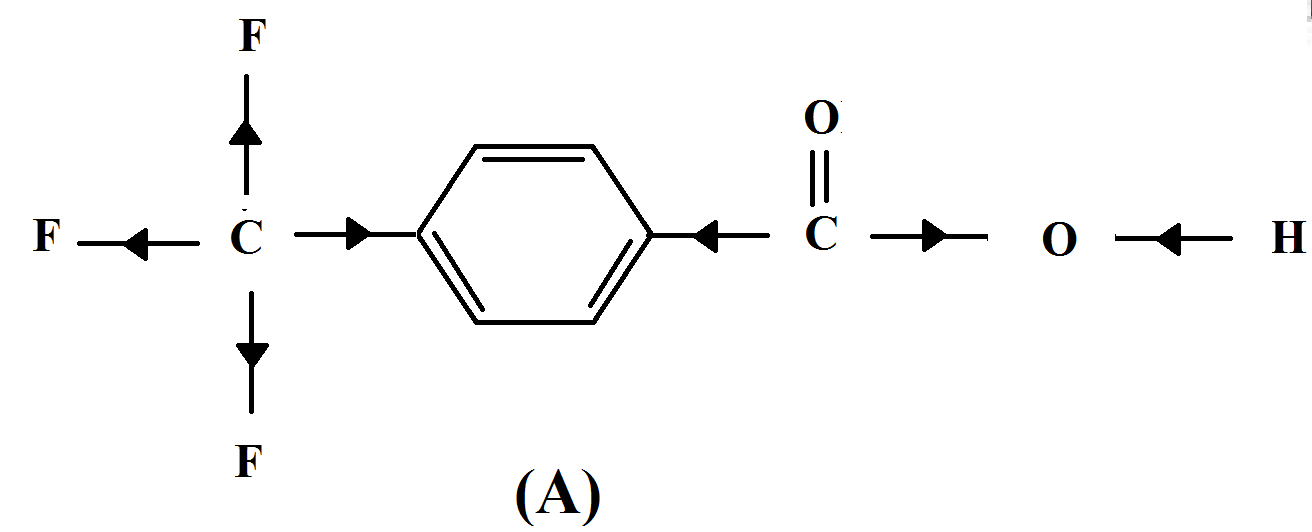
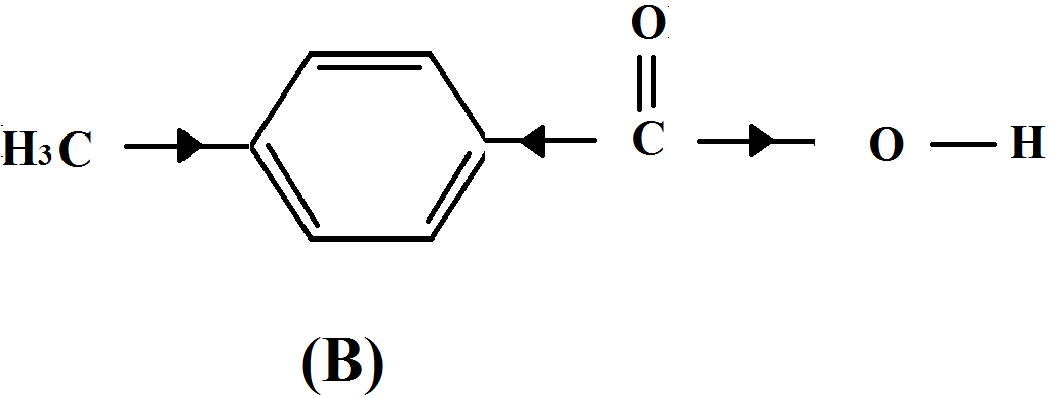
Due to the -I effect of F, it is easier to release proton in the case of compound (A).However, in the case of compound (B), release of proton is difficult due to the +I effect of$-CH_3$ group. Hence, (A) is a stronger acid than (B). View full question & answer→Question 371 Mark
Draw structure of the following derivative.The methyl hemiacetal of formaldehyde.
Question 381 Mark
Write the structure of product of the following reaction;
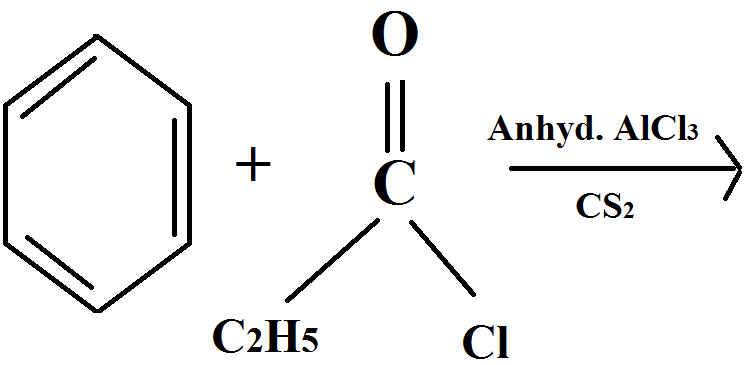
Question 391 Mark
Write the IUPAC name of the following ketone and aldehyde. Wherever possible, give also common name.Ph-CH=CH-CHO
AnswerPh-CH=CH-CHOIUPAC name: 3-phenylprop-2-enal
Common name: β-Pheynolacrolein.
View full question & answer→Question 401 Mark
How will you bring about the following conversion in not more than two step?Bromobenzene to 1-Phenylethanol.
AnswerBromobenzene to 1-Phenylethanol:$\ \ \ \ \ \ \ \ \ \ \ \ \ \ \ \ \ \ \ \ \ \ \ \ \ \ \ \ \ \ \ \ \ \ \ \ \ \ \ \ \ \ \ \ \ \ \ \ \ \ \ \ \ \ \ \ \ \ \ \ \ \ \ \ \ \ \ \ \ \ \ \ \ \ \ \ \ \ \ \ \ \ \ \ \ \ \ \ \text{OH}\\\ \ \ \ \ \ \ \ \ \ \ \ \ \ \ \ \ \ \ \ \ \ \ \ \ \ \ \ \ \ \ \ \ \ \ \ \ \ \ \ \ \ \ \ \ \ \ \ \ \ \ \ \ \ \ \ \ \ \ \ \ \ \ \ \ \ \ \ \ \ \ \ \ \ \ \ \ \ \ \ \ \ \ \ \ \ \ \ \ |\\\text{C}_6\text{H}_5\text{Br}\xrightarrow{\ \text{Mg/dry ether}\ }\text{C}_6\text{H}_5\text{MgBr}\xrightarrow[(\text{ii})\text{H}_3\text{O}^+]{(\text{i}) \text{CH}_3\text{CHO}}\text{C}_6\text{H}_5-\text{CH}-\text{CH}_3$
View full question & answer→Question 411 Mark
Draw the structure of the following compound. p, p’-Dihydroxybenzophenone.
Question 421 Mark
Name the following compound according to IUPAC system of nomenclature: $\mathrm{CH}_3 \mathrm{CH}\left(\mathrm{CH}_3\right) \mathrm{CH}_2 \mathrm{C}\left(\mathrm{CH}_3\right)_2 \mathrm{COCH}_3$
Answer3,3,5-Trimethylhexan-2-one.
View full question & answer→Question 431 Mark
Complete each synthesis by giving missing starting material, reagent or product.$\text{CH}_3\text{COCH}_2\text{COOC}_2\text{H}_5\xrightarrow[(\text{ii})\text{ H}^+]{(\text{i})\text{ NaBH}_4}$
Answer$\ \ \ \ \ \ \ \ \ \ \ \ \ \text{O}\ \ \ \ \ \ \ \ \ \ \ \ \ \ \ \ \ \ \ \ \ \ \ \ \ \ \ \ \ \ \ \ \ \ \ \ \ \ \ \ \ \ \ \ \ \ \ \ \ \ \ \ \ \ \ \ \ \ \ \ \text{OH}\\ \ \ \ \ \ \ \ \ \ \ \ \ \ ||\ \ \ \ \ \ \ \ \ \ \ \ \ \ \ \ \ \ \ \ \ \ \ \ \ \ \ \ \ \ \ \ \ \ \ \ \ \ \ \ \ \ \ \ \ \ \ \ \ \ \ \ \ \ \ \ \ \ \ \ \ \ |\\\text{CH}_3-\text{C}-\text{CH}_2\text{COOC}_2\text{H}_5\xrightarrow[(\text{ii})\text{ H}^+]{(\text{i})\text{ NaBH}_4}\text{CH}_3-\text{CH}-\text{CH}_2\text{COOC}_2\text{H}_5$
View full question & answer→Question 441 Mark
Draw the structure of the following compound.
3-Methylbutanal.
Answer$\ \ \ \ \ \ \ \ \ \ \ \ \text{CH}_3\ \ \ \ \ \ \ \ \ \ \ \ \ \ \ \ \text{O}\\\ \ \ \ \ \ \ \ \ \ \ \ \ |\ \ \ \ \ \ \ \ \ \ \ \ \ \ \ \ \ \ \ \ \ \ ||\\\text{H}_3\text{C}-\text{CH}-\text{CH}_2-\text{C}-\text{H}$
View full question & answer→Question 451 Mark
Give the IUPAC name of the following compound:
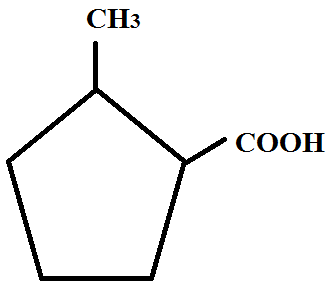
Answer2-Methylcyclopentanecarboxylic acid.
View full question & answer→Question 461 Mark
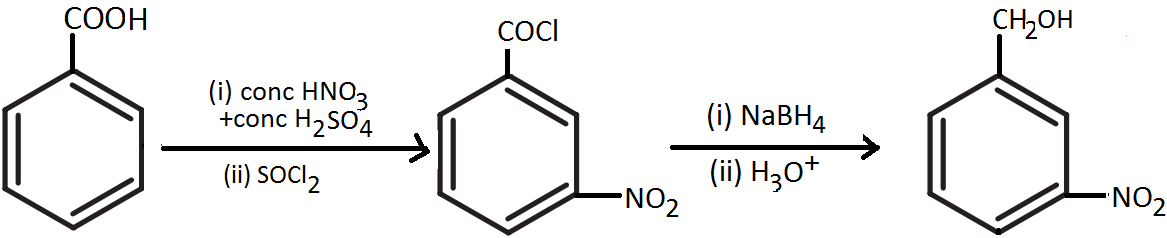
How will you bring about the following conversion in not more than two step?Benzoic acid to m-Nitrobenzyl alcohol.
Answer
Benzoic acid to m-Nitrobenzyl alcohol:
View full question & answer→Question 471 Mark
Write the IUPAC name of the following ketone and aldehyde. Wherever possible, give also common name.$\mathrm{CH}_3 \mathrm{CH}_2 \mathrm{CHBrCH}_2 \mathrm{CH}\left(\mathrm{CH}_3\right) \mathrm{CHO}$
Answer$\mathrm{CH}_3 \mathrm{CH}_2 \mathrm{CHBrCH}_2 \mathrm{CH}\left(\mathrm{CH}_3\right) \mathrm{CHO}$ IUPAC name: 4-Bromo-2-methylhaxanal
Common name: (Y-Bromo-α-methyl-caproaldehyde).
View full question & answer→Question 481 Mark
Complete each synthesis by giving missing starting material, reagent or product.
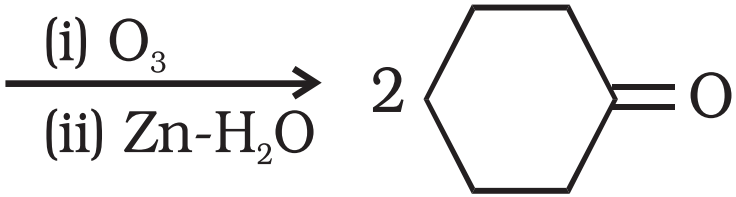
Question 491 Mark
Give simple chemical tests to distinguish between the following pairs of compound.Propanal and Propanone.
AnswerPropanal and Propanone can be distinguished by iodofonm test.$\text{CH}_3\text{COCH}_3+\text{3NaOI}\xrightarrow{\ \ \ \ \ \ \ \ }\text{CH}_3\text{I}\downarrow+\text{CH}_3\text{COONa}+\text{2NaOH}\\ \ \ \ \ \ \ \ \ \ \ \ \ \ \ \ \ \ \ \ \ \ \ \ \ \ \ \ \ \ \ \ \ \ \ \ \ \ \ \ \ \ \ \ \ \ \ \text{Iodoform}\\ \ \ \ \ \ \ \ \ \ \ \ \ \ \ \ \ \ \ \ \ \ \ \ \ \ \ \ \ \ \ \ \ \ \ \ \ \ \ \ \ \ \ \ \ (\text{Yellow ppt.})$
This test is given by aldebydes containing $-COCH_3$ group. Propanal does not have $-COCH_3$ group thus it does not give iodoform test.
View full question & answer→Question 501 Mark
Name the following compound according to IUPAC system of nomenclature: $\mathrm{OHCC}_6 \mathrm{H}_4 \mathrm{CHO}$-p
AnswerBenzene-1, 4-dicarbaldehyde.
View full question & answer→Question 511 Mark
Describe the following:Acetylation.
AnswerAcetylation refers to the process of introducing an acetyl group into a compound namely, the substitution of an acetyl group for an active hydrogen atom. Acetylation is usually carried out in presence of a base such as pyridine, dimethylanitine, etc.$\text{CH}_3\text{COCl}+\text{CH}_3\text{CH}_2\text{OH}\xrightarrow{\ \text{Pyridine }\ }\text{CH}_3\text{COOC}_2\text{H}_5+\text{HCl}$
View full question & answer→Question 521 Mark
Draw the structure of the following compound.
Hex-2-en-4-ynoic acid.
Answer$\ \ \ \ \ \ \ \ \ \ \ \ \ \ \ \ \ \ \ \ \ \ \ \ \ \ \ \ \ \ \ \ \ \ \ \ \ \ \ \ \ \ \ \ \ \ \ \ \ \ \ \text{O}\\\ \ \ \ \ \ \ \ \ \ \ \ \ \ \ \ \ \ \ \ \ \ \ \ \ \ \ \ \ \ \ \ \ \ \ \ \ \ \ \ \ \ \ \ \ \ \ \ \ \ \ \ ||\\ \text{H}_3\text{C}-\text{C}\equiv\text{C}-\text{CH}=\text{CH}-\text{C}-\text{OH}$
View full question & answer→Question 531 Mark
Write the structure of the following compound.3-Hydroxybutanal.
Answer$\ \ \ \ \ \ \ \ \ \ \ \ \ \ \ \ \ \ \ \ \ \ \ \ \ \ \ \ \ \ \ \ \ \ \ \ \text{O}\\\ \ \ \ \ \ \ \ \ \ \ \ \ \ \ \ \ \ \ \ \ \ \ \ \ \ \ \ \ \ \ \ \ \ \ \ \ ||\\\text{CH}_3-\text{CH}-\text{CH}_2-\text{C}-\text{H}\\\ \ \ \ \ \ \ \ \ \ \ \ \ \ |\\\ \ \ \ \ \ \ \ \ \ \ \ \ \text{OH}$
View full question & answer→Question 541 Mark
Draw structure of the following derivative.Cyclopropanone oxime.
Question 551 Mark
What is meant by the following term? Give an example of the reaction in each case.Acetal.
Answer
Acetal: Acetals are gem - dialkoxy alkanes in which two alkoxy groups are present on the terminal carbon atom. One bond is connected to an alkyl group while the other is connected to a hydrogen atom.
${\ \ \ \ \ \ \ \ \text{H}}\\\ \ \ \ \ \ \ \ \ |\\\text{R}-\text{C}-\text{OR'}\\\ \ \ \ \ \ \ \ \ |\\ \ \ \ \ \ \ \ \ \text{OR"}\\\text{ General structure of an acetal}$
When aldehydes are treated with two eQuivalents of a monohydric alcohol in the presence of dry HCl gas, hemiacetals are produced that further react with one more molecule of alcohol to yield acetal.

View full question & answer→Question 561 Mark
How will you prepare the following compound from benzene? You may use any inorganic reagent and any organic reagent having not more than one carbon atom.Methyl benzoate.
Question 571 Mark
Write the IUPAC name of the following ketone and aldehyde. Wherever possible, give also common name.
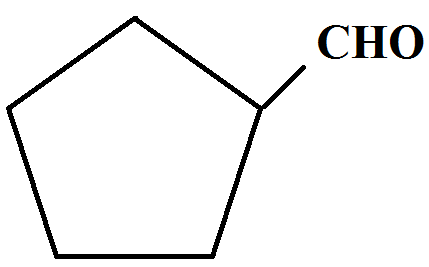
Answer
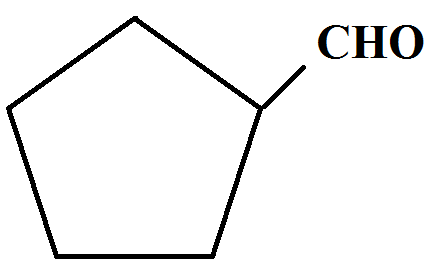
IUPAC name: Cyclopentanecarbaldehyde.
View full question & answer→Question 581 Mark
How will you prepare the following compound from benzene? You may use any inorganic reagent and any organic reagent having not more than one carbon atom.p-Nitrobenzaldehyde.
Question 591 Mark
Which acid of each pair shown here would you expect to be stronger?
$CH_3CO_2H$ or $CH_2FCO_2H$
Answer$\ \ \ \ \ \ \ \ \ \ \ \ \ \text{O}\ \ \ \ \ \ \ \ \ \ \ \ \ \ \ \ \ \ \ \ \ \ \ \ \ \ \ \ \ \ \ \ \ \ \ \ \ \ \ \ \ \ \ \ \ \ \ \ \ \ \ \ \ \ \ \text{O}\\\ \ \ \ \ \ \ \ \ \ \ \ \ \ ||\ \ \ \ \ \ \ \ \ \ \ \ \ \ \ \ \ \ \ \ \ \ \ \ \ \ \ \ \ \ \ \ \ \ \ \ \ \ \ \ \ \ \ \ \ \ \ \ \ \ \ \ \ \ \ \ ||\\\text{CH}_3\xrightarrow{}\text{C}\xrightarrow{}\text{O}\xrightarrow{}\text{H}\ \ \ \ \ \ \ \ \ \ \ \ \ \ \text{F}\leftarrow\text{CH}_2\xleftarrow{}\text{C}\xleftarrow{}\text{O}\xleftarrow{}\text{H}$
The +I effect of $-CH_3$ group increases the electron density on the O-H bond.
Therefore, release of proton becomes difficult. On the other hand,
the -I effect of F decreases the electron density on the O-H bond.
Therefore, proton can be released easily. Hence, $CH_2FCO_2H$ is a stronger acid than $CH_3CO_2H.$
View full question & answer→Question 601 Mark
Give simple chemical tests to distinguish between the following pairs of compound.Ethanal and Propanal.
AnswerEthanal and propanal can be distinguished by Iodoform test.$\text{CH}_3\text{CHO}+\text{3NaOI}\xrightarrow{\ \ \ \ \ \ \ \ \ \ }\text{HCOONa}+\text{CH}_3\text{I}\downarrow+\text{2NaOH}\\ \ \ \ \ \ \ \ \ \ \ \ \ \ \ \ \ \ \ \ \ \ \ \ \ \ \ \ \ \ \ \ \ \ \ \ \ \ \ \ \ \ \ \ \ \ \ \ \ \ \ \ \ \ \ \ \ \ \ \ \ \ \ \ (\text{Yellow ppt.})$
$\text{CH}_3\text{CH}_2\text{CHO}\xrightarrow{\ \text{I}_2/\text{NaOH}\ }\text{No yellow ppt.}$
View full question & answer→Question 611 Mark
Write the structure of product of the following reaction;
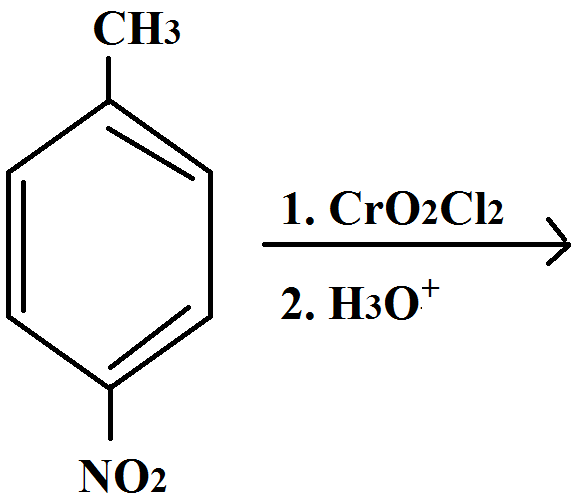
Question 621 Mark
Show how each of the following compound can be converted to benzoic acid.Bromobenzene.
Question 631 Mark
What is meant by the following term? Give an example of the reaction in each case.2,4-DNP-derivative.
Answer
2, 4 - DNP - derivative: 2, 4 - dinitrophenylhydragones are 2, 4 - DNP - derivatives, which are produced when aldehydes or ketones react with 2, 4 - dinitrophenylhydrazine in a weakly acidic medium.
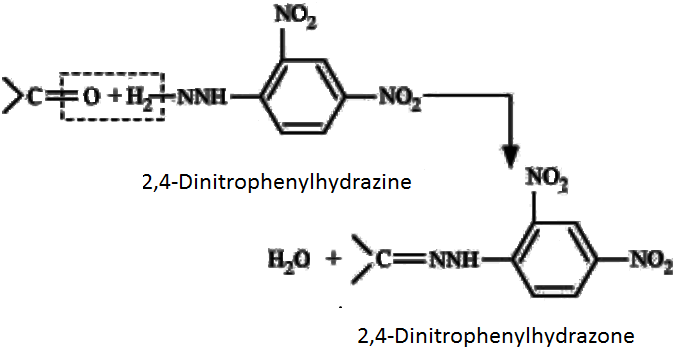
To identify and characterize aldehydes and ketones, 2, 4 - DNP derivatives are used.
View full question & answer→Question 641 Mark
Predict the product of the following reaction:
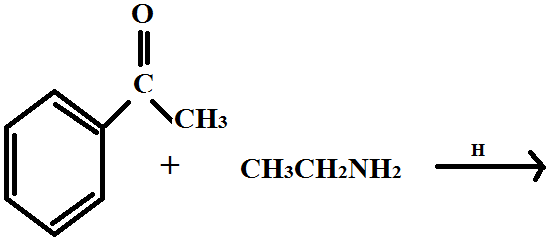
Question 651 Mark
Complete each synthesis by giving missing starting material, reagent or product.$\text{C}_6\text{H}_5\text{CHO}\xrightarrow{\text{H}_2\text{NCONHNH}_2}$
Answer$\text{C}_6\text{H}_5\text{CHO}\xrightarrow{\text{H}_2\text{NCONHNH}_2}\text{C}_6\text{H}_5\text{CH}=\text{NNHCONH}_2+\text{H}_2\text{O}$
View full question & answer→Question 661 Mark
Write the structure of product of the following reaction;$(\text{C}_6\text{H}_5\text{CH}_2)_2\text{ Cd}+\text{2 CH}_3 \text{ COCl}\xrightarrow{\ \ \ \ }$
View full question & answer→Question 671 Mark
Complete each synthesis by giving missing starting material, reagent or product.
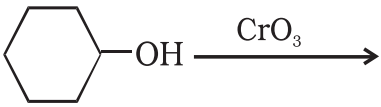
Question 681 Mark
Write the structure of the following compound.4-Oxopentanal.
Answer$\ \ \ \ \ \ \ \ \ \ \ \ \text{O}\ \ \ \ \ \ \ \ \ \ \ \ \ \ \ \ \ \ \ \ \ \ \ \ \ \text{O}\\\ \ \ \ \ \ \ \ \ \ \ \ \ ||\ \ \ \ \ \ \ \ \ \ \ \ \ \ \ \ \ \ \ \ \ \ \ \ \ \ ||\\ \text{CH}_3-\text{C}-\text{CH}_2\text{CH}_2-\text{C}-\text{H}$
View full question & answer→Question 691 Mark
Give simple chemical tests to distinguish between the following pairs of compound.Phenol and Benzoic acid.
AnswerPhenol and Benzoic acid can be distinguished by $FeCl_3$ test.
$\text{3C}_6\text{H}_5\text{OH}+\text{FeCl}_3\xrightarrow{\ \ \ \ \ \ \ \ }(\text{C}_6\text{H}_5\text{O})_3\text{Fe}+\text{3HCl}\\ \ \ \ \ \ \ \ \ \ \ \ \ \ \ \ \ \ \ \ \ \ \ \ \ \ \ \ \ \ \ \ \ \ \ \ \ \ \ \ \text{Violet colouration}$
$\text{3C}_6\text{H}_5\text{COOH}+\text{FeCl}_3\xrightarrow{\ \ \ \ \ \ \ \ }(\text{C}_6\text{H}_5\text{COO})_3\text{Fe}+\text{3HCl}\\ \ \ \ \ \ \ \ \ \ \ \ \ \ \ \ \ \ \ \ \ \ \ \ \ \ \ \ \ \ \ \ \ \ \ \ \ \ \ \ \ \ \ \ \ \ \text{Buff-colouration ppt.}$
View full question & answer→Question 701 Mark
What is meant by the following term? Give an example of the reaction in each case.Aldol.
Answer
Aldol: A β -hydroxy aldehyde or ketone is known as an aldol. It is produced by the condensation reaction of two molecules of the same or one molecule each of two different aldehydes or ketones in the presence of a base.

View full question & answer→Question 711 Mark
Which acid of each pair shown here would you expect to be stronger? $\mathrm{CH}_2 \mathrm{FCH}_2 \mathrm{CH}_2 \mathrm{CO}_2 \mathrm{H}$ or $\mathrm{CH}_3 \mathrm{CHFCH}_2 \mathrm{CO}_2 \mathrm{H}$
Answer$\ \ \ \ \ \ \ \ \ \ \ \ \ \ \ \ \ \ \ \ \ \ \ \ \ \ \ \ \ \ \ \ \ \ \ \ \ \ \ \ \ \ \ \ \ \ \ \ \ \ \text{O}\\\ \ \ \ \ \ \ \ \ \ \ \ \ \ \ \ \ \ \ \ \ \ \ \ \ \ \ \ \ \ \ \ \ \ \ \ \ \ \ \ \ \ \ \ \ \ \ \ \ \ \ ||\\\text{F}\xleftarrow{}\text{CH}_2\xleftarrow{}\text{CH}_2\xleftarrow{}\text{CH}_2\xleftarrow{}\text{C}\xleftarrow{}\text{O}\xleftarrow{}\text{H}$$\ \ \ \ \ \ \ \ \ \ \ \ \ \ \ \ \ \ \ \ \ \ \ \ \ \ \ \ \ \ \ \ \ \ \ \text{O}\\\ \ \ \ \ \ \ \ \ \ \ \ \ \ \ \ \ \ \ \ \ \ \ \ \ \ \ \ \ \ \ \ \ \ \ ||\\\text{F}\xleftarrow{}\text{CH}\xleftarrow{}\text{CH}_2\xleftarrow{}\text{C}\xleftarrow{}\text{O}\xleftarrow{}\text{H}\\\ \ \ \ \ \ \ \ \ \ |\\\\ \ \ \ \ \ \ \ \ \ \text{CH}_3$
Inductive effect decreases with increase in distance. Hence, the +1 effect of F in $\mathrm{CH}_3 \mathrm{CHFCH}_2 \mathrm{CO}_2 \mathrm{H}$ is more than it is in $\mathrm{CH}_2 \mathrm{FCH}_2 \mathrm{CH}_2 \mathrm{CO}_2 \mathrm{H}$. Hence, $\mathrm{CH}_3 \mathrm{CHFCH}_2 \mathrm{CO}_2 \mathrm{H}$ is stronger acid than $\mathrm{CH}_2 \mathrm{FCH}_2 \mathrm{CH}_2 \mathrm{CO}_2 \mathrm{H}$.
View full question & answer→Question 721 Mark
Arrange the following compound in increasing order of their property as indicated:Acetaldehyde, Acetone, Di-tert-butyl ketone, Methyl tert-butyl ketone (reactivity towards HCN)
Answer
The reactivity of aldehydes and ketones towards HCN addition decreases as the +1 - effect of the alkyl groups increases. Secondly it decreases with increase in steric hindrance to the nucleophilic attack by $CN^-$ at the carbonyl carbon. Thus the decreasing order of reactivity towards HCN is,
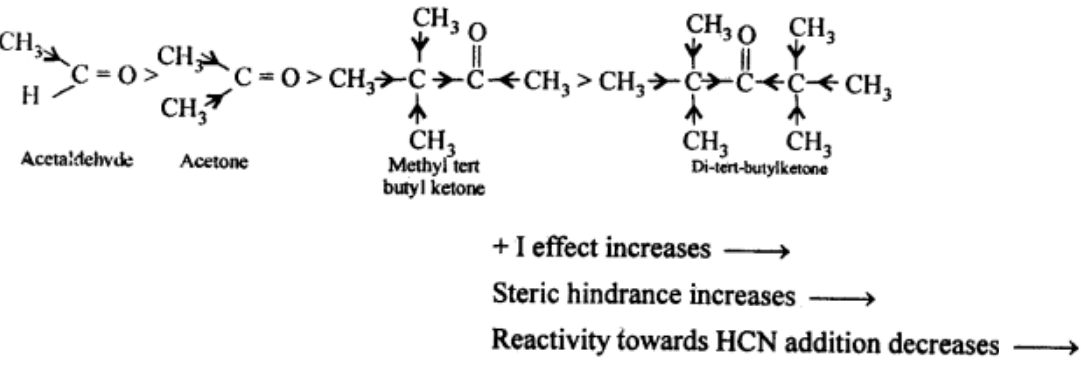
View full question & answer→Question 731 Mark
How will you bring about the following conversion in not more than two step?Benzaldehyde to benzophenone.
AnswerBenzaldehyde to benzophenone:$\text{C}_6\text{H}_5\text{CHO}\xrightarrow[(\text{ii})\text{CaCO}_3]{(\text{i})\text{K}_2\text{Cr}_2\text{O}_7/\text{H}_2\text{SO}_4}(\text{C}_6\text{H}_5\text{COO})_2\text{Ca}\xrightarrow[-\text{CaCO}_3]{\text{Dry Distillation}}(\text{C}_6\text{H}_5)_2\text{CO}$
View full question & answer→Question 741 Mark
Describe the following:Decarboxylation.
AnswerDecarboxylation: The process of removal of a molecule of $CO_2$ from a carboxylic acid is called decarboxylation. Sodium salts of carboxylic acids when heated with soda-lime undergoes decarboxylation to yield alkanes.$\text{CH}_3\text{CH}_2\text{COONa}+\text{NaOH}\xrightarrow{\ \text{Cao.630 k}}\text{CH}_3-\text{CH}_3+\text{Na}_2\text{CO}_3$
View full question & answer→Question 751 Mark
Write the IUPAC name of the following ketone and aldehyde. Wherever possible, give also common name.$\mathrm{CH}_3 \mathrm{CO}\left(\mathrm{CH}_2\right)_4 \mathrm{CH}_3$
Answer$\mathrm{CH}_3 \mathrm{CO}\left(\mathrm{CH}_2\right)_4 \mathrm{CH}_3$
IUPAC name: Heptan-2-one
Common name: Methyl n-propyl ketone.
View full question & answer→Question 761 Mark
Draw structure of the following derivative.The ethylene ketal of hexan-3-one.
Question 771 Mark
Predict the product of the following reaction:$\ \ \ \ \ \ \ \ \ \ \ \ \ \ \ \ \ \ \ \ \ \ \ \ \ \ \ \ \ \ \ \ \ \ \ \ \ \ \ \ \ \ \ \ \ \ \ \ \ \ \ \ \ \ \ \ \ \ \text{O}\\\ \ \ \ \ \ \ \ \ \ \ \ \ \ \ \ \ \ \ \ \ \ \ \ \ \ \ \ \ \ \ \ \ \ \ \ \ \ \ \ \ \ \ \ \ \ \ \ \ \ \ \ \ \ \ \ \ \ \ ||\\\text{R}-\text{CH}=\text{CH}-\text{CHO }+\text{ NH}_2-\text{C}-\text{NH}-\text{NH}_2\xrightarrow{\ \ \text{H}^+\ }$
Answer$\ \ \ \ \ \ \ \ \ \ \ \ \ \ \ \ \ \ \ \ \ \ \ \ \ \ \ \ \ \ \ \ \ \ \ \ \ \ \ \ \ \ \ \ \ \ \ \ \ \ \ \ \ \ \ \ \ \ \ \ \ \ \text{O}\\\ \ \ \ \ \ \ \ \ \ \ \ \ \ \ \ \ \ \ \ \ \ \ \ \ \ \ \ \ \ \ \ \ \ \ \ \ \ \ \ \ \ \ \ \ \ \ \ \ \ \ \ \ \ \ \ \ \ \ \ \ \ \ ||\\\text{R}-\text{CH}=\text{CH}-\text{CH }=\text{N }-\text{NH}-\text{C}-\text{NH}_2$
View full question & answer→Question 781 Mark
Which acid of each pair shown here would you expect to be stronger?
$CH_2FCO_2H$ or $CH_2ClCO_2H$
Answer$\ \ \ \ \ \ \ \ \ \ \ \ \ \ \ \ \ \ \ \ \ \ \text{O}\ \ \ \ \ \ \ \ \ \ \ \ \ \ \ \ \ \ \ \ \ \ \ \ \ \ \ \ \ \ \ \ \ \ \ \ \ \ \ \ \ \ \ \ \ \ \ \ \ \ \ \ \ \text{O}\\\ \ \ \ \ \ \ \ \ \ \ \ \ \ \ \ \ \ \ \ \ \ \ || \ \ \ \ \ \ \ \ \ \ \ \ \ \ \ \ \ \ \ \ \ \ \ \ \ \ \ \ \ \ \ \ \ \ \ \ \ \ \ \ \ \ \ \ \ \ \ \ \ \ \ \ \ \ ||\\\text{F}\xleftarrow{}\text{CH}_2\xleftarrow{}\text{C}\xleftarrow{}\text{O}\xleftarrow{}\text{H}\ \ \ \ \ \ \ \ \ \ \ \text{Cl}\xleftarrow{}\text{CH}_2\xleftarrow{}\text{C}\xleftarrow{}\text{O}\xleftarrow{}\text{H}$
F has stronger -I effect than Cl.
Therefore, $CH_2FCO_2H$ can release proton more easily than $CH_2ClCO_2H.$
Hence, $CH_2FCO_2H$ is stronger acid than $CH_2ClCO_2H.$
View full question & answer→Question 791 Mark
Show how each of the following compound can be converted to benzoic acid.Ethylbenzene.
Question 801 Mark
Draw the structure of the following compound.
3-Bromo-4-phenylpentanoic acid.
Answer$\ \ \ \ \ \ \ \ \ \ \ \ \text{C}_6\text{H}_5\ \ \text{Br}\ \ \ \ \ \ \ \ \ \ \ \ \ \ \ \ \ \ \ \text{O}\\\ \ \ \ \ \ \ \ \ \ \ \ \ \ |\ \ \ \ \ \ \ \ \ |\ \ \ \ \ \ \ \ \ \ \ \ \ \ \ \ \ \ \ \ \ \ ||\\ \text{H}_3\text{C}-\text{CH}-\text{CH}-\text{CH}_2-\text{C}-\text{OH}$
View full question & answer→Question 811 Mark
How will you bring about the following conversion in not more than two step?Benzene to m-Nitroacetophenone.
Answer
Benzene to m-Nitroacetophenone:
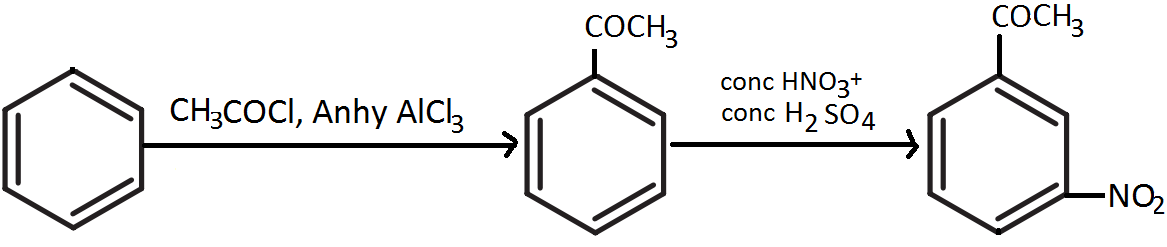
View full question & answer→Question 821 Mark
Write the structure of the following compound.$\alpha$-Methoxypropionaldehyde.
Answer$\ \ \ \ \ \ \ \ \ \ \ \ \ \ \ \ \ \ \ \ \ \ \ \text{O}\\\ \ \ \ \ \ \ \ \ \ \ \ \ \ \ \ \ \ \ \ \ \ \ \ ||\\\text{CH}_3-\text{CH}-\text{C}-\text{H}\\\ \ \ \ \ \ \ \ \ \ \ \ \ \ |\\\\ \ \ \ \ \ \ \ \ \ \ \ \ \ \text{OCH}_3$
View full question & answer→Question 831 Mark
What is meant by the following term? Give an example of the reaction in each case.Schiff’s base.
Answer
Schiff's base: Schiff's base (or azomethine) is a chemical compound containing a carbonnitrogen double bond with the nitrogen atom connected to an aryl or alkyl group-but not hydrogen. They have the general formula $R_1 R_2 C=NR_3$. Hence, it is an imine. It is named after a scientist, Hugo Schiff.
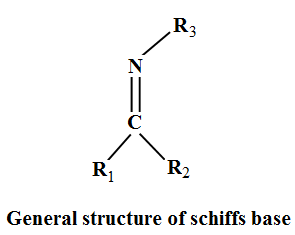
Aldehydes and ketones on treatment with primary aliphatic or aromatic amines in the presence of trace of an acid yields a Schiff's base.

View full question & answer→Question 841 Mark
Complete each synthesis by giving missing starting material, reagent or product.
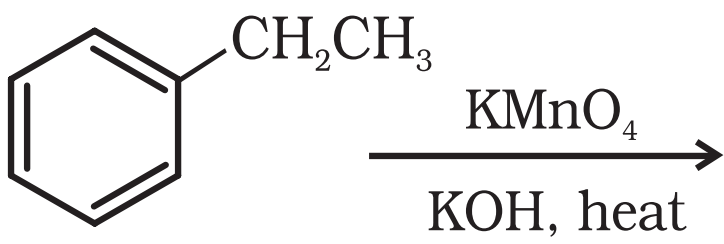
AnswerSolution is as follow:
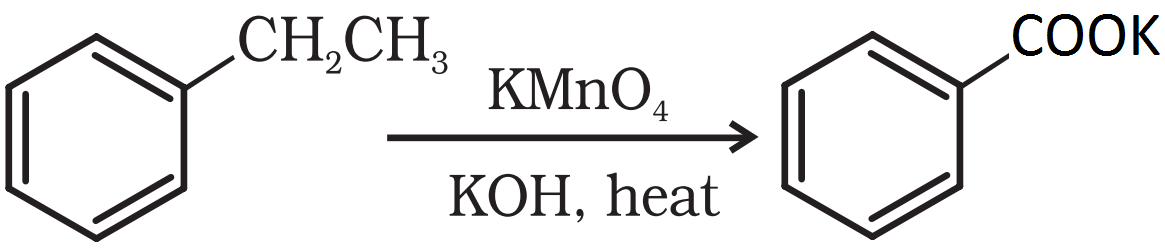
View full question & answer→Question 851 Mark
How will you bring about the following conversion in not more than two step?Benzoic acid to Benzaldehyde.
Answer
Benzoic acid to Benzaldehyde:
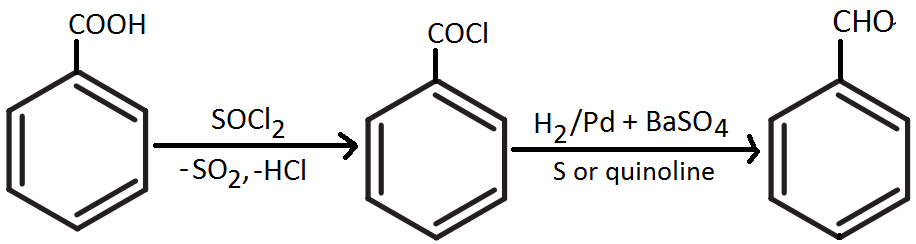
View full question & answer→Question 861 Mark
Describe the following:Cannizzaro reaction.
AnswerCannizzaro reaction: Aldehydes which do not contain an a-hydrogen atom, when treated with concentrated alkali solution undergo disproportionation, i.e., self oxidation reduction. As a result, one molecule of the aldehyde is reduced to the corresponding alcohol at the cost of the other which is oxidised to the corresponding carboxylic acid. This reaction is called Cannizzaro reaction.$\ \ \ \ \ \ \ \ \ \ \text{O}\ \ \ \ \ \ \ \ \ \ \ \ \ \ \ \ \ \ \ \ \ \ \ \ \ \ \ \ \ \ \ \ \ \ \ \ \ \ \ \ \ \ \ \ \ \ \ \ \ \ \ \ \ \ \ \ \ \ \ \ \ \ \ \ \ \ \text{O}\\ \ \ \ \ \ \ \ \ \ \ \ ||\ \ \ \ \ \ \ \ \ \ \ \ \ \ \ \ \ \ \ \ \ \ \ \ \ \ \ \ \ \ \ \ \ \ \ \ \ \ \ \ \ \ \ \ \ \ \ \ \ \ \ \ \ \ \ \ \ \ \ \ \ \ \ \ \ \ \ || \\ \text{2H}-\text{C}-\text{H}+\text{NaOH}\xrightarrow{\ \ \ \ \ \ \ \ \ }\text{CH}_3-\text{OH}+\text{H}-\text{C}-\text{ONa}\\ \ \ \ \ \ \ \ \ \ \ \ \ \ \ \ \ \ \ \ \ \ \ \ \ \ \ \ (\text{50%}) $
View full question & answer→Question 871 Mark
Predict the product formed when cyclohexanecarbaldehyde reacts with following reagent.Semicarbazide and weak acid.
Question 881 Mark
Give plausible explanation for each of the following:There are two $–NH_2$ groups in semicarbazide. However, only one is involved in the formation of semicarbazones.
Answer

Although semicarbazide has two $- NH_2$ groups but one of them (i.e., which is directly attached to C = 0) is involved in resonance as shown above. As a result, electron density on N of this $-NH_2$ group decreases and hence it does not act as a nucleophile. In contrast, the other $-NH_2$ group (i.e .. attached to NH) is not involved in resonance and hence lone pair of electrons present on N atom of this $-NH_2$ group is available for nucleophilic attack on the $C = 0$ group of aldehydes and ketones. View full question & answer→Question 891 Mark
Complete each synthesis by giving missing starting material, reagent or product.
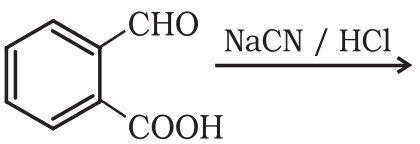
Question 901 Mark
Write the structure of the following compound.2-Hydroxycyclopentane carbaldehyde.
Question 911 Mark
How will you prepare the following compound from benzene? You may use any inorganic reagent and any organic reagent having not more than one carbon atom.p-Nitrobenzoic acid.
Question 921 Mark
Show how each of the following compound can be converted to benzoic acid.Acetophenone.
Question 931 Mark
Write the structure of product of the following reaction;$\text{H}_3\text{C}-\text{C}\equiv\text{C}-\text{H}\ \ \ \ \xrightarrow{\text{Hg}^{2+},\text{ H}_2\text{SO}_4}$
View full question & answer→Question 941 Mark
Write the IUPAC name of the following ketone and aldehyde. Wherever possible, give also common name.PhCOPh
AnswerPhCOPhIUPAC name: Diphenylmethanone
Common name: Benzophenone.
View full question & answer→Question 951 Mark
Give the IUPAC name of the following compound:$\left(\mathrm{CH}_3\right)_2 \mathrm{C}=\mathrm{CHCOOH}$.
Answer3-Methylbut-2-enoic acid.
View full question & answer→Question 961 Mark
Complete each synthesis by giving missing starting material, reagent or product.$\text{C}_6\text{H}_5\text{CHO}+\text{CH}_3\text{CH}_2\text{CHO}\xrightarrow{\text{dil.NaOH}}$
View full question & answer→Question 971 Mark
Predict the product formed when cyclohexanecarbaldehyde reacts with following reagent.PhMgBr and then $\mathrm{H}_3 \mathrm{O}^{+}$
View full question & answer→Question 981 Mark
Name the following compound according to IUPAC system of nomenclature:$\mathrm{CH}_3 \mathrm{COCH}_2 \mathrm{COCH} 3$
View full question & answer→Question 991 Mark
Draw the structure of the following compound.
4-Chloropentan-2-one.
Answer$\ \ \ \ \ \ \ \ \ \ \ \ \text{O}\ \ \ \ \ \ \ \ \ \ \ \ \ \ \ \ \ \ \text{Cl}\\\ \ \ \ \ \ \ \ \ \ \ \ \ ||\ \ \ \ \ \ \ \ \ \ \ \ \ \ \ \ \ \ \ |\\ \text{H}_3\text{C}-\text{C}-\text{CH}_2-\text{CH}-\text{CH}_3$
View full question & answer→Question 1001 Mark
Arrange the following compound in increasing order of their reactivity in nucleophilic addition reaction.Benzaldehyde, p-Tolualdehyde, p-Nitrob.
AnswerAcetophenone < p-tolualdehyde < benzaldehyde < p-nitrobenzaldehyde Acetophenone is ketone, rest all are aldehydes,
hence it is the least reactive.
In p-tolualdehyde, $-CH_3$ group at p-position.Increases $e^-$ density on C-atom of
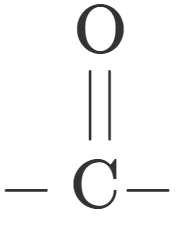
group thus making it less reactive than benaldehyde.
In p-nitrobenzaldehyde, $-NO_2$ groups with draw $e^{-1}$ s by inductive and resonance effect thus ris8ing $e^-$ density on carbonyl C, thus making it more reactive than benzaldehyde. View full question & answer→Question 1011 Mark
Name the following compound according to IUPAC system of nomenclature:$\mathrm{CH}_3 \mathrm{CH}\left(\mathrm{CH}_3\right) \mathrm{CH}_2 \mathrm{CH}_2 \mathrm{CHO}$
View full question & answer→Question 1021 Mark
Give the IUPAC name of the following compound:
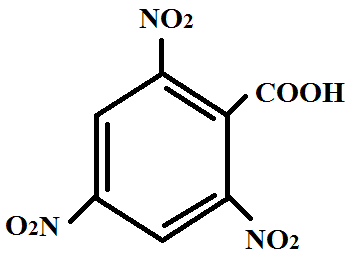
Answer2, 4, 6-Trinitrobenzoic acid.
View full question & answer→Question 1031 Mark
Predict the product of the following reaction:
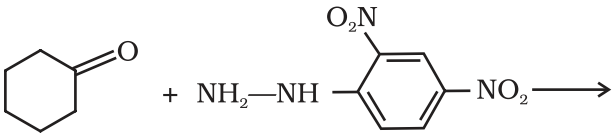
Question 1041 Mark
Predict the product formed when cyclohexanecarbaldehyde reacts with following reagent.Tollens’ reagent.
Question 1051 Mark
Arrange the following compound in increasing order of their boiling point. $\mathrm{CH}_3 \mathrm{CHO}_3, \mathrm{CH}_3 \mathrm{CH}_2 \mathrm{OH}, \mathrm{CH}_3 \mathrm{OCH}_3$, $\mathrm{CH}_3 \mathrm{CH}_2 \mathrm{CH}_3$
AnswerThe molecular masses of the given compounds are in the range 44 to 46. $\mathrm{CH}_3 \mathrm{CH}_2 \mathrm{OH}$ undergoes extensive intermolecular H -bonding, resulting in the association of molecules. Therefore, it has the highest boiling point. $\mathrm{CH}_3 \mathrm{CHO}$ is more polar than $\mathrm{CH}_3 \mathrm{OCH}_3$ and so $\mathrm{CH}_3 \mathrm{CHO}$ has stronger intermolecular dipole - dipole attraction than $\mathrm{CH}_3 \mathrm{OCH}_3 . \mathrm{CH}_3 \mathrm{CH}_2 \mathrm{CH}_3$ has only weak Vander Waals force. Thus, the arrangement of the given compounds in the increasing order of their boiling points is given by: $\mathrm{CH}_3 \mathrm{CH}_2 \mathrm{CH}_3<\mathrm{CH}_3 \mathrm{OCH}_3<\mathrm{CH}_3 \mathrm{CHO}<\mathrm{CH}_3 \mathrm{CH}_2 \mathrm{OH}$.
View full question & answer→Question 1061 Mark
Complete each synthesis by giving missing starting material, reagent or product.
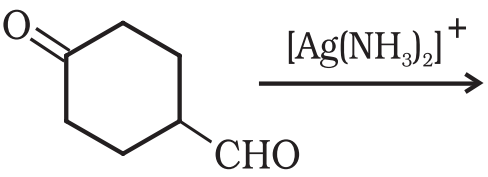
Question 1071 Mark
Name the following compound according to IUPAC system of nomenclature:$\mathrm{CH}_3 \mathrm{CH}=\mathrm{CHCHO}$
View full question & answer→Question 1081 Mark
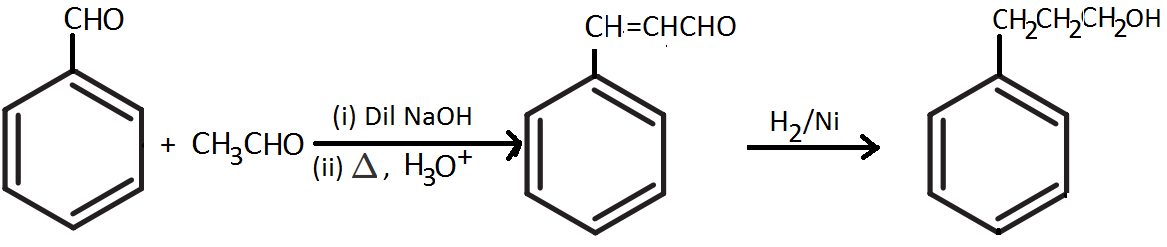
How will you bring about the following conversion in not more than two step?Benzaldehyde to 3-Phenylpropan-1-ol.
Answer
Benzaldehyde to 3-Phenylpropan-1-ol:
View full question & answer→Question 1091 Mark
What is meant by the following term? Give an example of the reaction in each case.Semicarbazone.
Answer
Semicarbarbazone: Semicarbazones are derivatives of aldehydes and ketones produced by the condensation reaction between a ketone or aldehyde and semicarbazide.
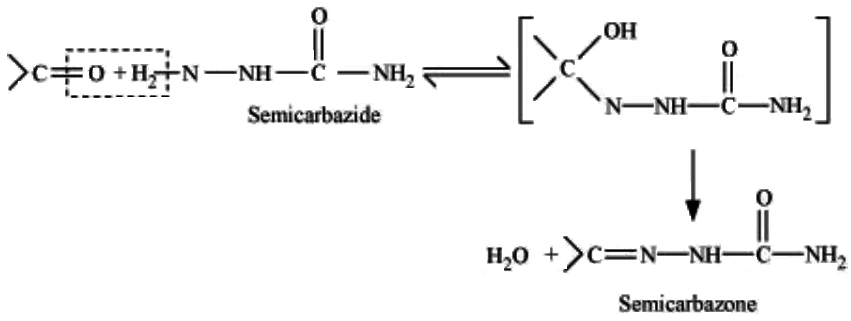
Semicarbazones are useful for identification and characterization of aldehydes and ketones.
View full question & answer→Question 1101 Mark
Write the structure of the following compound.Di-sec. butyl ketone.
Answer$\ \ \ \ \ \ \ \ \ \ \ \ \ \ \ \ \ \ \ \ \ \ \ \ \ \ \ \ \ \ \ \ \ \ \ \ \text{O}\\\ \ \ \ \ \ \ \ \ \ \ \ \ \ \ \ \ \ \ \ \ \ \ \ \ \ \ \ \ \ \ \ \ \ \ \ \ ||\\\text{CH}_3-\text{CH}_2-\text{CH}-\text{C}-\text{CH}-\text{CH}_2-\text{CH}_3\\\ \ \ \ \ \ \ \ \ \ \ \ \ \ \ \ \ \ \ \ \ \ \ \ \ \ \ |\ \ \ \ \ \ \ \ \ \ \ \ \ \ \ \ \ |\\\ \ \ \ \ \ \ \ \ \ \ \ \ \ \ \ \ \ \ \ \ \ \ \ \ \ \text{CH}_3\ \ \ \ \ \ \ \ \ \ \ \text{CH}_3$
View full question & answer→Question 1111 Mark
How will you convert ethanal into the following compound?But-2-enal.
AnswerOn treatment with dilute alkali, ethanal gives 3-hydroxybutanal which on heating produces but-2-enal.
$\ \ \ \ \ \ \ \ \ \ \ \ \ \ \ \ \ \ \ \ \ \ \ \ \ \ \ \ \ \ \ \ \ \ \ \ \ \ \ \ \ \ \ \ \ \ \text{OH}\\ \ \ \ \ \ \ \ \ \ \ \ \ \ \ \ \ \ \ \ \ \ \ \ \ \ \ \ \ \ \ \ \ \ \ \ \ \ \ \ \ \ \ \ \ \ \ \ |\\\text{CH}_3\text{CHO}\xrightarrow{ \ \text{dil}\text{NaOH}\ }\text{CH}_3-\text{CH}-\text{CH}_2-\text{CHO}\xrightarrow[\text{-H}_2\text{O}]{\Delta}\text{CH}_3-\text{CH}=\text{CH}-\text{CHO}\\ \text{Ethanal}\ \ \ \ \ \ \ \ \ \ \ \ \ \ \ \ \ \ \ \ \ \ \ \ \ \text{3 - Hydroxybutanal}\ \ \ \ \ \ \ \ \ \ \ \ \ \ \ \ \ \ \ \ \ \ \ \ \ \ \ \ \text{But - 2 - enal}$
View full question & answer→Question 1121 Mark
Draw structure of the following derivative.The semicarbazone of cyclobutanone.
Question 1131 Mark
Give simple chemical tests to distinguish between the following pairs of compound.Pentan-2-one and Pentan-3-one.
AnswerPentan-2-one arid Pentan-3-one can be distinguished by $NaHSO_3$ test.

$\text{CH}_3\text{CH}_2\text{COCH}_2\text{CH}_3+\text{NaHSO}_3\xrightarrow{\ \ \ \ \ \ \ \ }\text{No solid adduct.}$
Only methyl and cyclic ketones react with $NaHSO_3$ to give solid adduct. View full question & answer→Question 1141 Mark
What is meant by the following term? Give an example of the reaction in each case.Hemiacetal.
Answer
Hemiacetal: Hemiacetals are $\alpha$-alkoxyalcohols
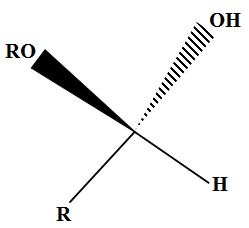
General structure of a hemiacetal Aldehyde reacts with one molecule of a monohydric alcohol in the presence of dry HCl gas.
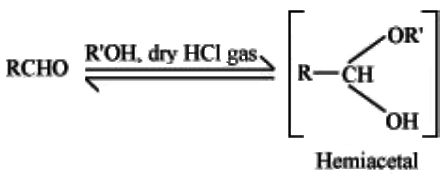
View full question & answer→Question 1151 Mark
What is Tollen’s reagent? Write one usefulness of this reagent.
AnswerAmmoniacal solution of silver nitrate is called Tollen’s reagent. It is used as an oxidizing reagent/test for –CHO group.
View full question & answer→Question 1161 Mark
Write the structural formula of 1-phenylpentan-1-one.
Question 1171 Mark
Draw the structure of the compound whose IUPAC name is 4-Chloropentan-2-one.
Question 1181 Mark
Which of the following isomers is more volatile:
o-nitrophenol or p-nitrophenol?
Question 1191 Mark
Write the structure of 3-methyl butanal.
Answer$\mathrm{H}_3 \mathrm{C}-\mathrm{CH}\left(\mathrm{CH}_3\right)-\mathrm{CH}_2-\mathrm{CHO}$.
View full question & answer→Question 1201 Mark
Draw the structure of 3-methylbutanal.
Question 1211 Mark
Draw the structural formula of I-phenylpropane-l-one molecule.
Answer$\mathrm{Ph}-\mathrm{CO}-\mathrm{CH}_2-\mathrm{CH}_3$.
View full question & answer→Question 1221 Mark
Write the structure of 3-oxopentanal.
Question 1231 Mark
Write the IUPAC name of the compound:

Answer2, 4–Dimethylpentan–3–one.
View full question & answer→Question 1241 Mark
What type of stoichiometric defect is shown by ZnS and why?
AnswerFrenkel defect due to large difference in size of ions.
View full question & answer→Question 1251 Mark
Write the structural formula and IUPAC name of terephthalic acid.
Question 1261 Mark
Write a test to differentiate between pentan-2-one and pentan-3-one.
AnswerPentan-2-one having a $\ \ \ \ \ \ \ \ \ \text{O}\\\ \ \ \ \ \ \ \ \ ||\\ \ \ \ \ -\text{C}-\text{CH}_3$ group form a yellow ppt of iodoform with an alkaline solution of iodine (i.e. iodoform test) while pentan-3-one does not.
$\ \ \ \ \ \ \ \ \ \ \ \ \ \ \ \ \ \ \ \ \ \ \ \ \ \ \ \ \text{O}\\ \ \ \ \ \ \ \ \ \ \ \ \ \ \ \ \ \ \ \ \ \ \ \ \ \ \ \ \ ||\\\text{CH}_3\text{CH}_2\text{CH}_2-\text{C}-\text{CH}_3\xrightarrow[\text{(Iodoform test)}]{\text{I}_2/\text{NaOH}}\text{CHI}_3+\text{CH}_3\text{CH}_2\text{CH}_2\text{COONa}\\ \ \ \ \ \ \ \ \ \ \ \ \ \ \ \ \ \ \ \ \ ^\text{pentan-2-one}\ \ \ \ \ \ \ \ \ \ \ \ \ \ \ \ \ \ \ \ \ \ \ \ \ \ \ \ \ ^\text{yellow ppt.}\ \ \ \ \ \ \ \ \ \ ^\text{sodium butanoate}$
View full question & answer→Question 1271 Mark
Bring out the following conversion:
Acetic acid to Acetaldehyde.
Answer$\ \ \ \ \ \ \ \ \ \ \ \ \ \text{O}\ \ \ \ \ \ \ \ \ \ \ \ \ \ \ \ \ \ \ \ \ \ \ \ \ \ \ \ \ \ \ \ \ \ \ \ \ \ \text{O}\ \ \ \ \ \ \ \ \ \ \ \ \ \ \ \ \ \ \ \ \ \ \ \ \ \ \ \ \ \ \ \ \ \ \ \ \ \ \ \ \ \text{O}\\ \ \ \ \ \ \ \ \ \ \ \ \ \ || \ \ \ \ \ \ \ \ \ \ \ \ \ \ \ \ \ \ \ \ \ \ \ \ \ \ \ \ \ \ \ \ \ \ \ \ \ \ \ || \ \ \ \ \ \ \ \ \ \ \ \ \ \ \ \ \ \ \ \ \ \ \ \ \ \ \ \ \ \ \ \ \ \ \ \ \ \ \ \ \ \ || \\ \text{CH}_3-\text{C}-\text{OH}\ \ \xrightarrow{\ +\text{PCl}_5}\text{CH}_3-\text{}\text{C}-\text{Cl}\ \xrightarrow[\text{Pd/ BaSO}_4]{+\text{H}_2}\ \text{CH}_3-\text{C}-\text{H}\\ \ \ \ \ \ \ \ \ ^\text{Acetic acid}\ \ \ \ \ \ \ \ \ \ \ \ \ \ \ \ \ \ \ \ \ \ \ \ \ \ \ \ \ \ \ \ \ \ \ \ \ \ \ \ \ \ \ \ \ \ \ \ \ \ \ \ \ \ \ \ \ \ \ \ \ \ \ \ \ \ \ \ \ ^\text{Acetaldehyde}$
View full question & answer→Question 1281 Mark
Bring out the following conversion: Acetophenone to 2-phenyl butan-2-ol.
Answer
Acetophenone to 2-phenyl butan-2-ol.
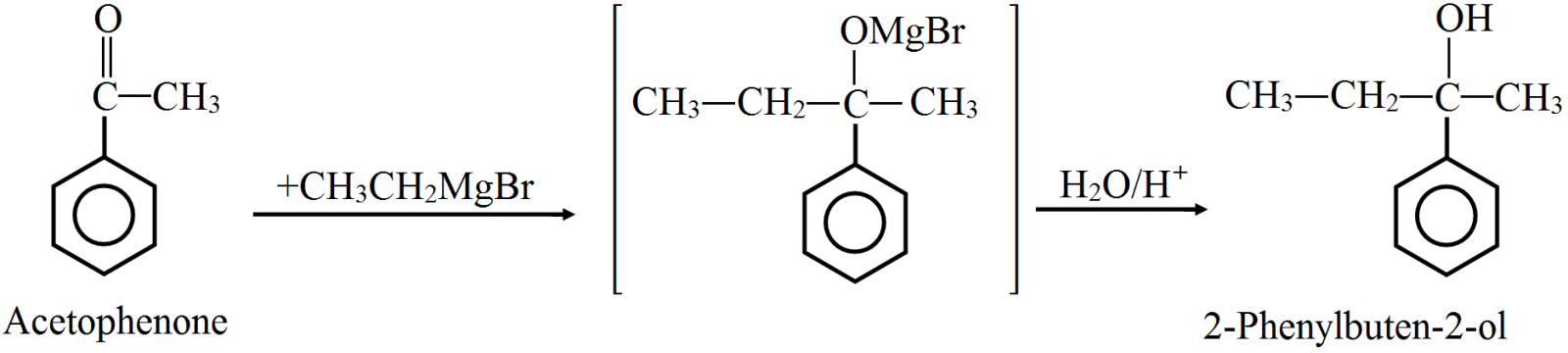
View full question & answer→Question 1291 Mark
Why is there a large difference in the boiling points of butanal and butan-1-ol?
AnswerBoiling points of aldehydes are lower than those of alcohols of similar molecular masses due to absence of intermolecular hydrogen bonding. This bonding makes the alcohol more stable at certain level of temperatures.
View full question & answer→Question 1301 Mark
Bring out the following conversion:
Propanoic acid to Acetic acid.
Answer$\text{CH}_3\text{CH}_2\text{COOH}\ \ \xrightarrow[\triangle]{\text{NH}_3}\ \ \text{CH}_3\text{CH}_2\text{CONH}_2\ \ \xrightarrow{\text{Br}_2/\text{KOH}}\text{CH}_3\text{CH}_2\text{NH}_2 \ \ \\ \\ \ \ \ \ ^\text{Propanoic acid}\ \ \ \ \ \ \ \ \ \ \ \ \ \ \ \ \ \ \ \ \ \ \ \ \ \ ^\text{Propanamide}\ \ \ \ \ \ \ \ \ \ \ \ \ \ \ \ \ \ \ \ \ \ \ \ \ \ \ ^\text{Ethyl amine}\ \ \ \ \ \\\xrightarrow{\text{HNO}_2}\ \ \text{CH}_3\text{CH}_2\text{OH}\ \ \xrightarrow[\text{(O)}]{\text{KMnO}_4/\text{dil. H}_2\text{SO}_4}\ \ \text{CH}_3\text{COOH}\\ \ \ \ \ \ \ \ \ \ \ \ \ \ \ \ \ \ \ ^\text{Ethanol}\ \ \ \ \ \ \ \ \ \ \ \ \ \ \ \ \ \ \ \ \ \ \ \ \ \ \ \ \ \ \ \ \ \ \ \ \ \ \ \ \ ^\text{Acetic acid}$
View full question & answer→Question 1311 Mark
Bring out the following conversion: Benzoic acid to Benzamide.
Question 1321 Mark
Write chemical reaction to affect the following transformation:
Butan-1-ol to butanoic acid.
Answer$\text{CH}_3\text{CH}_2\text{CH}_2\text{CH}_2\text{OH}\ \ +\ \ \text{[O]}\ \xrightarrow[\text{H}_2\text{O}]{\text{K}_2\text{Or}_2/ \text{H}_2\text{SO}_4}\ \text{CH}_3\text{CH}_2\text{CH}_2\text{CHO}\\ \ \ \ \ \ \ \ \ ^{\text{Butan}-1-\text{ol}}\\ \xrightarrow{\ \text{[O]}\ }\ \text{CH}_3-\text{CH}_2-\text{CH}_2-\text{COOH}\\ \ \ \ \ \ \ \ \ \ \ \ \ \ \ \ \ \ \ \ \ \ \ \ ^\text{Butanoic acid}$
View full question & answer→MCQ 1331 Mark
Arrange the following compounds in correct order of acidic strength.
- ✓
$\ce{HCOOH > CH_3COOH > C_6H_5OH > C_2H_5−OH}$
- B
$\ce{CH_{3}COOH > HCOOH > C_6H_5OH > C_2H_5−OH}$
- C
$\ce{C_{6}H_5OH > HCOOH > CH_3COOH > C_2H_5−OH}$
- D
AnswerCorrect option: A. $\ce{HCOOH > CH_3COOH > C_6H_5OH > C_2H_5−OH}$
The correct increasing order of acidic strength is given by $\ce{C_{2}H_5OH < C_6H_5OH < CH_{3}CO_2H < HCO_2H.}$ When substituent group is electron releasing, then the acidity decreases. Hence $CH_3CO_2H$ is less acidic than $\ce{HCO_2H.}$
As both $\ce{C_2H_5OH\ \&\ C_{2}H_{5}OH}$ come under alcohols $\ce{C_2H_5OH}$ is acidic acid due to resonance stabilized $\ce{C_6H_5O^−}$ ion.
View full question & answer→Question 1341 Mark
Predict the product of the following reaction:
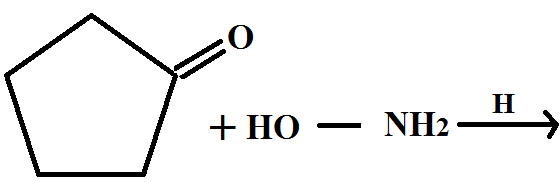
Question 1351 Mark
Bring out the following conversion:
Acetaldehyde to Ethane.
Answer$\text{}$$\text{CH}_3\text{CHO}\ \ + \ \ 4\text{[H]}\ \ \xrightarrow[\ \text{conc. HCl}\ ]{\ \text{Zn-Hg}\ }\ \ \text{CH}_3-\text{CH}_3\ \ + \ \ \text{H}_2\text{O}\\ ^\text{Acetaldehyde}\ \ \ \ \ \ \ \ \ \ \ \ \ \ \ \ \ \ \ \ \ \ \ \ \ \ \ \ \ \ \ \ \ \ \ \ \ \ \ \ \ \ \ ^\text{Ethane}$
View full question & answer→Question 1361 Mark
Write chemical reaction to affect the following transformation:
Benzyl alcohol to phenylethanoic acid.
Answer$\text{C}_6\text{H}_5\text{CH}_2\text{OH}\ \ \xrightarrow{\ \text{HBr}\ }\ \ \text{C}_6\text{H}_5\text{CH}_2\text{Br}\ \ \xrightarrow{\ \text{KCN}\ }\ \ \\ \ \ \ \ ^\text{Benzyl alcohol}\ \ \ \ \ \ \ \ \ \ \ \ \ \ \ \ \ ^\text{Benzyl bromide}\\ \text{C}_6\text{H}_5\text{CH}_2\text{CN}\ \ \xrightarrow[\ \text{H}_3\text{O}^+]{\ \triangle\ }\text{C}_6\text{H}_5\text{CH}_2\text{COOH}\\ \ \ \ ^\text{Benzyl cyanide}\ \ \ \ \ \ \ \ \ \ \ \ \ \ \ \ \ \ ^\text{Phenylethanoic acid}$
View full question & answer→Question 1371 Mark
How is acetone obtained from ethanol?
Answer$\text{CH}_3\text{CH}_2\text{OH}\xrightarrow{\ \ \ \ \text{K}_2\text{Cr}_2\text{O}_7/\text{H}_2\text{SO}_4\text{(conc.)} \ \ \ \ \ }\text{CH}_3\text{CO}\text{ OH}\xrightarrow[\text{CO}_2\Delta_2\Omega\text{H}_2\text{O}]{\text{CaCO}_3}(\text{CH}_3\text{COO})_2\text{Ca}\xrightarrow[\text{CaCO}_3]{\ \text{Dry ether}\ \ }\text{CH}_3\text{COCH}_3\\ \ \ \ \ \ ^\text{Ethanol}\ \ \ \ \ \ \ \ \ \ \ \ \ \ \ \ \ \ \ \ \ \ \ \ \ \ \ \ \ \ \ \ \ \ \ \ \ \ \ \ \ \ \ \ \ \ \ \ \ ^\text{Ethanoic acid}\ \ \ \ \ \ \ \ \ \ \ \ \ \ \ \ \ \ \ \ \ \ \ ^\text{Calcium ethanoate}\ \ \ \ \ \ \ \ \ \ \ \ \ \ \ \ \ \ \ \ \ \ \ \ \ \ ^\text{Acetone}$
View full question & answer→Question 1381 Mark
Bring out the following conversion:
Acetaldehyde to But-2-enal.
Answer$\ \ \ \ \ \ \ \ \ \ \ \ \ \text{O}\ \ \ \ \ \ \ \ \ \ \ \ \ \ \ \ \ \ \ \ \ \ \ \ \ \ \ \ \ \ \ \ \text{OH}\ \ \ \ \ \ \ \ \ \ \ \ \ \ \ \ \ \text{O}\\ \ \ \ \ \ \ \ \ \ \ \ \ \ || \ \ \ \ \ \ \ \ \ \ \ \ \ \ \ \ \ \ \ \ \ \ \ \ \ \ \ \ \ \ \ \ \ \ | \ \ \ \ \ \ \ \ \ \ \ \ \ \ \ \ \ \ \ \ \ ||\\ \text{CH}_3-\text{C}-\text{H}\ \xrightarrow{\text{OH}^-}\ \text{CH}_3-\text{CH}-\text{CH}_2-\text{C}-\text{H}\\ \ \ \ \ \ ^\text{Acetaldehyde}\\ \ \ \ \ \ \ \ \ \ \ \ \ \ \ \ \ \ \ \ \ \ \ \ \ \ \ \ \ \ \ \ \ \ \ \ \ \ \ \ \ \ \ \ \ \ \ \ \ \ \ \ \text{O}\\ \ \ \ \ \ \ \ \ \ \ \ \ \ \ \ \ \ \ \ \ \ \ \ \ \ \ \ \ \ \ \ \ \ \ \ \ \ \ \ \ \ \ \ \ \ \ \ \ \ \ \ ||\\\xrightarrow{\ \text{Heat}\ }\ \ \text{CH}_3-\text{CH}==\text{CH}-\text{C}-\text{H}\\ \ \ \ \ \ \ \ \ \ \ \ \ \ \ \ \ \ \ \ \ \ \ \ \ \ \ \ \ ^{\text{But}-2-\text{enal}}$
View full question & answer→Question 1391 Mark
Write the IUPAC name of the following compound:

Question 1401 Mark
Give names of the reagent that bring about the following transformation:
Allyl alcohol to propenal.
Question 1411 Mark
Name the aldehyde which does not give Fehling’s solution test.
Question 1421 Mark
Bring out the following conversion:
Propylene to Acetone.
AnswerPropylene to Acetone.
$\ \ \ \ \ \ \ \ \ \ \ \ \ \ \ \ \ \ \ \ \ \ \ \ \ \ \ \ \ \ \ \ \ \ \ \ \ \ \ \ \ \ \ \ \ \ \ \ \ \ \ \ \ \ \ \ \ \ \ \ \ \ \ \ \ \ \text{OH}\\ \ \ \ \ \ \ \ \ \ \ \ \ \ \ \ \ \ \ \ \ \ \ \ \ \ \ \ \ \ \ \ \ \ \ \ \ \ \ \ \ \ \ \ \ \ \ \ \ \ \ \ \ \ \ \ \ \ \ \ \ \ \ \ \ \ \ |\\ \text{CH}_3-\text{CH}==\text{CH}_2\ \xrightarrow{+\text{H}_2\text{O}/\text{H}^+}\ \text{CH}_3-\text{CH}-\text{CH}_3\\ \ \ \ \ \ \ \ \ \ ^\text{Propylene}\\ \ \ \ \ \ \ \ \ \ \ \ \ \ \ \ \ \ \ \ \ \ \ \ \ \ \ \ \ \ \ \text{O}\\ \ \ \ \ \ \ \ \ \ \ \ \ \ \ \ \ \ \ \ \ \ \ \ \ \ \ \ \ \ \ || \\ \xrightarrow{\text{Cu}/673\text{ K}}\ \ \text{CH}_3-\text{C}-\text{CH}_3\\ \ \ \ \ \ \ \ \ \ \ \ \ \ \ \ \ \ \ \ \ \ \ \ \ \ \ ^\text{Acetone}$
View full question & answer→Question 1431 Mark
Write chemical reaction to affect the following transformation: Cyclohexene to hexane-1, 6-dioic acid.
Question 1441 Mark
Can Gatterman-Koch reaction be considered similar to Friedel Craft’s acylation? Discuss.
AnswerGattermann-Koch reaction is formylation (introduction of-CHO group) to the benzene nucleus.
Friedel-Crafts acylation reaction is introduction of RCO— group in the benzene ring.
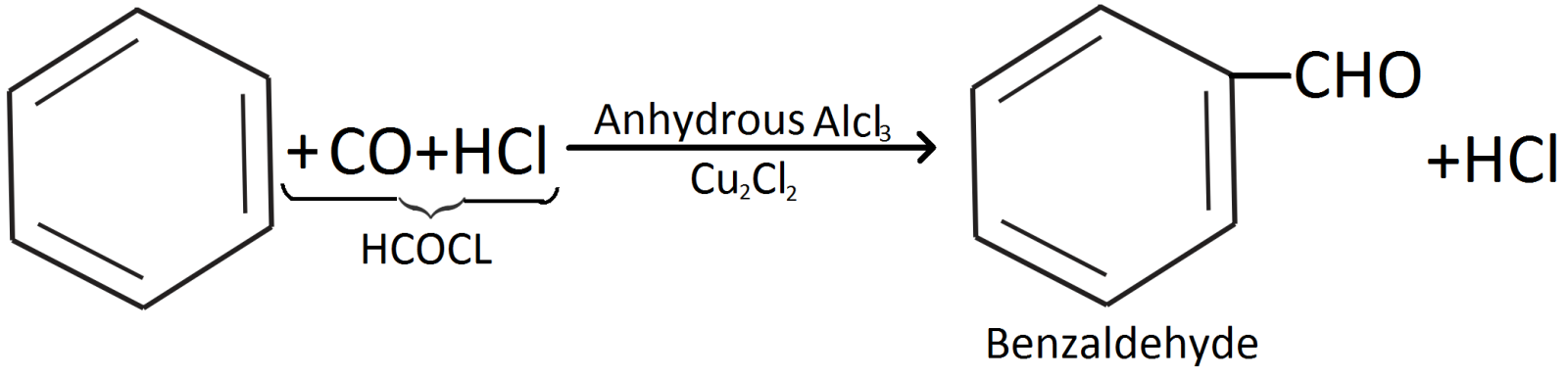
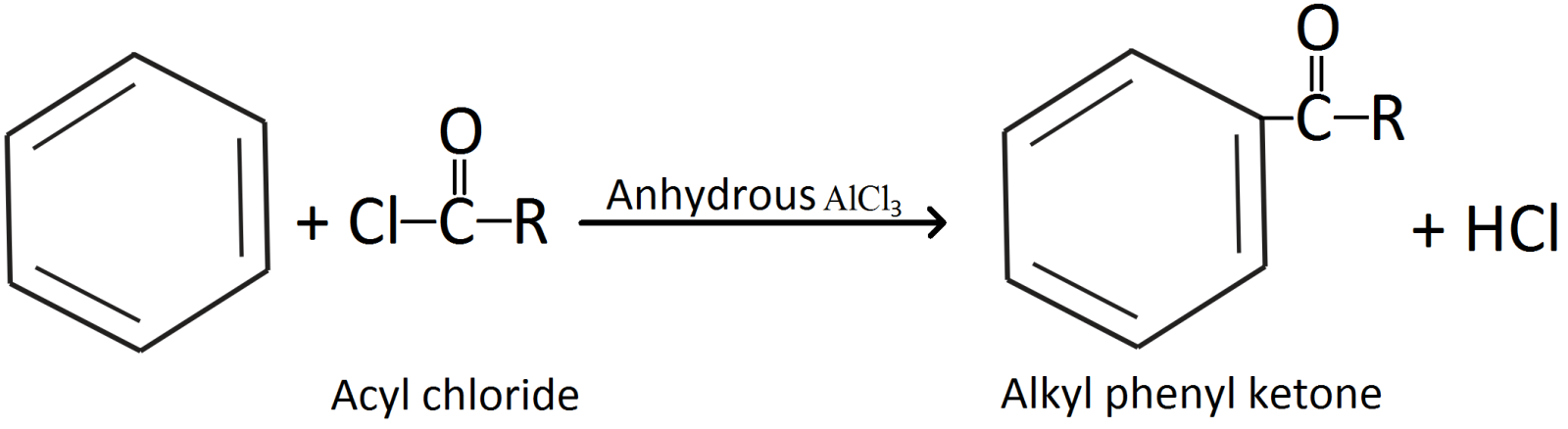
In Friedel-Crafts acylation reactions, the benzene is treated with an acid chloride in presence of anhydrous $\mathrm{AlCl}_3$. So, Gattermann-Koch reaction can be considered similar to Friedel-Crafts acylation reaction. View full question & answer→Question 1451 Mark
Write the structural formula and IUPAC name of the compound: di-sec. butylketone.
Answer$\ \ \ \ \ \ \ \ \ \ \ \ \ \ \ \ \ \ \ \ \ \ \ \ \ \ \text{CH}_3\ \ \ \text{O}\ \ \ \ \text{CH}_3\\ \ \ \ \ \ \ \ \ \ \ \ \ \ \ \ \ \ \ \ \ \ \ \ \ \ \ | \ \ \ \ \ \ \ \ \ || \ \ \ \ \ \ |\\\text{CH}_3-\text{CH}_2-\text{CH}-\text{C}-\text{CH}-\text{CH}_2-\text{CH}_33,5-\text{Dimethylheptan}-4-\text{one}$
View full question & answer→Question 1461 Mark
Give names of the reagent that bring about the following transformation:
p-Fluorotoluene to p-fluorobenzaldehyde.
Answer$\mathrm{CrO}_3$ in the presence of acetic anhydride/1. $\mathrm{CrO}_2 \mathrm{Cl}_2 2 . \mathrm{HOH}$.
View full question & answer→Question 1471 Mark
Oxidation of ketones involves carbon-carbon bond cleavage. Name the products formed on oxidation of 2, 5-dimethylhexan-3-one.
Question 1481 Mark
Lower aldehyde and ketones attributed to the formation of ______bonding with water molecules.
- Sigma bonding
- Pii bonding
- Covalent bonding
- Hydrogen bonding
Answer
- Hydrogen bonding
Explanation:
Lower members of aldehydes and ketones are misible with water because they form hydrogen bonds with water. The carbonyl carbon is electrophillic (lewis acid) and carbonyl oxygen is nuceophillic (lewis base).
The dipole movement of carbonyl compounds is due to the highly polar character of the carbonyl group.
View full question & answer→Question 1491 Mark
Write two important uses of formalin.
AnswerFormalin is used in the:
- Preservation of biological specimens.
- Manufacture of bakelite.
View full question & answer→Question 1501 Mark
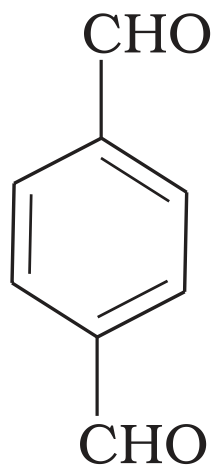
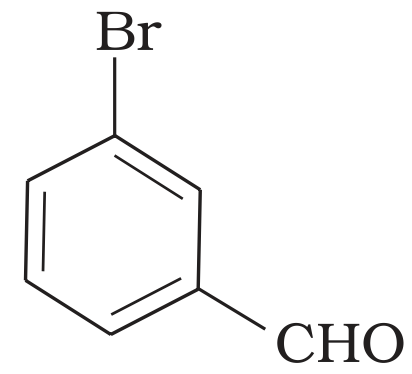
Write IUPAC names of the following structures.
- ${\text{CHO}}\\\ |\\\text{CHO}$
-
-
Answer
- Ethane-1,2-dial.
- Benzene-1, 4-dicarbaldehyde.
- 3-Bromobenzaldehyde.
View full question & answer→Question 1511 Mark
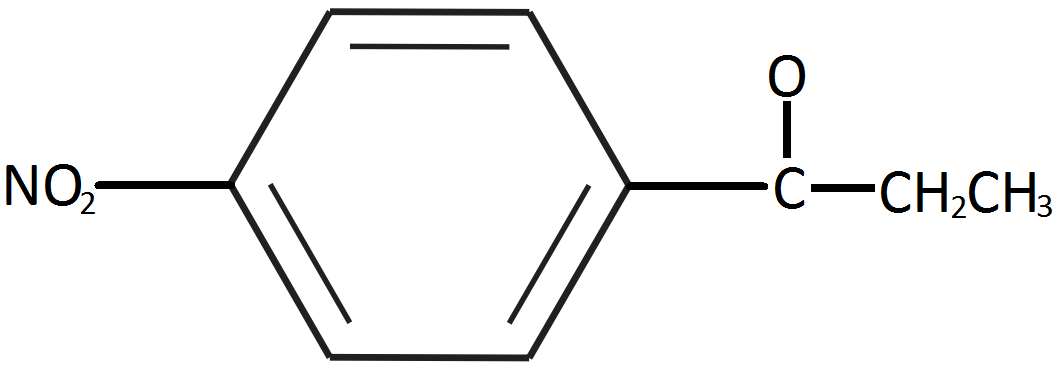
Give the structure of the following compounds.
- 4-Nitropropiophenone.
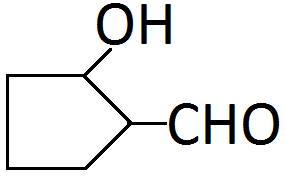
- 2-Hydroxycyclopentanecarbaldehyde.
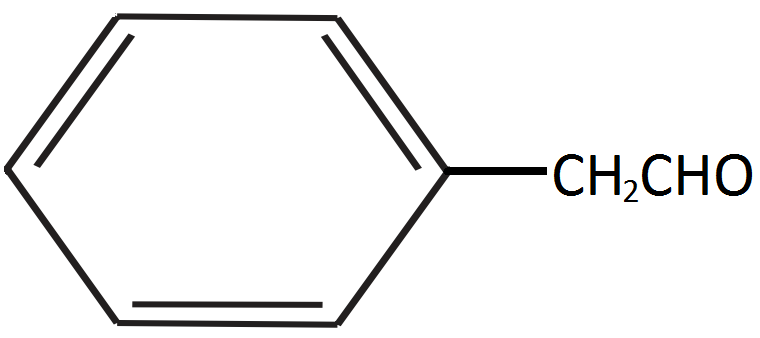
- Phenyl acetaldehyde.
Answer
- 4-Nitropropiophenone.
- 2-Hydroxycyclopentanecarbaldehyde.
- Phenyl acetaldehyde.
View full question & answer→Question 1521 Mark
Bring out the following conversion:
Acetic acid to Malonic acid.
Answer$\text{CH}_3-\text{CO OH}\ \xrightarrow[\text{H}_2\text{O}]{\ \text{Cl}_2/ \text{red P}}\ \text{Cl}-\text{CH}_2\text{COOH}\ \xrightarrow{\ +\text{KCN (ale.)}}\ \\ \ \ \ \ \ ^\text{Acetic acid}\\ \text{NC}-\text{CH}_2-\text{COOH}\ \xrightarrow{\ \text{H}_2\text{O/ H}^+\ }\ \text{HOOC}-\text{CH}_2-\text{COOH}\\ \ \ \ \ \ \ \ \ \ \ \ \ \ \ \ \ \ \ \ \ \ \ \ \ \ \ \ \ \ \ \ \ \ \ \ \ \ \ \ \ \ \ \ \ \ \ \ \ \ \ \ \ \ \ \ \ \ \ \ \ \ ^\text{Malonic acid}$
View full question & answer→