Questions

1 Marks Question

Take a timed test

67 questions · self-marked practice — reveal the answer and mark yourself.

Question 11 Mark
How do you explain the functionality of a monomer?
Answer
Functionality means the number of binding sites in a molecule. For example, the functionality of ethene, propene, styrene, acrylonitrile is one while that of 1, 3-butadiene, adipic acid, terephthaliC' acid, hexa methylenediamine is two.
View full question & answer
Question 21 Mark
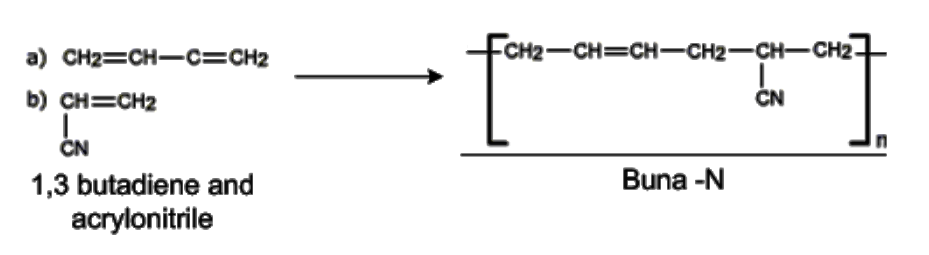
Explain the difference between Buna-N and Buna-S.
Answer
Buna-N is a copolymer of 1, 3-butadiene and acrylonitrile and Buna-S is a copolymer of 1, 3-butadiene and styrene.
View full question & answer
Question 31 Mark
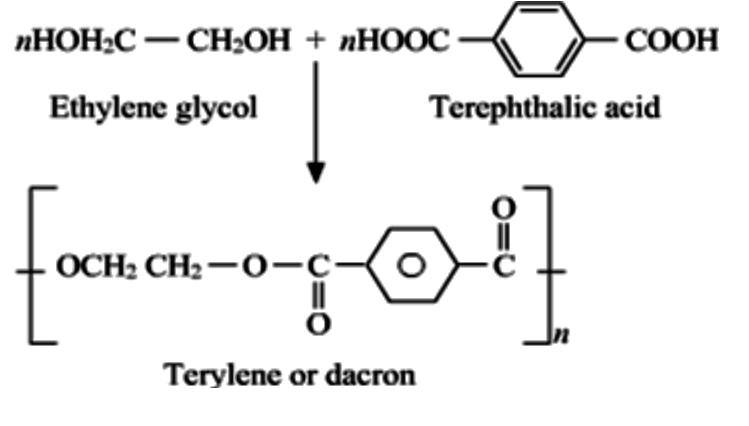
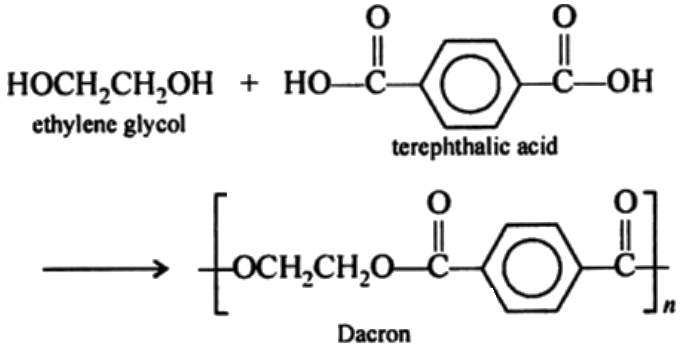
How is dacron obtained from ethylene glycol and terephthalic acid ?
Answer

Dacron is prepared by the condensation of terephthalic acid ethylene glycol in the presence of catalyst zinc acetate and antimony trioxide.
View full question & answer
Question 41 Mark
How does the presence of double bonds in rubber molecules influence their structure and reactivity?
Answer
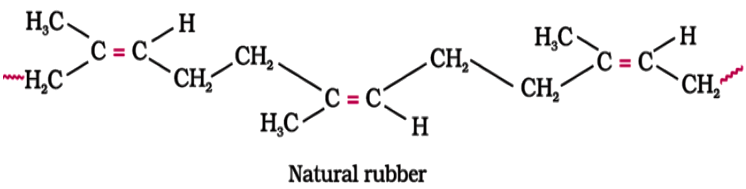
From the structural point of view, the natural rubber is a linear cis-1, 4-polyisoprene. In this polymer the double bonds are located between $C_2$ and $C_3$ of isoprene units. This cis-configuration about double bonds do not allow the chains to come closer for effective attraction due to weak intermolecular attractions. Hence, the natural rubber has a coiled structure and shows elasticity.
View full question & answer
Question 51 Mark
Write the names and structures of the monomers of the following polymer: Buna-N.
Answer

The names and structures of monomers are:
Buna-N is known as nitrile rubber.
View full question & answer
Question 61 Mark
Write the names and structures of the monomers of the following polymer: Dacron.
Answer

The names and structures of monomers are:
Dacron is known as Polyethylene terephthalate.
View full question & answer
Question 71 Mark
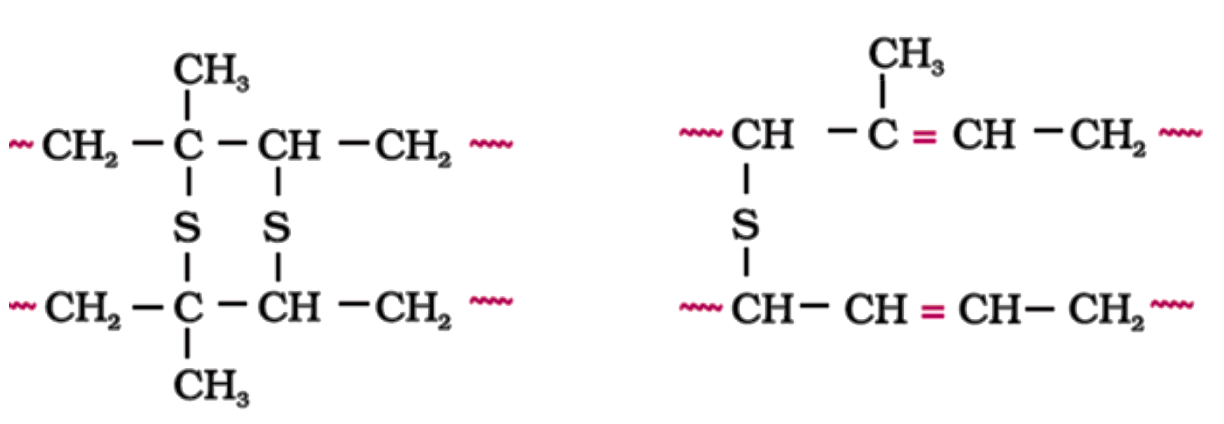
Discuss the main purpose of vulcanisation of rubber.
Answer

Natural rubber becomes soft at high temperature (> 335K) and brittle at low temperatures (<283K). To improve physical properties of rubber, vulcanisation is carried out. This process consists of heating a mixture of raw rubber with sulphur and an appropriate additive at a temperature range between 373K to 415K. On vuclcanisation, sulphur forms cross links at the reactive sites of double bonds and thus the rubber gets stiffened.
View full question & answer
Question 81 Mark
Define the term polymerisation.
Answer
It is a process of formation of a high molecular Sol. mass polymer from one or more monomers by linking together a large number of repeating structural units through covalent bonds.
View full question & answer
Question 91 Mark
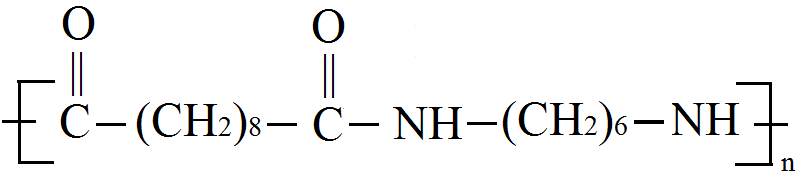
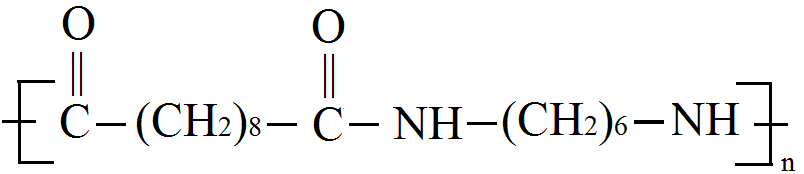
Identify the monomer in the following polymeric structures:
Answer
The monomers forming the polymer are Decanoic acid $HOOC(CH_2)_8COOH$ and hexamethylene diamine $H_2N (CH_2)_6NH_2.$
View full question & answer
Question 101 Mark
Write the name and structure of one of the common initiators used in free radical addition polymerisation.
Answer
The common initiator used in free radical polymerization is benzoyl peroxide. The structure of benzoyl peroxide is given below,
$ \ \ \ \ \ \ \ \ \ \ \ \ \ \ \text{O}\ \ \ \ \ \ \ \ \ \ \ \ \ \ \ \ \ \ \ \ \ \text{O}\\ \ \ \ \ \ \ \ \ \ \ \ \ \ \ \ \text{||}\ \ \ \ \ \ \ \ \ \ \ \ \ \ \ \ \ \ \ \ \ \text{||}\\\text{C}_{6}\text{H}_{5}-\text{C}-\text{O}-\text{O}-\text{C}-\text{C}_{6}\text{H}_{5}$
View full question & answer
Question 111 Mark
What is a biodegradable polymer? Give an example of a biodegradable aliphatic polyester.
Answer
The polymers which decompose on their own by bacterial action are called biodegradable polymers. Example of a biodegradable aliphatic polyester are Poly-β-hydroxy butyrate-co-β-hydroxy valerate (PHBV). Nylon 2-nylon 6 is another example of biodegradable polymers.
View full question & answer
Question 131 Mark
Is $( NH-CHR-CO )_n$, a homopolymer or copolymer?
Answer
It is a homopolymer because the repeating structural unit has only one type of monomer, i.e., $NH_2-CHR-COOH.$
View full question & answer
Question 141 Mark
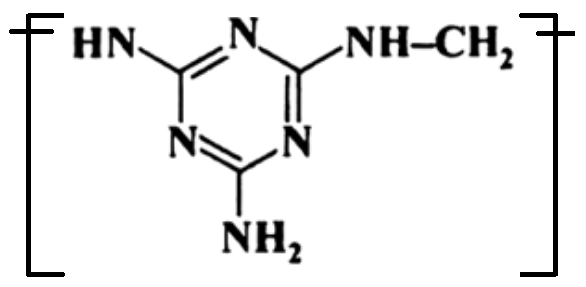
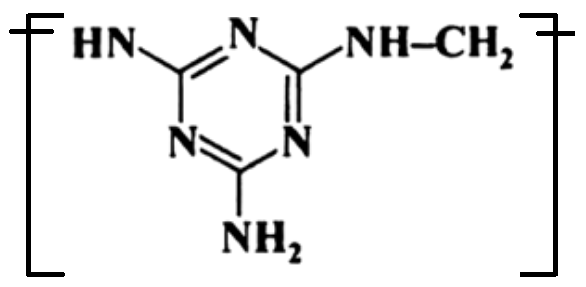
Identify the monomer in the following polymeric structure:
Answer
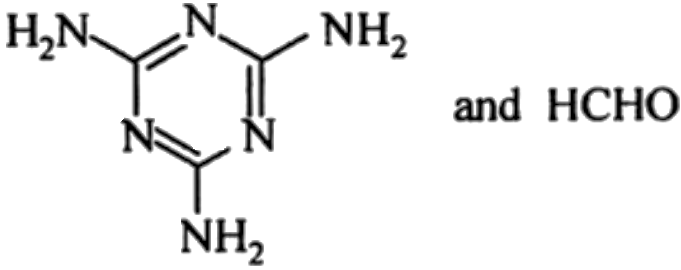
The monomers present in the polymer are melamine and formaldehyde.
View full question & answer
Question 151 Mark
Write the names of monomers of the following polymers:
$\big[\text{CF}_2-\text{CF}_2\big]_{\text{n}}$
Answer
Tetrafluoroethene $\big(\text{CF}_2=\text{CF}_2\big)$
View full question & answer
Question 161 Mark
Arrange the following polymers in increasing order of their intermolecular forces.
  1. Nylon 6,6, Buna-S, Polythene.
  2. Nylon 6, Neoprene, Polyvinyl chloride.
Answer
Different types of polymers have different intermolecular forces of attraction. Elastomers or rubbers have the weakest while fibres have the strongest intermolecular forces of attraction. Plastics have intermediate intermolecular forces of attraction. Hence, the increasing order of the intermolecular forces of the given polymers is as follows:
  1. Buna - S < polythene < Nylon 6, 6.
  2. Neoprene < polyvinyl chloride < Nylon 6.
View full question & answer
Question 171 Mark
What are polymers ?
Answer
Polymers are high molecular mass substances $(10^3 — 10^7u)$ consisting of a very large number of simple repeating structural units joined together through covalent bonds in a linear fashion. They are also called macromolecules.
Ex: polythene, nylon 6,6, bakelite, rubber, etc.
View full question & answer
Question 181 Mark
Write the names of monomers of the following polymers:
Answer
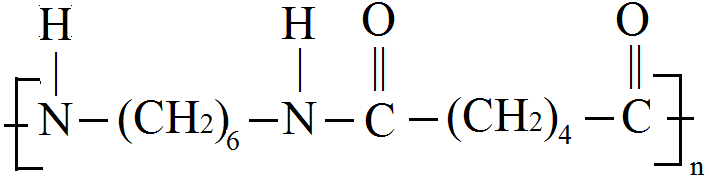
Hexamethylenediamine $[\text{H}_2\text{N}-(\text{CH}_2)_6-\text{NH}_2]$ and adipic acid $[\text{HOOC}-(\text{CH}_2)_4-\text{COOH}]$
View full question & answer
Question 191 Mark
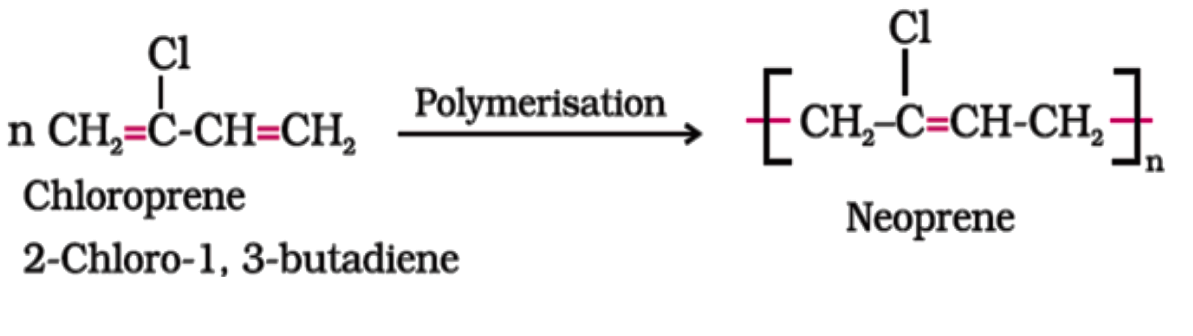
Write the names and structures of the monomers of the following polymer: Neoprene.
Answer

The names and structures of monomers are:
Neoprene is known as polychloroprene.
View full question & answer
Question 201 Mark
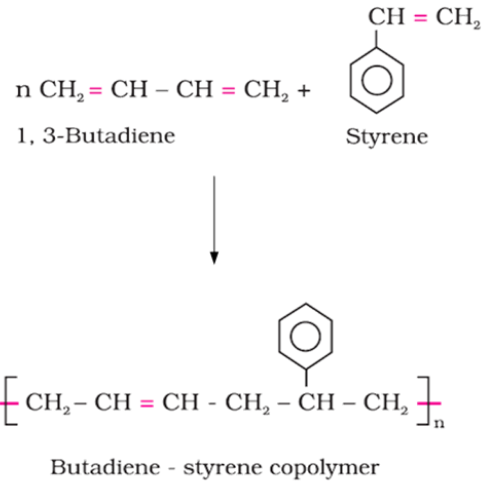
Write the names and structures of the monomers of the following polymer:
Buna-S.
Answer
The names and structures of monomers are:Buna-S is known as butadiene-styrene copolymer.
View full question & answer
Question 211 Mark
Distinguish between the terms homopolymer and copolymer and give an example of each.
Answer
Polymers whose repeating structural units are derived from only one type of monomer units are called homopolymers, e.g., PVC polyethene, PAN, teflon, polystyrene, nylon- 6 etc. Polymers whose repeating structural units are derived from two or more types of monomer molecules are copolymers, e.g., Buna-S, Buna-N, nylon-66, polyester, bakelite.
View full question & answer
Question 221 Mark
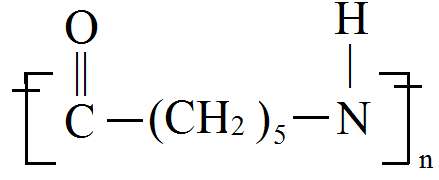
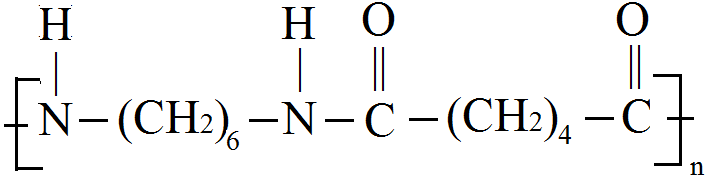
What are the monomeric repeating units of Nylon-6 and Nylon-6, 6?
Answer
The monomeric repeating unit of nylon 6 is $\big[\text{NH}-(\text{CH}_2)_5-\text{CO}\big],$ which is derived from Caprolactam.
The monomeric repeating unit of nylon 6, 6 is $\big[\text{NH}-(\text{CH}_2)_6-\text{NH}-\text{CO}-(\text{CH}_2)_4-\text{CO}\big],$ which is derived from hexarnethylene diamine and adipic acid.
View full question & answer
Question 231 Mark
Classify the following as addition and condensation polymers: Terylene, Bakelite, Polyvinyl chloride, Polythene.
Answer
Addition polymers: Polyvinyl chloride, Polythene.
Condensation polymers: Terylene, bakelite.
View full question & answer
Question 241 Mark
What are biodegradable polymers? Give two examples.
Answer
The polymers which can be produced by biological system such as micro organisms, plants or animals. They can also be chemically synthesized. These are biodegradable and are from renewable sources. They act as stabalizers, thickness, binders, lubricants, etc.
e.g PHBV and Nylon-2–Nylon-6.
View full question & answer
Question 251 Mark
Write the structures of monomers used and one use of each of the following polymers:
  1. Teflon.
  2. Buna-N.
Answer
  1. Teflon: $CF_2 = CF_2.$
It is used as lubricant, Insulator etc.
  1. Buna N: $CH_2=CH–CH=CH_2$ and $CH_2=CH-CN.$
It is used in making oil seals, hoses, tank lining.
View full question & answer
Question 271 Mark
Based on molecular forces what type of polymer is neoprene?
Answer
Weak intermolecular forces are present between the polymeric chains in neoprene; thus, it is an elastomer.
View full question & answer
Question 301 Mark
What does the designation ‘6, 6’ mean in the name nylon-6, 6?
Answer
6, 6 means the number of carbon atoms in the monomers of Nylon-6, 6.
View full question & answer
Question 311 Mark
What does '6, 6' indicate in the name nylon-6, 6?
Answer
The two molecules combine to make nylon-6, 6, each contains 6 carbon atoms.
View full question & answer
Question 321 Mark
Define the term ‘polymerisation’.
Answer
The process of formation of polymers from the respective monomers is called polymerization.
View full question & answer
Question 331 Mark
Define the term, 'homopolymerisation' giving an example.
Answer
The polymer formed by the polymerization of a single/same monomeric species is known as Homopolymerisation.
View full question & answer
Question 341 Mark
What are biodegradable polymers?
Answer
Polymers which undergo bacterial degradation in the environment and are thus ecofriendly.
View full question & answer
Question 391 Mark
Identify the type of polymer.
—A—B—B—A—A—A—B—A—
Answer
It is a copolymer, since, its repeating structural unit is derived from two types of monomer units, i.e., A and B.
View full question & answer
Question 401 Mark
Which type of biomolecules have some structural similarity with synthetic polyamides? What is this similarity?
Answer
Proteins are also like polyamides. Proteins and polyamide both contains amide linkages.
View full question & answer
Question 411 Mark

Out of chain growth polymerisation and step growth polymerisation, in which type will you place the following.
Answer
This is a type of chain growth polymerisation.
View full question & answer
Question 421 Mark
What is a plasticiser?
Answer
Organic compounds which when added to plastics make them soft and workable are called plasticisers. Examples are di-n-octylphthalate, tricresyl phosphate, etc.
View full question & answer
Question 431 Mark
What is the commercial name of PMMA? What is its use?
Answer
The commercial name of PMMA (polymethylmethacrylate) is perspex. It is used as a substitute of glass. It is used for making lenses, transparent domes, aircraft windows and sky lights.
View full question & answer
Question 441 Mark
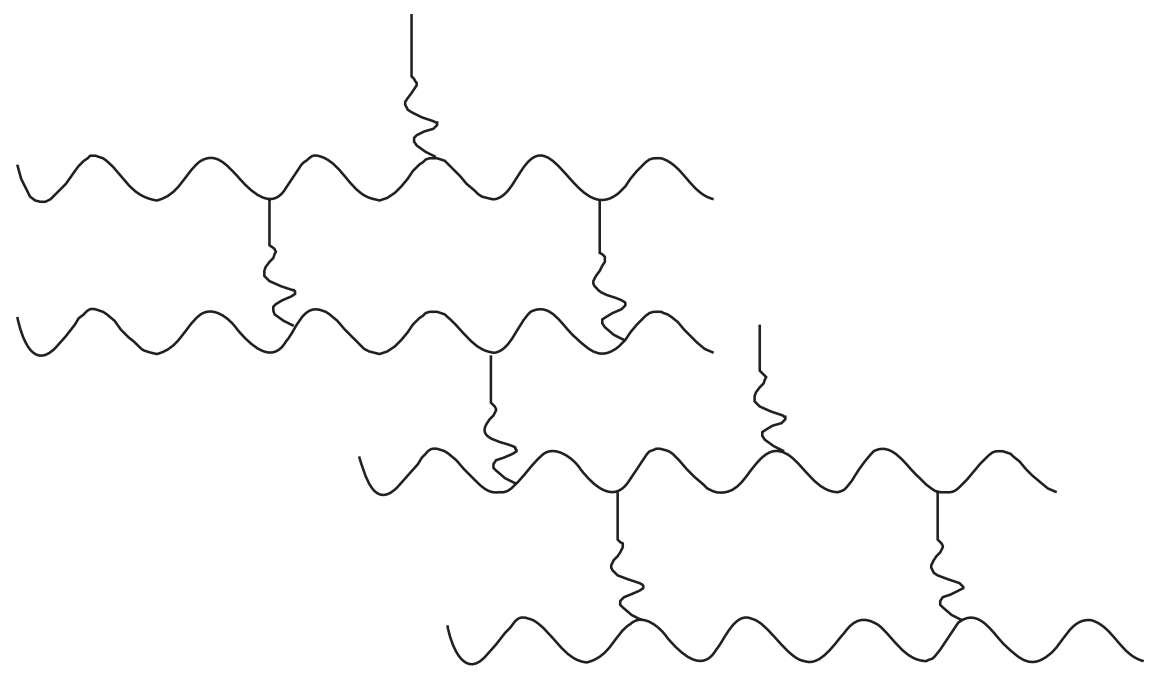
Identify the type of polymer given in the following figure.
Answer
It is a cross linked polymer, since the various polymer chains are joined together to form a three-dimensional network structure (giant molecule).
View full question & answer
Question 451 Mark
Mention which of the following are addition polymer:
  1. Terylene.
  2. Nylon-6, 6
  3. Neoprene Teflon.
Answer
Neoprene and teflon are addition polymers.
View full question & answer
Question 511 Mark
Identify the monomer in the following polymeric structures:
Answer
The monomers forming the polymer are Decanoic acid $\mathrm{HOOC}\left(\mathrm{CH}_2\right)_8 \mathrm{COOH}$ and hexamethylene diamine $\mathrm{H}_2 \mathrm{N}\left(\mathrm{CH}_2\right)_6 \mathrm{NH}_2$.
View full question & answer
Question 521 Mark
Which factor imparts crystalline nature to a polymer like nylon?
Answer
Polymers possessing amide linkages are important examples of synthetic fibres and are termed as nylons strong intermolecular forces like hydrogen bonding, lead to close packing of chains that imparts crystalline character.
View full question & answer
Question 531 Mark
What do you understand by addition polymers?
Answer
Polymers which are formed by repeated addition of monomer molecules containing double and triple bonds are called addition polymers. Examples are polythene, PVC, PAN, PMMA, etc.
View full question & answer
Question 541 Mark
Answer the following question:
How does vulcanisation change the properties of natural rubber?
Answer
Rubber gets cross-linked through —S—S— bonds and becomes hard on vulcanisation.
View full question & answer
Question 551 Mark
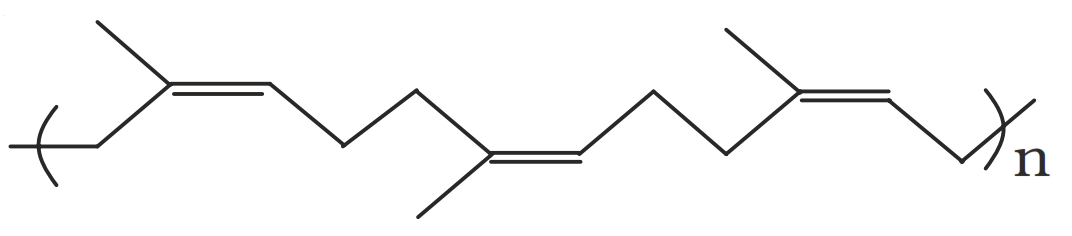
Identify the polymer given below:
Answer

The cis-polyisoprene molecule consists of various chains held together by weak van der Waals interactions and has a coiled structure. Thus, it can be stretched like a spring and exhibits elastic properties.
View full question & answer
Question 561 Mark
Is $[-\text{CH}_2-\text{CH}(\text{C}_6\text{H}_5)-]_\text{n}$ a homopolymer or a copolymer?
Answer
It is a homopolymer and the monomer from which it is obtained is styrene $\mathrm{C}_6 \mathrm{H}_5 \mathrm{CH}=\mathrm{CH}_2$.
View full question & answer
Question 571 Mark
Identify the monomer in the following polymeric structure:
Answer
The monomers present in the polymer are melamine and formaldehyde.
View full question & answer
Question 581 Mark
Why should the monomers used in addition polymerisation through free radical pathway be very pure?
Answer
Pure monomers are required because even the traces of impurities may act as initiators which lead to the formation of polymers of small chain lengths.
View full question & answer
Question 601 Mark
Name the polymers used in laminated sheets and give the name of monomeric units involved in its formation.
Answer
The polymer is urea-formaldehyde resin,
$\text{Monomers}:\ \ \ \ \ \text{Urea}\ \ \ \ \ \ \ \ \ \ \ \ \ \ \ \ \ \ \ :\text{NH}_2\text{CONH}_2\\ \ \ \ \ \ \ \ \ \ \ \ \ \ \ \ \ \ \ \ \ \ \ \ \ \ \ \ \text{Formaldehyde}\ \ :\text{HCHO}$
View full question & answer
Question 611 Mark
Write the names of monomers of the following polymers:
Answer
Hexamethylenediamine $[\text{H}_2\text{N}-(\text{CH}_2)_6-\text{NH}_2]$ and adipic acid $[\text{HOOC}-(\text{CH}_2)_4-\text{COOH}]$
View full question & answer
Question 621 Mark
Can enzyme be called a polymer?
Answer
Enzymes are biocatalysts. They are basically proteins thus they are also considered as polymer.
View full question & answer
Question 631 Mark
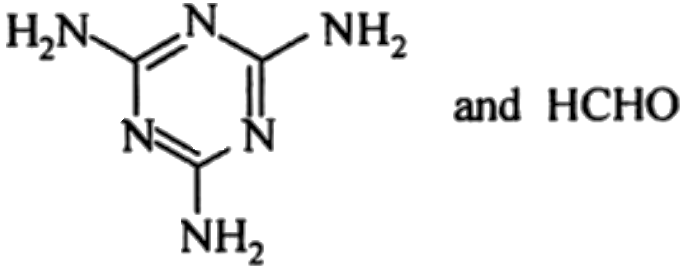
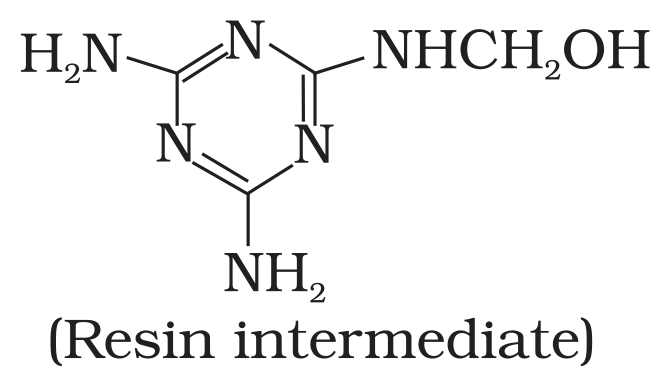
How is the following resin intermediate prepared and which polymer is formed by this monomer unit?
Answer

Melamine and formaldehyde are starting materials for this intermediate. Its polymerisation gives melamine formaldehyde polymer.
View full question & answer
Question 651 Mark
Why does cis-polyisoprene possess elastic property?
Answer
The cis-polyisoprene molecule consists of various chains held together by weal vander Waals interactions and has a coiled structure. Thus, it can be stretched like a spring and shows elastic properties.
View full question & answer
Question 661 Mark
Differentiate the following pair of polymer based on the property mentioned against:
Novolac and bakelite (structure).
Answer
Novolac is a straight chain linear polymer but bakelite is cross linked.
View full question & answer
Question 671 Mark
Why are rubbers called elastomers?
Answer
Rubbers are stretched on application of force and come to its original position after the force is removed. Therefore, these are called elastomers.
View full question & answer