MCQ 11 Mark
In these questions, a statement of assertion followed by a statement of reason is given. Choose the correct answer out of the following choices.
Assertion: $Fe^{3+}$ is more stable than $Fe^{2+}.$
Reason: $Fe^{2+}$ ions are easily oxidised to $Fe^{3+}$ ions.
- A
Assertion and reason both are correct statements and reason is correct explanation for assertion.
- ✓
Assertion and reason both are correct statements but reason is not correct explanation for assertion.
- C
Assertion is correct statement but reason is wrong statement.
- D
Assertion is wrong statement but reason is correct statement.
AnswerCorrect option: B. Assertion and reason both are correct statements but reason is not correct explanation for assertion.
$Fe^{3+}$ is more stable than $Fe^{2+}$. The electronic configuration of $Fe^{3+}$ has half$-$filled $'d\ '$ orbitals and thus, becomes more stable.
$26\text{Fe}2+: \text{Is}^2 \ 2\text{s}^2 \ 2\text{p}^6 \ 3\text{s}^2 \ 3\text{p}^6 \ 3\text{d}^6$
$26\text{Fe}^3+: \text{Is}^2 \ 2\text{s}^2 \ 2\text{p}^6 \ 3\text{s}^2 \ 3\text{p}^6 \ 3\text{d}^5$
View full question & answer→MCQ 21 Mark
In these questions, a statement of assertion followed by a statement of reason is given. Choose the correct answer out of the following choices.
Assertion: Transition metals are good catalysts.
Reason: $\ce{V_2O_5}$ or $Pt$ is used in the preparation of $\ce{H_2SO_4}$ by Con tact process.
- A
Assertion and reason both are correct statements and reason is correct explanation for assertion.
- ✓
Assertion and reason both are correct statements but reason is not correct explanation for assertion.
- C
Assertion is correct statement but reason is wrong statement.
- D
Assertion is wrong statement but reason is correct statement.
AnswerCorrect option: B. Assertion and reason both are correct statements but reason is not correct explanation for assertion.
Due to large surface area and variable valencies, transition metals form intermediate activated complexes easily, hence they are used as good catalysts.
View full question & answer→MCQ 31 Mark
In these questions, a statement of assertion followed by a statement of reason is given. Choose the correct answer out of the following choices.
Assertion: Europium $(II)$ is more stable than cerium $(II).$
Reason: Cerium salts are used as a catalyst in petroleum cracking
- A
Assertion and reason both are correct statements and reason is correct explanation for assertion.
- ✓
Assertion and reason both are correct statements but reason is not correct explanation for assertion.
- C
Assertion is correct statement but reason is wrong statement.
- D
Assertion is wrong statement but reason is correct statement.
AnswerCorrect option: B. Assertion and reason both are correct statements but reason is not correct explanation for assertion.
The electronic configurations of europium $(II)$ and cerium $(II)$ are $Eu^{2+}: [Xe]4f^7$ and $Ce^{2+}: [Xe]4f^15d^1$
In $Eu^{2+}, f-$suabshell is half$-$filled thus, it is more stable.
View full question & answer→MCQ 41 Mark
In these questions, a statement of assertion followed by a statement of reason is given. Choose the correct answer out of the following choices.
Assertion: Most of the trivalent lanthanide ions are coloured both in the solid state and in aqueous solution.
Reason: The elements with xf electrons have a similar colour to those of $(14 - x)f$ electrons.
- A
Assertion and reason both are correct statements and reason is correct explanation for assertion.
- ✓
Assertion and reason both are correct statements but reason is not correct explanation for assertion.
- C
Assertion is correct statement but reason is wrong statement.
- D
Assertion is wrong statement but reason is correct statement.
AnswerCorrect option: B. Assertion and reason both are correct statements but reason is not correct explanation for assertion.
The lanthanide ions are coloured due to the partly filled $f-$orbitals which permits $f - f$ transition.
View full question & answer→MCQ 51 Mark
In these questions, a statement of assertion followed by a statement of reason is given. Choose the correct answer out of the following choices.
Assertion: When $Zn$ is placed in a magnetic field, it is feebly magnetised in a direction opposite to that of the magnetising field.
Reason: $Zn$ has completely filled atomic orbitals.
- ✓
Assertion and reason both are correct statements and reason is correct explanation for assertion.
- B
Assertion and reason both are correct statements but reason is not correct explanation for assertion.
- C
Assertion is correct statement but reason is wrong statement.
- D
Assertion is wrong statement but reason is correct statement.
AnswerCorrect option: A. Assertion and reason both are correct statements and reason is correct explanation for assertion.
Zinc has all electrons paired $[Ar]3d^{10}4s^2.$ So, it is diamagnetic in nature.
View full question & answer→MCQ 61 Mark
In these questions, a statement of assertion followed by a statement of reason is given. Choose the correct answer out of the following choices.
Assertion: Zinc becomes dull in moist air.
Reason: Zinc is coated by a thin film of its basic carbonate in moist air.
- ✓
Assertion and reason both are correct statements and reason is correct explanation for assertion.
- B
Assertion and reason both are correct statements but reason is not correct explanation for assertion.
- C
Assertion is correct statement but reason is wrong statement.
- D
Assertion is wrong statement but reason is correct statement.
AnswerCorrect option: A. Assertion and reason both are correct statements and reason is correct explanation for assertion.
Zinc, in presence of moist air, is coated by a thin film of its basic carbonates on its surface and becomes dull.
$\ce{4Zn + 3H_2O + 2O_2 + CO_2 → ZnCO_3. 3Zn(OH)_2}$
View full question & answer→MCQ 71 Mark
In these questions, a statement of assertion followed by a statement of reason is given. Choose the correct answer out of the following choices.
Assertion: Promethium is a manmade element.
Reason: It is radioactive and has been prepared by artificial means.
- ✓
Assertion and reason both are correct statements and reason is correct explanation for assertion.
- B
Assertion and reason both are correct statements but reason is not correct explanation for assertion.
- C
Assertion is correct statement but reason is wrong statement.
- D
Assertion is wrong statement but reason is correct statement.
AnswerCorrect option: A. Assertion and reason both are correct statements and reason is correct explanation for assertion.
View full question & answer→MCQ 81 Mark
In these questions, a statement of assertion followed by a statement of reason is given. Choose the correct answer out of the following choices.
Assertion: Transition metals form substitutional alloys.
Reason: Alloys are made to develop some useful properties which are absent in the constituent elements.
- A
Assertion and reason both are correct statements and reason is correct explanation for assertion.
- ✓
Assertion and reason both are correct statements but reason is not correct explanation for assertion.
- C
Assertion is correct statement but reason is wrong statement.
- D
Assertion is wrong statement but reason is correct statement.
AnswerCorrect option: B. Assertion and reason both are correct statements but reason is not correct explanation for assertion.
Transition metals form substitutional alloys since they have nearly the same size, they can substitute one another in the crystal lattice.
View full question & answer→MCQ 91 Mark
In these questions, a statement of assertion followed by a statement of reason is given. Choose the correct answer out of the following choices.
Assertion: Reduction potential of $Mn\ (+3$ to $+2)$ is more positive than $Fe\ (+3$ to $+2).$
Reason: Ionisation potential of $Mn$ is more than that of $Fe.$
- A
Assertion and reason both are correct statements and reason is correct explanation for assertion.
- B
Assertion and reason both are correct statements but reason is not correct explanation for assertion.
- ✓
Assertion is correct statement but reason is wrong statement.
- D
Assertion is wrong statement but reason is correct statement.
AnswerCorrect option: C. Assertion is correct statement but reason is wrong statement.
$Mn^{2+} = [Ar]3d^5, Mn^{3+} = [Ar]3d^4$
$Fe^{2+} = [Ar]3d^6, Fe^{3+} = [Ar]3d^5$
Thus, $Mn^{2+}$ has more stable configuration than $Mn^{3+}$ while $Fe^{3+}$ has more stable configuration than $Fe^{2+}.$
Hence, reduction potential for $\frac{\text{Mn}^{3+}}{\text{Mn}^{2+}}$
couple is more positive than $\frac{\text{Fe}^{3+}}{\text{Fe}^{2+}}.$
As we move across the period, ionisation potential increases, thus, ionisation potential of $Fe$ is more than that of $Mn.$
View full question & answer→MCQ 101 Mark
In these questions, a statement of assertion followed by a statement of reason is given. Choose the correct answer out of the following choices.
Assertion: Zinc is used in the galvanisation of iron.
Reason: Its coating on iron articles increases their life by protecting them from rusting.
- ✓
Assertion and reason both are correct statements and reason is correct explanation for assertion.
- B
Assertion and reason both are correct statements but reason is not correct explanation for assertion.
- C
Assertion is correct statement but reason is wrong statement.
- D
Assertion is wrong statement but reason is correct statement.
AnswerCorrect option: A. Assertion and reason both are correct statements and reason is correct explanation for assertion.
Zinc has no action of air or water on it and thus, its coating on iron articles increase their life by protecting them from rusting.
View full question & answer→MCQ 111 Mark
In these questions, a statement of assertion followed by a statement of reason is given. Choose the correct answer out of the following choices.
Assertion: $Fe^{2+}$ is paramagnetic.
Reason: $Fe^{2+}$ contains four unpaired electrons.
- ✓
Assertion and reason both are correct statements and reason is correct explanation for assertion.
- B
Assertion and reason both are correct statements but reason is not correct explanation for assertion.
- C
Assertion is correct statement but reason is wrong statement.
- D
Assertion is wrong statement but reason is correct statement.
AnswerCorrect option: A. Assertion and reason both are correct statements and reason is correct explanation for assertion.
$Fe$ has atomic number $26.$ So, its electronic configuration is $[Ar]3d^64s^2.$
$Fe^{2+}$ has electronic configuration $[Ar]3d^6.$
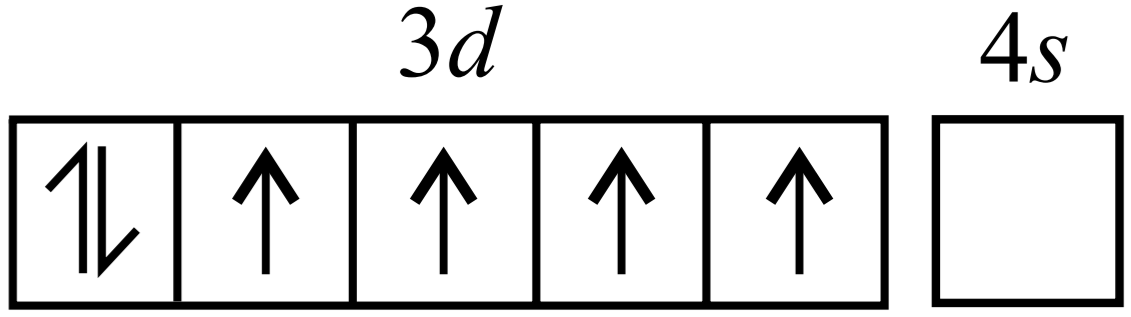
It has four unpaired electrons and it is paramagnetic. View full question & answer→MCQ 121 Mark
In these questions, a statement of assertion followed by a statement of reason is given. Choose the correct answer out of the following choices.
Assertion: Members of $4d$ and $5d$ series of transition elements have nearly same atomic radii.
Reason: Atomic and ionic radii for transition elements are smaller than their corresponding $s-$block elements.
- A
Assertion and reason both are correct statements and reason is correct explanation for assertion.
- ✓
Assertion and reason both are correct statements but reason is not correct explanation for assertion.
- C
Assertion is correct statement but reason is wrong statement.
- D
Assertion is wrong statement but reason is correct statement.
AnswerCorrect option: B. Assertion and reason both are correct statements but reason is not correct explanation for assertion.
It is due to lanthanide contraction.
View full question & answer→MCQ 131 Mark
In these questions, a statement of assertion followed by a statement of reason is given. Choose the correct answer out of the following choices.
Assertion: In transition elements, ns orbital is filled up first and $(n - 1)d$ afterwards, during ionization ns electrons are lost prior to $(n - 1)d$ electrons.
Reason: The effective nuclear charge felt by $(n - 1)d$ electrons is higher as compared to that by ns electrons.
- ✓
Assertion and reason both are correct statements and reason is correct explanation for assertion.
- B
Assertion and reason both are correct statements but reason is not correct explanation for assertion.
- C
Assertion is correct statement but reason is wrong statement.
- D
Assertion is wrong statement but reason is correct statement.
AnswerCorrect option: A. Assertion and reason both are correct statements and reason is correct explanation for assertion.
View full question & answer→MCQ 141 Mark
In these questions, a statement of assertion followed by a statement of reason is given. Choose the correct answer out of the following choices.
Assertion: Transition metals form a large number of interstitial compounds.
Reason: They have high melting point and boiling point.
- A
Assertion and reason both are correct statements and reason is correct explanation for assertion.
- ✓
Assertion and reason both are correct statements but reason is not correct explanation for assertion.
- C
Assertion is correct statement but reason is wrong statement.
- D
Assertion is wrong statement but reason is correct statement.
AnswerCorrect option: B. Assertion and reason both are correct statements but reason is not correct explanation for assertion.
Some non$-$metallic atoms $($e.g.$\text{, H, B, C, N,}$ etc$.)$ are able to fit in the interstitial sites of transition metals lattices to form interstitial compounds.
View full question & answer→MCQ 151 Mark
In these questions, a statement of assertion followed by a statement of reason is given. Choose the correct answer out of the following choices.
Assertion: The correct order of oxidising power is$:\ \text{VO}^+_2<\text{VO}<\text{VO}_2^+.$
Reason: The oxidation state of $Mn$ is $+7.$
- A
Assertion and reason both are correct statements and reason is correct explanation for assertion.
- B
Assertion and reason both are correct statements but reason is not correct explanation for assertion.
- C
Assertion is correct statement but reason is wrong statement.
- ✓
Assertion is wrong statement but reason is correct statement.
AnswerCorrect option: D. Assertion is wrong statement but reason is correct statement.
The oxidation states of the given compounds are the following,
$\text{VO}^+_2;\text{x}+2(-2)=+1$
$\Rightarrow \text{x} = +5$
$VO,$
$\Rightarrow \text{x} - 2 = 0;\ \text{x} = +2$
$\text{VO}_2^+;\text{x}+1(-2)=+2$
$\text{x} = +4$
The correct order of oxidising power is :
$\text{VO}<\text{VO}_2^+<\text{VO}^+_2.$
View full question & answer→MCQ 161 Mark
In these questions, a statement of assertion followed by a statement of reason is given. Choose the correct answer out of the following choices.
Assertion: Chromium is hard but mercury is soft.
Reason: Chromium is a $3d$ transition element.
- A
Assertion and reason both are correct statements and reason is correct explanation for assertion.
- ✓
Assertion and reason both are correct statements but reason is not correct explanation for assertion.
- C
Assertion is correct statement but reason is wrong statement.
- D
Assertion is wrong statement but reason is correct statement.
AnswerCorrect option: B. Assertion and reason both are correct statements but reason is not correct explanation for assertion.
Chromium has maximum numberofunpaired $d$ electrons while $Hg$ do not have any unpaired $d$ electrons. Thus$, Cr$ is hard but $Hg$ is soft metal.
View full question & answer→MCQ 171 Mark
In these questions, a statement of assertion followed by a statement of reason is given. Choose the correct answer out of the following choices.
Assertion: $Cu^{2+}$ is paramagnetic.
Reason: $Cu^{2+}$ is less stable than $Cu^{2+}.$
- A
Assertion and reason both are correct statements and reason is correct explanation for assertion.
- B
Assertion and reason both are correct statements but reason is not correct explanation for assertion.
- C
Assertion is correct statement but reason is wrong statement.
- ✓
Assertion is wrong statement but reason is correct statement.
AnswerCorrect option: D. Assertion is wrong statement but reason is correct statement.
Even though $Cu^+$ has completely filled $3d$ orbitals$, [Ar]3d^{10}$ the nuclear charge in $Cu$ is not enough to hold a core of $18$ electrons in $Cu^+$ and thus, $Cu^+$ is unstable in comparison to $Cu^{2+}.\ Cu^+$ is diamagnetic in nature.
View full question & answer→MCQ 181 Mark
In these questions, a statement of assertion followed by a statement of reason is given. Choose the correct answer out of the following choices.
Assertion: $Mn^{2+}$ is more stable than $Mn^{3+}$.
Reason: $Mn^{2+}$ has half$-$filled configuration.
- ✓
Assertion and reason both are correct statements and reason is correct explanation for assertion.
- B
Assertion and reason both are correct statements but reason is not correct explanation for assertion.
- C
Assertion is correct statement but reason is wrong statement.
- D
Assertion is wrong statement but reason is correct statement.
AnswerCorrect option: A. Assertion and reason both are correct statements and reason is correct explanation for assertion.
A half$-$filled or fully$-$filled orbital is more stable than incompletely filled orbital.
View full question & answer→MCQ 191 Mark
In these questions, a statement of assertion followed by a statement of reason is given. Choose the correct answer out of the following choices.
Assertion: $[Ti(H_2O)6]^{3+}$ is a coloured ion.
Reason: $Ti$ shows $+2, +3, +4$ oxidation states.
- A
Assertion and reason both are correct statements and reason is correct explanation for assertion.
- ✓
Assertion and reason both are correct statements but reason is not correct explanation for assertion.
- C
Assertion is correct statement but reason is wrong statement.
- D
Assertion is wrong statement but reason is correct statement.
AnswerCorrect option: B. Assertion and reason both are correct statements but reason is not correct explanation for assertion.
$Ti^{3+}$ has $[Ar]3d^1$ configuration. Thus$, d - d$ transition is possible and thereby it shows colour.
View full question & answer→