Question 12 Marks
Find the value of c in Rolle’s theorem for the function $\text{f(x)} = \text{x}^{3} - \text{3x in} [ -\sqrt{3}, 0].$
Answer$\text{f(x)} = \text{x}^{3} - \text{3x}$
$\therefore \text{f}'\text{(c)} = 3\text{ c}^{2} - 3 = 0$
$\therefore \text{c}^{2} = 1 \Rightarrow \text{c} = \pm 1.$
Rejecting c = 1 as it does not belong to $(-\sqrt{3, 0)},$
we get c = –1.
View full question & answer→Question 22 Marks
$\text{Find } \frac{\text{dy}}{\text{dx}} \text{ at t} = \frac{2\pi}{3} \text{ when x 10 (t} -\sin \text{t) and y = 12 } (1 - \cos \text{t}).$
Answer$\frac{\text{dy}}{\text{dt}} = 12 \sin \text{t}, \frac{\text{dx}}{\text{dt}} = 10 \text{ }(1 - \cos \text{t})$
$\therefore \frac{\text{dy}}{\text{dx}} = \frac{6}{5} \times \frac{\sin \text{t}}{1 - \cos \text{t}}$
$\frac{\text{dy}}{\text{dx}}\bigg|_{\text{t} = \frac{2\pi}{3}} = \frac{6}{5\sqrt{3}}$
View full question & answer→Question 32 Marks
$\text{If y}=\text{sin}^{-1}(6\text{x}\sqrt{1-9\text{x}^2}), -\frac{1}{3\sqrt{2}}<\text{x}<\frac{1}{3\sqrt{2}},\text{then find}\frac{\text{dy}}{dx}$
Answer$\text{y}=\text{sin}^{-1}(6\text{x}\sqrt{1-9\text{x}^2}),-\frac{1}{3\sqrt2}<\text{x}<\frac{1}{3\sqrt2}$ $\text{put 3x}=\text{sin}\ \theta$ $\Rightarrow\theta=\text{sin}^{-1}3\text{x}$$\text{y}=\text{sin}^{-1}(\text{sin}\ 2\theta)$
$=2\theta$ $=2\ \text{sin}^{-1}3\text{x}$ $\therefore\ \frac{\text{dy}}{\text{dx}}=\frac{6}{\sqrt{1-9\text{x}^2}}$
View full question & answer→Question 42 Marks
Differentiate $\tan^{-1}\Big(\frac{1+\cos\text{x}}{\sin\text{x}}\Big)$ with respect to x.
AnswerLet $\tan^{-1}\Big(\frac{1+\cos\text{x}}{\sin\text{x}}\Big)=\text{y}$
$\text{y}=\tan^{-1}\bigg(\frac{2\cos^2\frac{\text{x}}{2}}{2\sin\frac{\text{x}}{2}\cos\frac{\text{x}}{2}}\bigg)$
$=\tan^{-1}\Big(\cot\frac{\text{x}}{2}\Big)$
$=\tan^{-1}\Big[\tan\Big(\frac{\pi}{2}-\frac{\text{x}}{2}\Big)\Big]$
$\text{y}=\frac{\pi}{2}-\frac{\text{x}}{2}$
$\frac{\text{dy}}{\text{dx}}=0-\frac{1}{2}=\frac{-1}{2}$
View full question & answer→Question 52 Marks
If $x = at^2, y = 2$ at, then find $\frac{\text{d}^2\text{y}}{\text{dx}^2}.$
AnswerGiven,
$x = at^2$ and $y = 2$ at
On differentiating both sides w.r.t.t, we get,
$\frac{\text{dx}}{\text{dt}}=2\text{at and}\frac{\text{dy}}{\text{dt}}=2\text{a}$
Therefore,
$\frac{\text{dy}}{\text{dx}}=\frac{2\text{a}}{2\text{at}}=\frac{1}{\text{t}}$
Now, $\frac{\text{d}^2\text{y}}{\text{dx}^2}=\frac{\text{d}}{\text{dx}}\Big(\frac{\text{dy}}{\text{dx}}\Big)\times\frac{\text{dt}}{\text{dx}}$
$=\frac{\text{d}}{\text{dt}}\Big(\frac{1}{\text{t}}\Big)\times\frac{1}{2\text{at}}=-\frac{1}{\text{t}^2}\times\frac{1}{\text{2at}}=-\frac{1}{\text{2at}^3}$
View full question & answer→Question 62 Marks
Prove that $\text{f(x)}=\begin{cases}\frac{\text{x}-|\text{x}|}{\text{x}},&\text{x}\neq0\\2,&\text{x}=0\end{cases}$ is discontinuous at x = 0.
AnswerThe given function can be rewritten as
$\text{f(x)}=\begin{cases}\frac{\text{x}-\text{x}}{\text{x}},&\text{when }\text{ x}>0\\\frac{\text{x}+\text{x}}{\text{x}},&\text{when }\text{ x}<0\\2,&\text{when }\text{ x}=0\end{cases}$
$\text{f(x)}=\begin{cases}0,&\text{when }\text{ x}>0\\2,&\text{when }\text{ x}<0\\2,&\text{when }\text{ x}=0\end{cases}$
We have,
$(\text{LHL at x}= 0)=\lim_\limits{\text{x}\rightarrow0^-}\text{f(x)}=\lim_\limits{\text{h}\rightarrow0}\text{f}(0-\text{h})$
$=\lim_\limits{\text{h}\rightarrow0}\text{f}(-\text{h})=\lim_\limits{\text{h}\rightarrow0}2=2$
$(\text{RHL at x}= 0)=\lim_\limits{\text{x}\rightarrow0^+}\text{f(x)}=\lim_\limits{\text{h}\rightarrow0}\text{f}(0+\text{h})$
$=\lim_\limits{\text{h}\rightarrow0}\text{f}(\text{h})=\lim_\limits{\text{h}\rightarrow0}0=0$
$\therefore\lim_\limits{\text{x}\rightarrow0^-}\text{f}(\text{x})\neq\lim_\limits{\text{x}\rightarrow0^+}\text{f}(\text{x})$
Thus, f(x) is discontinuous at x = 0
View full question & answer→Question 72 Marks
Write an example of a function which is everywhere continuous but fails to differentiable exactly at five points.
AnswerWe know that, modulus functionf(x) = |x| is continuous but not differntiable at x = 0.
So,
f(x) = |x| + |x - 1| + |x - 2| + |x - 3| + |x - 4| is continuous but not differentiable x = 0, 1, 2, 3, 4.
View full question & answer→Question 82 Marks
Is the function defined by $f(x) = x^2 – \sin x + 5$ continuous at $\text{x} = \pi$ ?
Answer$\text{f(x)}=\text{x}^{2} - \sin\text{x}+ 5$
$^{\ \ \text{Lt}}_{\text{x}\rightarrow\pi}\text{f(x)} = ^{\ \ \text{Lt}}_{\text{x}\rightarrow\pi}\text{(x}^{2} - \sin \text{x} + 5)$
$= \pi^{2} - \sin\pi + 5 = \pi^{2} - 0 + 5 = \pi^{2} + 5$
Also $\text{f}(\pi)= \pi^{2} - \sin\pi + 5 = \pi^{2} - 0 + 5 = \pi^{2} + 5$
$\therefore \ ^{\ \ \text{Lt}}_{\text{x}\rightarrow{\pi}}\text{f(x)} = \text{f}(\pi)$
$\therefore$ f is continous at $\text{x} = \pi.$
View full question & answer→Question 92 Marks
If x and y are connected parametrically by the equations given in Exercise without eliminating the parameter, Find $\frac{\text{dy}}{\text{dx}}.$
$x = 2at^2, y = at^4$
AnswerThe given equations are $x = 2at^2$ and $y = at^4$
Then, $\frac{\text{dx}}{\text{dt}}=\frac{\text{d}}{\text{dt}}(2\text{at}^2)=2\text{a}.\frac{\text{d}}{\text{dt}}(\text{t}^2)=4\text{at}\text{ and y}=\text{at}^4$
$\frac{\text{dx}}{\text{dt}}=\frac{\text{d}}{\text{dt}}(\text{at}^4)=\text{a}\frac{\text{d}}{\text{dt}}\text{(t}^4)=\text{a}.4.\text{t}^3=4\text{at}^3$
$\therefore\ \frac{\text{dy}}{\text{dx}}=\frac{\Big(\frac{\text{dy}}{\text{dt}}\Big)}{\Big(\frac{\text{dx}}{\text{dt}}\Big)}=\frac{4\text{at}^3}{4\text{at}}=\text{t}^2$
View full question & answer→Question 102 Marks
Find $\frac{\text{dx}}{{\text{dy}}}$ in the following:
$2\text{x} + 3\text{y} = \sin\text{x}$
AnswerThe given relationship is $2\text{x} + 3\text{y} = \sin\text{x}$
Differentiating this relationship with respect to x, we obtain
$\frac{\text{d}}{\text{dx}}(2\text{x} + 3\text{y}) = \frac{\text{d}}{\text{dx}}(\sin\text{x)}$
$\therefore\ \frac{\text{d}}{\text{dx}}(2\text{x}) + \frac{\text{d}}{\text{dx}}(3\text{y)} = \cos\text{x}$
$\Rightarrow 2 + 3\frac{\text{dy}}{\text{dx}}= \cos\text{x}$
$\Rightarrow 3 \frac{\text{dy}}{\text{dx}}= \cos\text{x} - 2$
$\therefore\ \frac{\text{dy}}{\text{dx}}=\frac{ \cos\text{x} - 2}{3}$
View full question & answer→Question 112 Marks
Differentiate the following w.r.t.x:$\sqrt{\text{e}^\sqrt{\text{x}}},\ \text{x}>0$
Answer$\text{Let}\ \sqrt{\text{e}^\sqrt{\text{x}}}=(\sqrt{\text{e}^\sqrt{\text{x}}})^{\frac{1}{2}}$
$\therefore\ \frac{\text{dy}}{\text{dx}} =\frac{{1}}{{2}} (\sqrt{\text{e}^\sqrt{\text{x}}})^{\frac{1}{2}}.\frac{\text{d}}{\text{dx}}(\sqrt{\text{e}^\sqrt{\text{x}}})=\frac{1}{2\sqrt{\text{e}^\sqrt{\text{x}}}}.\sqrt{\text{e}^\sqrt{\text{x}}}\frac{\text{d}}{\text{dx}}(\sqrt{\text{x}})$
$=\frac{1}{2\sqrt{\text{e}^\sqrt{\text{x}}}}.\text{e}\sqrt{\text{x}}.\frac{\text{1}}{{2\sqrt{\text{x}}}}=\frac{1}{4}\frac{{\text{e}^\sqrt{\text{x}}}}{\sqrt{\text{x e}^\sqrt{\text{x}}}}$
View full question & answer→Question 122 Marks
If $\text{f(x)}=\begin{cases}\frac{\text{x}}{\sin3\text{x}},&\text{x}\neq0\\\text{k},&\text{x}=0\end{cases}$ is continuous at x = 0, then write the value of k.
AnswerIf f(x) is continuous at x = 0, then
$\lim\limits_{{\text{x}}\rightarrow0}\text{f(x})=\text{f}(0)$
$\Rightarrow\lim\limits_{{\text{x}}\rightarrow0}\frac{\text{x}}{\sin3\text{x}}=\text{k}$
$\Rightarrow\lim\limits_{{\text{x}}\rightarrow0}\frac{1}{\frac{\sin3\text{x}}{\text{x}}}=\text{k}$
$\Rightarrow\lim\limits_{{\text{x}}\rightarrow0}\frac{1}{\frac{3\sin3\text{x}}{3\text{x}}}=\text{k}$
$\Rightarrow\frac{1}{3}\Bigg(\frac{1}{\lim\limits_{{\text{x}}\rightarrow0}\frac{3\sin3\text{x}}{3\text{x}}}\Bigg)=\text{k}$
$\Rightarrow\text{k}=\frac{1}{3}$
View full question & answer→Question 132 Marks
Find the second order derivatives of the function given in Exercise:
$\tan^{-1}\text{x}$
AnswerLet $\text{y}=\tan^{-1}\text{x}$
$\therefore\ \frac{\text{dy}}{\text{dx}}=\frac{1}{1+\text{x}^2}$
and $\frac{\text{d}^2\text{y}}{\text{dx}^2}=\frac{(1+\text{x}^2).0-1.2\text{x}}{(1+\text{x}^2)^2}=-\frac{2\text{x}}{(1+\text{x}^2)^2}$
View full question & answer→Question 142 Marks
If f'(1) = 2 and $\text{y}=\text{f}(\log_\text{e}\text{x}),$ find $\frac{\text{d}}{\text{dx}}\text{at x}=\text{e}.$
AnswerWe have, f'(1) = 2 and $\text{y}=\text{f}(\log_\text{e}\text{x})$
Differentiate it with respect to x,
$\frac{\text{dy}}{\text{dx}}=\text{f}'(\log_\text{e}\text{x})\times\frac{\text{d}}{\text{dx}}(\log_\text{e}\text{x})$
$\Rightarrow\frac{\text{dy}}{\text{dx}}=\text{f}'(\log_\text{e}\text{x})\big(\frac{1}{\text{x}}\big)$
$\Rightarrow\frac{\text{dy}}{\text{dx}}=\text{f}'(\log_\text{e}\text{e})\big(\frac{1}{\text{e}}\big) \big[\because\text{x}=\text{e}\big]$
$\Rightarrow\frac{\text{dy}}{\text{dx}}=\text{f}'(1)\big(\frac{1}{\text{e}}\big) \big[\because\log_\text{e}\text{e}=1\big]$
$\Rightarrow\frac{\text{dy}}{\text{dx}}=\frac{2}{\text{e}} \big[\because\text{f}'(1)=2\big]$
View full question & answer→Question 152 Marks
Find the second order derivatives of the function given in Exercise:
$\sin(\log\text{x})$
AnswerLet $\text{y}=\sin(\log\text{x}).$ $\therefore\ \frac{\text{dy}}{\text{dx}}=\cos(\log\text{x}).\frac{1}{\text{x}}$$\therefore\ \frac{\text{d}^2\text{y}}{\text{dx}^{2}}=\cos(\log\text{x}).\frac{\text{d}}{\text{dx}}\Big(\frac{1}{\text{x}}\Big)+\frac{1}{\text{x}}.\frac{\text{d}}{\text{dx}}[\cos(\log\text{x})]$
$=\cos(\log\text{x}).\Big(-\frac{1}{\text{x}^2}\Big)+\frac{1}{\text{x}}.\Big[\frac{-\sin(\log\text{x})}{\text{x}}\Big]$ $=-\frac{\cos(\log\text{x})}{\text{x}^2}-\frac{\sin(\log\text{x})}{\text{x}^2}=-\frac{1}{\text{x}^2}[\cos(\log\text{x})+\sin(\log\text{x})]$
View full question & answer→Question 162 Marks
Find the relationship between a and b so that the function f defined by
$\text{f(x)}= \begin{cases}\text{ax} + 1, \text{if}\ \text{x} \leq3\\ \text{bx} + 3, \text{if}\ \text{x} > 3\end{cases}$
is continuous at x = 3.
Answer$\text{f(x)}= \begin{cases}\text{ax} + 1, \text{if}\ \text{x} \leq3\\ \text{bx} + 3, \text{if}\ \text{x} > 3\end{cases}$$^{\ \ \text{Lt}}_{\text{x}\rightarrow\text{3}^{-}}\text{f(x)} = ^{\ \ \text{Lt}}_{\text{x}\rightarrow\text{3}^{-}}(\text{ax + 1}) = \text{3a + 1}$
$^{\ \ \text{Lt}}_{\text{x}\rightarrow\text{3}^{+}}\text{f(x)} = ^{\ \ \text{Lt}}_{\text{x}\rightarrow\text{3}^{+}}(\text{bx + 3}) = \text{3b + 3}$
Also f(3) = 3a + 1 Since f is continuous at x = 3 $\therefore \ ^{\ \ \text{Lt}}_{\text{x}\rightarrow\text{3}^{-}}\text{f(x)} = ^{\ \ \text{Lt}}_{\text{x}\rightarrow\text{3}^{+}}\text{f(x }) = \text{f(3)}$ $\therefore$ 3a + 1 = 3b + 3 = 3a + 1 $\therefore$ 3a = 3b + 2 $\Rightarrow\ \text{a} = \text{b}+\frac{2}{3}$, which is required relation.
View full question & answer→Question 172 Marks
Differentiate the functions with respect to x.
$2\sqrt{\cot(\text{x}^{2})}$
Answer$\text{Let y} =2\sqrt{\cot(\text{x}^{2})}$
$\therefore \frac{\text{dy}}{\text{dx}} =2\frac{1}{2}\left\{\cot(\text{x}^{2})^\frac{{-1}}{{2}}\right\}.\frac{\text{d}}{\text{dx}}\cot(\text{x}^{2})$
$\frac{1}{\sqrt{\cot(\text{x})^{2}}}.\left\{-\text{cosec}\text{(x}^{2})\right\}\frac{\text{d}}{\text{dx}}\text{x}^{2}$
$\frac{1}{\sqrt{\cot(\text{x})^{2}}}.\left\{-\text{cosec}\text{(x}^{2})\right\}(2\text{x})=\frac{-2\text{x cosec}(\text{x}^{2})}{\sqrt{\cot(\text{x}^{2})}}$
View full question & answer→Question 182 Marks
Differentiate the following $\text{e}^{\text{x}}+\text{e}^{\text{x}^{2}} +.....+\ \text{e}^{\text{x}^{5}}$ w.r.t.x.
Answer$\text{Let y} = \text{e}^{\text{x}}+\text{e}^{\text{x}^{2}} +\text{e}^{\text{x}^{3}}+\text{e}^{\text{x}^{4}}+\ \text{e}^{\text{x}^{5}}$
$\therefore\ \frac{\text{dy}}{\text{dx}} =\frac{\text{d}}{\text{dx}} (\text{e}^{\text{x}}+\text{e}^{\text{x}^{2}} +\text{e}^{\text{x}^{3}}+\text{e}^{\text{x}^{4}}+\ \text{e}^{\text{x}^{5}})$
$ =\frac{\text{d}}{\text{dx}} (\text{e}^{\text{x}})+\frac{\text{d}}{\text{dx}}( \text{e}^{\text{x}^{2}})+\frac{\text{d}}{\text{dx}} (\text{e}^{\text{x}^{3}})+\frac{\text{d}}{\text{dx}} (\text{e}^{\text{x}^{4}})+\frac{\text{d}}{\text{dx}} (\text{e}^{\text{x}^{5}})$
$ =\text{e}^{\text{x}}.\frac{\text{d}}{\text{dx}} ({\text{x}})+\text{e}^{\text{x}^{2}}.\frac{\text{d}}{\text{dx}} (\text{x}^{2})+\text{e}^{\text{x}^{3}}.\frac{\text{d}}{\text{dx}} ({\text{x}^{3})}+\text{e}^{\text{x}^{4}}.\frac{\text{d}}{\text{dx}}({\text{x}^{4}})+\text{e}^{\text{x}^{5}}.\frac{\text{d}}{\text{dx}} ({\text{x}^{5}})$
$= \text{e}^{\text{x}}.1+\text{e}^{\text{x}^{2}}.2\text{x} +\text{e}^{\text{x}^{3}}.3\text{x}^{2}+\text{e}^{\text{x}^{4}}.4\text{x}^{3}+\ \text{e}^{\text{x}^{5}}.5\text{x}^{4}$
$ =\text{e}^{\text{x}}+2 \text{x} \ \text{e}^{\text{x}^{2}} +3\text{x}^{2}\ \text{e}^{\text{x}^{3}}+\ 4\text{x}^{3}\ \text{e}^{\text{x}^{4}}+\ 5\text{x}^{4}\ \text{e}^{\text{x}^{5}}$
View full question & answer→Question 192 Marks
Discuss the applicability of the Rolle's theorem for the following function on the indicated interval
$\text{f}(\text{x})=\sin\frac{1}{\text{x}}\text{ for}-1\leq\text{x}\leq1$
AnswerThe given function $\text{f}(\text{x})=\sin\frac{1}{\text{x}}$ The domain of f is given to be [-1, 1]. It is known that $\lim\limits_{\text{x}\rightarrow0}\sin\frac{1}{\text{x}}$ does not exist.Thus, f(x) is not discontinuos at x = 0 on [-1, 1].
Hence, Rolle's theorem is not applicable for the given function.
View full question & answer→Question 202 Marks
Examine the following functions for continuity.
f(x) = $\frac{1}{\text{x}-5}$
AnswerHere f(x) = $\frac{1}{\text{x}-5}$For f to be defined,
x - 5 $\neq$ 0 i.e. x $\neq$ 5
$\therefore D_f$= Set of real number except 5 = R = -{5}
Let c $\neq$ 5 be any real number.
Also $^{\ \ \text{Lt}}_{\text{x}\rightarrow\text{c}}\text{f(x)}-^{\ \ \text{Lt}}_{\text{x}\rightarrow\text{c}}\Big(\frac{1}{\text x- 5}\Big)= \frac{1}{\text{c}-5}$
$\therefore\ ^{\ \ \text{Lt}}_{\text{x}\rightarrow\text{c}}\text{f(x)} = \text{f(c)}$
$\therefore$ f is continuous at x = c.
But c $\neq$ 5 is any real number
$\therefore$ f is continuous at every real number $\text{c}\in \text{D}$
$\therefore$ f is continuous function.
View full question & answer→Question 212 Marks
$\text{If }\text{ f(x)}=|\text{x}|^3,$ show that f″(x) exists for all real x and find it.
AnswerIt is known that, $|\text{x}|=\ \begin{cases}\text{x}& \quad \text{if x } \geq 0\\ -\text{x},& \quad \text{if x} <0 \end{cases}$
Therefore when $\text{x}\geq,\ \text{f(x)}=|\text{x}|^3=\text{x}^3$
In this case, $\text{f}'\text{(x)}=3\text{x}^2\text{and hence},\ \text{f}''\text{(x)}=6\text{x}$
When $\text{x}<0,\ \text{f(x)}=|\text{x}|^3=(-\text{x})^3=-\text{x}^3$
In this case, $\text{f}'\text{(x)}=-3\text{x}^2\text{ and hence},\ \text{f}''\text{(x)}=-6\text{x}$
Thus, for $\text{f(x)}=|\text{x}|^3,\ \text{f}''\text{(x)}$ exists for all real xand is given by,
$\text{f}''\text{x}=\ \begin{cases}6\text{x},& \quad \text{if x } \geq 0\\ -6\text{x},& \quad \text{if x} <0 \end{cases}$
View full question & answer→Question 222 Marks
$\text{If y}=\begin{vmatrix}\text{f(x)} & \text{g(x)} & \text{h(x)} \\ \text{l} & \text{m} & \text{n} \\ \text{a} & \text{b} & \text{c} \end{vmatrix},\ \text{prove that}\frac{\text{dy}}{\text{dx}}= \begin{vmatrix}\text{f(x)} & \text{g'(x)} & \text{h'(x)} \\ \text{l} & \text{m} & \text{n} \\ \text{a} & \text{b} & \text{c}\end{vmatrix}$
Answer$ \begin{vmatrix} \text{f(x)} & \text{g(x)} & \text{h(x)} \\ \text{l} & \text{m} & \text{n} \\ \text{a} & \text{b} & \text{c} \end{vmatrix}$
$\Rightarrow\ \text{y}=(\text{mc}-\text{nb})\text{f(x)}-(\text{lc}-\text{na})\text{g(x)}+(\text{lb}-\text{ma})\text{h(x)}$
Then, $\frac{\text{dy}}{\text{dx}}=\frac{\text{d}}{\text{dx}}[(\text{mc}-\text{nb)}\text{f(x)}]-\frac{\text{d}}{\text{dx}}[(\text{lc}-\text{na)}\text{g(x)}]+\frac{\text{d}}{\text{dx}}[(\text{lb}-\text{ma})\text{h(x)}]$
$=(\text{mc}-\text{nb})\text{f}'\text{(x})-(\text{lc}-\text{na})\text{g}'\text{(x)}=(\text{lb}-\text{ma})\text{h}'\text{(x)}$
$= \begin{vmatrix} \text{f}'\text{(x)} & \text{g}'\text{(x)} & \text{h}'\text{(x)} \\ \text{l} & \text{m} & \text{n} \\ \text{a} & \text{b} & \text{c} \end{vmatrix}$
Thus, $\frac{\text{dy}}{\text{dx}} = \begin{vmatrix} \text{f}'\text{(x)} & \text{g}'\text{(x)} & \text{h}'\text{(x)} \\ \text{l} & \text{m} & \text{n} \\ \text{a} & \text{b} & \text{c} \end{vmatrix}$
View full question & answer→Question 232 Marks
If $\text{x}^\text{m}.\text{y}^\text{n}=(\text{x}+\text{y})^{\text{m}+\text{n}},$ prove that:
$\frac{\text{d}^2\text{y}}{\text{dx}^2}=0.$
AnswerWe have, $\text{x}^\text{m}.\text{y}^\text{n}=(\text{x}+\text{y})^{\text{m}+\text{n}}\ \ \dots(\text{i})$
Further, differentiating Eq. (ii) i.e., $\frac{\text{dy}}{\text{dx}}=\frac{\text{y}}{\text{x}}$ on both the sides w.r.t. x, we get
$\frac{\text{d}^2\text{y}}{\text{dx}^2}=\frac{\text{x}.\frac{\text{dy}}{\text{dx}}-\text{y}.1}{\text{x}^2}$
$=\frac{\text{x}.\frac{\text{y}}{\text{x}}-\text{y}}{\text{x}^2}\Big[\because\frac{\text{dy}}{\text{dx}}=\frac{\text{y}}{\text{x}}\Big]$
$=0$
Hence proved.
View full question & answer→Question 242 Marks
Differentiate the following w.r.t.x: $\cos({\log\text{x}}+\text{e}^{\text{x}}),\text{x}>0$
Answer$\text{Let y}=\cos({\log\text{x}}+\text{e}^{\text{x}})$
$\therefore\ \frac{\text{dy}}{\text{dx}} =-\sin(\log\text{x}+\text{e}^\text{x})\frac{\text{d}}{\text{dx}}(\log\text{x}+\text{e}^\text{x})$
$ =-\sin(\log\text{x}+\text{e}^\text{x}).\Big(\frac{1}{\text{x}}+\text{e}^\text{x}\Big)$
$ =-\Big(\frac{1}{\text{x}}+\text{e}^\text{x}\Big)\sin(\log\text{x}+\text{e}^\text{x})$
View full question & answer→Question 252 Marks
If y = x|x|, find $\frac{\text{dy}}{\text{dx}}\text{ for x 0}<0.$
AnswerWe have, y = x|x|
$\Rightarrow\text{y}=\text{x}(-\text{x})\big(\because\text{x}>0\big)$
$\Rightarrow\text{y}=-\text{x}^2$
$\Rightarrow\frac{\text{dy}}{\text{dx}}=\frac{\text{d}}{\text{dx}}(-\text{x}^2)$
$\Rightarrow\frac{\text{dy}}{\text{dx}}=-2\text{x}$
View full question & answer→Question 262 Marks
Differentiate w.r.t. x the function in Exercise:
$\sin^{-1}(\text{x}\sqrt{\text{x)}},\ 0\leq\text{x}\leq1$
AnswerLet $\text{y}=\sin^{-1}(\text{x}\sqrt{\text{x)}}$
Using chain rule, we obtain
$\frac{\text{dy}}{\text{dx}}=\frac{\text{d}}{\text{dx}}\sin^{-1}(\text{x}\sqrt{\text{x})}$
$=\frac{1}{\sqrt{1-(\text{x}\sqrt{\text{x})^2}}}\times\frac{\text{d}}{\text{dx}}(\text{x}\sqrt{\text{x}})$
$=\frac{1}{\sqrt{1-(\text{x}\sqrt{\text{x})^2}}}.\frac{\text{d}}{\text{dx}}\Big(\text{x}^{\frac{3}{2}}\Big)$
$=\frac{1}{\sqrt{1-(\text{x}\sqrt{\text{x})^2}}}\times\frac{3}{2}.\text{x}^{\frac{1}{2}}$
$=\frac{3\sqrt{\text{x}}}{2\sqrt{1-\text{x}^3}}$
$=\frac{3}{2}\sqrt{\frac{\text{x}}{1-\text{x}^3}}$
View full question & answer→Question 272 Marks
If $\text{y}=\mid\text{x}-\text{x}^2\mid,$ then find $\frac{\text{d}^2\text{y}}{\text{dx}^2}$
AnswerWe have
$\text{y}=\mid\text{x}-\text{x}^2\mid$
$\Rightarrow\text{y}=\mid\text{x}(1-\text{x})\mid$
$\Rightarrow\text{y}=\begin{cases}\text{x} -\text{x}^2 &\text{if}&0\leq\times\leq1\\\text{x}^2-\text{x} & \text{if}&\text{x}<0\ \text{or}\ \text{x}>1\end{cases}$
$\Rightarrow\frac{\text{dy}}{\text{dx}}=\begin{cases}1-2\text{x}&\text{if}&0\leq\times\leq1\\2\text{x}-1&\text{if}&\text{x}\times0\ \text{or}\ \text{x}>1 \end{cases}$
$\Rightarrow\frac{\text{d}^2\text{y}}{\text{dx}^2}=\begin{cases}-2&\text{if}&0\leq\times\leq1\\2&\text{if}&\text{x}<\ \text{or}\ \text{x}\geq\end{cases}$
View full question & answer→Question 282 Marks
Find $\frac{\text{dy}}{\text{dx}}$ when x and y are connected by the relation:
$\tan^{-1}(\text{x}^2+\text{y}^2)=\text{a}$
AnswerConsider, $\tan^{-1}(\text{x}^2+\text{y}^2)=\text{a}$
$\text{x}^2+\text{y}^2=\tan\text{a}$
$\Rightarrow\ 2\text{x}+2\text{y}\frac{\text{dy}}{\text{dx}}=0$
$\Rightarrow\ 2\text{y}\cdot\frac{\text{dy}}{\text{dx}}=-2\text{x}$
$\Rightarrow\ \frac{\text{dy}}{\text{dx}}=\frac{-2\text{x}}{2\text{y}}=\frac{-\text{x}}{\text{y}}$
View full question & answer→Question 292 Marks
$\text{If y}=500\text{e}^{7\text{x}}+600\text{e}^{-7\text{x}},\text{ show that }\frac{\text{d}^2\text{y}}{\text{dx}^2}=49\text{y}$
Answer$\text{y}=500\text{e}^{7\text{x}}+600\text{e}^{-7\text{x}}\dots(1)$
$\frac{\text{dy}}{\text{dx}}=3500\text{e}^{7\text{x}}-4200\text{e}^{-7\text{x}}$
$\frac{\text{d}^2\text{y}}{\text{dx}^2}=24500\text{e}^{7\text{x}}+29400\text{e}^{-7\text{x}}$
$\Rightarrow\ \frac{\text{d}^2\text{y}}{\text{dx}^2}=49(500\text{e}^{7\text{x}}+600\text{e}^{-7\text{x}})$
$\Rightarrow\ \frac{\text{d}^2\text{y}}{\text{dx}^2}=49\text{y}\ \ [\because\text{of }1]$
View full question & answer→Question 302 Marks
If $\text{f}:[-5,\ 5]\rightarrow\ \text{R}$ is a differentiable function and if f'(x) does not vanish anywhere, then prove that $\text{f}(-5)\neq\text{f}(5).$
AnswerFor, Rolle’s theorem, if
f is continuous is [a, b]
f is derivable in [a, b]
f(a) = f(b)
Then, $\text{f}'\text{(c)}=0,\ \text{c}\in(\text{a},\ \text{b)}$
It is given that f is continuous and derivable, but $\text{f}'\text{(c)}\neq0$
$\Rightarrow\ \text{f(a)}\neq\text{f(b)}$
$\Rightarrow\ \text{f}(-5)\neq\text{f}(5)$
View full question & answer→Question 312 Marks
If $-\frac{\pi}{2}<\text{x}<0\text{ and y}=\tan^{-1}\sqrt{\frac{1-\cos2\text{x}}{1+\cos2\text{x}}},$ find $\frac{\text{dy}}{\text{dx}}.$
AnswerWe have, $\text{y}=\tan^{-1}\sqrt{\frac{1-\cos2\text{x}}{1+\cos2\text{x}}}$
$\Rightarrow\text{y}=\tan^{-1}\sqrt{\frac{2\sin^2\text{x}}{2\cos^2\text{x}}}$
$\Rightarrow\text{y}=\tan^{-1}\sqrt{\tan^2\text{x}}$
$\Rightarrow\text{y}=\tan^{-1}(\tan\text{x})$
$\Big[\because\tan^{-1}(\tan\text{x})=-\text{x},\text{if x}\in\big(-\frac{\pi}{2},0\big)\Big]$
$\Rightarrow\frac{\text{dy}}{\text{dx}}=-1$
View full question & answer→Question 322 Marks
Define continuity of a function at a point.
AnswerContinuity at a point:
A function f(x) is said to be continuous at a point x = a of its domain, $\lim\limits_{{\text{x}}\rightarrow\text{a}}\text{f(x)}=\text{f(a)}$
Thus, f(x) is continuous at $\text{x}=\text{a}\Leftrightarrow\lim\limits_{{\text{x}}\rightarrow\text{a}}\text{f(x)}=\text{f}(\text{a})\Leftrightarrow\lim\limits_{{\text{x}}\rightarrow\text{a}^-}\text{f(x)}=\lim\limits_{{\text{x}}\rightarrow\text{a}^+}\text{f(x)}=\text{f}(\text{a})$
View full question & answer→Question 332 Marks
Find $\frac{\text{dy}}{\text{ dx}} $in the following:
$\text{x}^{2}+\text{xy} + \text{y}^{2} =100$
AnswerThe given relationship is $\text{x}^{2}+\text{xy} + \text{y}^{2} =100$ differenting this relationship with respect to x, we obtain $\frac{\text{d}}{\text{dx}}(\text{x}^{2}+\text{xy} + \text{y}^{2}) = \frac{\text{d}}{\text{dx}}(100)$ $\frac{\text{d}}{\text{dx}}(\text{x}^{2})+\frac{\text{d}}{\text{dx}}(\text{xy})+\frac{\text{d}}{\text{dx}}\text{(y}^{2}) =0\ [\text{Derivative of constant function is 0}]$ $\Rightarrow 2\text{x}+ \Big[\text{y}.\frac{\text{d}}{\text{dx}}(\text{x})+\text{x}.\frac{\text{dy}}{\text{dx}}\Big] +2\text{y} \frac{\text{dy}}{\text{dx}}=0\ \ [\text{Using product rule and chain rule]}$$\Rightarrow\ 2\text{x}+\text{y}.1+\text{x}.\frac{\text{dy}}{\text{dx}}+2\text{y}\frac{\text{dy}}{\text{dx}}=0$
$\Rightarrow\ 2\text{x}+\text{y}+(\text{x}+2\text{y})\frac{\text{dy}}{\text{dx}}=0$
$\therefore\frac{\text{dy}}{\text{dx}}= -\frac{2\text{x}+\text{y}}{\text{x} + 2\text{y}}$
View full question & answer→Question 342 Marks
Discuss the continuity and differntiability of f(x) = |log |x||.
Answerf(x) = |log |x||
Since, it is an absolute function. So, it is continuous function. The graph of the function is as below:-
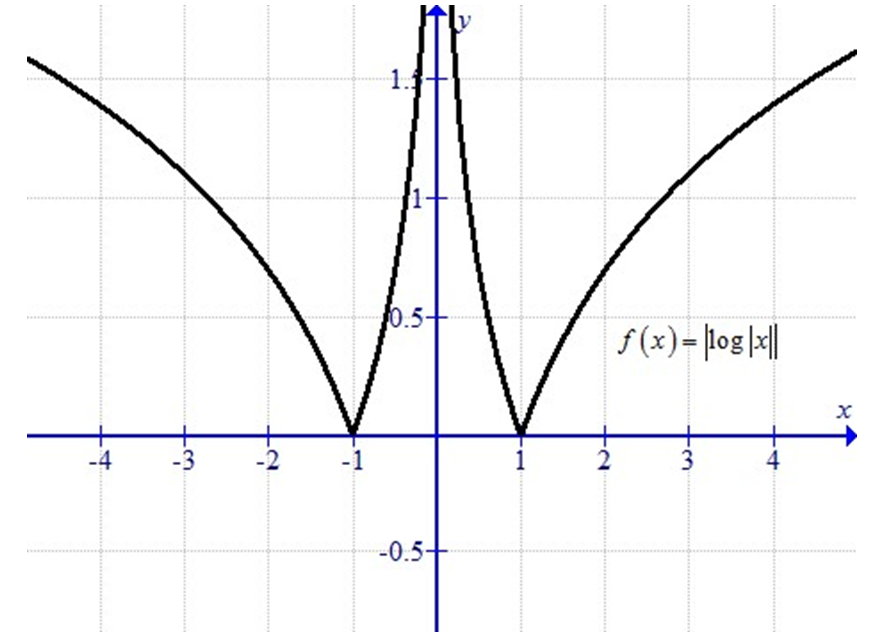
From the graph, it is clear that f(x) is not differentiable at x = -1, 1 but continuous for all x.
View full question & answer→Question 352 Marks
Differentiate w.r.t. x the function in Exercise:
$\cos(\text{a}\cos\text{x}+\text{b}\sin\text{x}),\ $ for some constant a and b.
AnswerLet $\text{y}=\cos(\text{a}\cos\text{x}+\text{b}\sin\text{x})$By using chain rule, we obtain
$\frac{\text{dy}}{\text{dx}}=\frac{\text{d}}{\text{dx}}\cos(\text{a}\cos\text{x}+\text{b}\sin\text{x})$ $\Rightarrow\ \frac{\text{dy}}{\text{dx}}=-\sin(\text{a}\cos\text{x}+\text{b}\sin\text{x}).\frac{\text{d}}{\text{dx}}(\text{a}\cos\text{x}+\text{b}\sin\text{x})$ $=-\sin(\text{a}\cos\text{x}+\text{b}\sin\text{x}).[\text{a}(-\sin\text{x})+\text{b}\cos\text{x}]$ $(\text{a}\sin\text{x}-\text{b}\cos\text{x})-\sin(\text{a}\cos\text{x}+\text{b}\sin\text{x})$
View full question & answer→Question 362 Marks
If $\text{y}=\sec^{-1}\Big(\frac{\text{x}+1}{\text{x}-1}\Big)+\sin^{-1}\Big(\frac{\text{x}-1}{\text{x}+1}\Big),$ then write the value of $\frac{\text{dy}}{\text{dx}}.$
AnswerWe have, $\text{y}=\sec^{-1}\Big(\frac{\text{x}+1}{\text{x}-1}\Big)+\sin^{-1}\Big(\frac{\text{x}-1}{\text{x}+1}\Big)$
$\Rightarrow\text{y}=\cos^{-1}\Big(\frac{\text{x}-1}{\text{x}+1}\Big)+\sin^{-1}\Big(\frac{\text{x}-1}{\text{x}+1}\Big)$
$\Big[\because\sec^{-1}\text{x}=\cos^{-1}\big(\frac{1}{\text{x}}\big)\Big]$
$\Rightarrow\text{y}=\frac{\pi}{2}\Big[\because\sin^{-1}\text{x}+\cos^{-1}\text{x}=\frac{\pi}{2}\Big]$
$\Rightarrow\frac{\text{dy}}{\text{dx}}=0$
View full question & answer→Question 372 Marks
Define differentiability of a function at a point.
AnswerLet f(x) be a real valued function defined on an open interval (a, b) and let $\text{c}\in(\text{a, b}).$
Then f(x) is said to be differentiable or derivable at x = c iff $\lim_\limits{\text{x}\rightarrow{\text{c}}}\frac{\text{f(x)}-\text{f(c)}}{\text{x}-\text{c}}$ exists finitely.
or, $\text{f}'(\text{c})=\lim_\limits{\text{x}\rightarrow{\text{c}}}\frac{\text{f(x)}-\text{f(c)}}{\text{x}-\text{c}}.$
View full question & answer→Question 382 Marks
Differentiate w.r.t. x the function in Exercise:
$\sin^3\text{x}+\cos^6\text{x}$
AnswerLet $\text{y}=\sin^3\text{x}+\cos^6\text{x}$$\therefore\ \frac{\text{dy}}{\text{dx}}=\frac{\text{d}}{\text{dx}}(\sin^3\text{x})+\frac{\text{d}}{\text{dx}}(\cos^6\text{x})$
$=3\sin^2\text{x}.\frac{\text{d}}{\text{dx}}(\sin\text{x})+6\cos^5\text{x}.\frac{\text{d}}{\text{dx}}(\cos\text{x})$
$=3\sin^2\text{x}.\cos\text{x}+6\cos^5\text{x}.(-\sin\text{x})$
$=3\sin\text{x}\cos\text{x}(\sin\text{x}-2\cos^4\text{x})$
View full question & answer→Question 392 Marks
If x and y are connected parametrically by the equations given in Exercise without eliminating the parameter, Find $\frac{\text{dy}}{\text{dx}}.$
$\text{x}=\cos\theta-\cos2\theta,\text{y}=\sin\theta-\sin2\theta$
AnswerThe given equations are $\text{x}=\cos\theta-\cos2\theta\text{ and y}=\sin\theta-\sin2\theta$
Then, $\frac{\text{dx}}{\text{d}\theta}=\frac{\text{d}}{\text{d}\theta}(\cos\theta-\cos2\theta)=\frac{\text{d}}{\text{d}\theta}(\cos\theta)-\frac{\text{d}}{\text{d}\theta}(\cos2\theta)$
$=-\sin\theta-(-2\sin2\theta)=2\sin2\theta-\sin\theta$
$\frac{\text{dy}}{\text{d}\theta}=\frac{\text{d}}{\text{d}\theta}(\sin-\sin2\theta)=\frac{\text{d}}{\text{d}\theta}(\sin\theta)-\frac{\text{d}}{\text{d}\theta}(\sin2\theta)$
$=\cos\theta-2\cos2\theta$
$\therefore\ \frac{\text{dy}}{\text{dx}}=\frac{\Big(\frac{\text{dy}}{\text{d}\theta}\Big)}{\Big(\frac{\text{dx}}{\text{d}\theta}\Big)}=\frac{\cos\theta-2\cos2\theta}{2\sin2\theta-\sin\theta}$
View full question & answer→Question 402 Marks
Differentiate the functions with respect to x.
$\sec(\tan(\sqrt{\text{x}}))$
Answer$\text{Let y} = \sec(\tan\sqrt{\text{x}})$
$\therefore \frac{\text{dy}}{\text{dx}} = \sec(\tan\sqrt{\text{x}})\tan(\tan\sqrt{\text{x}})\frac{\text{d}}{\text{dx}}(\tan\sqrt{\text{x}})$
$= \sec(\tan\sqrt{\text{x}})\tan(\tan\sqrt{\text{x}})\sec^{2}\sqrt{\text x}\frac{\text{d}}{\text{dx}}\sqrt{\text{x}}$
$= \sec(\tan\sqrt{\text{x}})\tan(\tan\sqrt{\text{x}})\sec^{2}\sqrt{\text x}.\frac{1}{2}\text{x}^{\frac{1}{2}-1}$
$= \sec(\tan\sqrt{\text{x}})\tan(\tan\sqrt{\text{x}})\sec^{2}\sqrt{\text x}.\frac{1}{2\sqrt{\text{x}}}$
View full question & answer→Question 412 Marks
Differentiate the following w.r.t.x: $\log(\cos\text{e}^{\text{x}})$
Answer$\text{Let}\ \text{y}=\log(\cos\text{e}^{\text{x}})$
$\therefore\ \frac{\text{dy}}{\text{dx}}=\frac{1}{\cos\text{e}^{\text{x}}}\frac{\text{d}}{\text{dx}}(\cos\text{e}^\text{x})\ \ \bigg[\because\frac{\text{d}}{\text{dx}}\log\text{f(x)}=\frac{1}{\text{f(x)}}\frac{\text{d}}{\text{dx}}\text{f(x)}\bigg]$
$=\frac{1}{\cos\text{e}^{\text{x}}}(-\sin\text{e}^\text{x})\frac{\text{d}}{\text{dx}}\text{e}^\text{x}= \bigg[\because\frac{\text{d}}{\text{dx}}\cos\text{f(x)}=-\sin\text{f(x)}\frac{\text{d}}{\text{dx}}\text{f(x)}\bigg]$
$=-(\tan\text{e}^\text{x})\text{e}^\text{x}=-\text{e}^\text{x}(\tan\text{e}^\text{x})$
View full question & answer→Question 422 Marks
Differentiate $x^2$ with respect to $x^3$.
AnswerLet $u = x^2$ and $v = x^3$
$\Rightarrow\frac{\text{du}}{\text{dx}}=2\text{x and }\frac{\text{dv}}{\text{dx}}=3\text{x}^2$
$\therefore\frac{\text{du}}{\text{dv}}=\frac{\frac{\text{du}}{\text{dx}}}{\frac{\text{dv}}{\text{dx}}}=\frac{2\text{x}}{3\text{x}^2}=\frac{2}{3\text{x}}$
View full question & answer→Question 432 Marks
Find the second order derivatives of the function given in Exercise:
$\text{e}^{6\text{x}}\cos3\text{x}$
AnswerLet $\text{y}=\text{e}^{6\text{x}}\cos3\text{x}$
$\therefore\ \frac{\text{dy}}{\text{dx}}=6\text{e}^{6\text{x}}\cos3\text{x}-3\text{e}^{6\text{x}}\sin3\text{x}$
$\therefore\ \frac{\text{d}^2\text{y}}{\text{dx}^2}=36\text{e}^{6\text{x}}\cos3\text{x}-18\text{e}^{6\text{x}}\sin3\text{x}-18\text{e}^{6\text{x}}\sin3\text {x}-9\text{e}^{6\text{x}}\cos3\text{x}$
$=27\text{e}^{6\text{x}}\cos3\text{x}-36\text{e}^{6\text{x}}\sin3\text{x}=9\text{e}^{6\text{x}}(3\cos\text{x}-4\sin3\text{x})$
View full question & answer→Question 442 Marks
If $\text{f}'\text{(x)}=\sqrt{2\text{x}^2-1}$ and $\text{y}=\text{f}(\text{x}^2),$ then find $\frac{\text{dy}}{\text{dx}}\text{at x}=1.$
AnswerHere,
$\text{f}'\text{(x)}=\sqrt{2\text{x}^2-1}$
and $\text{y}=\text{f}\big(\text{x}^2\big)$
Differentiating it with respect to x,
$\frac{\text{dy}}{\text{dx}}=\frac{\text{d}}{\text{dx}}\text{f}\big(\text{x}^2\big)$
$=\text{f}'\big(\text{x}^2\big)\frac{\text{d}}{\text{dx}}\big(\text{x}^2\big)$
$=\text{d}'\big(\text{x}^2\big)\times2\text{x}$
$\frac{\text{dy}}{\text{dx}}=2\text{xf}'\big(\text{x}^2\big)$
Put x = 1
$\frac{\text{dy}}{\text{dx}}=2(1)\text{f}'(1)$
$=2\times\text{f}'(1)$
$\frac{\text{dy}}{\text{dx}}=2\times1$
$\big[\text{Since},\text{f}'(1)=\sqrt{2(1)^2-1}=\sqrt{2-1}=1\big]$
$\frac{\text{dy}}{\text{dx}}=2$
View full question & answer→Question 452 Marks
If $\pi\leq\text{x}\leq3\pi$ and $\text{y}=\cos^{-1}(\cos\text{x}),$ find $\frac{\text{dy}}{\text{dx}}.$
AnswerWe have,
$\text{y}=\cos^{-1}(\cos\text{x})$
$\Rightarrow\text{y}=2\pi-\text{x}$
$\big[\because\cos^{-1}(\cos\text{x})=2\pi-\text{x},\text{if x}\in[\pi,2{\pi}]\big]$
$\Rightarrow\frac{\text{dy}}{\text{dx}}=\frac{\text{d}}{\text{dx}}(2\pi-\text{x})$
$\Rightarrow\frac{\text{dy}}{\text{dx}}=0-1$
$\Rightarrow\frac{\text{dy}}{\text{dx}}=-1$
View full question & answer→Question 462 Marks
Determine whether $\text{f(x)}=\begin{cases}\frac{\sin\text{x}^2}{\text{x}},&\text{x}\neq0\\0,&\text{x}=0\end{cases}$ is continuous at x = 0 or not.
AnswerGiven, $\text{f(x)}=\begin{cases}\frac{\sin\text{x}^2}{\text{x}},&\text{x}\neq0\\0,&\text{x}=0\end{cases}$
We have
$\lim\limits_{{\text{x}}\rightarrow0}\text{f(x})=\lim\limits_{{\text{x}}\rightarrow0}\frac{\sin\text{x}^2}{\text{x}}$
$=\lim\limits_{{\text{x}}\rightarrow0}\frac{\text{x}\sin\text{x}^2}{\text{x}^2}$
$=\lim\limits_{{\text{x}}\rightarrow0}\frac{\sin\text{x}^2}{\text{x}^2}\lim\limits_{{\text{x}}\rightarrow0}\text{x}$
$=1\times0$
$=0$
$=\text{f}(0)$
$\therefore\ \lim\limits_{{\text{x}}\rightarrow0}\text{f(x)}=\text{f}(0)$
Hence, f(x) is continuous at x = 0.
View full question & answer→Question 472 Marks
Find $\frac{\text{dy}}{\text{dx}},$ when
$x = at^2$ and $y = 2at$
AnswerWe have $x = at^2$ and $y = 2$ at
$\Rightarrow\frac{\text{dx}}{\text{dx}}=2\text{at}\text{ and }\frac{\text{dy}}{\text{dx}}=2\text{a}$
$\therefore\frac{\text{dy}}{\text{dx}}=\frac{\frac{\text{dy}}{\text{dt}}}{\frac{\text{dx}}{\text{dt}}}=\frac{2\text{a}}{2\text{at}}=\frac{1}{\text{t}}$
View full question & answer→Question 482 Marks
Find $\frac{\text{dy}}{\text{ dx}} $in the following:
$\text{xy} + \text{y}^{2} = \tan\text{x + y}$
AnswerThe given relationship is $\text{xy} + \text{y}^{2} = \tan\text{x + y}$ differenting this relationship with respect to x, we obtain $\frac{\text{d}}{\text{dx}}(\text{xy} + \text{y}^{2}) = \frac{\text{d}}{\text{dx}}(\tan\text{x} + \text{y})$ $\frac{\text{d}}{\text{dx}}(\text{xy})+\frac{\text{d}}{\text{dx}}\text{(y}^{2}) = \frac{\text{d}}{\text{dx}}(\tan\text{x})+\frac{\text{dy}}{\text{dx}}$ $\Rightarrow \Big[\text{y}.\frac{\text{d}}{\text{dx}}(\text{x})+\text{x}.\frac{\text{dy}}{\text{dx}}\Big] +2\text{y} \frac{\text{dy}}{\text{dx}}=\sec^{2}\text{x}+\frac{\text{dy}}{\text{dx}}\ \ [\text{Using product rule and chain rule]}$$\Rightarrow(\text{x}+2\text{y}-1)\frac{\text{dy}}{\text{dx}}=\sec^{2}\text{x}-\text{y}$
$\therefore\frac{\text{dy}}{\text{dx}}= \frac{\sec^{2}\text{x}-\text{y}}{(\text{x} + 2\text{y}-1)}$
View full question & answer→Question 492 Marks
Find the second order derivatives of the function given in Exercise:
$\text{e}^\text{x}\sin5\text{x}$
AnswerLet $\text{y}=\text{e}^\text{x}\sin5\text{x}$
$\therefore\ \frac{\text{dy}}{\text{dx}}=\text{e}^\text{x}\sin\text{x}+5\text{e}^\text{x}\cos5\text{x}$
$\therefore\ \frac{\text{d}^2\text{y}}{\text{dx}^2}=\text{e}^\text{x}\sin5\text{x}+5\text{e}^\text{x}\cos5\text{x}+5\text{e}^\text{x}\cos5\text {x}-25\text{ e}^\text{x}\sin5\text{x}$
$=10\text{e}^\text{x}\cos5\text{x}-24\text{e}^\text{x}\sin5\text{x}=2\text{e}^\text{x}(5\cos5\text{x}-12\sin5\text{x})$
View full question & answer→Question 502 Marks
Differentiate the following w.r.t.x: $\frac{\cos\text{x}}{\log\text{x}},\text{x}>0$
Answer$\text{Let y}=\frac{\cos\text{x}}{\log\text{x}}$
$\therefore\ \frac{\text{dy}}{\text{dx}} =\frac{(\log\text{x}).\frac{\text{d}}{\text{dx}}(\cos\text{x})-\cos\text{x}.\frac{\text{d}}{\text{dx}}(\log\text{x})}{(\log\text{x})^{2}}$
$ =\frac{(\log\text{x}).(-\sin\text{x})-\cos\text{x}\cdot\frac{\text{1}}{\text{x}}}{(\log\text{x})^{2}}=\frac{-\sin\text{x}\log\text{x}-\frac{\cos\text{x}}{\text{x}}}{(\log\text{x}^{2})}$
$=\frac{-\text{x}\sin\text{x}\ \log\text{x}-\cos\text{x}}{\text{x}(\log\text{x})^2}$
View full question & answer→Question 512 Marks
Verify Mean Value Theorem, if $f(x) = x^2 - 4x - 3$ in the interval $[a, b],$ where $a = 1$ and $b = 4$.
AnswerFunction is continuous in [1, 4] as it is a polynomial function and polynomial function is always continuous. f'(x) = 2x - 4, f'(x) exists in [1, 4], hence derivable. Conditions of MVT theorem are satisfied, hence there exists, at least one $\text{c}\in(1,\ 4)$ such that.
$\frac{\text{f}(4)-\text{(f)}(1)}{4-1}=\text{f}'\text{(c)}\ \Rightarrow\ \frac{-3-(-6)}{3}=2\text{c}-4$
$\Rightarrow\ 1=2\text{c}-4\ \Rightarrow\ \text{c}=\frac{5}{2}$
View full question & answer→Question 522 Marks
Differentiate the functions with respect to x.
$\sin(\text{x}^{2} + 5)$
Answer$\text{Let y} = \sin(\text{x}^{2} + 5)$
$\therefore \frac{\text{dy}}{\text{dx}} = \cos(\text{x}^{2} + 5)\frac{\text{d}}{\text{dx}}(\text{x}^{2} + 5)$$ = \cos (\text{x}^{2} + 5)(2\text{x} + 0) = 2\text{x}\cos(\text{x}^{2} +5)$
View full question & answer→Question 532 Marks
Find $\frac{\text{d}^2\text{y}}{\text{dx}^2},$ where $\text{y}=\log\Big(\frac{\text{x}^2}{\text{e}^2}\Big)$
AnswerHere
$\text{y}=\log\Big(\frac{\text{x}^2}{\text{e}^2}\Big)$
Differentiating w.r.t.x, we get
$\frac{\text{dy}}{\text{dx}}=\frac{1}{\frac{\text{x}^2}{\text{e}^2}}\times\frac{2\text{x}}{\text{e}^2}=\frac{2}{\text{x}}$
Differentiating w.r.t.x, we get
$\frac{\text{d}^2\text{y}}{\text{dx}^2}=\frac{-2}{\text{x}^2}$
View full question & answer→Question 542 Marks
Differentiate the functions with respect to x.
$\cos(\sin \text{x})$
Answer$\text{Let y} = \cos(\sin\text{x})$
$\therefore \frac{\text{dy}}{\text{dx}} = -\sin(\sin\text{x})\frac{\text{d}}{\text{dx}}\sin\text{x} = -\sin(\sin\text{x})\cos\text{x}$
View full question & answer→Question 552 Marks
Find $\frac{\text{dy}}{\text{dx}},$ when
$\text{x}=\text{a}\cos\theta$ and $\text{y}=\text{b}\sin\theta$
View full question & answer→Question 562 Marks
If $\text{y}=\sin^{-1}\text{x}+\cos^{-1}\text{x},$ find $\frac{\text{dy}}{\text{dx}}.$
AnswerWe have, $\text{y}=\sin^{-1}\text{x}+\cos^{-1}\text{x}$
$\Rightarrow\text{y}=\frac{\pi}{2}$
$\Big[\because\sin^{-1}\text{x}+\cos^{-1}\text{x}=\frac{\pi}{2}\Big]$
$\Rightarrow\frac{\text{dy}}{\text{dx}}=0$
View full question & answer→Question 572 Marks
Verify Rolle’s theorem for the function $\text{f(x)}=\text{x}^2+2\text{x}-8,\text{x}\in[-4,2].$
AnswerConsider $\text{f(x)}=\text{x}^2+2\text{x}-8,\text{x}\in[-4,\ 2]$
Function is continuous in [-4,2] as it is a polynomial function and polynomial function is always continuous.
$\text{f}'\text{(x)}=2\text{x}+2, \text{f}'\text{(x)}$ exists in [-4, 2], hence derivable.
$\text{f}(-4)=0\text{ and f }(2)=0$
$\therefore\ \text{f}(-4)=\text{f}(2)$
Conditions of Rolle’s theorem are satisfied, hence there exists, at least one $\text{c}\in(-4,2)$ such that $\text{f}'\text{(c)}=0$
$\Rightarrow\ 2\text{c}+2=0\ \Rightarrow\ \text{c}=-1$
View full question & answer→Question 582 Marks
If $\text{y}=\sin^{-1}(\sin\text{x}),-\frac{\pi}{2}\leq\text{x}\leq\frac{\pi}{2}.$ Then, wrrite tha value of $\frac{\text{dy}}{\text{dx}}\text{ for x}\in\Big(-\frac{\pi}{2},\frac{\pi}{2}\Big).$
AnswerWe have, $\text{y}=\sin^{-1}(\sin\text{x})$
$\Rightarrow\text{y}=\text{x}$
$\Big[\because\sin^{-1}(\sin\text{x})=\text{x},\text{ if x}\in\Big[-\frac{\pi}{2},\frac{\pi}{2}\Big]\Big]$
$\Rightarrow\frac{\text{dy}}{\text{dx}}=\frac{\text{d}}{\text{dx}}(\text{x})$
$\Rightarrow\frac{\text{dy}}{\text{dx}}=1$
View full question & answer→Question 592 Marks
Differentiate w.r.t. x the function in Exercise:
$(3\text{x}^2-9\text{x}+5)^9$
AnswerLet $\text{y}=(3\text{x}^2-9\text{x}+5)^9$
Using chain rule, we obtain
$\frac{\text{dy}}{\text{dx}}=\frac{\text{d}}{\text{dx}}(3\text{x}^2-9\text{x}+5)^9$
$=9(3\text{x}^2-9\text{x}+5)^8.\frac{\text{d}}{\text{dx}}(3\text{x}^2-9\text{x}+5)$
$=9(3\text{x}^2-9\text{x}+5)^8.(6\text{x}-9)$
$=9(3\text{x}^2-9\text{x}+5)^8.3(2\text{x}-3)$
$=27(3\text{x}^2-9\text{x}+5)^8.3(2\text{x}-3)$
View full question & answer→Question 602 Marks
Differentiate the functions with respect to x.
$\cos(\sqrt{\text{x})}$
Answer$\text{Let y} =\cos(\sqrt{\text{x})}$
$\therefore \frac{\text{dy}}{\text{dx}}= -\sin\sqrt{\text{x}}\frac{\text{d}}{\text{dx}}\sqrt{\text{x}} = -\sin\sqrt{\text{x}}.\frac{1}{2}(\text{x})^{\frac{-1}{2}}=\frac{-\sin\sqrt{\text{x}}}{2\sqrt{\text{x}}}$
View full question & answer→Question 612 Marks
Differentiate $(x^2– 5x + 8) (x^3 + 7x + 9)$ in three ways mentioned below:
by expanding the product to obtain a single polynomial.
Answer$y = (x^2 - 5x + 8) (x^3 + 7x + 9)$
$\Rightarrow\ \text{y}=\text{x}^5+7\text{x}^3+9\text{x}^2-5\text{x}^4-35\text{x}^2-45\text{x}+8\text{x}^3+56\text{x}+72$
$\Rightarrow\ \text{y}=\text{x}^5-5\text{x}^4+15\text{x}^3-26\text{x}^2+11\text{x}+72$
$\frac{\text{dy}}{\text{dx}}=5\text{x}^4-20\text{x}^3+45\text{x}^2-52\text{x}+11\ \dots\text{(iii)}$
View full question & answer→Question 622 Marks
For what value of $\lambda$ is the function $\text{f(x)}=\begin{cases}\lambda(\text{x}^2-2\text{x}),&\text{if }\text{ x}\leq0\\4\text{x}+1,&\text{if }\text{ x}>0\end{cases}$ continuous at x = 0? What about continuity at $\text{x}=\pm1?$
View full question & answer→Question 632 Marks
If $\text{f(x)}=\begin{cases}\frac{\text{x}^2-16}{\text{x}-4},&\text{if }\text{ x}\neq4\\\text{k},&\text{if }\text{ x}=4\end{cases}$ is continuous at x = 4, find k.
AnswerGiven, $\text{f(x)}=\begin{cases}\frac{\text{x}^2-16}{\text{x}-4},&\text{if }\text{ x}\neq4\\\text{k},&\text{if }\text{ x}=4\end{cases}$
If f(x) is continuous at x = 4, then
$\lim\limits_{{\text{x}}\rightarrow4}\text{f(x})=\text{f(4)}$
$\Rightarrow\lim\limits_{{\text{x}}\rightarrow4}\Big(\frac{\text{x}^2-16}{\text{x}-4}\Big)=\text{k}$
$\Rightarrow\lim\limits_{{\text{x}}\rightarrow4}\frac{(\text{x}+4)(\text{x}-4)}{(\text{x}-4)}=\text{k}$
$\Rightarrow\lim\limits_{{\text{x}}\rightarrow4}(\text{x}+4)=\text{k}$
$\Rightarrow\text{k}=8$
View full question & answer→Question 642 Marks
Find the second order derivatives of the function given in Exercise:
$\text{x}^3\log\text{x}$
AnswerLet $\text{y}=\text{x}^3\log\text{x}$
$\therefore\ \frac{\text{dy}}{\text{dx}}=\text{x}^3.\frac{1}{\text{x}}+\log\text{x}.3\text{x}^2=\text{x}^2+3\text{x}^2\log\text{x}=\text{x}^2(1+3\log\text{x})$
$\therefore\ \frac{\text{d}^2\text{y}}{\text{dx}^2}=\text{x}^2.\frac{3}{\text{x}}+(1+3\log\text{x}).2\text{x}$
$=3\text{x}+2\text{x}(1+3\log\text{x})=\text{x}[3+2(1+3\log\text{x})]$
$=\text{x}[3+2+6\log\text{x}]=\text{x}(5+6\log\text{xz})$
View full question & answer→Question 652 Marks
If x and y are connected parametrically by the equations given in Exercise without eliminating the parameter, Find $\frac{\text{dy}}{\text{dx}}.$
$\text{x}=\text{a}\cos\theta,\text{y}=\text{b}\cos\theta$
AnswerThe given equations are $\text{x}=\text{a}\cos\theta\text{ and y}=\text{b}\cos\theta$
Then, $\frac{\text{dx}}{\text{d}\theta}=\frac{\text{d}}{\text{d}\theta}(\text{a}\cos\theta)=\text{a}(-\sin\theta)=-\text{a}\sin\theta$
$\frac{\text{dy}}{\text{d}\theta}=\frac{\text{d}}{\text{d}\theta}(\text{b}\cos\theta)=\text{b}(-\sin\theta)=-\text{b}\sin\theta$
$\therefore\ \frac{\text{dy}}{\text{dx}}=\frac{\Big(\frac{\text{dy}}{\text{d}\theta}\Big)}{\Big(\frac{\text{dx}}{\text{d}\theta}\Big)}=\frac{-\text{b}\sin\theta}{-\text{a}\sin\theta}=\frac{\text{b}}{\text{a}}$
View full question & answer→Question 662 Marks
If $\text{y}=\mid\log_\text{e}\text{x}\mid $ find $\frac{\text{d}^2\text{y}}{\text{dx}^2}$
AnswerHere,
$\text{y}=\mid\log_\text{e}\text{x}\mid$
$=\begin{cases}-\log_\text{e}\text{x}&\text{if}&0<\text{x}< 1\\\log_\text{e}\text{x}&\text{if}&\text{x}>1\end{cases}$
Differentiating w.r.t.x, we get
$\frac{\text{dy}}{\text{dx}}=\begin{cases}\frac{-1}{\text{x}}&\text{if}&0<\text{x}<1\\\frac{1}{\text{x}}&\text{if}&\text{x}>1\end{cases}$
Differentiating w.r.t.x, we get
$\frac{\text{d}^2\text{y}}{\text{dx}^2}=\begin{cases}\frac{1}{\text{x}^2}&\text{if}&0<\text{x}<1\\\frac{-1}{\text{x}^2}&\text{if}&\text{x}>1 \end{cases}$
View full question & answer→Question 672 Marks
Write the points of non-differentiability of f(x) = |log |x||.
AnswerHere,
f(x) = |log |x||
f(x) will always positive and let two points x = 1 and x = -1
f(x) = 0
The function f(x) = |log |x|| is not differentiable at x = -1 and 1.
View full question & answer→Question 682 Marks
If $\text{f(x)}=\begin{cases}\frac{1-\cos\text{x}}{\text{x}^2},&\text{x}\neq0\\\text{k},&\text{x}=0\end{cases}$ is continuous at x = 0, find k.
AnswerSince f(x) is continuous at x = 0,
$\text{f}(0)=\lim\limits_{{\text{x}}\rightarrow0}\text{f(x})$
$\Rightarrow\text{k}=\lim\limits_{{\text{x}}\rightarrow0}\frac{1-\cos\text{x}}{\text{x}^2}$
$\Rightarrow\text{k}=\lim\limits_{{\text{x}}\rightarrow0}\frac{2\sin^2\frac{\text{x}}{2}}{\text{x}^2}$
$\Rightarrow\text{k}=\frac{1}{2}$
View full question & answer→Question 692 Marks
If x and y are connected parametrically by the equations given in Exercise without eliminating the parameter, Find $\frac{\text{dy}}{\text{dx}}.$
$\text{x}=4\text{t, y}=\frac{4}{\text{t}}$
AnswerThe given equations are $\text{x}=4\text{t, and y}=\frac{4}{\text{t}}$
$\frac{\text{dx}}{\text{dt}}=\frac{\text{d}}{\text{dt}}(4\text{t)}=4$
$\frac{\text{dy}}{\text{dt}}=\frac{\text{d}}{\text{dt}}\Big(\frac{4}{\text{t}}\Big)=4.\frac{\text{d}}{\text{dt}}\Big(\frac{1}{\text{t}}\Big)=4.\Big(\frac{-1}{\text{t}^2}\Big)=\frac{-4}{\text{t}^2}$
$\therefore\ \frac{\text{dy}}{\text{dx}}=\frac{\Big(\frac{\text{dy}}{\text{dt}}\Big)}{\Big(\frac{\text{dx}}{\text{dt}}\Big)}=\frac{\Big(\frac{-4}{\text{t}^2}\Big)}{4}=\frac{-1}{\text{t}^2}$
View full question & answer→Question 702 Marks
For what value of $\lambda$ is the function defined by
$\text{f(x)}= \begin{cases}\lambda(\text{x}^{2} - 2\text{x}), \text{if}\ \text{x} \leq0\\ \text{4x} + 1,\ \ \ \ \ \ \ \text{if}\ \text{x} > 0\end{cases}$
Answer$\text{f(x)}= \begin{cases}\lambda(\text{x}^{2} - 2\text{x}), \text{if}\ \text{x} \leq0\\ \text{4x} + 1,\ \ \ \ \ \ \ \text{if}\ \text{x} > 0\end{cases}$ At x = 0$^{\ \ \text{Lt}}_{\text{x}\rightarrow\text{0}^{-}}\text{f(x)} = ^{\ \ \text{Lt}}_{\text{x}\rightarrow\text{0}^{-}}\lambda(\text{x}^{2} - \text{2x}) = \lambda(0 - 0) = 0$
$^{\ \ \text{Lt}}_{\text{x}\rightarrow\text{0}^{+}}\text{f(x)} = ^{\ \ \text{Lt}}_{\text{x}\rightarrow\text{0}^{+}}(4\text{x} + 1) = 4(0) + 1 = 0 + 1 = 1$
$\therefore \ ^{\ \ \text{Lt}}_{\text{x}\rightarrow\text{0}^{+}}\text{f(x)} \neq ^{\ \ \text{Lt}}_{\text{x}\rightarrow\text{0}^{+}}\text{f(x }) $ At x = 1$^{\ \ \text{Lt}}_{\text{x}\rightarrow\text{1}}\text{f(x)} = ^{\ \ \text{Lt}}_{\text{x}\rightarrow\text{1}}(4\text{x} + 1) = 4 + 1 = 5$
Also f(1) = 4 + 1 = 5 $\therefore\ ^{\ \ \text{Lt}}_{\text{x}\rightarrow\text{c}}\text{f(x)} = \text{f(1)}$ $\therefore$ f is continuous at x = 1 whatever value of $\lambda$ be.
View full question & answer→Question 712 Marks
Is every continuous function differentiable?
AnswerNo, function may be continuous at a point but may not be differentiable at that point .
For example: function f(x) = |x| is continuous at x = 0 but it is not differentiable at x = 0.
View full question & answer→Question 722 Marks
If $\text{x}=\text{f}(\text{t})$ and $\text{y}=\text{g}(\text{t}),$ then write the value of $\frac{\text{d}^2\text{y}}{\text{dx}^2}.$
AnswerWe are given
$\text{x}=\text{f}(\text{t})$
$\text{Y}=\text{g}(\text{t})$
Then $\frac{\text{dy}}{\text{dx}}=\frac{\text{dy}}{\text{dt}}\times\frac{\text{dt}}{\text{dx}}=\frac{\text{g}'(\text{t})}{\text{f}'(\text{t})}$
$\therefore\frac{\text{d}^2\text{y}}{\text{dx}^2}=\frac{\text{d}}{\text{dx}}\frac{\text{f}'(\text{t})\text{g}'\text({t})-\text{g}'(\text{t})\text{f}''\text({t})}{[\text{f}'(\text{t})]^3}$
View full question & answer→Question 732 Marks
If $\text{y}=\sin^{-1}\Big(\frac{1-\text{x}^2}{1+\text{x}^2}\Big)+\cos^{-1}\Big(\frac{1-\text{x}^2}{1+\text{x}^2}\Big),$ find $\frac{\text{dy}}{\text{dx}}.$
AnswerHere,
$\text{y}=\sin^{-1}\Big(\frac{1-\text{x}^2}{1+\text{x}^2}\Big)+\cos^{-1}\Big(\frac{1-\text{x}^2}{1+\text{x}^2}\Big)$
$\Big[\text{Since},\sin^{-1}\text{x}+\cos^{-1}=\frac{\pi}{2}\Big]$
So,
$\text{y}=\frac{\pi}{2}$
Differentiating it with respect to x,
$\frac{\text{dy}}{\text{dx}}=0$
View full question & answer→Question 742 Marks
Differentiate the functions with respect to x.
$\sin(\text{ax + b})$
Answer$\text{Let y} = \sin(\text{ax + b})$
$\therefore \frac{\text{dy}}{\text{dx}} = \cos(\text{ax + b})\frac{\text{d}}{\text{dx}}\text{(ax + b)}$
$= \cos(\text{ax + b)}\text{(a + 0)} = \text{a}\cos\text{(ax + b)}$
View full question & answer→Question 752 Marks
Find $\frac{\text{dy}}{\text{ dx}} $in the following:
$\sin^{2}\text{x}+\cos^{2}\text{y}=1$
AnswerThe given relationship is $\sin^{2}\text{x}+\cos^{2}\text{y}=1$
differenting this relationship with respect to x, we obtain
$\frac{\text{d}}{\text{dx}}(\sin^{2}\text{x}+\cos^{2}\text{y})=\frac{\text{d}}{\text{dx}}(1)$
$\Rightarrow\frac{\text{d}}{\text{dx}}(\sin^{2}\text{x})+\frac{\text{d}}{\text{dx}}(\cos^{2}\text{y})=0$
$\Rightarrow 2\sin\text{x}.\frac{\text{d}}{\text{dx}}(\sin\text{x})+2\cos\text{y}.\frac{\text{d}}{\text{dx}}(\cos\text{y})=0$
$\Rightarrow2\sin\text{x}\cos\text{x}+2\cos\text{y}(-\sin\text{y}).\frac{\text{dy}}{\text{dx}}=0$
$\Rightarrow\sin2\text{x}-\sin2\text{y}\frac{\text{dy}}{\text{dx}}=0$
$\therefore\frac{\text{dy}}{\text{dx}}=\frac{\sin2\text{x}}{\sin2\text{y}}$
View full question & answer→Question 762 Marks
If $\text{x}=2\text{ at},\text{y}=\text{at}^2,$ where a is a constant, then find $\frac{\text{d}^2\text{y}}{\text{dx}^2}\text{ at}\text{ x}=\frac{1}{2}.$
AnswerHere,
$\text{x}=2\text{at}\ \text{and}\ \text{y}=\text{at}^2$
Differentiating w.r.t.t, we get
$\frac{\text{dx}}{\text{dt}}=2\text{a}\ \text{and}\ \frac{\text{dy}}{\text{dt}}=2\text{at}$
$\therefore\frac{\text{dy}}{\text{dx}}=\frac{2\text{at}}{2\text{a}}=\text{t}$
Differentiating w.r.t.t, we get
$\frac{\text{d}^2\text{y}}{\text{dx}^2}=1\times\frac{\text{dt}}{\text{dx}}=\frac{1}{2\text{a}}$
Now $\Big[\frac{\text{d}^2\text{y}}{\text{dx}^2}\Big]_{\text{x}=\frac{1}{2}}=\frac{1}{2\text{a}}$
View full question & answer→Question 772 Marks
If |x| < 1 and $\text{y}=1+\text{x}+\text{x}^2+\ .....\ \text{to}\ \infty,$ then find the value of $\frac{\text{dy}}{\text{dx}}.$
AnswerWe have, $\text{y}=1+\text{x}+\text{x}^2+\ .....\ \text{to}\ \infty,$
$\Rightarrow\text{y}=\frac{1}{1-\text{x}}$
[$\because$ It is a G.P with first term 1 and common ration x]
$\Rightarrow\frac{\text{dy}}{\text{dx}}=\frac{\text{d}}{\text{dx}}\Big(\frac{1}{1-\text{x}}\Big)$
$\Rightarrow\frac{\text{dy}}{\text{dx}}=-\frac{1}{(1-\text{x})^2}\frac{\text{d}}{\text{dx}}(1-\text{x})$
$\Rightarrow\frac{\text{dy}}{\text{dx}}=-\frac{1}{(1-\text{x})^2}(-1)$
$\Rightarrow\frac{\text{dy}}{\text{dx}}=-\frac{1}{(1-\text{x})^2}$
View full question & answer→Question 782 Marks
If $\frac{\pi}{2}\leq\text{x}\leq\frac{3\pi}{2}$ and $\text{y}=\sin^{-1}(\sin\text{x}),$ find $\frac{\text{dy}}{\text{dx}}.$
AnswerHere,
$\text{y}=\sin^{-1}(\sin\text{x}),\text{x}\in\Big[\frac{\pi}{2},\frac{3\pi}{1}\Big]$
$\Big[\text{Since},\sin^{-1}(\sin\text{x})=\text{x},\text{if x}\in\Big[-\frac{\pi}{2},\frac{\pi}{2}\Big]\Big]$
$\text{y}=\pi-\text{x}$
Differentiating it with respect to x,
$\frac{\text{dy}}{\text{dx}}=\frac{\text{d}}{\text{dx}}(\pi-\text{x})$
$0-1$
$\frac{\text{dy}}{\text{dx}}=-1$
View full question & answer→Question 792 Marks
If $\text{x}=\text{t}^2$ and $\text{y}=\text{t}^3$ then find $\frac{\text{d}^2\text{y}}{\text{dx}^2}$
AnswerHere,
$\text{x}=\text{t}^2\ \text{and}\ \text{y}=\text{t}^3$
$\Rightarrow\frac{\text{dx}}{\text{dt}}=2\text{t}\ \text{and}\ \frac{\text{dy}}{\text{dt}^2}=3\text{t}^2$
$\therefore\frac{\text{dy}}{\text{dx}}=\frac{3\text{t}}{2}$
$\Rightarrow\frac{\text{d}^2\text{y}}{\text{dx}^2}=\frac{3}{2}\frac{\text{dt}}{\text{dx}}=\frac{3}{4\text{t}}$
View full question & answer→Question 802 Marks
Discuss the applicability of the Rolle's theorem for the following function on the indicated interval
$\text{f}(\text{x})=2\text{x}^2-5\text{x}+3\text{ on }[1,3]$
AnswerThe given function $\text{f}(\text{x})=2\text{x}^2-5\text{x}+3\text{ on }[1,3].$ The domain of f is given to be (1, 3). It is a polynomial function.Thus, it is everywhere derivable and hence continuous.
But
f(1) = 0 and f(3) = 6
$\Rightarrow\text{f}(3)\neq\text{f}(1)$ Hence, Rolle's theorem is not applicable for the given function.
View full question & answer→Question 812 Marks
Find the values of k so that the function f is continuous at the indicated point:
$\text{f(x)}=\begin{cases}\text{k}\text{x}+1,&\text{if}\ \text{x}\leq{5}\\3\text{x} - 5,& \text{if}\ \text{x}> 5\end{cases}$
$\text{at} \text{x} = 5$
AnswerHere $\text{f(x)}=\begin{cases}\text{k}\text{x}+1,&\text{if}\ \text{x}\leq{5}\\3\text{x} - 5,& \text{if}\ \text{x}> 5\end{cases}$
$^{\ \ \text{Lt}}_{\text{x}\rightarrow\text{5}^{-}}\text{f(x)}=^{\ \ \text{Lt}}_{\text{x}\rightarrow\text{5}^{-}}(\text{k}\text{x} + 1) = 5\text{k} + 1$
$^{\ \ \text{Lt}}_{\text{x}\rightarrow\text{5}^{+}}\text{f(x)}=^{\ \ \text{Lt}}_{\text{x}\rightarrow\text{5}^{+}}({3}\text{x} - 5) = 15 - 5 = 10$
Since f is continuous at x = 1
$\therefore\ ^{\ \ \text{Lt}}_{\text{x}\rightarrow\text{5}^{-}}\text{f(x)}=^{\ \ \text{Lt}}_{\text{x}\rightarrow\text{5}^{+}}\text{f(x)}$
$\therefore 5 \text{k} + 1 = 10 \Rightarrow 5\text{k} = 9 \Rightarrow\text{k} = \frac{9}{5}$
View full question & answer→Question 822 Marks
Differentiate the following w.r.t.x: $\frac{\text{e}^\text{x}}{\sin\text{x}}$
Answer$\text{Let}\ \text{y}=\frac{\text{e}^\text{x}}{\sin\text{x}}$
$\therefore\frac{\text{dy}}{\text{dx}}=\frac{\sin\text{x}.\frac{\text{d}}{\text{dx}}(\text{e}^{\text{x}})-\text{e}^{\text{x}}.\frac{\text{d}}{\text{dx}}(\sin\text{x})}{\sin^{2}\text{x}}$
$=\frac{\sin\text{x}.\text{e}^{\text{x}}-\text{e}^{\text{x}}.\cos\text{x}}{\sin^{2}\text{x}}=\text{e}^{\text{x}}\bigg(\frac{\sin\text{x}-\cos\text{x}}{\sin^{2}\text{x}}\bigg)$
View full question & answer→Question 832 Marks
Examine the continuity of the function $f(x) = 2x^2 – 1 at x = 3$.
AnswerHere $f(x) = 2x^2 - 1$
$^{\ \ \text{Lt}}_{\text{x}\rightarrow{3}}\text{f(x)}=^{\ \ \text{Lt}}_{\text{x}\rightarrow{3}}(2\text{x}^3-1) = 2(3)^2 - 1$
$= 2(9) - 1 = 18 - 1 = 17$
Now f is defined at $x = 3$
and $f(x) = 2(3)^2 - 1 = 2(9) - 1 = 18 - 1 = 17$
$\therefore\ \ \text{Lt}\ \ \ \ \text{f(x)} = \text{f(3)} = 17\\ \ \ \ \ \text{x}\rightarrow3$
$\therefore$ f is continous at $x = 3$.
View full question & answer→Question 842 Marks
If $\text{f(x)}=\log_\text{e}(\log_\text{e}\text{x}),$ then write the value of f'(e).
AnswerWe have, $\text{f(x)}=\log_\text{e}(\log_\text{e}\text{x})$
Differentiating with respect to x,
$\text{f}'\text{(x)}=\frac{1}{\log_\text{e}\text{x}}\frac{\text{d}}{\text{dx}}(\log_\text{e}\text{x})$
$\Rightarrow\text{f}'\text{(x)}=\frac{1}{\log_\text{e}\text{x}}\Big(\frac{1}{\text{x}}\Big)$
$\Rightarrow\text{f}'\text{(e)}=\frac{1}{\log_\text{e}\text{e}}\Big(\frac{1}{\text{e}}\Big) \big[\because\text{x}=\text{e}\big]$
$\Rightarrow\text{f}'\text{(e)}=\frac{1}{\text{x}}\big[\because\log_\text{e}=1\big]$
View full question & answer→Question 852 Marks
if f(1) = 4, f'(1) = 2, find the value of the derivative of $\log\Big(\text{f}\big(\text{e}^\text{x}\big)\Big)$ w.r.t x at the point x = 0.
AnswerWe have, f(1) = 4 and f'(1) = 2
Let $\text{y}=\log\big\{\text{f}\big(\text{e}^\text{x}\big)\big\}$
$\Rightarrow\frac{\text{dy}}{\text{dx}}=\frac{\text{d}}{\text{dx}}\Big[\log\big\{\text{f}\big(\text{e}^\text{x}\big)\big\}\Big]$
$\Rightarrow\frac{\text{dy}}{\text{dx}}=\frac{1}{\text{f}\big(\text{e}^\text{x}\big)}\times\frac{\text{d}}{\text{dx}}\big\{\text{f}\big(\text{e}^\text{x}\big)\big\}$
$\Rightarrow\frac{\text{dy}}{\text{dx}}=\frac{1}{\text{f}(\text{e}^\text{x})}\times\text{f}'\big(\text{e}^\text{x}\big)\times\frac{\text{d}}{\text{dx}}\big(\text{e}^\text{x}\big)$
$\Rightarrow\frac{\text{dy}}{\text{dx}}=\frac{\text{e}^\text{x}\text{f}'\big(\text{e}^\text{x}\big)}{\text{f}\big(\text{e}^\text{x}\big)}$
Putting x = 0, we get,
$\Rightarrow\frac{\text{dy}}{\text{dx}}=\frac{\text{e}^0\text{f}'\big(\text{e}^0\big)}{\text{f}\big(\text{e}^0\big)}$
$\Rightarrow\frac{\text{dy}}{\text{dx}}=\frac{1\text{f}'(1)}{\text{f}(1)}$
$\Rightarrow\frac{\text{dy}}{\text{dx}}=\frac{2}{4}\big[\because\text{f}'(1)=2\text{ and f}(1)=4\big]$
$\Rightarrow\frac{\text{dy}}{\text{dx}}=\frac{1}{2}$
View full question & answer→Question 862 Marks
Differentiate the following with respect to x:
$\cos^{-1}(\sin\text{ x})$
AnswerLet $\text{f(x)}=\cos^{-1}(\sin\text{x})$
We observe that this function is defined for all real numbers.
$\text{f(x)}=\cos^{-1}(\sin\text{x})$
$=\cos^{-1}\Big[\cos\Big(\frac{\pi}{2}-\text{x}\Big)\Big]=\frac{\pi}{2}-\text{x}$
Thus, $\text{f(x)}=\frac{\text{d}}{\text{dx}}\Big(\frac{\pi}{2}-\text{x}\Big)=-1$
View full question & answer→Question 872 Marks
If x and y are connected parametrically by the equations given in Exercise without eliminating the parameter, Find $\frac{\text{dy}}{\text{dx}}.$
$\text{x}=\sin\text{t, y}=\cos2\text{t}$
AnswerThe given equations are $\text{x}=\sin\text{ t and y}=\cos=2\text{t}$
Then, $\frac{\text{dx}}{\text{dt}}=\frac{\text{d}}{\text{dt}}(\sin\text{t)}=\cos\text{t}$
$\frac{\text{dy}}{\text{dt}}=\frac{\text{d}}{\text{dt}}(\cos2\text{t})=-\sin2\text{t}.\frac{\text{d}}{\text{dt}}(2\text{t})=-2\sin2\text{t}$
$\therefore\ \frac{\text{dy}}{\text{dx}}=\frac{\Big(\frac{\text{dy}}{\text{dt}}\Big)}{\Big(\frac{\text{dx}}{\text{dt}}\Big)}=\frac{-2\sin2\text{t}}{\cos\text{t}}=\frac{-2.2\sin\text{t}\cos\text{t}}{\cos\text{t}}=-4\sin\text{t}$
View full question & answer→Question 882 Marks
Find $\frac{\text{dy}}{\text{dx}},$ when
$\text{x}=\text{a}(1-\cos\theta)\text{ and y}=\text{a}(\theta+\sin\theta)\text{ at }\theta=\frac{\pi}{1}$
AnswerWe have, $\text{x}=\text{a}(1-\cos\theta)\text{ and y}=\text{a}(\theta+\sin\theta)$
$\therefore\frac{\text{dx}}{\text{d}\theta}=\frac{\text{d}}{\text{d}\theta}[\text{a}(1-\cos\theta)]=\text{a}(\sin\theta)$
and
$\frac{\text{dx}}{\text{d}\theta}=\frac{\text{d}}{\text{d}\theta}[\text{a}(\theta+\sin\theta)]=\text{a}(1+\cos\theta)$
$\therefore\Big[\frac{\text{dy}}{\text{dx}}\Big]_{\theta=\frac{\pi}{2}}=\bigg[\frac{\frac{\text{dy}}{\text{d}\theta}}{\frac{\text{dx}}{\text{d}\theta}}\bigg]_{\theta=\frac{\pi}{2}} \\ =\Big[\frac{\text{a}(1+\cos\theta)}{\text{a}(\sin\theta)}\Big]_{\theta=\frac{\pi}{2}}=\frac{\text{a}(1+0)}{\text{a}}=1$
View full question & answer→Question 892 Marks
Find the second order derivatives of the function given in Exercise:
$\log(\log\text{x})$
AnswerLet $\text{y}=\log(\log\text{x})$ $\therefore\ \frac{\text{dy}}{\text{dx}}=\frac{1}{\log\text{x}}.\frac{1}{\text{x}}=\frac{1}{\text{x}\log\text{x}}$$\therefore\ \frac{\text{d}^2\text{y}}{\text{dx}^2}=\frac{(\text{x}\log\text{x}).\frac{\text{d}}{\text{dx}}(1)-1.\frac{\text{d}}{\text{dx}}(\text{x}\log\text{x})}{(\text{x}\log\text{x})^2}$
$=\frac{(\text{x}\log\text{x}).0-1.\Big(\text{x}.\frac{1}{\text{x}}+\log\text{x}.1\Big)}{(\text{x}\log\text{x})^2}$ $=\frac{0-(1+\log\text{x})}{(\text{x}\log\text{x})}$ $=-\frac{(1+\log\text{x})}{(\text{x}\log\text{x})^2}$
View full question & answer→Question 902 Marks
If f(x) = x + 1 then write the value of $\frac{\text{d}}{\text{dx}}\text{ fof }\text{(x)}.$
AnswerHere,
f(x) = x + 1
(fof)(x) = f(f(x))
= f(x + 1)
= (x + 1) + 1
(fof)(x) = x + 2
Differentiating it with respect to x,
$\frac{\text{d}}{\text{dx}}(\text{fof})\text{(x)}=\frac{\text{d}}{\text{dx}}\text{(x)}+\frac{\text{d}}{\text{dx}}(2)$
$=1+0$
$\frac{\text{d}}{\text{dx}}\text{(fof)}\text{(x)}=1$
View full question & answer→Question 912 Marks
Find the second order derivatives of the function given in Exercise:
$\text{x }\cos\text{x}$
AnswerLet $\text{y}=\text{x}\cos\text{x}$
$\therefore\ \frac{\text{dy}}{\text{dx}}=\text{x}(-\sin\text{x})+\cos\text{x}.1=-\text{x}\sin\text{x}+\cos\text{x}$
and $\frac{\text{d}^2\text{y}}{\text{dx}^2}=-\text{x}\cos\text{x}-\sin\text{x}.1-\sin\text{x}=-\text{x}\cos\text{x}-2\sin\text{x}$
View full question & answer→Question 922 Marks
Find $\frac{\text{dx}}{{\text{dy}}}$ in the following:
$\text{ax} + \text{by}^{2} = \cos\text{y}$
AnswerThe given relationship is $\text{ax} + \text{by}^{2} = \cos\text{y}$
Differentiating this relationship with respect to x, we obtain
$\frac{\text{d}}{\text{dx}}(\text{ax}) + \frac{\text{d}}{\text{dx}}(\text{by}^{2}) =\frac{\text{d}}{\text{dx}}( \cos\text{y})$
$\Rightarrow \text{a + b}\frac{\text{d}}{\text{dx}}(\text{y}^{2}) =\frac{\text{d}}{\text{dx}}( \cos\text{y}) ...(\text{i})$
Using chain rule, we obtain $\frac{\text{d}}{\text{dx}}(\text{y}^{2}) = 2\text{y}\frac{\text{dy}}{\text{dx}}\ \text{and}\ \frac{\text{d}}{\text{dx}}( \cos\text{y}) = -\sin\text{y}\frac{\text{dy}}{\text{dx}} ...{\text{(ii)}}$
Form (i) and (ii), we obtain
$\text{a + b}\times 2\text{y}\frac{\text{dy}}{\text{dx}} = -\sin\text{y}\frac{\text{dy}}{\text{dx}}$
$\Rightarrow(2\text{by} + \sin\text{y})\frac{\text{dy}}{\text{dx}} = -\text{a}$
$\therefore\frac{\text{dy}}{\text{dx}} =\frac{\text{-a}}{2\text{by} + \sin\text{y}}$
View full question & answer→Question 932 Marks
If $\text{y}=\cot\text{x}$ show that $\frac{\text{d}^2\text{y}}{\text{dx}^2}+2\text{y}\frac{\text{dy}}{\text{dx}}=0$
Answer$\text{y}=\cot\text{x}$
Differentiating w.r.t.x
$\Rightarrow\frac{\text{dy}}{\text{dx}}=-\text{cosec}^2\text{x}$
Differentiating w.r.t.x
$\Rightarrow\frac{\text{d}^2\text{y}}{\text{dx}^2}=-[2\text{cosec}\text{ x}(-\text{cosec}^2\times\cot\text{x})]=-2\frac{\text{dy}}{\text{dx}}.\text{y}$
$\Rightarrow\frac{\text{d}^2\text{y}}{\text{dx}^2}+2\text{y}\frac{\text{dy}}{\text{dx}}=0$
Hence proved.
View full question & answer→Question 942 Marks
If $\text{f(x)}=\begin{cases}\frac{\sin^{-1}\text{x}}{\text{x}},&\text{x}\neq0\\\text{k},&\text{x}=0\end{cases}$ is continuous at x = 0, write the value of k.
AnswerGiven, $\text{f(x)}=\begin{cases}\frac{\sin^{-1}\text{x}}{\text{x}},&\text{x}\neq0\\\text{k},&\text{x}=0\end{cases}$
If f(x) is continuous at x = 0, then
$\lim\limits_{{\text{x}}\rightarrow0}\text{f(x})=\text{f}(0)$
$\Rightarrow\lim\limits_{{\text{x}}\rightarrow0}\text{f(x})\Big(\frac{\sin^{-1}\text{x}}{\text{x}}\Big)=\text{f}(0)$
$\Rightarrow\lim\limits_{{\text{x}}\rightarrow0}\Big(\frac{\sin^{-1}\text{x}}{\text{x}}\Big)=\text{k}$
$\Rightarrow\text{k}=1$ $\bigg[\because\ \lim\limits_{{\text{x}}\rightarrow0}\Big(\frac{\sin^{-1}\text{x}}{\text{x}}\Big)=1\bigg]$
View full question & answer→Question 952 Marks
If $\text{y}=1-\text{x}+\frac{\text{x}^2}{2!}-\frac{\text{x}^3}{3!}+\frac{\text{x}^4}{4!}+...\infty$ then write $\frac{\text{d}^2\text{y}}{\text{dx}^2}$ in terms of y.
AnswerHere,
$\text{y}=1-\text{x}+\frac{\text{x}^2}{2!}-\frac{\text{x}^3}{3!}+\frac{\text{x}^4}{4!}+...\infty$
Thus
$\Rightarrow\frac{\text{dy}}{\text{dx}}=-1+\frac{2\text{x}}{2!}-\frac{3\text{x}^2}{3!}+\frac{4\text{x}^3}{4!}...\infty$
$=-1+\text{x}-\frac{\text{x}^2}{2!}+\frac{\text{x}^3}{3!}...\infty$
$\Rightarrow\frac{\text{d}^2\text{y}}{\text{dx}^2}=1-\frac{2\text{x}}{2!}+\frac{3\text{x}^2}{3!}-\frac{4\text{x}^3}{4!}+...\infty$
$\Rightarrow\frac{\text{d}^2\text{y}}{\text{dx}^2}=1-\frac{2\text{x}}{2!}+\frac{3\text{x}^2}{3!}-\frac{4\text{x}^3}{4!}+...\infty$
$=1-\text{x}+\frac{\text{x}^2}{2!}-\frac{\text{x}^3}{3!}+...\infty$
$=\text{y}$
View full question & answer→Question 962 Marks
If $\text{y}=\text{x}+\text{e}^\text{x},$ find $\frac{\text{d}^2\text{x}}{\text{dy}^2}.$
AnswerHere,
$\text{y}=\text{x}+\text{e}^\text{x}$
$\Rightarrow\frac{\text{dy}}{\text{dx}}=1+\text{e}^\text{x}$
$\Rightarrow\frac{\text{dy}}{\text{dx}}=\frac{1}{1+\text{e}^\text{x}}$
$\Rightarrow\frac{\text{d}^2\text{y}}{\text{dx}^2}=\frac{-\text{e}^\text{x}}{(1+\text{e}^\text{x})^2}$
$\frac{\text{dx}}{\text{dy}}=-\frac{-\text{e}^\text{x}}{(1+\text{e}^\text{x})^3}$
View full question & answer→