Questions

3 Marks Question

Take a timed test

26 questions · self-marked practice — reveal the answer and mark yourself.

Question 13 Marks
Find an angle $\theta$
Which increases twice as fast as its cosine.
Answer
Let $\text{x}=\cos\theta$
Differentiating both sides with respect to t, we get
$\frac{\text{dx}}{\text{dt}}=\frac{\text{d}(\cos\theta)}{\text{dt}}$
$=-\sin\theta\frac{\text{d}\theta}{\text{dt}}$
But it is given that $\frac{\text{d}\theta}{\text{dt}}=2\frac{\text{dx}}{\text{dt}}$
$\Rightarrow\frac{\text{dx}}{\text{dt}}=-\sin\theta\Big(2\frac{\text{dx}}{\text{dt}}\Big)$
$\Rightarrow\sin\theta=-\frac{1}{2}$
$\Rightarrow\theta=\pi+\frac{\pi}{6}=\frac{7\pi}{6}$
Hence, $\theta=\frac{7\pi}{6}.$
View full question & answer
Question 23 Marks
A circular disc of radius 3cm is being heated. Due to expansion, its radius increases at the rate of 0.05cm/ sec. Find the rate at which its area is increasing when radius is 3.2cm.
Answer
Let r be the radius and A be the area of the circular disc at any time t. Then,
$\text{A}=\pi\text{r}^2$
$\Rightarrow\frac{\text{dA}}{\text{dt}}=2\pi\text{r}\frac{\text{dr}}{\text{dt}}$
$\Rightarrow\frac{\text{dA}}{\text{dt}}=2\pi\times3.2\times0.05$
$\Big[\therefore\text{r}=3.2\text{cm}\text{ and }\frac{\text{dr}}{\text{dt}}=0.05\text{cm}/\sec\Big]$
$\Rightarrow\frac{\text{dA}}{\text{dt}}=0.32\pi\text{ cm}^2/\sec$
View full question & answer
Question 33 Marks
A balloon which always remains spherical, is being inflated by pumping in 900 cubic centimetres of gas per second. Find the rate at which the radius of the balloon is increasing when the radius is 15cm.
Answer
Let r be the radius and V be the volume of the spherical ballon at any time t. Then,
$\text{V}=\frac{4}{3}\pi\text{r}^3$
$\Rightarrow\frac{\text{dV}}{\text{dt}}=4\pi\text{r}^2\frac{\text{dr}}{\text{dt}}$
$\Rightarrow\frac{\text{dr}}{\text{dt}}=\Big(\frac{1}{4\pi\text{r}^2}\Big)\frac{\text{dV}}{\text{dt}}$
$\Rightarrow\frac{\text{dr}}{\text{dt}}=\frac{900}{4\pi(15)^2}$ $\Big[\therefore\text{r}=15\text{cm}\text{ and }\frac{\text{dV}}{\text{dt}}=900\text{cm}^3/\sec\Big]$
$\Rightarrow\frac{\text{dr}}{\text{dt}}=\frac{1}{\pi}\text{cm}/\sec$
View full question & answer
Question 43 Marks
Find the rate of change of the volume of a ball with respect to its radius r. How fast is the volume changing with respect to the radius when the radius is 2cm?
Answer
Let V be the volume of the spherical ball.
Then,
$\text{V}=\frac{4}{3}\pi\text{r}^3$
$\frac{\text{dV}}{\text{dr}}=4\pi\text{r}^2$
Thus,
The rate of change of the volume of the sphere is $4\pi\text{r}^2.$
When $\text{r}=2\text{cm},$
$\Big(\frac{\text{dV}}{\text{dr}}\Big)_\text{r=2}=4\pi(2)^2=16\pi\text{cm}^3/\text{cm}$
View full question & answer
Question 53 Marks
Find the rate of change of the volume of a sphere with respect to its diameter.
Answer
Let D be the diameter and r be the radius of sphere,
So, volume of sphere $=\frac{4}{3}\pi\text{r}^2$
$\text{v}=\frac{4}{3}\pi\Big(\frac{\text{D}}{2}\Big)^3$
$\text{v}=\frac{4}{24}\pi\text{D}^3$
Differentiating it with respect to D.
$\frac{\text{dv}}{\text{dD}}=\frac{12}{24}\pi\text{D}^2$
$\frac{\text{dv}}{\text{dD}}=\frac{\pi\text{D}^2}{2}$
View full question & answer
Question 63 Marks
If the rate of change of volume of a sphere is equal to the rate of change of its radius, find the radius of the sphere.
Answer
Here,
$\frac{\text{dV}}{\text{dt}}=\frac{\text{dr}}{\text{dt}}$
We know that,
$\text{V}=\frac{4}{3}\pi\text{r}^3$
$\frac{\text{dV}}{\text{dt}}=4\pi\text{r}^2\frac{\text{dr}}{\text{dt}}$
$\frac{\text{dr}}{\text{dt}}=4\pi\text{r}^2\frac{\text{dr}}{\text{dt}}$ [Using equation (i)]
$4\pi\text{r}^2=1$
$\text{r}=\frac{1}{\sqrt{4\pi}}$
Radius of sphere $=\frac{1}{2\sqrt{\pi}}$ units.
View full question & answer
Question 73 Marks
Find the rate of change of the area of a circle with respect to its radius r when r = 5 cm.
Answer
Let A be area of the circle. Then,
$\text{A}=\pi\text{r}^2$
$\Rightarrow\frac{\text{dA}}{\text{dr}}=2\pi\text{r}$
Hence, the rate of change of the area of the circle is $2\pi\text{r}.$
When r = 5cm,
$\Big(\frac{\text{dA}}{\text{dr}}\Big)_\text{r=5}=2\pi(5)$
$=10\pi\text{cm}^2/\text{cm}$
View full question & answer
Question 83 Marks
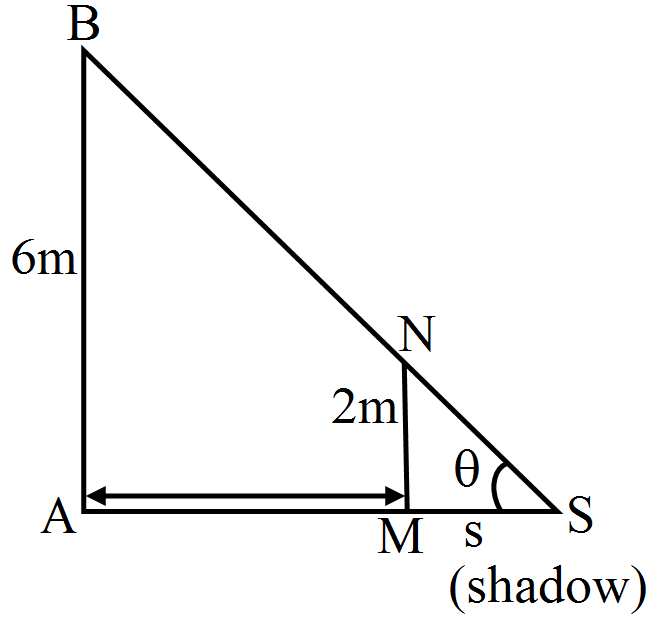
A man 2 metres high walks at a uniform speed of 5km/-hr away from a lamp-post 6 metres high. Find the rate at which the length of his shadow increases.
Answer

Let AB be the lamp-post. suppose at time t, the man CD is at a distance of x meters from the lamp-post any y meters be the length of his shadow CB.
Here, $\frac{\text{dx}}{\text{dt}}=5\text{km}/\text{hr}$
Here, $\triangle\text{ABE}$ and $\triangle\text{CDE}$ are similar, so
$\frac{\text{AB}}{\text{CD}}=\frac{\text{AE}}{\text{CE}}$
$\frac{6}{2}=\frac{\text{x}+\text{y}}{\text{y}}$
$3\text{y}=\text{x}+\text{y}$
$2\frac{\text{dy}}{\text{dt}}=\frac{\text{dx}}{\text{dt}}$
$\frac{\text{dy}}{\text{dt}}=\frac{5}{2}\text{km}/\text{hr}$
So, the length of his shadow increases at the rate of $\frac{5}{2}\text{km}/\text{hr}.$
View full question & answer
Question 93 Marks
The volume of a cube is increasing at the rate of $9cm^3/ \sec$. How fast is the surface area increasing when the length of an edge is $10cm$?
Answer
Here,
$\text{y}=\frac{2}{3}\text{x}+1$
$\Rightarrow\frac{\text{dy}}{\text{dt}}=2\text{x}^2\frac{\text{dx}}{\text{dt}}$
$\Rightarrow2\frac{\text{dx}}{\text{dt}}=2\text{x}^2\frac{\text{dx}}{\text{dt}}$ $\Big[\therefore\frac{\text{dy}}{\text{dt}}=2\frac{\text{dx}}{\text{dt}}\Big]$
$\Rightarrow\text{x}=\pm1$
Substituting the value of $\text{x}=1$ and $\text{x}=-1$ in $\text{y}=\frac{2}{3}\text{x}^3+1,$ we get
$\Rightarrow\text{y}=\frac{5}{3}$ and $\text{y}=\frac{1}{3}$
So, the points are $\Big(1,\frac{5}{3}\Big)$ and $\Big(-1,\frac{1}{3}\Big).$
View full question & answer
Question 103 Marks
If $y = 7x - x^3$ and $x$ increases at the rate of $4$ units per second, how fast is the slope of the curve changing when $x = 2$?
Answer
Here,
$\frac{\text{dx}}{\text{dt}}=4\text{ units/sec},\text{and }\text{x}=2$
And, $\text{y}=7\text{x}-\text{x}^3$
Slope of the curve (S) $=\frac{\text{dy}}{\text{dx}}$
$\text{S}=7-3\text{x}^2$
$\frac{\text{ds}}{\text{dt}}-6\text{x}\frac{\text{dx}}{\text{dt}}$
$=-6(2)(4)$
$=-48\text{ units}/\sec$
So, slope is decreasing at the rate of $48\text{ units}/\sec.$
View full question & answer
Question 113 Marks
The radius of a circle is increasing at the rate of 0.7cm/ sec. What is the rate of increase of its circumfrence?
Answer
Let r be the radius and C be the circumfrence of the circle at any times t. Then,
$\text{C}=2\pi\text{r}$
$\Rightarrow\frac{\text{dC}}{\text{dt}}=2\pi\frac{\text{dr}}{\text{dt}}$
$\Rightarrow\frac{\text{dC}}{\text{dt}}=2\pi\times0.7$ $\Big[\therefore\frac{\text{dr}}{\text{dt}}=0.7\text{cm}/\sec\Big]$
$\Rightarrow\frac{\text{dC}}{\text{dt}}=1.4\pi\text{ cm}/\sec$
View full question & answer
Question 123 Marks
Sand is being poured onto a conical pile at the constant rate of $50cm^3/ minute$ such that the height of the cone is always one half of the radius of its base. How fast is the height of the pile increasing when the sand is 5cm deep.
Answer
Let r be the radius, h be the height and V be the volume of the conical pile at any t. Then,
$\text{V}=\frac{1}{3}\pi\text{r}^2\text{h}$
$\Rightarrow\text{V}=\frac{1}{3}\pi(2\text{h})^2\text{h}$ $\big[\therefore\text{h}=\frac{\text{r}}{2}\big]$
$\Rightarrow\text{V}=\frac{4}{3}\pi\text{h}^3$
$\Rightarrow\frac{\text{dV}}{\text{dt}}=4\pi\text{h}^2\frac{\text{dh}}{\text{dt}}$
$\Rightarrow50=4\pi\text{h}^2\frac{\text{dh}}{\text{dt}}$
$\Rightarrow\frac{\text{dh}}{\text{dt}}=\frac{50}{4\pi(5)^2}$
$\Rightarrow\frac{\text{dh}}{\text{dt}}=\frac{1}{2\pi}\text{cm}/\text{min}$
View full question & answer
Question 133 Marks
The side of a square sheet is increasing at the rate of 4cm per minute. At what rate is the area increasing when the side is 8cm long?
Answer
Given: $\text{A}=\text{x}^2$ and $\frac{\text{dx}}{\text{dt}}=4\text{cm}/\text{min}$
let x be the side of the square and A be its area at any time t. Then,
$\text{A}=\text{x}^2$
$\Rightarrow\frac{\text{dA}}{\text{dt}}=2\text{x}\frac{\text{dA}}{\text{dt}}$
$\Rightarrow\frac{\text{dA}}{\text{dt}}=2\times8\times4$ $\Big[\therefore\text{x}=8\text{cm}\text{ and }\frac{\text{dx}}{\text{dt}}=4\text{cm}/\text{min}\Big]$
$\Rightarrow\frac{\text{dA}}{\text{dt}}=64\text{cm}^2/\text{min}$
View full question & answer
Question 143 Marks
The side of a square is increasing at the rate of 0.2cm/ sec. Find the rate of increase of the perimeter of the sqaure.
Answer
Let x be the side and p be the perimeter of the sqaure at any time t. Then,
$\text{P}=4\text{x}$
$\Rightarrow\frac{\text{dP}}{\text{dt}}=4\frac{\text{dx}}{\text{dt}}$
$\Rightarrow\frac{\text{dP}}{\text{dt}}=4\times0.2$ $\Big[\therefore\frac{\text{dx}}{\text{dt}}=0.2\text{cm}/\sec\Big]$
$\Rightarrow\frac{\text{dP}}{\text{dt}}=4\times0.2$
$\Rightarrow\frac{\text{dP}}{\text{dt}}=0.8\text{cm}/\sec$
View full question & answer
Question 153 Marks
The volume of a sphere is increasing at 3 cubic centimeter per second. Find the rate of increase of the radius, when the radius is 2cms.
Answer
Here,
$\text{r}=2\text{cm},\frac{\text{dV}}{\text{dt}}=3\text{cm}^3/\sec$
Now, we know that
$\text{V}=\frac{4}{3}\pi\text{r}^3$
Differentiating it with respct to t,
$\frac{\text{dV}}{\text{dt}}=4\pi\text{r}^2\frac{\text{dr}}{\text{dt}}$
$(3)=4\pi(2)^2\frac{\text{dr}}{\text{dt}}$
$3=16\pi\frac{\text{dr}}{\text{dt}}$
$\frac{\text{dr}}{\text{dt}}=\frac{3}{16\pi}\text{cm}/\sec.$
View full question & answer
Question 163 Marks
The radius of an air bubble is increasing at the rate of 0.5cm/ sec. At what rate is the volume of the bubble increasing when the radius is 1cm?
Answer
Let r be the radius and v be the volume of the air bubble at any time t. Then.
$\text{V}=\frac{4}{3}\pi\text{r}^3$
$\Rightarrow\frac{\text{dV}}{\text{dt}}=4\pi\text{r}^2\frac{\text{dr}}{\text{dt}}$
$\Rightarrow\frac{\text{dV}}{\text{dt}}=4\pi(1)^2\times0.5$ $\Big(\therefore\text{r}=1\text{cm}\text{ and }\frac{\text{dr}}{\text{dt}}=0.5\text{cm}/\sec\Big)$
$\Rightarrow\frac{\text{dV}}{\text{dt}}=2\pi\text{ cm}^3/\sec$
View full question & answer
Question 173 Marks
Find the rate of change of the total surface area of a cylinder of radius r and height h, when the radius varies.
Answer
Let T be the total surface area of a cylinder. Then,
$\text{T}=2\pi\text{r}(\text{r}+\text{h})$
Since the radius varies, we differentiate the total surface area w.r.t radius r.
Now,
$\frac{\text{dT}}{\text{dr}}=\frac{\text{d}}{\text{dr}}\big[2\pi\text{r}(\text{r}+\text{h})\big]$
Implies that $\frac{\text{dT}}{\text{dr}}=\frac{\text{d}}{\text{dr}}(2\pi\text{r}^2)+\frac{\text{d}}{\text{dr}}(2\pi\text{ rh})$
Implies that $\frac{\text{dT}}{\text{dr}}=4\pi\text{r}+2\pi\text{h}$
Implies that $\frac{\text{dT}}{\text{dr}}=2\pi(\text{r}+\text{h})$
View full question & answer
Question 183 Marks
The volume of a spherical balloon is increasing at the rate of $25cm^3/ \sec$. Find the rate of change of its surface area at the instant when radius is $5cm$.
Answer
Given, $\frac{\text{dV}}{\text{dt}}=25\text{cm}^3/\sec$
To find $\frac{\text{dA}}{\text{dt}}$ when $\text{r}=5\text{cm}$
We know that,
$\text{V}=\frac{4}{3}\pi\text{r}^3$
$\frac{\text{dV}}{\text{dt}}=\frac{4}{3}\pi(3\text{r}^2)\frac{\text{dr}}{\text{dt}}$
$25=4\pi(5)^2\frac{\text{dr}}{\text{dt}}$
$\frac{\text{dA}}{\text{dt}}=\frac{1}{4\pi}\text{cm}/\sec$
Now, $\text{A}=4\pi\text{r}^2$
$\frac{\text{dA}}{\text{dt}}=8\pi\text{r}\frac{\text{dr}}{\text{dt}}$
$=8\pi(5)\big(\frac{1}{4\pi}\big)$
$\frac{\text{dA}}{\text{dt}}=10\text{cm}^2/\sec.$
View full question & answer
Question 193 Marks
The money to be spent for the welfare of the employees of a firm is proportional to the rate of change of its total revenue (Marginal revenue). If the total revenue (in rupees) recieved from the sale of x units of a product is given by $R(x) = 3x^2 + 36x + 5$, find the marginal revenue, when $x = 5$, and write which value does the question indicate.
Answer
$\text{R}(\text{x})=3\text{x}^2+36\text{x}+5$
$\frac{\text{dR}}{\text{dx}}=6\text{x}+36$
$\frac{\text{dR}}{\text{dx}}\Big|_\text{x-5}=6\text{x }5+36$
$-30+36$
$-66$
This, as per the question, indicates the money to be spent
On the welfare of the employess, when the number of employees is 5.
View full question & answer
Question 203 Marks
An edge of a variable cube is increasing at the rate of 3cm per second. How fast is the volume of the cube increasing when the edge is 10cm long?
Answer
Let edge of the cube is x cm.
$\frac{\text{dx}}{\text{dt}}=3\text{cm}/\sec,\text{x}=10\text{cm}$
Let v be volume of cube,
$\text{V}=\text{x}^3$
$\frac{\text{dV}}{\text{dt}}=3\text{x}^2\frac{\text{dx}}{\text{dt}}$
$=3(10)^2\times(3)$
$=900\text{cm}^3/\sec$
So,
Volume increases at a rate of $=900\text{cm}^3/\sec.$
View full question & answer
Question 213 Marks
The amount of pollution content added in air in a city due to x diesel vehicles is given by $P(x) = 0.005x^3 + 0.02x^2 + 30x$. Find the marginal increase in pollution content when $3$ diesel vehicles are added and write which value is indicated in the above questions.
Answer
Since, marginal increase in the pollution content is the rate of change of total pollution with respect to the number of diesel vehicles, we have.
Marginal increase in pollution $=\frac{\text{dP}}{\text{dx}}=0.015\text{x}^2+0.04\text{x}+30$
When $x = 3$, marginal increase in pollution
$= 0.015 (9) + 0.04 (3) + 30 = 0.135 + 0.12 + 30 = 30.255$
Hence, the required marginal increase in pollution is 30.255 units.
It indicates the pollution level due to x diesel vehicles.
View full question & answer
Question 223 Marks
The radius of a spherical soap bubble is increasing at the rate of 0.2cm/ sec. Find the rate of increase of its surface area, when the radius is 7cm.
Answer
Let r be the radius of the spherical soap bubble.
Here, $\frac{\text{dr}}{\text{dt}}=0.2\text{cm}/\sec,\text{r}=7\text{cm}$
Surface Area (A) $=4\pi\text{r}^2$
$\frac{\text{dA}}{\text{dt}}=4\pi(2\text{r})\frac{\text{dr}}{\text{dt}}$
$\Big(\frac{\text{dA}}{\text{dt}}\Big)_\text{r-7}=4\pi(2\times7)\times0.$
$11.2\pi\text{ cm}^2/\sec.$
So, area of bubble increases at the rate of $11.2\pi\text{ cm}^2/\sec.$
View full question & answer
Question 233 Marks
Find the point on the curve $y^2 = 8x$ for which the abscissa and ordinate change at the same rate.
Answer
Here,
$\text{y}^2=8\text{x}\dots(1)$
$\Rightarrow2\text{y}\frac{\text{dy}}{\text{dt}}=8\frac{\text{dx}}{\text{dt}}$
$\Rightarrow2\text{y}=8$ $\Big[\therefore\frac{\text{dy}}{\text{dt}}=\frac{\text{dx}}{\text{dt}}\Big]$
$\Rightarrow\text{y}=4$
$\Rightarrow\text{x}=\frac{\text{y}^2}{8}$ [From eq. (1)]
$\Rightarrow\text{x}=\frac{16}{8}=2$
So, the point is $(2,4).$
View full question & answer
Question 243 Marks
The total cost $C(x)$ associated with the production of x units of an item is given by $C(x) = 0.007x^3 - 0.003x^2 + 15x + 4000$. Find the marginal cost when $17$ units are produced.
Answer
Marginal cost is the rate of change of total cost with respect to output.
$\therefore$ Marginal cost $(MC)$,
$\Rightarrow\frac{\text{dc}}{\text{dx}}=0.007(3\text{x}^2)-0.003(2\text{x})+15$
$= 0.021x^2 - 0.006x + 15$
When $x = 17, MC = 0.021(17^2) - 0.006(17) + 15$
$= 0.021(289) - 0.006(17) + 15$
$= 6.069 - 0.102 + 15$
$= 20.967$
Hence, when 17 units are produced, the marginal cost is Rs. $20.967$
View full question & answer
Question 253 Marks
A ladder, 5 metre long, standing on a horizontal floor, leans against a vertical wall. If the top of the ladder slides down wards at the rate of 10cm/ sec, then find the rate at which the angle between the floor and ladder is decreasing when lower end of ladder is 2 metres from the wall.
Answer
Length of the ladder $=500\text{cm}$
Let $\theta$ be the angle between the floor and ladder.
$\sin\theta=\frac{\text{y}}{500}$
On differentiating w.r.t t we get,
$\cos\theta\frac{\text{d}\theta}{\text{dt}}=\frac{1}{500}\frac{\text{dy}}{\text{dt}}\ \dots(1)$
It is given $\frac{\text{dy}}{\text{dt}}=10\text{cm}/\sec\ \dots(2)$
Also,
$\cos\theta=\frac{\text{x}}{500}$
When $\text{x}=200\text{cm},$
$\cos\theta=\frac{200}{500}=\frac{2}{5}\ \dots(3)$
Substituting the respective values we get,
$\frac{2}{5}\frac{\text{d}\theta}{\text{dt}}=\frac{1}{500}(-10)$
$\frac{\text{d}\theta}{\text{dt}}=-\frac{1}{20}\text{rad}/\sec.$
View full question & answer
Question 263 Marks
A particle moves along the curve $y = x^3$. Find the points on the curve at which the y-coordinate changes three times more rapidly than the x-coordinate.
Answer
According to the question,
$\frac{\text{dy}}{\text{dt}}=3\frac{\text{dx}}{\text{dt}}$
Now,
$\text{y}=\text{x}^3$
$\Rightarrow\frac{\text{dy}}{\text{dt}}=3\text{x}^2\frac{\text{dx}}{\text{dt}}$
$\Rightarrow3\frac{\text{dx}}{\text{dt}}=3\text{x}^2\frac{\text{dx}}{\text{dt}}$
$\Rightarrow\text{x}^2=1$
$\Rightarrow\text{x}=\pm1$
Substituting $\text{x}=\pm1$ in $\text{y}=\text{x}^3,$ we get
$\text{y}=\pm1$
So, the points are $(1,1)$ and $(-1,-1).$
View full question & answer