Question 11 Mark
Find the sum of the order and the degree of the following differential equation:
$\text{y = x} \bigg(\frac{\text{dy}}{\text{dx}}\bigg)^{3} + \frac{\text{d}^{2}{\text{y}}}{\text{d}}$
Answer$\text{Order 2 or degree = 1}$
$\text{sum} = 3$
View full question & answer→Question 21 Mark
Find the solution of the following differential equation:
$\text{x}\sqrt{(1 + \text{y}^{2})} \text{dx + y} \sqrt{( 1 + \text{x}^{2})} \text{dy} = 0$
Answer$\text{Writing} \int \frac{\text{y}}{\sqrt{1 + \text{y}^{2}}} \text{dy} = -\int \frac{\text{x dx}}{\sqrt{1 + \text{x}^{2}}}$
$\text{Getting} \sqrt{1 + \text{y}^{2}} + \sqrt{1 + \text{x}^{2}} = \text{c}$
View full question & answer→Question 31 Mark
Find the sum of the order and the degree of the following differential equation:
$\text{y = x} \bigg(\frac{\text{dy}}{\text{dx}}\bigg)^{3} + \frac{\text{d}^{2}{\text{y}}}{\text{dx}^2}$
Answer$\text{Order 2 or degree = 1}$
$\text{sum} = 3$
View full question & answer→Question 41 Mark
Write the differential equation representing the family of curves y = mx, where m is an arbitrary constant.
Answery = mx
Differentiating both sides w.r.t. x, we get
$\frac{\text{dy}}{\text{dx}} = \text{m}$
Hence, required differential equation is
$\text{y} = \frac{\text{dy}}{\text{dx}}.\text{x}\Rightarrow\text{ ydx} - \text{xdy} = 0 .$
View full question & answer→Question 51 Mark
Find the differential equation representing the family of curves $\text{v} = \frac{\text{A}}{\text{r}} + \text{B},$ where A and B are arbitrary constants.
Answer$\frac{\text{dv}}{\text{dr}} = - \frac{\text{A}}{\text{r}^{2}}, \Rightarrow {\text{r}^{2}} \frac{\text{d}^{2}\text{v}}{\text{dr}^{2}} + \text{2 r} \frac{\text{dv}}{\text{dr}} = 0$
View full question & answer→Question 61 Mark
Find the integrating factor of the differential equation
$\bigg(\frac{e^{-2}\sqrt{x}}{\sqrt{x}} - \frac{y}{\sqrt{x}}\bigg) = \frac{dx}{dy} = 1.$
Answer$\text{I.F} = e^{{\int}\frac{1}{\sqrt{x}}\text{dx}} = e^{2\sqrt{x}}$
View full question & answer→Question 71 Mark
Write the degree of the differential equation $\text{x}^{3}\bigg(\frac{\text{d}^{2}\text{y}}{\text{dx}^{2}}\bigg)^{2} + \text{x}\bigg(\frac{\text{dy}}{\text{dx}}\bigg)^{4} = 0.$
View full question & answer→Question 81 Mark
What is the degree of the following differential equation?
$\text{5x}\Bigg(\frac{\text{dy}}{\text{dx}}\Bigg)^{2}-\frac{\text{d}^{2}\text{y}}{\text{dx}^{2}}-\text{6y = log x}$.
View full question & answer→Question 91 Mark
Write the order and the degree of the following differential equation:
$\text{x}^3\Big(\frac{\text{d}^2\text{y}}{\text{dx}^2}\Big)^2+\text{x}\Big(\frac{\text{dy}}{\text{dx}}\Big)^4=0$
AnswerOrder is the highest order derivative present in the differential equation.
And degree is the power of highest order derivative.
We have given the differential equation:
$\text{x}^3\Big(\frac{\text{d}^2\text{y}}{\text{dx}^2}\Big)^2+\text{x}\Big(\frac{\text{dy}}{\text{dx}}\Big)^4=0$
Here, order is 2 and degree is 2.
View full question & answer→Question 101 Mark
Find the order and the degree of the differential equation $\text{x}^2\frac{\text{d}^2\text{y}}{\text{dx}^2}=\bigg\{1+\Big(\frac{\text{dy}}{\text{dx}}\Big)^2\bigg\}^4.$
AnswerThe highest order derivative present in the given differential equation is $\frac{\text{d}^2\text{y}}{\text{dx}^2},$ so its order is 2.
It is a polynomial $\frac{\text{d}^2\text{y}}{\text{dx}^2},$ and $\frac{\text{dy}}{\text{dx}}$ and the highest power raised to $\frac{\text{d}^2\text{y}}{\text{dx}^2},$ is 1, so its degree is 1.
View full question & answer→Question 111 Mark
How many arbitray constants are there in the genral solution of the differential equation of orader 3.
AnswerThe arbitrary constants in the general solution of the differential equation is equal to the order of the differntial equation.
Hence, the number of arbitrary constant in the general solution of the order 3 are 3.
View full question & answer→Question 121 Mark
Write the order of the differential equation of all non-horizontal lines in a plane.
AnswerThe equationof the non - horizontal lines in a plan is ,
$\text{y}=\text{mx}+\text{C}$
Where m is the slope and C is the intercept on y-axis.
Differentiating with respect to x, we get
$\frac{\text{dy}}{\text{dx}}=\text{m}$
$\Rightarrow \frac{\text{d}^{2}\text{y}}{\text{dx}^{2}}=0$
This is the required differential equation.
Here, we observe that the order of the equation is 2.
View full question & answer→MCQ 131 Mark
Family $y = Ax + A^4$ of curves is represented by the differential equation of degree :
Answer$Y = Ax + A^4$
This equation is a linear Differential equation
$=\frac{\text{dy}}{\text{dx}}=\text{A}$
Here the highest order Derivative is $y$
The Degree of this Derivative is $1$
View full question & answer→Question 141 Mark
Write the differential equation obtained emliminating the arbitrary constant $C$ in the equation $xy = C^2$.
AnswerWe have,
$\text{xy}=\text{C}^{2}$
Differentiating with respect to x, we get
$\text{x}\frac{\text{dy}}{\text{dx}}+\text{y}=0$
$\Rightarrow \text{x}\frac{\text{dy}}{\text{dx}}=-\text{y}$
$\Rightarrow \text{x}\ \text{dy}=-\text{y}\ \text{dx}$
$\Rightarrow \text{x}\ \text{dy}-\text{y}\ \text{dx}=0$
Hence, $ \text{x}\ \text{dy}-\text{y}\ \text{dx}=0$ is the differential equation.
View full question & answer→Question 151 Mark
Determine the order and degree of the following differential equations. state also whether they are linear or non linear.
$\sqrt{1-\text{y}^2}\text{dx}+\sqrt{1-\text{x}^2}\text{dx}=0$
Answer$\sqrt{1-\text{y}^2}\text{dx}+\sqrt{1-\text{x}^2}\text{dx}=0$
$\Rightarrow\sqrt{1-\text{y}^2}\text{dx}=-\sqrt{1-\text{x}^2}\text{dy}$
$\Rightarrow-\frac{\sqrt{1-\text{y}^2}}{\sqrt{1-\text{x}^2}}=\frac{\text{dy}}{\text{dx}}$
$\Rightarrow\sqrt{1-\text{x}^2}\frac{\text{dy}}{\text{dx}}+\sqrt{1-\text{y}^2}=0$
In this differential equation, the order of the highest order derivative is 1 and its power is 1. So, it is a differential equation of order 1 and degree 1.
Its is a non linear equation, as the exponent of dependent variable(y) is more than 1 (on expanding $\sqrt{1-\text{y}^2}$ binomially).
View full question & answer→Question 161 Mark
Determine order and degree (if defined) of differential equations given in Exercise.
y' + 5y = 0
AnswerThe given differential equation is
y' + 5y = 0
The highest order derivative present in the given differential equation is y' and index of its highest power is one.
$\therefore$ the given differential equation is order 1 and degree 1.
View full question & answer→Question 171 Mark
Determine the order and degree of the following differential equations. state also whether they are linear or non linear.
$\frac{\text{d}^2\text{y}}{\text{dx}^2}+5\text{x}\Big(\frac{\text{dy}}{\text{dx}}\Big)-6\text{y}=\log\text{x}$
Answer$\frac{\text{d}^2\text{y}}{\text{dx}^2}+5\text{x}\Big(\frac{\text{dy}}{\text{dx}}\Big)-6\text{y}=\log\text{x}$
The highest order differential coefficient is $\frac{\text{d}^2\text{y}}{\text{dx}^2}$ and its power is 1.
So, it is non linear differential equation with order 2 and degree 1.
View full question & answer→Question 181 Mark
Determine order and degree (if defined) of differential equations given in Exercise.
y" + 2y' + sin y = 0
AnswerThe given differential equation is
y" + 2y' + sin y = 0
The highest order derivative present in the given differential equation, is y" and index of its highest power is 1.
$\therefore$ the given differential equation is of order 2 and degree 1.
View full question & answer→Question 191 Mark
Write the order of the differential equation of the family of circles touching X-axis at the origin.
Answer
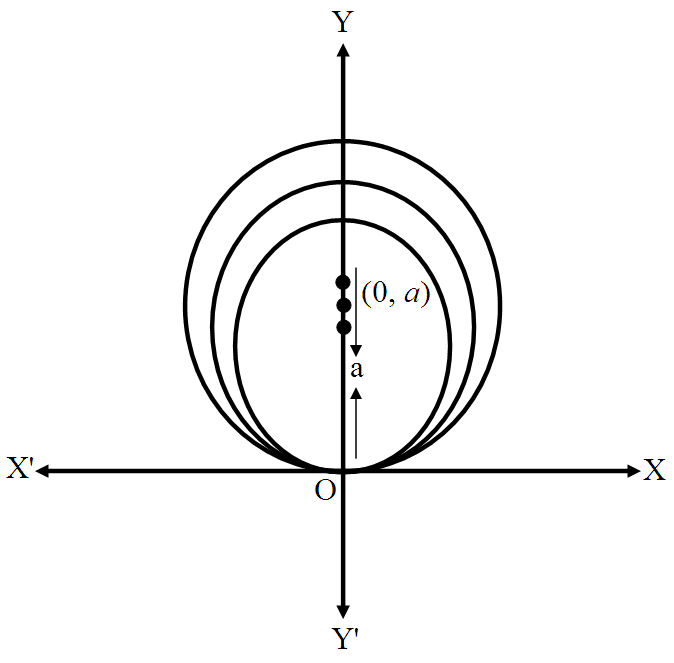 The equation of the famliy of circles touching x-axis at the origin is
$(\text{x}-0)^{2}+(\text{y}-\text{a})^{2}=\text{a}^{2}$
$\text{x}^{2}+\text{y}^{2}-2\text{ay}=0\ ...(\text{i})$
Here, a is the parameter.
Since, this equation contain only one conatant, we differentiate it only once.
$2\text{x}+2\text{y}\frac{\text{dy}}{\text{dx}}-2\text{a}\frac{\text{dy}}{\text{dx}}=0$
$\text{a}=\frac{\text{x}+\text{y}(\frac{\text{dy}}{\text{dx}})}{\frac{\text{dy}}{\text{dx}}}\ ...(\text{ii})$
Putting the value of a from (i) in (i), we get
$\text{x}^{2}+\text{y}^{2}=2\text{y}\left\{\frac{\text{x}+\text{y}(\frac{\text{dy}}{\text{dx}})}{\frac{\text{dy}}{\text{dx}}}\right\}$
$(\text{x}^{2}+\text{y}^{2})\frac{\text{dy}}{\text{dx}}=2\text{xy}$
So, this is the differential equation.
Here, order of the diffrential equation is 1. View full question & answer→Question 201 Mark
Determine order and degree (if defined) of differential equations given in Exercise.
$(y''')^2 + (y")^3 + (y')^4 + y^5 = 0$
AnswerThe given differential equation is
$(y''')^2 + (y")^3 + (y')^4 + y^5 = 0$
The highest order derivative present in the given differential equation is y" and the index of its highest power is 2.
$\therefore$ the given differential equation is of order is 3 and degree 2.
View full question & answer→Question 211 Mark
Write the degree of the differrntial equation $\Big(1+\frac{\text{dy}}{\text{dx}}\Big)^{3}=\Big(\frac{\text{d}^{2}\text{y}}{\text{dx}^{2}}\Big)^{2}.$
Answer$\Big(1+\frac{\text{dy}}{\text{dx}}\Big)^{3}=\Big(\frac{\text{d}^{2}\text{y}}{\text{dx}^{2}}\Big)^{2}$
Here, the highest 2 order derivative is $\frac{\text{d}^{2}\text{y}}{\text{dx}^{2}}$ and its power is 2.
View full question & answer→Question 221 Mark
Determine the order and degree of the following differential equations. state also whether they are linear or non linear.
$\frac{\text{d}^3\text{y}}{\text{dx}^3}+\Big(\frac{\text{d}^2\text{y}}{\text{dx}^2}\Big)+\frac{\text{dy}}{\text{dx}}+4\text{y}=\sin\text{x}$
Answer$\frac{\text{d}^3\text{y}}{\text{dx}^3}+\Big(\frac{\text{d}^2\text{y}}{\text{dx}^2}\Big)+\frac{\text{dy}}{\text{dx}}+4\text{y}=\sin\text{x}$
The highest order differential coefficient is $\frac{\text{d}^2\text{y}}{\text{dx}^3}$ and its power is 1.
So, it is a non linear differential equation with order 3 and degree 1.
View full question & answer→Question 231 Mark
Determine order and degree (if defined) of differential equations given in Exercise.
$\bigg(\frac{\text{ds}}{\text{dt}}\bigg)^4 + 3\text{s} \frac{\text{d}^2\text{s}}{\text{dt}^2} =0$
Answer The given differential equation is
$\bigg(\frac{\text{ds}}{\text{dt}}\bigg)^4 + 3\text{s} \frac{\text{d}^2\text{s}}{\text{dt}^2} =0$
The highest order derivative present in the differential equation is $\frac{\text{d}^2\text{s}}{\text{dt}^2}$
$\therefore$ its order is 2
The highest power raised to $\frac{\text{d}^2\text{s}}{\text{dt}^2}$ is one, so its degree is 1.
View full question & answer→Question 241 Mark
Determine order and degree (if defined) of differential equations given in Exercise.
$\bigg(\frac{\text{d}^{2}\text{y}}{\text{dx}^{2}}\bigg)^{2}+\cos\bigg(\frac{\text{dy}}{\text{dx}}\bigg)=0$
AnswerThe given differential equation is
$\bigg(\frac{\text{d}^2\text{y}}{\text{dx}^2}\bigg)^2 + \text{cos} \bigg(\frac{\text{dy}}{\text{dx}}\bigg) = 0$
The highest order derivative present in the given differential equation is $\frac{\text{d}^2\text{y}}{\text{dx}^2}.$ therefore, its order is 2.
Since the given differential equation is not a polynomail $\frac{\text{dy}}{\text{dx}}.$ therefore, its degree is not defined.
View full question & answer→Question 251 Mark
Determine order and degree (if defined) of differential equations given in Exercise.
$\frac{\text{d}^{4}{\text{y}}}{\text{d}\text{x}^{4}}+\text{sin}(\text{y"'})=0$
AnswerThe given differential equation is$\frac{\text{d}^{4}{\text{y}}}{\text{d}\text{x}^{4}}+\text{sin}(\text{y"'})=0$
The highest order derivative present in the differential equation is $\frac{\text{d}^{4}\text{y}}{\text{dx}^{4}}$
$\therefore$ its order is 4
The given differential equation is not a polynomial equation in its derivative and so its degree is not defined.
View full question & answer→Question 261 Mark
Write the order of the differrntial quation associated with the primitive $\text{y}=\text{C}_{1}+\text{C}_{2}\text{e}^{\text{x}}+\text{C}_{3}\text{e}^{-2\text{x}+\text{C}_{4}}$ where $C_1, C_2, C_3, C_4$ are arbitrary constants.
Answer$\text{y}=\text{C}_{1}+\text{C}_{2}\text{e}^{\text{x}}+\text{C}_{3}\text{e}^{-2\text{x}+\text{C}_{4}}$
the given equation can be reduced to:
$\text{y}=\text{C}_{1}+\text{C}_{2}\text{e}^{\text{x}}+\text{C}_{3}\big(\text{e}^{-2\text{x}}\times\text{e}^{\text{C}_{4}}\big)$
Here, will be a constant.
We have 3 constant as $C_1, C_2,$ and $C_3$.
Hence, the order of the differential equation is 3.
View full question & answer→Question 271 Mark
Determine the order and degree of the following differential equations. state also whether they are linear or non linear.
$(\text{y"})^2+(\text{y})^3+\sin\text{y}=0$
Answer$(\text{y"})^2+(\text{y})^3+\sin\text{y}=0$
In this differential equation, the order of the highest order derivative is 2 and its power is 2. So, the order of the differential equation is 2 and its degree is 2. It is a non-linear differential equation, as its degree is 2, which is more than 1.
View full question & answer→Question 281 Mark
Write the degree of the differential equation $\frac{\text{d}^{2}\text{y}}{\text{dx}^2}+\text{x}\Big(\frac{\text{dy}}{\text{dx}}\Big)^{2}=2\text{x}^{2}\log\Big(\frac{\text{d}^{2}\text{y}}{\text{dx}^2}\Big).$
AnswerWe have,
$\frac{\text{d}^{2}\text{y}}{\text{dx}^2}+\text{x}\Big(\frac{\text{dy}}{\text{dx}}\Big)^{2}=2\text{x}^{2}\log\Big(\frac{\text{d}^{2}\text{y}}{\text{dx}^2}\Big)$
$\frac{\text{d}^{2}\text{y}}{\text{dx}^2}+\text{x}\Big(\frac{\text{dy}}{\text{dx}}\Big)^{2}=2\text{x}^{2}\log\Big(\frac{\text{d}^{2}\text{y}}{\text{dx}^2}\Big)=0$
Here, we observe that LHS of the differential equation be as a polynomial in $\frac{\text{dy}}{\text{dx}}.$
So, its degree is not defined.
View full question & answer→Question 291 Mark
Write the degree of the differrntial equation $\text{x}^{3}\Big(\frac{\text{d}^{2}\text{y}}{\text{dx}^{2}}\Big)^{2}+\text{x}\Big(\frac{\text{dy}}{\text{dx}}\Big)^{4}=0.$
Answer$\text{x}^{3}\Big(\frac{\text{d}^{2}\text{y}}{\text{dx}^{2}}\Big)^{2}+\text{x}\Big(\frac{\text{dy}}{\text{dx}}\Big)^{4}=0$
Here, the highest order derivative is $\frac{\text{d}^{2}\text{y}}{\text{dx}^{2}}$ and its power is 2.
Therefore, degree of given differential equation is 2.
View full question & answer→Question 301 Mark
Write the degree of the differrntial equation $\Big(\frac{\text{d}^{2}\text{y}}{\text{dx}^{2}}\Big)^{2}+\Big(\frac{\text{dy}}{\text{dx}}\Big)^{2}=\text{x}\sin\Big(\frac{\text{dy}}{\text{dx}}\Big).$
AnswerThe given differential equation is not a polnomial equation in derivaties.
Hence, the degree for this differential equation is not defind.
View full question & answer→Question 311 Mark
Write the degree of the following differrntial equation $\text{x} \Big(\frac{\text{dy}}{\text{dx}}\Big)^{3}+\text{y}\Big(\frac{\text{dy}}{\text{dx}}\Big)^{4}+\text{x}^{3}=0.$
Answer$\text{x} \Big(\frac{\text{dy}}{\text{dx}}\Big)^{3}+\text{y}\Big(\frac{\text{dy}}{\text{dx}}\Big)^{4}+\text{x}^{3}=0$
Here, we see that the highest order derivative is $\frac{\text{d}^{2}\text{y}}{\text{dx}^{2}}$ and its power is 3.
Therefore, the given differential equation is of first degree 3.
View full question & answer→Question 321 Mark
Write the order of the differential equation whose solution is $\text{y}=\text{a} \cos\text{x}+\text{b}\ \sin\text{x}+\text{Ce}^{-\text{x}}.$
Answer$\text{y}=\text{a} \cos\text{x}+\text{b}\ \sin\text{x}+\text{Ce}^{-\text{x}}$
Here, we see that there are three arbitary conatants.
Therefore, we differentiant it three times to get rid of all three constant.
Hence, the order of the equation is 3.
View full question & answer→Question 331 Mark
Write the degree of the differential equation $\text{a}^{2}\frac{\text{d}^{2}\text{y}}{\text{dx}^{2}}=\left\{1+(\frac{\text{dy}}{\text{dx}})^{2}\right\}^{\frac{1}{4}}.$
AnswerWe have,
$\text{a}^{2}\frac{\text{d}^{2}\text{y}}{\text{dx}^{2}}=\left\{1+(\frac{\text{dy}}{\text{dx}})^{2}\right\}^{\frac{1}{4}}$
$\left\{\text{a}^{2}\frac{\text{d}^{2}\text{y}}{\text{dx}^{2}}\right\}^{4}={1+\big(\frac{\text{dy}}{\text{dx}}\big)^{2}}$
Degree of the diffrential equation is the degree of the highest order derivative.
Therefore, the deree must be 4.
View full question & answer→Question 341 Mark
Determine the order and degree of the following differential equations. state also whether they are linear or non linear.
$\text{y}=\text{x}\frac{\text{dy}}{\text{dx}}+\text{a}\sqrt{1+\Big(\frac{\text{dy}}{\text{dx}}\Big)^2}$
Answer$\text{y}=\text{x}\frac{\text{dy}}{\text{dx}}+\text{a}\sqrt{1+\Big(\frac{\text{dy}}{\text{dx}}\Big)^2}$
$\Rightarrow\text{y}-\text{x}\frac{\text{dy}}{\text{dx}}=\text{a}\sqrt{1+\Big(\frac{\text{dy}}{\text{dx}}\Big)^2}$
Squaring both sides, we get
$\Rightarrow(\text{y}-\text{x}\frac{\text{dy}}{\text{dx}}\Big)^2=\text{a}^2\Big[1+\Big(\frac{\text{dy}}{\text{dx}}\Big)^2\Big]$
$\Rightarrow\text{y}^2-2\text{xy}\frac{\text{dy}}{\text{dx}}+\text{x}^2\Big(\frac{\text{dy}}{\text{dx}}\Big)^2=\text{a}^2+\text{a}\Big(\frac{\text{dy}}{\text{dx}}\Big)^2$
$\Rightarrow(\text{x}^2-\text{a}^2)\Big(\frac{\text{dy}}{\text{dx}}\Big)^2-2\text{xy}\frac{\text{dy}}{\text{dx}}+(\text{y}^2-\text{a}^2)=0$
In this differential equation, the order of the highest order derivative is 1 and its highest power is 2. So, it is a differential equation of order 1 and degree 2.
It is a non-linear differential equation, as its degree is 2, which is greater than 1.
View full question & answer→Question 351 Mark
Write the degree of the following differrntial equation?
$5\text{x}\Big(\frac{\text{dy}}{\text{dx}}\Big)^{2}-\frac{\text{d}^{2}\text{y}}{\text{dx}^{2}}-6\text{y}=\log\text{x}$
Answer$5\text{x}\Big(\frac{\text{dy}}{\text{dx}}\Big)^{2}-\frac{\text{d}^{2}\text{y}}{\text{dx}^{2}}-6\text{y}=\log\text{x}$
Here, we see that the highest order derivative is $\frac{\text{d}^{2}\text{y}}{\text{dx}^{2}}$ and its power is 1.
Therefore, the given differential equation is of first degree.
View full question & answer→Question 361 Mark
Write the degree of the differrntial equation $\frac{\text{d}^{2}\text{y}}{\text{dx}^{2}}+\Big(\frac{\text{dy}}{\text{dx}}\Big)^{\frac{1}{4}}+\text{x}^{\frac{1}{5}}=0.$
AnswerThe order is 2 as the highest derivative is 2.
The given differential equation is not a polynomial equation in derivaties.
Hence, the degree for this differential equation is not defined.
View full question & answer→Question 371 Mark
Write the degree of the differrntial equation $\frac{\text{d}^{2}\text{y}}{\text{dx}^{2}}+\text{e}^{\frac{\text{dy}}{\text{dx}}}=0.$
AnswerThe given differential equation is not a polynomial equation in derivaties.
Hence, the degree for this differential equation is not defined.
View full question & answer→Question 381 Mark
Determine the order and degree of the following differential equations. state also whether they are linear or non linear.
$\text{y}=\text{px}+\sqrt{\text{a}^2\text{p}^2+\text{b}^2},$ where $\text{p}=\frac{\text{dy}}{\text{dx}}$
Answer$\text{y}=\text{px}+\sqrt{\text{a}^2\text{p}^2+\text{b}^2},$
$\Rightarrow\text{y}-\text{px}=\sqrt{\text{a}^2\text{p}^2+\text{b}^2}$
Squaring both sides, we get
$\Rightarrow(\text{y}-\text{px})^2=\text{a}^2\text{p}^2+\text{b}^2$
$\Rightarrow\text{y}^2-2\text{pxy}+\text{p}^2\text{x}^2=\text{a}^2\text{p}^2+\text{b}^2$
$\Rightarrow(\text{x}^2-\text{a}^2)\text{p}^2-2\text{pxy}+(\text{y}^2-\text{b}^2)=0$
$\Rightarrow(\text{x}^2-\text{a}^2)\Big(\frac{\text{dy}}{\text{dx}}\Big)^2-2\text{pxy}\frac{\text{dy}}{\text{dx}}+\text{y}^2-\text{b}^2=0$
$\Big[\text{substituting}\text{ p}=\frac{\text{dy}}{\text{dx}}\Big]$
In this differential equation, the order of the highest order derivative is 1 and its highest power is 2.
So, it is a differential equation of order 1 and degree 2.
It is a non-linear differential equation, as its degree is 2, which is greater than 1.
View full question & answer→Question 391 Mark
For each of the differential equations given below, indicate its order and degree (if defined).
$\frac{\text{d}^4\text{y}}{\text{dx}^4}-\sin\Big(\frac{\text{d}^3\text{y}}{\text{dx}^3}\Big)=0$
AnswerGiven: Differential equation $\frac{\text{d}^4\text{y}}{\text{dx}^4}-\sin\Big(\frac{\text{d}^3\text{y}}{\text{dx}^3}\Big)=0$
The highest order derivative present in this differential equation is $\frac{\text{d}^4\text{y}}{\text{dx}^4}$ and hence order of this differential equation if 4.
The given differential equation is a polynomial equation in derivatives therefore, degree of this differential equation is not defined.
Therefore, order = 4, Degree not defined
View full question & answer→Question 401 Mark
For each of the differential equations given below, indicate its order and degree (if defined). $\Big(\frac{\text{dy}}{\text{dx}}\Big)^3-4\Big(\frac{\text{dy}}{\text{dx}}\Big)^2+7\text{y}=\sin\text{x}$
AnswerGiven: Differential equation $\Big(\frac{\text{dy}}{\text{dx}}\Big)^3-4\Big(\frac{\text{dy}}{\text{dx}}\Big)^2+7\text{y}=\sin\text{x}$
The highest order derivative present in this differential equation is $\frac{\text{dy}}{\text{dx}}$ and hence order of this differential equation if 1.
The given differential equation is a polynomial equation in derivatives and highest power of the highest order derivative $\frac{\text{dy}}{\text{dx}}$ is 3.
Therefore, order = 1, Degree = 3
View full question & answer→Question 411 Mark
Determine order and degree (if defined) of differential equations given in Exercise.
y''' + 2y" + y' = 0
AnswerThe highest order derivative present in the given differential equation is y" and index of its highest power is 1.
$\therefore$ the given differential equation is of order 3 and degree 1.
View full question & answer→Question 421 Mark
Write the order of the differential equation $1+\Big(\frac{\text{dy}}{\text{dx}}\Big)^{2}=7\Big(\frac{\text{d}^{2}}{\text{dx}^{2}}\Big)^{3}.$
AnswerWe have,
$1+\Big(\frac{\text{dy}}{\text{dx}}\Big)^{2}=7\Big(\frac{\text{d}^{2}}{\text{dx}^{2}}\Big)^{3}$
The order of a diffrential equation is the order of the highest order derivative.
Here, the deree must be 2.
View full question & answer→Question 431 Mark
Define order of a differential equation.
AnswerOrder of differential equation:
The order of a differential equation is the order of its highest order derivative that apears in the equation.
example: $\frac{\text{d}^{2}\text{y}}{\text{dx}^{2}}-4(\frac{\text{dy}}{\text{dx}})=2\text{y}$
Order of the differential equation is 2.
View full question & answer→Question 441 Mark
Write the differential equation obtained by emliminating the abitrary constant C in the equation $\text{x}^{2}-\text{y}^{2}=\text{C}^{2}.$
AnswerWe have,
$\text{x}^{2}-\text{y}^{2}=\text{C}^{2}$
Differentiating with respect to x, we get
$2\text{x}-2\text{y}\frac{\text{dy}}{\text{dx}}=0$
$\Rightarrow 2\text{x}=2\text{y}\frac{\text{dy}}{\text{dx}}$
$\Rightarrow \text{x}\ \text{dx}=\text{y}\ \text{dy}$
$\Rightarrow \text{x}\ \text{dx}-\text{y}\ \text{dy}=0$
Hence, $ \text{x}\ \text{dx}-\text{y}\ \text{dy}=0$ is the differential equation.
View full question & answer→Question 451 Mark
Determine order and degree (if defined) of differential equations given in Exercise.
$\frac{\text{d}^2\text{y}}{\text{dx}^2} =\text{cos} 3\text{x}+\text{sin} 3\text{x}$
AnswerThe given differential equation is
$\frac{\text{d}^2\text{y}}{\text{dx}^2} =\text{cos} 3\text{x}+\text{sin} 3\text{x}$
The highest order derivative present in the given differential equation is $\frac{\text{d}^2\text{y}}{\text{dx}^2}$ and index of its highest power is 1.
$\therefore$ the given differential equation is of order is 2 and degree 1.
View full question & answer→Question 461 Mark
Define degree of a differential equation.
AnswerDegree of differential equation:
The degree of a differential equation is the power of the highest order derivative occurring in a differential equation when it is written as a polynomial in differential equation.
example: $\Big(\frac{\text{d}\text{y}}{\text{dx}}\Big)^{2}-4(\frac{\text{dy}}{\text{dx}})=2\text{y}$
the degreen of the given differential equation is 2.
View full question & answer→Question 471 Mark
Write the order of the differential equation representing the famliy of curve $y = ax + a^3$.
AnswerThe order of the diffrention is equal to the arbitrary constants present in the general soultion of the differential equation.
Hence, the order of the differential equation of curve $y = ax + a^3$ is $1$.
View full question & answer→Question 481 Mark
Determine the order and degree of the following differential equations. state also whether they are linear or non linear.
$\frac{\text{d}^2\text{y}}{\text{dx}^2}=\Big(\frac{\text{dy}}{\text{dx}}\Big)^{\frac{2}{3}}$
Answer$\frac{\text{d}^2\text{y}}{\text{dx}^2}=\Big(\frac{\text{dy}}{\text{dx}}\Big)^{\frac{2}{3}}$
Taking cubes of both sides, we get
$\Rightarrow\Big(\frac{\text{d}^2\text{y}}{\text{dx}^2}\Big)^3=\Big(\frac{\text{dy}}{\text{dx}}\Big)^2$
In this differential equation, the order of the highest order derivative is 2 and its power is 3. So, it is a differential equation of order 2 and degree 3. It is a non-linear differential equation, as it has degree 3, which is greater than 1.
View full question & answer→Question 491 Mark
Determine the order and degree of the following differential equations. state also whether they are linear or non linear.
$(\text{xy}^2+\text{x})\text{dx}+(\text{y}-\text{x}^2\text{y})\text{dy}=0$
Answer$(\text{xy}^2+\text{x})\text{dx}+(\text{y}-\text{x}^2\text{y})\text{dy}=0$
$\Rightarrow\text{x}(\text{y}^2+1)\text{dx}=\text{y}(\text{x}^2-1)\text{dy}$
$\Rightarrow\frac{\text{x}(\text{y}^2+1)}{\text{y}(\text{x}^2-1)}=\frac{\text{dy}}{\text{dx}}$
$\Rightarrow\text{x}(\text{y}^2+1)\frac{\text{dy}}{\text{dx}}-\text{y}(\text{x}^2-1)=0$
$\Rightarrow(\text{y}^2+1)\frac{\text{dy}}{\text{dx}}-\text{y}(\text{x}-\frac{1}{\text{x})}=0$
In this differential equation, the order of the highest order derivative is 1 and its power is 1. So, it is a differential equation of degree 1 and order 1.
It is a non-linear equation, as the product containing dependent variable and its differential co-efficient $\Big(\text{y}^2\frac{\text{dy}}{\text{dx}}\Big)$ is present in it.
View full question & answer→Question 501 Mark
For each of the differential equations given below, indicate its order and degree (if defined).
$\frac{\text{d}^2\text{y}}{\text{dx}^2}+5\text{x}\Big(\frac{\text{dy}}{\text{dx}}\Big)^2-6\text{y}=\log\text{x}$
AnswerGiven: Differential equation $\frac{\text{d}^2\text{y}}{\text{dx}^2}+5\text{x}\Big(\frac{\text{dy}}{\text{dx}}\Big)^2-6\text{y}=\log\text{x}$
The highest order derivative present in this differential equation is $\frac{\text{d}^2\text{y}}{\text{dx}^2}$ and hence order of this differential equation if 2.
The given differential equation is a polynomial equation in derivatives and highest power of the highest order derivative $\frac{\text{d}^2\text{y}}{\text{dx}^2}$ is 1.
Therefore, Order = 2, Degree = 1
View full question & answer→Question 511 Mark
Find the sum of the order and degree of the differential equation $\text{y}=\text{x}\Big(\frac{\text{dy}}{\text{dx}}\Big)^{3}+\frac{\text{d}^{2}\text{y}}{\text{dx}^{2}}.$
AnswerThe order is 2 as the highest derivative is 2.
The degree is 1 as the highest derivative is of order 1.
Hence, the sum of the order and dergree of the differential equation $\text{y}=\text{x}\Big(\frac{\text{dy}}{\text{dx}}\Big)^{3}+\frac{\text{d}^{2}\text{y}}{\text{dx}^{2}}$ is 2 + 1 = 3.
View full question & answer→Question 521 Mark
Determine the order and degree of the following differential equations. state also whether they are linear or non linear.
$\frac{\text{d}^2\text{y}}{\text{dx}^2}+3\Big(\frac{\text{dy}}{\text{dx}}\Big)^2=\text{x}^2\log\Big(\frac{\text{d}^2\text{y}}{\text{dx}^2}\Big)$
Answer$\frac{\text{dy}}{\text{dx}}+\text{e}^\text{x}=0$
The highest order differential coefficient is $\frac{\text{dy}}{\text{dx}}$ and its power is 1.
So, it is a non linear differential equation of order 1 and degree 1.
View full question & answer→Question 531 Mark
Determine order and degree (if defined) of differential equations given in Exercise.
$y' + y = e^x$
AnswerThe given differential equation is
$y' + y = e^x$
The highest order derivative present in the given differential equation is y' and index of its highest power is 1.
$\therefore$ the given differential equation is of order 1 and degree 1.
View full question & answer→Question 541 Mark
Write the order of the differential equation of the famliy of circles of radius r.
AnswerGiven, the equation of famliy of circle,
$(\text{x}-\text{a}^{2})+(\text{y}-\text{b})^{2}=\text{r}^{2}\ ...(\text{i})$
Since, given equation have two arbiteary constant, so we differential the above equation two times wrt.x.
Differential equation (i) wrt.x. we get
$2(\text{x}-\text{a})+2(\text{y}-\text{b})\frac{\text{}dy}{\text{dx}}=\text{r}^{2}=0$
$\Rightarrow (\text{x}-\text{a})+(\text{y}-\text{b})\frac{\text{dy}}{\text{dx}}=0\ ...(\text{ii})$
Differential equation (ii) wrt.x. we get,
$1+(\text{y}-\text{b})\frac{\text{d}^{2}\text{y}}{\text{dx}^{2}}+\big(\frac{\text{dy}}{\text{dx}}\big)=0$
$\Rightarrow(\text{y}-\text{b})=\frac{1+\big(\frac{\text{dy}}{\text{dx}}\Big)^{2}}{\frac{\text{d}^{2}\text{y}}{\text{dx}^{2}}}\ ...(\text{iii})$
Substitite value of (y - b) in equation (ii), we have,
$(\text{x}-\text{a})+\Bigg[\frac{1+\big(\frac{\text{dy}}{\text{dx}}\Big)^{2}}{\frac{\text{d}^{2}\text{y}}{\text{dx}^{2}}}\Bigg]\frac{\text{dy}}{\text{dx}}=0$
$(\text{x}+\text{a})+\frac{\Big[ 1+\big(\frac{\text{dy}}{\text{dx}}\Big)^{2}\Big]\frac{\text{dy}}{\text{dx}}}{\frac{\text{d}^{2}\text{y}}{\text{dx}^{2}}}\ ...(\text{iv})$
Substitite value of (x - a) (y - b) in equation (ii), we have,
$\Bigg[\frac{1+\big(\frac{\text{dy}}{\text{dx}}\Big)^{2}}{\frac{\text{d}^{2}\text{y}}{\text{dx}^{2}}}\Bigg]\frac{\text{dy}}{\text{dx}}+\Bigg[\frac{1+\big(\frac{\text{dy}}{\text{dx}}\Big)^{2}}{\frac{\text{d}^{2}\text{y}}{\text{dx}^{2}}}\Bigg]\frac{\text{dy}}{\text{dx}} =\text{r}^{2}$
$\Rightarrow \Big[1+\big(\frac{\text{dy}}{\text{dx}}\big)^{2}\Big] ^{3}=\text{r}^{2}\Big(\frac{\text{d}^{2}\text{y}}{\text{dx}^{2}}\Big)^{2}$
The order of the differential equation of the famliy of circle of redius r is 2.
View full question & answer→Question 551 Mark
Determine the order and degree of the following differential equations. state also whether they are linear or non linear.
$\frac{\text{d}^3\text{y}}{\text{dx}^3}+\frac{\text{d}^2\text{y}}{\text{dx}^2}+\frac{\text{dy}}{\text{dx}}+\text{y}\sin\text{y}=0$
Answer$\frac{\text{d}^3\text{y}}{\text{dx}^3}+\frac{\text{d}^2\text{y}}{\text{dx}^2}+\frac{\text{dy}}{\text{dx}}+\text{y}\sin\text{y}=0$
The highest order differential coefficient is $\frac{\text{d}^2\text{y}}{\text{dx}^2}$ and its power is 1.
So, it is non linear differential equation with order 3 and degree 1.
View full question & answer→Question 561 Mark
Determine the order and degree of the following differential equations. state also whether they are linear or non linear.
$\frac{\text{dy}}{\text{dx}}+\text{e}^\text{y}=0$
Answer$\frac{\text{dy}}{\text{dx}}+\text{e}^\text{y}=0$
In this differential equation, the order of the highest order derivative is 1 and its power is 1. So, it is a differential equation of order 1 and degree 1.
It is a non-linear differential equation, as the exponent of the dependent variable is not equal to 1(as per expansion series series of $e^y$.
View full question & answer→Question 571 Mark
Write the degree of the following differrntial equation $ \Big(\frac{\text{dy}}{\text{dx}}\Big)^{4}+3\text{x}\frac{\text{d}^{2}\text{y}}{\text{dx}^{2}}=0.$
Answer$ \Big(\frac{\text{dy}}{\text{dx}}\Big)^{4}+3\text{x}\frac{\text{d}^{2}\text{y}}{\text{dx}^{2}}=0$
Here, we see that the highest order derivative is $\frac{\text{d}^{2}\text{y}}{\text{dx}^{2}}$ and its power is 1.
Therefore, the given differential equation is of first degree.
View full question & answer→Question 581 Mark
Write the differential equation representing the famliy of straight line y = Cx + 5, where C is an arbitrary constant.
AnswerWe have,
$\text{y}=\text{Cx}+5\ ...(\text{i})$
$\Rightarrow \frac{\text{dy}}{\text{dx}}=\text{C}$
Substituting the value of C in (i),
$\text{y}=\frac{\text{dy}}{\text{dx}}\times\text{x}+5$
$\Rightarrow\text{x}\frac{\text{dy}}{\text{dx}}-\text{y}+5=0$
Hence, $\text{x}\frac{\text{dy}}{\text{dx}}-\text{y}+5=0$ is the differential equation tha famliy of lines $\text{y}=\text{Cx}+5$ When C is an arbita.
View full question & answer→Question 591 Mark
Write the degree of the differrntial equation $\frac{\text{d}^{2}\text{y}}{\text{dx}^{2}}+3\Big(\frac{\text{dy}}{\text{dx}}\Big)^{2}=\text{x}^{2}\log\Big(\frac{\text{d}^{2}\text{y}}{\text{dx}^{2}}\Big).$
AnswerThe given differential equation is not a polnomial equation in derivaties.
Hence, the degree for this differential equation is not defind.
View full question & answer→Question 601 Mark
Write the differrntial equation representing famliy of curve y = mx, where m is arbitrary constant.
AnswerWe have,
$\text{y}=\text{mx}\ ...(\text{i})$
Differentiating with respect to x,
$\Rightarrow \frac{\text{dy}}{\text{dx}}=\text{m}$
Substituting the value of $\frac{\text{dy}}{\text{dx}}=\text{m}$ in equation (i),
$\text{y}=\text{x}\frac{\text{dy}}{\text{dx}}$
Hence, $\text{y}=\text{x}\frac{\text{dy}}{\text{dx}}$ is the required differential equation.
View full question & answer→Question 611 Mark
Determine the order and degree of the following differential equations. state also whether they are linear or non linear.
$\Big(\frac{\text{dy}}{\text{dx}}\Big)^3-4\Big(\frac{\text{dy}}{\text{dx}}\Big)^2+7\text{y}=\sin\text{x}$
Answer$\Big(\frac{\text{dy}}{\text{dx}}\Big)^3-4\Big(\frac{\text{dy}}{\text{dx}}\Big)^2+7\text{y}=\sin\text{x}$
The order of a differential equation is the order of the highest order derivative appearing in the equation. The degree of a differential equation is the degree of the highest order derivative. Consider the given differential equation
$\Big(\frac{\text{dy}}{\text{dx}}\Big)^3-4\Big(\frac{\text{dy}}{\text{dx}}\Big)^2+7\text{y}=\sin\text{x}$
In the above equation, the order of the highest order derivative is 1. So the differential equation is of order 1. In the above differential equation, the power of the highest order derivative is 3. Hence, it is a differential equation of degree 3. Since the degree of the above differential equation is 3, more than one, it is a non-linear differential equation.
View full question & answer→Question 621 Mark
Determine the order and degree of the following differential equations. state also whether they are linear or non linear.
$\Big(\frac{\text{d}^2\text{y}}{\text{dx}^2}\Big)^2+\Big(\frac{\text{dy}}{\text{dx}}\Big)^2=\text{x}\sin\Big(\frac{\text{d}^2\text{y}}{\text{dx}}\Big)$
Answer$\Big(\frac{\text{d}^2\text{y}}{\text{dx}^2}\Big)^2+\Big(\frac{\text{dy}}{\text{dx}}\Big)^2=\text{x}\sin\Big(\frac{\text{d}^2\text{y}}{\text{dx}}\Big)$
In this differential equation, the order of the highest order derivative is 2.
Clearly, the R.H.S. of the differential equation cannot be expressed as a polynomial in $\frac{\text{d}^2\text{y}}{\text{dx}^2}$ So, its degree is not defined.
The order of the differential equation is 2 and its degree is not defined.
It is a non-linear differential equation, as one of its differential co-efficients, that is, $\Big(\frac{\text{dy}}{\text{dx}}\Big)$ has exponent 2, which is more than 1.
View full question & answer→Question 631 Mark
Determine the order and degree of the following differential equations. state also whether they are linear or non linear.
$\text{x}^2\Big(\frac{\text{d}^2\text{y}}{\text{dx}}\Big)^3+\text{y}\Big(\frac{\text{dy}}{\text{dx}}\Big)^4+\text{y}^4=0$
Answer$\text{x}^2\Big(\frac{\text{d}^2\text{y}}{\text{dx}}\Big)^3+\text{y}\Big(\frac{\text{dy}}{\text{dx}}\Big)^4+\text{y}^4=0$
In this differential equation, the order of the highest order derivative is 2 and its power is 3. So, it is a differential equation of order 2 and degree 3.
It is a non linear differential equation, as its degree is more than 1.
View full question & answer→