Question 1013 Marks
For the principal values, evaluate the following:
$\sin^{-1}\Big(-\frac{\sqrt3}{2}\Big)-2\sec^{-1}\Big(2\tan\frac{\pi}{6}\Big)$
Answer$\sin^{-1}\Big(-\frac{\sqrt3}{2}\Big)-2\sec^{-1}\Big(2\tan\frac{\pi}{6}\Big)$
$=-\sin^{-1}\Big(\frac{\sqrt3}{2}\Big)-2\sec^{-1}\Big(2\times\frac{1}{\sqrt3}\Big)$
$=-\sin^{-1}\Big(\frac{\sqrt3}{2}\Big)-2\sec^{-1}\Big(\frac{2}{\sqrt3}\Big)$
$=-\sin^{-1}\Big(\sin\frac{\pi}{3}\Big)-2\sec^{-1}\Big(\sec\frac{\pi}{6}\Big)$
$=-\frac{\pi}{3}-\frac{\pi}{3}$
$=-\frac{2\pi}{3}$
View full question & answer→Question 1023 Marks
Solve:
$\sin\Big(\sin^{-1}\frac{1}{5}+\cos^{-1}\text{x}\Big)=1$
Answer$\sin\Big(\sin^{-1}\frac{1}{5}+\cos^{-1}\text{x}\Big)=1$
$\Rightarrow\sin^{-1}\frac{1}{5}+\cos^{-1}\text{x}=\sin^{-1}1$
$\Rightarrow\sin^{-1}\frac{1}{5}+\cos^{-1}\text{x}=\frac{\pi}{2}$
$\Rightarrow\sin^{-1}\frac{1}{5}=\frac{\pi}{2}-\cos^{-1}\text{x}$
$\Rightarrow\sin^{-1}\frac{1}{5}=\sin^{-1}\text{x}$ $\Big[\because\ \sin^{-1}\text{x}=\frac{\pi}{2}-\cos^{-1}\text{x}\Big]$
$\Rightarrow\text{x}=\frac{1}{5}$
View full question & answer→Question 1033 Marks
Solve the following:
$\cos^{-1}\text{x}+\sin^{-1}\frac{\text{x}}{2}=\frac{\pi}{6}$
Answer$\cos^{-1}\text{x}+\sin^{-1}\frac{\text{x}}{2}=\frac{\pi}{6}$
$\Rightarrow\sin^{-1}\frac{\text{x}}{2}=\sin^{-1}\Big(\frac{1}{2}\Big)-\sin^{-1}\Big(\sqrt{1-\text{x}^2}\Big)$
$\Rightarrow\sin^{-1}\frac{\text{x}}{2}=\sin^{-1}\Big[\frac{1}{2}\sqrt{1-1+\text{x}^2}-\sqrt{1-\text{x}^2}\sqrt{1-\frac{1}{4}}\Big]$
$\Rightarrow\frac{\text{x}}{2}=\frac{\text{x}}{2}-\frac{\sqrt3\sqrt{1-\text{x}^2}}{2}$
$\Rightarrow\frac{\sqrt3\sqrt{1-\text{x}^2}}{2}=0$
$\Rightarrow\sqrt{1-\text{x}^2}=0$
$\Rightarrow\text{x}=\pm\frac{1}{2}$
View full question & answer→Question 1043 Marks
Find the principal values of the following:
$\text{cosec}^{-1}\Big(2\cos\frac{2\pi}{3}\Big)$
AnswerLet $\text{cosec}^{-1}\Big(2\cos\frac{2\pi}{3}\Big)=\text{y}$ Then, $\text{cosec y}=2\cos\frac{2\pi}{3}$ We know that the range of the principal value branch is $\Big[-\frac{\pi}{2},\frac{\pi}{2}\Big]-\{0\}$Thus,
$\text{cosec y}=2\cos\frac{2\pi}{3}=2\times\frac{-1}{2}=-1=\text{cosec}\Big(-\frac{\pi}{2}\Big)$ $\Rightarrow\text{y}=-\frac{\pi}{2}\in\Big[-\frac{\pi}{2},\frac{\pi}{2}\Big],\text{y}\neq0$ Hence, the principal value of $\text{cosec}^{-1}\Big(2\cos\frac{2\pi}{3}\Big)$ is $-\frac{\pi}{2}.$
View full question & answer→Question 1053 Marks
Prove the following results:
$\tan^{-1}\frac{2}{3}=\frac{1}{2}\tan^{-1}\frac{12}{5}$
Answer$\text{L.H.S}=\tan^{-1}\frac{2}{3}$
$=\frac{1}{2}\tan^{-1}\begin{Bmatrix}\frac{2\times\frac{2}{3}}{1-\Big(\frac{2}{3}\Big)^2}\end{Bmatrix}$ $\Big[\because\ \tan^{-1}\text{x}=\frac{1}{2}\tan^{-1}\Big\{\frac{2\text{x}}{1-\text{x}^2}\Big\}\Big]$
$=\frac{1}{2}\tan^{-1}\Bigg\{\frac{\frac{4}{3}}{\frac{5}{9}}\Bigg\}$
$=\frac{1}{2}\tan^{-1}\frac{12}{5}=\text{R.H.S}$
View full question & answer→Question 1063 Marks
Evaluate the following:
$\tan^{-1}\Big(-\frac{1}{\sqrt3}\Big)+\tan^{-1}\Big(-\sqrt3\Big)+\tan^{-1}\Big(\sin\Big(-\frac{\pi}{2}\Big)\Big)$
Answer$\tan^{-1}\Big(-\frac{1}{\sqrt3}\Big)+\tan^{-1}\Big(-\sqrt3\Big)+\tan^{-1}\Big(\sin\Big(-\frac{\pi}{2}\Big)\Big)$
$=\tan^{-1}\Big(-\frac{1}{\sqrt3}\Big)+\tan^{-1}\Big(-\sqrt3\Big)+\tan^{-1}\Big(-\sin\Big(\frac{\pi}{2}\Big)\Big)$
$=\tan^{-1}\Big(-\frac{1}{\sqrt3}\Big)+\tan^{-1}\Big(-\sqrt3\Big)+\tan^{-1}(-1)$
$=-\tan^{-1}\Big(-\frac{1}{\sqrt3}\Big)-\tan^{-1}\Big(-\sqrt3\Big)-\tan^{-1}(1)$
$=-\tan^{-1}\Big(\tan\frac{\pi}{6}\Big)-\tan^{-1}\Big(\frac{\pi}{3}\Big)-\tan^{-1}\Big(\frac{\pi}{4}\Big)$
$=-\frac{\pi}{6}-\frac{\pi}{3}-\frac{\pi}{4}$
$=-\frac{3\pi}{4}$
View full question & answer→Question 1073 Marks
Find the principal value of the following:
$\sec^{-1}\Big(2\tan\frac{3\pi}{4}\Big)$
AnswerLet $\sec^{-1}\Big(2\tan\frac{3\pi}{4}\Big)=\text{y}$Then,
$\sec\text{y}=2\tan\frac{3\pi}{4}$ We know that the range of the principal value branch is $[0,\pi]-\Big\{\frac{\pi}{2}\Big\}.$ Thus, $\sec\text{y}=2\tan\frac{3\pi}{4}=2\times(-1)$ $=-2=\sec\Big(\frac{2\pi}{3}\Big)$ $\Rightarrow\text{y}=\frac{2\pi}{3}\in[0,\pi]$ Hence, the principal value of $\sec^{-1}\Big(2\tan\frac{3\pi}{4}\Big)$ is $\frac{2\pi}{3}.$
View full question & answer→Question 1083 Marks
Prove the following results
$\tan\Big(\sin^{-1}\frac{15}{13}+\cos^{-1}\frac{3}{5}\Big)=\frac{63}{16}$
Answer$\tan\Big(\sin^{-1}\frac{5}{13}+\cos^{-1}\frac{3}{5}\Big)$
$\tan\Big(\tan^{-1}\frac{5}{12}+\tan^{-1}\frac{4}{3}\Big)\\\dots\dots\begin{bmatrix}\sin^{-1}\Big(\frac{\text{p}}{\text{h}}\Big)=\tan^{-1}\Big(\frac{\text{p}}{\text{b}}\Big)\\\cos^{-1}\Big(\frac{\text{b}}{\text{h}}\Big)=\tan^{-1}\Big(\frac{\text{p}}{\text{b}}\Big)\end{bmatrix}$
$=\tan\Bigg(\tan^{-1}\bigg(\frac{\frac{5}{12}+\frac{4}{3}}{1-\frac{5}{12}\times\frac{4}{3}}\bigg)\Bigg)\dots\dots\\\Big[\tan^{-1}(\text{x})+\tan^{-1}(\text{y})=\tan^{-1}\Big(\frac{\text{x+y}}{1-\text{xy}}\Big)\Big]$
$$$=\tan\bigg(\tan^{-1}\bigg(\frac{\frac{21}{12}}{\frac{4}{9}}\bigg)\bigg)$
$=\tan\Big(\tan^{-1}\Big(\frac{63}{16}\Big)\Big)$
$=\frac{63}{16}$
View full question & answer→Question 1093 Marks
Write the value of $\tan^{-1}\text{x}+\tan^{-1}\Big(\frac{1}{\text{x}}\Big)$ for x > 0.
Answer$\tan^{-1}\text{x}+\tan^{-1}\text{y}=\tan^{-1}\Big(\frac{\text{x}+\text{y}}{1-\text{xy}}\Big),\text{xy}<1$
$\therefore\ \tan^{-1}\text{x}+\tan^{-1}\frac{1}{\text{x}}=\tan^{-1}\bigg(\frac{\text{x}+\frac{1}{\text{x}}}{1-\text{x}\frac{1}{\text{x}}}\bigg),\text{x}>0$
$=\tan^{-1}\Big(\frac{\text{x}^2+1}{0}\Big)$
$=\tan^{-1}(\infty)$
$=\tan^{-1}\Big(\tan\frac{\pi}{2}\Big)$
$=\frac{\pi}{2}$
$\therefore\ \tan^{-1}\text{x}+\tan^{-1}\frac{1}{\text{x}}=\frac{\pi}{2}$
View full question & answer→Question 1103 Marks
Prove the following results:
$4\tan^{-1}\frac{1}{5}-\tan^{-1}\frac{1}{239}=\frac{\pi}{4}$
Answer$4\tan^{-1}\frac{1}{5}-\tan^{-1}\frac{1}{239}$
$=\tan^{-1}\begin{bmatrix}\frac{4\big(\frac{1}{5}\big)-4\big(\frac{1}{5}\big)^3}{1-6\big(\frac{1}{5}\big)^2+\big(\frac{1}{5}\big)^4}\end{bmatrix}-\tan^{-1}\frac{1}{239}$ $\Big[4\tan^{-1}(\text{x})=\tan^{-1}\Big(\frac{4\text{x}-4\text{x}^3}{1-6\text{x}^2+\text{x}^4}\Big)\Big]$
$=\tan^{-1}\Big[\frac{120}{119}\Big]-\tan^{-1}\frac{1}{239}$
$=\tan^{-1}\Big(\frac{120\times239-119}{119\times239+120}\Big)$ $\Big[\tan^{-1}(\text{x})-\tan^{-1}(\text{y})=\tan^{-1}\Big(\frac{\text{x}-\text{y}}{1+\text{xy}}\Big)\Big]$
$=\tan^{-1}\Big(\frac{28561}{28561}\Big)$
$=\tan^{-1}(1)$
$=\frac{\pi}{4}$
View full question & answer→Question 1113 Marks
Find the domain of $\text{f(x)}=2\cos^{-1}2\text{x}=\sin^{-1}\text{x}.$
AnswerDomain of $\cos^{-1}\text{x}$ lies in the interval [-1, 1]
$\therefore$ Domain of $\cos^{-1}(2\text{x})$ lies in the interval [-1, 1]
$\Rightarrow-1\leq2\text{x}\leq1$
$\Rightarrow\frac{-1}{2}\leq\text{x}\leq\frac{1}{2}$
Domain of $\cos^{-1}(2\text{x})$ is $\Big[-\frac{1}{2},\frac{1}{2}\Big]$
Domain of $\cos^{-1}\text{x}$ lies in the interval [-1, 1]
$\therefore$ Domain of $\cos^{-1}(2\text{x})+\sin^{-1}\text{x}$ lies in the interval $\Big[-\frac{1}{2},\frac{1}{2}\Big].$
View full question & answer→Question 1123 Marks
Find the principal values of the following:
$\text{cosec}^{-1}\Big(\frac{2}{\sqrt3}\Big)$
AnswerLet $\text{cosec}^{-1}\Big(\frac{2}{\sqrt3}\Big)=\text{y}$ Then, $\text{cosec y}=\frac{2}{\sqrt3}$ We know that the range of the principal value branch is $\Big[-\frac{\pi}{2},\frac{\pi}{2}\Big]-\{0\}$Thus,
$\text{cosec y}=\frac{2}{\sqrt3}=\text{cosec}\Big(\frac{\pi}{3}\Big)$ $\Rightarrow\text{y}=\frac{\pi}{3}\in\Big[-\frac{\pi}{2},\frac{\pi}{2}\Big],\text{y}\neq0$ Hence, the principal value of $\text{cosec}^{-1}\Big(\frac{2}{\sqrt3}\Big)$ is $\frac{\pi}{3}.$
View full question & answer→Question 1133 Marks
If x < 1, then write the value of $\cos^{-1}\Big(\frac{1-\text{x}^2}{1+\text{x}^2}\Big)$ in terms of $\tan^{-1}\text{x.}$
AnswerHence,
$\text{x}<0$
$\Rightarrow-\infty<\text{x}<0$
Let, $\text{x}=\tan\theta$
$\Rightarrow-\infty<\tan\theta<0$
$\Rightarrow-\frac{\pi}{2}<\theta<0$
Multiplying by (-2),
We know that
$\cos2\theta=\frac{1-\tan^2\theta}{1+\tan^2\theta}$
$\cos(-2\theta)=\frac{1-\text{x}^2}{1+\text{x}^2}$
$-2\theta=\cos^{-1}\Big(\frac{1-\text{x}^2}{1+\text{x}^2}\Big)$
$-2\tan^{-1}\text{x}=\cos^{-1}\Big(\frac{1-\text{x}^2}{1+\text{x}^2}\Big)$ $\{\text{Since},\text{x}=\tan\theta=\tan^{-1}\text{x}\}$
So,
$\cos^{-1}\Big(\frac{1-\text{x}^2}{1+\text{x}^2}\Big)=-2\tan^{-1}\text{x}$
View full question & answer→Question 1143 Marks
Find the real solutions of the equation $\tan^{-1}\sqrt{\text{x}(\text{x}+1)}+\sin^{-1}\sqrt{\text{x}^2+\text{x}+1}=\frac{\pi}{2}.$
Answer
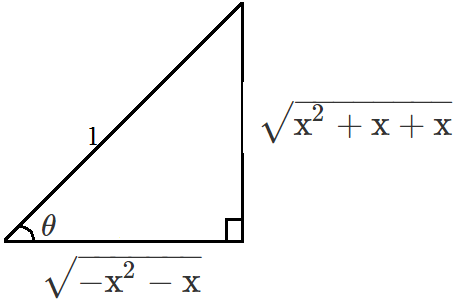 We have $\tan^{-1}\sqrt{\text{x}(\text{x}+1)}+\sin^{-1}\sqrt{\text{x}^2+\text{x}+1}=\frac{\pi}{2}$
$\Rightarrow\ \tan^{-1}\sqrt{\text{x}(\text{x}+1)}=\frac{\pi}{2}-\sin^{-1}\sqrt{\text{x}^2+\text{x}+1}$
$=\cos^{-1}\sqrt{\text{x}^2+\text{x}+1}$
$=\tan^{-1}\frac{\sqrt{-\text{x}^2-\text{x}}}{\sqrt{\text{x}^2+\text{x}+1}}$ (From the figure)
$\Rightarrow\ \sqrt{\text{x}(\text{x}+1)}=\frac{\sqrt{-\text{x}^2-\text{x}}}{\sqrt{\text{x}^2+\text{x}+1}}$
$\Rightarrow\ \text{x}^2+\text{x}=0$
$\Rightarrow\ \text{x}=0,-1$ View full question & answer→Question 1153 Marks
Write the value of $\cos^{-1}\Big(\frac{1}{2}\Big)+2\sin^{-1}\Big(\frac{1}{2}\Big).$
Answer$\cos^{-1}\Big(\frac{1}{2}\Big)+2\sin^{-1}\Big(\frac{1}{2}\Big)$
$=\frac{\pi}{3}+2\times\frac{\pi}{6}$
$\begin{Bmatrix}\text{Since},\cos^{-1}\text{x}=\text{An angle in }[0,\pi]\text{ whose cosin is x}\\\sin^{-1}\text{x}=\text{An angle in }\Big[-\frac{\pi}{2},\frac{\pi}{2}\Big]\text{ whose sine is x}\end{Bmatrix}$
$=\frac{\pi}{3}+\frac{\pi}{3}$
$=\frac{2\pi}{3}$
So,
$\cos^{-1}\Big(\frac{1}{2}\Big)+2\sin^{-1}\Big(\frac{1}{2}\Big)=\frac{2\pi}{3}.$
View full question & answer→Question 1163 Marks
Evaluate $\sin\Big(\tan^{-1}\frac{3}{4}\Big).$
AnswerWe know that
$\tan^{-1}\text{x}=\sin^{-1}\frac{\text{x}}{\sqrt{1+\text{x}^2}}$
$\therefore\ \sin\Big(\tan^{-1}\frac{3}{4}\Big)=\sin\Bigg\{\sin^{-1}\Bigg(\frac{\frac{3}{4}}{\sqrt{1+\frac{9}{10}}}\Bigg)\Bigg\}$
$=\sin\Bigg\{\sin^{-1}\Bigg(\frac{\frac{3}{4}}{\frac{5}{4}}\Bigg)\Bigg\}$
$=\sin\Big(\sin^{-1}\frac{3}{5}\Big)$
$=\frac{3}{5}$ $\big[\because\ \sin\big(\sin^{-1}\text{x}\big)=\text{x}\big]$
$\therefore\ \Big(\tan^{-1}\frac{3}{4}\Big)=\frac{3}{5}$
View full question & answer→Question 1173 Marks
Write the value of $\sin^{-1}\Big(\frac{-\sqrt3}{2}\Big)+\cos^{-1}\Big(\frac{-1}{2}\Big)$
Answer$\sin^{-1}(-\text{x})=\sin^{-1}\text{x},\text{x}\in[-1,1]$
$\cos^{-1}(-\text{x})=\pi-\cos^{-1}\text{x},\text{x}\in[-1,1]$
$\therefore\ \sin^{-1}\Big(\frac{-\sqrt3}{2}\Big)+\cos^{-1}\Big(\frac{-1}{2}\Big)$
$=-\sin^{-1}\Big(\frac{\sqrt3}{2}\Big)+\pi-\cos^{-1}\Big(\frac{1}{2}\Big)$
$=-\sin^{-1}\Big(\sin\frac{\pi}{3}\Big)+\pi-\cos^{-1}\Big(\cos\frac{\pi}{3}\Big)$
$=-\frac{\pi}{3}+\pi-\frac{\pi}{3}$
$=\frac{\pi}{3}$
$\therefore\ \sin^{-1}\Big(\frac{-\sqrt3}{2}\Big)+\cos^{-1}\Big(\frac{-1}{2}\Big)=\frac{\pi}{3}$
View full question & answer→Question 1183 Marks
Prove that
$\tan^{-1}\Big(\frac{1-\text{x}^2}{2\text{x}}\Big)+\cot^{-1}\Big(\frac{1-\text{x}^2}{2\text{x}}\Big)=\frac{\pi}{2}$
Answer$\tan^{-1}\Big(\frac{1-\text{x}^2}{2\text{x}}\Big)+\cot^{-1}\Big(\frac{1-\text{x}^2}{2\text{x}}\Big)=\frac{\pi}{2}$
$\text{L.H.S}=\tan^{-1}\Big(\frac{1-\text{x}^2}{2\text{x}}\Big)+\cot^{-1}\Big(\frac{1-\text{x}^2}{2\text{x}}\Big)$
$=\tan^{-1}\Big(\frac{1-\text{x}^2}{2\text{x}}\Big)+\frac{\pi}{2}-\tan^{-1}\Big(\frac{1-\text{x}^2}{2\text{x}}\Big)$
$\Big[\because\ \tan^{-1}\text{x}+\cot^{-1}\text{x}=\frac{\pi}{2}\Big]$
$=\frac{\pi}{2}=\text{R..H.S}$
View full question & answer→Question 1193 Marks
Prove the following:
$2\tan^{-1}\frac{1}{2}+\tan^{-1}\frac{1}{7}=\tan^{-1}\frac{31}{17}$
Answer$\text{L.H.S.}=2\tan^{-1}\frac{1}{2}+\tan^{-1}\frac{1}{7}=\tan^{-1}\frac{2\times\frac{1}{2}}{1-\left(\frac{1}{2}\right)^2}+\tan^{-1}\frac{1}{7}$ $\bigg[\because2\tan^{-1}x=\tan^{-1}\frac{2x}{1-x^2}\bigg]$
$=\tan^{-1}\frac{4}{3}+\tan^{-1}\frac{1}{7}=\tan^{-1}\frac{\frac{4}{3}+\frac{1}{7}}{1-\frac{4}{3}\times\frac{1}{7}}$ $\bigg[\because\tan^{-1}x+\tan^{-1}y=\tan^{-1}\frac{x+y}{1-xy}\bigg]$
$ =\tan^{-1}\frac{28+3}{21-4}=\tan^{-1}\frac{31}{17}=\text{R.H.S.}$ Proved.
View full question & answer→Question 1203 Marks
If $2\tan^{-1}(\cos\theta)=\tan^{-1}(2\text{cosec}\theta),$ then show that $\theta=\frac{\pi}{4},$ where n is any integer.
AnswerWe have, $2\tan^{-1}(\cos\theta)=\tan^{-1}(2\text{cosec}\theta)$
$\Rightarrow\ \tan^{-1}\Big(\frac{2\cos\theta}{1-\cos^2\theta}\Big)=\tan^{-1}(2\text{cosec}\theta)$
$\Big[\because\ 2\tan^{-1}\text{x}=\tan^{-1}\Big(\frac{2\text{x}}{1-\text{x}^2}\Big)\Big]$
$\Rightarrow\ \frac{2\cos\theta}{\sin^2\theta}=(2\text{cosec}\theta)$
$\Rightarrow\ \cot\theta.2\text{ cosec}\theta=2\text{ cosec}\theta$
$\Rightarrow\ \cot\theta=1$
$\Rightarrow\ \cot\theta=\cot\frac{\pi}{4}$
$\Rightarrow\ \theta=\frac{\pi}{4}$
View full question & answer→Question 1213 Marks
Find the values:
$\tan^{-1}\bigg[2\cos\bigg(2\sin^{-1}\frac{1}{2}\bigg)\bigg]$
Answer$\tan^{-1}\bigg[2\cos\bigg(2\sin^{-1}\frac{1}{2}\bigg)\bigg]=\tan^{-1}\bigg[2\cos\bigg(2\sin^{-1}\sin\frac{\pi}{6}\bigg)\bigg]$
$=\tan^{-1}\bigg[2\cos\bigg(2\times\frac{\pi}{6}\bigg)\bigg]=\tan^{-1}\bigg[2\cos\frac{\pi}{3}\bigg]$
$=\tan^{-1}\bigg[2\times\frac{1}{2}\bigg]=\tan^{-1}1=\tan^{-1}\tan\frac{\pi}{4}=\frac{\pi}{4}$
View full question & answer→Question 1223 Marks
Write the following in the simplest form:
$\sin^{-1}\Big\{\frac{\text{x}+\sqrt{1-\text{x}^2}}{\sqrt{2}}\Big\},-1<\text{x}<1$
AnswerLet, $\text{x}=\text{a}\sin\theta$
Now,
$\sin^{-1}\Big\{\frac{\text{x}+\sqrt{1-\text{x}^2}}{\sqrt{2}}\Big\}=\sin^{-1}\Big\{\frac{\sin\theta+\sqrt{1-\sin^2\theta}}{\sqrt{2}}\Big\}$
$=\sin^{-1}\Big\{\frac{\sin\theta+\cos\theta}{\sqrt2}\Big\}$
$=\sin^{-1}\Big\{\frac{1}{\sqrt2}\sin\theta=\frac{1}{\sqrt2}\cos\theta\Big\}$
$=\sin^{-1}\Big\{\cos\frac{\pi}{4}\sin\theta+\sin\frac{\pi}{4}\cos\theta\Big\}$
$=\sin^{-1}\Big\{\sin\Big(\theta+\frac{\pi}{4}\Big)\Big\}$
$=\theta+\frac{\pi}{4}$
$=\frac{\pi}{4}=\sin^{-1}\text{x}$
$\therefore\ \sin^{-1}\bigg\{\frac{\text{x}+\sqrt{1-\text{x}^2}}{\sqrt{2}}\bigg\}=\cos^{-1}\text{x}+\frac{\pi}{4}$
View full question & answer→Question 1233 Marks
Find the values:
$\tan\frac{1}{2}\bigg[\sin^{-1}\frac{2x}{1+x^{2}}+\cos^{-1}\frac{1-y^{2}}{1+y^{2}}\bigg], \left|x\right|<1, y>0\ \text{and}\ xy<1$
AnswerPutting $x=\tan\theta$ and $y=\tan\phi$
$\therefore\tan\frac{1}{2}\bigg[\sin^{-1}\frac{2x}{1+x^2}+\cos^{-1}\frac{1-y^2}{1+y^2}\bigg] $
$=\tan\frac{1}{2}\bigg[\sin^{-1}\frac{2\tan\theta}{1+\tan^2\theta}+\cos^{-1}\frac{1-\tan^2\phi}{1+\tan^2\phi}\bigg]$
$=\tan\frac{1}{2}\bigg[\sin^{-1}\sin2\theta+\cos^{-1}\cos2\phi\bigg]$
$=\tan\frac{1}{2}\left[2\theta+2\phi\right]=\tan\left[\theta+\phi\right]$
$=\frac{\tan\theta+\tan\phi}{1-\tan\theta\tan\phi}=\frac{x+y}{1-xy}$
View full question & answer→Question 1243 Marks
Prove the following results:
$2\tan^{-1}\frac{3}{4}-\tan^{-1}\frac{17}{31}=\frac{\pi}{4}$
Answer$\text{L.H.S}=2\tan^{-1}\frac{3}{4}-\tan^{-1}\frac{17}{31}$ $=\tan^{-1}\Bigg(\frac{2\times\frac{3}{4}}{1-\big(\frac{3}{4}\big)^2}\Bigg)+\tan^{-1}\Big(\frac{17}{31}\Big)$ $\Big[\because\ 2\tan^{-1}\text{x}=\tan^{-1}\frac{2\text{x}}{1-\text{x}^2}\Big]$ $=\tan^{-1}\Bigg\{\frac{\frac{3}{2}}{\frac{7}{16}}\Bigg\}-\tan^{-1}\Big(\frac{17}{31}\Big)$ $=\tan^{-1}\Big(\frac{24}{7}\Big)+\tan^{-1}\Big(\frac{17}{31}\Big)$ $=\tan^{-1}\Bigg(\frac{\frac{24}{7}-\frac{17}{31}}{1+\frac{24}{7}\times\frac{17}{31}}\Bigg)$ $\Big[\text{Since }\tan^{-1}\text{x}-\tan^{-1}\text{y}=\tan^{-1}\Big(\frac{\text{x}-\text{y}}{1+\text{xy}}\Big)\Big]$$=\tan^{-1}\Bigg(\frac{\frac{625}{217}}{\frac{625}{217}}\Bigg)$
$=\tan^{-1}(1)=\frac{\pi}{4}=\text{R.H.S}$
View full question & answer→Question 1253 Marks
Find the principal values of each of the following:
$\text{cosec}^{-1}\big(-\sqrt2\big)$
AnswerLet $\text{cosec}^{-1}\big(-\sqrt2\big)=\text{y}$ Then, $\text{cosec}\text{y}=-\sqrt{2}$We know that the range of the principal value branch is $\Big[-\frac{\pi}{2},\frac{\pi}{2}\Big]-\{0\}$
Thus, $\text{cosec}\text{y}=-\sqrt{2}=\text{cosec}\Big(-\frac{\pi}{4}\Big)$ $\text{y}=-\frac{\pi}{4}\in\Big[-\frac{\pi}{2},\frac{\pi}{2}\Big],\text{y}\neq0$ Hence, the principal value of $\text{cosec}^{-1}\big(-\sqrt2\big)$ is $-\frac{\pi}{4}.$
View full question & answer→Question 1263 Marks
Write the value of $\sin^{-1}(\sin(-600^\circ))\sin(-600^\circ).$
Answer$\sin^{-1}\{\sin(-600^\circ)\}$
$=\sin^{-1}\{\sin(-600^\circ+360\times2)\}$ $\{\text{Since},\sin(2\text{n}\pi+\theta)=\sin\theta\}$
$=\sin^{-1}\{\sin120^\circ\}$
$=180^\circ-120^\circ$
$\begin{Bmatrix}\text{Since},\sin^{-1}(\sin\theta)=\begin{cases}-\pi-\theta,&\text{ if }\theta\in\Big[\frac{-3\pi}{2},\frac{-\pi}{2}\Big]\\\theta,&\text{ if }\theta\in\Big[-\frac{\pi}{2},\frac{\\\pi}{2}\Big]\\\pi-\theta,&\text{ if }\theta\in\Big[\frac{\pi}{2},\frac{3\pi}{2}\Big]\\\pi-\theta,&\text{ if }\theta\in\Big[\frac{3\pi}{2},\frac{5\pi}{2}\Big]\end{cases}\end{Bmatrix}$
$=60^\circ$
Hence,
$\sin^{-1}\{\sin(-600^\circ)\}=60^\circ$
View full question & answer→Question 1273 Marks
Find the value of $\tan^{-1}\Big(-\frac{1}{\sqrt{3}}\Big)+\cot^{-1}\Big(\frac{1}{\sqrt{3}}\Big)+\tan^{-1}\Big[\sin\Big(\frac{-\pi}{2}\Big)\Big].$
AnswerWe have, $\tan^{-1}\Big(-\frac{1}{\sqrt{3}}\Big)+\cot^{-1}\Big(\frac{1}{\sqrt{3}}\Big)+\tan^{-1}\Big[\sin\Big(\frac{-\pi}{2}\Big)\Big]$ $=\tan^{-1}\Big(\tan\frac{5\pi}{6}\Big)+\tan^{-1}(\sqrt{3})+\tan^{-1}(-1)$ $\Big[\because\ \cot^{-1}\text{x}=\tan^{-1}\frac{1}{\text{x}}\Big]$ $=\tan^{-1}\Big(\tan\frac{5\pi}{6}\Big)+\tan^{-1}\Big(\tan\frac{\pi}{3}\Big)+\tan^{-1}\Big(\frac{3\pi}{4}\Big)$ $=\tan^{-1}\Big[\tan\Big(\pi-\frac{\pi}{6}\Big)\Big]+\tan^{-1}\Big[\tan\Big(\frac{\pi}{3}\Big)\Big]+\tan^{-1}\Big[\tan\Big(\pi-\frac{\pi}{4}\Big)\Big]$ $=\tan^{-1}\Big[\tan\Big(-\frac{\pi}{6}\Big)\Big]+\tan^{-1}\Big[\tan\Big(\frac{\pi}{3}\Big)\Big]+\tan^{-1}\Big[\tan\Big(-\frac{\pi}{4}\Big)\Big]$ $=-\tan^{-1}\Big[\Big(\tan\frac{\pi}{6}\Big)\Big]+\tan^{-1}\Big[\tan\Big(\frac{\pi}{3}\Big)\Big]-\tan^{-1}\Big[\Big(\tan\frac{\pi}{4}\Big)\Big]$ $[\because\ \tan^{-1}(-\text{x})=-\tan^{-1}\text{x}]$$=-\frac{\pi}{6}+\frac{\pi}{3}-\frac{\pi}{4}$
$\Big[\because\ \tan^{-1}(\tan\text{x})=\text{x},\ \text{x}\in\Big(-\frac{\pi}{2},\frac{\pi}{2}\Big)\Big]$
$=\frac{-2\pi+4\pi-3\pi}{12}$
$=-\frac{\pi}{12}$
View full question & answer→Question 1283 Marks
Prove the following results:
$\frac{9\pi}{4}-\frac{9}{4}\sin^{-1}\frac{1}{3}=\frac{9}{4}\sin^{-1}\frac{2\sqrt2}{3}$
Answer$\text{L.H.S}=\frac{9\pi}{4}-\frac{9}{4}\sin^{-1}\frac{1}{3}$
$=\frac{9}{4}\Big(\frac{\pi}{2}-\sin^{-1}\frac{1}{3}\Big)...(1)$ $\Big[\sin^{-1}\text{x}+\cos^{-1}\text{x}=\frac{\pi}{2}\Big]$
Now, let $\cos^{-1}\frac{1}{3}=\text{x}.$ Then,
$\cos\text{x}=\frac{1}{3}\Rightarrow\sin\text{x}=\sqrt{1-\Big(\frac{1}{3}\Big)^2}=\frac{2\sqrt2}{3}.$
$\therefore\ \text{x}=\sin^{-1}\frac{2\sqrt2}{3}\Rightarrow\cos^{-1}\frac{1}{3}=\frac{9}{4}\sin^{-1}\frac{2\sqrt2}{3}$
$\therefore\ \text{L.H.S}=\frac{9}{4}\sin^{-1}\frac{2\sqrt2}{3}=\text{R.H.S}$
View full question & answer→Question 1293 Marks
Write the following function in the simplest form:
$\tan^{-1}\frac{\sqrt{1+x^{2}}-1}{x},x\neq0$
AnswerPutting $x=\tan\theta$ so that $\theta=\tan^{-1}x$ $\Rightarrow\tan^{-1}\frac{\sqrt{1+x^2}-1}{x}=\tan^{-1}\frac{\sqrt{1+\tan^2\theta}-1}{\tan\theta}$$=\tan^{-1}\frac{\sec\theta-1}{\tan\theta}=\tan^{-1}\bigg(\frac{\frac{1}{\cos\theta}-1}{\frac{\sin\theta}{\cos\theta}}\bigg)$
$=\tan{-1}\bigg(\frac{1-\cos\theta}{\sin\theta}\bigg)=\tan^{-1}\bigg(\frac{2\sin^2\frac{\theta}{2}}{2\sin\frac{\theta}{2}\cos\frac{\theta}{2}}\bigg)$$=\tan^{-1}\bigg(\tan\frac{\theta}{2}\bigg)=\frac{\theta}{2}=\frac{1}{2}\tan^{-1}x$
View full question & answer→Question 1303 Marks
Evaluate the following:
$\cos^{-1}\Big\{\cos\Big(-\frac{\pi}{4}\Big)\Big\}$
AnswerWe know that,
$\cos^{-1}\big(\cos\theta\big)=\begin{cases}-\theta,&\text{if }\theta\in[-\pi,0]\\\theta,&\text{if }\theta\in[0,\pi]\\2\pi-\theta,&\text{if }\theta\in[\pi,2\pi]\\-2\pi+\theta,&\text{if }\theta\in[2\pi,3\pi]\end{cases}$
$\therefore\ \cos^{-1}\Big\{\cos\Big(-\frac{\pi}{4}\Big)\Big\}$
$=-\Big(-\frac{\pi}{4}\Big)$ $\Big\{\because-\frac{\pi}{4}\in[-\pi,0]\Big\}$
$=\frac{\pi}{4}$
Hence,
$\therefore\ \cos^{-1}\Big\{\cos\Big(-\frac{\pi}{4}\Big)\Big\}=\frac{\pi}{4}$
View full question & answer→Question 1313 Marks
For the principal values, evaluate the following:
$\sin^{-1}[\cos\{2\text{cosec}^{-1}(-2)\}]$
Answer$\text{cosec}^{-1}\text{x}$ represents an angle in $\Big[-\frac{\pi}{2},0\Big)\cup\Big(0,\frac{\pi}{2}\Big]$ whose cosecant is x. Let $\text{x}=\text{cosec}^{-1}(-2)$ $\Rightarrow\text{cosec x}=-2=\text{cosec c}\Big(-\frac{\pi}{6}\Big)$ $\Rightarrow\text{x}=-\frac{\pi}{6}$ $\sin^{-1}[\cos\{2\text{cosec}^{-1}(-2)\}]=\sin^{-1}\Big[\cos\Big\{2\times\Big(-\frac{\pi}{6}\Big)\Big\}\Big]$ $=\sin^{-1}\Big[\cos\Big(-\frac{\pi}{3}\Big)\Big]=\sin^{-1}\Big[\frac{1}{2}\Big]$ $\sin^{-1}\text{x}$ represents an angle in $\Big[-\frac{\pi}{2},\frac{\pi}{2}\Big]$ whose sin is x.Let $\text{x}=\sin^{-1}\Big[\frac{1}{2}\Big]$
$\Rightarrow\sin\text{x}=\frac{1}{2}=\sin\Big(\frac{\pi}{6}\Big)$
$\Rightarrow\text{x}=\frac{\pi}{6}$
View full question & answer→Question 1323 Marks
Write the following function in the simplest form:
$\tan^{-1}\frac{x}{\sqrt{a^{2}-x^{2}}}, \left|x\right|
AnswerPutting $x=a\sin\theta$ so that $\theta=\sin^{-1}\frac{x}{a}$
$\Rightarrow\ \tan^{-1}\bigg(\frac{a\sin\theta}{\sqrt{a^2-a^2\sin^2\theta}}\bigg)=\tan^{-1}\bigg(\frac{a\sin\theta}{\sqrt{a^2(1-\sin^{2}\theta)}}\bigg)$
$=\tan^{-1}\bigg(\frac{a\sin\theta}{\sqrt{a^2\cos^2\theta}}\bigg) =\tan^{-1}\bigg(\frac{a\sin\theta}{a\cos\theta}\bigg)$
$=\tan^{-1}\tan\theta=\theta=\sin^{-1}\frac{x}{a}$
View full question & answer→Question 1333 Marks
Evaluate the following:
$\tan^{-1}\Big(\tan\frac{5\pi}{6}\Big)+\cos^{-1}\Big\{\cos\Big(\frac{13\pi}{6}\Big)\Big\}$
Answer$\tan^{-1}\Big(\tan\frac{5\pi}{6}\Big)+\cos^{-1}\Big\{\cos\Big(\frac{13\pi}{6}\Big)\Big\}$
$=\tan^{-1}\Big\{\tan\Big(\pi-\frac{5\pi}{6}\Big)\Big\}+\cos^{-1}\Big\{\cos\Big(2\pi+\frac{\pi}{6}\Big)\Big\}$
$=\tan^{-1}\Big\{-\tan\Big(\frac{\pi}{6}\Big)\Big\}+\cos^{-1}\Big\{\cos\Big(\frac{\pi}{6}\Big)\Big\}$
$=-\tan^{-1}\Big\{\tan\Big(\frac{\pi}{6}\Big)\Big\}+\cos^{-1}\Big\{\cos\Big(\frac{\pi}{6}\Big)\Big\}$
$=-\frac{\pi}{6}+\frac{\pi}{6}$
$=0$
View full question & answer→Question 1343 Marks
Evaluate: $\sin^{-1}\Big(\sin\frac{3\pi}{5}\Big).$
Answer$\sin^{-1}\Big(\sin\frac{3\pi}{5}\Big).$
$ =\pi-\frac{3\pi}{5}$
$\begin{Bmatrix}\text{Since},\sin^{-1}(\sin\theta)=\begin{cases}-\pi-\theta,&\text{if }\theta\in\Big[-\frac{3\pi}{2},-\frac{\pi}{2}\Big]\\\theta,&\text{if }\theta\in\Big[-\frac{\pi}{2},\frac{\pi}{2}\Big]\\\pi-\theta,&\text{if }\theta\in\Big[\frac{\pi}{2},\frac{\\\pi}{2}\Big]\\-2\pi+\theta,&\text{if }\theta\in\Big[\frac{3\pi}{2},\frac{5\pi}{2}\Big]\end{cases}\end{Bmatrix}$
$=\frac{2\pi}{5}$
View full question & answer→Question 1353 Marks
Write the difference between maximum and minimum values of $\sin^{-1}\text{x}$ for $\text{x}\in[-1,1].$
AnswerWe have to find the difference between maximum and minimum values of $\sin^{-1}\text{x}$ for $\text{x}\in[-1,1]$ We know that, $\sin^{-1}\text{x}=$ An angle in $\Big[-\frac{\pi}{2},\frac{\pi}{2}\Big]$ whose sin is x. So, minimum value of $\sin^{-1}\text{x}=-\frac{\pi}{2}$ maximum value of $\sin^{-1}\text{x}=\frac{\pi}{2}$Difference between maximum and minimum values of
$\sin^{-1}\text{x}=\frac{\pi}{2}-\Big(-\frac{\pi}{2}\Big)$ $=\frac{\pi}{2}+\frac{\pi}{2}$ $=\pi$ The required difference $=\pi.$
View full question & answer→Question 1363 Marks
Write the value of $\sin\Big\{\frac{\pi}{3}-\sin^{-1}\Big(-\frac{1}{2}\Big)\Big\}.$
Answer$\sin\Big\{\frac{\pi}{3}-\sin^{-1}\Big(-\frac{1}{2}\Big)\Big\}$
$=\sin\Big\{\frac{\pi}{3}+\sin^{-1}\Big(\frac{1}{2}\Big)\Big\}$ $\big\{\text{Since},\sin^{-1}(-\theta)=-\sin^{-1}\theta\big\}$
$=\sin\Big\{\frac{\pi}{3}+\frac{\pi}{6}\Big\}$ $\Big\{\text{Since},\sin^{-1}\text{x}=\text{An angle in}\Big[-\frac{\pi}{2},\frac{\pi}{2}\Big]\text{whose sine is x}\Big\}$
$=\sin\Big(\frac{\pi}{2}\Big)$
$=1$
Hence,
$\sin\Big\{\frac{\pi}{3}-\sin^{-1}\Big(-\frac{1}{2}\Big)\Big\}=1$
View full question & answer→Question 1373 Marks
If $\big(\sin^{-1}\text{x}\big)^2+\big(\sin^{-1}\text{y}\big)^2+\big(\sin^{-1}\text{z}\big)^2=\frac{3}{4}\pi^2,$ find the value of $x^2 + y^2 + z^2$
AnswerRange of $\sin^{-1}$ is $\Big[-\frac{\pi}{2},\frac{\pi}{2}\Big].$
Given that $\big(\sin^{-1}\text{x}\big)^2+\big(\sin^{-1}\text{y}\big)^2+\big(\sin^{-1}\text{z}\big)^2=\frac{3}{4}\pi^2$
⇒ Each of $\sin^{-1}\text{x},\sin^{-1}\text{y}$ and $\sin^{-1}\text{z}$ takes value of $\frac{\pi}{2}.$
⇒ x = 1, y = 1 and z = 1
$x^2 + y^2 + z^2 = 1 + 1 + 1 = 3$
View full question & answer→Question 1383 Marks
For the principal values, evaluate the following:
$\sin^{-1}\Big(-\frac{\sqrt3}{2}\Big)+\cos^{-1}\Big(\frac{\sqrt3}{2}\Big)$
Answer$\sin^{-1}\Big(\frac{-\sqrt3}{2}\Big)+\cos^{-1}\Big(\frac{\sqrt3}{2}\Big)$
$=\sin^{-1}\Big\{\sin\Big(-\frac{\pi}{3}\Big)\Big\}=\cos^{-1}\Big(\cos\frac{\pi}{6}\Big)$
$=-\frac{\pi}{3}+\frac{\pi}{6}$ $\begin{bmatrix}\because\text{Range of sine is }\Big[-\frac{\pi}{2},\frac{\pi}{2}\Big];-\frac{\pi}{3}\in\Big[-\frac{\pi}{2},\frac{\pi}{2}\Big]\\\ \\\text{and range of cosine is }[0,\pi];\frac{\pi}{6}\in[0,\pi]\end{bmatrix}$
$=-\frac{\pi}{6}$
$\therefore\sin^{-1}\Big(-\frac{\sqrt3}{2}\Big)+\cos^{-1}\Big(\frac{\sqrt3}{2}\Big)=-\frac{\pi}{6}$
View full question & answer→Question 1393 Marks
Write the following in the simplest form:
$\sin\Big\{2\tan^{-1}\sqrt{\frac{1-\text{x}}{1+\text{x}}}\Big\}$
Answer$\sin\Big\{2\tan^{-1}\sqrt{\frac{1-\text{x}}{1+\text{x}}}\Big\}$
$=\sin\begin{Bmatrix}\sin^{-1}\begin{pmatrix}\frac{2\sqrt{\frac{1-\text{x}}{1+\text{x}}}}{1+\Big(\sqrt{\frac{1-\text{x}}{1+\text{x}}}\Big)^2}\end{pmatrix}\end{Bmatrix}$ $\Big\{\text{Since},2\tan^{-1}\text{x}=\sin^{-1}\frac{2\text{x}}{1+\text{x}^2}\Big\}$
$=\sin\begin{Bmatrix}\sin^{-1}\begin{pmatrix}\frac{2\sqrt{\frac{1-\text{x}}{1+\text{x}}}}{\frac{1+\text{x}+1-\text{x}}{1+\text{x}}}\end{pmatrix}\end{Bmatrix}$
$=2\sqrt{\frac{1-\text{x}}{1+\text{x}}}\times\frac{1+\text{x}}{2}$
$=\sqrt{1-\text{x}}\sqrt{1+\text{x}}$
$=\sqrt{1-\text{x}^2}$
Hence, $\sin\Big\{2\tan^{-1}\sqrt{\frac{1-\text{x}}{1+\text{x}}}\Big\}=\sqrt{1-\text{x}^2}$
View full question & answer→Question 1403 Marks
If $\sin^{-1}\frac{2\text{a}}{1+\text{a}^2}+\sin^{-1}\frac{2\text{b}}{1+\text{b}^2}=2\tan^{-1}\text{x},$ prove that $\text{x}=\frac{\text{a}+\text{b}}{1-\text{ab}}.$
AnswerLet: $\text{a}=\tan\text{z}$ $\text{b}=\tan\text{y}$ Then, $\sin^{-1}\frac{2\text{a}}{1+\text{a}^2}+\sin^{-1}\frac{2\text{b}}{1+\text{b}^2}=2\tan^{-1}\text{x}$$\Rightarrow\sin^{-1}\frac{2\tan\text{z}}{1+\tan^2\text{z}}+\sin^{-1}\frac{2\tan\text{y}}{1+\tan^2\text{y}}=2\tan^{-1}\text{x}$
$\Rightarrow\sin^{-1}(\sin2\text{z})+\sin^{-1}(\sin2\text{y})=2\tan^{-1}\text{x}$ $\Big[\because\ \sin2\text{x}=\frac{2\tan\text{x}}{1+\tan^2\text{x}}\Big]$ $\Rightarrow2\text{z}+2\text{y}=2\tan^{-1}\text{x}$ $\Rightarrow\tan^{-1}\text{a}+\tan^{-1}\text{b}=\tan^{-1}\text{x}$ $[\because\ \text{a}=\tan\text{z}\text{ and }\text{b}=\tan\text{y}]$ $\Rightarrow\tan^{-1}\frac{\text{a}+\text{b}}{1-\text{ab}}=\tan^{-1}\text{x}$ $\Big[\because\ \tan^{-1}\text{x}+\tan^{-1}\text{y}=\tan^{-1}\frac{\text{x}+\text{y}}{1-\text{xy}}\Big]$ $\Rightarrow\text{x}=\frac{\text{a}+\text{b}}{1-\text{ab}}$
View full question & answer→Question 1413 Marks
Solve the following equation for x:
$\cos^{-1}\Big(\frac{\text{x}^2-1}{\text{x}^2+1}\Big)+\frac{1}{2}\tan^{-1}\Big(\frac{2\text{x}}{1-\text{x}^2}\Big)=\frac{2\pi}{3}$
Answer$\cos^{-1}\Big(\frac{\text{x}^2-1}{\text{x}^2+1}\Big)+\frac{1}{2}\tan^{-1}\Big(\frac{2\text{x}}{1-\text{x}^2}\Big)=\frac{2\pi}{3}$
$\Rightarrow\cos^{-1}\Big(\frac{1-\text{x}^2}{1+\text{x}^2}\Big)+\frac{1}{2}\times2\tan^{-1}\text{x}=\frac{2\pi}{3}$ $\Big[\because\ \tan^{-1}\Big(\frac{2\text{x}}{1-\text{x}^2}\Big)=2\tan^{-1}\text{x}\Big]$
$\Rightarrow2\tan^{-1}\text{x}+\tan^{-1}\text{x}=\frac{2\pi}{3}$ $\Big[\because\ \cos^{-1}\Big(\frac{1-\text{x}^2}{1+\text{x}^2}\Big)=2\tan^{-1}\text{x}\Big]$
$\Rightarrow3\tan^{-1}\text{x}=\frac{2\pi}{3}$
$\Rightarrow\tan^{-1}\text{x}=\frac{2\pi}{9}$
$\Rightarrow\text{x}=\tan\Big(\frac{2\pi}{9}\Big)$
View full question & answer→Question 1423 Marks
Find the principal values of the following:
$\tan^{-1}\Big(\cos\frac{\pi}{2}\Big)$
AnswerLet $\tan^{-1}\Big(-\frac{1}{\sqrt3}\Big)=\text{y}$Then,
$\tan\text{y}=\cos\frac{\pi}{2}$
We know that the range of the principal value branch is $\Big(-\frac{\pi}{2},\frac{\pi}{2}\Big).$
Thus,
$\tan\text{y}=\cos\frac{\pi}{2}=0=\tan(0)$
$\Rightarrow\text{y}=0\in\Big(-\frac{\pi}{2},\frac{\pi}{2}\Big)$
Hence, the principal value of $\tan^{-1}\Big(\cos\frac{\pi}{2}\Big)$ is 0.
View full question & answer→Question 1433 Marks
Write the value of $\cos^2\Big(\frac{1}{2}\cos^{-1}\frac{3}{5}\Big).$
AnswerLet $\text{y}=\cos^{-1}\Big(\frac{3}{5}\Big)$
$\Rightarrow\cos\text{y}=\frac{3}{5}$
Now,
$\cos^2\Big(\frac{1}{2}\cos^{-1}\frac{3}{5}\Big)=\cos^{2}\Big(\frac{1}{2}\text{y}\Big)$
$=\frac{\cos\text{y}+1}{2}$ $\big[\because\ \cos2\text{x}=\cos^2\text{x}-1\big]$
$=\frac{\frac{3}{5}+1}{2}$
$=\frac{\frac{8}{5}}{2}$
$=\frac{4}{5}$
$\therefore\ \cos^2\Big(\frac{1}{2}\cos^{-1}\frac{3}{5}\Big)=\frac{4}{5}$
View full question & answer→Question 1443 Marks
Solve: $\cos\big(\sin^{-1}\text{x}\big)=\frac{1}{6}$
Answer$\cos\big(\sin^{-1}\text{x}\big)=\frac{1}{6}$
$\Rightarrow\cos\Big(\cos^{-1}\sqrt{1-\text{x}^2}\Big)=\frac{1}{6}$
$\Rightarrow\sqrt{1-\text{x}^2}=\frac{1}{6}$
$\Rightarrow1-\text{x}^2=\frac{1}{36}$
$\Rightarrow1-\frac{1}{36}=\text{x}^2$
$\Rightarrow\text{x}^2=\frac{35}{36}$
$\Rightarrow\text{x}=\pm\frac{\sqrt{35}}{6}$
View full question & answer→Question 1453 Marks
Find the values:
If $\tan^{-1}\frac{x-1}{x-2}+\tan^{-1}\tan\frac{x+1}{x+2}=\frac{\pi}{4},$ then find the value of x
AnswerGiven: $\tan^{-1}\frac{x-1}{x-2}+\tan^{-1}\frac{x+1}{x+2}=\frac{\pi}{4}$
$\Rightarrow\tan^{-1}\frac{\frac{x-1}{x-2}+\frac{x+1}{x+2}}{1-\left(\frac{x-1}{x-2}\right)\left(\frac{x+1}{x+2}\right)}=\frac{\pi}{4}$ $\bigg[\because\tan^{-1}x+\tan^{-1}y=\tan^{-1}\frac{x+y}{1-xy}\bigg]$
$\Rightarrow\tan^{-1}\frac{\left(x-1\right)\left(x+2\right)+\left(x+1\right)\left(x-2\right)}{\left(x-2\right)\left(x+2\right)-\left(x-1\right)\left(x+1\right)}=\frac{\pi}{4}$
$\Rightarrow\tan^{-1}\frac{x^2+2x-x-2+x^2-2x+x-2}{x^2-4-\left(x^2-1\right)}=\frac{\pi}{4}$
$\Rightarrow\frac{2x^2-4}{x^2-4-x^2+1}=\tan\frac{\pi}{4}$ $\Rightarrow\frac{2x^2-4}{-3}=1$
$ \Rightarrow\ 2x^2-4=-3$ $\Rightarrow\ 2x^2=1$
$\Rightarrow\ x^2=\frac{1}{2}$ $ \Rightarrow\ x=\pm\frac{1}{\sqrt{2}}$
View full question & answer→Question 1463 Marks
Evaluate:
$\cos\Big(\tan^{-1}\frac{3}{4}\Big)$
AnswerWe have
$\cos\Big(\tan^{-1}\frac{3}{4}\Big)$
$=\cos\Bigg[\frac{1}{2}\cos^{-1}\Bigg(\frac{1-\big(\frac{3}{4}\big)^2}{1+\big(\frac{3}{4}\big)^2}\Bigg)\Bigg]$ $\Big[\because\ 2\tan^{-1}\text{x}=\cos^{-1}\Big(\frac{1-\text{x}^2}{1+\text{x}^2}\Big)\Big]$
$=\cos\Big[\frac{1}{2}\cos^{-1}\Big(\frac{7}{25}\Big)\Big]$
Let
$\text{y}=\cos^{-1}\Big(\frac{7}{25}\Big)$
$\Rightarrow\cos\text{y}=\frac{7}{25}$
Now,
$=\cos\Big[\frac{1}{2}\cos^{-1}\Big(\frac{7}{25}\Big)\Big]=\cos\Big[\frac{1}{2}\text{y}\Big]$
$=\sqrt{ \frac{\cos\text{y}+1}{2}}$ $\big[\because\ \cos2\text{x}=2\cos^2\text{x}-1\big]$
$=\sqrt{\frac{\frac{7}{25}+1}{2}}$
$=\sqrt{\frac{32}{50}}$
$=\frac{4}{5}$
$\therefore\ \cos\Big[\tan^{-1}\Big(\frac{3}{4}\Big)\Big]=\frac{4}{5}$
View full question & answer→Question 1473 Marks
Solve the following equation for x:
$\tan^{-1}(\text{x}-1)+\tan^{-1}\text{x}+\tan^{-1}(\text{x}+1)=\tan^{-1}3\text{x}$
AnswerWe know
$\tan^{-1}\text{x}+\tan^{-1}\text{y}=\tan^{-1}\Big(\frac{\text{x}+\text{y}}{1-\text{xy}}\Big)$ and
$\tan^{-1}\text{x}-\tan^{-1}\text{y}=\tan^{-1}\Big(\frac{\text{x}-\text{y}}{1+\text{xy}}\Big)$
$\therefore\ \tan^{-1}(\text{x}+1)+\tan^{-1}(\text{x}-1)+\tan^{-1}\text{x}=\tan^{-1}3\text{x}$
$\Rightarrow\tan^{-1}\Big\{\frac{\text{x}+1+\text{x}-1}{1-(\text{x}+1)\times(\text{x} +1)}\Big\}=\tan^{-1}3\text{x}-\tan^{-1}\text{x}$
$\Rightarrow\tan^{-1}\Big(\frac{2\text{x}}{2-\text{x}^2}\Big)=\tan^{-1}\Big(\frac{3\text{x}-\text{x}}{1+3\text{x}^2}\Big)$
$\Rightarrow\frac{2\text{x}}{2-\text{x}^2}=\frac{2\text{x}}{1+3\text{x}^2}$
$\Rightarrow2-\text{x}^2=1+3\text{x}^2$
$\Rightarrow4\text{x}^2-1=0$
$\Rightarrow\text{x}^2=\frac{1}{4}$
$\Rightarrow\text{x}=\pm\frac{1}{2}$
View full question & answer→Question 1483 Marks
Solve the following equation for x:
$\tan^{-1}(\text{x}+1)+\tan^{-1}(\text{x}-1)=\tan^{-1}\frac{8}{31}$
AnswerWe know
$\tan^{-1}\text{x}+\tan^{-1}\text{y}=\tan^{-1}\Big(\frac{\text{x}+\text{y}}{1-\text{xy}}\Big)$
$\therefore\ \tan^{-1}(\text{x}+1)+\tan^{-1}(\text{x}-1)=\tan^{-1}\frac{8}{31}$
$\Rightarrow\tan^{-1}\Big\{\frac{\text{x}+1+\text{x}-1}{1-(\text{x}+1)\times(\text{x} -1)}\Big\}=\tan^{-1}\frac{8}{31}$
$\Rightarrow\frac{2\text{x}}{1-\text{x}^2+1}=\frac{8}{31}$
$\Rightarrow\frac{2\text{x}}{2-\text{x}^2}=\frac{8}{31}$
$\Rightarrow31\text{x}=8-4\text{x}^2$
$\Rightarrow4\text{x}^2+31\text{x}-8=0$
$\Rightarrow4\text{x}^2+32\text{x}-\text{x}-8=0$
$\Rightarrow(4\text{x}-1)(\text{x}+8)=0$
$\Rightarrow\text{x}=\frac{1}{4}$ [As x =-8 is not satisfying the equation]
View full question & answer→Question 1493 Marks
Write the value of $\tan^{-1}\frac{\text{a}}{\text{b}}-\tan^{-1}\Big(\frac{\text{a}-\text{b}}{\text{a}+\text{b}}\Big).$
Answer$\tan^{-1}\frac{\text{a}}{\text{b}}-\tan^{-1}\Big(\frac{\text{a}-\text{b}}{\text{a}+\text{b}}\Big)$
$=\tan^{-1}\begin{bmatrix}\frac{\frac{\text{a}}{\text{b}}-\frac{\text{a}-\text{b}}{\text{a}+\text{b}}}{1+\Big(\frac{\text{a}}{\text{b}}\Big)-\Big(\frac{\text{a}-\text{b}}{\text{a}+\text{b}}\Big)}\end{bmatrix}$
$\Big\{\text{Since},\tan^{-1}\text{x}-\tan^{-1}\text{y}=\tan^{-1}\Big(\frac{\text{x}-\text{y}}{1+\text{xy}}\Big)\Big\}$
$=\tan^{-1}\begin{bmatrix}\frac{\frac{\text{a}^2+\text{ab}-\text{ab}+\text{b}^2}{\text{b}(\text{a}+\text{b})}}{\frac{\text{ba}+\text{b}^2+\text{a}^2-\text{ab}}{{\text{b}(\text{a}+\text{b})}}}\end{bmatrix}$
$=\tan^{-1}\Big[\frac{\text{a}^2+\text{b}^2}{\text{a}^2+\text{b}^2}\Big]$
$=\tan^{-1}(1)$
$=\frac{\pi}{4}$
Hence,
$\tan^{-1}\frac{\text{a}}{\text{b}}-\tan^{-1}\Big(\frac{\text{a}-\text{b}}{\text{a}+\text{b}}\Big)=\frac{\pi}{4}$
View full question & answer→Question 1503 Marks
Write the following in the simplest form:
$\tan^{-1}\Big\{\frac{\sqrt{1+\text{x}^2}+1}{\text{x}}\Big\},\text{x}\neq0$
AnswerLet $\text{x}=\tan\theta$Now,
$\tan^{-1}\Big\{\frac{\sqrt{1+\text{x}^2}+1}{\text{x}}\Big\}$ $=\tan^{-1}\Big\{\frac{\sqrt{1+\tan^2\theta}+1}{\tan\theta}\Big\}$ $=\tan^{-1}\Big\{\frac{\sqrt{1+\sec^2\theta}+1}{\tan\theta}\Big\}$ $=\tan^{-1}\Big\{\frac{\sec\theta+1}{\tan\theta}\Big\}$ $=\tan^{-1}\Big\{\frac{\cos\theta+1}{\sin\theta}\Big\}$ $=\tan^{-1}\Bigg\{\frac{2\cos^2\frac{\theta}{2}}{2\sin\frac{\theta}{2}\cos\frac{\theta}{2}}\Bigg\}$ $=\tan^{-1}\Big(\frac{\cot\theta}{2}\Big)$ $=\tan^{-1}\Big\{\tan\Big(\frac{\pi}{2}-\frac{\theta}{2}\Big)\Big\}$ $=\Big(\frac{\pi}{2}-\frac{\theta}{2}\Big)$ $=\frac{\pi}{2}-\frac{\tan^{-1}\text{x}}{2}$
View full question & answer→